
|
시장보고서
상품코드
2073314
직원 역량 평가 및 매핑 플랫폼 : 시장 점유율 분석, 업계 동향 및 통계, 성장 예측(2026-2031년)Employee Skills Assessment and Mapping Platform - Market Share Analysis, Industry Trends & Statistics, Growth Forecasts (2026 - 2031) |
||||||
 Mordor Intelligence
Mordor Intelligence에 의하면, 직원 역량 평가 및 매핑 플랫폼 시장 규모는 2025년에 17억 7,000만 달러로 평가되었습니다. 2026년에 19억 2,000만 달러에 달하고, 2031년까지 29억 2,000만 달러에 이를 것으로 예상되며 2026년부터 2031년에 걸쳐 CAGR 8.72%로 성장할 전망입니다.
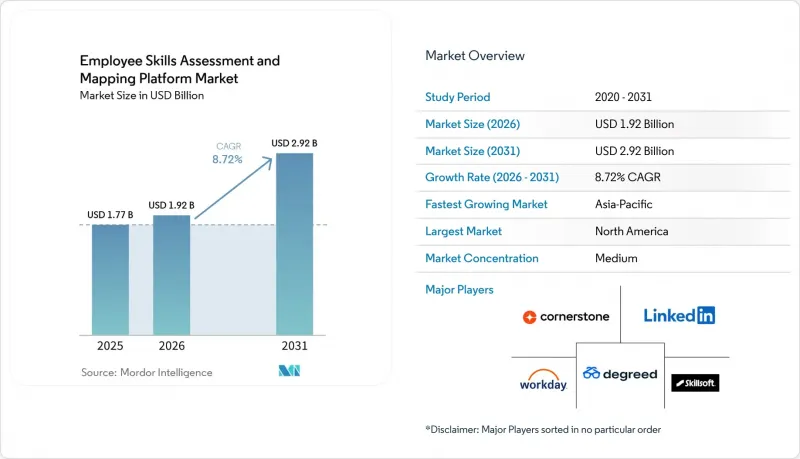
본 보고서는 용도별(학습·개발, 성과 관리, 후계자 계획 등), 배포 방식별(클라우드, On-Premise, 하이브리드), 기업 규모별(중소기업(SME), 대기업), 산업별(IT 및 통신 등) 및 지역별로 분류되어 있습니다. 시장 전망치는 금액(달러)으로 표시되어 있습니다.
세계의 직원 역량 평가 및 매핑 플랫폼 시장 동향 및 인사이트
학습 및 개발 기능의 급속한 디지털 전환
기업의 교육 담당 팀은 연간 교육 과정을 폐지하고, 실시간 역량 대시보드를 기반으로 한 지속적이고 개인 맞춤형 개발 경로로 전환하고 있습니다. 2025년 머서(Mercer)의 조사에 따르면, 기업의 91%가 AI를 중심으로 인재 전략을 재구축하고 있으며, 스킬 매핑 플랫폼을 적응형 학습의 데이터 기반으로 삼고 있습니다. 클라우드 네이티브 학습 경험 플랫폼은 현재 평가 결과, 프로젝트 관리 산출물, 코드 저장소 커밋 내역을 반영하여, 과제 수행 및 자격증 취득 시마다 직원 프로파일을 업데이트하고 있습니다. 이번 통합을 통해 L&D(학습·개발) 담당자는 분석을 통해 역량 향상이 가장 클 것으로 예측되는 분야에 예산을 집중할 수 있게 되었으며, 중요한 역할에서 ‘역량 습득에 걸리는 시간"을 최대 40% 단축할 수 있습니다. 스킬 데이터가 사내 인재 마켓플레이스에 반영됨에 따라 사내 채용 주기가 단축되고, 외부 채용에 드는 비용이 절감됩니다.
애자일 인재 계획에서 실시간 기술 역량 가시화에 대한 수요 증가
스프린트 기반 딜리버리 모델에서는 인재 기획자가 분기 단위가 아닌 며칠 단위로 인재와 프로젝트를 매칭해야 합니다. 협업 도구 및 버전 관리 시스템과 연동되는 스킬 플랫폼은 팀이 실제 업무를 수행하는 과정에서 새롭게 드러나는 역량을 파악합니다. 맥킨지의 분석에 따르면, 2025년에는 실시간 스킬 인텔리전스를 활용하는 기업에서 외부 인력에 대한 지출이 18% 감소했습니다. 금융기관에서는 이와 유사한 도구를 활용하여 ISO 20022로의 전환을 추진하고 있습니다. 구체적으로는 현재 직원을 새로운 메시징 요건에 맞추어 분석하고, 조직의 노하우를 보호하기 위한 단기 집중형 역량 강화 교육을 설계하고 있습니다.
직원 프로파일링과 관련된 데이터 개인정보 보호 문제
GDPR(EU 개인정보보호규정)에서는 상세한 기술 프로파일을 개인 데이터로 분류하고 있으며, 이에 대한 명확한 동의와 이용 제한이 요구됩니다. 또한, EU AI법에서는 많은 인사 분석 도구가 고위험 시스템으로 지정되어 있습니다. 2025년에 발간된 시행 지침에서는 지속적인 행동 모니터링이 제22조에 근거한 설명 요구 권리의 행사로 이어질 가능성이 있다고 밝히며, 고용주에게 경고를 내리고 있습니다. 캘리포니아주 소비자 개인정보 보호법(CCPA)과 같은 유사한 법령들도 미국에서 이와 같은 규제 체계를 추가하고 있습니다. 각 벤더사는 세밀한 동의 워크플로우, 익명화 파이프라인, 현지화된 데이터 저장 옵션을 통해 이에 대응하고 있지만, 이러한 조치들은 도입 비용을 증가시키고 알고리즘의 성능을 저하시키고 있습니다.
부문별 분석
후계자 계획은 2031년까지 연평균 10.45%의 성장이 예상되며, 직원 역량 평가 및 매핑 플랫폼 시장에서 가장 빠르게 확대되고 있는 활용 사례입니다. 기업은 근속 연수에 따른 승진 명단을 바탕으로, 리더십 교체를 앞두고 몇 달 전부터 사내 인재를 순위를 매기는 ‘준비 현황 대시보드"로 전환되고 있습니다. 이러한 전환은 간부직의 공석이 수익 성장세를 둔화시키고 채용 비용을 증가시키기 때문에 지속적인 투자를 뒷받침하고 있습니다. 2025년 직원 역량 평가 및 매핑 플랫폼 시장의 36.14%를 차지한 ‘학습 및 개발"는 여전히 수요의 기반이 되고 있지만, 조직은 현재 교육 관리에 그치지 않고, 인재 배치 의사결정을 위한 기술 데이터의 수익화에 주력하고 있습니다.
성과 관리 및 채용 워크플로우에서는 기술이 접목된 피드백 사이클과 보다 상세한 지원자 심사 과정을 통해 혜택을 얻고 있으며, 이를 통해 채용까지 소요되는 기간이 단축되고 있습니다. 컴플라이언스 관리는 특히 의료 및 제조업 분야에서 규제 당국이 감사 수준에 대한 자격 인증을 요구하는 분야로 성장하고 있습니다. 최근 부상하고 있는 사내 인재 마켓플레이스는 기술 평가를 긱형 프로젝트 보드와 직접 연동함으로써, 직원 수를 늘리지 않고도 역량 격차를 해소하고 있습니다. 이러한 변화들이 맞물리면서, 직원 역량 평가 및 매핑 플랫폼 시장은 데이터 기반 인사 전략의 초석으로서 그 입지를 더욱 공고히 하고 있습니다.
하이브리드 아키텍처는 2026년부터 2031년까지 연평균 성장률(CAGR) 11.12%로 성장할 것으로 전망됩니다. 이는 기업이 데이터 거주 규정을 준수하면서도 클라우드 분석에 대한 접근성을 유지하려는 노력을 반영한 것입니다. 클라우드 도입은 2025년 매출의 62.11%를 차지하며, 여전히 주류를 이루고 있습니다. 그 이유는 유연한 컴퓨팅 능력을 통해 설비 투자 없이도 대규모 평가에 대응할 수 있기 때문입니다. 정부 및 국방 분야에서는 여전히 On-Premise 도입이 주류를 이루고 있지만, 혁신 속도 면에서는 뒤처지고 있습니다.
현대적인 벤더들은 개인을 식별할 수 있는 데이터를 로컬 스토리지에 분리해 두면서, 익명화된 스킬 벡터를 벤치마킹을 위해 클라우드 엔진으로 전송하고 있습니다. 유럽의 조직들은 GDPR(EU 개인정보보호규정)의 국경 간 데이터 전송 규정을 준수하기 위해 이러한 설계를 선호하고 있으며, 규제가 엄격한 아시아 시장에서도 비슷한 경향이 나타나고 있습니다. 이러한 하이브리드화의 급증은 직원 역량 평가 및 매핑 플랫폼 시장이 두 가지 선택지 중 하나를 강요하는 대신, 아키텍처를 점차 적응시켜 나가고 있음을 보여줍니다.
지역별 분석
북미는 기술, 금융, 헬스케어 분야의 조기 도입에 힘입어 2025년 매출의 37.21%를 차지했습니다. 이 지역의 기업들은 사내 전보를 촉진함으로써 임금 상승과 인력 부족 문제를 완화하기 위해 해당 플랫폼을 도입하고 있습니다. 캐나다에서는 중견 기업을 대상으로 한 플랫폼 비용을 보전해 주는 연방 정부의 보조금 제도가 활용되고 있는 반면, 멕시코의 BPO 부문에서는 다국적 기업 고객에게 인력의 질을 입증하기 위해 평가 도구를 도입하고 있습니다.
아시아태평양은 2031년까지 연평균 10.78%의 성장률이 예상되며, 직원 역량 평가 및 매핑 플랫폼 시장에서 가장 높은 지역 성장률을 나타낼 것으로 전망됩니다. 싱가포르의 ‘ SkillsFuture"이 이니셔티브는 평생 학습에 40억 싱가포르 달러(30억 달러)를 배정하고, 기업들이 국가의 자격 인증 체계에 부합하도록 장려하고 있습니다. 인도의 국립기술 개발공사(NSDC)는 공급업체와 제휴하여 제조업 및 서비스업 분야에 종사하는 수백만 명의 근로자에게 자격을 부여하고 있습니다. 중국은 디지털 역량 향상을 위해 공적 자금을 투입하고, 일회성 평가에서 지속적인 모니터링으로 전환하는 대규모 도입 기반을 구축하고 있습니다.
유럽에서는 엄격한 개인정보 보호 규제와 평생학습에 대한 공공 투자의 균형을 맞추고 있습니다. 독일, 영국, 프랑스의 단체들은 “유럽 기술 아젠다"에 따라, 자동화 및 지속가능성에 대한 요구에 부응하기 위해 플랫폼을 도입하고 있습니다. 남유럽 국가들은 EU의 구조기금을 활용하여 직업 훈련의 현대화를 추진하고 있습니다. 중동에서는 사우디아라비아와 아랍에미리트의 다각화 이니셔티브를 통해 성장이 나타나고 있습니다. 한편, 남미와 아프리카는 여전히 초기 단계에 있으며, 현지 인력에 대한 표준화된 기술 데이터가 필요한 다국적 기업들의 도입이 주도되고 있습니다.
기타 혜택 :
- 엑셀 형식 시장 예측(ME) 시트
- 3개월간의 애널리스트 지원
자주 묻는 질문
목차
제1장 서론
제2장 조사 방법
제3장 주요 요약
제4장 시장 구도
제5장 시장 규모 및 성장 예측
제6장 경쟁 구도
제7장 시장 기회 및 향후 전망
KTH 26.07.08According to Mordor Intelligence, the employee skills assessment and mapping platform market size is expected to be USD 1.77 billion in 2025, USD 1.92 billion in 2026, and reach USD 2.92 billion by 2031, growing at a CAGR of 8.72% from 2026 to 2031.
This report is Segmented by Application (Learning and Development, Performance Management, Succession Planning, and More), Deployment (Cloud, On-Premises, and Hybrid), Organization Size (Small and Medium Enterprises [SMEs], and Large Enterprises), Industry Vertical (IT and Telecommunications, and More), and Geography. The Market Forecasts are Provided in Terms of Value (USD).
Global Employee Skills Assessment and Mapping Platform Market Trends and Insights
Rapid Digital Transformation of Learning and Development Functions
Corporate learning teams are abandoning annual curricula in favor of continuous, personalized development pathways that depend on live skills dashboards. A 2025 Mercer study found 91% of enterprises reshaping workforce strategies around AI, positioning skills-mapping platforms as the data backbone for adaptive learning. Cloud-native learning-experience platforms now ingest assessment results, project-management artifacts, and code-repository commits to refresh employee profiles after every task or certification. This integration lets L&D leaders target budgets where analytics predict the highest capability lift, cutting time-to-competency for critical roles by up to 40%. As skills data loop into internal talent marketplaces, internal hiring cycles accelerate and external recruiting spend falls.
Rising Need for Real-Time Skill Visibility in Agile Workforce Planning
Sprint-based delivery models require workforce planners to match talent to projects in days, not quarters. Skills platforms that connect with collaboration tools and version-control systems capture emergent capabilities as teams execute live work. McKinsey analysis reported 18% lower contractor spend at firms using real-time skills intelligence in 2025. Financial institutions are applying the same tools to navigate ISO 20022 migration by mapping current staff against new messaging requirements and designing micro-upskilling bursts that shield institutional knowledge.
Data Privacy Concerns Around Employee Profiling
GDPR classifies granular skill profiles as personal data that require clear consent and usage limits, and the EU AI Act designates many HR analytics tools as high-risk systems. Enforcement guidance issued in 2025 warns employers that continuous behavioral monitoring may trigger Article 22 rights to explanation. Parallel statutes such as the California Consumer Privacy Act are adding similar guardrails in the United States. Vendors are responding with granular consent workflows, anonymization pipelines, and localized data-storage options, but these steps inflate implementation cost and dampen algorithmic performance.
Other drivers and restraints analyzed in the detailed report include:
- Growing Compliance Mandates in Safety-Critical Industries
- Adoption of Dynamic Skills Taxonomies Powered by Knowledge Graphs
- Integration Complexities With Legacy Human Resource Information System Stacks
For complete list of drivers and restraints, kindly check the Table Of Contents.
Segment Analysis
Succession Planning is projected to grow at 10.45% through 2031, making it the fastest-expanding use case within the employee skills assessment and mapping platform market. Enterprises are shifting from tenure-based promotion lists to readiness dashboards that rank internal talent months before leadership transitions. This pivot drives sustained investment because executive roles left vacant reduce revenue momentum and increase recruitment costs. Learning and Development, which commanded 36.14% of the employee skills assessment and mapping platform market share in 2025, continues to anchor demand, but organizations now look beyond training administration and focus on monetizing skill data for workforce decisions.
Performance Management and Recruitment workflows benefit from skills-embedded feedback cycles and richer applicant screening, which shortens hiring timelines. Compliance Management grows where regulators demand audit-quality credentialing, especially in healthcare and manufacturing. Emerging internal talent marketplaces connect skills assessments directly to gig-style project boards, closing capability gaps without inflating headcount. Together these shifts reinforce the employee skills assessment and mapping platform market as a cornerstone of data-driven HR strategy.
Hybrid architectures are set to advance at an 11.12% CAGR between 2026 and 2031, reflecting enterprise attempts to satisfy data-residency rules while still accessing cloud analytics. Cloud deployments remain dominant at 62.11% of 2025 revenue because their elastic compute scales large-volume assessments with no capital outlay. On-premises installations persist in government and defense, yet they lag in innovation cadence.
Modern vendors now split personally identifiable data to local storage while pushing anonymized skill vectors to cloud engines for benchmarking. European organizations favor this design to comply with GDPR cross-border transfer restrictions, and similar patterns appear in highly regulated Asian markets. The hybrid surge signals that the employee skills assessment and mapping platform market is adapting architectures rather than forcing binary deployment choices.
Complete Report Scope:
- By Application
- Learning and Development
- Performance Management
- Succession Planning
- Recruitment and Hiring
- Compliance Management
- Other Applications
- By Deployment
- Cloud
- On-Premises
- Hybrid
- By Organization Size
- Small and Medium Enterprises (SMEs)
- Large Enterprises
- By Industry Vertical
- IT and Telecommunications
- Banking, Financial Services and Insurance
- Manufacturing
- Healthcare and Life Sciences
- Retail and E-Commerce
- Government
- Education
- Other Industry Verticals
- By Geography
- North America
- United States
- Canada
- Mexico
- South America
- Brazil
- Argentina
- Rest of South America
- Europe
- Germany
- United Kingdom
- France
- Italy
- Spain
- Russia
- Rest of Europe
- Asia-Pacific
- China
- India
- Japan
- South Korea
- Australia and New Zealand
- Rest of Asia-Pacific
- Middle East
- Saudi Arabia
- United Arab Emirates
- Turkey
- Rest of Middle East
- Africa
- South Africa
- Nigeria
- Rest of Africa
- North America
Geography Analysis
North America accounted for 37.21% of 2025 revenue, propelled by early adoption in technology, finance, and healthcare. Enterprises in the region deploy platforms to mitigate wage inflation and talent shortages by boosting internal mobility. Canada benefits from federal subsidies that offset platform costs for mid-sized employers, while Mexico's BPO sector deploys assessments to prove workforce quality to multinational clients.
Asia-Pacific is forecast to grow at 10.78% through 2031, the fastest regional rate in the employee skills assessment and mapping platform market. Singapore's SkillsFuture initiative allocates SGD 4 billion (USD 3 billion) for lifelong learning, encouraging firms to align with national credential frameworks. India's National Skill Development Corporation partners with platform vendors to certify millions of workers across manufacturing and services. China channels public funds into digital upskilling, creating large installed bases that move from one-time assessments to continuous monitoring.
Europe balances strict privacy regulation with public investment in lifelong learning. Organizations in Germany, the United Kingdom, and France adopt platforms to navigate automation and sustainability demands under the European Skills Agenda. Southern Europe leverages EU structural funds to modernize vocational training. The Middle East sees growth through diversification initiatives in Saudi Arabia and the United Arab Emirates, while South America and Africa remain early-stage, with uptake led by multinationals needing standardized skills data for local workforces.
- Cornerstone OnDemand, Inc.
- Workday, Inc.
- Degreed, Inc.
- Skillsoft Corporation
- Pluralsight, Inc.
- Udacity, Inc.
- Coursera Inc.
- LinkedIn Corporation
- SHL Group Ltd.
- Talview, Inc.
- Mercer LLC
- Pearson plc
- iMocha Inc.
- HackerRank, Inc.
- Harver B.V.
- Vervoe, Inc.
- Codility Ltd.
- Thomas International Ltd.
- Psytech International Ltd.
Additional Benefits:
- The market estimate (ME) sheet in Excel format
- 3 months of analyst support
TABLE OF CONTENTS
1 INTRODUCTION
- 1.1 Study Assumptions and Market Definition
- 1.2 Scope of the Study
2 RESEARCH METHODOLOGY
3 EXECUTIVE SUMMARY
4 MARKET LANDSCAPE
- 4.1 Market Overview
- 4.2 Market Drivers
- 4.2.1 Rapid Digital Transformation of L&D Functions
- 4.2.2 Rising Need for Real-Time Skill Visibility in Agile Workforce Planning
- 4.2.3 Growing Compliance Mandates in Safety-Critical Industries
- 4.2.4 Adoption of Dynamic Skills Taxonomies Powered by Knowledge Graphs
- 4.2.5 Shift Toward Skills-Based Pay Architectures
- 4.2.6 Expansion of Public-Private Reskilling Funds Targeting Mid-Career Workers
- 4.3 Market Restraints
- 4.3.1 Data Privacy Concerns Around Employee Profiling
- 4.3.2 Integration Complexities with Legacy HRIS Stacks
- 4.3.3 Algorithmic Bias in AI-Driven Skill Inference Engines
- 4.3.4 Resistance from Labor Unions over Continuous Assessment Practices
- 4.4 Industry Value Chain Analysis
- 4.5 Regulatory Landscape
- 4.6 Technological Outlook
- 4.7 Impact of Macroeconomic Factors on the Market
- 4.8 Porter's Five Forces Analysis
- 4.8.1 Threat of New Entrants
- 4.8.2 Bargaining Power of Suppliers
- 4.8.3 Bargaining Power of Buyers
- 4.8.4 Threat of Substitutes
- 4.8.5 Intensity of Competitive Rivalry
5 MARKET SIZE AND GROWTH FORECASTS (VALUE)
- 5.1 By Application
- 5.1.1 Learning and Development
- 5.1.2 Performance Management
- 5.1.3 Succession Planning
- 5.1.4 Recruitment and Hiring
- 5.1.5 Compliance Management
- 5.1.6 Other Applications
- 5.2 By Deployment
- 5.2.1 Cloud
- 5.2.2 On-Premises
- 5.2.3 Hybrid
- 5.3 By Organization Size
- 5.3.1 Small and Medium Enterprises (SMEs)
- 5.3.2 Large Enterprises
- 5.4 By Industry Vertical
- 5.4.1 IT and Telecommunications
- 5.4.2 Banking, Financial Services and Insurance
- 5.4.3 Manufacturing
- 5.4.4 Healthcare and Life Sciences
- 5.4.5 Retail and E-Commerce
- 5.4.6 Government
- 5.4.7 Education
- 5.4.8 Other Industry Verticals
- 5.5 By Geography
- 5.5.1 North America
- 5.5.1.1 United States
- 5.5.1.2 Canada
- 5.5.1.3 Mexico
- 5.5.2 South America
- 5.5.2.1 Brazil
- 5.5.2.2 Argentina
- 5.5.2.3 Rest of South America
- 5.5.3 Europe
- 5.5.3.1 Germany
- 5.5.3.2 United Kingdom
- 5.5.3.3 France
- 5.5.3.4 Italy
- 5.5.3.5 Spain
- 5.5.3.6 Russia
- 5.5.3.7 Rest of Europe
- 5.5.4 Asia-Pacific
- 5.5.4.1 China
- 5.5.4.2 India
- 5.5.4.3 Japan
- 5.5.4.4 South Korea
- 5.5.4.5 Australia and New Zealand
- 5.5.4.6 Rest of Asia-Pacific
- 5.5.5 Middle East
- 5.5.5.1 Saudi Arabia
- 5.5.5.2 United Arab Emirates
- 5.5.5.3 Turkey
- 5.5.5.4 Rest of Middle East
- 5.5.6 Africa
- 5.5.6.1 South Africa
- 5.5.6.2 Nigeria
- 5.5.6.3 Rest of Africa
- 5.5.1 North America
6 COMPETITIVE LANDSCAPE
- 6.1 Market Concentration
- 6.2 Strategic Moves
- 6.3 Market Share Analysis
- 6.4 Company Profiles (includes Global Level Overview, Market Level Overview, Core Segments, Financials as available, Strategic Information, Market Rank/Share, Products and Services, Recent Developments)
- 6.4.1 Cornerstone OnDemand, Inc.
- 6.4.2 Workday, Inc.
- 6.4.3 Degreed, Inc.
- 6.4.4 Skillsoft Corporation
- 6.4.5 Pluralsight, Inc.
- 6.4.6 Udacity, Inc.
- 6.4.7 Coursera Inc.
- 6.4.8 LinkedIn Corporation
- 6.4.9 SHL Group Ltd.
- 6.4.10 Talview, Inc.
- 6.4.11 Mercer LLC
- 6.4.12 Pearson plc
- 6.4.13 iMocha Inc.
- 6.4.14 HackerRank, Inc.
- 6.4.15 Harver B.V.
- 6.4.16 Vervoe, Inc.
- 6.4.17 Codility Ltd.
- 6.4.18 Thomas International Ltd.
- 6.4.19 Psytech International Ltd.
7 MARKET OPPORTUNITIES AND FUTURE OUTLOOK
- 7.1 White-Space and Unmet-Need Assessment