|
시장보고서
상품코드
2073321
아프리카의 사료용 산성화제 시장 : 점유율 분석, 업계 동향과 통계, 성장 예측(2026-2031년)Africa Feed Acidifiers - Market Share Analysis, Industry Trends & Statistics, Growth Forecasts (2026 - 2031) |
||||||
 Mordor Intelligence
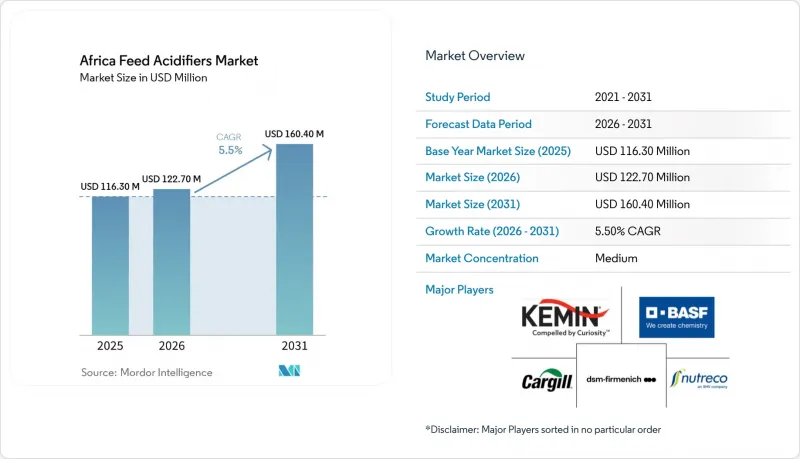
Mordor Intelligence에 의하면, 아프리카 사료용 산성화제 시장 규모는 2025년 1억 1,630만 달러에서 2026년에는 1억 2,270만 달러로 확대되어 2026년부터 2031년까지 CAGR 5.5%로 성장을 지속하여, 2031년에는 1억 6,040만 달러에 이를 것으로 예측됩니다.
본 보고서는 제품 유형별(프로피온산, 포름산, 푸마르산, 기타 산성화제), 대상 동물별(가금류, 돼지, 반추동물, 수산 양식, 기타), 지역별(남아프리카, 이집트, 나이지리아, 케냐 및 아프리카의 기타 지역)로 분류되어 있습니다. 시장 전망은 금액(달러) 및 수량(미터톤) 단위로 제시되어 있습니다.
아프리카 사료용 산성화제 시장 동향 및 분석
고온 다습한 보관 환경에서 사료 위생의 중요성이 커지고 있습니다.
아프리카의 사료용 산성화제 시장은 기후와 밀접한 관련이 있습니다. 대륙의 대부분은 열대 및 아열대 기후 조건에 속하기 때문에 저장 중인 사료에서 미생물의 증식이 촉진되기 때문입니다. 높은 주변 온도와 높은 습도는 특히 보관 관리가 미흡하고 운송 시간이 긴 경우, 사료의 안정성을 급격히 저하시킬 가능성이 있습니다. 2024년 『Agriculture』지에 게재된 과학 연구에 따르면, 포름산 및 프로피온산은 오염된 배합 사료 내 살모넬라균의 부하를 줄일 수 있는 것으로 나타났으며, 산 첨가제는 보존과 병원체 관리라는 두 가지 역할을 수행하고 있습니다. BASF SE는 또한, “Lupro-Cid” 등의 프로피온산을 고온·고습도 환경에 적합한 제품으로 포지셔닝하고 있으며, 여기에는 사료 공장의 취급 안전성을 향상시키는 완충제 배합 제품도 포함됩니다. 이러한 기후적 스트레스, 미생물 위험 및 제품의 기능성이 복합적으로 작용하여 아프리카의 사료용 산성화제 시장에는 안정적인 수요 기반이 형성되어 있으며, 다른 많은 사료 첨가제 부문에 비해 생산자의 단기적 동향에 대한 의존도가 낮은 것이 특징입니다.
아프리카 전역에서의 상업용 가금류 생산 확대
상업용 가금류 생산의 확대는 아프리카 전역에서 사료용 산성화제 수요를 지속적으로 뒷받침하고 있습니다. 이는 사육 규모가 확대됨에 따라 일관된 사료 품질과 더욱 철저한 질병 관리가 요구되기 때문입니다. 경제협력개발기구(OECD)와 유엔식량농업기구(FAO)의 예측에 따르면, 아프리카의 닭고기 생산량은 2020-2022년의 670만 메트르톤에서 2032년까지 870만 메트르톤으로 증가할 것으로 예상되며, 이는 첨가제 사용을 위한 장기적인 사료 수요 기반의 확대를 시사하고 있습니다. 미국 농무부(USDA)에 따르면, 남아프리카공화국은 2023년 주당 1,900만 마리에서 2024년 7월까지 이미 2,260만 마리로 가금류 가공 능력을 회복했으며, 상업 시스템이 얼마나 신속하게 재건되고 사료 수요가 회복될 수 있는지를 보여주고 있습니다. 나이지리아도 2025년에 축산 개혁 의제를 승인하고, 사료 및 목초 개발을 보다 광범위한 분야의 현대화와 연계했습니다. 상업적 집약도가 높아짐에 따라, 수요는 소규모 농가 유통 채널의 불규칙한 구매 주기보다는 통합형 생산자에 의한 체계적인 조달에 점점 더 좌우되고 있습니다.
중소규모 사료 제조업체의 가격 탄력성 한계
아프리카의 사료용 산성화제 시장은 가장 발전된 사료 시스템을 갖춘 지역을 제외하고는 여전히 가격 측면에서 뚜렷한 장벽에 직면해 있습니다. 남아프리카와 이집트를 제외한 많은 제분소는 소규모로 운영되고 있으며, 가격에 민감한 농가 네트워크에 서비스를 제공하고 있기 때문에 추가 비용을 고객에게 전가할 여지가 거의 없습니다. 나이지리아에서는 『가디언 나이지리아』(2026년 2월)에 따르면, 산란용 사료는 25kg 포대당 15,000-17,000 나이라(약 10-11 달러 상당)에 거래되고 있으며, 나이지리아 가금협회는 제분업자들에게 새로운 비용 요인을 추가하는 대신, 곡물 가격 하락에 맞추어 가격을 인하할 것을 요구하고 있습니다. 이러한 가격적 압박은 구매자들이 여전히 해당 제품을 필수품이 아닌 선택품으로 인식하고 있는 상황에서 산 첨가제의 도입을 더욱 어렵게 만들고 있습니다. 장기적으로는 우간다의 ‘2024년 동물사료법”와 같은 공식적인 품질 기준이 아프리카 사료용 산성화제 시장을 “선택 구매 모델”에서 “최저 기준 준수 모델”로 전환하는 데 도움이 될 가능성이 있지만, 그 전환은 많은 국가에서 여전히 고르지 않은 상황입니다.
부문별 분석
프로피온산은 가장 큰 제품 유형으로, 2025년 아프리카 사료용 산성화제 시장 점유율의 39.2%를 차지했습니다. 이러한 주도적인 위상은 곡물 저장, 배합 사료의 보존, 그리고 온난한 저장 조건 하에서의 사일리지 활용에 있어 강력한 항진균·항균 성능을 발휘하고 있음을 반영합니다. 아프리카의 사료용 산성화제 시장에서는 남아프리카의 상업용 가금류 사육 시스템에서 오랫동안 이 화학 물질이 선호되어 왔습니다. 해당 국가에서는 공급업체들이 제분소에서 일상적으로 사용할 수 있도록 완충 처리가 되어 취급이 용이한 제제를 제공합니다. BASF SE는 “Luprosil”이나 “Lupro-Cid”와 같은 제품을 통해 이러한 입지를 공고히 하고 있으며, 여기에는 고온 환경에서의 저장 및 실용적인 취급을 목적으로 설계된 프로피온산과 포름산의 조합도 포함됩니다. 포름산은 여전히 두 번째로 큰 제품군인 반면, 젖산, 아세트산, 소르빈산, 구연산 및 맞춤형 다중산 혼합물은 장내 pH 조절, 식수 처리, 보존, 킬레이트화 지원과 같은 보다 전문적인 역할을 수행하고 있습니다.
푸마르산은 가장 빠르게 성장하는 제품 유형으로, 아프리카 사료용 산성화제 시장에서 2026년부터 2031년까지 연평균 성장률(CAGR) 7.8%를 나타낼 것으로 전망됩니다. 이러한 경향은 케냐의 낙농 시스템과, 생산자들이 투입 자재의 효율성을 높여 생산성을 개선해야 하는 상황에 놓여 있는 남아프리카의 비육장 운영에 있어 중요한 의미를 지닙니다. 또한, 아프리카의 사료용 산성화제 시장에서는 단일 산 제품에서 벗어나, 사료의 위생, 장 건강, 취급 안전성을 하나의 배합으로 실현하는 것을 목표로 하는 다중 산 시스템으로의 광범위한 전환이 나타나고 있습니다. Perstorp Holding AB는 에스테르화 및 열안정성 솔루션에 관한 기술적 지침을 통해 이러한 방향성을 강조하고 있으며, 이는 더욱 가혹한 운영 조건에 놓인 시장에서 더 고도화된 블렌드로의 전환을 촉진하는 것입니다.
기타 혜택:
- 엑셀 형식 시장 예측(ME) 시트
- 3개월간의 애널리스트 지원
자주 묻는 질문
목차
제1장 서론
제2장 조사 방법
제3장 주요 요약
제4장 시장 구도
제5장 시장 규모와 성장 예측
제6장 경쟁 구도
제7장 시장 기회와 향후 전망
JHS 26.07.07According to Mordor Intelligence, the africa feed acidifiers market size is projected to grow from USD 116.3 million in 2025 to USD 122.7 million in 2026 and is forecasted to reach USD 160.4 million by 2031 at 5.5% CAGR over 2026-2031.
This report is Segmented by Product Type (Propionic, Formic, Fumaric, and Other Acidifiers), by Animal (Poultry, Swine, Ruminants, Aquaculture, and Others), and by Geography (South Africa, Egypt, Nigeria, Kenya, and the Rest of Africa). The Market Forecasts are Provided in Terms of Value (USD) and Volume (Metric Tons).
Africa Feed Acidifiers Market Trends and Insights
Rising Need for Feed Hygiene in Hot and Humid Storage Conditions
The African feed acidifiers market is closely tied to climate, as much of the continent operates under tropical and subtropical conditions that accelerate microbial growth in stored feed. High ambient temperatures and elevated humidity can quickly reduce feed stability, especially when storage discipline is weak and transport times are long. Scientific work published in 2024 in Agriculture showed that formic acid and propionic acid can reduce Salmonella load in contaminated compound feed, giving acidifiers a dual role in preservation and pathogen management. BASF SE also positions propionic acids, such as Lupro-Cid, for high-temperature and high-moisture conditions, including buffered formats that improve handling safety for feed mills. This combination of climate stress, microbial risk, and product functionality gives the Africa feed acidifiers market a stable demand base that is less dependent on short-term producer sentiment than many other feed additive categories.
Expansion of Commercial Poultry Production Across Africa
Commercial poultry expansion continues to support demand for feed acidifiers across Africa, as larger flocks require consistent feed quality and stronger disease control. The Organization for Economic Co-operation and Development and the Food and Agriculture Organization of the United Nations (OECD-FAO) projected African poultry meat output to rise from 6.7 million metric tons in 2020-2022 to 8.7 million metric tons by 2032, suggesting a larger long-term feed base for additive use. According to the United States Department of Agriculture (USDA), South Africa had already restored weekly poultry processing capacity to 22.6 million birds by July 2024, up from 19 million in 2023, demonstrating how quickly commercial systems can rebuild and resume feed demand. Nigeria also endorsed a livestock reform agenda in 2025 and linked feed and fodder development to broader sector modernization. As commercial density rises, demand becomes increasingly influenced by structured procurement from integrated producers rather than by irregular buying cycles in smallholder channels.
Limited Price Tolerance Among Small and Mid-Sized Feed Manufacturers
The Africa feed acidifiers market still faces a clear affordability barrier outside the most developed feed systems. Many mills outside South Africa and Egypt operate on a smaller scale, serve price-sensitive farmer networks, and have little room to pass additional costs through to customers. In Nigeria, layer feed trades at NGN 15,000 to NGN 17,000 per 25 kg bag, equivalent to approximately USD 10 to USD 11, according to The Guardian Nigeria (February 2026), and the Poultry Association of Nigeria is urging millers to lower prices in line with softer grain costs rather than add new cost layers. That kind of pricing pressure makes it harder to adopt acidifiers when buyers still view these products as optional rather than essential. Over time, formal quality rules such as Uganda's Animal Feeds Act 2024 can help shift the Africa feed acidifiers market from a discretionary purchase model toward a minimum compliance model, but that transition is still uneven across many countries.
Other drivers and restraints analyzed in the detailed report include:
- Increasing Adoption of Non-Antibiotic Feed Additives in Livestock Nutrition
- Rising Demand for Pathogen Control in Feed and Drinking Water Systems
- Volatile Availability and Cost of Imported Raw Materials
For complete list of drivers and restraints, kindly check the Table Of Contents.
Segment Analysis
Propionic acid was the largest product type, accounted for 39.2% of the Africa feed acidifiers market share in 2025. Its leading position reflects strong antifungal and antibacterial performance in grain storage, compound feed preservation, and silage use under warm storage conditions. The Africa feed acidifiers market has long favored this chemistry in South Africa's commercial poultry systems, where suppliers offer buffered and easier-to-handle formulations for routine mill use. BASF SE supports this position through products such as Luprosil and Lupro-Cid, including combinations of propionic acid and formic acid designed for high-ambient-temperature storage and practical handling. Formic acid remained the next major product group, while lactic acid, acetic acid, sorbic acid, citric acid, and custom multi-acid blends served more specialized roles in gut pH control, drinking water treatment, preservation, and chelation support.
Fumaric acid was the fastest product type, with a projected 7.8% CAGR during 2026-2031 in the Africa feed acidifiers market. That profile is relevant for Kenya's dairy systems and for South Africa's feedlot operations, where producers are under pressure to improve performance with better input efficiency. The Africa feed acidifiers market is also seeing a wider shift from single-acid products to multi-acid systems that aim to combine feed hygiene, gut health, and handling safety in one formulation. Perstorp Holding AB highlighted this direction through technical guidance on esterified and heat-stable solutions, which supports the move toward more advanced blends in markets with tougher operating conditions.
Complete Report Scope:
- By Product Type
- Formic Acid
- Propionic Acid
- Lactic Acid
- Other Organic Acidifiers
- By Animal
- Aquaculture
- Fish
- Shrimp
- Other Aquaculture Species
- Poultry
- Broiler
- Layer
- Other Poultry Birds
- Ruminants
- Beef Cattle
- Dairy Cattle
- Other Ruminants
- Swine
- Other Animals
- Aquaculture
- By Country
- South Africa
- Egypt
- Nigeria
- Kenya
- Rest of Africa
List of Companies Covered in this Report:
- BASF SE
- Cargill, Incorporated
- DSM-Firmenich
- Kemin Industries, Inc.
- Adisseo Group
- Nutreco (SHV Holdings)
- Novus International, Inc.
- Archer Daniel Midland Company
- Perstorp Holding AB
- Alltech, Inc.
- Impextraco NV
- Lallemand Inc.
- Vetagro S.p.A.
- CID LINES
- Phibro Animal Health Corporation
Additional Benefits:
- The market estimate (ME) sheet in Excel format
- 3 months of analyst support
TABLE OF CONTENTS
1 INTRODUCTION
- 1.1 Study Assumptions and Market Definition
- 1.2 Scope of the Study
2 RESEARCH METHODOLOGY
3 EXECUTIVE SUMMARY
4 MARKET LANDSCAPE
- 4.1 Market Overview
- 4.2 Market Drivers
- 4.2.1 Rising Need for Feed Hygiene in Hot and Humid Storage Conditions
- 4.2.2 Expansion of Commercial Poultry Production Across Africa
- 4.2.3 Greater Focus on Feed Conversion Efficiency Under High Feed Cost Pressure
- 4.2.4 Increasing Adoption of Non-Antibiotic Feed Additives in Livestock Nutrition
- 4.2.5 Rising Demand for Pathogen Control in Feed and Drinking Water Systems
- 4.2.6 Growing Use of Acidifiers to Improve Local Ingredient Digestibility
- 4.3 Market Restraints
- 4.3.1 Limited Price Tolerance Among Small and Mid-Sized Feed Manufacturers
- 4.3.2 Uneven Technical Awareness of Inclusion Rates and Product Selection
- 4.3.3 Fragmented Distribution and Limited Storage Discipline in Some Markets
- 4.3.4 Volatile Availability and Cost of Imported Raw Materials
- 4.4 Technological Outlook
- 4.5 Regulatory Landscape
- 4.6 Porter's Five Forces Analysis
- 4.6.1 Bargaining Power of Suppliers
- 4.6.2 Bargaining Power of Buyers
- 4.6.3 Threat of New Entrants
- 4.6.4 Threat of Substitutes
- 4.6.5 Intensity of Competitive Rivalry
5 MARKET SIZE AND GROWTH FORECASTS (VALUE AND VOLUME)
- 5.1 By Product Type
- 5.1.1 Formic Acid
- 5.1.2 Propionic Acid
- 5.1.3 Lactic Acid
- 5.1.4 Other Organic Acidifiers
- 5.2 By Animal
- 5.2.1 Aquaculture
- 5.2.1.1 Fish
- 5.2.1.2 Shrimp
- 5.2.1.3 Other Aquaculture Species
- 5.2.2 Poultry
- 5.2.2.1 Broiler
- 5.2.2.2 Layer
- 5.2.2.3 Other Poultry Birds
- 5.2.3 Ruminants
- 5.2.3.1 Beef Cattle
- 5.2.3.2 Dairy Cattle
- 5.2.3.3 Other Ruminants
- 5.2.4 Swine
- 5.2.5 Other Animals
- 5.2.1 Aquaculture
- 5.3 By Country
- 5.3.1 South Africa
- 5.3.2 Egypt
- 5.3.3 Nigeria
- 5.3.4 Kenya
- 5.3.5 Rest of Africa
6 COMPETITIVE LANDSCAPE
- 6.1 Market Concentration
- 6.2 Strategic Moves
- 6.3 Market Share Analysis
- 6.4 Company Profiles (includes Global Level Overview, Market Level Overview, Core Segments, Financials as Available, Strategic Information, Market Rank/Share, Products and Services, Recent Developments)
- 6.4.1 BASF SE
- 6.4.2 Cargill, Incorporated
- 6.4.3 DSM-Firmenich
- 6.4.4 Kemin Industries, Inc.
- 6.4.5 Adisseo Group
- 6.4.6 Nutreco (SHV Holdings)
- 6.4.7 Novus International, Inc.
- 6.4.8 Archer Daniel Midland Company
- 6.4.9 Perstorp Holding AB
- 6.4.10 Alltech, Inc.
- 6.4.11 Impextraco NV
- 6.4.12 Lallemand Inc.
- 6.4.13 Vetagro S.p.A.
- 6.4.14 CID LINES
- 6.4.15 Phibro Animal Health Corporation