|
시장보고서
상품코드
2073328
아시아태평양의 SPC 바닥재 : 시장 점유율 분석, 업계 동향 및 통계, 성장 예측(2026-2031년)Asia-Pacific Stone Plastic Composite (SPC) Flooring - Market Share Analysis, Industry Trends & Statistics, Growth Forecasts (2026 - 2031) |
||||||
 Mordor Intelligence
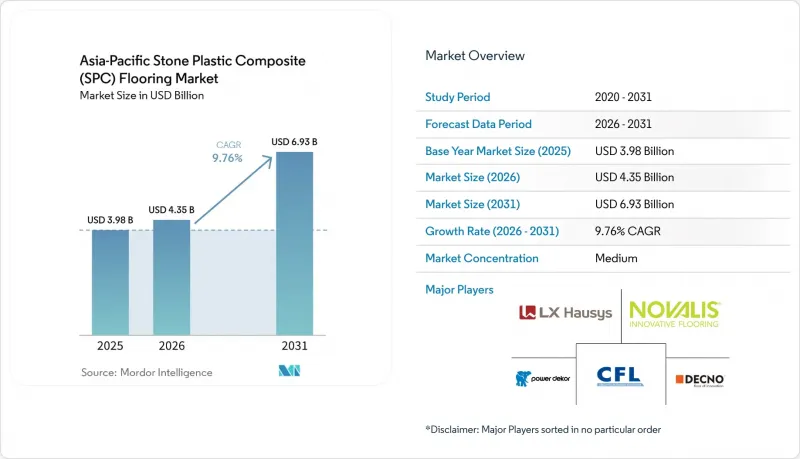
Mordor Intelligence에 의하면, 아시아태평양의 SPC 바닥재 시장 규모는 2025년에 39억 8,000만 달러로 평가되었습니다. 2026년 43억 5,000만 달러에서 2031년까지 69억 3,000만 달러에 이를 것으로 예상되며, 예측 기간(2026-2031년) CAGR은 9.76%를 나타낼 전망입니다.
본 보고서는 제품 유형(SPC 타일, SPC 플랭크), 제품 두께(4.0-5.0 mm, 5.1-6 mm, 기타), 시공 방법(인터로킹/클릭락, 기타), 최종 사용자(주택, 상업시설), 유통 채널(B2C/소매, B2B/시공 업체), 지역(인도, 중국, 기타)별로 분류되어 있습니다. 시장 전망은 금액(달러) 기준으로 제시되어 있습니다.
아시아태평양의 SPC 바닥재 시장 동향 및 분석
중국의 도시 재생이 2급 도시의 바닥재 교체 주기를 앞당기고 있습니다.
친환경 소재 및 저VOC(휘발성 유기 화합물) 건축자재를 장려하는 중국의 정책 방향에 따라, 신축 및 리모델링 모두에서 리지드 코어 바닥재의 사용이 확대되고 있으며, 이는 대규모 2급 및 3급 도시권에서 바닥재 교체 주기를 뒷받침하고 있습니다. 중국 국가통계국에 따르면, 중국의 도시화율은 65%를 넘어섰으며, 2급 도시에서 주택 교체 현상이 지속적으로 진행되고 있습니다. 이러한 시장의 대부분에서 아파트 바닥재 교체는 부동산 재판매 주기와 밀접한 관련이 있습니다. 방수 기능이 있는 클릭 잠금식 SPC 시스템(ASTM F3261 등의 탄성 바닥재 규격에 정의된 바와 같이, 일반적으로 두께 4-6mm, 마모층 0.3-0.7mm)는 접착제 경화에 24-72시간이 소요되는 세라믹 타일 시스템에 비해 시공으로 인한 가동 중단 시간을 단축합니다. 중국의 주요 제조업체들은 더 높은 밀도의 코어 프로파일과 더 두꺼운 마모층 개발에 투자해 왔습니다. 동시에, 일부 기업 그룹은 관세의 영향을 쉽게 받는 수출 경로공급을 더욱 안정화하기 위해 베트남과 태국에 병행 생산 거점을 추가로 마련하고 있습니다. 현재 허베이성과 장쑤성의 생산 거점은 동남아시아의 생산 능력을 보완함으로써 리드 타임을 균형 있게 유지하고, 무역 정책 변동에 대한 대응력을 높이고 있습니다. 이러한 공급 측면의 개선이 중국의 꾸준한 리모델링 추세와 맞물리면서, 아시아태평양의 SPC 바닥재 시장에서는 내륙 및 연안 지역의 구매자 모두로부터 더욱 광범위한 지역적 참여가 나타나고 있습니다.
방수형 리지드 코어 클릭 시스템이 개보수 소요 시간을 대폭 단축
SPC의 방수성 석회암·PVC 코어와 공구가 필요 없는 클릭식 시스템은 리모델링 공사를 대폭 단축하며, 탄성 바닥재 시공 지침 및 ASTM F3261에 따른 시공 관행에서 명시된 바와 같이, 접착식 비닐 바닥재에 비해 시공 시간을 30-50% 단축합니다. 이에 따라 운영 중인 아파트나, 가동 중단 시간이 수익에 직접적인 영향을 미치는 회전율이 높은 상업 공간에서 그 중요성이 더욱 두드러지고 있습니다. 주택 구매자들은 주방, 욕실, 현관의 방수 성능을 매우 중요하게 생각하며, 클릭락 방식의 시공을 통해 도심부의 좁은 아파트에 거주하는 가족들이 리모델링 공사로 인한 생활의 불편을 줄일 수 있습니다. 기존 바탕 위에 시공되는 리지드 코어 방식의 제품은 해체 작업을 최소화하고 바탕 조정재의 필요성을 줄여, 공수를 절감하며 야간이나 주말에도 보수 공사를 진행할 수 있게 해줍니다. 그 결과, 아시아태평양의 SPC 바닥재 시장은 예측 가능한 일정과 원활한 납품이 필수적인 주거 및 상업시설의 리모델링 프로그램에서 계속해서 사양 채택을 확보하고 있습니다.
EPR 의무화와 순환형 경제의 도입으로 인해 단위당 규정 준수 부담이 증가하고 있습니다.
아세안 전역에서 확대 생산자 책임(EPR) 체계가 강화되고 있으며, 생산자에게는 회수, 재활용 또는 스튜어드십 제도에 대한 자금 지원이 요구됨에 따라 플라스틱 밸류체인 내에서의 규정 준수 의무가 증가하고 있습니다. 베트남에서는 EPR 정책의 일환으로 재활용 의무화 또는 국가 환경보호 기금에 대한 자금 납부가 의무화되어 있으며, 인근 시장에서도 이와 유사한 조치들이 사업 계획에 영향을 미치고 있습니다. 필리핀에서는 EPR법(공화국법 제11898호)에 따라 대기업에 대한 회수 의무가 단계적으로 강화되고 있으며, 2028년까지 회수율을 80%까지 단계적으로 높이는 것이 의무화되어 있습니다. 이는 수입되는 탄성 바닥재의 포장, 표시 및 제품 관리 체계의 설계에 직접적인 영향을 미치고 있습니다. 호주의 경쟁 규제 당국은 탄성 바닥재용 ‘ResiLoop"스튜어드십 프로그램을 승인했습니다. 이 프로그램은 회수 및 재활용 체계를 지원하는 것으로, 현재 많은 사양 결정자들이 공급업체의 자격 요건으로 중요하게 여기는 선례가 되고 있습니다. 이러한 변화로 인해 PVC에 의존하는 공급망에는 새로운 비용 항목과 공정 요건이 발생하고 있으며, 아시아태평양의 SPC 바닥재 시장에서는 공공 조달 및 대기업의 지속가능성 기준을 준수하기 위해 제품 설계 및 문서화 재검토가 진행되고 있습니다.
부문별 분석
2025년, SPC 플랑크는 친근한 나뭇결 무늬의 외관과 주택 리모델링 프로젝트에 적합한 간편한 클릭식 시공 방식 덕분에 아시아태평양의 SPC 바닥재 시장에서 74.71%의 점유율을 차지하며 시장을 휩쓸었습니다. SPC 타일은 이음매 관리가 필요 없으면서도 세라믹과 같은 외관을 구현하는 ‘프리그라우트"표면 기술에 힘입어 2031년까지 연평균 성장률(CAGR) 8.20%로 확대될 것으로 전망됩니다. 이에 따라 습기가 많은 공간의 리모델링이나 상업용 욕실에서의 도입이 가속화되고 있습니다. 각 제조업체는 하나의 패널로 두 개의 타일을 모방한 통합형 이음매 라인 표면 처리 기술에 대한 라이선스를 취득했으며, 이를 통해 레이아웃의 복잡성이 줄어들고, 계단식 패턴의 시공 절차도 간소화될 것으로 기대됩니다. 공사로 인한 가동 중단에 민감한 시장에서 물이 닿는 곳의 공사 없이 클릭 방식으로 설치할 수 있는 타일은 모르타르 시공 방식의 세라믹 타일을 대체할 실용적인 대안이 되고 있으며, 이것이 아시아태평양의 SPC 바닥재 시장이 욕실, 현관 및 기타 물이 닿는 공간에서 지속적으로 확대되고 있는 주된 이유입니다. 제품 라인이 새로운 크기와 마감재로 확대됨에 따라, 타일 형태의 SPC는 오픈 플랜 공간이나 인접한 방에서 플랭크 소재를 시공하는 것과 함께 디자인의 연속성을 높이고 있습니다.
일본과 한국에서는 방음 성능이 제품 선정의 중요한 요소로 자리 잡고 있으며, LL40 또는 LL45 기준을 충족하는 습기가 많은 공간용 타일형 제품은 공동주택 리모델링에서 표준으로 자리 잡아가고 있습니다. 개발업체들은 관리조합에 의해 소음 전파가 규제되는 수직형 주거 환경에서 충격음을 줄이기 위해, 발포 패드가 내장된 더 무겁고 고밀도의 코어를 채택하는 경향이 있습니다. 프로젝트 매니저에게 있어, 기존 바닥을 철거하지 않고도 SPC 타일을 플로팅 방식으로 시공할 수 있다는 점은 인건비와 공수를 절감할 수 있게 해주며, 자재비의 미미한 차이보다 더 중요한 요소가 될 수 있습니다. 이러한 기술적·실용적 특징이 누적됨에 따라, 타일은 습기가 많은 공간의 시공에 점점 더 많이 채택되고 있습니다. 한편, 아시아태평양의 SPC 바닥재 시장에서는 거실, 복도, 침실에서 플랭크가 여전히 주류를 이루고 있습니다. 그 결과, 타일과 플랭크가 서로를 보완하여 통일감 있는 미관을 구현하는 동시에, 유지보수 부담을 줄이고 프로젝트 납기를 단축하는 등 명확한 “두 가지 형식" 전략이 확립되어 있습니다.
두께 5.1-6.0 mm 범주는 2025년 매출의 35.40%를 차지했으며, 고급 방음층이 필요하지 않고 표준적인 강성을 요구하는 주택 소유자나 건설업체에게 비용 및 취급 면에서 최적의 선택지가 되고 있습니다. 오버레이를 이용한 리모델링 공사에서는 문이나 문턱의 높이에 따라 바닥 두께에 제한이 있는 경우, 특히 방 사이의 허용 오차가 엄격한 아파트에서 더 얇은 4.0-4.5 mm 제품이 선호됩니다. 많은 공급업체들은 안정적인 코어와 보호용 마모층을 갖춘 중간 두께의 SKU를 최적화하고 있으며, 이러한 제품들은 일상적인 주거용 성능 요건을 충족하기 때문에 아시아태평양의 SPC 바닥재 시장에서 이 부문의 판매량을 뒷받침하고 있습니다. 주택 시공업체들은 음향적 제약이 중간 정도인 경우, 5.0-5.5 mm 제품을 표준 사양 목록에 유지하는 이유로 예측 가능한 클릭식 시공 성능과 낮은 재방문률을 꼽고 있습니다. 중국과 베트남에서 공급망이 확대되는 가운데, 대부분의 유통업체은 지역 시장의 가격대와 디자인 다양성 간의 균형을 맞추기 위해 이 두께 범위 내에서 폭넓은 제품 라인업을 갖추고 있습니다.
6.5 mm를 초과하는 초두꺼운 포맷은 2031년까지 연평균 성장률(CAGR) 8.57%를 나타낼 것으로 예측됩니다. 이는 일본과 한국의 엄격한 바닥 충격음 기준에 따라, IXPE나 EVA 패드가 미리 부착된 제품이 선호되는 추세가 뒷받침하고 있습니다. 많은 아파트 관리조합과 부동산 관리 회사는 바닥재 교체 시 LL40 또는 LL45에 상응하는 성능을 의무화하고 있으며, 이에 따라 사양 결정자는 충격 전달을 억제하기 위해 고밀도 코어재나 두꺼운 하층을 갖춘 제품을 선택하게 되었습니다. 패드가 일체 성형된 6.5-7.0 mm 두께의 프리미엄 플랭크는 일반적인 아파트 규정을 충족하는 IIC 및 STC 등급을 표방하는 경우가 많으며, 이로 인해 아시아태평양의 SPC 바닥재 시장에서 구매자들의 관심이 고부가가치 SKU로 이동하고 있습니다. 두께가 6.0-6.5 mm인 제품군은 예산이 제한적이고 음향 기준도 그리 엄격하지 않은 경우, 여전히 현실적인 중간 선택지로 남아 있습니다. 그렇긴 하지만, 규제 동향에 따라 고층 건물에서 바닥재를 교체할 때 더 두꺼운 제품으로 전환하는 추세가 이어지고 있습니다. 그 결과, 각 제조업체들은 이러한 프리미엄 수요에 대응하기 위해 패드 장착 라인 및 고밀도 코어 배합 개발에 지속적으로 투자하고 있습니다.
기타 혜택 :
- 엑셀 형식 시장 예측(ME) 시트
- 3개월간의 애널리스트 지원
자주 묻는 질문
목차
제1장 서론
제2장 조사 방법
제3장 주요 요약
제4장 시장 구도
제5장 시장 규모 및 성장 예측
제6장 경쟁 구도
제7장 시장 기회 및 향후 전망
KTH 26.07.08According to Mordor Intelligence, the asia-Pacific stone plastic composite flooring market size was valued at USD 3.98 billion in 2025 and is estimated to grow from USD 4.35 billion in 2026 to reach USD 6.93 billion by 2031, at a CAGR of 9.76% during the forecast period (2026-2031).
This report is Segmented by Product Type (SPC Tiles, SPC Planks), Product Thickness (4. 0-5. 0 Mm, 5. 1-6 Mm, and More), Installation Method (Interlocking/Click-lock, and More), End User (Residential, Commercial), Distribution Channel (B2C/Retail and B2B/Contractors), and Geography (India, China, and More). The Market Forecasts are Provided in Terms of Value (USD).
Asia-Pacific Stone Plastic Composite (SPC) Flooring Market Trends and Insights
China Urban Renewal Amplifies Tier-2 Replacement Cycles
China's policy direction for greener materials and lower-VOC construction products is encouraging wider use of rigid-core flooring in both newbuilds and renovations, which supports replacement cycles in large tier-2 and tier-3 city clusters. According to the National Bureau of Statistics of China, the country's urbanization rate has exceeded 65%, reinforcing sustained residential turnover in secondary cities. In many of these markets, apartment flooring replacement is closely linked to property resale cycles. Waterproof click-lock SPC systems (typically 4-6 mm thick with 0.3-0.7 mm wear layers, as defined in resilient flooring specifications such as ASTM F3261) reduce installation downtime compared with ceramic tile systems, which require adhesive curing periods of 24-72 hours. Leading Chinese manufacturers have invested in denser core profiles and higher-wear layers. At the same time, some groups have added parallel bases in Vietnam or Thailand to serve tariff-sensitive export lanes more predictably. Production footprints in Hebei and Jiangsu now complement Southeast Asian capacity, helping balance lead times and improving resilience to trade policy swings. As these supply-side improvements align with China's steady renovation cadence, the Asia-Pacific SPC flooring market is seeing broader geographic participation from both inland and coastal buyers.
Waterproof Rigid-Core Click Systems Collapse Refurbishment Lead Times
SPC's waterproof limestone-PVC core and tool-free click systems significantly shorten renovation projects, reducing installation times by 30-50% compared with glue-down vinyl systems, as indicated in resilient flooring installation guidelines and ASTM F3261-based application practices. This makes it important for occupied apartments and fast-turnover commercial spaces where downtime directly affects revenue. Residential buyers place a high value on waterproofing for kitchens, bathrooms, and entries, and click-lock installation lowers disruption for families in small urban flats during refurbishments. Rigid-core formats installed over existing substrates limit demolition and reduce the need for leveling compounds, cutting labor hours, and making overnight or weekend retrofits feasible. As a result, the Asia-Pacific SPC flooring market continues to win specifications in both residential and commercial refresh programs where predictable schedules and clean turnarounds are essential.
EPR Mandates and Circularity Specifications Inflate Per-Unit Compliance Burdens
Extended Producer Responsibility (EPR) frameworks are tightening across ASEAN, pushing producers to fund collection, recycling, or stewardship schemes and increasing compliance obligations for plastics value chains. In Vietnam, the EPR policy includes mandated recycling or financial contributions to a national environmental protection fund, and similar approaches are influencing business planning in neighboring markets. In the Philippines, the EPR Act (Republic Act No. 11898) sets escalating recovery obligations for large enterprises, with mandated recovery rates increasing progressively up to 80% by 2028, directly influencing packaging, labeling, and product stewardship design for imported resilient flooring materials. Australia's competition regulator authorized the ResiLoop stewardship program for resilient flooring, which supports a collection and recycling pathway and sets a precedent that many specifiers now look for in supplier credentials. These changes create new cost items and process requirements for supply chains that rely on PVC, and the Asia-Pacific SPC flooring market is adjusting product designs and documentation to align with public procurement and large-firm sustainability criteria.
Other drivers and restraints analyzed in the detailed report include:
- Healthcare, Hospitality, and Retail Prioritize Low-Lifecycle-Cost Surfaces
- APAC Capacity Build-Out Tightens Lead Times and Localizes Supply Chains
- Feedstock Price Surges Triggered by Supply Disruptions and Refinery Constraints
For complete list of drivers and restraints, kindly check the Table Of Contents.
Segment Analysis
SPC planks dominated the Asia-Pacific SPC flooring market with a 74.71% share in 2025, supported by familiar wood-look aesthetics and straightforward click installations for residential refresh projects. SPC tiles are projected to expand at a 8.20% CAGR through 2031, aided by pre-grouted surface technologies that deliver the look of ceramic without grout maintenance, accelerating adoption in wet-room retrofits and commercial bathrooms. Manufacturers are licensing integrated grout-line surface treatments that simulate two tiles on one panel, reducing layout complexity and potentially reducing installation steps for staggered patterns. In markets sensitive to downtime, tiles that click into place without wet trades are a practical alternative to mortar-set ceramic, which is a key reason the Asia-Pacific SPC flooring market continues to expand in bathrooms, entryways, and other wet zones. As product lines broaden into new sizes and finishes, tile-format SPC is improving design continuity alongside plank installations across open-plan spaces and adjacent rooms.
Acoustic compliance in Japan and South Korea is central to product selection, and wet-area tile formats that meet LL40 or LL45 standards are becoming a staple of multi-family retrofits. Developers lean toward heavier, denser cores with integrated foam pads to manage impact sound in vertical living arrangements where noise transmission is regulated by building associations. For project managers, the ability to install SPC tiles as a floating system over existing surfaces without demolition reduces labor and time, which can matter more than small differences in material costs. As these technical and practical features stack up, tiles are capturing more wet-room specifications. At the same time, planks continue to dominate living areas, corridors, and bedrooms across the Asia-Pacific SPC flooring market. The net effect is a clear two-format strategy where tiles complement planks to deliver a uniform aesthetic with lower maintenance and faster project turnover.
The 5.1-6.0 mm thickness category accounted for 35.40% of 2025 revenues, serving as a cost-and-handling sweet spot for homeowners and builders who need standard rigidity without premium acoustic layers. In overlay retrofits, thinner 4.0-4.5 mm products are preferred where door and threshold heights limit build-up, especially in apartments with tight tolerances between rooms. Many suppliers are optimizing mid-thickness SKUs with stable cores and protective wear layers that meet everyday residential performance needs, which sustains volume in this segment across the Asia-Pacific SPC flooring market. Residential installers cite predictable click performance and low call-back rates as reasons to keep 5.0-5.5 mm on standard spec lists where acoustic constraints are moderate. As supply chains scale in China and Vietnam, most distributors carry deep assortments in this thickness range to balance price points and design variety for regional markets.
Ultra-thick formats above 6.5 mm are forecast to grow at 8.57% CAGR through 2031, lifted by strict floor impact sound requirements in Japan and South Korea that favor pre-attached IXPE or EVA pads. Many condo associations and property managers enforce LL40 or LL45 equivalents for replacements, which point specifiers to higher-density cores and thicker underlayment layers to control impact transmission. Premium 6.5-7.0 mm planks with integrated pads often advertise IIC and STC ratings that meet common condominium rules, which shifts buyers toward higher-value SKUs within the Asia-Pacific SPC flooring market. The 6.0-6.5 mm tier remains a viable middle ground for budgets that are tighter and acoustic standards that are less prescriptive. Still, regulatory momentum is tilting replacements toward higher thicknesses in high-rise applications. As a result, manufacturers continue to invest in pad-attachment lines and denser core formulations to serve this premium demand profile.
Complete Report Scope:
- By Product Type
- SPC Tiles
- SPC Planks
- By Product Thickness
- 4.0-5.0 mm
- 5.1-6.0 mm
- 6.1-6.5 mm
- Above 6.5 mm
- By Installation Method
- Self-Adhesive
- Glue-Down
- Interlocking/Click-lock
- Others
- By End User
- Residential
- Commercial
- By Distribution Channel
- B2C/Retail
- Home Centers
- Specialty Flooring Stores
- Online
- Local Hardware Shops (unorganized market)
- Other Distribution Channels
- B2B/Contractors
- B2C/Retail
- By Geography
- India
- China
- Japan
- Australia
- South Korea
- South East Asia (Singapore, Malaysia, Thailand, Indonesia, Vietnam, and the Philippines)
- Rest of Asia-Pacific
List of Companies Covered in this Report:
- CFL Flooring (Creative Flooring Solutions)
- Power Dekor Group
- Novalis Innovative Flooring
- DECNO GROUP Ltd.
- Armstrong Flooring Asia
- LX Hausys (HFLOR)
- Zhejiang GIMIG Technology
- Protex Flooring (Changzhou)
- TopJoy Industrial
- Hanflor (Hanhent International)
- EFLOOR (E-Block JSC., Vietnam)
- HAODIBAN
- Proluxe Floor (Changzhou)
- Jiangsu Kentier Wood
- Zhangjiagang Yihua Rundong New Material
- Cicko Flooring
- Zhejiang Ballun Ecological Household
- Changzhou Aojia Decorate Material
- Changzhou Lexuan New Material
- Changzhou Yuhe New Construction Materials
Additional Benefits:
- The market estimate (ME) sheet in Excel format
- 3 months of analyst support
TABLE OF CONTENTS
1 Introduction
- 1.1 Study Assumptions & Market Definition
- 1.2 Scope of the Study
2 Research Methodology
3 Executive Summary
4 Market Landscape
- 4.1 Market Overview
- 4.2 Market Drivers
- 4.2.1 China urban renewal-fueled renovation demand
- 4.2.2 Waterproof rigid-core and click-lock enabling fast refurb
- 4.2.3 Adoption in healthcare, hospitality, retail upgrades
- 4.2.4 APAC SPC capacity expansions improving availability
- 4.2.5 Apartment sound insulation standards (LL45/LL40) push thicker SPC
- 4.2.6 Pre-grouted SPC tile innovations speeding tile-look installs
- 4.3 Market Restraints
- 4.3.1 PVC sustainability/EPR raising compliance costs
- 4.3.2 PVC/plasticizer feedstock price volatility
- 4.3.3 Competition from ceramic tile and engineered wood
- 4.3.4 Condo acoustic rules increasing installed system cost
- 4.4 Industry Value Chain Analysis
- 4.5 Porter's Five Forces Analysis
- 4.5.1 Threat of New Entrants
- 4.5.2 Bargaining Power of Suppliers
- 4.5.3 Bargaining Power of Buyers
- 4.5.4 Threat of Substitutes
- 4.5.5 Competitive Rivalry
- 4.6 Insights into the Latest Trends and Innovations in the Industry
- 4.7 Insights on Recent Developments (New Product Launches, Strategic Initiatives, Investments, Partnerships, JVs, Expansion, M&As, etc.) in the Industry
5 Market Size & Growth Forecasts (Value in USD Billion)
- 5.1 By Product Type
- 5.1.1 SPC Tiles
- 5.1.2 SPC Planks
- 5.2 By Product Thickness
- 5.2.1 4.0-5.0 mm
- 5.2.2 5.1-6.0 mm
- 5.2.3 6.1-6.5 mm
- 5.2.4 Above 6.5 mm
- 5.3 By Installation Method
- 5.3.1 Self-Adhesive
- 5.3.2 Glue-Down
- 5.3.3 Interlocking/Click-lock
- 5.3.4 Others
- 5.4 By End User
- 5.4.1 Residential
- 5.4.2 Commercial
- 5.5 By Distribution Channel
- 5.5.1 B2C/Retail
- 5.5.1.1 Home Centers
- 5.5.1.2 Specialty Flooring Stores
- 5.5.1.3 Online
- 5.5.1.4 Local Hardware Shops (unorganized market)
- 5.5.1.5 Other Distribution Channels
- 5.5.2 B2B/Contractors
- 5.5.1 B2C/Retail
- 5.6 By Geography
- 5.6.1 India
- 5.6.2 China
- 5.6.3 Japan
- 5.6.4 Australia
- 5.6.5 South Korea
- 5.6.6 South East Asia (Singapore, Malaysia, Thailand, Indonesia, Vietnam, and the Philippines)
- 5.6.7 Rest of Asia-Pacific
6 Competitive Landscape
- 6.1 Market Concentration
- 6.2 Strategic Moves (capacity, JV, export shifts)
- 6.3 Market Share Analysis
- 6.4 Company Profiles (includes Global level Overview, Market level overview, Core Segments, Financials as available, Strategic Information, Market Rank/Share for key companies, Products & Services, and Recent Developments)
- 6.4.1 CFL Flooring (Creative Flooring Solutions)
- 6.4.2 Power Dekor Group
- 6.4.3 Novalis Innovative Flooring
- 6.4.4 DECNO GROUP Ltd.
- 6.4.5 Armstrong Flooring Asia
- 6.4.6 LX Hausys (HFLOR)
- 6.4.7 Zhejiang GIMIG Technology
- 6.4.8 Protex Flooring (Changzhou)
- 6.4.9 TopJoy Industrial
- 6.4.10 Hanflor (Hanhent International)
- 6.4.11 EFLOOR (E-Block JSC., Vietnam)
- 6.4.12 HAODIBAN
- 6.4.13 Proluxe Floor (Changzhou)
- 6.4.14 Jiangsu Kentier Wood
- 6.4.15 Zhangjiagang Yihua Rundong New Material
- 6.4.16 Cicko Flooring
- 6.4.17 Zhejiang Ballun Ecological Household
- 6.4.18 Changzhou Aojia Decorate Material
- 6.4.19 Changzhou Lexuan New Material
- 6.4.20 Changzhou Yuhe New Construction Materials
7 Market Opportunities & Future Outlook
- 7.1 Acoustic-compliant thick SPC systems for Japan/Korea multi-family
- 7.2 Pre-grouted SPC tile systems for wet-room retrofits across China/SEA