|
시장보고서
상품코드
2073343
PVC 프리 비닐 바닥재 : 시장 점유율 분석, 업계 동향 및 통계, 성장 예측(2026-2031년)PVC-free Vinyl Flooring - Market Share Analysis, Industry Trends & Statistics, Growth Forecasts (2026 - 2031) |
||||||
 Mordor Intelligence
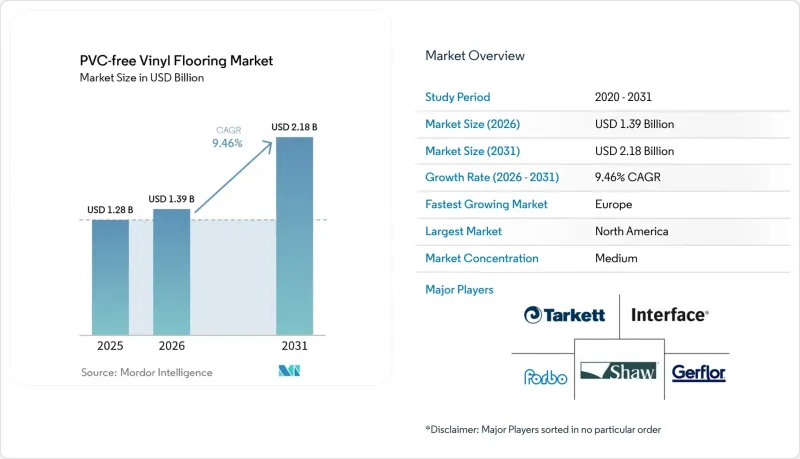
Mordor Intelligence에 의하면, PVC 프리 비닐 바닥재 시장 규모는 2025년에 12억 8,000만 달러로 평가되었습니다. 2026년 13억 9,000만 달러에서 2031년까지 21억 8,000만 달러에 이를 것으로 예상되며, 예측 기간(2026-2031년) CAGR은 9.46%를 나타낼 전망입니다.
본 보고서는 형태(시트, 타일, 플랭크), 시공 방법(접착 시공, 프리레이, 클릭/인터로킹), 최종 사용자(주택, 상업시설, 산업용 및 특수 차량), 유통 채널(B2C/소매, B2B/시공업체/건설업체), 지역(북미, 남미, 아시아태평양, 기타)별로 분류되어 있습니다. 시장 전망은 금액(10억 달러) 기준으로 제시되어 있습니다.
세계의 PVC 프리 비닐 바닥재 시장 동향 및 분석
친환경 건축물 인증의 급증
LEED v5에서는 자재의 투명성과 인바디 카본(제조·운송·사용 단계에서의 탄소 배출량)에 관한 요건이 강화되었으며, 이는 공공시설 및 대규모 상업 프로젝트의 제품 선정에 영향을 미치고 있습니다. 조달 팀은 검증된 EPD(환경 제품 선언)를 보유하거나 CDPH 섹션 01350 또는 이에 상응하는 기준을 준수하는 확실한 저배출 인증을 획득한 제품을 우선적으로 선정함으로써, 건강을 고려한 공간에서 PVC가 포함되지 않은 탄성 바닥재에 대한 수요를 촉진하고 있습니다. 2025년부터 2026년에 걸쳐 개정될 BREEAM 지침에서는 실내용 제품에 대해 인정되는 배출량 산정 방식이 명확히 규정됨에 따라, 영국 및 기타 도입 시장에서 실시되는 시험과 규정 준수가 더욱 표준화될 것입니다. 이러한 체계가 발주처의 요구 사항에 널리 자리 잡음에 따라, 제3자 기관의 검증을 거친 선언서와 실증된 배출량 실적을 보유한 공급업체가 사양 선정 시 우선적으로 고려되고 있습니다. 이러한 변화는 사무실, 학교, 의료시설용 배출량이 검증된 플랫폼으로의 전환을 통해, PVC가 함유되지 않은 비닐 바닥재 시장의 제품 구성 변화를 촉진하고 있습니다.
염소 및 오르토프탈산 에스테르류에 대한 규제 강화
미국의 TSCA(유해물질관리법) 및 CPSC(소비자제품안전위원회)가 시행한 특정 프탈레이트류 금지 조치는 교육 기관 및 보육 시설의 실내 마감재 선정에 계속해서 영향을 미치고 있습니다. EU의 REACH 규정 및 SVHC(고위험물질) 승인 제도는 오르토프탈산 에스테르 사용에 대해 계속해서 강력한 압력을 가하고 있으며, 대체재를 사용할 수 있는 경우에는 공공 조달에서 PVC가 포함되지 않은 화학 성분이 우선적으로 채택되도록 유도하고 있습니다. 그 결과, 염소와 오르토프탈산 에스테르가 함유되지 않은 탄성 바닥재의 제품 라인업이 확대되고 있으며, 이를 통해 공공 부문의 구매 담당자들은 표시 의무로 인한 부담을 피하고 규제 위험을 줄일 수 있게 되었습니다. 이러한 정책 동향은 건강 관련 기준이 평가에서 크게 중시되는 특히 세심한 배려가 필요한 시설에서 PVC 프리 소재를 채택해야 할 근거를 한층 더 확고히 하고 있습니다. 따라서 PVC가 함유되지 않은 비닐 바닥재 시장은 화학 물질에 대한 직접적인 규제는 물론, 프탈레이트나 할로겐을 포함하지 않은 제품을 선호하는 구매 담당자들의 리스크 관리 측면에서의 선호도 덕분에 혜택을 보고 있습니다.
도입 장벽 : 가격 프리미엄, 시공업체의 수용도, 그리고 입수 가능성
PVC가 포함되지 않은 탄성 바닥재는 수지 비용, 인증 취득에 드는 투자 비용, 그리고 아직 정상화 단계에 있는 소량 생산 등을 반영하여, 일반적인 PVC 기반 대체재보다 가격이 비싼 경우가 많습니다. PVC 기반 LVT 시스템에 대한 교육을 이수한 시공업체는 염소 및 오르토프탈산 에스테르가 함유되지 않은 제품을 시공할 때, 바탕 처리 및 접착제의 적합성에 대해 추가 교육이 필요할 수 있습니다. 공공 공사 시방서에서는 배출 기준을 준수하는 접착제 사용이 점점 더 의무화되고 있으며, 보증상의 문제를 피하기 위해서는 시스템 차원의 지침 및 문서화된 적합성의 중요성이 더욱 커지고 있습니다. 인증된 시공 및 제품 시험 기준은 치수 공차와 성능 검증을 정의함으로써, 사양 수립자 및 시공업체에게 명확성을 높여줍니다. 지역 네트워크 전체의 생산 능력이 확대되고 교육이 충실해짐에 따라, 검증된 저VOC 성능을 중시하는 공공시설 및 상업시설 채널에서는 가격이나 익숙함의 장벽이 완화될 것으로 예측됩니다.
부문별 분석
2025년에는 플랑크가 매출의 66.52%를 차지했으며, 사무실, 소매점, 교육 시설 프로젝트에서 나뭇결 무늬 외관과 모듈성에 대한 선호에 힘입어 2031년까지 연평균 성장률(CAGR) 10.07%를 나타낼 것으로 예측됩니다. 이 점유율은 건축가와 시설 관리 팀이 저VOC 요건을 충족하면서도 익숙한 시공 리듬을 유지할 수 있는 PVC가 포함되지 않은 대체재를 채택하고 있음을 보여줍니다. 위생 측면이나 이음매 최소화가 중요한 상황에서는 시트 형태의 제품이 배출 기준 및 청소 규정을 준수하는 의료시설이나 클린룸 관련 공간에서 계속해서 활용되고 있습니다. 타일 형태의 제품은 유동 인구가 많은 실내 공간에서 단계적인 리모델링과 시각적인 구역 설정을 지원하며, 가동 중단 시간을 최소화하는 것을 최우선으로 하는 상업시설의 리뉴얼 주기에 적합합니다. 이러한 제품에는 CDPH 섹션 01350의 기준치나 조달 팀이 인정하는 이에 상응하는 기준을 충족하는 배출량 인증서 및 문서가 점점 더 많이 첨부되고 있습니다.
PVC가 포함되지 않은 비닐 바닥재 시장에서도 포맷 수준에서 재활용에 대한 고려가 더욱 깊이 반영되어 있으며, 모듈형 제품은 부분적인 교체나 재료 회수율 향상이 가능하도록 설계되어 있습니다. 검증된 저배출 인증 및 EPD(환경 제품 선언)를 통해, 이러한 제품들은 LEED v5 및 BREEAM 인증 기준을 충족하며, 배출량 시험 및 공인 시험 기관의 절차는 교육 기관 및 의료 기관 고객들의 신뢰를 높이고 있습니다. 타일과 플랭크는 통제된 철거 작업에 적합하며, 이는 '순환형 경제 행동 계획' 에 근거한 EU의 친환경 공공조달에 관한 회수 시스템 규정에 부합합니다. 시트 제품은 이음매 없는 표면이 요구되는 환경에서 여전히 필수적이지만, 공공 부문 입찰에서 계속해서 지지를 얻기 위해서는 사용 후 명확한 처리 방법을 제시해야 합니다. PVC가 함유되지 않은 비닐 바닥재 시장 규모는 실내 공기질 확보를 최우선으로 하는 공공시설 및 상업시설의 인테리어 사양에서 확실한 인증을 갖춘 모듈형 제품이 앞으로도 주도적인 역할을 계속해 나갈 것임을 시사하고 있습니다.
2025년에는 클릭식 및 인터록식 시공이 매출의 43.67%를 차지했습니다. 이는 접착제 사용을 최소화하거나 아예 사용하지 않음으로써 시공의 신속성, 예측 가능성 및 현장 가동 중단 시간 단축을 실현했음을 반영합니다. 루즈레이 방식은 사용 후 회수에 대한 배려, 철거의 간소화, 그리고 유럽의 회수 요건 준수를 배경으로 연평균 성장률(CAGR) 11.52%를 기록하며 가장 빠르게 성장하고 있는 시공 방식입니다. 접착 시공은 동적 하중 하에서 최고 수준의 접착 강도와 치수 안정성이 우선시되는 교통량이 많은 환경이나 특수한 환경에서 여전히 필수적입니다. 공공 사양서에는 사람이 이용하는 공간에서 접착제의 휘발성 물질 배출량 및 함유량에 관한 규정이 명시되어 있으며, 설계 및 조달 단계에서 시스템 전체가 고려되도록 보장하고 있습니다. 이러한 접근 방식은 탄성 바닥재 제품의 치수 안정성, 압흔 저항성 및 표면 무결성을 규정하는 성능 기준에 근거하고 있습니다.
순환형 경제는 시공 방법 선정에 영향을 미치는 중요한 주제이며, 입찰 공고에는 완공된 바닥면을 재사용하는 스포츠 시설 및 커뮤니티 시설을 포함하여 회수 및 재사용 계획이 명시되어 있습니다. 루즈레이 방식은 해체와 재사용을 보다 현실적으로 만들고, 접착제 사용량을 더욱 줄임으로써 시공 및 사용 종료 후의 과정을 모두 간소화합니다. 클릭식 시스템은 배출량 및 실내 공기질 기준이 충족되는 한, 일관된 밀착감과 공사 기간 단축을 실현하므로, 바쁜 캠퍼스나 운영 중인 의료시설에 매력적인 선택지입니다. 접착제 선정에 관해서는 CDPH 섹션 01350 또는 이에 상응하는 기준을 준수한 배출량 프로그램의 참조 정보를 첨부한 제출 서류에 명시되어 있으며, 공공 부문 입찰에서의 규정 준수 관련 설명을 강화하고 있습니다. 이러한 조건에 따라, 저VOC 접착제, 인증된 배출량 시험, 그리고 EU 공공 조달 지침을 준수하는 폐쇄형 회수 체계와 원활하게 통합되는 시공 방법이 우선시됩니다.
지역별 분석
2025년, 북미는 33.00%의 점유율을 차지했습니다. 이는 LEED 기준을 준수하는 프로젝트나 배출량 기반 사양이 공공 및 민간 조달 분야에서 여전히 핵심을 차지하고 있었기 때문입니다. 미국 연방정부 및 국방부의 건설 관련 문서에서는 저VOC 배출 프로그램이 언급되어 있으며, 이에 따라 탄성 바닥재 및 접착제에 대한 시스템 기반의 규정 준수 요건이 강화되었습니다. 탄성 바닥재 플랫폼 및 회수 서비스 분야의 국내 생산 능력 확대는 짧은 공급망과 검증된 회수 체계를 선호하는 기관 고객을 지원하고 있습니다. 교육 및 의료 분야는 배출 성능과 장기적인 유지보수 성과를 중시하여, 계속해서 안정적인 수요를 창출하고 있습니다. 이러한 구매자들은 CDPH 섹션 01350 또는 해당 지역에서 널리 채택되고 있는 이에 상응하는 기준을 충족하는 제3자 기관에 의한 시험 및 공인 인증을 우선시하고 있습니다.
유럽은 EU의 '순환형 경제 행동 계획' 또한 친환경 공공 조달에 회수 시스템을 통합한 점을 반영하여, 2031년까지 연평균 성장률(CAGR) 10.16%로 세계 시장을 견인할 것으로 예측됩니다. 북유럽의 친환경 라벨 기준 및 유사한 체계에 따라 배출량과 재활용 함량에 대한 기대치가 더욱 엄격해지고 있으며, 명확한 회수 및 재처리 경로를 갖춘 플랫폼이 지지를 받고 있습니다. 학교, 병원, 관공서에서 진행되는 공공 입찰에서는 배출 성능이 문서화되어 있고, 확립된 회수 물류 체계를 갖춘 자재가 우선적으로 선정됩니다. 각국의 조달 지침에서 최저 기준이 일반화됨에 따라, 장기적인 회수 프로그램과 검증된 EPD(환경 제품 선언)를 갖춘 공급업체는 더 유리한 입장에 있습니다. 해당 지역의 PVC가 함유되지 않은 비닐 바닥재 시장 점유율은 순환형 설계, 사용 후 책임, 그리고 일관된 배출 시험을 촉진하는 조화로운 규정에 힘입어 유지되고 있습니다.
아시아태평양은 2031년까지 지속적인 성장이 예상되는 중요한 기반을 차지하고 있으며, 특히 의료 및 기술 분야에서 배출량과 위생 문제를 중시하는 성숙한 시장의 움직임이 가장 활발합니다. 배출량 시험에 대한 표준화된 접근 방식과 인증 시험소는 제약 및 의료 기술 시설에서의 도입을 지속적으로 촉진하고 있습니다. 동남아시아의 공공 프로젝트에서는 비용과 성능·내구성의 균형이 잘 잡혀 있으며, 습도 관리와 수명 주기 전반에 걸친 유지보수가 사양을 결정짓고 있습니다. 사용한 식용유 수출 및 재생 가능 연료 혼합과 관련된 지역 정책으로 인해 바이오 순환형 원료 시장이 공급 부족에 직면할 가능성이 있습니다. 공급망은 PVC가 포함되지 않은 견고한 플랫폼을 제공하기 위해 이러한 상황을 적절히 관리해야 합니다. 일본과 한국의 발주자 요건에서는 배출 가스 및 자재의 안전성 관리가 중시되고 있으며, 이는 확립된 저VOC(휘발성 유기 화합물) 체계 및 널리 인정받는 시험 체계와 부합합니다.
기타 혜택 :
- 엑셀 형식 시장 예측(ME) 시트
- 3개월간의 애널리스트 지원
자주 묻는 질문
목차
제1장 서론
제2장 조사 방법
제3장 주요 요약
제4장 시장 구도
제5장 시장 규모 및 성장 예측
제6장 경쟁 구도
제7장 시장 기회 및 향후 전망
KTH 26.07.07According to Mordor Intelligence, the PVC-free vinyl flooring market size was valued at USD 1.28 billion in 2025 and is estimated to grow from USD 1.39 billion in 2026 to reach USD 2.18 billion by 2031, at a CAGR of 9.46% during the forecast period (2026-2031).
This report is Segmented by Format (Sheets, Tiles, Planks), Installation Method (Glue-Down, Loose-Lay, Click/Interlocking), End User (Residential, Commercial, Industrial & Specialized Vehicles), Distribution Channel (B2C/Retail, B2B/Contractors/Builders), and Geography (North America, South America, Asia-Pacific, and More). Market Forecasts are Provided in Terms of Value (USD Billion).
Global PVC-free Vinyl Flooring Market Trends and Insights
Surge in Green-Building Certifications
LEED v5 sharpened its material transparency and embodied carbon expectations, which are influencing product selection in institutional and large commercial projects. Procurement teams are prioritizing products with verified EPDs and robust low-emission certifications that map to CDPH Section 01350 or equivalent, reinforcing demand for PVC-free resilient options in health-sensitive spaces. BREEAM guidance updated in 2025-2026 clarifies accepted emissions schemes for indoor products, which further standardizes testing and compliance in the United Kingdom and other adopting markets. As these frameworks spread across owner requirements, suppliers with third-party verified declarations and proven emissions performance are gaining specification preference. This shift supports a structural mix change in the PVC-free vinyl flooring market toward emission-verified platforms for offices, schools, and healthcare facilities.
Tightening Regulations on Chlorine and Ortho-Phthalates
United States regulatory actions under TSCA and CPSC prohibitions on certain phthalates continue to shape material decisions across interior finishes in education and childcare environments. EU REACH restrictions and SVHC authorizations continue to exert strong pressure on the use of ortho-phthalates, steering public tenders toward PVC-free chemistries when alternatives are available. The result is an expansion of chlorine-free, ortho-phthalate-free resilient offerings that avoid labeling burdens and reduce regulatory risk for public-sector buyers. These policy dynamics reinforce the case for PVC-free materials in sensitive occupancies, where health-related criteria are strongly weighted in scoring. The PVC-free vinyl flooring market, therefore, benefits from both direct chemical restrictions and buyer risk-management preferences that favor phthalate- and halogen-free platforms.
Adoption Barriers: Price Premium, Installer Acceptance, and Availability
PVC-free resilient products often cost more than commodity PVC-based alternatives, reflecting resin costs, certification investments, and smaller production runs that are still normalizing. Contractors trained on PVC-based LVT systems may need additional training on substrate preparation and adhesive compatibility when installing chlorine-free and ortho-phthalate-free platforms. Public specifications increasingly mandate emissions-compliant adhesives, which raises the importance of system-level guidance and documented compatibility to avoid warranty issues. Recognized installation and product testing standards are improving clarity for specifiers and installers by defining dimensional tolerances and performance verification. As capacity expands and training improves across regional networks, price and familiarity barriers are expected to ease in institutional and commercial channels that value verified low-VOC performance.
Other drivers and restraints analyzed in the detailed report include:
- Healthcare and Education Demand for Low-VOC Interiors
- Bio-Polyolefin Breakthroughs Enable 100% Recyclability
- Feed-Stock Volatility for Bio-Based Polymers
For complete list of drivers and restraints, kindly check the Table Of Contents.
Segment Analysis
Planks accounted for 66.52% of revenue in 2025 and are expected to advance at 10.07% CAGR through 2031, supported by the preference for wood visuals and modularity in offices, retail, and education projects. This share confirms that architects and facility teams are adopting PVC-free alternatives that meet low-VOC requirements and deliver familiar installation rhythms. Where hygiene and seam minimization are critical, sheet formats continue to serve use cases in healthcare and cleanroom-adjacent spaces aligned with emissions criteria and cleaning protocols. Tile formats support phased renovations and visual zoning in high-traffic interiors, which suits commercial refresh cycles that prioritize minimal downtime. These options are increasingly accompanied by emissions certifications and documentation that meet CDPH Section 01350 thresholds and comparable schemes recognized by procurement teams.
The PVC-free vinyl flooring market is also seeing deeper integration of take-back considerations at the format level, with modular products positioned for selective replacement and improved material recovery. Verified low-emissions credentials and EPDs align these products with LEED v5 and BREEAM pathways, with emissions testing and accredited laboratory procedures enhancing confidence among education and healthcare clients. Tiles and planks support controlled disassembly, which aligns with EU Green Public Procurement language on take-back systems under the Circular Economy Action Plan. Sheet products remain essential in environments requiring seamless surfaces, but must demonstrate clear end-of-life handling to remain favored in public-sector bids. The PVC-free vinyl flooring market size signals that modular formats with robust documentation will continue to set the pace in specifications for institutional and commercial interiors with indoor air quality priorities.
Click-and-interlocking installations accounted for 43.67% of revenue in 2025, reflecting speed, predictability, and reduced site downtime, as adhesives are minimized or avoided. Loose-lay is the fastest-growing method, with a 11.52% CAGR, driven by end-of-life recovery considerations, simplified removal, and alignment with take-back requirements in Europe. Glue-down remains essential for heavy-traffic or specialty environments where peak bond strength and dimensional stability under dynamic loads are prioritized. Public specifications codify adhesive emissions and content rules for occupied spaces, ensuring that full systems are considered at design and procurement stages. These approaches are underpinned by performance standards that define dimensional stability, indentation resistance, and surface integrity for resilient products.
Circularity is a key theme influencing method selection, as tenders specify take-back and reuse plans, including for sports and community facilities that redeploy finished surfaces. Loose-lay systems make disassembly and reuse more practical and further reduce adhesive use, simplifying both installation and end-of-life processes. Click systems deliver consistent fit and shorter schedules that appeal to busy campuses and occupied healthcare environments, provided emissions and indoor air quality thresholds are met. Adhesive choices are documented in submittals with emissions program references that comply with CDPH Section 01350 or an equivalent, strengthening compliance narratives in public-sector bids. These conditions favor installation methods that integrate well with low-VOC adhesives, accredited emissions testing, and closed-loop collection frameworks consistent with EU public procurement guidance.
Complete Report Scope:
- By Format
- Sheets
- Tiles
- Planks
- By Installation Method
- Glue-down
- Loose-lay
- Click / Interlocking
- By End User
- Residential
- Commercial
- Industrial & Specialized Vehicles
- By Distribution Channel
- B2C/Retail
- Home Centers
- Specialty Flooring Stores
- Online
- Local Hardware Shops (unorganized market)
- Other Distribution Channels
- B2B/Contractors/Builders
- B2C/Retail
- By Geography
- North America
- Canada
- United States
- Mexico
- South America
- Brazil
- Peru
- Chile
- Argentina
- Rest of South America
- Asia-Pacific
- India
- China
- Japan
- Australia
- South Korea
- South East Asia (Singapore, Malaysia, Thailand, Indonesia, Vietnam, and Philippines)
- Rest of Asia-Pacific
- Europe
- United Kingdom
- Germany
- France
- Spain
- Italy
- BENELUX (Belgium, Netherlands, and Luxembourg)
- NORDICS (Denmark, Finland, Iceland, Norway, and Sweden)
- Rest of Europe
- Middle East And Africa
- United Arab of Emirates
- Saudi Arabia
- South Africa
- Nigeria
- Rest of Middle East And Africa
- North America
Geography Analysis
North America held 33.00% share in 2025 as LEED-aligned projects and emissions-based specifications remained a backbone of public and private procurement. U.S. federal and defense construction documents reference low-VOC emissions programs, which reinforce systems-based compliance for resilient floors and adhesives. Domestic capacity additions in resilient platforms and reclamation services support institutional clients that prefer short supply lines and verified take-back. The education and healthcare segments continue to provide steady volume, with an emphasis on emissions performance and assured maintenance outcomes over time. These buyers prioritize third-party testing and recognized certifications that meet CDPH Section 01350 or equivalent standards widely used in the region.
Europe is expected to pace global growth at 10.16% CAGR through 2031, reflecting the EU's Circular Economy Action Plan and the integration of take-back systems into green public procurement. Nordic ecolabel criteria and similar frameworks are tightening expectations for emissions and recycled content, which supports platforms with clear reclamation and reprocessing pathways. Public tenders in schools, hospitals, and government offices favor materials with documented emissions performance and established collection logistics. Suppliers with long-running take-back programs and verified EPDs are better positioned as minimum criteria become common within country-level procurement guidance. The PVC-free vinyl flooring market share in the region is supported by harmonized rules that promote circular design, end-of-life accountability, and consistent emissions testing.
Asia-Pacific accounts for a meaningful base with sustained growth through 2031, with activity strongest in mature markets that emphasize emissions and hygiene in healthcare and technology sectors. Standardized approaches to emissions testing and accredited laboratories continue to support adoption in pharmaceutical and medical technology facilities. Public projects in Southeast Asia are balancing cost with performance and durability, with humidity management and lifecycle maintenance shaping specifications. Regional policies on used cooking oil exports and renewable-blended fuels can tighten bio-circular feedstock markets, which the supply chain must navigate to deliver PVC-free, resilient platforms. Owner requirements in Japan and South Korea emphasize emissions and material-safety controls, which align with established low-VOC frameworks and recognized testing regimes.
- Tarkett S.A.
- Forbo Flooring Systems
- Interface Inc.
- Gerflor Group
- Mohawk Industries Inc.
- Shaw Industries Group Inc.
- Armstrong Flooring LLC
- IVC Group (Mohawk)
- Windmoller GmbH (wineo PURLINE)
- Upofloor Oy
- Ecore International
- LG Hausys Ltd.
- Beaulieu International Group (BerryAlloc)
- Amorim Cork Flooring
- Parador GmbH
- Karndean Designflooring
- Roppe Corporation
- Novalis Innovative Flooring
- NOX Corporation
- CFL Flooring
Additional Benefits:
- The market estimate (ME) sheet in Excel format
- 3 months of analyst support
TABLE OF CONTENTS
1 Introduction
- 1.1 Study Assumptions & Market Definition
- 1.2 Scope of the Study
2 Research Methodology
3 Executive Summary
4 Market Landscape
- 4.1 Market Overview
- 4.2 Market Drivers
- 4.2.1 Surge in green-building certifications (LEED, BREEAM)
- 4.2.2 Tightening regulations on chlorine & ortho-phthalates
- 4.2.3 Healthcare & education demand for low-VOC interiors
- 4.2.4 Bio-polyolefin breakthroughs enable 100 % recyclability
- 4.2.5 EU take-back mandates in public tenders
- 4.2.6 Niche OEM uptake in electric RVs & e-buses
- 4.3 Market Restraints
- 4.3.1 Adoption Barriers (Price premium vs. conventional PVC flooring, Installer Acceptance, Supply-Chain Availability)
- 4.3.2 Limited installer familiarity & tooling
- 4.3.3 Feed-stock volatility for bio-based polymers
- 4.3.4 Dimensional-stability issues in humid climates
- 4.4 Industry Value Chain Analysis
- 4.5 Porter's Five Forces Analysis
- 4.5.1 Threat of New Entrants
- 4.5.2 Bargaining Power of Suppliers
- 4.5.3 Bargaining Power of Buyers
- 4.5.4 Threat of Substitutes
- 4.5.5 Competitive Rivalry
- 4.6 Comparative Performance Benchmarking for Traditional versus PVC-free Vinyl Flooring (Durability, Acoustics, Lifecycle Cost, Maintenance, etc.)
- 4.7 Cost-Structure Benchmarking vs. Traditional LVT / SPC
- 4.8 Insights into the Latest Trends and Innovations in the Industry
- 4.9 Insights on Recent Developments (New Product Launches, Strategic Initiatives, Investments, Partnerships, JVs, Expansion, M&As, etc.) in the Industry
5 Market Size & Growth Forecasts (Value in USD Billion)
- 5.1 By Format
- 5.1.1 Sheets
- 5.1.2 Tiles
- 5.1.3 Planks
- 5.2 By Installation Method
- 5.2.1 Glue-down
- 5.2.2 Loose-lay
- 5.2.3 Click / Interlocking
- 5.3 By End User
- 5.3.1 Residential
- 5.3.2 Commercial
- 5.3.3 Industrial & Specialized Vehicles
- 5.4 By Distribution Channel
- 5.4.1 B2C/Retail
- 5.4.1.1 Home Centers
- 5.4.1.2 Specialty Flooring Stores
- 5.4.1.3 Online
- 5.4.1.4 Local Hardware Shops (unorganized market)
- 5.4.1.5 Other Distribution Channels
- 5.4.2 B2B/Contractors/Builders
- 5.4.1 B2C/Retail
- 5.5 By Geography
- 5.5.1 North America
- 5.5.1.1 Canada
- 5.5.1.2 United States
- 5.5.1.3 Mexico
- 5.5.2 South America
- 5.5.2.1 Brazil
- 5.5.2.2 Peru
- 5.5.2.3 Chile
- 5.5.2.4 Argentina
- 5.5.2.5 Rest of South America
- 5.5.3 Asia-Pacific
- 5.5.3.1 India
- 5.5.3.2 China
- 5.5.3.3 Japan
- 5.5.3.4 Australia
- 5.5.3.5 South Korea
- 5.5.3.6 South East Asia (Singapore, Malaysia, Thailand, Indonesia, Vietnam, and Philippines)
- 5.5.3.7 Rest of Asia-Pacific
- 5.5.4 Europe
- 5.5.4.1 United Kingdom
- 5.5.4.2 Germany
- 5.5.4.3 France
- 5.5.4.4 Spain
- 5.5.4.5 Italy
- 5.5.4.6 BENELUX (Belgium, Netherlands, and Luxembourg)
- 5.5.4.7 NORDICS (Denmark, Finland, Iceland, Norway, and Sweden)
- 5.5.4.8 Rest of Europe
- 5.5.5 Middle East And Africa
- 5.5.5.1 United Arab of Emirates
- 5.5.5.2 Saudi Arabia
- 5.5.5.3 South Africa
- 5.5.5.4 Nigeria
- 5.5.5.5 Rest of Middle East And Africa
- 5.5.1 North America
6 Competitive Landscape
- 6.1 Market Concentration
- 6.2 Strategic Moves
- 6.3 Market Share Analysis
- 6.4 Company Profiles (includes Global-level Overview, Market-level Overview, Core Segments, Financials as available, Strategic Information, Market Rank / Share for key companies, Products & Services, and Recent Developments)
- 6.4.1 Tarkett S.A.
- 6.4.2 Forbo Flooring Systems
- 6.4.3 Interface Inc.
- 6.4.4 Gerflor Group
- 6.4.5 Mohawk Industries Inc.
- 6.4.6 Shaw Industries Group Inc.
- 6.4.7 Armstrong Flooring LLC
- 6.4.8 IVC Group (Mohawk)
- 6.4.9 Windmoller GmbH (wineo PURLINE)
- 6.4.10 Upofloor Oy
- 6.4.11 Ecore International
- 6.4.12 LG Hausys Ltd.
- 6.4.13 Beaulieu International Group (BerryAlloc)
- 6.4.14 Amorim Cork Flooring
- 6.4.15 Parador GmbH
- 6.4.16 Karndean Designflooring
- 6.4.17 Roppe Corporation
- 6.4.18 Novalis Innovative Flooring
- 6.4.19 NOX Corporation
- 6.4.20 CFL Flooring
7 Market Opportunities & Future Outlook
- 7.1 Closed-loop Recycling Infrastructure Build-out
- 7.2 Hybrid Bio-Composite Flooring Innovation