|
시장보고서
상품코드
1940691
비닐 바닥재 : 시장 점유율 분석, 업계 동향과 통계, 성장 예측(2026-2031년)Vinyl Floor Covering - Market Share Analysis, Industry Trends & Statistics, Growth Forecasts (2026 - 2031) |
||||||
 Mordor Intelligence
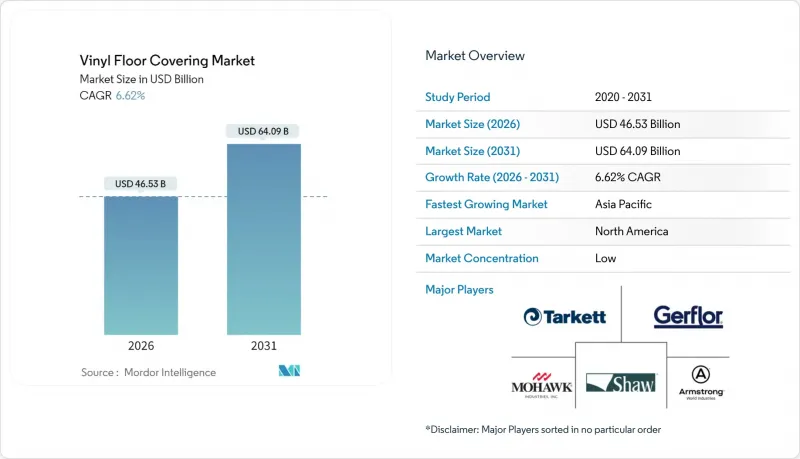
비닐 바닥재 시장은 2025년 436억 4,000만 달러에서 2026년에는 465억 3,000만 달러로 성장하여 2026년부터 2031년까지 CAGR 6.62%를 기록하며 2031년까지 640억 9,000만 달러에 달할 것으로 예측됩니다.
현재의 확장은 엔지니어드 우드나 라미네이트를 대체하는 리지드 코어 기술에 의해 추진되고 있으며, 이러한 움직임은 비닐 바닥재 시장을 건설 산업의 변동으로부터 보호하고 있습니다. 순환경제의 요구, 낮은 유지보수성, 비용 효율성이 주택 리모델링 및 상업시설 개보수에서 결합되어 채택이 가속화되고 있습니다. 고급 비닐 타일(LVT)이 주도권을 유지하는 가운데, 고급 비닐플랭크(LVP)는 석재복합재(SPC) 및 목질복합재(WPC)의 발전을 배경으로 타사 대비 높은 성장세를 보이고 있습니다. 아시아태평양의 규모 우위, 남미의 성장세, 북미의 니어쇼어링(near-shoring) 노력과 함께 생산능력과 수요의 세계 재분배가 두드러지게 나타나고 있습니다.
세계 비닐 바닥재 시장 동향 및 인사이트
신흥국 건설 수요 회복
신흥 시장에서의 건설 확대는 급속한 도시화에 대응하기 위해 정부가 비용 효율적이고 내구성 있는 솔루션을 우선시하는 가운데 비닐 바닥재 시장을 확대시키고 있습니다. 인도의 스마트 시티 구상이나 브라질의 주택 부양책은 높은 교통량에 대한 내성을 중시하는 SPC 및 WPC 형식을 선호하는 바닥재 업그레이드에 자원을 집중하고 있습니다. 제조업체들은 경쟁력 있는 인건비를 활용하고 아세안 및 라틴아메리카의 수요에 효율적으로 대응하기 위해 베트남의 생산능력을 활용하고 있습니다. 현지 대리점은 비닐의 빠른 시공성과 엄격한 시공 일정을 결합하여 프로젝트의 납기 단축을 촉진하고 있습니다. 이러한 요인들이 복합적으로 작용하여 기준 수요를 증가시켜 원자재 가격 변동에도 불구하고 가격 안정성을 유지하고 있습니다.
내구성 및 낮은 유지보수성으로의 전환
의료, 교육, 숙박 시설 관리자들은 청소 효율과 감염 관리를 개선하고, 세라믹 타일이나 목재의 대안으로 비닐 바닥재 시장을 확대하고 있습니다. 비닐의 이음새가 없는 표면은 미생물의 잠복을 억제하고, 루스레이 시스템은 유지보수 주기 동안 신속한 교체가 가능합니다. 제조업체는 초저 VOC 배합과 프탈레이트 프리 가소제를 통합하여 성능 저하 없이 강화되는 실내 공기질 기준에 대응하고 있습니다. 디자이너들은 이러한 진보를 프리미엄 포지셔닝으로 평가하여 비닐과 고급 표면 소재의 인식 격차를 좁히고 있습니다. 내구성이라는 장점은 라이프사이클 비용 절감으로 이어져 예산을 중시하는 기관에서 선호하고 있습니다.
PVC 수지 및 가소제 가격 변동성
PVC 수지는 에너지와 나프타 가격 변동에 연동되어 비닐 바닥재 시장 전체에 비용 충격이 파급됩니다. 제조업체들은 장기 계약으로 일부 헤지하고 있지만, 아시아 에틸렌 가격이 급등할 때 여전히 영향을 받습니다. 중소 제조업체는 판매량 유지를 위해 수익률을 압축할 수밖에 없고, 연구개발 예산과 설비투자에 제한을 받게 됩니다. 전 세계 바이어들이 가격 유효기간 단축을 협상하기 때문에 대규모 프로젝트의 입찰 과정이 복잡해지고 있습니다. 재활용 공정에 전 공정 통합을 통해 버진 PVC 의존도를 낮추기 위해 노력하고 있지만, 다층 LVT의 재활용에는 기술적 과제가 존재합니다.
부문 분석
2025년 비닐 바닥재 시장에서 고급 비닐 타일(LVT)은 74.12%의 점유율을 차지했습니다. 시설 계획 담당자 및 주택 소유주들이 다양한 디자인 변형과 검증된 내구성에 매력을 느꼈기 때문입니다. 의료, 교육, 숙박시설에서의 확고한 입지가 안정적인 기반 수요를 창출하여 전체 비닐 바닥재 시장 규모를 지탱하고 있습니다. 한편, 럭스 비닐 판자는 리지드 코어 기술로 인한 치수 안정성과 나뭇결의 사실감 향상으로 2031년까지 CAGR 6.79%로 확대될 것으로 예상됩니다. 엠보싱 가공의 정밀도 향상, 무광택 마감, 프레스 가공에 의한 베벨 가공의 발전으로 미적 사실감이 높아져 고급 리폼 시장에서 비닐이 엔지니어링 경재와 경쟁할 수 있는 가능성이 넓어지고 있습니다. 항균성 및 내스크래치성 코팅의 지속적인 개선으로 세라믹 및 라미네이트 제품과의 성능 차이는 더욱 확대되고 있습니다.
예측 기간 동안 LVP의 클릭 잠금식 조립 구조는 시공 주기를 단축시켜 노동력 제약에 직면한 전문 시공업체에게 매력적인 특징이 될 수 있습니다. 제조업체는 디지털 인쇄를 활용하여 패턴 재고를 줄이고 PVC 가격 변동에 따른 현금 흐름을 개선합니다. 이에 LVT 업체들은 기업 사무실이나 공동주택 복도용으로 두꺼운 마모층과 일체형 하부재를 투입하여 교통량이 많은 시설에서 점유율을 유지하고자 합니다. 바이오 유래 PVC 배합은 유럽 LVT 제품 라인에 최초로 도입되어 환경 라벨 조달 규정을 충족합니다. 제품 환경 전체가 저가형과 고급형의 이분법에서 핵심 기술, 표면처리, 지속가능성 인증으로 정의되는 스펙트럼으로 전환되고 있습니다.
2025년 매출에서 연동형 비닐 타일은 56.20%를 차지하며, 프로젝트 공사 기간 단축과 주거 공간의 접착제 냄새를 줄이는 플로팅 플로어에 대한 수요가 증가하고 있음을 보여줍니다. 클릭락 구조는 하부의 요철에 대한 내성을 향상시켜 영구성보다 신속성이 중시되는 공동주택 리노베이션이나 사무실 인테리어 공사에 채용을 촉진하고 있습니다. 접착식 포맷은 2031년까지 CAGR 7.02%로 증가할 것으로 예상되며, 현재 공항, 식료품점, 산업용 조립 라인 등 가장 높은 치수 안정성이 요구되는 용도를 타겟으로 하고 있습니다. 개량형 폴리우레탄 접착제와 고마찰 안감으로 뒤틀림 위험을 감소시켜 10년 이상의 유지보수 주기를 실현했습니다.
루즈레이 방식의 혁신은 호스피탈리티 스위트에서 테넌트를 신속하게 교체할 수 있는 재배치 가능한 판재를 제공함으로써 인터로킹 방식을 보완합니다. 통합형 방음패드는 별도의 바닥재를 추가하지 않고도 층간소음의 전달을 감소시켜 고층건축에서 우위를 점할 수 있습니다. 제조업체는 로봇 가공 기술에 투자하여 혀와 홈의 공차를 완벽하게 조정하여 현장 폐기물과 보증 청구를 줄였습니다. 접착제가 필요 없는 시스템은 VOC 배출량도 감소시켜 LEED 인증 획득을 지원하며, 그린 빌딩 프로그램에서의 비닐 바닥재 시장 규모 확대를 촉진하고 있습니다. 전반적으로, 시공 기술은 시각적 디자인 및 원료의 화학적 특성과 함께 주요 차별화 요소로 부상하고 있습니다.
지역별 분석
북미는 2025년 매출의 36.20%를 차지하며, UFLPA 관련 공급 리스크를 줄이고 리모델링 공사의 리드타임을 단축하는 니어쇼어링이 이를 뒷받침하고 있습니다. 조지아주와 테네시주의 국내 생산능력 확대는 아시아 수입에 대한 의존도를 낮추고, 대형 소매업체와 상업용 계약업체를 위한 재고를 안정화시키고 있습니다. 한편, 아시아태평양은 2031년까지 CAGR 7.90%가 예상됩니다. 중국, 인도, 동남아시아의 도시화와 인프라 계획이 수요를 견인하는 가운데, 베트남의 신흥 생산기지는 비용 우위를 활용하여 지역 소비와 미국으로의 재수출 흐름을 모두 지원하고 있습니다.
한국과 호주에서는 가처분 소득이 증가함에 따라 소비자의 선호도가 고급 리지드 코어 플랭크로 이동하면서 평균 판매가격이 상승하고 있습니다. 인도의 스마트 시티 구상과 주택 정책은 기존의 세라믹 바닥재의 우위를 뛰어넘어 현대식 내충격성 바닥재로 직접 전환하고 있습니다. RCEP(역내포괄적경제동반자협정)에 기반한 무역협정은 아시아 역내 운송을 효율화하여 제품의 회전율과 시장 침투를 가속화하고 있습니다. 한편, 캐나다에서는 VOC 규제가 강화되어 저배출 비닐 제품군으로 구매자의 전환을 유도하고 있습니다. 이러한 지리적 추세는 공급망 재편과 다양한 성장 요인이 세계 비닐 바닥재 시장 점유율의 분포를 재편하는 과정을 여실히 보여주고 있습니다.
남미의 기록은 브라질의 '우리 집 우리 생활' 주택 정책과 내구성과 위생을 중시하는 칠레의 교육시설 개보수에 힘입은 바 큽니다. 통화 안정과 자원 수출이 가계 개조 예산을 지원하고 비닐 소비를 촉진하고 있습니다. 아르헨티나의 수입 규제는 현지 SPC 공장의 전망을 밝게 하는 반면, 페루는 내진 재건 자재 보충을 위해 북미에서 수입에 의존하고 있습니다. 메르코수르 역내 무역 협정은 역내 운송을 간소화하고 국경을 초월한 유통업체들의 통합을 촉진하고 있습니다. 신뢰감이 회복되면서 상업용 개발업체들은 공사기간 단축과 구조물 하중을 줄이기 위해 화강암에서 나뭇결 SPC로 전환하고 있습니다.
기타 특전:
- 엑셀 형식의 시장 예측(ME) 시트
- 애널리스트의 3개월간 지원
자주 묻는 질문
목차
제1장 소개
제2장 조사 방법
제3장 주요 요약
제4장 시장 구도
제5장 시장 규모와 성장 예측
제6장 경쟁 구도
제7장 시장 기회와 향후 전망
KSM 26.03.10The vinyl floor covering market is expected to grow from USD 43.64 billion in 2025 to USD 46.53 billion in 2026 and is forecast to reach USD 64.09 billion by 2031 at 6.62% CAGR over 2026-2031.
Current expansion is propelled by rigid-core technologies that displace engineered wood and laminate, a move that shields the vinyl floor covering market from construction volatility. Adoption accelerates as circular-economy mandates, low-maintenance attributes, and cost efficiencies converge in residential remodeling and commercial retrofits. Luxury Vinyl Tile (LVT) retains leadership, yet Luxury Vinyl Plank (LVP) outpaces peers on the back of stone plastic composite (SPC) and wood plastic composite (WPC) advances. Asia-Pacific's scale advantage, South America's growth momentum, and near-shoring efforts in North America together highlight the global re-allocation of capacity and demand vectors.
Global Vinyl Floor Covering Market Trends and Insights
Construction Rebound in Emerging Economies
Emerging market build-outs expand the vinyl floor covering market as governments prioritize cost-effective, durable solutions for rapid urbanization. India's Smart Cities Mission and Brazil's residential stimulus funnel resources into flooring upgrades that favor SPC and WPC formats for heavy traffic endurance. Manufacturers leverage Vietnam-based capacity to serve ASEAN and Latin American demand efficiently, capitalizing on competitive labor rates. Local distributors pair vinyl's quick installation with constrained construction schedules, accelerating project turnovers. Collectively, these factors raise baseline demand and underpin positive price discipline amid raw-material swings.
Shift Toward Resilient, Low-Maintenance Flooring
Facility managers in healthcare, education, and hospitality sectors elevate cleaning efficiency and infection control, expanding the vinyl floor covering market as an alternative to ceramic tile and wood . Vinyl's seamless surfaces reduce microbial harborage, while loose-lay systems facilitate rapid replacement during maintenance cycles. Producers integrate ultra-low VOC recipes and phthalate-free plasticizers, addressing stricter indoor-air-quality codes without sacrificing performance . Specifiers reward these advances with premium positioning, narrowing the perception gap between vinyl and high-end surfaces. The durability narrative translates into lower lifecycle costs that resonate with budget-sensitive institutions.
Volatility in PVC and Plasticizer Prices
PVC resin tracks energy and naphtha inputs, producing cost shocks that ripple through the vinyl floor covering market. Producers hedge partially with long-term contracts but remain exposed when Asian ethylene values spike . Smaller firms thin margins to preserve volume, limiting R&D budgets and capital investment. Global buyers negotiate shorter price-validity windows, complicating tender processes for large-scale projects. Forward integration into recycling streams aims to lower virgin PVC dependence but faces technical hurdles in multilayer LVT reclamation.
Other drivers and restraints analyzed in the detailed report include:
- Rapid Adoption of Rigid-Core Technologies (SPC/WPC)
- Surge in Residential Remodeling Activity
- Indoor-Air-Quality & VOC Emission Concerns
For complete list of drivers and restraints, kindly check the Table Of Contents.
Segment Analysis
Luxury Vinyl Tile commanded 74.12% of the 2025 vinyl floor covering market share as facility planners and homeowners gravitated toward its broad design palette and proven durability. The segment's entrenched position across healthcare, education, and hospitality installations provides stable baseline volume that anchors the overall vinyl floor covering market size. Luxury Vinyl Plank, meanwhile, is projected to grow at a 6.79% CAGR through 2031 as rigid-core technology elevates dimensional stability and wood-look authenticity. Advancements in embossed-in-register textures, matte finishes, and pressed bevels heighten aesthetic realism, enabling vinyl to contest engineered hardwood in premium remodels. Continuous upgrades in antimicrobial and scratch-resistant coatings further widen the performance gap with ceramic and laminate alternatives.
Over the forecast horizon, LVP's click-lock assemblies shorten installation cycles, a feature that appeals to professional contractors juggling labor constraints. Makers capitalize on digital printing to reduce pattern inventory, improving cash flow amid PVC price swings. LVT producers respond with thicker wear layers and integrated underlayment aimed at corporate offices and multifamily corridors, preserving share in heavy-traffic venues. Bio-attributed PVC formulas debut first in European LVT lines to satisfy eco-label procurement rules. Collectively, the product landscape is shifting from a budget-versus-premium dichotomy toward a spectrum defined by core technology, surface finish, and sustainability credentials.
Interlocking vinyl tiles held 56.20% of 2025 revenue, underscoring buyer preference for floating floors that accelerate project timelines and minimize adhesive odors in occupied spaces. Click-lock geometries have grown increasingly tolerant of subfloor irregularities, encouraging adoption in multifamily renovations and office fit-outs where speed outweighs permanence. Glue-down formats, although forecast to climb at a 7.02% CAGR to 2031, now target applications demanding maximum dimensional stability such as airports, grocery aisles, and industrial assembly lines. Enhanced polyurethane adhesives and high-friction backings reduce curl risk, extending lifecycle beyond ten-year maintenance windows.
Loose-lay innovations complement the interlocking segment by offering repositionable planks that facilitate rapid tenant turnovers in hospitality suites. Integrated acoustic pads mitigate floor-to-floor sound transfer without adding separate underlayment, an advantage in high-rise construction. Manufacturers invest in robotic milling to perfect tongue-and-groove tolerances, shrinking on-site waste and warranty claims. Adhesive-free systems also lower VOC emissions, helping projects qualify for LEED credits and propelling the vinyl floor covering market size within green-building programs. Overall, installation technology has emerged as a primary differentiator alongside visual design and raw-material chemistry.
The Vinyl Floor Covering Market is Segmented by Product Type ( Product Type, Luxury Vinyl Plank (LVP), and Other), Installation Method (Self-Adhesive Vinyl Tiles, Glue-Down, and Other), End-User (Residential and Commercial), Construction Type (New Construction and Remodeling / Retrofit), and Distribution Channel(B2C / Retail and B2B / Contractors / Builders ). The Market Forecasts are Provided in Terms of Value (USD).
Geography Analysis
North America generated 36.20% of 2025 revenue, supported by near-shoring that mitigates UFLPA-related supply risk and shortens lead times for remodel projects. Domestic capacity expansions in Georgia and Tennessee reduce dependency on Asian imports, stabilizing inventory for big-box retailers and commercial contractors. Asia-Pacific, in contrast, is poised for an 7.90% CAGR through 2031 as urbanization and infrastructure programs fuel demand in China, India, and Southeast Asia. Vietnam's burgeoning production hub leverages cost advantages while serving both regional consumption and U.S. re-export flows.
Rising disposable incomes in South Korea and Australia shift consumer preference toward premium rigid-core planks, elevating average selling prices. India's Smart Cities and housing initiatives pivot directly to modern resilient flooring, bypassing legacy ceramic dominance. Trade agreements under RCEP streamline intra-Asia shipments, accelerating product turnover and market penetration. Meanwhile, Canada tightens VOC regulations, nudging buyers toward low-emission vinyl lines. Collectively, the geographic dynamics illustrate how supply-chain realignment and disparate growth drivers reshape the global vinyl floor covering market share distribution.
South America records underpinned by Brazil's Minha Casa Minha Vida housing push and Chilean education upgrades that target durable, hygienic surfaces. Currency stability and commodity exports shore up household renovation budgets, uplifting vinyl consumption. Argentine import restrictions lift prospects for local SPC factories, while Peru leans on North American imports to replenish quake-resilient reconstruction stock. Trade pacts under Mercosur simplify intra-regional shipments, fostering cross-border distributor consolidation. As confidence rebounds, commercial developers shift from granite to wood-look SPC to shorten build schedules and cut structural loads.
- Mohawk Industries
- Tarkett SA
- Shaw Industries Group
- Armstrong World Industries
- Gerflor Group
- Mannington Mills
- Interface Inc.
- Beaulieu International Group
- Forbo Holding AG
- LG Hausys
- Novalis Innovative Flooring
- Milliken & Company
- Raskin Industries
- Congoleum Corporation
- IVCT (IndoFloor Vinyl Composite Tile)
- Karndean Designflooring
- CFL Flooring
- Responsive Industries
- Polyflor Ltd
- ShawContract
Additional Benefits:
- The market estimate (ME) sheet in Excel format
- 3 months of analyst support
TABLE OF CONTENTS
1 Introduction
- 1.1 Study Assumptions & Market Definition
- 1.2 Scope of the Study
2 Research Methodology
3 Executive Summary
4 Market Landscape
- 4.1 Market Overview
- 4.2 Market Drivers
- 4.2.1 Construction rebound in emerging economies
- 4.2.2 Shift toward resilient, low-maintenance flooring
- 4.2.3 Rapid adoption of rigid-core technologies (SPC/WPC)
- 4.2.4 Surge in residential remodeling activity
- 4.2.5 Circular-economy take-back mandates for vinyl floors
- 4.2.6 Near-shoring of LVT production in North America & EU
- 4.3 Market Restraints
- 4.3.1 Volatility in PVC and plasticizer prices
- 4.3.2 Indoor-air-quality & VOC emission concerns
- 4.3.3 U.S.-China trade & UFLPA supply-chain disruptions
- 4.3.4 End-of-life recycling challenges for multilayer LVT
- 4.4 Industry Value Chain Analysis
- 4.5 Porter's Five Forces
- 4.5.1 Threat of New Entrants
- 4.5.2 Bargaining Power of Suppliers
- 4.5.3 Bargaining Power of Buyers
- 4.5.4 Threat of Substitutes
- 4.5.5 Competitive Rivalry
- 4.6 Insights into the Latest Trends and Innovations in the Market
- 4.7 Insights on Recent Developments (New Product Launches, Strategic Initiatives, Investments, Partnerships, JVs, Expansion, M&As, etc.) in the Market
5 Market Size & Growth Forecasts
- 5.1 By Product Type
- 5.1.1 Luxury Vinyl Tile (LVT)
- 5.1.1.1 Stone Plastic Composite (SPC)
- 5.1.1.2 Wood Plastic Composite (WPC)
- 5.1.2 Luxury Vinyl Plank (LVP)
- 5.1.3 Sheet Vinyl
- 5.1.4 Others (VCT, Resilient Vinyl-Backed Rubber Hybrid)
- 5.1.1 Luxury Vinyl Tile (LVT)
- 5.2 By Installation Method
- 5.2.1 Self-Adhesive Vinyl Tiles
- 5.2.2 Glue-Down
- 5.2.3 Interlocking Vinyl Tiles
- 5.2.4 Others
- 5.3 By End-User
- 5.3.1 Residential
- 5.3.2 Commercial
- 5.3.2.1 Hospitality & Leisure
- 5.3.2.2 Retail & Shopping Centers
- 5.3.2.3 Healthcare Facilities
- 5.3.2.4 Education
- 5.3.2.5 Corporate Offices
- 5.3.2.6 Public & Government Buildings
- 5.3.2.7 Other Commercial Users
- 5.4 By Construction Type
- 5.4.1 New Construction
- 5.4.2 Remodeling / Retrofit
- 5.5 By Distribution Channel
- 5.5.1 B2C / Retail
- 5.5.1.1 Home Centers
- 5.5.1.2 Specialty Flooring Stores
- 5.5.1.3 Online
- 5.5.1.4 Other Distribution Channels
- 5.5.2 B2B / Contractors / Builders
- 5.5.1 B2C / Retail
- 5.6 By Geography
- 5.6.1 North America
- 5.6.1.1 Canada
- 5.6.1.2 United States
- 5.6.1.3 Mexico
- 5.6.2 South America
- 5.6.2.1 Brazil
- 5.6.2.2 Peru
- 5.6.2.3 Chile
- 5.6.2.4 Argentina
- 5.6.2.5 Rest of South America
- 5.6.3 Europe
- 5.6.3.1 United Kingdom
- 5.6.3.2 Germany
- 5.6.3.3 France
- 5.6.3.4 Spain
- 5.6.3.5 Italy
- 5.6.3.6 BENELUX (Belgium, Netherlands, Luxembourg)
- 5.6.3.7 NORDICS (Denmark, Finland, Iceland, Norway, Sweden)
- 5.6.3.8 Rest of Europe
- 5.6.4 Asia-Pacific
- 5.6.4.1 India
- 5.6.4.2 China
- 5.6.4.3 Japan
- 5.6.4.4 Australia
- 5.6.4.5 South Korea
- 5.6.4.6 South-East Asia
- 5.6.4.7 Rest of Asia-Pacific
- 5.6.5 Middle East & Africa
- 5.6.5.1 United Arab Emirates
- 5.6.5.2 Saudi Arabia
- 5.6.5.3 South Africa
- 5.6.5.4 Nigeria
- 5.6.5.5 Rest of Middle East & Africa
- 5.6.1 North America
6 Competitive Landscape
- 6.1 Market Concentration
- 6.2 Strategic Moves
- 6.3 Market Share Analysis
- 6.4 Company Profiles (includes Global level Overview, Market level overview, Core Segments, Financials as available, Strategic Information, Market Rank/Share for key companies, Products & Services, and Recent Developments)
- 6.4.1 Mohawk Industries
- 6.4.2 Tarkett SA
- 6.4.3 Shaw Industries Group
- 6.4.4 Armstrong World Industries
- 6.4.5 Gerflor Group
- 6.4.6 Mannington Mills
- 6.4.7 Interface Inc.
- 6.4.8 Beaulieu International Group
- 6.4.9 Forbo Holding AG
- 6.4.10 LG Hausys
- 6.4.11 Novalis Innovative Flooring
- 6.4.12 Milliken & Company
- 6.4.13 Raskin Industries
- 6.4.14 Congoleum Corporation
- 6.4.15 IVCT (IndoFloor Vinyl Composite Tile)
- 6.4.16 Karndean Designflooring
- 6.4.17 CFL Flooring
- 6.4.18 Responsive Industries
- 6.4.19 Polyflor Ltd
- 6.4.20 ShawContract
7 Market Opportunities & Future Outlook
- 7.1 Eco-Friendly Vinyl: Recyclable, Low-VOC, and Sustainable Materials
- 7.2 Luxury Vinyl Tiles (LVT) Surging with Hyper-Realistic Textures
- 7.3 DIY-Friendly Click-Lock and Peel-and-Stick Innovations