|
시장보고서
상품코드
2073366
소프트웨어 개발 : 시장 점유율 분석, 업계 동향 및 통계, 성장 예측(2026-2031년)Software Development - Market Share Analysis, Industry Trends & Statistics, Growth Forecasts (2026 - 2031) |
||||||
 Mordor Intelligence
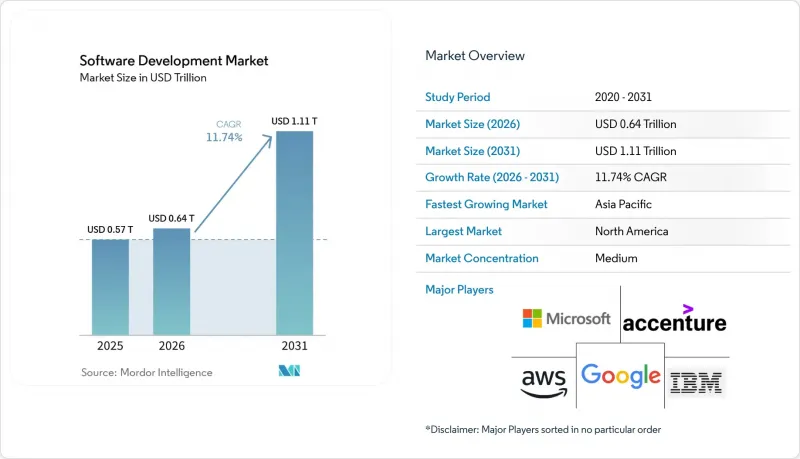
Mordor Intelligence에 의하면, 소프트웨어 개발 시장 규모는 2025년 5,700억 달러로 평가되었습니다. 2026년에는 6,400억 달러로 확대되어 2026년부터 2031년에 걸쳐 CAGR 11.74%로 성장을 지속하여, 2031년까지 1조 1,100억 달러에 이를 것으로 예측됩니다.
본 보고서는 제품 유형(솔루션 및 서비스), 도입 형태(On-Premise 및 클라우드), 조직 규모(중소기업 및 대기업), 최종 사용자(은행, 금융서비스 및 보험(BFSI), 미디어 및 엔터테인먼트, 정부·국방, 기타) 및 지역(북미, 남미, 유럽, 아시아태평양)별로 분류되어 있습니다. 시장 전망은 금액(달러) 기준으로 제시되어 있습니다.
세계의 소프트웨어 개발 시장 동향 및 인사이트
로우코드 및 노코드 도입이 급증하고 있습니다.
기업들은 용도 수요와 활용 가능한 개발자 자원 간의 격차가 커지는 것을 해소하기 위해 로우코드 및 노코드 플랫폼을 도입하고 있습니다. Microsoft Power Platform은 2024년에 월간 활성 사용자 수 2,000만 명을 돌파하며, 비즈니스 분석가가 수동 코딩 없이도 워크플로우 자동화를 구축할 수 있게 되었음을 입증했습니다. 자본도 같은 방향으로 유입되고 있습니다. 아웃시스템즈는 2024년 초, 로우코드 제품 포트폴리오를 확충하기 위해 시리즈 D 자금 조달을 통해 1억 5,000만 달러를 확보하며 투자자들의 확고한 신뢰를 입증했습니다. 이러한 플랫폼은 인프라의 복잡성을 추상화하고 정형화된 코드를 자동 생성함으로써 프로토타이핑을 가속화합니다. 그러나, "시민 개발자" 그러나 IT 관리 절차를 우회하여 섀도 용도를 개발하는 경우가 있어, 보안 팀이 사후 감사를 수행해야 하는 상황이 발생할 수 있으므로 거버넌스상의 위험은 여전히 남아 있습니다. 이러한 단점이 있음에도 불구하고, 로우코드는 시장의 연평균 성장률(CAGR)을 실질적으로 2.3% 끌어올리고 있으며, 그 효과는 고도의 엔지니어링 자원을 충분히 갖추지 못한 중견 기업에서 가장 두드러지게 나타나고 있습니다.
클라우드 네이티브 및 서버리스 개발
클라우드 네이티브 아키텍처는 용도 로직을 하드웨어에서 분리함으로써, 팀이 워크로드를 탄력적으로 확장하고 실제로 소비한 컴퓨팅 리소스에 대해서만 정확하게 비용을 지불할 수 있도록 합니다. AWS Lambda는 2024년에 수조 건의 요청을 처리하며, 이벤트 기반 서버리스 함수가 주류로 자리 잡았음을 상징했습니다. Kubernetes의 도입도 계속해서 견조한 추세를 보이고 있으며, 2024년에는 700만 명 이상의 개발자가 해당 생태계에 기여했습니다. 금융 기관들은 실시간 결제 요건을 충족하기 위해 모놀리식 시스템을 마이크로서비스로 재구축하고 있습니다. 이는 클라우드 네이티브에 대한 전문 지식이 필요한 수년에 걸친 프로젝트입니다. 그 결과, 인프라 비용 절감과 마이그레이션 및 가시성 관련 서비스 지출 증가가 맞물리면서 연평균 성장률(CAGR)이 2.8포인트 상승했습니다.
심화되는 사이버 보안 위협
현재 공급망 공격은 지속적 통합(CI) 파이프라인과 타사 의존성을 표적으로 삼고 있습니다. 2020년에 드러났으며 2024년이 된 지금도 여전히 영향이 남아 있는 SolarWinds 침해 사건은 침해당한 빌드 도구가 수천 곳에 달하는 다운스트림 고객사들로 감염을 확산시킬 가능성이 있음을 여실히 드러냈습니다. Log4j의 취약점으로 인해 수백만 개의 자바 용도에 긴급 패치를 적용해야만 했으며, 곳곳에서 사용되고 있는 오픈소스 라이브러리의 취약점이 다시 한번 부각되었습니다. 현재 기업들은 소프트웨어 부품 목록(SBOM) 증명 및 아티팩트의 암호 서명을 의무화하고 있으며, 이러한 추가 절차로 인해 릴리스 주기가 길어지고 있습니다. EU 사이버 복원력법과 같은 규정 준수 체계는 책임의 무게를 더욱 가중시켜 연평균 성장률(CAGR)을 1.4% 하락시키는 요인이 되고 있습니다.
부문별 분석
2025년에는 솔루션이 매출의 58.12%를 차지했으며, 이는 기업이 라이선스 계약 또는 구독 계약을 체결하는 모바일 기반 및 웹 기반 플랫폼을 아우르는 수치입니다. 모바일 서비스는 전 세계 스마트폰의 보급에 힘입어 현장 기술자, 영업팀 및 소비자가 휴대 단말기를 통해 거래를 할 수 있도록 하고 있습니다. 프로그레시브 웹 용도는 네이티브 앱과 브라우저 경험의 경계를 모호하게 만들어, 여러 운영 체제를 지원하는 데 드는 비용을 절감하고 있습니다. 웹 기반 솔루션은 성숙한 프레임워크와 풍부한 플러그인 생태계를 활용하여, 기업 자원 계획(ERP) 및 고객 관계 관리(CRM)와 같은 백오피스 기능의 기반으로서 계속해서 자리 잡고 있습니다.
한편, 서비스 분야는 2031년까지 연평균 성장률(CAGR) 13.35%로 확대되고 있습니다. 소프트웨어 구매는 점점 더 단순한 첫 단계에 불과해지고 있습니다. 레거시 시스템과의 통합, 데이터 마이그레이션, 사용자 교육, 보안 강화에는 전문적인 지식이 필요합니다. 대형 컨설팅 기업이나 지역 시스템 통합 업체들이 이러한 업무를 맡아, 매니지드 서비스, 인프라 모니터링, 지속적인 개선을 다년 계약에 포함시키고 있습니다. 이러한 추세는 소프트웨어 개발 시장 전반에서 차별화의 요소가 기능 목록보다 구현 품질에 더 중점을 두게 되고 있음을 보여줍니다.
클라우드 도입은 2025년에 매출의 71.26%를 차지했으며, 기업들이 유연한 확장성과 설비 투자 절감을 추구함에 따라 12.17%의 속도로 확대되고 있습니다. 하이퍼스케일러(Amazon Web Services, Microsoft Azure, Google Cloud Platform)는 2024년에 데이터센터 인프라에 총 1,500억 달러 이상을 투자하여 전 세계적 확장과 우수한 네트워크 지연 시간을 실현했습니다. 매니지드 서비스가 패치 적용, 백업, 재해 복구를 처리함으로써 사내 팀은 용도 로직에 집중할 수 있게 됩니다. 따라서 클라우드 관련 소프트웨어 개발 시장 점유율은 앞으로 매년 확대될 전망입니다.
기업들이 데이터센터 임대 계약을 종료함에 따라 On-Premise 환경은 계속해서 축소되는 추세이지만, 초저지연이나 엄격한 데이터 상주 요건이 요구되는 분야에서는 하이브리드 모델이 여전히 뿌리 깊게 자리 잡고 있습니다. 소버린 클라우드는 하드웨어를 국내에 배치함으로써 공공 부문의 규제를 준수하고 있습니다. 그럼에도 불구하고, 레거시 워크로드의 플랫폼 이전과 서버리스 및 컨테이너 방식으로 직접 개발되는 신규 용도의 확산에 힘입어, 클라우드의 성장 추세는 부인할 수 없는 사실이 되고 있습니다.
지역별 분석
북미는 2025년에 매출의 38.13%를 차지했으며, 포춘 500대 기업의 본사, 벤처 캐피털, 하이퍼스케일 클라우드 인프라가 밀집해 있는 이점을 계속해서 누리고 있습니다. 미국 연방 정부의 제로 트러스트 아키텍처 의무화는 안정적인 조달 기회를 창출하고 있습니다. 캐나다는 유리한 이민 정책을 활용해 숙련된 인재를 유치하고 있는 반면, 멕시코의 니어쇼어 아웃소싱 부문은 시간대 차이로 인한 마찰을 최소화하고자 하는 미국 고객들 사이에서 성장세를 보이고 있습니다. 캘리포니아주 소비자 개인정보 보호법(CCPA)과 같은 데이터 개인정보 보호 관련 법규는 제품 설계에까지 영향을 미치며, 지역 전체에서 동의 관리 및 데이터 주체의 권리 준수를 철저히 하고 있습니다.
아시아태평양은 2031년까지 연평균 12.47%의 성장률을 보일 것으로 예측되며, 지역별로는 가장 높은 연평균 성장률(CAGR)을 보일 전망입니다. 인도의 소프트웨어 서비스 수출액은 2024 회계연도에 1,940억 달러에 달했으며, 타타 컨설팅 서비스(Tata Consultancy Services)와 인포시스(Infosys) 같은 기업들이 클라우드 전환 및 AI 통합 수요에 부응하고 있습니다. 디지털 정부 프로그램을 통해 광대역 및 디지털 결제 이용이 확대됨에 따라, 클라우드 애플리케이션에 대한 국내 수요도 증가하고 있습니다. 중국이 '국산 소프트웨어'이를 중시하고 있기 때문에 자체 개발한 데이터베이스와 개발 도구에 대한 투자가 촉진되어 서유럽 국가들에 대한 의존도가 낮아지고 있습니다. 일본은 스마트 제조를 추진하는 한편, 호주와 한국은 5G 및 스마트시티 인프라에 자금을 투자하고 있습니다. 중국의 데이터 현지화법부터 호주의 개인정보 보호 체계에 이르기까지, 다양한 규제 환경으로 인해 공급업체들은 규정 준수 모듈의 현지화를 피할 수 없게 되었지만, 이 지역은 여전히 소프트웨어 개발 시장에서 가장 큰 성장 동력으로 남아 있습니다.
기타 지역은 유럽, 남미, 중동 및 아프리카로 구성되어 있습니다. 유럽의 일반 데이터 보호 규정(GDPR(EU 개인정보보호규정))과 제안된 AI 법안은 '프라이버시 바이 디자인' 또한 알고리즘의 투명성에 관한 요건을 부과함으로써, 규정 준수 비용을 증가시키는 한편, 보안을 중시하는 개발 도구에 대한 수요도 촉진하고 있습니다. 남미는 인터넷 보급률 상승의 혜택을 누리고 있으며, 브라질이 이 지역의 SaaS 도입을 주도하고 있습니다. 사우디아라비아와 아랍에미리트(UAE) 등 중동 국가들에서는 야심 찬 스마트시티 및 전자정부 프로그램이 추진되고 있습니다. 아프리카 시장은 아직 발전 단계에 있지만, 모바일 광대역 서비스가 아직 미치지 못한 계층까지 확산됨에 따라 성장이 가속화되고 있으며, 케냐와 남아프리카공화국이 이 지역의 혁신 허브로 자리 잡고 있습니다.
기타 혜택 :
- 엑셀 형식 시장 예측(ME) 시트
- 3개월간의 애널리스트 지원
자주 묻는 질문
목차
제1장 서론
제2장 조사 방법
제3장 주요 요약
제4장 시장 구도
제5장 시장 규모 및 성장 예측
제6장 경쟁 구도
제7장 시장 기회 및 향후 전망
KTH 26.07.07According to Mordor Intelligence, the software development market size is expected to grow from USD 0.57 trillion in 2025 to USD 0.64 trillion in 2026 and is forecast to reach USD 1.11 trillion by 2031 at 11.74% CAGR over 2026-2031.
This report is Segmented by Product Type (Solutions, and Services), Deployment Type (On-Premise, and Cloud), Organization Size (Small and Medium Enterprises, and Large Enterprises), End-User (BFSI, Media and Entertainment, Government and Defense, and More), and Geography (North America, South America, Europe, and Asia-Pacific). The Market Forecasts are Provided in Terms of Value (USD).
Global Software Development Market Trends and Insights
Low-Code and No-Code Adoption Surge
Enterprises deploy low-code and no-code platforms to close the widening gap between application demand and available developer capacity. Microsoft Power Platform surpassed 20 million monthly active users in 2024, proving that business analysts can now build workflow automations without hand-coding. Capital is flowing in the same direction. OutSystems secured USD 150 million in Series D financing in early 2024 to enlarge its low-code portfolio, signaling durable investor confidence. These platforms abstract infrastructure complexity and auto-generate boilerplate, accelerating prototyping. Governance risk persists, however, because "citizen developers" sometimes bypass IT controls, creating shadow applications that security teams then need to audit. Even with that drawback, low-code provides a net 2.3 percentage-point lift to the market CAGR, most visible within mid-market firms that lack deep engineering resources.
Cloud-Native and Serverless Development
Cloud-native architectures decouple application logic from hardware, letting teams scale workloads elastically and pay strictly for consumed compute. AWS Lambda processed trillions of requests in 2024, marking the mainstream shift toward event-driven, serverless functions. Kubernetes adoption also remains strong, with more than seven million developers contributing to its ecosystem in 2024. Financial institutions re-architect monolithic systems into microservices to meet real-time payment requirements, a multi-year journey demanding cloud-native expertise. The result is a 2.8 percentage-point boost to the CAGR that blends infrastructure savings with elevated services spending on migration and observability.
Escalating Cyber-Security Threats
Supply-chain attacks now target continuous-integration pipelines and third-party dependencies. The SolarWinds breach, disclosed in 2020 but still echoing through 2024, showed how compromised build tools can infect thousands of downstream customers. The Log4j vulnerability forced emergency patching across millions of Java applications, underscoring the fragility of ubiquitous open-source libraries. Enterprises now mandate software bill of materials attestations and cryptographic signing of artifacts, adding steps that lengthen release cycles. Compliance frameworks like the EU Cyber Resilience Act further raise liability, imposing a 1.4 percentage-point drag on CAGR.
Other drivers and restraints analyzed in the detailed report include:
- Enterprise Digital-Transformation Budgets
- Gen-AI Code Assistants Scaling Productivity
- Global Shortage of Senior Developers
For complete list of drivers and restraints, kindly check the Table Of Contents.
Segment Analysis
Solutions generated 58.12% revenue in 2025, spanning mobile-based and web-based platforms that enterprises license or subscribe to. Mobile-oriented offerings ride global smartphone penetration, letting field technicians, sales teams, and consumers transact on handheld devices. Progressive web applications blur boundaries between native apps and browser experiences, lowering the cost of supporting multiple operating systems. Web-based solutions remain the backbone for back-office functions such as enterprise resource planning and customer relationship management, leveraging mature frameworks and rich plugin ecosystems.
Services, however, are expanding at a 13.35% CAGR to 2031. Purchasing software increasingly marks only the first stage; integration with legacy estates, data migration, user training, and security hardening demand specialized expertise. Consulting giants and regional system integrators absorb that workload, bundling managed services, infrastructure oversight, and continuous improvement into multi-year contracts. The cadence underscores a shift where differentiation rests less on feature checklists and more on implementation quality across the broader software development market.
Cloud deployment captured 71.26% revenue in 2025 and is advancing at 12.17% as enterprises pivot toward elastic scalability and lower capital expense. Hyperscalers (Amazon Web Services, Microsoft Azure, and Google Cloud Platform) collectively invested more than USD 150 billion in data-center infrastructure during 2024, unlocking global regions and superior network latency. Managed services handle patching, backup, and disaster recovery, allowing internal teams to zero in on application logic. The software development market share tied to cloud is therefore poised to deepen every year.
On-premise estates continue to recede as firms exit data-center leases, yet hybrid models endure in sectors requiring ultra-low latency or strict data residency. Sovereign clouds satisfy public-sector rules by locating hardware within national borders. Even so, the cloud trajectory remains unmistakable, buttressed by re-platforming of legacy workloads and a wave of greenfield applications born directly in serverless or containerized form.
Complete Report Scope:
- By Product Type
- Solutions
- Mobile-based
- Web-based
- Services
- Solutions
- By Deployment Type
- On-premise
- Cloud
- By Organization Size
- Small and Medium Enterprises (SMEs)
- Large Enterprises
- By End-User
- BFSI
- Media and Entertainment
- Government and Defense
- IT and Telecommunication
- Healthcare
- Manufacturing
- Other End-Users
- By Geography
- North America
- United States
- Canada
- Mexico
- South America
- Brazil
- Argentina
- Rest of South America
- Europe
- United Kingdom
- Germany
- France
- Spain
- Italy
- Rest of Europe
- Asia-Pacific
- China
- India
- Japan
- Australia
- South Korea
- Rest of Asia-Pacific
- Middle East
- Saudi Arabia
- United Arab Emirates
- Turkey
- Rest of Middle East
- Africa
- South Africa
- Kenya
- Rest of Africa
- North America
Geography Analysis
North America commanded 38.13% revenue in 2025 and continues to benefit from a dense concentration of Fortune 500 headquarters, venture capital, and hyperscale cloud infrastructure. Zero-trust architecture mandates by the United States federal government create steady procurement opportunities. Canada leverages favorable immigration policies to attract skilled talent, while Mexico's near-shore outsourcing sector gains traction for U.S. clients seeking minimal time-zone friction. Data-privacy statutes like the California Consumer Privacy Act ripple through product design, enforcing consent management and data-subject rights across the region.
Asia Pacific is poised to grow at 12.47% through 2031, the fastest regional CAGR. India's software services exports hit USD 194 billion in fiscal 2024, with firms such as Tata Consultancy Services and Infosys fulfilling cloud migration and AI-integration needs. Digital-government programs expand broadband and digital-payment usage, expanding domestic demand for cloud applications. China's emphasis on sovereign software drives investment in homegrown databases and development tools, reducing Western dependency. Japan pursues smart-manufacturing, while Australia and South Korea pour capital into 5G and smart-city infrastructure. Diverse regulatory landscapes-from China's data-localization laws to Australia's privacy frameworks-compel vendors to localize compliance modules, yet the region remains the largest incremental growth engine within the software development market.
Europe, South America, Middle East, and Africa comprise the remainder. Europe's General Data Protection Regulation and proposed AI Act impose privacy-by-design and algorithmic transparency requirements, raising compliance costs but also stimulating demand for security-focused development tooling. South America benefits from rising internet penetration, with Brazil leading regional SaaS uptake. Middle-Eastern economies like Saudi Arabia and the United Arab Emirates launch ambitious smart-city and e-government programs. Africa's market remains nascent but accelerates as mobile broadband extends to underserved populations, with Kenya and South Africa forming regional innovation hubs.
- Microsoft Corporation
- Amazon Web Services, Inc.
- Google LLC
- IBM Corporation
- Accenture plc
- Apple Inc.
- Oracle Corporation
- Salesforce Inc.
- Adobe Inc.
- NVIDIA Corporation
- Infosys Ltd.
- Tata Consultancy Services (TCS)
- Cognizant Technology Solutions
- Wipro Ltd.
- Capgemini SE
- SAP SE
- Intuit Inc.
- ServiceNow Inc.
- Atlassian Corp.
- GitLab Inc.
Additional Benefits:
- The market estimate (ME) sheet in Excel format
- 3 months of analyst support
TABLE OF CONTENTS
1 INTRODUCTION
- 1.1 Study Assumptions and Market Definition
- 1.2 Scope of the Study
2 RESEARCH METHODOLOGY
3 EXECUTIVE SUMMARY
4 MARKET LANDSCAPE
- 4.1 Market Overview
- 4.2 Market Drivers
- 4.2.1 Low-code / No-code Adoption Surge
- 4.2.2 Cloud-native and Serverless Development
- 4.2.3 Enterprise Digital-Transformation Budgets
- 4.2.4 Gen-AI Code Assistants Scaling Productivity
- 4.2.5 Sustainability-Driven Green-Coding Mandates
- 4.2.6 AI-Augmented DevSecOps Integration
- 4.3 Market Restraints
- 4.3.1 Escalating Cyber-Security Threats
- 4.3.2 Global Shortage of Senior Developers
- 4.3.3 Rising Compute Energy-Costs for AI-Powered Builds
- 4.3.4 Licence-Model Shifts in Open-Source Ecosystems
- 4.4 Industry ValueChain Analysis
- 4.5 Regulatory Landscape
- 4.6 Technological Outlook
- 4.7 Impact of Macroeconomic Factors on the Market
- 4.8 Porter's Five Forces Analysis
- 4.8.1 Bargaining Power of Suppliers
- 4.8.2 Bargaining Power of Buyers
- 4.8.3 Threat of New Entrants
- 4.8.4 Threat of Substitutes
- 4.8.5 Intensity of Competitive Rivalry
5 MARKET SIZE AND GROWTH FORECASTS (VALUE)
- 5.1 By Product Type
- 5.1.1 Solutions
- 5.1.1.1 Mobile-based
- 5.1.1.2 Web-based
- 5.1.2 Services
- 5.1.1 Solutions
- 5.2 By Deployment Type
- 5.2.1 On-premise
- 5.2.2 Cloud
- 5.3 By Organization Size
- 5.3.1 Small and Medium Enterprises (SMEs)
- 5.3.2 Large Enterprises
- 5.4 By End-User
- 5.4.1 BFSI
- 5.4.2 Media and Entertainment
- 5.4.3 Government and Defense
- 5.4.4 IT and Telecommunication
- 5.4.5 Healthcare
- 5.4.6 Manufacturing
- 5.4.7 Other End-Users
- 5.5 By Geography
- 5.5.1 North America
- 5.5.1.1 United States
- 5.5.1.2 Canada
- 5.5.1.3 Mexico
- 5.5.2 South America
- 5.5.2.1 Brazil
- 5.5.2.2 Argentina
- 5.5.2.3 Rest of South America
- 5.5.3 Europe
- 5.5.3.1 United Kingdom
- 5.5.3.2 Germany
- 5.5.3.3 France
- 5.5.3.4 Spain
- 5.5.3.5 Italy
- 5.5.3.6 Rest of Europe
- 5.5.4 Asia-Pacific
- 5.5.4.1 China
- 5.5.4.2 India
- 5.5.4.3 Japan
- 5.5.4.4 Australia
- 5.5.4.5 South Korea
- 5.5.4.6 Rest of Asia-Pacific
- 5.5.5 Middle East
- 5.5.5.1 Saudi Arabia
- 5.5.5.2 United Arab Emirates
- 5.5.5.3 Turkey
- 5.5.5.4 Rest of Middle East
- 5.5.6 Africa
- 5.5.6.1 South Africa
- 5.5.6.2 Kenya
- 5.5.6.3 Rest of Africa
- 5.5.1 North America
6 COMPETITIVE LANDSCAPE
- 6.1 Market Concentration
- 6.2 Strategic Moves
- 6.3 Market Share Analysis
- 6.4 Company Profiles (Includes Global-Level Overview, Market-Level Overview, Core Segments, Financials, Strategic Information, Market Rank/Share, Products and Services, Recent Developments)
- 6.4.1 Microsoft Corporation
- 6.4.2 Amazon Web Services, Inc.
- 6.4.3 Google LLC
- 6.4.4 IBM Corporation
- 6.4.5 Accenture plc
- 6.4.6 Apple Inc.
- 6.4.7 Oracle Corporation
- 6.4.8 Salesforce Inc.
- 6.4.9 Adobe Inc.
- 6.4.10 NVIDIA Corporation
- 6.4.11 Infosys Ltd.
- 6.4.12 Tata Consultancy Services (TCS)
- 6.4.13 Cognizant Technology Solutions
- 6.4.14 Wipro Ltd.
- 6.4.15 Capgemini SE
- 6.4.16 SAP SE
- 6.4.17 Intuit Inc.
- 6.4.18 ServiceNow Inc.
- 6.4.19 Atlassian Corp.
- 6.4.20 GitLab Inc.
7 MARKET OPPORTUNITIES AND FUTURE OUTLOOK
- 7.1 White-space and Unmet-need Assessment