|
시장보고서
상품코드
2073376
사프란 : 시장 점유율 분석, 업계 동향 및 통계, 성장 예측(2026-2031년)Saffron - Market Share Analysis, Industry Trends & Statistics, Growth Forecasts (2026 - 2031) |
||||||
 Mordor Intelligence
Mordor Intelligence에 의하면, 사프란 시장 규모는 2025년에 14억 2,000만 달러로 평가되었습니다. 2026년 15억 1,000만 달러에서 2031년까지 20억 6,000만 달러에 이를 것으로 예상되며, 예측 기간(2026-2031년) CAGR은 6.36%를 나타낼 전망입니다.
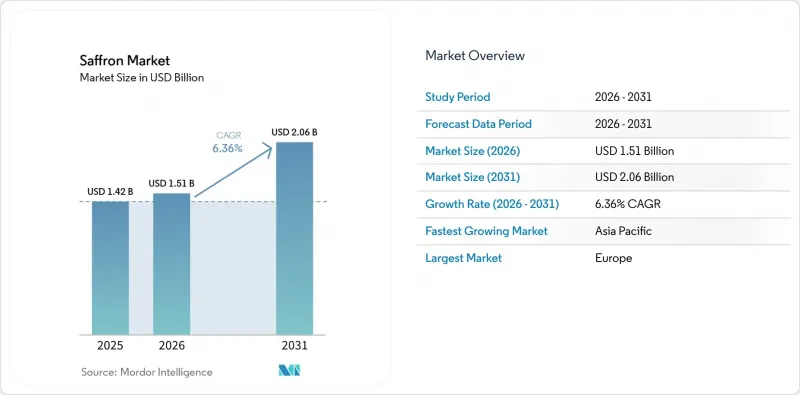
본 보고서는 등급별(등급 I, 등급 II, 기타), 용도별(식품 가공, 기타) 및 지역별(북미, 유럽, 아시아태평양, 남미, 중동 및 아프리카)로 분류되어 있습니다. 본 보고서에는 생산 분석, 소비 분석, 수입 분석, 수출 분석 및 가격 동향 분석이 포함되어 있습니다. 시장 전망은 금액(달러) 및 수량(미터톤) 단위로 제시되어 있습니다.
세계의 사프란 시장 동향 및 인사이트
즉석 에스닉 식품에 대한 수요 증가
대도시권에서는 색과 향을 사프란에 의존하는 바로 먹을 수 있는 비리야니나 파에야, 그 밖의 이국적인 요리들이 점점 더 인기를 얻고 있습니다. 식품 가공업체들은 합성 첨가물을 사용하지 않고도 이러한 기능을 모두 갖춘 사프란의 특성을 높이 평가하고 있으며, 이를 통해 프리미엄 가격으로 판매하거나 더 깨끗한 원재료 표시가 가능해졌습니다. 1,370억 달러 규모의 한국 소매 시장에서 수입 식품의 3분의 1이 미국산이라는 사실은 편리한 형태로 현지 본고장의 맛을 찾는 수요가 널리 존재하고 있음을 보여줍니다.
천연 화장품 유효 성분의 프리미엄화
2,800억 달러 규모의 미용 업계에서는 식물 유래 유효 성분에 대한 새로운 투자가 진행되고 있으며, 화장품용 사프란은 1Kg당 약 1,600달러에 거래되고 있습니다. 크로신의 항산화 작용을 활용한 외용 제품은 피부의 광채와 피부 장벽 기능 강화 등의 효능을 내세울 수 있어, 브랜드는 해당 제품을 프리미엄 가격대에 포지셔닝할 수 있게 됩니다. 로레알의 2024년 매출액은 411억 8,000만 유로(445억 7,000만 달러)에 달했으며, '그린 사이언스' 제품 출시의 호재에 힘입어, 검증된 식물 유래 원료에 대한 지속적인 수요가 나타났습니다. 이러한 추세로 인해 1등급 사프란에 대한 수요가 확고해졌으며, 생산자들은 수확 후 관리 기준을 더욱 엄격히 준수하고 인증된 공급망에 대한 투자를 확대되고 있습니다.
변동이 심한 생산자 가격
사프란 가격은 강수량에 따라 변동합니다. 가뭄은 수확량을 감소시키지만, 크로신 농도를 높이는 경우가 많아 프리미엄 가격을 끌어올립니다. 반면, 과도한 강우는 개화에 피해를 주어 가격 변동성을 높입니다. 식품 가공업체와 화장품 개발업체들은 생산 예산 확정 문제로 고심하고 있으며, 급격한 가격 상승으로 인해 합성 착색료나 경쟁 관계에 있는 식물 유래 원료로의 대체가 촉진되고 있습니다. 2023년 이란의 생산량 감소는 하류 부문 사용자에게 미치는 단기적인 가격 충격을 더욱 가중시켰습니다.
부문별 분석
2025년 기준으로, 1등급은 사프란 시장 규모의 37.65%를 차지했으며, 2031년까지 연평균 성장률(CAGR) 6.12%로 성장하고 있습니다. 이는 최종 소비자들이 가장 높은 크로신 함량과 최고의 향기 강도를 선호한다는 점을 반영한 것입니다. 사프란 시장은 높은 이익률 덕분에 기후 변화의 영향을 상쇄하는 데 필요한 온실 시설 개보수 비용을 충당할 수 있어 혜택을 보고 있습니다. 그레이드 II는 포장 쌀 및 과자 제조업체들 사이에서 인기가 높으며, 꾸준하기는 하지만 성장 속도는 완만합니다. 한편, III급 및 IV급 제품은 비용을 중시하는 외식 산업에서 합성 착색료를 사용한 대체품의 위협에 직면해 있습니다.
조명 제어 기술의 발전으로 크로신 함량이 최대 18% 증가하는 것이 입증됨에 따라, 1등급 제품공급이 확대되고 있습니다. 이는 임상 연구를 통해 사프란이 정신 건강에 미치는 효과가 입증된 점과 맞물려, 생산자들에게 호재가 되고 있습니다. IoT 대시보드를 활용하는 생산자들은 개화 주기를 시차를 두고 계획함으로써 비수기의 가격 급등을 활용할 수 있게 되었으며, 이를 통해 프리미엄 등급 수익에서의 우위가 더욱 공고해지고 있습니다.
지역별 분석
2025년, 유럽은 세계 사프란 시장 매출의 36.25%를 차지했습니다. 이는 엄격한 품질 검사, 원산지 보호, 그리고 대량 출하보다 프리미엄 로트를 우선시하는 열처리 의무가 한몫하고 있습니다. 스페인은 생산자이자 집하업자로서의 역할을 수행하며, 엄선된 물량을 유럽 무역권 전역으로 재수출하고 있습니다. 소매업체들은 PDO(원산지명칭보호) 라벨이 부착된 싱글 오리진 병입 제품을 점점 더 적극적으로 판매하고 있으며, 새로운 EU 표시 지침에 따라 위조에 대한 처벌이 강화됨에 따라 인증을 받은 공급이 보상을 받게 되었습니다.
아시아태평양은 2031년까지 연평균 성장률(CAGR) 8.12%를 나타낼 것으로 예측되며, 중산층의 소득 증가와 사프란이 전통 의학, 현대 건강기능식품, 인스턴트 음료 소포장 제품 등에 활용되고 있는 점이 성장에 긍정적인 요인으로 작용하고 있습니다. 인도가 향신료 수출에서 주도적인 위치를 차지하고 있다는 점은 고품질의 카슈미르산 사프란에 있어 효율적인 판로가 되고 있습니다. 중국 제약 업계에서는 표준화된 추출물에 대한 수요가 확대되고 있는 반면, 한국의 201억 달러에 달하는 농산물 수입액은 사프란이 첨가된 인스턴트 식품에 대한 소비자 수용도를 반영하고 있습니다.
북미에서는 기능성 식품 및 클린 라벨 보충제 분야에서 꾸준한 성장세가 나타나고 있습니다. 중동에서는 문화적 친화성 덕분에 안정적인 내수 수요가 유지되고 있지만, 지정학적 마찰로 인해 구매자들은 단일 국가에 대한 의존에서 벗어나 조달처를 다각화하려고 하고 있습니다. 칠레와 아르헨티나의 새로운 시장 전망은 지중해 연안 지역과의 기후적 유사성에 기반을 두고 있으며, 이란의 물 부족을 우려하는 전 세계 구매자들에게 장기적인 위험 헤지 수단이 될 것입니다.
- 엑셀 형식 시장 예측(ME) 시트
- 3개월간의 애널리스트 지원
자주 묻는 질문
목차
제1장 서론
제2장 조사 방법
제3장 주요 요약
제4장 시장 구도
제5장 시장 규모 및 성장 예측
제6장 경쟁 구도
제7장 시장 기회 및 향후 전망
KTH 26.07.07According to Mordor Intelligence, the saffron market size was valued at USD 1.42 billion in 2025 and estimated to grow from USD 1.51 billion in 2026 to reach USD 2.06 billion by 2031, at a CAGR of 6.36% during the forecast period (2026-2031).
This report is Segmented by Grade (Grade I, Grade II, and More), by Application (Food Processing and More), and by Geography (North America, Europe, Asia-Pacific, South America, Middle East, and Africa). The Report Includes Production Analysis, Consumption Analysis, Import Analysis, Export Analysis, and Price Trend Analysis. The Market Forecasts are Provided in Terms of Value (USD) and Volume (Metric Tons).
Global Saffron Market Trends and Insights
Rising Demand from Ready-to-Eat Ethnic Foods
Large urban centers increasingly favor ready-to-eat biryanis, paellas, and other ethnic dishes that rely on saffron for color and aroma. Food processors value the spice's ability to deliver both functions without synthetic additives, enabling premium shelf pricing and cleaner ingredient decks. In South Korea's USD 137 billion retail market, one-third of imported foods originate from the United States, illustrating the broader appetite for authentic flavors in convenient formats.
Premiumization of Natural Cosmetic Actives
The beauty sector, valued at USD 280 billion, directs fresh investment toward plant-based actives, with saffron commanding roughly USD 1,600 per kilogram for cosmetic use. Topicals leveraging crocin's antioxidant properties promise claims tied to radiance and skin-barrier support, allowing brands to position products at prestige price points. L'Oreal's EUR 41.18 billion (USD 44.57 billion) 2024 revenue, buoyed by "green science" launches, showcases a sustained preference for verified botanical inputs. The trend locks in demand for Grade I saffron, encouraging growers to invest in stricter post-harvest handling and authenticated supply chains.
Volatile Farm-Gate Prices
Saffron prices swing with precipitation, drought lowers harvest volumes yet often boosts crocin concentration, lifting premiums, and the excessive rain damages blooms and increases volatility. Food processors and cosmetic formulators struggle to lock production budgets, and sudden spikes encourage substitution with synthetic colorants or competing botanicals. Iran's 2023 production slide amplified short-term price shocks for downstream users.
Other drivers and restraints analyzed in the detailed report include:
- Expansion of Nutraceutical SKUs Featuring Crocin and Safranal
- Farm-Level IoT for Micro-Climate Optimization, boosting yields
- Water Stress in Primary Producing Regions
For complete list of drivers and restraints, kindly check the Table Of Contents.
Segment Analysis
Grade I accounted for 37.65% of the saffron market size in 2025 and is growing at a 6.12% CAGR through 2031, reflecting an end-user preference for the deepest crocin levels and highest aromatic intensity. The saffron market benefits because higher margins fund the greenhouse retrofits needed to offset climate variability. Grade II, popular with packaged rice and confectionery makers, enjoys steady but slower growth, while Grades III and IV face substitution threats from synthetic colorants in cost-sensitive food-service channels.
Improvements in controlled lighting have been shown to lift crocin by up to 18%, bolstering Grade I supply, just as clinical research validates saffron's mental health benefits. Producers leveraging IoT dashboards can now schedule staggered flowering cycles and capture off-season pricing spikes, further entrenching premium grades' revenue dominance.
Complete Report Scope:
- By Grade (Value)
- Grade I
- Grade II
- Grade III
- Grade IV and below
- By Application (Value)
- Food Processing
- Food Service
- Cosmetics and Personal Care
- Pharmaceuticals and Nutraceuticals
- Fragrances and Others
- By Geography (Production Analysis (Volume), Consumption Analysis (Volume and Value), Import Analysis (Volume and Value), Export Analysis (Volume and Value), and Price Trend Analysis)
- North America
- United States
- Canada
- Mexico
- Europe
- Spain
- Italy
- France
- United Kingdom
- Greece
- Russia
- Asia-Pacific
- China
- India
- Afghanistan
- Australia
- South America
- Argentina
- Chile
- Middle East
- Iran
- Turkey
- UAE
- Saudi Arabia
- Africa
- South Africa
- North America
Geography Analysis
Europe generated 36.25% of global saffron market revenue in 2025, leveraging stringent quality checks, origin protections, and heat-treatment mandates that favor premium lots over bulk shipments. Spain functions as both producer and consolidator, re-exporting curated batches across the European trading bloc. Retailers increasingly promote single-origin jars featuring PDO seals, and new EU labeling directives heighten penalties for adulteration, thereby rewarding authenticated supply.
Asia-Pacific, forecast for an 8.12% CAGR to 2031, benefits from rising middle-class incomes and the integration of saffron into traditional medicine, modern supplements, and instant beverage sachets. India's spice-export leadership provides an efficient route to market for premium Kashmiri lots. China's pharma sector scales up demand for standardized extracts, while South Korea's USD 20.1 billion agricultural imports reflect openness to saffron-enhanced convenience meals.
North America shows healthy momentum in functional foods and clean-label supplements. In the Middle East, cultural affinity sustains stable household demand, yet geopolitical frictions motivate buyers to diversify away from single-country reliance. Emerging prospects in Chile and Argentina draw on climatic similarities with the Mediterranean basin, offering long-run hedging for global buyers concerned about Iranian water stress.
- The market estimate (ME) sheet in Excel format
- 3 months of analyst support
TABLE OF CONTENTS
1 Introduction
- 1.1 Study Assumptions and Market Definition
- 1.2 Scope of the Study
2 Research Methodology
3 Executive Summary
4 Market Landscape
- 4.1 Market Overview
- 4.2 Market Drivers
- 4.2.1 Rising demand from ready-to-eat ethnic foods
- 4.2.2 Premiumization of natural cosmetic actives
- 4.2.3 Expansion of nutraceutical SKUs featuring crocin and safranal
- 4.2.4 Digitised B2B spice exchanges improving price discovery
- 4.2.5 Farm-level IoT for micro-climate optimization boosting yields
- 4.2.6 Stricter food-fraud and origin-traceability regulations
- 4.3 Market Restraints
- 4.3.1 Volatile farm-gate prices
- 4.3.2 High labor intensity despite mechanization gaps
- 4.3.3 Rising synthetic colourant substitution in food service
- 4.3.4 Water-stress in primary producing regions
- 4.4 Value/Supply-Chain Analysis
- 4.5 Regulatory Landscape
- 4.6 Technological Outlook
- 4.7 Porter's Five Forces
- 4.7.1 Threat of New Entrants
- 4.7.2 Bargaining Power of Buyers
- 4.7.3 Bargaining Power of Suppliers
- 4.7.4 Threat of Substitutes
- 4.7.5 Intensity of Competitive Rivalry
5 Market Size and Growth Forecasts (Value and Volume)
- 5.1 By Grade (Value)
- 5.1.1 Grade I
- 5.1.2 Grade II
- 5.1.3 Grade III
- 5.1.4 Grade IV and below
- 5.2 By Application (Value)
- 5.2.1 Food Processing
- 5.2.2 Food Service
- 5.2.3 Cosmetics and Personal Care
- 5.2.4 Pharmaceuticals and Nutraceuticals
- 5.2.5 Fragrances and Others
- 5.3 By Geography (Production Analysis (Volume), Consumption Analysis (Volume and Value), Import Analysis (Volume and Value), Export Analysis (Volume and Value), and Price Trend Analysis)
- 5.3.1 North America
- 5.3.1.1 United States
- 5.3.1.2 Canada
- 5.3.1.3 Mexico
- 5.3.2 Europe
- 5.3.2.1 Spain
- 5.3.2.2 Italy
- 5.3.2.3 France
- 5.3.2.4 United Kingdom
- 5.3.2.5 Greece
- 5.3.2.6 Russia
- 5.3.3 Asia-Pacific
- 5.3.3.1 China
- 5.3.3.2 India
- 5.3.3.3 Afghanistan
- 5.3.3.4 Australia
- 5.3.4 South America
- 5.3.4.1 Argentina
- 5.3.4.2 Chile
- 5.3.5 Middle East
- 5.3.5.1 Iran
- 5.3.5.2 Turkey
- 5.3.5.3 UAE
- 5.3.5.4 Saudi Arabia
- 5.3.6 Africa
- 5.3.6.1 South Africa
- 5.3.1 North America
6 Competitive Landscape
- 6.1 List of Stakeholders
- 6.1.1 Everest Spices.
- 6.1.2 Azafranes Manchegos S.L.
- 6.1.3 Mozaffari Saffron
- 6.1.4 Baby Brand Saffron
- 6.1.5 La Casa de los Aromas (HEA&CO)
- 6.1.6 Taj Agro International (Taj pharmaceuticals limited)
- 6.1.7 Veles Farming
- 6.1.8 Heray Spice
- 6.1.9 Rowhani Saffron Co.
- 6.1.10 Tarvand Saffron Co.
- 6.1.11 Gohar Saffron
- 6.1.12 Novin Saffron (Golrang Industrial Group)
- 6.1.13 Edman Saffron