|
시장보고서
상품코드
2073377
통합 리스크 관리 : 시장 점유율 분석, 업계 동향 및 통계, 성장 예측(2026-2031년)Integrated Risk Management - Market Share Analysis, Industry Trends & Statistics, Growth Forecasts (2026 - 2031) |
||||||
 Mordor Intelligence
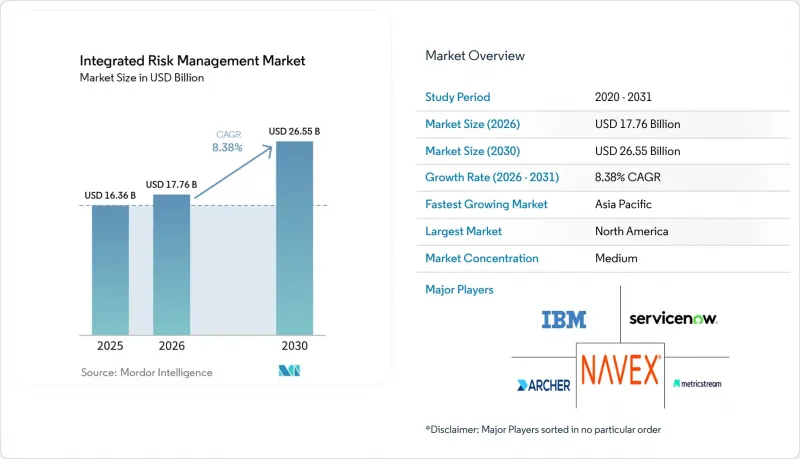
Mordor Intelligence에 의하면, 통합 리스크 관리 시장 규모는 2025년 163억 6,000만 달러로 평가되었습니다. 2026년에는 177억 6,000만 달러로 확대되어 2031년까지 265억 5,000만 달러에 이를 것으로 예상되며 2026년부터 2031년에 걸쳐 CAGR 8.38%로 성장할 전망입니다.
본 보고서는 구성 요소(소프트웨어, 솔루션, 서비스), 도입 형태(클라우드, On-Premise), 기업 규모(중소기업 및 대기업), 최종 사용자 산업 분야(은행, 금융서비스 및 보험(BFSI), 헬스케어, IT 및 통신, 소매, 제조, 에너지, 정부, 운송, 교육) 및 지역별로 분류되어 있습니다. 시장 전망은 금액(달러) 기준으로 제시되어 있습니다.
세계의 통합 리스크 관리 시장 동향 및 인사이트
세계 규제 체계의 복잡화
유럽연합(EU)의 ‘디지털 운영 탄력성법(DORA)’는 2025년 1월에 전면 시행되며, 금융기관에 대해 엄격한 보고 기한 내에 정보통신 기술의 복원력을 입증할 것을 의무화하고 있습니다. ‘기업 지속가능성 보고 지침’ 개정된 GDPR(EU 개인정보보호규정)의 동의 규정과 같은 병행되는 규제들로 인해, 기업들은 개인정보 보호, 사이버 보안, ESG 및 제3자 관련 위험을 단일 시스템으로 통합해야 할 필요성이 대두되고 있으며, 이에 따라 통합 리스크 관리 시장 플랫폼에 대한 수요가 증가하고 있습니다. 다국적 은행들은 또한 회복탄력성 인증을 보유하지 않은 공급업체에 대한 아웃소싱을 금지하는 DORA 조항에 직면해 있으며, 스프레드시트로는 처리하기 어려울 정도의 실사 감사가 잇따르고 있습니다. 현재 중복되는 법령은 자금 조달에 대한 접근성에도 영향을 미치고 있습니다. 유럽증권시장감독청(ESMA)에 제출되는 투자설명서에는 지속가능성에 관한 공시가 포함되어야 하며, 운용상의 규정 준수가 자금 조달의 전제조건이 되고 있습니다. 이러한 압박 요인들이 복합적으로 작용함에 따라, 리스크 관리는 단순한 백오피스 기능에서 이사회 차원의 최우선 과제로 변모하고 있습니다.
심화되는 사이버 보안 위협과 데이터 유출
2025년에는 랜섬웨어 공격이 68% 증가했고, 건당 평균 복구 비용이 454만 달러에 달함에 따라, 공급망 리스크 관리가 기업의 최우선 과제로 더욱 주목받게 되었습니다. 2024년에 발생한 클라우드 서비스 침해 사건에서 8,200개사의 인증 정보가 유출된 것처럼, 고도화된 공급망 침해 사례는 경계 방어만으로는 더 이상 충분하지 않음을 보여주고 있습니다. 이에 대응하기 위해 조직은 통합형 리스크 관리 솔루션에 사고 대응 워크플로를 통합하여, 침해 통지서의 자동 발행 및 실시간 히트맵 업데이트를 실현하고 있습니다. SEC(미국 증권거래위원회)의 규정에 따르면, 상장 기업은 중대한 사이버 사고를 4영업일 이내에 보고해야 할 의무가 있으며, 수동적인 시정 조치의 유예 기간은 대폭 단축되었습니다. 은행들은 연방금융기관검사위원회(FFIEC)의 추가 지침에 직면해 있으며, 이에 따라 사이버 위험 평가 대상이 4차 하청업체까지 확대됨에 따라 플랫폼 도입이 촉진되고 있습니다. IT와 운영 기술(OT)의 융합으로 인해 공격 대상 영역이 더욱 확대되고 있으며, 공공 서비스 및 제조업 분야에서는 단일 대시보드 내에서 IT 경보와 OT 자산 목록을 통합하는 움직임이 확산되고 있습니다.
높은 총소유비용(TCO)과 긴 도입 주기
도입에 드는 비용은 라이선스, 통합 작업, 교육을 포함해 5년간 평균 320만 달러에 달하며, On-Premise 환경으로 구축하는 데 최대 18개월이 소요될 수 있습니다. 소규모 제조업체는 벌금 부과 위협에 직면해 있더라도, 이토록 오랜 기간 동안 6명으로 구성된 프로젝트 팀을 구성할 수는 없습니다. 클라우드 도입으로 기간은 약 6개월로 단축되지만, 예산의 40%는 여전히 설정 작업과 사용자 교육에 소요됩니다. 프로젝트는 수백 장에 달하는 스프레드시트에 걸쳐 있는 공급업체 이름의 불일치를 조정하는 등, 데이터 정제 작업의 부담이 과소평가되어 좌절되는 경우가 종종 있습니다. 벤더들이 영구 라이선스를 해마다 급등하는 연간 요금제로 대체함에 따라, '구독 피로'이 높아지고 있어, 조달 팀은 다년 계약을 체결하기 전에 보다 명확한 ROI 지표를 요구하고 있습니다.
부문별 분석
2025년, 소프트웨어 솔루션은 통합 리스크 관리 시장에서 63.18%의 점유율을 차지했습니다. 이는 스프레드시트 기반 관리에서 정책, 인시던트, 규정 준수 증거를 일원화하는 통합 플랫폼으로의 전환을 반영한 것입니다. 리스크 분석 및 보고서 작성 모듈이 차지하는 통합 리스크 관리 시장 규모는 2026년부터 2031년까지 연평균 성장률(CAGR) 9.11%로 확대될 것으로 전망됩니다. 이는 이사회가 경영진을 위한 실시간 대시보드를 강력히 요구하는 가운데, 소프트웨어 스택 내에서 가장 빠른 성장 속도를 기록하고 있습니다. 대형 은행들은 DORA의 분기별 평가 규정을 충족하기 위해 자동화된 통제 테스트 엔진을 도입한 반면, 의료 시스템에서는 HIPAA 위반 대응 프로세스를 효율화하는 사고 관리 모듈이 채택되고 있습니다.
2025년 지출 중 서비스가 36.82%를 차지했으며, 그 내역은 전문 서비스와 관리형 서비스로 나뉩니다. 딜로이트나 PwC와 같은 시스템 통합사업자들이 복잡한 도입 프로젝트를 주도하는 한편, 매니지드 서비스 제공업체들은 현재 성과 기반 계약을 바탕으로 연중무휴 24시간 가동되는 플랫폼을 운영하고 있습니다. 많은 기업은 분류 체계의 미세 조정, API 구축, 분산된 사용자 교육에 필요한 사내 역량이 부족하기 때문에 서비스에 대한 수요는 앞으로도 지속될 전망이지만, 자동화 및 사전 설정된 컨텐츠 라이브러리를 통해 표준화된 업무에 소요되는 청구 가능 시간은 점차 줄어들고 있습니다.
2025년에는 통합 리스크 관리 시장의 71.24%를 클라우드 도입이 차지했으며, 2031년까지 연평균 성장률(CAGR) 8.41%로 그 성장세를 유지할 전망입니다. 규제 측면의 명확화도 한몫을 했습니다. 유럽은행감독청(EBA)은 적절하게 인증된 SaaS 플랫폼이 DORA 요건을 충족함을 확인하고, 유럽 전역의 금융기관을 대상으로 한 투자를 촉진했습니다. 멀티테넌트 아키텍처 덕분에 분기별 기능 출시가 가속화되고 있으며, ServiceNow는 2025년 한 해에만 4건의 주요 기능 개선 사항을 출시했습니다. 고객에게 업그레이드 부담을 주지 않으면서 클라우드의 매력을 한층 더 높이고 있습니다.
On-Premise 도입은 여전히 지출의 28.76%를 차지하고 있으며, 데이터 주권법 및 CUI(기밀 정보) 규제로 인해 퍼블릭 클라우드에 저장하는 것이 금지된 국방, 정부 및 규제가 엄격한 금융 부문에 집중되어 있습니다. 기밀 데이터를 On-Premise에 보관하면서 분석 처리를 클라우드로 오프로드하는 하이브리드형 접근 방식이 점차 확산되고 있으며, 이는 이분법적인 전환이 아닌 단계적인 전환 패턴을 시사하고 있습니다.
지역별 분석
북미는 SEC(미국 증권거래위원회)의 기후 변화 및 사이버 정보 공개에 관한 엄격한 규제, 성숙한 사이버 보험 생태계, 그리고 데이터 유출에 대한 막대한 벌금으로 인해 2025년에도 통합 리스크 관리 시장에서 41.84%의 점유율을 유지했습니다. 캐나다의 더욱 엄격해진 개인정보 보호법 개정과 멕시코의 핀테크 추진 정책이 지역적 호재로 작용하고 있습니다. 미국 연방거래위원회(FTC)는 2025년, 데이터 보안 미비에 대한 합의금으로 12억 달러를 징수했습니다. 이는 규제 당국의 단호한 태도를 보여주는 것으로, 중견 기업층에서 대책을 광범위하게 도입하도록 촉진하고 있습니다.
아시아태평양은 중국의 ‘“개인정보보호법”또는 인도의 '디지털 개인 데이터 보호법' 위험 등록부의 현지화 및 자동화된 동의 모듈 도입을 추진하고 있는 만큼, 2031년까지 연평균 성장률(CAGR) 11.42%로 가장 높은 성장률을 기록할 전망입니다. 일본 은행 업계에서는 매년 랜섬웨어 상황을 가정한 테이블톱 훈련을 실시하는 것이 의무화되어 있으며, 이것이 시나리오 플래닝 엔진 도입을 촉진하고 있습니다. 한편, 호주에서는 데이터 침해 건수가 급증하고 있어, 사고 관리가 이사회가 최우선으로 다루어야 할 과제가 되고 있습니다. 아세안(ASEAN) 내 규제 조화를 위한 노력은 국경을 초월한 규정 준수 요구를 더욱 높임으로써, 여러 법역에 대응할 수 있는 라이브러리를 보유한 공급업체에게 좋은 기회를 제공합니다.
유럽은 2025년에 28%의 점유율을 유지했습니다. 이는 2025년 1월 DORA의 본격적인 운영 개시와, 궁극적으로 5만 개의 사업체를 대상으로 하는 CSRD의 단계적 도입이 뒷받침한 결과입니다. 독일의 BaFin은 제3자 리스크 관리에 미비점이 있었던 은행에 대해 여러 가지 시정 조치를 취함으로써, 규정 준수(컴플라이언스)의 시급성을 한층 더 높이고 있습니다. 영국의 업무 복원력 프레임워크와 프랑스의 GDPR(EU 개인정보보호규정) 위반에 대한 막대한 벌금은 원칙에 기반한 감독에서 측정 가능한 관리 체제로의 전환을 여실히 보여주고 있습니다. 남미, 중동 및 아프리카의 합계 점유율은 12%를 차지하고 있습니다. 도입은 브라질 금융 업계, 걸프 지역 국가들의 스마트시티 인프라, 남아프리카공화국의 개인정보 보호법 집행에 집중되고 있지만, 인프라 격차와 환율 변동이 더 광범위한 수요를 억제하고 있습니다.
기타 혜택 :
- 엑셀 형식 시장 예측(ME) 시트
- 3개월간의 애널리스트 지원
자주 묻는 질문
목차
제1장 서론
제2장 조사 방법
제3장 주요 요약
제4장 시장 구도
제5장 시장 규모 및 성장 예측
제6장 경쟁 구도
제7장 시장 기회 및 향후 전망
KTH 26.07.07According to Mordor Intelligence, the integrated risk management market size is expected to increase from USD 16.36 billion in 2025 to USD 17.76 billion in 2026 and reach USD 26.55 billion by 2031, growing at a CAGR of 8.38% over 2026-2031.
This report is Segmented by Component (Software, Solutions, and Services), Deployment Mode (Cloud, and On-Premise), Enterprise Size (SMEs and Large Enterprises), End-User Industry (BFSI, Healthcare, IT and Telecommunications, Retail, Manufacturing, Energy, Government, Transportation, and Education), and Geography. The Market Forecasts are Provided in Terms of Value (USD).
Global Integrated Risk Management Market Trends and Insights
Complexity of Global Regulatory Frameworks
The European Union's Digital Operational Resilience Act entered full enforcement in January 2025 and obliges financial entities to prove the resilience of information and communication technologies within strict reporting windows. Parallel mandates such as the Corporate Sustainability Reporting Directive and revised GDPR consent rules compel firms to aggregate privacy, cyber, ESG, and third-party exposures in one system, elevating demand for integrated risk management market platforms. Multinational banks also face DORA clauses that ban outsourcing to vendors without resilience certifications, generating cascades of due diligence audits that spreadsheets cannot handle. Overlapping statutes now influence access to capital; prospectuses filed with the European Securities and Markets Authority must include sustainability disclosures, making operational compliance a prerequisite for fundraising. Together, these pressures transform risk management from a back-office function into a board-level imperative.
Escalating Cybersecurity Threats and Data Breaches
Ransomware assaults rose 68% in 2025, with average recovery costs of USD 4.54 million per incident, intensifying the focus on Supply Chain Risk Management as a critical enterprise priority. Sophisticated supply-chain compromises, such as the 2024 cloud-service breach that exposed credentials of 8,200 enterprises, reveal that perimeter defenses alone no longer suffice. In response, organizations embed incident workflows into integrated risk management market suites, enabling automatic breach-notification letters and real-time heat-map updates. SEC rules require public companies to report material cyber events within four business days, collapsing the window for manual remediation. Banks confront additional directives from the Federal Financial Institutions Examination Council that extend cyber-risk assessment across fourth-party subcontractors, boosting platform adoption. The convergence of IT and operational technology further enlarges the attack surface, encouraging utilities and manufacturers to unify IT alerts with OT asset inventories inside a single dashboard.
High Total Cost of Ownership and Long Implementation Cycles
Deployments average USD 3.2 million over five years, covering licenses, integration labor, and training, and on-premise rollouts can stretch to 18 months. Small manufacturers cannot field six-person project teams for such durations, even when fines loom. Although cloud delivery trims timelines to about six months, 40% of budgets still vanish into configuration and user enablement. Projects are often derailed by underestimated data-cleansing workloads, such as reconciling inconsistent vendor names across hundreds of spreadsheets. Subscription fatigue is rising as vendors replace perpetual licenses with escalating annual fees, forcing procurement teams to demand clearer ROI metrics before signing multiyear agreements.
Other drivers and restraints analyzed in the detailed report include:
- Rapid Digital Transformation and Cloud Adoption
- Expansion of Third-Party and Supply-Chain Ecosystems
- Shortage of IRM-Skilled Professionals
For complete list of drivers and restraints, kindly check the Table Of Contents.
Segment Analysis
Software solutions held 63.18% integrated risk management market share in 2025, reflecting the pivot from spreadsheet registers to unified platforms that centralize policies, incidents, and compliance evidence. The integrated risk management market size captured by risk analytics and reporting modules is projected to expand at a 9.11% CAGR between 2026 and 2031, the fastest pace inside the software stack as boards insist on real-time executive dashboards. Large banks deploy automated control-testing engines to meet DORA's quarterly assessment rules, while healthcare systems embrace incident modules that streamline HIPAA breach processes.
Services represented 36.82% of 2025 spending, split between professional and managed offerings. System integrators such as Deloitte and PwC dominate complex rollouts, whereas managed-service providers now operate 24/7 platforms under outcome-based contracts. Demand for services will persist because many enterprises lack in-house skills to fine-tune taxonomies, build APIs, and train distributed users, yet automation and preset content libraries are trimming billable hours for commoditized tasks.
Cloud deployments captured 71.24% of the integrated risk management market in 2025 and will maintain momentum with an 8.41% CAGR through 2031. Regulatory clarity helped: the European Banking Authority confirmed that properly certified SaaS platforms meet DORA expectations, unlocking investment across European finance houses. Multi-tenant architectures push quarterly feature drops, ServiceNow shipped four major enhancements in 2025 alone, without customer upgrade pain, reinforcing cloud's appeal.
On-premise installations still account for 28.76% of spending, concentrated in defense, government, and highly regulated financial segments where data-sovereignty laws or CUI mandates prohibit public-cloud storage. Hybrid approaches that keep sensitive data on-site while off-loading analytics to the cloud are gaining ground, signaling a phased, rather than binary, migration pattern.
Complete Report Scope:
- By Component
- Software Solutions
- Risk and Compliance Management
- Incident and Issue Management
- Policy Management
- Risk Analytics and Reporting
- Services
- Professional Services
- Managed Services
- Software Solutions
- By Deployment Mode
- Cloud
- On-Premise
- By Enterprise Size
- Small and Medium Enterprises (SMEs)
- Large Enterprises
- By End-User Industry
- BFSI
- Healthcare and Life Sciences
- IT and Telecommunications
- Retail and Consumer Goods
- Manufacturing
- Energy and Utilities
- Government and Public Sector
- Transportation
- Education
- By Geography
- North America
- United States
- Canada
- Mexico
- South America
- Brazil
- Argentina
- Rest of South America
- Europe
- Germany
- United Kingdom
- France
- Italy
- Spain
- Rest of Europe
- Asia Pacific
- China
- Japan
- South Korea
- India
- Australia
- New Zealand
- Rest of Asia-Pacific
- Middle East and Africa
- Middle East
- United Arab Emirates
- Saudi Arabia
- Turkey
- Rest of Middle East
- Africa
- South Africa
- Nigeria
- Kenya
- Rest of Africa
- Middle East
- North America
Geography Analysis
North America sustained 41.84% integrated risk management market share in 2025 due to formidable SEC climate- and cyber-disclosure rules, a mature cyber-insurance ecosystem, and high breach penalties. Canada's stricter privacy amendments and Mexico's fintech initiatives add regional tailwinds. The United States Federal Trade Commission collected USD 1.2 billion in settlements for lax data security in 2025, signaling regulators' rising intolerance and prompting widespread adoption in mid-market cohorts.
Asia-Pacific posts the fastest 11.42% CAGR through 2031 as China's Personal Information Protection Law and India's Digital Personal Data Protection Act drive localization of risk registers and automated consent modules. Japan's banking sector must run annual ransomware tabletop exercises, which fuels uptake of scenario-planning engines, while Australia's soaring breach numbers make incident management a board priority. ASEAN harmonization efforts further boost cross-border compliance needs, creating fertile ground for vendors with multi-jurisdiction libraries.
Europe retained 28% share in 2025, energized by the January 2025 go-live of DORA and phased CSRD rollouts that eventually cover 50,000 entities. Germany's BaFin issued multiple enforcement actions against banks found wanting in third-party risk, reinforcing compliance urgency. The United Kingdom's operational-resilience framework and France's sizeable GDPR fines underline a shift from principles-based supervision toward measurable controls. South America, the Middle East, and Africa together hold 12% share; adoption is concentrated in Brazilian finance, Gulf smart-city infrastructure, and South African privacy enforcement, though infrastructure gaps and currency volatility temper broader demand.
- IBM Corporation
- ServiceNow Inc.
- Archer Technologies LLC
- NAVEX Global Inc.
- MetricStream Inc.
- SAP SE
- LogicManager Inc.
- AuditBoard Inc.
- Onspring Technologies LLC
- Centraleyes Ltd.
- Riskonnect Inc.
- Diligent Corporation
- OneTrust LLC
- LogicGate Inc.
- Resolver Inc.
- RSA Security LLC
- SureCloud Ltd.
- IsoMetrix
- SAI360 Inc.
- Quantivate LLC
Additional Benefits:
- The market estimate (ME) sheet in Excel format
- 3 months of analyst support
TABLE OF CONTENTS
1 INTRODUCTION
- 1.1 Study Assumptions and Market Definition
- 1.2 Scope of the Study
2 RESEARCH METHODOLOGY
3 EXECUTIVE SUMMARY
4 MARKET LANDSCAPE
- 4.1 Market Overview
- 4.2 Market Drivers
- 4.2.1 Complexity of Global Regulatory Frameworks (GDPR, DORA, CSRD)
- 4.2.2 Escalating Cybersecurity Threats and Data Breaches
- 4.2.3 Rapid Digital Transformation and Cloud Adoption
- 4.2.4 Expansion of Third-Party and Supply-Chain Ecosystems
- 4.2.5 Mandatory ESG and Climate-Risk Disclosure Regimes
- 4.2.6 Digital-Twin Risk Simulation for Critical Infrastructure
- 4.3 Market Restraints
- 4.3.1 High Total Cost of Ownership and Long Implementation Cycles
- 4.3.2 Shortage of IRM-Skilled Professionals
- 4.3.3 Vendor Consolidation Creating Lock-In Concerns
- 4.3.4 Uncertain AI Governance Standards Across Jurisdictions
- 4.4 Industry Value-Chain Analysis
- 4.5 Regulatory Landscape
- 4.6 Technological Outlook
- 4.7 Porter's Five Forces Analysis
- 4.7.1 Bargaining Power of Buyers
- 4.7.2 Bargaining Power of Suppliers
- 4.7.3 Threat of New Entrants
- 4.7.4 Threat of Substitutes
- 4.7.5 Competitive Rivalry
5 MARKET SIZE AND GROWTH FORECASTS (VALUE)
- 5.1 By Component
- 5.1.1 Software Solutions
- 5.1.1.1 Risk and Compliance Management
- 5.1.1.2 Incident and Issue Management
- 5.1.1.3 Policy Management
- 5.1.1.4 Risk Analytics and Reporting
- 5.1.2 Services
- 5.1.2.1 Professional Services
- 5.1.2.2 Managed Services
- 5.1.1 Software Solutions
- 5.2 By Deployment Mode
- 5.2.1 Cloud
- 5.2.2 On-Premise
- 5.3 By Enterprise Size
- 5.3.1 Small and Medium Enterprises (SMEs)
- 5.3.2 Large Enterprises
- 5.4 By End-User Industry
- 5.4.1 BFSI
- 5.4.2 Healthcare and Life Sciences
- 5.4.3 IT and Telecommunications
- 5.4.4 Retail and Consumer Goods
- 5.4.5 Manufacturing
- 5.4.6 Energy and Utilities
- 5.4.7 Government and Public Sector
- 5.4.8 Transportation
- 5.4.9 Education
- 5.5 By Geography
- 5.5.1 North America
- 5.5.1.1 United States
- 5.5.1.2 Canada
- 5.5.1.3 Mexico
- 5.5.2 South America
- 5.5.2.1 Brazil
- 5.5.2.2 Argentina
- 5.5.2.3 Rest of South America
- 5.5.3 Europe
- 5.5.3.1 Germany
- 5.5.3.2 United Kingdom
- 5.5.3.3 France
- 5.5.3.4 Italy
- 5.5.3.5 Spain
- 5.5.3.6 Rest of Europe
- 5.5.4 Asia Pacific
- 5.5.4.1 China
- 5.5.4.2 Japan
- 5.5.4.3 South Korea
- 5.5.4.4 India
- 5.5.4.5 Australia
- 5.5.4.6 New Zealand
- 5.5.4.7 Rest of Asia-Pacific
- 5.5.5 Middle East and Africa
- 5.5.5.1 Middle East
- 5.5.5.1.1 United Arab Emirates
- 5.5.5.1.2 Saudi Arabia
- 5.5.5.1.3 Turkey
- 5.5.5.1.4 Rest of Middle East
- 5.5.5.2 Africa
- 5.5.5.2.1 South Africa
- 5.5.5.2.2 Nigeria
- 5.5.5.2.3 Kenya
- 5.5.5.2.4 Rest of Africa
- 5.5.5.1 Middle East
- 5.5.1 North America
6 COMPETITIVE LANDSCAPE
- 6.1 Market Concentration
- 6.2 Strategic Moves
- 6.3 Market Share Analysis
- 6.4 Company Profiles (includes Global Level Overview, Market Level Overview, Core Segments, Financials as available, Strategic Information, Market Rank/Share, Products and Services, Recent Developments)
- 6.4.1 IBM Corporation
- 6.4.2 ServiceNow Inc.
- 6.4.3 Archer Technologies LLC
- 6.4.4 NAVEX Global Inc.
- 6.4.5 MetricStream Inc.
- 6.4.6 SAP SE
- 6.4.7 LogicManager Inc.
- 6.4.8 AuditBoard Inc.
- 6.4.9 Onspring Technologies LLC
- 6.4.10 Centraleyes Ltd.
- 6.4.11 Riskonnect Inc.
- 6.4.12 Diligent Corporation
- 6.4.13 OneTrust LLC
- 6.4.14 LogicGate Inc.
- 6.4.15 Resolver Inc.
- 6.4.16 RSA Security LLC
- 6.4.17 SureCloud Ltd.
- 6.4.18 IsoMetrix
- 6.4.19 SAI360 Inc.
- 6.4.20 Quantivate LLC
7 MARKET OPPORTUNITIES AND FUTURE OUTLOOK
- 7.1 White-Space and Unmet-Need Assessment