
|
시장보고서
상품코드
2073423
사료용 파이토제닉스 : 시장 점유율 분석, 업계 동향 및 통계, 성장 예측(2026-2031년)Feed Phytogenics - Market Share Analysis, Industry Trends & Statistics, Growth Forecasts (2026 - 2031) |
||||||
 Mordor Intelligence
Mordor Intelligence에 의하면, 사료용 파이토제닉스 시장 규모는 2025년 9억 6,000만 달러로 평가되었습니다. 2026년에는 10억 달러로 확대되어 2031년까지 12억 3,000만 달러에 이를 것으로 예측되며, 2026년부터 2031년에 걸쳐 CAGR 4.23%로 성장할 전망입니다.
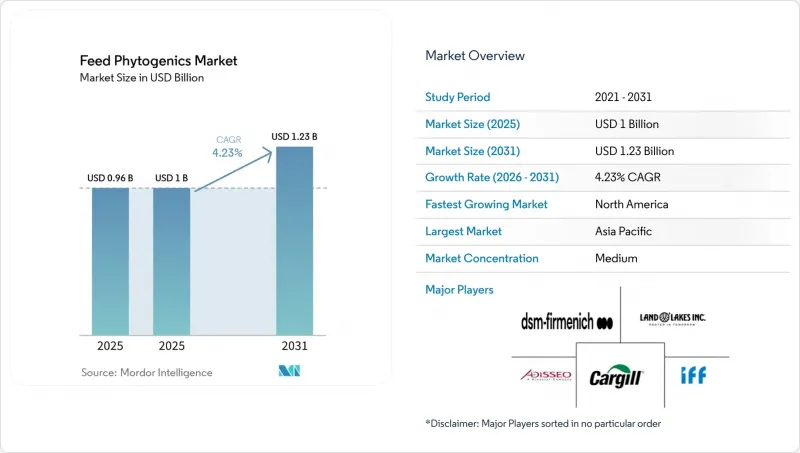
본 보고서는 부가물 유형별(에센셜 오일, 허브 및 향신료, 기타 식물성 부가물), 동물 유형별(수산물 양식, 가금류, 반추동물, 돼지, 기타 동물), 지역별(북미, 남미, 유럽, 아시아태평양, 중동 및 아프리카)로 분류되어 있습니다. 시장 전망은 금액(달러) 및 수량(미터톤) 단위로 제시되어 있습니다.
세계의 사료용 파이토제닉스 시장 동향 및 인사이트
항생제계 성장촉진제의 규제에 따른 단계적 폐지
수의용 항생제 사용에 대한 정부의 규제로 인해, 사료용 파이토제닉스에 대한 관심이 시장 전반에서 실질적인 상업적 수요로 계속 전환되고 있습니다. 유럽의약품청(EMA)의 보고에 따르면, 유럽위원회는 항생제 내성 문제 해결을 위한 노력의 일환으로 2030년까지 유럽연합(EU) 전역에서 가축 및 수산 양식용 항생제 판매량을 50% 감축하겠다는 목표를 세웠습니다. 인도 역시 2025년 4월에 발효된 규제를 추진하고 있으며, 이는 세계 최대 규모의 육계 및 수산 양식 생산 거점 중 하나에 더욱 탄력을 불어넣고 있습니다. 이처럼 각국의 규제가 서로 다른 속도로 확대되는 가운데, 다국적 사료 기업들은 관할 구역마다 다른 항생제 승인 절차보다 광범위하게 작용하는 파이토제닉스의 배합 관리가 더 용이하다는 사실을 깨닫기 시작하고 있습니다.
잔류물이 없는 단백질에 대한 수요
사료용 파이토제닉스 시장은 잔류물이 없는 육류, 계란, 유제품, 수산물에 대한 소매업체 및 외식업계 수요에 힘입어 성장하고 있습니다. 2025년까지 항생제 미사용 조달 요건이 북미와 유럽의 주요 조달 기준에 더욱 널리 확산될 전망이며, 공급업체들은 사료 단계에서 해당 주장을 입증해야 할 압박을 받고 있습니다. 『Frontiers in Veterinary Science』 저널의 2025년 연구에 따르면, 파이토제닉스이 상업용 가금류의 장내 미생물 군집과 면역 기능을 조절하는 것으로 밝혀졌으며, 이는 잔류물 없는 생산과 관련된 생산성 향상 프로그램에서 해당 첨가물의 사용을 뒷받침하고 있습니다. 첨가물 비용을 감수하는 생산자는 프리미엄 가격 책정이나 항생제를 사용하지 않는 유통 채널에서 구매자들의 높은 수용도를 통해 그 비용을 회수할 수 있는 경우가 많습니다. 이로 인해 수요는 단기적인 대체 주기보다 지속성이 높아지고 있습니다. 왜냐하면 구매 신호는 사료 첨가제 공급업체뿐만 아니라 하류의 단백질 조달 측에서도 점점 더 많이 발신되고 있기 때문입니다.
원자재 가격의 변동성과 비용 프리미엄
원료 가격의 변동성은 사료용 파이토제닉스 시장의 보급 확대를 가로막는 가장 뚜렷한 제약 요인 중 하나로 계속 남아 있습니다. 합성 첨가물과 달리, 에센셜 오일이나 식물 추출물은 작물의 생육 주기, 기상 조건, 수확량, 그리고 농업 지역공급 차질에 따라 영향을 받습니다. 비용에 민감한 축산 시스템에서는 식물성 원료 가격이 조금만 상승해도 구매자들이 더 저렴한 합성 대체품으로 돌아설 가능성이 있습니다. 이 문제는 사료가 이미 총생산 비용에서 큰 비중을 차지하고 있는 동남아시아와 라틴아메리카에서 더욱 심각합니다. 대부분의 향기성 식물은 표준화된 선물 계약을 통해 적극적으로 헤지되지 않기 때문에 구매자는 장기적인 조달 주기 동안 가격 리스크를 관리할 수 있는 수단을 여전히 거의 가지고 있지 않습니다.
부문별 분석
2025년, 사료용 파이토제닉스 시장에서 보조 첨가제형 정유가 55.6%를 차지하며 최대 부문이 되었습니다. 이러한 우위는 오랜 기간에 걸친 상업적 활용 실적과 항균 작용, 항산화 작용, 소화 기능 지원 작용과 같은 입증된 특성에 기인합니다. 타임과 오레가노에서 추출되는 티몰과 카르바크롤은 여전히 에센셜 오일 기반 시판 제제의 상당 부분을 차지하고 있습니다. 이러한 성분들의 매력은 단위동물용 사료에서 가장 두드러지며, 그 효과에 관한 실증 데이터가 풍부하고 생산 성과와의 연관성을 파악하기 쉽기 때문입니다. 이러한 근거에 따라, 새로운 유형의 제품이 주목을 받고 있는 상황에서도 에센셜 오일은 사료용 파이토제닉스 시장에서 중심적인 위치를 확고히 하고 있습니다.
허브와 향신료는 가장 빠르게 성장하고 있는 부문으로, 2026년부터 2031년까지 연평균 성장률(CAGR) 4.1%를 나타낼 것으로 전망됩니다. 이 시장의 성장은 비용 측면에서의 우위와, 이러한 제품의 생리활성 특성을 뒷받침하는 연구의 확대에 힘입어 이루어지고 있습니다. 오레가노 오일은 입증된 항균 효과 덕분에 에센셜 오일의 용도에서 주류를 차지하고 있습니다. 한편, 타임과 로즈마리 오일은 2024년 유럽식품안전청(EFSA)의 승인을 받은 것을 계기로 유럽 시장에서 인기가 높아지고 있습니다. 올레오레진은 고농도의 생리활성 물질이 필요한 특수한 용도, 특히 수중에서의 안정성이 중요한 요소가 되는 수산 양식용 사료에 사용되고 있습니다.
지역별 분석
아시아태평양은 최대 시장으로, 2025년 사료용 파이토제닉스 시장 점유율의 23.8%를 차지했습니다. 중국, 인도, 베트남, 태국에서는 가금류 및 돼지 생산량이 많은 반면, 항생제 사용에 대한 규제가 강화되고 있습니다. 중국의 농업 현대화를 위한 광범위한 노력과, 2024년에 발표되어 2025년 4월부터 시행된 인도의 항생제 사용 금지 조치는 서로 다른 정책적 관점에서 이러한 제품의 도입을 뒷받침하고 있습니다. 2025년 『Veterinary Sciences』지에 게재된 연구에 따르면, 식물 유래 배합 사료를 급여받은 중국의 상업용 흰깃 육계에서 일일 평균 체중 증가량이 21% 향상된 것으로 보고되었으며, 이는 해당 지역에서의 도입을 뒷받침하는 더욱 강력한 실증 데이터가 되고 있습니다. 또한, 아시아태평양은 수산 양식 분야에서도 중요한 역할을 하고 있으며, 각 공급업체들은 보다 정밀한 투여와 생물 보안 지원이 필요한 새우 및 어류 양식 시스템용 제품을 개발하고 있습니다.
북미는 가장 빠르게 성장하고 있는 지역으로, 2026년부터 2031년까지 연평균 성장률(CAGR) 3.5%로 확대될 것으로 전망됩니다. 미국 식품의약국(FDA)의 “수의용 사료 지침"와 캘리포니아주의 주 차원 규제로 인해, 천연 유래 대체재에 대한 규제상의 지원이 마련되고 있습니다. 또한, 대형 식품 소매업체들의 항생제 미사용 조달 요건이 생산자들의 식물 유래 솔루션 도입을 촉진하고 있으며, 이를 통해 원재료 비용 상승을 상쇄할 수 있는 시장 프리미엄을 실현할 수 있게 되었습니다. 캐나다에서는 유기 축산 부문이 인증된 천연 사료 첨가제 수요를 주도하고 있는 반면, 멕시코의 수출 지향형 가금류 산업은 국제 바이어들의 요건을 충족하기 위해 식물 유래 사료 첨가제를 도입하고 있습니다.
남미에서는 브라질과 아르헨티나가 대규모 축산 생산과, 특히 반추동물을 위한 지속가능성을 고려한 사료 솔루션에 대한 관심 증가를 연계하고 있어, 그 중요성이 점점 더 커지고 있습니다. 중동 및 아프리카는 2025년에도 지역별로는 여전히 기여도가 가장 낮은 수준을 유지했으나, 국내 식량 안보 및 수직 통합형 가금류 생산에 대한 투자가 사료용 파이토제닉스 시장의 중기적 성장 기반을 마련해 가고 있습니다.
기타 혜택 :
- 엑셀 형식 시장 예측(ME) 시트
- 3개월간의 애널리스트 지원
자주 묻는 질문
목차
제1장 서론
제2장 보고서의 내용
제3장 주요 요약 및 주요 조사 결과
제4장 주요 업계 동향
제5장 시장 규모 및 성장 예측
제6장 경쟁 구도
제7장 CEO에 대한 주요 전략적 질문
KTH 26.07.08According to Mordor Intelligence, the feed phytogenics market size is projected to increase from USD 0.96 billion in 2025 to USD 1.00 billion in 2026 and reach USD 1.23 billion by 2031, growing at a CAGR of 4.23% over 2026 to 2031.
This report is Segmented by Sub-Additive (Essential Oils, Herbs and Spices, and Other Phytogenics), by Animal (Aquaculture, Poultry, Ruminants, Swine, and Other Animals), and by Geography (North America, South America, Europe, Asia-Pacific, Middle East, and Africa). The Market Forecasts are Provided in Terms of Value (USD) and Volume (metric Tons).
Global Feed Phytogenics Market Trends and Insights
Regulatory Phaseout of Antibiotic Growth Promoters
Government restrictions on veterinary antibiotic use continue to turn interest in botanical additives into real commercial demand across the feed phytogenics market. The European Medicines Agency reported that the European Commission has set targets as part of its efforts to address antimicrobial resistance, including an aspirational goal to reduce overall European Union sales of antimicrobials for farmed animals and in aquaculture by 50% by 2030. India also moved ahead with restrictions that took effect in April 2025, adding momentum to one of the world's largest broiler and aquaculture production bases. As these national rules expand at different speeds, multinational feed companies are finding that broad-spectrum phytogenic formulations are easier to manage than antibiotic approvals that vary by jurisdiction.
Residue-Free Protein Demand
The feed phytogenics market is also being pulled forward by retailer and foodservice demand for residue-free meat, eggs, dairy, and aquaculture products. By 2025, antibiotic-free sourcing requirements had moved further into mainstream procurement standards in North America and Europe, pushing suppliers to support the claim at the feed level. A 2025 study in Frontiers in Veterinary Science found that phytogenics modulate gut microbiota and immune function in commercial poultry, which supports their use in performance programs tied to residue-free production. Producers that accept the additive cost can often recover it through premium pricing or stronger buyer acceptance in antibiotic-free channels. That makes demand more durable than a short replacement cycle because the buying signal is increasingly coming from downstream protein procurement rather than only from feed additive suppliers.
Raw-Material Price Volatility and Cost Premium
Raw-material price volatility remains one of the clearest limits on broader adoption in the feed phytogenics market. Unlike synthetic additives, essential oils and botanical extracts depend on crop cycles, weather conditions, harvest volumes, and supply disruptions in agricultural regions. In cost-sensitive livestock systems, even a moderate rise in botanical input prices can push buyers back toward cheaper synthetic alternatives. The problem is sharper in Southeast Asia and Latin America, where feed already accounts for a large share of total production cost. Because most aromatic plants are not actively hedged through standardized futures contracts, buyers still have few tools to manage price risk over longer procurement cycles.
Other drivers and restraints analyzed in the detailed report include:
- Poultry Focus on Feed Efficiency and Gut Health
- Efficacy Validation and Formulation Science
- Regulatory Fragmentation
For complete list of drivers and restraints, kindly check the Table Of Contents.
Segment Analysis
Sub-additive essential oils accounted for 55.6% of the feed phytogenics market in 2025, making them the largest segment. This dominance is attributed to their long-standing commercial use and well-established antimicrobial, antioxidant, and digestive-support properties. Thymol and carvacrol, derived from thyme and oregano, still anchor a large share of essential-oil-based commercial formulations. Their appeal remains strongest in monogastric diets, where the response is better documented and easier to link to production outcomes. This evidence base helps establish essential oils in a central position in the feed phytogenics market, even as newer product types gain attention.
Herbs and spices are the fastest-growing segment, projected to grow at a 4.1% CAGR from 2026 to 2031. The market is driven by cost advantages and expanding research supporting the bioactive properties of these products. Oregano oil dominates essential oil applications due to its proven antimicrobial efficacy, while thyme and rosemary oils are gaining popularity in European markets following European Food Safety Authority (EFSA) approvals in 2024. Oleoresins are used in specialized applications that require concentrated bioactive compounds, particularly in aquaculture feeds, where water stability is a critical factor.
Complete Report Scope:
- Sub Additive
- Essential Oil
- Herbs & Spices
- Other Phytogenics
- Animal
- Aquaculture
- Fish
- Shrimp
- Other Aquaculture Species
- Poultry
- Broiler
- Layer
- Other Poultry Birds
- Ruminants
- Beef Cattle
- Dairy Cattle
- Other Ruminants
- Swine
- Other Animals
- Aquaculture
- Geography
- Africa
- Egypt
- Kenya
- South Africa
- Rest of Africa
- Asia-Pacific
- Australia
- China
- India
- Indonesia
- Japan
- Philippines
- South Korea
- Thailand
- Vietnam
- Rest of Asia-Pacific
- Europe
- France
- Germany
- Italy
- Netherlands
- Russia
- Spain
- Turkey
- United Kingdom
- Rest of Europe
- Middle East
- Iran
- Saudi Arabia
- Rest of Middle East
- North America
- Canada
- Mexico
- United States
- Rest of North America
- South America
- Argentina
- Brazil
- Chile
- Rest of South America
- Africa
Geography Analysis
Asia-Pacific is the largest region, accounting for 23.8% of the feed phytogenics market share in 2025. China, India, Vietnam, and Thailand combine large poultry and swine output with stricter expectations for antibiotic use. China's broad push toward agricultural modernization and India's 2024 antibiotic ban, effective from April 2025, are reinforcing adoption from different policy angles. A 2025 study in Veterinary Sciences reported a 21% improvement in average daily gain in Chinese commercial white-feathered broilers fed a phytogenic formula, providing the region with stronger local evidence for adoption. Asia-Pacific is also important for aquaculture, where suppliers are building products for shrimp and fish systems that need more targeted delivery and biosecurity support.
North America is the fastest-growing region, forecast to expand at a 3.5% CAGR through 2026 to 2031. The United States Food and Drug Administration (FDA) Veterinary Feed Directive and state-level restrictions in California have generated regulatory support for natural alternatives. Additionally, major food retailers' antibiotic-free sourcing requirements are encouraging producers to implement phytogenic solutions, enabling market premiums that offset higher ingredient costs. In Canada, the organic livestock sector is driving demand for certified natural feed additives, while Mexico's export-focused poultry industry is adopting phytogenics to comply with international buyer requirements.
South America is becoming more relevant as Brazil and Argentina connect large-scale livestock output with rising interest in sustainability-linked feed solutions, especially for ruminants. The Middle East and Africa remained the smallest regional contributor in 2025, but investments in domestic food security and vertically integrated poultry production are building a base for medium-term growth in the feed phytogenics market.
- Cargill, Incorporated
- DSM-Firmenich AG
- Kemin Industries, Inc
- Adisseo
- Alltech
- IFF (Danisco Animal Nutrition)
- Borregaard
- Land O'Lakes, Inc
- Orffa International
- Prinova Group
- Phytobiotics Futterzusatzstoffe
- Nor-Feed
- Silvateam
- Amax NutraSource
- Nutrex NV
Additional Benefits:
- The market estimate (ME) sheet in Excel format
- 3 months of analyst support
TABLE OF CONTENTS
1 Introduction
- 1.1 Study Assumptions & Market Definition
- 1.2 Scope of the Study
- 1.3 Research Methodology
2 Report Offers
3 Executive Summary and Key Findings
4 Key Industry Trends
- 4.1 Animal Headcount
- 4.1.1 Poultry
- 4.1.2 Ruminants
- 4.1.3 Swine
- 4.2 Feed Production
- 4.2.1 Aquaculture
- 4.2.2 Poultry
- 4.2.3 Ruminants
- 4.2.4 Swine
- 4.3 Regulatory Framework
- 4.3.1 Argentina
- 4.3.2 Australia
- 4.3.3 Brazil
- 4.3.4 Canada
- 4.3.5 Chile
- 4.3.6 China
- 4.3.7 Egypt
- 4.3.8 France
- 4.3.9 Germany
- 4.3.10 India
- 4.3.11 Indonesia
- 4.3.12 Iran
- 4.3.13 Italy
- 4.3.14 Japan
- 4.3.15 Kenya
- 4.3.16 Mexico
- 4.3.17 Netherlands
- 4.3.18 Philippines
- 4.3.19 Russia
- 4.3.20 Saudi Arabia
- 4.3.21 South Africa
- 4.3.22 South Korea
- 4.3.23 Spain
- 4.3.24 Thailand
- 4.3.25 Turkey
- 4.3.26 United Kingdom
- 4.3.27 United States
- 4.3.28 Vietnam
- 4.4 Value Chain & Distribution Channel Analysis
- 4.5 Market Drivers
- 4.5.1 Regulatory phaseout of antibiotic growth promoters
- 4.5.2 Residue-free protein demand
- 4.5.3 Poultry focus on feed efficiency and gut health
- 4.5.4 Efficacy validation and formulation science
- 4.5.5 Microencapsulation and precision dosing
- 4.5.6 Ruminant methane programs
- 4.6 Market Restraints
- 4.6.1 Raw-material price volatility and cost premium
- 4.6.2 Regulatory fragmentation
- 4.6.3 Limited encapsulation and toll-processing capacity
- 4.6.4 Botanical supply variability and traceability pressure
5 Market Size and Growth Forecasts (Value and Volume)
- 5.1 Sub Additive
- 5.1.1 Essential Oil
- 5.1.2 Herbs & Spices
- 5.1.3 Other Phytogenics
- 5.2 Animal
- 5.2.1 Aquaculture
- 5.2.1.1 Fish
- 5.2.1.2 Shrimp
- 5.2.1.3 Other Aquaculture Species
- 5.2.2 Poultry
- 5.2.2.1 Broiler
- 5.2.2.2 Layer
- 5.2.2.3 Other Poultry Birds
- 5.2.3 Ruminants
- 5.2.3.1 Beef Cattle
- 5.2.3.2 Dairy Cattle
- 5.2.3.3 Other Ruminants
- 5.2.4 Swine
- 5.2.5 Other Animals
- 5.2.1 Aquaculture
- 5.3 Geography
- 5.3.1 Africa
- 5.3.1.1 Egypt
- 5.3.1.2 Kenya
- 5.3.1.3 South Africa
- 5.3.1.4 Rest of Africa
- 5.3.2 Asia-Pacific
- 5.3.2.1 Australia
- 5.3.2.2 China
- 5.3.2.3 India
- 5.3.2.4 Indonesia
- 5.3.2.5 Japan
- 5.3.2.6 Philippines
- 5.3.2.7 South Korea
- 5.3.2.8 Thailand
- 5.3.2.9 Vietnam
- 5.3.2.10 Rest of Asia-Pacific
- 5.3.3 Europe
- 5.3.3.1 France
- 5.3.3.2 Germany
- 5.3.3.3 Italy
- 5.3.3.4 Netherlands
- 5.3.3.5 Russia
- 5.3.3.6 Spain
- 5.3.3.7 Turkey
- 5.3.3.8 United Kingdom
- 5.3.3.9 Rest of Europe
- 5.3.4 Middle East
- 5.3.4.1 Iran
- 5.3.4.2 Saudi Arabia
- 5.3.4.3 Rest of Middle East
- 5.3.5 North America
- 5.3.5.1 Canada
- 5.3.5.2 Mexico
- 5.3.5.3 United States
- 5.3.5.4 Rest of North America
- 5.3.6 South America
- 5.3.6.1 Argentina
- 5.3.6.2 Brazil
- 5.3.6.3 Chile
- 5.3.6.4 Rest of South America
- 5.3.1 Africa
6 Competitive Landscape
- 6.1 Key Strategic Moves
- 6.2 Market Share Analysis
- 6.3 Company Landscape
- 6.4 Company Profiles (includes Global Level Overview, Market Level Overview, Core Business Segments, Financials, Headcount, Key Information, Market Rank, Market Share, Products and Services, and Analysis of Recent Developments).
- 6.4.1 Cargill, Incorporated
- 6.4.2 DSM-Firmenich AG
- 6.4.3 Kemin Industries, Inc
- 6.4.4 Adisseo
- 6.4.5 Alltech
- 6.4.6 IFF (Danisco Animal Nutrition)
- 6.4.7 Borregaard
- 6.4.8 Land O'Lakes, Inc
- 6.4.9 Orffa International
- 6.4.10 Prinova Group
- 6.4.11 Phytobiotics Futterzusatzstoffe
- 6.4.12 Nor-Feed
- 6.4.13 Silvateam
- 6.4.14 Amax NutraSource
- 6.4.15 Nutrex NV