
|
시장보고서
상품코드
2073176
아프리카의 사료용 피트제닉스 시장 : 점유율 분석, 업계 동향과 통계, 성장 예측(2026-2031년)Africa Feed Phytogenics - Market Share Analysis, Industry Trends & Statistics, Growth Forecasts (2026 - 2031) |
||||||
 Mordor Intelligence
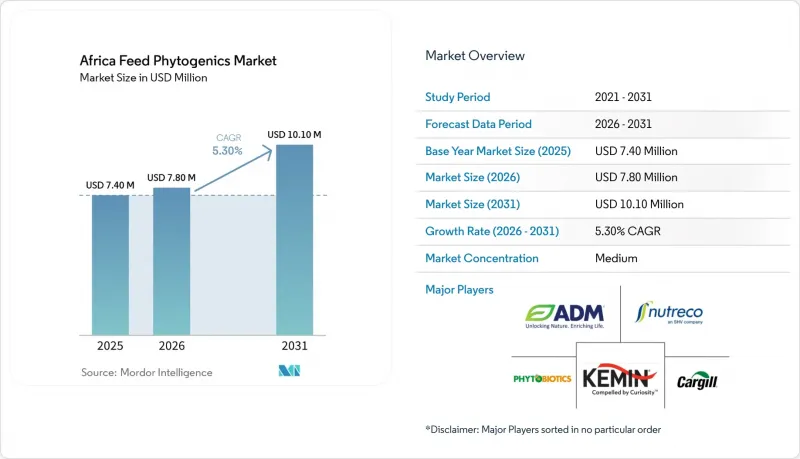
Mordor Intelligence에 의하면, 아프리카 사료용 피트제닉스 시장 규모는 2025년 740만 달러에서 2026년에는 780만 달러로 확대되어 2026년부터 2031년까지 CAGR 5.3%로 성장을 지속하여, 2031년에는 1,010만 달러에 이를 것으로 예측됩니다.
본 보고서는 제품 유형별(에센셜 오일 등), 동물 유형별(가금류, 반추동물, 돼지, 수산 양식, 기타 동물), 그리고 지역별(남아프리카, 이집트, 모로코, 나이지리아, 케냐 및 아프리카의 기타 지역)로 분류되어 있습니다. 시장 전망은 금액(달러) 및 수량(미터톤) 단위로 제시되어 있습니다.
아프리카 사료용 피토제닉스 시장 동향 및 인사이트
항생제를 사용하지 않는 가금류 및 수산 양식 프로그램
아프리카의 상업용 가금류 및 수산 양식 시스템은 항생제 내성 대책 측면에서 더욱 엄격한 단계로 전환되고 있으며, 이는 아프리카의 사료용 피토제닉스 시장을 직접적으로 견인하고 있습니다. 나이지리아는 2024년 10월에 원헬스 항생제 내성 국가 행동 계획 2.0을, 에티오피아는 2025년 12월에 제4차 국가행동계획을 발표했습니다. 이는 불필요한 항생제 사용을 줄이도록 축산 시스템에 대한 정책적 압력이 강화되고 있음을 보여줍니다. 유엔 식량농업기구(FAO)는 2025년 6월, 짐바브웨의 육계 사육을 대상으로 한 RENOFARM 프로젝트에 대해, 사육 관리 및 생물안전성 개선을 통해 항생제 과다 사용을 줄일 수 있었습니다고 보고했습니다. 이는 체계적인 대안책이 아프리카의 생산 환경에서도 효과적임을 입증하는 것입니다. 제품 차원에서 볼 때, 가금류에 대한 조사 결과, 식물 유래 혼합물 및 에센셜 오일의 유효 성분이 병원체를 억제하고, 장 건강을 증진시키며, 사료 효율을 향상시키는 것으로 나타났으며, 이는 현대 사료 프로그램이 추구하는 규정 준수 및 성능 목표와 부합합니다.
곡물 가격 급등이라는 압박 속에서 사료 효율 향상
사료 효율의 향상은 나이지리아, 케냐, 남아프리카 전역에서 식물 유래 첨가제가 채택되는 가장 분명한 상업적 이유 중 하나로 계속해서 꼽히고 있습니다. 사료 투입 비용이 상승하는 가운데, 생산자들은 이익률을 유지해야 하는 압박을 받고 있으며, 이에 따라 소화율과 사료 전환율을 향상시키는 첨가제는 구매 결정에 있어 더욱 중요한 요소가 되고 있습니다. 2025년 『Frontiers in Immunology』지에 게재된 연구에 따르면, 150 mg/kg의 타임 오일을 첨가함으로써 육계의 체중 증가, 사료 전환율, 소화 효소 활성 및 경제적 수익이 개선된 것으로 밝혀졌습니다. 2025년 『Scientific Reports』지에 게재된 또 다른 연구에 따르면, 400 mg/kg의 호로파 오일이 육계를 대상으로 한 실험에서 사용된 에센셜 오일 중 가장 일관된 체중 증가와 사료 전환율 개선을 가져온 것으로 나타났습니다. 또한, 『Ruminants』지에 게재된 2025년 체계적 문헌고찰에 따르면, 사하라 이남 아프리카 전역의 반추동물 사육 시스템에서 커큐민 계열 제품 및 에센셜 오일 블렌드가 평균 일일 증체량과 사료 전환율을 개선한 것으로 확인되었습니다. 이러한 결과는 아프리카 사료용 피토제닉스 시장의 입지를 강화하는 것입니다. 왜냐하면, 비록 미미한 성능 향상이라 할지라도 사료 비용이 높은 환경에서 식물성 첨가물을 배합함으로써 발생하는 추가 비용을 상쇄하는 데 도움이 되기 때문입니다.
식물성 유효 성분의 로트 간 변동
식물성 유효 성분의 로트 간 변동은 아프리카 사료 시장에서 식물성 제품의 보급 확대를 저해하는 주요 제약 요인 중 하나로 계속 남아 있습니다. 이 문제는 특히 기술 지원이 제한적인 시장에서 사료 공장 구매 담당자가 지속적인 구매를 결정하기 전에 예측 가능한 결과를 필요로 하기 때문에 중요한 의미를 지닙니다. 『Frontiers in Veterinary Science』지에 게재된 2025년 총설에서는 수확 시기, 식물 종의 차이, 재배지, 추출 방법 및 보관 조건이 티몰, 카르바크롤, 시나말데히드, 아피제닌 등의 유효 성분 변동에 영향을 미치는 주요 요인으로 밝혀졌습니다. 이 문제는 아프리카의 다른 시장들에서 더욱 심각합니다. 이러한 시장에서는 현지 식물 원료를 조달함으로써 비용을 절감할 수 있는 경우가 많지만, 일관된 성능을 보장하기 위해 필요한 품질 표준화가 미비한 경우가 많기 때문입니다. 마이크로캡슐화, 유효 성분 함량의 표준화 및 분석 증명서 제공을 수행하는 공급업체는 공식 입찰 과정에서 유리한 입장에 있지만, 이러한 조치들은 제품 비용 상승으로 이어지기도 합니다. 이로 인해 남아프리카공화국, 이집트, 모로코 등 가격 프리미엄을 감당할 수 있는 시장과, 여전히 가격에 대한 민감성으로 인해 도입이 제한되고 있는 시장 사이에 뚜렷한 양극화가 나타나고 있습니다.
부문별 분석
2025년, 아프리카의 사료용 피토제닉스 시장에서 에센셜 오일은 55%의 점유율을 차지하며, 지역 전체 포트폴리오에서 가장 큰 제품 유형일 뿐만 아니라, 예측 기간 동안 연평균 성장률(CAGR) 5.8%를 기록하는 가장 빠르게 성장하는 부문이 되었습니다. 『International Journal of Poultry Science』지에 게재된 2024년 연구에 따르면, 체중 1kg당 40-60µ L의 생강 뿌리줄기 유래 에센셜 오일을 투여함으로써, 육계의 일일 평균 체중 증가량이 56.09 g에서 64.83 g으로 개선된 것으로 나타났습니다. 이러한 측정 가능한 성과 결과는 2025년에도 에센셜 오일이 아프리카 사료용 피토제닉스 시장에서 여전히 주요 제품 유형으로 자리매김한 이유를 설명하는 요인 중 하나입니다. 티몰, 카르바크롤, 유게놀, 시나말데히드와 같은 주요 유효 성분은 항균 작용, 항염증 작용 및 소화 기능 지원 효과를 제공하며, 이는 아프리카의 상업용 가금류, 반추동물 및 수산 양식 사료 시스템이 안고 있는 주요 요구 사항에 부합합니다. 국제적인 공급업체를 통해 쉽게 구할 수 있을 뿐만 아니라, 남아프리카, 이집트, 나이지리아 전역에서 펠렛 사료 및 프리믹스 시스템과의 호환성이 뛰어나기 때문에 이러한 성분들은 정식 사료 공장에서의 조달에 있어 가장 널리 정착된 식물성 첨가제 형태가 되었습니다. Trouw Nutrition사의 “Fytera Perform”는 정향, 계피, 오레가노 에센셜 오일을 마이크로캡슐화한 블렌드로, 6건의 독립적인 상업적 시험을 통해 그 효능이 입증되었습니다. 이 제품은 해당 카테고리가 단순한 ‘식물 유래’ 표기에 그치지 않고, 유효 성분 수준의 표준화와 성능 입증으로 나아가고 있음을 보여줍니다. 올레오레진, 사포닌, 탄닌, 플라보노이드 등 기타 식물성 성분이 제품 구성의 나머지 부분을 차지하고 있으며, 특히 이집트와 신흥 동아프리카 시장에서 틈새 수산 양식 용도나 반추동물 사육 프로그램에서 그 중요성이 커지고 있습니다.
허브와 향신료의 경우, 동아프리카 및 서아프리카 전역에서 타임, 마늘, 로즈마리, 레몬그라스 등의 식물성 원료를 현지에서 널리 구할 수 있다는 점이 반영되어 있습니다. 케냐의 한 연구 기관은 육계에서 항생제 대체제로 마늘의 알리신을 활용한 것에 대한 동료 심사를 거친 연구 결과를 발표했으며, 한편 서아프리카산 후추와 월계수에 대한 지역 조사에서는 육질을 저하시키지 않으면서도 육계 생산 과정에서 혈액 및 면역 반응에 긍정적인 영향을 미치는 것으로 나타났습니다. 현재 아디세오의 한 부서로 임베디드된 NOR-FEED도 2025년에 시트로플라보노이드와 펙틴 올리고당을 함유한 표준화된 감귤류 추출물 ‘Nor-Spice AB”가 육계 닭의 성장 성적, 장내 환경 및 도체 품질을 개선했다는 증거를 발표했습니다. 이 점이 중요한 이유는 허브나 향신료에서 유래한 피토제닉스에 사용되는 식물 원료의 상당수가 이미 케냐, 에티오피아, 탄자니아, 나이지리아에서 재배되고 있어, 지역에 특화된 가격 전략의 가능성이 열려 있기 때문입니다. 또한, 이러한 성장은 나이지리아나 에티오피아와 같은 국가들에서 이 분야가 항생제 내성 대책의 정책 우선순위와 얼마나 밀접하게 부합하고 있는지를 반영하고 있습니다. 이 나라들에서는 허브에서 추출한 유효 성분이 신뢰할 수 있는 항생제의 대체제로서 점점 더 주목받고 있습니다.
기타 혜택:
- 엑셀 형식 시장 예측(ME) 시트
- 3개월간의 애널리스트 지원
자주 묻는 질문
목차
제1장 서론
제2장 조사 방법
제3장 주요 요약
제4장 시장 구도
제5장 시장 규모와 성장 예측
제6장 경쟁 구도
제7장 시장 기회와 향후 전망
JHS 26.07.07According to Mordor Intelligence, the africa feed phytogenics market size is projected to grow from USD 7.4 million in 2025 to USD 7.8 million in 2026 and is forecast to reach USD 10.1 million by 2031 at 5.3% CAGR over 2026-2031.
This report is Segmented by Product Type (Essential Oils, and More), by Animal Type (Poultry, Ruminants, Swine, Aquaculture, and Other Animals), and by Geography (South Africa, Egypt, Morocco, Nigeria, Kenya, and Rest of Africa). The Market Forecasts are Provided in Terms of Value (USD) and Volume (Metric Tons).
Africa Feed Phytogenics Market Trends and Insights
Antibiotic-Free Poultry and Aquaculture Programs
Commercial poultry and aquaculture systems in Africa are moving into a stricter phase of antimicrobial resistance control, which directly supports the Africa feed phytogenics market. Nigeria launched its One Health Antimicrobial Resistance National Action Plan 2.0 in October 2024, and Ethiopia launched its fourth national action plan in December 2025, which signals stronger policy pressure on animal production systems to reduce unnecessary antibiotic use. The Food and Agriculture Organization of the United Nations documented in June 2025 that Zimbabwe's RENOFARM work on broilers reduced antimicrobial overuse through improved husbandry and biosecurity, demonstrating that structured alternatives can work in African production settings. At the product level, poultry research shows that phytogenic blends and essential oil actives can suppress pathogens, improve gut integrity, and support feed efficiency, which fits the compliance and performance goals of modern feed programs.
Feed Efficiency Improvement Under High Grain-Cost Pressure
Feed efficiency remains one of the clearest commercial reasons for phytogenic adoption across Nigeria, Kenya, and South Africa. Producers are under pressure to protect margins when feed input costs rise, so additives that support digestibility and conversion become more relevant to buying decisions. A 2025 study published in Frontiers in Immunology found that thyme oil at 150 mg/kg improved body weight gain, feed conversion ratio, digestive enzyme activity, and economic return in broilers. A separate 2025 study published in Scientific Reports showed that fenugreek oil at 400 mg/kg delivered the most consistent body weight gain and feed conversion improvement among the tested essential oils in broilers. A 2025 systematic review published in Ruminants also confirmed that curcumin-based products and essential oil blends improved average daily gain and feed conversion performance in ruminant systems across sub-Saharan Africa. These results strengthen the case for the Africa feed phytogenics market because even modest performance gains can help offset the added cost of phytogenic inclusion in high-cost feeding environments.
Batch-to-Batch Variability in Botanical Active Content
Batch variability in botanical actives remains one of the main constraints to wider adoption of phytogenic products in African feed markets. This issue matters because feed mill buyers need predictable results before they commit to repeat purchasing, especially in markets with limited technical support. A 2025 review published in Frontiers in Veterinary Science identified harvest timing, differences in plant species, growing location, extraction method, and storage conditions as major factors contributing to variation in actives such as thymol, carvacrol, cinnamaldehyde, and apigenin. The challenge is more severe in the rest of Africa markets, where local botanical sourcing may reduce cost but often lacks the quality standardization needed for consistent performance. Suppliers that offer microencapsulation, active-level standardization, and certificate-of-analysis support are better positioned in formal tender processes, but these steps also raise product cost. This creates a clear split between markets that can absorb the premium, such as South Africa, Egypt, and Morocco, and those where price sensitivity still limits adoption.
Other drivers and restraints analyzed in the detailed report include:
- Demand for Natural Antimicrobial and Gut-Health Solutions in Commercial Feed
- Encapsulation Improving Phytogenic Stability in Hot and Humid Feed Chains
- Higher Formulation Cost Versus Conventional Feed Additives
For complete list of drivers and restraints, kindly check the Table Of Contents.
Segment Analysis
Essential oils held 55% of the Africa feed phytogenics market share in 2025, making them the largest product type across the regional portfolio and also the fastest growing segment with 5.8% CAGR during the forecast period. A 2024 study in the International Journal of Poultry Science showed that ginger rhizome essential oil at 40-60 µL/kg body weight improved average daily broiler weight gain from 56.09 to 64.83 g/day. This kind of measurable performance outcome helps explain why Essential oils remained the leading product type in the Africa feed phytogenics market in 2025. Key active molecules such as thymol, carvacrol, eugenol, and cinnamaldehyde offer antimicrobial, anti-inflammatory, and digestive-support effects that match the main needs of commercial poultry, ruminant, and aquaculture feed systems in Africa. Their strong availability through international suppliers and their compatibility with pelleted feed and premix systems across South Africa, Egypt, and Nigeria have made them the most established phytogenic format in formal feed mill procurement. Trouw Nutrition's Fytera Perform, a microencapsulated blend of clove, cinnamon, and oregano essential oils validated across 6 independent commercial trials, also shows how the category is moving toward stronger active-level standardization and performance documentation rather than simple botanical labeling. Other phytogenics, including oleoresins, saponins, tannins, and flavonoids, account for the rest of the product mix and are gaining more relevance in niche aquaculture uses and in ruminant feeding programs, especially in Egypt and emerging East African markets.
Herbs and spices reflects the wide local availability of botanicals such as thyme, garlic, rosemary, and lemongrass across East and West Africa. Kenyan research institutions have published peer-reviewed findings on garlic allicin as an antibiotic alternative in broilers, while regional studies on West African pepper and bay leaf have shown positive blood and immune responses in broiler production without reducing meat quality. NOR-FEED, now part of Adisseo, also published evidence in 2025 showing that Nor-Spice AB, a standardized citrus extract containing citroflavonoids and pectic oligosaccharides, improved broiler growth performance, gut health, and carcass quality. This matters because many of the botanical raw materials used in Herbs and spices phytogenics are already cultivated in Kenya, Ethiopia, Tanzania, and Nigeria, which opens the possibility for more region-specific pricing strategies. The growth also reflects how closely this category lines up with antimicrobial resistance policy priorities in countries such as Nigeria and Ethiopia, where herb-derived actives are increasingly seen as credible antibiotic alternatives.
Complete Report Scope:
- By Product Type
- Essential Oils
- Herbs & Spices
- Other Phytogenics
- By Animal Type
- Aquaculture
- Fish
- Shrimp
- Other Aquaculture Species
- Poultry
- Broiler
- Layer
- Other Poultry Birds
- Ruminants
- Beef Cattle
- Dairy Cattle
- Other Ruminants
- Swine
- Other Animals
- Aquaculture
- By Geography
- South Africa
- Egypt
- Morocco
- Nigeria
- Kenya
- Rest of Africa
List of Companies Covered in this Report:
- Cargill, Incorporated
- Kemin Industries, Inc.
- Adisseo
- Natural Remedies Pvt. Ltd.
- Phode Animal Care (Phode Group)
- Nutrex NV
- Phytosynthese
- DOSTOFARM GmbH
- Archer-Daniels-Midland Company
- CCPA Group
- EW Nutrition GmbH
- Phytobiotics Futterzusatzstoffe GmbH
- Trouw Nutrition (Nutreco N.V.)
- Orffa International Holding B.V.
- Norel S.A.
Additional Benefits:
- The market estimate (ME) sheet in Excel format
- 3 months of analyst support
TABLE OF CONTENTS
1 INTRODUCTION
- 1.1 Study Assumptions and Market Definition
- 1.2 Scope of the Study
2 RESEARCH METHODOLOGY
3 EXECUTIVE SUMMARY
4 MARKET LANDSCAPE
- 4.1 Market Overview
- 4.2 Market Drivers
- 4.2.1 Antibiotic-Free Poultry and Aquaculture Programs
- 4.2.2 Feed Efficiency Improvement Under High Grain-Cost Pressure
- 4.2.3 Demand for Natural Antimicrobial and Gut-Health Solutions in Commercial Feed
- 4.2.4 Encapsulation Improving Phytogenic Stability in Hot and Humid Feed Chains
- 4.2.5 Heat-stress mitigation needs in tropical livestock systems
- 4.2.6 Standardized Botanical Actives Supporting More Repeatable Field Performance
- 4.3 Market Restraints
- 4.3.1 Batch-to-Batch Variability in Botanical Active Content
- 4.3.2 Higher Formulation Cost Versus Conventional Feed Additives
- 4.3.3 Limited Africa-Specific Field Validation Across Species and Production Systems
- 4.3.4 Distributor and Technical-Service Gaps Outside Major Livestock Hubs
- 4.4 Regulatory Landscape
- 4.5 Technological Outlook
- 4.6 Porter's Five Forces Analysis
- 4.6.1 Threat of New Entrants
- 4.6.2 Bargaining Power of Suppliers
- 4.6.3 Bargaining Power of Buyers
- 4.6.4 Threat of Substitutes
- 4.6.5 Intensity of Competitive Rivalry
5 MARKET SIZE AND GROWTH FORECASTS (VALUE AND VOLUME)
- 5.1 By Product Type
- 5.1.1 Essential Oils
- 5.1.2 Herbs & Spices
- 5.1.3 Other Phytogenics
- 5.2 By Animal Type
- 5.2.1 Aquaculture
- 5.2.1.1 Fish
- 5.2.1.2 Shrimp
- 5.2.1.3 Other Aquaculture Species
- 5.2.2 Poultry
- 5.2.2.1 Broiler
- 5.2.2.2 Layer
- 5.2.2.3 Other Poultry Birds
- 5.2.3 Ruminants
- 5.2.3.1 Beef Cattle
- 5.2.3.2 Dairy Cattle
- 5.2.3.3 Other Ruminants
- 5.2.4 Swine
- 5.2.5 Other Animals
- 5.2.1 Aquaculture
- 5.3 By Geography
- 5.3.1 South Africa
- 5.3.2 Egypt
- 5.3.3 Morocco
- 5.3.4 Nigeria
- 5.3.5 Kenya
- 5.3.6 Rest of Africa
6 COMPETITIVE LANDSCAPE
- 6.1 Market Concentration
- 6.2 Strategic Moves
- 6.3 Market Share Analysis
- 6.4 Company Profiles (includes Global Level Overview, Market Level Overview, Core Segments, Financials as Available, Strategic Information, Market Rank/Share for Key Companies, Products and Services, and Recent Developments)
- 6.4.1 Cargill, Incorporated
- 6.4.2 Kemin Industries, Inc.
- 6.4.3 Adisseo
- 6.4.4 Natural Remedies Pvt. Ltd.
- 6.4.5 Phode Animal Care (Phode Group)
- 6.4.6 Nutrex NV
- 6.4.7 Phytosynthese
- 6.4.8 DOSTOFARM GmbH
- 6.4.9 Archer-Daniels-Midland Company
- 6.4.10 CCPA Group
- 6.4.11 EW Nutrition GmbH
- 6.4.12 Phytobiotics Futterzusatzstoffe GmbH
- 6.4.13 Trouw Nutrition (Nutreco N.V.)
- 6.4.14 Orffa International Holding B.V.
- 6.4.15 Norel S.A.