|
시장보고서
상품코드
2073434
합성 윤활유 : 시장 점유율 분석, 업계 동향 및 통계, 성장 예측(2026-2031년)Synthetic Lubricants - Market Share Analysis, Industry Trends & Statistics, Growth Forecasts (2026 - 2031) |
||||||
 Mordor Intelligence
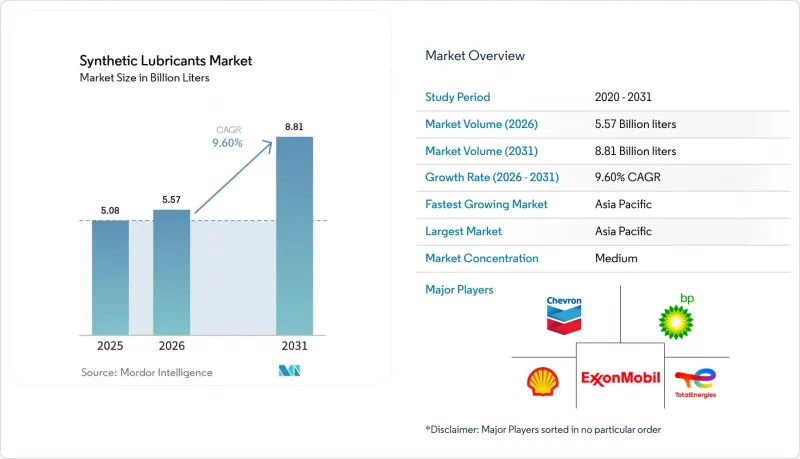
Mordor Intelligence에 의하면, 2026년 합성 윤활유 시장 규모는 55억 7,000만 리터에 이를 것으로 예상되고 2025년 50억 8,000만 리터로부터 확대해, 2031년에는 88억 1,000만 리터에 달할 것으로 예측됩니다.
2026년부터 2031년까지 연평균 성장률(CAGR) 9.6%로 성장할 것으로 전망됩니다.
본 보고서에서는 업계를 제품 유형별(엔진 오일, 변속기·기어 오일, 작동유 등), 기유별(폴리아알파올레핀(PAO), 에스테르, 폴리알킬렌글리콜(PAG) 등), 최종 사용자별(발전, 자동차, 중장비 등), 지역별(아시아태평양, 북미, 유럽 등)로 분류하고 있습니다. 시장 전망은 판매량(리터) 기준으로 제시되어 있습니다.
세계의 합성 윤활유 시장 동향 및 인사이트
자동차 애프터마켓에서 고성능 합성 엔진 오일의 사용 확대
2024년 이후 애프터마켓에서 완전 합성 엔진 오일로 전환되는 추세는 2025년 3월 API SQ 규격이 시행되면서 두드러지게 나타났습니다. 이 새로운 규격을 충족하는 셸의 '헬릭스 울트라' 이 시리즈는 최대 출력을 유지하면서 연비를 향상시키는 성능을 발휘하고 있어, 서비스 센터에서 기본 주입 오일로 프리미엄 합성 오일을 권장하는 계기가 되고 있습니다. 점도가 낮을수록 콜드 스타트 시 연비 효율이 향상되기 때문에 시장의 선호도는 0W-20, 나아가 0W-8 등급으로 빠르게 이동하고 있습니다. 2024년 하반기에 출시된 발보라인의 프리미엄 완전 합성 기어 오일은 기존 제품에 비해 4배의 마모 방지 성능을 발휘하며, 총 소유 비용(TCO)을 고려할 때 고객들도 그 가격 프리미엄을 기꺼이 수용하고 있습니다. 엄격한 규제와 소비자의 높은 인식 덕분에 북미와 유럽이 여전히 선두를 달리고 있지만, 딜러 네트워크가 오일 교환 주기 연장을 강조함에 따라 이러한 추세는 아시아태평양의 도시 시장으로도 점차 확산되고 있습니다.
엄격한 배기가스 및 연비 규제
2025년 7월에는 유로 7 규정이 예정대로 시행되었으며, 미국에서는 EPA 2026에 따라 대형 차량에 대한 규제가 강화되었습니다. 이러한 규정에 따라 5W-20이나 0W-20과 같은 저점도 등급의 사용이 의무화되어 있으며, 윤활유 배합 개발자들은 차세대 디젤 엔진의 65만 마일이라는 연장된 사용 한계를 충족하기 위해 산화 안정성을 높여야만 합니다. ILSAC GF-7 규격에는 광물유로는 달성하기 어려운 LSPI(저압 연소) 보호 및 타이밍 체인의 마모 억제 기능이 추가되어 있어, 이에 따라 합성 기유가 필수적입니다. 중국에서 수립이 진행 중인 '중국 VI'또는 인도의 '바라트 스테이지 VII' 이러한 체계 역시 유사한 기준치로 수렴해 가고 있으며, 사실상 가장 엄격한 요건이 세계 표준으로 자리 잡아가고 있습니다. 규격의 조화는 전 세계에서 동일한 배합을 적용할 수 있는 다국적 공급업체에 유리하게 작용하여, 검증 주기를 단축하고 규모의 경제를 강화하는 데 기여합니다.
합성 윤활유의 높은 초기 비용
완전 합성 제품은 대개 광물유보다 2-3배 비싼 가격에 판매되고 있으며, 이러한 가격 차이는 가격에 민감한 시장 부문에서 여전히 진입 장벽으로 작용하고 있습니다. 가동 주기가 짧은 경우, 오일 교환 주기를 연장함으로써 얻는 이점은 제한적이며, 개발도상국의 차량 관리 담당자들이 그로 인한 비용 부담을 정당화하기가 어려워지고 있습니다. 칼텍스의 데이터에 따르면, 정비 주기가 5,000 km 미만인 경우 투자 수익률(ROI)을 확보하기 어렵다는 사실이 확인되었습니다. 그러나 원유 가격의 상승으로 인해 광물유 원가 수준이 합성 윤활유보다 더 빠르게 상승하고 있어, 양자 간의 가격 차이는 점차 좁혀지고 있습니다. 한편, 예측 유지보수 도구는 수명 주기 비용 절감 효과를 뚜렷이 보여주고 있어, 상용 차량 플리트에서 이에 대한 거부감이 점차 줄어들고 있습니다.
부문별 분석
2025년, 엔진 오일은 합성 윤활유 시장에서 수량 기준 34.10%의 점유율을 차지했습니다. 이러한 위상은 내연 기관차의 막대한 도입 대수와 합성 윤활유가 제공하는 뛰어난 내구성에 힘입어 유지되고 있습니다. 변속기 및 기어 오일은 자동화 생산 라인과 풍력 터빈 모두에서 높은 부하 하에서도 깨끗한 작동이 요구되기 때문에 2위를 차지하고 있습니다. 작동유는 건설 업계의 호황과 로봇 기술 도입의 혜택을 받아, 광범위한 온도 범위에서 안정적인 점도를 제공합니다. 그리스는 윤활유가 떨어지지 않는 것이 필수적인 항공우주용 액추에이터나 중장비의 관절부에서 여전히 없어서는 안 될 존재입니다. 금속 가공액은 판매량 점유율은 낮지만, 정밀 가공 및 적층 가공 기술이 성숙해짐에 따라 10.84%라는 가장 높은 연평균 성장률(CAGR)을 기록하며 성장하고 있습니다.
이 부문의 전망은 ILSAC GF-7 및 API SQ에 의해 결정되며, 이 두 규격 모두 허용 마모량과 LSPI(저속 점화) 발생률을 저감합니다. 이러한 변화로 인해 오일 교환 주기를 연장하고, 정비소에 방문하는 횟수와 폐유 처리량을 줄일 수 있는 프리미엄 합성 윤활유가 유리해지고 있습니다. 또한, 미스트 발생이 적고 인화점이 높은 금속 가공액은 작업상의 위험을 줄이기 위해 공장에서 합성 에스테르 및 PAG 계열 시스템으로의 전환이 진행되고 있습니다. 이러한 추세들이 맞물리면서, 엔진 오일을 제외한 합성 윤활유 시장 규모는 2031년까지 꾸준히 확대될 것으로 확실시되고 있습니다.
지역별 분석
아시아태평양은 2025년에 합성 윤활유 시장의 40.00%를 차지했으며, 연평균 성장률(CAGR)은 10.62%로 전망됩니다. 중국의 첨단 제조업이 다시 가속화되고, 인도의 자동차 판매 대수가 두 자릿수 회복세를 보이면서 이 지역의 소비를 뒷받침하고 있습니다. 2026년 가동을 예정하고 있는 퀘이커 호튼의 장자강 공장 등 중국 연안 지역에 신설되는 블렌딩 공장은 고성장 분야를 겨냥한 공급의 현지화를 목표로 하는 공급업체들의 결의를 여실히 보여주고 있습니다. 일본에서는 고품질의 공장 충진용 윤활유에 대한 수요가 지속되고 있는 반면, 동남아시아 국가들에서는 산업 생산이 확대되면서 고객 기반이 넓어지고 있습니다. 베트남의 윤활유 시장은 자동차 제조업체와 중장비 운영업체 수요 증가에 힘입어 성장을 이어가고 있습니다.
북미는 판매량 기준 2위를 차지하며, 여전히 기술의 지표로 자리 잡고 있습니다. EPA의 2026년 규제 및 API의 카테고리 수립 과정이 배합 제조업체들을 차세대 첨가제 화학 분야로 이끌고 있습니다. 또한, 미국은 광범위한 프로파일렌 인프라 덕분에 고점도 PAO 공급을 주도하고 있지만, 2025년 중반에는 프로파일렌 공급 부족이 이익률을 위협했습니다. 캐나다의 오일샌드 및 광업용 차량, 그리고 멕시코의 자동차 수출 거점 등은 가동률 유지와 보증의 확실성을 확보하기 위해 합성 윤활유에 의존하는 안정적인 수요처가 되고 있습니다.
유럽은 엄격한 환경 규제와 선진적인 OEM 기술 기준을 통해 프리미엄 위상을 유지하고 있습니다. 유로 7 규제로 인해 저점도화와 후처리 시스템과의 높은 호환성이 요구됨에 따라, 경량 및 중량 차량 모두에서 에스테르 함량을 강화한 배합이 널리 채택되고 있습니다. 홋카이도의 해상 풍력 발전 회랑이나 이베리아 반도에서 부상하고 있는 재생에너지 클러스터에서는 바닷물에 노출되어도 견딜 수 있는 ‘ "충전 후 교체 불필요" 기어박스 오일에 대한 수요가 증가함에 따라, 고부가가치 PAG 및 PAO 블렌드의 적용 범위가 확대되고 있습니다. 동유럽의 산업 기반에서는 자동화에 대한 투자가 가속화됨에 따라 수요의 다양화가 진행되고 있습니다. 중동 및 아프리카 시장 규모는 작지만, 걸프 지역의 석유화학 허브와 남아프리카의 광산들이 혹독한 기후 조건 하에서 오일 교환 주기를 연장하고자 함에 따라, 광물유에서 합성유로의 전환이 서서히 진행되고 있습니다.
기타 혜택 :
- 엑셀 형식 시장 예측(ME) 시트
- 3개월간의 애널리스트 지원
자주 묻는 질문
목차
제1장 서론
제2장 조사 방법
제3장 주요 요약
제4장 시장 구도
제5장 시장 규모 및 성장 예측
제6장 경쟁 구도
제7장 시장 기회 및 향후 전망
KTH 26.07.07According to Mordor Intelligence, synthetic lubricants market size in 2026 is estimated at 5.57 Billion liters, growing from 2025 value of 5.08 Billion liters with 2031 projections showing 8.81 Billion liters, growing at 9.6% CAGR over 2026-2031.
This report Segments the Industry by Product Type (Engine Oils, Transmission and Gear Oils, Hydraulic Fluids, and More), by Base Oil (Polyalpha-Olefin (PAO), Esters, Polyalkylene Glycol (PAG), and More), by End User (Power Generation, Automotive, Heavy Equipment, and More), and Geography (Asia-Pacific, North America, Europe, and More). The Market Forecasts are Provided in Terms of Volume (Liters).
Global Synthetic Lubricants Market Trends and Insights
Increasing Usage of High-Performance Synthetic Engine Oils in the Automotive Aftermarket
The post-2024 aftermarket pivot toward full-synthetic engine oils became pronounced once the API SQ standard entered force in March 2025. Shell's Helix Ultra line, which satisfies the new category, demonstrates full power retention and better fuel economy, convincing service centers to recommend premium synthetics as default fills . Market preference is shifting rapidly to 0W-20 and even 0W-8 grades because lower viscosity improves fuel efficiency during cold starts. Valvoline's premium full-synthetic gear oils, launched late 2024, provide four-fold wear protection over conventional products and command price premiums that customers accept when total cost of ownership is explained. North America and Europe remain at the forefront thanks to higher regulatory stringency and consumer awareness, yet momentum is spreading to urban markets in Asia-Pacific as dealership networks highlight extended drain intervals.
Stringent Emission and Fuel-Economy Regulations
July 2025 marked the planned start of Euro 7, while EPA 2026 tightens heavy-duty requirements in the United States. These rules mandate lower-viscosity grades such as 5W-20 and 0W-20, forcing lubricant formulators to boost oxidation stability to satisfy extended service limits of 650,000 miles for next-generation diesel engines. The ILSAC GF-7 specification adds LSPI protection and timing chain wear control that mineral oils struggle to achieve, making synthetic base stocks indispensable. China's evolving China VI and India's Bharat Stage VII frameworks are converging toward similar thresholds, which effectively globalize the most stringent requirements. Harmonized standards benefit multinational suppliers that can deploy one formulation worldwide, cutting validation cycles and strengthening economies of scale.
Higher Upfront Cost of Synthetic Lubricants
Full-synthetic products often sell at prices two to three times those of mineral oils, a differential that remains a stumbling block in cost-sensitive segments. In short duty cycles the benefit of extended drains is muted, preventing fleet managers in developing economies from justifying the premium. Caltex data confirm that where service intervals sit below 5,000 km, ROI is difficult to secure. Rising crude prices, however, are lifting the cost base of mineral oils faster than synthetics, narrowing the gap. Meanwhile, predictive maintenance tools underscore lifetime savings, gradually eroding resistance among commercial fleets.
Other drivers and restraints analyzed in the detailed report include:
- Growth in Industrial Automation Demanding Advanced Hydraulic & Gear Oils
- Rapid Expansion in Aerospace, Defense and Offshore Renewables Demanding Synthetic Turbine & Gearbox Oils
- Growing Electric-Vehicle Fleet
For complete list of drivers and restraints, kindly check the Table Of Contents.
Segment Analysis
Engine oils captured 34.10% of the synthetic lubricants market in 2025 by volume, a position protected by the vast installed base of internal-combustion vehicles and the superior longevity synthetics deliver. Transmission and gear oils follow as the second-largest category because automated manufacturing lines and wind turbines both require high-load, clean-running formulations. Hydraulic fluids benefit from a construction upswing and robotics integration, supplying stable viscosity across wide temperature spreads. Greases remain indispensable in aerospace actuators and heavy machinery joints where drip-free lubrication is vital. Metalworking fluids, though holding a smaller volume share, advance at the fastest 10.84% CAGR as precision machining and additive manufacturing mature.
The segment outlook is shaped by ILSAC GF-7 and API SQ, both of which reduce permissible wear and LSPI occurrence. This shift favors premium synthetics that can sustain longer drains, reducing workshop visits, and oil disposal. Furthermore, metalworking fluids with low mist and high flash points mitigate occupational hazards, leading factories to migrate to synthetic ester-and-PAG systems. Together, these trends ensure that the synthetic lubricants market size for fluids beyond engine oils will expand steadily through 2031.
Complete Report Scope:
- By Product Type
- Engine Oils
- Transmission and Gear Oils
- Hydraulic Fluids
- Metalworking Fluids
- Greases
- Other Product Types (General Industrial Oils, etc.)
- By Base Oil
- Polyalpha-olefin (PAO)
- Esters
- Polyalkylene Glycol (PAG)
- Group III / GTL-derived Synthetic
- Others (Alkylated Naphthalene, etc.)
- By End User
- Automotive
- Power Generation
- Heavy Equipment
- Metallurgy and Metalworking
- Other End-user Industries (Oil and Gas, Marine, Data-centres, etc.)
- By Geography
- Asia-Pacific
- China
- India
- Japan
- South Korea
- Malaysia
- Indonesia
- Thailand
- Vietnam
- Rest of Asia-Pacific
- North America
- United States
- Canada
- Mexico
- Europe
- Germany
- United Kingdom
- France
- Italy
- Russia
- NORDIC Countries
- Turkey
- Rest of Europe
- South America
- Brazil
- Argentina
- Colombia
- Rest of South America
- Middle East and Africa
- Saudi Arabia
- United Arab Emirates
- Qatar
- Egypt
- South Africa
- Nigeria
- Rest of Middle East and Africa
- Asia-Pacific
Geography Analysis
Asia-Pacific held 40.00% of the synthetic lubricants market in 2025, with a 10.62% CAGR outlook. China's re-acceleration in advanced manufacturing, together with India's double-digit vehicle sales rebound, underpins regional consumption. New blending plants in coastal China, such as Quaker Houghton's Zhangjiagang facility scheduled for 2026, illustrate suppliers' determination to localize supply for high-growth sectors. Japan sustains demand for high-grade factory fills, while Southeast Asian economies ramp up industrial output, widening the customer base. Vietnam lubricants market is growing, driven by automotive manufacturing and rising demand from heavy equipment operators.
North America ranks second in volume and remains a technology bellwether. EPA 2026 rules and API's category pipeline push formulators into next-generation additive chemistry. The United States also dominates supply of high-viscosity PAO thanks to extensive propylene infrastructure, although propylene tightness predicted for mid-2025 could test margins. Canada's oil sands and mining fleets, plus Mexico's automotive export platforms, add stable demand pockets that rely on synthetic lubricants for uptime and warranty assurance.
Europe preserves its premium positioning through stringent environmental legislation and advanced OEM technical standards. Euro 7 compels lower viscosities and stronger aftertreatment compatibility, pushing adoption of ester-enhanced formulations in both light- and heavy-duty fleets. The North Sea offshore wind corridor and the Iberian Peninsula's emerging renewable clusters require fill-for-life gearbox oils that tolerate brine exposure, widening scope for high-value PAG and PAO blends. Eastern Europe's industrial base further diversifies demand as automation investments accelerate. The Middle East and Africa, while smaller, show a gradual shift from mineral to synthetic as Gulf petrochemical hubs and South African mines target longer drain intervals in harsh climates.
- Shell plc
- Exxon Mobil Corporation
- BP p.l.c. (Castrol)
- Chevron Corporation
- TotalEnergies
- Valvoline Global Operations (Saudi Aramco)
- China Petrochemical Corporation (Sinopec)
- PETRONAS Lubricants International
- FUCHS SE
- ENEOS Corporation
- Indian Oil Corporation Ltd
- AMSOIL Inc.
- Idemitsu Kosan Co.,Ltd.
- Gazpromneft-Lubricants Ltd.
- LUKOIL
- Phillips 66 Company
- Suncor Energy Inc.
- Quaker Chemical Corporation
- Repsol
- Motul
Additional Benefits:
- The market estimate (ME) sheet in Excel format
- 3 months of analyst support
TABLE OF CONTENTS
1 Introduction
- 1.1 Study Assumptions & Market Definition
- 1.2 Scope of the Study
2 Research Methodology
3 Executive Summary
4 Market Landscape
- 4.1 Market Overview
- 4.2 Market Drivers
- 4.2.1 Increasing Usage of High-Performance Synthetic Engine Oils in the Automotive Aftermarket
- 4.2.2 Stringent Emission & Fuel-Economy Regulations
- 4.2.3 Growth in Industrial Automation Demanding Advanced Hydraulic & Gear Oils
- 4.2.4 Rapid Expansion in Aerospace & Defence Requiring Synthetic Turbine Oils
- 4.2.5 Surge in Offshore Wind Installations Boosting Long-Drain Synthetic Gearbox Oils
- 4.3 Market Restraints
- 4.3.1 Higher Upfront Cost Versus Mineral Oils
- 4.3.2 Growing Electric-Vehicle Fleet Reducing Demand for Engine Oils
- 4.3.3 Volatility in Polyalphaolefin (PAO) Feed-Stock Supply
- 4.4 Value Chain Analysis
- 4.5 Porter's Five Forces Analysis
- 4.5.1 Bargaining Power of Suppliers
- 4.5.2 Bargaining Power of Buyers
- 4.5.3 Threat of New Entrants
- 4.5.4 Threat of Substitute Products
- 4.5.5 Degree of Competition
5 Market Size & Growth Forecasts (Volume)
- 5.1 By Product Type
- 5.1.1 Engine Oils
- 5.1.2 Transmission and Gear Oils
- 5.1.3 Hydraulic Fluids
- 5.1.4 Metalworking Fluids
- 5.1.5 Greases
- 5.1.6 Other Product Types (General Industrial Oils, etc.)
- 5.2 By Base Oil
- 5.2.1 Polyalpha-olefin (PAO)
- 5.2.2 Esters
- 5.2.3 Polyalkylene Glycol (PAG)
- 5.2.4 Group III / GTL-derived Synthetic
- 5.2.5 Others (Alkylated Naphthalene, etc.)
- 5.3 By End User
- 5.3.1 Automotive
- 5.3.2 Power Generation
- 5.3.3 Heavy Equipment
- 5.3.4 Metallurgy and Metalworking
- 5.3.5 Other End-user Industries (Oil and Gas, Marine, Data-centres, etc.)
- 5.4 By Geography
- 5.4.1 Asia-Pacific
- 5.4.1.1 China
- 5.4.1.2 India
- 5.4.1.3 Japan
- 5.4.1.4 South Korea
- 5.4.1.5 Malaysia
- 5.4.1.6 Indonesia
- 5.4.1.7 Thailand
- 5.4.1.8 Vietnam
- 5.4.1.9 Rest of Asia-Pacific
- 5.4.2 North America
- 5.4.2.1 United States
- 5.4.2.2 Canada
- 5.4.2.3 Mexico
- 5.4.3 Europe
- 5.4.3.1 Germany
- 5.4.3.2 United Kingdom
- 5.4.3.3 France
- 5.4.3.4 Italy
- 5.4.3.5 Russia
- 5.4.3.6 NORDIC Countries
- 5.4.3.7 Turkey
- 5.4.3.8 Rest of Europe
- 5.4.4 South America
- 5.4.4.1 Brazil
- 5.4.4.2 Argentina
- 5.4.4.3 Colombia
- 5.4.4.4 Rest of South America
- 5.4.5 Middle East and Africa
- 5.4.5.1 Saudi Arabia
- 5.4.5.2 United Arab Emirates
- 5.4.5.3 Qatar
- 5.4.5.4 Egypt
- 5.4.5.5 South Africa
- 5.4.5.6 Nigeria
- 5.4.5.7 Rest of Middle East and Africa
- 5.4.1 Asia-Pacific
6 Competitive Landscape
- 6.1 Market Concentration
- 6.2 Strategic Moves
- 6.3 Market Share Analysis
- 6.4 Company Profiles (includes Global-level Overview, Market-level Overview, Core Segments, Financials as available, Strategic Information, Market Rank/Share, Products & Services, Recent Developments)
- 6.4.1 Shell plc
- 6.4.2 Exxon Mobil Corporation
- 6.4.3 BP p.l.c. (Castrol)
- 6.4.4 Chevron Corporation
- 6.4.5 TotalEnergies
- 6.4.6 Valvoline Global Operations (Saudi Aramco)
- 6.4.7 China Petrochemical Corporation (Sinopec)
- 6.4.8 PETRONAS Lubricants International
- 6.4.9 FUCHS SE
- 6.4.10 ENEOS Corporation
- 6.4.11 Indian Oil Corporation Ltd
- 6.4.12 AMSOIL Inc.
- 6.4.13 Idemitsu Kosan Co.,Ltd.
- 6.4.14 Gazpromneft-Lubricants Ltd.
- 6.4.15 LUKOIL
- 6.4.16 Phillips 66 Company
- 6.4.17 Suncor Energy Inc.
- 6.4.18 Quaker Chemical Corporation
- 6.4.19 Repsol
- 6.4.20 Motul
7 Market Opportunities & Future Outlook
- 7.1 White-space & Unmet-need Assessment
- 7.2 Growing Adoption of Bio-lubricants