|
시장보고서
상품코드
2073450
이탈리아의 안과 의료기기 : 시장 점유율 분석, 업계 동향 및 통계, 성장 예측(2026-2031년)Italy Ophthalmic Devices - Market Share Analysis, Industry Trends & Statistics, Growth Forecasts (2026 - 2031) |
||||||
 Mordor Intelligence
Mordor Intelligence에 의하면, 이탈리아의 안과 의료기기 시장 규모는 2025년 15억 9,000만 달러로 평가되었습니다. 2026년에는 16억 8,000만 달러로 확대되어 2026-2031년에 걸쳐 CAGR 5.95%로 성장을 지속하여, 2031년까지 22억 5,000만 달러에 이를 것으로 예측됩니다.
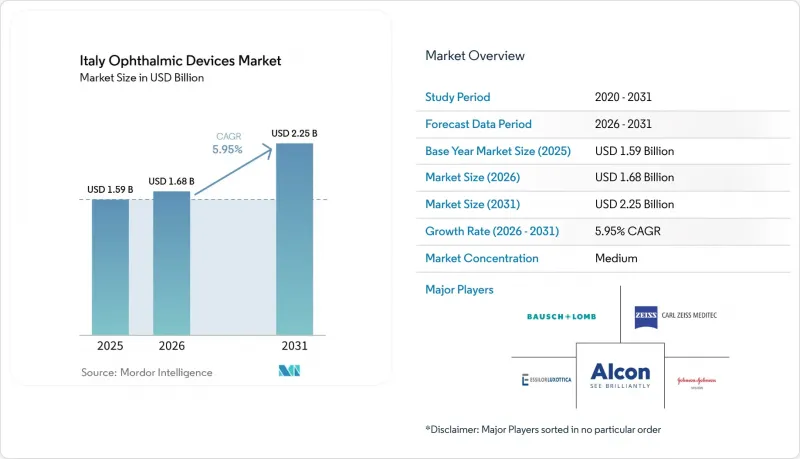
본 보고서는 기기 유형(진단·모니터링 기기, 수술용 기기, 시력 관리 기기), 질환별(백내장, 녹내장, 당뇨병성 망막병증, 기타 질환), 최종 사용자(병원, 안과 전문 클리닉, 기타)별로 분류되어 있습니다. 시장 전망은 금액(달러) 기준으로 제시되어 있습니다.
이탈리아의 안과 의료기기 시장 동향 및 분석
이탈리아 북부 지역의 당뇨병성 망막병증 및 연령 관련 황반변성(AMD) 유병률 증가
현재 북부 각 현에서는 성인 당뇨병 환자의 당뇨병성 망막병증(DR) 유병률이 최대 39%에 달하고 있으며, 이러한 부담으로 인해 스펙트럼 도메인 OCT 스캐너, 초광각 안저 카메라, 원격 안과 진료 키트에 대한 수요가 증가하고 있습니다. 검진 참여율이 50% 미만에 그치고 있어, 망막 영상을 3차 의료기관으로 전송해 신속한 판독을 실시하는 지역 밀착형 프로그램에 대한 필요성이 대두되고 있습니다. 당뇨병성 망막병증의 직접 치료비는 환자 1인당 4,050-5,799유로에 달하며, 이러한 지출 규모로 인해 보험사는 병변을 조기에 발견할 수 있는 기술에 대한 보험금 지급을 적극적으로 실시했습니다. 이에 대응하여 각 벤더사는 인공지능(AI) 기반의 분류 알고리즘을 하드웨어에 탑재하여 판독 시간을 단축하는 한편, 이탈리아의 안과 의료기기 시장에서 새로운 수익원을 개척하고 있습니다.
밀라노의 패션 산업 집적이 주도하는 높은 1인당 안경 지출
밀라노가 지닌 세계 패션계의 매력은 안경을 라이프스타일 액세서리로 재정의하여, “이탈리아산"라는 브랜드 덕분에 거시경제의 변동 속에서도 프리미엄 가격을 유지할 수 있게 되었습니다. 2024년 총 수출액은 전년 대비 0.6% 감소에 그쳤으며, 52억 3,600만 유로에 달하고, 고급 프레임 시장의 견조한 실적을 입증하고 있습니다. 젊은 전문직 계층은 재활용 아세테이트와 바이오 폴리머를 선호하고 있으며, 이것이 수익률을 높이는 지속가능성 추세를 주도하고 있습니다. 옴니채널을 전개하는 대형 체인은 디지털 기술을 활용한 시착 서비스를 통해 브랜드 스토리를 강화하고, 이탈리아의 안과 의료기기 시장에서 지배력을 확대되고 있습니다.
EU-MDR 적합성 승인 절차가 장기화되면서 제품 출시가 지연되고 있습니다.
2021년에 도입된 EU-MDR 제도에 따라 데이터 요건, 시판 후 모니터링 절차, 의료기기 고유 식별자(UDI)의 의무화가 강화되었습니다. 국내 중소 혁신 기업들은 현재 최대 18개월에 달하는 인증 지연에 직면해 있으며, 이로 인해 상품화 일정이 늦어지고 비용이 증가하고 있습니다. 인증 기관의 처리 능력이 제한적이기 때문에 신규 신청보다 인증 갱신이 우선시되고 있어, 다국적 기존 기업들이 시기적 이점을 얻고 있는 반면, 이탈리아의 안과 의료기기 시장으로의 혁신 유입은 둔화되고 있습니다.
부문별 분석
2025년, 이탈리아의 안과 의료기기 시장에서 시력 관리 기기가 63.70%의 점유율을 차지했습니다. 이는 국내의 뛰어난 설계 능력과 1인당 안경 교체 주기가 짧다는 점이 뒷받침하고 있습니다. 현재 프리미엄 아세테이트 안경테의 소매 가격은 250유로 전후이며, 블루라이트 차단 스마트 코팅이 자주 적용되고 있는 것은 소비자들이 성능과 미관에 투자하려는 의지가 높아지고 있음을 반영합니다. 콘택트렌즈 시장은 위생에 중점을 두는 추세가 뒷받침되고 있으며, 도시 지역의 직장인들이 가격보다 편의성을 우선시하는 경향이 있어 1일용 렌즈가 1개월용 렌즈보다 더 높은 성장세를 보이고 있습니다. 한편, 진단·모니터링 기기는 가장 빠르게 성장하고 있는 부문으로, 병원들이 AI 트리아지 소프트웨어와 연동되는 스펙트럼 도메인 OCT 장비로 교체를 진행함에 따라 연평균 성장률(CAGR) 8.02%를 기록하며 시장 규모가 확대되고 있습니다. 최근, OCT 분할 분야에서 정확도 0.9792로 검증된 ‘Attention-Based DenseNet"모델은 영상 진단 분야에 대한 투자에 임상적인 탄력을 불어넣고 있습니다. 이러한 추세로 인해, 이탈리아의 안과 의료기기 시장공급업체들에게 향후 수년에 걸친 수요의 확실성이 확고해졌습니다.
2세대 현장 진단용 안압계, 휴대용 안저 카메라, 클라우드 연동형 슬릿 램프는 이탈리아의 안과 의료기기 시장의 기술적 범위를 한층 더 넓히고 있습니다. 각 벤더사는 전자건강기록(EHR) 데이터를 통합한 분석 대시보드를 세트로 제공하는 사례가 늘어나고 있으며, 이를 통해 임상의는 질환의 진행 상황을 추적하고 보고 절차를 효율화할 수 있게 됩니다. 병원들이 조달 규정 준수를 간소화하기 위해 원스톱 파트너를 모색하는 가운데, 제품 포트폴리오의 충실도가 차별화 요인으로 대두되고 있습니다.
기타 혜택
- 엑셀 형식 시장 예측(ME) 시트
- 3개월간의 애널리스트 지원
자주 묻는 질문
목차
제1장 서론
제2장 조사 방법
제3장 주요 요약
제4장 시장 구도
제5장 시장 규모 및 성장 예측
제6장 경쟁 구도
제7장 시장 기회 및 향후 전망
KTH 26.07.08According to Mordor Intelligence, the italy ophthalmic devices market size is expected to grow from USD 1.59 billion in 2025 to USD 1.68 billion in 2026 and is forecast to reach USD 2.25 billion by 2031 at 5.95% CAGR over 2026-2031.
This report is Segmented by Device Type (Diagnostic & Monitoring Devices, Surgical Devices, and Vision Care Devices), Disease Indication (Cataract, Glaucoma, Diabetic Retinopathy, Other Disease Indications), End-User (Hospitals, Specialty Ophthalmic Clinics, and More). The Market Forecasts are Provided in Terms of Value (USD).
Italy Ophthalmic Devices Market Trends and Insights
Rising Prevalence of Diabetic Retinopathy & AMD In Northern Italy
Northern provinces now report diabetic retinopathy (DR) rates as high as 39% among adults with diabetes, a burden that elevates demand for spectral-domain OCT scanners, ultra-wide-field fundus cameras, and tele-ophthalmology kits. Screening uptake hovers below 50%, creating latitude for community-based programs that route retinal images to tertiary centers for rapid reads. Direct DR treatment costs lie between EUR 4,050 and 5,799 per patient, an outlay that convinces payers to reimburse technologies that catch pathology sooner rather than later. In response, vendors bundle artificial-intelligence triage algorithms with hardware to shorten interpretation times and unlock incremental revenue in the Italy ophthalmic devices market.
High Per-Capita Eyewear Spending Driven by Fashion Industry Clustering in Milan
Milan's global fashion pull reframes glasses as lifestyle accessories, allowing "Made in Italy" labels to command premium price points even during macroeconomic volatility. Exports still totaled EUR 5.236 billion in 2024 despite a fractional 0.6% dip from the prior year, underscoring the resilience of high-end frames. Younger professionals favor recycled acetate and bio-based polymers, driving a sustainability narrative that enhances margins. Omnichannel corporate chains amplify brand storytelling with digitally enabled fittings, strengthening their grip on the Italy ophthalmic devices market.
Lengthy EU-MDR Conformity Approval Cycles Delaying Product Launches
The 2021 EU-MDR regime increases data requirements, post-market surveillance steps, and unique device identification mandates. Smaller domestic innovators now face certification delays up to 18 months, pushing commercialization milestones and elevating costs. Limited notified-body capacity prioritizes certificate renewals over new submissions, giving multinational incumbents a timing advantage and slowing innovation flow into the Italy ophthalmic devices market.
Other drivers and restraints analyzed in the detailed report include:
- Rapid Public-Hospital Adoption of Femtosecond & Excimer Laser Platforms
- Government PNRR Funding for ASC Upgrades
- Price Caps Imposed By Servizio Sanitario Nazionale (SSN) Tenders
For complete list of drivers and restraints, kindly check the Table Of Contents.
Segment Analysis
Vision care devices secured 63.70% of the Italy ophthalmic devices market in 2025, propelled by domestic design strength and high per-capita eyewear replacement cycles. Premium acetate frames now retail near EUR 250 and frequently integrate smart coatings for blue-light absorption, reflecting consumer readiness to invest in performance and aesthetics. Contact lenses ride a hygiene-focused tailwind, with daily disposables outpacing monthlies as urban professionals choose convenience over price. Meanwhile diagnostic & monitoring devices represent the fastest-growing slice, expanding at an 8.02% CAGR as hospitals upgrade to spectral-domain OCT units that interface with AI triage software. The Attention-Based DenseNet model recently validated for OCT segmentation with 0.9792 accuracy adds clinical momentum for imaging investments. These dynamics cement multi-year demand certainty for suppliers in the Italy ophthalmic devices market.
Second-generation point-of-care tonometers, handheld fundus cameras, and cloud-linked slit lamps further widen the technological scope of the Italy ophthalmic devices market. Vendors increasingly bundle analytics dashboards that integrate Electronic Health Record (EHR) data, allowing clinicians to track disease progression and streamline referrals. Portfolio depth thus becomes a differentiator as hospitals seek single-source partners to simplify procurement compliance.
Complete Report Scope:
- By Device Type
- Diagnostic & Monitoring Devices
- OCT Scanners
- Fundus & Retinal Cameras
- Autorefractors & Keratometers
- Corneal Topography Systems
- Ultrasound Imaging Systems
- Perimeters & Tonometers
- Other Diagnostic & Monitoring Devices
- Surgical Devices
- Cataract Surgical Devices
- Vitreoretinal Surgical Devices
- Refreactive Surgical Devices
- Glaucoma Surgical Devices
- Other Surgical Devices
- Vision Care Devices
- Spectacles Frames & Lenses
- Contact Lenses
- Diagnostic & Monitoring Devices
- By Disease Indication
- Cataract
- Glaucoma
- Diabetic Retinopathy
- Other Disease Indications
- By End-user
- Hospitals
- Specialty Ophthalmic Clinics
- Ambulatory Surgery Centers (ASCs)
- Other End-users
List of Companies Covered in this Report:
- Alcon
- Johnson & Johnson
- EssilorLuxottica S.A.
- Carl Zeiss
- Bausch + Lomb Corp.
- Hoya Corp.
- CooperVision Inc.
- Topcon Corp.
- Nidek
- HAAG-Streit
- Heidelberg Engineering
- Quantel Medical SAS
- Danaher
- Glaukos Corp.
- Menicon Co. Ltd.
Additional Benefits:
- The market estimate (ME) sheet in Excel format
- 3 months of analyst support
TABLE OF CONTENTS
1 Introduction
- 1.1 Study Assumptions & Market Definition
- 1.2 Scope of the Study
2 Research Methodology
3 Executive Summary
4 Market Landscape
- 4.1 Market Overview
- 4.2 Market Drivers
- 4.2.1 Rising Prevalence of Diabetic Retinopathy & AMD In Northern Italy
- 4.2.2 High Per-Capita Eyewear Spending Driven by Fashion Industry Clustering in Milan
- 4.2.3 Rapid Public-Hospital Adoption of Femtosecond & Excimer Laser Platforms
- 4.2.4 Government "Piano Nazionale Di Ripresa (PNRR) " Funding for ASC Upgrades
- 4.2.5 Expansion of Corporate Optical Retail Chains
- 4.2.6 Domestic IOL Contract-Manufacturing Base Lowering Procurement Costs
- 4.3 Market Restraints
- 4.3.1 Lengthy EU-MDR Conformity Approval Cycles Delaying Product Launches
- 4.3.2 Price Caps Imposed By Servizio Sanitario Nazionale (SSN) Tenders
- 4.3.3 Shortage of Ophthalmologists in Southern Regions
- 4.3.4 Rising Post-Operative Endophthalmitis Litigation Risk
- 4.4 Regulatory Outlook
- 4.5 Porter's Five Forces Analysis
- 4.5.1 Threat of New Entrants
- 4.5.2 Bargaining Power of Buyers
- 4.5.3 Bargaining Power of Suppliers
- 4.5.4 Threat of Substitutes
- 4.5.5 Competitive Rivalry
5 Market Size & Growth Forecasts (Value, USD)
- 5.1 By Device Type
- 5.1.1 Diagnostic & Monitoring Devices
- 5.1.1.1 OCT Scanners
- 5.1.1.2 Fundus & Retinal Cameras
- 5.1.1.3 Autorefractors & Keratometers
- 5.1.1.4 Corneal Topography Systems
- 5.1.1.5 Ultrasound Imaging Systems
- 5.1.1.6 Perimeters & Tonometers
- 5.1.1.7 Other Diagnostic & Monitoring Devices
- 5.1.2 Surgical Devices
- 5.1.2.1 Cataract Surgical Devices
- 5.1.2.2 Vitreoretinal Surgical Devices
- 5.1.2.3 Refreactive Surgical Devices
- 5.1.2.4 Glaucoma Surgical Devices
- 5.1.2.5 Other Surgical Devices
- 5.1.3 Vision Care Devices
- 5.1.3.1 Spectacles Frames & Lenses
- 5.1.3.2 Contact Lenses
- 5.1.1 Diagnostic & Monitoring Devices
- 5.2 By Disease Indication
- 5.2.1 Cataract
- 5.2.2 Glaucoma
- 5.2.3 Diabetic Retinopathy
- 5.2.4 Other Disease Indications
- 5.3 By End-user
- 5.3.1 Hospitals
- 5.3.2 Specialty Ophthalmic Clinics
- 5.3.3 Ambulatory Surgery Centers (ASCs)
- 5.3.4 Other End-users
6 Competitive Landscape
- 6.1 Market Concentration
- 6.2 Market Share Analysis
- 6.3 Company Profiles (includes Global level Overview, Market level overview, Core Business Segments, Financials, Headcount, Key Information, Market Rank, Market Share, Products and Services, and analysis of Recent Developments)
- 6.3.1 Alcon Inc.
- 6.3.2 Johnson & Johnson Vision
- 6.3.3 EssilorLuxottica S.A.
- 6.3.4 Carl Zeiss Meditec AG
- 6.3.5 Bausch + Lomb Corp.
- 6.3.6 Hoya Corp.
- 6.3.7 CooperVision Inc.
- 6.3.8 Topcon Corp.
- 6.3.9 Nidek Co. Ltd.
- 6.3.10 HAAG-Streit Group
- 6.3.11 Heidelberg Engineering GmbH
- 6.3.12 Quantel Medical SAS
- 6.3.13 Leica Microsystems GmbH
- 6.3.14 Glaukos Corp.
- 6.3.15 Menicon Co. Ltd.
7 Market Opportunities & Future Outlook
- 7.1 White-space & Unmet-Need Assessment