|
시장보고서
상품코드
2073452
북미의 줄기세포 : 시장 점유율 분석, 업계 동향 및 통계, 성장 예측(2026-2031년)North America Stem Cell - Market Share Analysis, Industry Trends & Statistics, Growth Forecasts (2026 - 2031) |
||||||
 Mordor Intelligence
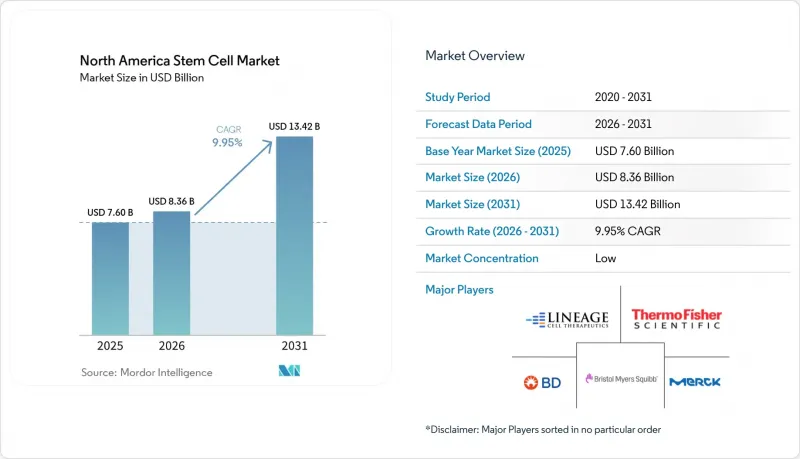
Mordor Intelligence에 의하면, 북미의 줄기세포 시장 규모는 2025년 76억 달러로 평가되었습니다. 2026년에는 83억 6,000만 달러로 확대되어 2026년부터 2031년에 걸쳐 CAGR 9.95%로 성장을 지속하여, 2031년에는 134억 2,000만 달러에 이를 것으로 예측됩니다.
본 보고서는 제품 유형(성체 줄기세포, 유도 만능 줄기세포 등), 용도(신경 질환, 정형외과 치료 등), 치료 유형(동종 이식 요법, 자가 이식 요법 등), 최종 사용자(병원 및 전문 클리닉 등) 및 지역(미국, 캐나다, 멕시코)별로 분류되어 있습니다. 시장 전망은 금액(달러) 기준으로 제시되어 있습니다.
북미의 줄기세포 시장 동향 및 인사이트
FDA의 패스트 트랙 및 RMAT 지정 가속화
RMAT의 적용 범위 확대에 따라 기존 개발 기간이 절반으로 단축되면서, 북미의 줄기세포 시장은 새로운 국면을 맞이했습니다. 소아 이식편 대 숙주 질환(GVHD)에 대한 remestemcel-L의 승인은 중간엽 줄기세포의 유효성을 입증했을 뿐만 아니라, 각 후원사가 신경학 및 심장학 분야에서도 유사한 승인을 신청하는 데 박차를 가하는 계기가 되었습니다. 희귀 안과 질환에 대한 최초의 캡슐화된 동종 유전자 치료제인 ‘“Encelto”이는 혁신적인 배송 플랫폼에 대한 규제 당국의 관용을 다시 한번 보여주고 있습니다. 효능 분석에 대한 합의가 이루어짐에 따라, 업계 분석가들은 2028년까지 RMAT 승인이 최소 25개의 서로 다른 적응증을 포괄하게 될 것이며, 북미의 줄기세포 시장이 전 세계 규제 동향의 지표로서의 입지를 공고히할 것으로 전망하고 있습니다.
기성 MSC 플랫폼에 대한 사모펀드 자금 조달의 급증
2,000만 달러를 초과하는 시리즈 A 및 시리즈 B 자금 조달 라운드에서는 현재 자동화된 동종 생산 라인이 일상적으로 주요 대상이 되고 있습니다. Kincell Bio사가 다목적 중간엽 줄기세포(MSC)의 생산 확대에만 전념하기 위해 2,200만 달러를 조달한 것은 규모의 경제에 따른 이점을 기대할 수 있는 플랫폼에 대한 투자자들의 관심이 높아지고 있음을 뒷받침합니다. 자동화가 성숙 단계에 이르면 1회당 비용이 50만 달러에서 5만 달러로 낮아질 것으로 예상되는 가운데, 북미의 줄기세포 시장에서는 벤처 캐피털 주도로 해당 지역 최초의 수직 통합형 '세포 공장'건설 경쟁이 치열하게 벌어지고 있습니다.
GMP 규모의 동종 세포 제조에 따른 높은 제조 원가
GMP 등급의 동종 요법은 엄격한 품질 관리와 숙련된 인력에 대한 수요로 인해 여전히 기존 생물학적 제제보다 3-4배의 비용이 듭니다. Ori Biotech사의 자동화 플랫폼은 인건비를 70% 절감할 것을 약속하고 있지만, 신생 기업들에게는 여전히 설비 투자가 걸림돌로 작용하고 있습니다. 수탁 개발·제조 기관(CDMO)은 일부 분야에서 생산 과잉에 직면하는 한편, 전문 역량 부족 문제도 겪고 있으며, 이로 인해 가격 변동이 발생하여 시장 전체의 경제성에 영향을 미치고 있습니다.
부문별 분석
2025년, 북미의 줄기세포 시장에서 성체 줄기세포가 51.25%의 점유율을 차지했습니다. 이는 수십 년에 걸친 안전성 데이터와 합리화된 규제 선례에 근거한 것입니다. 정형외과, 혈액학, 자가면역 질환 분야에서 확고한 임상적 활용을 바탕으로 지속적인 수요가 보장되고 있으나, 대량 투여가 필요한 적응증의 경우 여전히 생산 규모 확대에 한계가 있습니다. 유도 만능 줄기세포(iPS 세포)는 현재 시장 규모는 작지만, CRISPR 기술과 밀폐형 바이오리액터의 도입으로 생산 경제성이 획기적으로 개선되어 연평균 성장률(CAGR) 9.71%로 시장을 확대되고 있습니다.
AI를 활용한 배양 최적화를 통해 iPS 세포(iPSCs)의 배치 실패가 줄어들고 비용이 절감될 것으로 예상되며, 이에 따라 유전자 편집된 세포주는 향후 10년 내에 광범위한 동종 이식으로 확대 적용될 수 있을 것으로 전망됩니다. 윤리적 제약으로 인해 인간 배아 줄기세포는 여전히 틈새 연구 프로그램에 국한되어 있으며, 그 결과 성체 줄기세포 및 iPS 세포주가 북미의 줄기세포 산업의 상업적 중심을 형성하게 될 것입니다. 이러한 제품 유형 간경쟁 구도는 순수한 과학적 고려 사항이라기보다는 제조의 경제성에 의해 점점 더 좌우되고 있으며, 각 기업은 안전성, 유효성 및 상업적 실현 가능성 간의 최적의 균형을 모색하고 있습니다.
2025년 매출액 중 정형외과 수술이 24.75%를 차지했습니다. 이는 외과 의사들이 익숙한 기법과 보험 환급 제도에 부합하는 관절 내 및 척추에 대한 확립된 적용 방식이 기여한 결과입니다. 그러나 파킨슨병, 척수 손상, 다발성 경화증을 대상으로 한 최초의 인간 임상시험에서 지속적인 기능 개선이 입증됨에 따라, 신경 질환 적응증 분야의 연평균 성장률(CAGR)은 11.21%를 나타낼 것으로 예측됩니다.
외상성 뇌손상 및 신경손상에 대한 미국 국방부의 꾸준한 자금 지원 덕분에, 중개 연구의 진행이 가속화되고 민간 보험사들 간의 신뢰가 높아지고 있습니다. 종양학, 심혈관, 상처 관리 각 분야는 부수적인 성장 기회를 제공하지만, 북미의 줄기세포 시장 전체에서 제품 원가에 대한 우려를 완화하기 위해서는 제조 공정의 수율 향상을 지속적으로 도모해야 합니다. 응용 분야의 동향은 기술적 실현 가능성보다 충족되지 않은 의료 수요에 의해 점점 더 주도되고 있으며, 각 기업은 기존 의약품으로는 얻을 수 없는 독자적인 치료 효과를 줄기세포가 제공할 수 있는 질환에 초점을 맞추었습니다.
기타 혜택 :
- 엑셀 형식 시장 예측(ME) 시트
- 3개월간의 애널리스트 지원
자주 묻는 질문
목차
제1장 서론
제2장 조사 방법
제3장 주요 요약
제4장 시장 구도
제5장 시장 규모 및 성장 예측
제6장 경쟁 구도
제7장 시장 기회 및 향후 전망
KTH 26.07.07According to Mordor Intelligence, the north america stem cell market size is expected to grow from USD 7.60 billion in 2025 to USD 8.36 billion in 2026 and is forecast to reach USD 13.42 billion by 2031 at 9.95% CAGR over 2026-2031.
This report is Segmented by Product Type (Adult Stem Cells, Induced Pluripotent Stem Cells, and More), Application (Neurological Disorders, Orthopedic Treatment, and More), Treatment Type (Allogeneic Therapy, Autologous Therapy, and More), End User (Hospitals & Specialty Clinics, and More), and Geography (United States, Canada, Mexico). The Market Forecasts are Provided in Terms of Value (USD).
North America Stem Cell Market Trends and Insights
Accelerated FDA Fast-Track and RMAT Designations
A broader RMAT mandate has re-charted the North America stem cell market by halving historical development timelines. Approval of remestemcel-L for pediatric graft-versus-host disease validated mesenchymal stem-cell efficacy and emboldened sponsors to file similar applications in neurology and cardiology. Encelto, the first encapsulated allogeneic gene therapy for rare eye disease, further shows regulators' tolerance for innovative delivery platforms. As potency assays gain consensus, industry analysts expect RMAT approvals to cover at least 25 distinct indications by 2028, cementing the North America stem cell market as the world's regulatory bellwether.
Surge in Private Equity Funding for Off-the-Shelf MSC Platforms
Series A and Series B rounds topping USD 20 million now routinely target automated allogeneic manufacturing lines. Kincell Bio's USD 22 million raise earmarked solely for scaling multipurpose mesenchymal stromal cell (MSC) production underscores investors' tilt toward platforms with economy-of-scale upside. With per-dose costs projected to drop from USD 500,000 to USD 50,000 once automation matures, the North America stem cell market is witnessing a venture-capital-driven race to build the region's first vertically integrated "cell-factories."
High COGS of GMP-Scale Allogeneic Manufacturing
GMP-grade allogeneic therapies still cost 3-4 times more than traditional biologics because of intensive quality controls and skilled-labor demands. Automation platforms from Ori Biotech promise 70% labor savings, yet capital outlays remain prohibitive for emerging firms. Contract development and manufacturing organizations (CDMOs) are experiencing overcapacity in some segments while facing shortages in specialized capabilities, creating pricing volatility that impacts overall market economics.
Other drivers and restraints analyzed in the detailed report include:
- Expansion of Hospital-Affiliated Stem-Cell Centers Across the U.S.
- Integration of CRISPR With iPSC Pipelines
- Patchwork State-Level Reimbursement Rules
For complete list of drivers and restraints, kindly check the Table Of Contents.
Segment Analysis
Adult stem cells controlled 51.25% of the North America stem cell market in 2025, supported by decades of safety data and streamlined regulatory precedent. Their entrenched clinical use in orthopedic, hematology and autoimmune disorders secures recurrent demand, yet scalability limits remain for large-volume indications. Induced pluripotent counterparts, though smaller today, are climbing at a 9.71% CAGR as CRISPR integration and closed-system bioreactors overhaul production economics.
AI-guided culture optimization is expected to trim Induced Pluripotent Stem Cells (iPSCs) batch failures and compress costs, positioning gene-edited lines for broad allogeneic deployment over the next decade. Ethical constraints continue to confine human embryonic cells to niche research programs, ensuring adult and iPSC lines will shape the commercial core of the North America stem cell industry landscape. The competitive dynamics between these product types are increasingly driven by manufacturing economics rather than purely scientific considerations, with companies seeking the optimal balance between safety, efficacy, and commercial viability.
Orthopedic procedures represented 24.75% of 2025 revenue, leveraging well-established intra-articular and spinal applications that align with surgeons' familiarity and reimbursement pathways. However, neurological indications are projected to post an 11.21% CAGR as first-in-human trials for Parkinson's disease, spinal cord injury and multiple sclerosis validate durable functional improvements.
Robust Defense Department funding for traumatic brain and nerve injury accelerates translational pipelines, reinforcing confidence among civilian payors. Oncology, cardiovascular and wound-care segments provide ancillary upside but will require continued process-yield gains to temper cost-of-goods concerns across the North America stem cell market. The application landscape is increasingly driven by unmet medical need rather than technical feasibility, with companies focusing on conditions where stem cells can provide unique therapeutic benefits unavailable through traditional pharmaceuticals.
Complete Report Scope:
- By Product Type
- Adult Stem Cells
- Induced Pluripotent Stem Cells
- Human Embryonic Stem Cells
- Other Product Types
- By Application
- Neurological Disorders
- Orthopedic Treatments
- Oncology Disorders
- Cardiovascular Disorders
- Injuries and Wounds
- Other Applications
- By Treatment Type
- Allogeneic Therapy
- Autologous Therapy
- Syngeneic Therapy
- By End User
- Hospitals & Specialty Clinics
- Academic and Research Institutes
- Biopharma and Biotech Firms
- Stem-Cell Banks
- Other End Users
- By Geography
- United States
- Canada
- Mexico
List of Companies Covered in this Report:
- Thermo Fisher Scientific
- Beckton Dickinson
- Merck
- Lonza Group
- Mesoblast Ltd.
- Fate Therapeutics Inc.
- Bristol-Myers Squibb (Bluebird Bio)
- Lineage Cell Therapeutics
- BrainStorm Cell
- Osiris Therapeutics
- Stem Cell Technologies
- Miltenyi Biotec
- AlloSource
- Organogenesis Holdings
- Gamida Cell Ltd.
- Pluristem Therapeutics
- Cynata Therapeutics
- Takara Bio
Additional Benefits:
- The market estimate (ME) sheet in Excel format
- 3 months of analyst support
TABLE OF CONTENTS
1 Introduction
- 1.1 Study Assumptions & Market Definition
- 1.2 Scope of the Study
2 Research Methodology
3 Executive Summary
4 Market Landscape
- 4.1 Market Overview
- 4.2 Market Drivers
- 4.2.1 Accelerated FDA Fast-Track and RMAT Designations
- 4.2.2 Surge in Private Equity Funding for off-the-shelf MSC Platforms
- 4.2.3 Expansion of Hospital-Affiliated Stem-Cell Centers across the U.S.
- 4.2.4 Integration of CRISPR with iPSC Pipelines
- 4.2.5 Pentagon & VA Grants for War-Injury Regenerative Programs
- 4.2.6 Corporate Decarbonization Policies Boosting "Green Bioprocessing" Demand
- 4.3 Market Restraints
- 4.3.1 High COGS of GMP-Scale Allogeneic Manufacturing
- 4.3.2 Patchwork State-Level Reimbursement Rules
- 4.3.3 Donor-Shortage Risk in Autologous Supply Chains
- 4.3.4 Tumorigenicity Concerns Slowing Pluripotent Approvals
- 4.4 Regulatory Landscape
- 4.5 Technological Outlook
- 4.6 Porter's Five Forces Analysis
- 4.6.1 Threat of New Entrants
- 4.6.2 Bargaining Power of Buyers
- 4.6.3 Bargaining Power of Suppliers
- 4.6.4 Threat of Substitutes
- 4.6.5 Intensity of Competitive Rivalry
5 Market Size & Growth Forecasts (Value)
- 5.1 By Product Type
- 5.1.1 Adult Stem Cells
- 5.1.2 Induced Pluripotent Stem Cells
- 5.1.3 Human Embryonic Stem Cells
- 5.1.4 Other Product Types
- 5.2 By Application
- 5.2.1 Neurological Disorders
- 5.2.2 Orthopedic Treatments
- 5.2.3 Oncology Disorders
- 5.2.4 Cardiovascular Disorders
- 5.2.5 Injuries and Wounds
- 5.2.6 Other Applications
- 5.3 By Treatment Type
- 5.3.1 Allogeneic Therapy
- 5.3.2 Autologous Therapy
- 5.3.3 Syngeneic Therapy
- 5.4 By End User
- 5.4.1 Hospitals & Specialty Clinics
- 5.4.2 Academic and Research Institutes
- 5.4.3 Biopharma and Biotech Firms
- 5.4.4 Stem-Cell Banks
- 5.4.5 Other End Users
- 5.5 By Geography
- 5.5.1 United States
- 5.5.2 Canada
- 5.5.3 Mexico
6 Competitive Landscape
- 6.1 Market Concentration
- 6.2 Market Share Analysis
- 6.3 Company Profiles (includes Global level Overview, Market level overview, Core Segments, Financials as available, Strategic Information, Market Rank/Share for key companies, Products & Services, and Recent Developments)
- 6.3.1 Thermo Fisher Scientific Inc.
- 6.3.2 Becton, Dickinson & Company
- 6.3.3 Merck KGaA (Sigma-Aldrich)
- 6.3.4 Lonza Group AG
- 6.3.5 Mesoblast Ltd.
- 6.3.6 Fate Therapeutics Inc.
- 6.3.7 Bristol-Myers Squibb (Bluebird Bio)
- 6.3.8 Lineage Cell Therapeutics
- 6.3.9 BrainStorm Cell Therapeutics
- 6.3.10 Osiris Therapeutics
- 6.3.11 STEMCELL Technologies Inc.
- 6.3.12 Miltenyi Biotec
- 6.3.13 AlloSource
- 6.3.14 Organogenesis Holdings
- 6.3.15 Gamida Cell Ltd.
- 6.3.16 Pluristem Therapeutics
- 6.3.17 Cynata Therapeutics
- 6.3.18 Takara Bio Inc.
7 Market Opportunities & Future Outlook
- 7.1 White-space & Unmet-Need Assessment