|
시장보고서
상품코드
2073460
중국의 치과 기기 : 시장 점유율 분석, 업계 동향 및 통계, 성장 예측(2026-2031년)China Dental Devices - Market Share Analysis, Industry Trends & Statistics, Growth Forecasts (2026 - 2031) |
||||||
 Mordor Intelligence
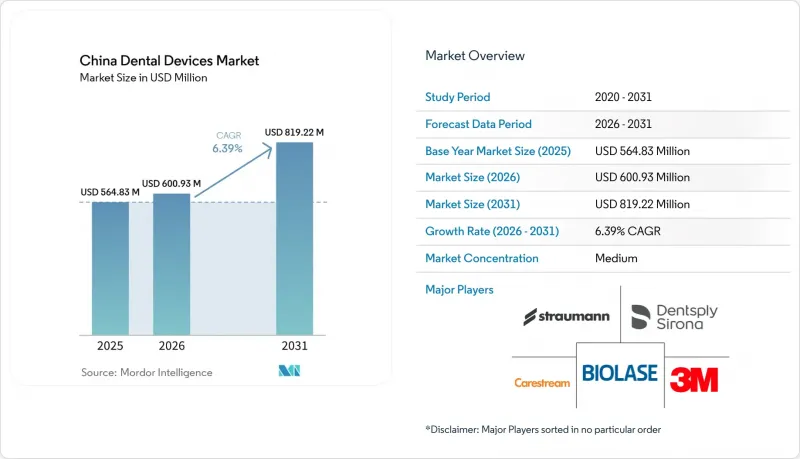
Mordor Intelligence에 의하면, 중국의 치과 기기 시장 규모는 2025년에 5억 6,483만 달러로 평가되었습니다. 2026년 6억 93만 달러에서 2031년까지 8억 1,922만 달러에 이를 것으로 예상되며, 예측 기간(2026-2031년) CAGR은 6.39%를 나타낼 전망입니다.
본 보고서는 제품별(진단 기기, 치료 기기, 치과용 소모품, 기타 치과 기기), 치료 분야별(교정치과, 치수 치료, 치주질환, 보철 치과), 최종 사용자별(치과 병원, 치과 진료소, 학술·연구 기관)로 분류되어 있습니다. 시장 전망은 금액(달러) 기준으로 제시되어 있습니다.
중국의 치과 기기 시장 동향 및 인사이트
중국 주요 도시에서의 디지털 치과 워크플로우 보급 확대
베이징, 상하이, 광저우, 선전의 치과에서는 아날로그 인상 채취에서 완전 디지털 구강 내 스캔 및 CAD/CAM을 통한 제작으로 비약적으로 전환하고 있으며, 이를 통해 치료 계획 소요 시간을 60% 단축하고, 진료 수락률을 32% 향상시켰습니다. 치과 진료용 기기를 클라우드에 통합함으로써, 치과의사는 치과 기공소와 실시간으로 보철물을 공동 설계할 수 있게 되어, 납기 기간을 며칠에서 몇 시간으로 단축하고 있습니다. 경쟁 심화는 소프트웨어 생태계로 옮겨가고 있으며, 스캐너, 밀링 장비, AI 설계 모듈을 단일 구독 패키지로 묶어 제공할 수 있는 공급업체에게 경쟁 우위가 생기고 있습니다. 이 도시들의 초기 기술 도입자들은 전국적인 도입 양상에 영향을 미치며, 2차 시장으로의 디지털 도구 보급을 가속화하는 동시에 중국의 치과 장비 시장 전체의 장기적인 수요를 뒷받침하고 있습니다.
중국 국민의료보험 시범 사업에서 임플란트 치료 적용 범위 확대
치과 임플란트에 대한 첫 전국 입찰을 통해 병원 평균 가격이 55% 인하되었으며, 225만 세트를 목표로 하여 환자의 연간 부담액이 약 40억 위안 감소한 것으로 추산됩니다. 한때는 본인 부담금을 감당할 수 있는 부유층에게만 국한되었던 임플란트 치료가, 현재는 더 폭넓은 중산층에게도 부담 없는 가격대가 되어, 2030년까지 잠재 고객층이 30% 확대될 전망입니다. 입찰 물량을 보장할 수 있는 병원은 중앙정부로부터 보조금을 받을 수 있으며, 현지 생산 능력을 확대할 수 있는 제조업체는 시장 점유율을 확보하고 있습니다. 각 성의 시범 사업이 영구적인 상환 제도로 통합됨에 따라, 중국의 치과 기기 시장은 구조적인 변화를 겪고 있습니다. 즉, 가성비가 뛰어난 제품의 판매량이 급증하는 반면, 프리미엄 시스템은 차별화된 표면 기술을 통해 틈새 시장에서 입지를 유지하고 있습니다.
고급 기기에 대한 공동구매 단체의 가격 압박
임플란트 입찰에 이어, 병원 컨소시엄은 공동 조달 대상을 CBCT 및 체어사이드 밀링 유닛으로까지 확대함에 따라 평균 판매 가격이 최대 35% 하락했습니다. 각 제조업체들은 목표 가격을 달성하기 위해 필수적이지 않은 기능을 제거한 단계별 제품 라인업으로 대응하고 있습니다. 이 정책은 비용 구조가 효율적인 국내 제조업체에 유리하게 작용하여 다국적 기업의 프리미엄 시장 점유율을 잠식하고, 중국의 치과 기기 시장의 전반적인 매출 성장을 둔화시키고 있습니다.
부문별 분석
2025년에는 치과용 소모품이 매출의 46.06%를 차지했으며, 그 주력은 대량으로 소비되는 임플란트, 크라운, 생체 재료였습니다. 전국적인 임플란트 입찰을 통해 환자의 본인 부담금이 대폭 줄어들었고, 현립병원에서 나사 고정식 크라운의 보급이 확대되었습니다. 소모품 시장은 연평균 성장률(CAGR) 3.08%로 확대될 것으로 예상되며, 2031년까지 중국의 치과 기기 시장 규모에서 가장 큰 점유율을 유지할 전망입니다. 진단 기기는 시장 규모는 작지만, AI 도구가 진료 의자의 생산성을 향상시켜, '건강 중국 2030' 해당 목표에 부합하는 예방적 개입을 가능하게 하기 위해, 비율 면에서 가장 빠른 증가세가 예상됩니다. AI를 활용한 충치 감지 소프트웨어는 중국의 치과에서 93.40%의 정확도를 보였으며, 대규모 도입을 위한 준비가 완료되었음을 보여주고 있습니다.
클라우드 연동형 구강 내 스캐너는 인상 채취 워크플로우를 단축하고, 체어사이드 밀링 장치와 연동함으로써 하이브리드 세라믹 블록의 추가 판매를 촉진하고 있습니다. 치료용 기기, 특히 CAD/CAM 시스템은 당일 치료로 환자 만족도를 높여 내원 환자 수가 많은 치과에서 조기에 보급되고 있습니다. 에어 폴리셔와 외과용 모터를 포함한 ‘"기타 기기"는 전국 민간 치과 병원의 설치 대수가 12만 대를 넘어섬에 따라 꾸준히 성장하고 있습니다. 이러한 부문 간의 상호작용이 생태계의 정착도를 높이고, 중국의 치과 기기 시장에서 다각적인 수익 흐름을 강화하고 있습니다.
기타 혜택 :
- 엑셀 형식 시장 예측(ME) 시트
- 3개월간의 애널리스트 지원
자주 묻는 질문
목차
제1장 서론
제2장 조사 방법
제3장 주요 요약
제4장 시장 구도
제5장 시장 규모 및 성장 예측(중국의 치과 기기 시장, 금액 기준)
제6장 경쟁 구도
제7장 시장 기회 및 향후 전망
KTH 26.07.07According to Mordor Intelligence, the china dental devices market size was valued at USD 564.83 million in 2025 and estimated to grow from USD 600.93 million in 2026 to reach USD 819.22 million by 2031, at a CAGR of 6.39% during the forecast period (2026-2031).
This report is Segmented by Product (Diagnostics Equipment, Therapeutic Equipment, Dental Consumables, Other Dental Devices), Treatment (Orthodontic, Endodontic, Peridontic, Prosthodontic), End User (Dental Hospitals, Dental Clinics, Academic & Research Institutes). The Market Forecasts are Provided in Terms of Value (USD).
China Dental Devices Market Trends and Insights
Growing Adoption of Digital Dentistry Workflows in Tier-1 Chinese Cities
Clinics in Beijing, Shanghai, Guangzhou, and Shenzhen are leapfrogging from analogue impressions to fully digital intraoral scanning and CAD/CAM fabrication, cutting treatment-planning time by 60% and lifting case-acceptance rates by 32%. The cloud integration of chairside devices lets practitioners co-design restorations with labs in real time, compressing turnaround from days to hours. Competitive intensity is shifting toward software ecosystems, tilting advantage to vendors able to bundle scanners, mills, and AI design modules as a single subscription. Early technology adopters in these cities influence referral patterns nationwide, accelerating the diffusion of digital tools into tier-2 markets and undergirding long-run demand across the China dental devices market.
Expanding Coverage of Implantology in China's National Medical Insurance Pilot
The first national tender for dental implants reduced average hospital prices by 55%, targeting 2.25 million sets and saving patients an estimated CNY4 billion annually. Implants-once confined to self-pay elites-are now affordable to a broader middle-income cohort, enlarging the addressable pool by 30% through 2030. Hospitals able to guarantee tender volumes benefit from central subsidies, while manufacturers with scalable local capacity win share. As provincial pilots converge into a permanent reimbursement schedule, the China dental devices market experiences a structural shift: value items rise sharply in unit volume, premium systems defend niche positioning through differentiated surface technologies.
Price Pressures from Group Purchasing Organizations on High-end Equipment
Following the implant tender, hospital consortia are extending pooled procurement to CBCT and chairside milling units, compressing average selling prices by up to 35%. Makers respond with tiered portfolios, stripping non-essential features to hit target price points. The policy favours domestic producers with leaner cost structures, eroding premium share for multinationals and moderating overall revenue expansion within the China dental devices market.
Other drivers and restraints analyzed in the detailed report include:
- Aging Population Driving Prosthodontic & Implant Demand in Coastal Provinces
- Cosmetic Consciousness Among Millennials Boosting Demand for Clear Aligners
- Shortage of Trained Oral Radiologists Limiting Imaging Adoption in Lower-Tier Cities
For complete list of drivers and restraints, kindly check the Table Of Contents.
Segment Analysis
Dental consumables commanded 46.06% revenue in 2025, anchored by high-volume implants, crowns, and biomaterials. The national implant tender slashed patient out-of-pocket costs, widening penetration of screw-retained crowns across county hospitals. Consumables are projected to expand at a 3.08% CAGR, sustaining the largest slice of the China dental devices market size through 2031. Diagnostic equipment, though smaller in value, is set for the fastest proportional climb as AI tools elevate chair productivity and enable preventive interventions aligned with Healthy China 2030 targets. AI-guided caries-detection software demonstrated 93.40% accuracy in Chinese clinics, illustrating readiness for widescale rollout.
Cloud-connected intraoral scanners shorten impression workflows and dovetail with chairside mills, encouraging upsell of hybrid ceramic blocks. Therapeutic equipment, notably CAD/CAM systems, finds early traction in high-footfall practices where same-day dentistry boosts patient satisfaction. 'Other devices', including air-polishers and surgical motors, grow steadily as the installed base of private clinics rises above 120,000 nationwide. The interplay among these segments strengthens ecosystem stickiness, reinforcing multi-line revenue flows within the China dental devices market.
Complete Report Scope:
- By Product
- Diagnostics Equipment
- Dental Laser
- Soft Tissue Lasers
- Hard Tissue Lasers
- Radiology Equipment
- Extra Oral Radiology Equipment
- Intra-oral Radiology Equipment
- Dental Chair and Equipment
- Dental Laser
- Therapeutic Equipment
- Dental Hand Pieces
- Electrosurgical Systems
- CAD/CAM Systems
- Milling Equipment
- Casting Machine
- Other Therapeutic Equipments
- Dental Consumables
- Dental Biomaterial
- Dental Implants
- Crowns and Bridges
- Other Dental Consumables
- Other Dental Devices
- Diagnostics Equipment
- By Treatment
- Orthodontic
- Endodontic
- Peridontic
- Prosthodontic
- By End User
- Dental Hospitals
- Dental Clinics
- Academic & Research Institutes
List of Companies Covered in this Report:
- Mindray
- Foshan ANLE Dental Equipment Co., Ltd. (Sinol)
- Ningbo Runyes Medical Instrument Co., Ltd.
- Shanghai Fosun Pharmaceutical Co., Ltd. (Sail Dental)
- Guangdong Huge Dental Material Co., Ltd.
- Align Technology
- Straumann Group
- Dentsply Sirona
- Medit Corporation
- Envista
- GC Corporation
- Ivoclar Vivadent
- Kulzer GmbH (Mitsui Chemicals)
- Planmeca
- Carestream Dental
- Vatech Co., Ltd.
- Shenzhen Upcera Dental Technology Co., Ltd.
- Shandong Huge Dental Material Corporation
- Shanghai Luk Company Ltd
- Runyes Medical Instrument Development Co
- Hangzhou Insert Dental Equipment Co., Ltd.
Additional Benefits:
- The market estimate (ME) sheet in Excel format
- 3 months of analyst support
TABLE OF CONTENTS
1 Introduction
- 1.1 Study Assumptions & Market Definition
- 1.2 Scope of the Study
2 Research Methodology
3 Executive Summary
4 Market Landscape
- 4.1 Market Overview
- 4.2 Market Drivers
- 4.2.1 Growing Adoption of Digital Dentistry Workflows in Tier-1 Chinese Cities
- 4.2.2 Expanding Coverage of Implantology in China's National Medical Insurance Pilot
- 4.2.3 Rise of Dental Service Organizations (DSOs) Accelerating Bulk Equipment Procurement
- 4.2.4 Aging Population Driving Prosthodontic & Implant Demand in Coastal Provinces
- 4.2.5 Cosmetic Consciousness Among Millennials Boosting Demand for Clear Aligners
- 4.2.6 Government's "Healthy China 2030" Targets Supporting Preventive Equipment Investments
- 4.3 Market Restraints
- 4.3.1 Price Pressures from Group Purchasing Organizations on High-end Equipment
- 4.3.2 Shortage of Trained Oral Radiologists Limiting Imaging Adoption in Lower-Tier Cities
- 4.3.3 Persistent Import Dependency for High-precision CAD/CAM Materials
- 4.3.4 Regulatory Delays in NMPA Approval for Novel Class III Dental Implants
- 4.4 Value / Supply-Chain Analysis
- 4.5 Regulatory Landscape
- 4.6 Technological Outlook
- 4.7 Porter's Five Forces
- 4.7.1 Bargaining Power of Suppliers
- 4.7.2 Bargaining Power of Buyers
- 4.7.3 Threat of New Entrants
- 4.7.4 Threat of Substitutes
- 4.7.5 Competitive Rivalry
5 Market Size & Growth Forecasts (China Dental Devices Market, Value)
- 5.1 By Product
- 5.1.1 Diagnostics Equipment
- 5.1.1.1 Dental Laser
- 5.1.1.1.1 Soft Tissue Lasers
- 5.1.1.1.2 Hard Tissue Lasers
- 5.1.1.2 Radiology Equipment
- 5.1.1.2.1 Extra Oral Radiology Equipment
- 5.1.1.2.2 Intra-oral Radiology Equipment
- 5.1.1.3 Dental Chair and Equipment
- 5.1.1.1 Dental Laser
- 5.1.2 Therapeutic Equipment
- 5.1.2.1 Dental Hand Pieces
- 5.1.2.2 Electrosurgical Systems
- 5.1.2.3 CAD/CAM Systems
- 5.1.2.4 Milling Equipment
- 5.1.2.5 Casting Machine
- 5.1.2.6 Other Therapeutic Equipments
- 5.1.3 Dental Consumables
- 5.1.3.1 Dental Biomaterial
- 5.1.3.2 Dental Implants
- 5.1.3.3 Crowns and Bridges
- 5.1.3.4 Other Dental Consumables
- 5.1.4 Other Dental Devices
- 5.1.1 Diagnostics Equipment
- 5.2 By Treatment
- 5.2.1 Orthodontic
- 5.2.2 Endodontic
- 5.2.3 Peridontic
- 5.2.4 Prosthodontic
- 5.3 By End User
- 5.3.1 Dental Hospitals
- 5.3.2 Dental Clinics
- 5.3.3 Academic & Research Institutes
6 Competitive Landscape
- 6.1 Market Concentration
- 6.2 Market Share Analysis
- 6.3 Company Profiles {(includes Global level Overview, Market level overview, Core Segments, Financials as available, Strategic Information, Market Rank/Share for key companies, Products & Services, and Recent Developments)}
- 6.3.1 Shenzhen Mindray Bio-Medical Electronics Co., Ltd.
- 6.3.2 Foshan ANLE Dental Equipment Co., Ltd. (Sinol)
- 6.3.3 Ningbo Runyes Medical Instrument Co., Ltd.
- 6.3.4 Shanghai Fosun Pharmaceutical Co., Ltd. (Sail Dental)
- 6.3.5 Guangdong Huge Dental Material Co., Ltd.
- 6.3.6 Align Technology, Inc.
- 6.3.7 Straumann Holding AG
- 6.3.8 Dentsply Sirona Inc.
- 6.3.9 Medit Corporation
- 6.3.10 Envista Holdings Corporation
- 6.3.11 GC Corporation
- 6.3.12 Ivoclar Vivadent AG
- 6.3.12.1 Ivoclar Vivadent AG
- 6.3.13 Kulzer GmbH (Mitsui Chemicals)
- 6.3.14 Planmeca Oy
- 6.3.15 Carestream Dental LLC
- 6.3.16 Vatech Co., Ltd.
- 6.3.17 Shenzhen Upcera Dental Technology Co., Ltd.
- 6.3.18 Shandong Huge Dental Material Corporation
- 6.3.19 Shanghai Luk Company Ltd
- 6.3.20 Runyes Medical Instrument Development Co
- 6.3.21 Hangzhou Insert Dental Equipment Co., Ltd.
7 Market Opportunities & Future Outlook
- 7.1 White-space & Unmet-need Assessment
- 7.1.1 Integration of Chair-side AI for Early Caries Detection in Community Clinics
- 7.1.2 Locally Manufactured Zirconia Blocks for Cost-effective CAD/CAM Restorations
- 7.1.3 Expansion of Mobile Dental Vans in Rural Western Provinces
- 7.1.4 Subscription-based Equipment-as-a-Service Models for DSOs