|
시장보고서
상품코드
2073481
방위 부문용 위성통신 : 시장 점유율 분석, 업계 동향 및 통계, 성장 예측(2026-2031년)Satellite Communication In The Defense Sector - Market Share Analysis, Industry Trends & Statistics, Growth Forecasts (2026 - 2031) |
||||||
 Mordor Intelligence
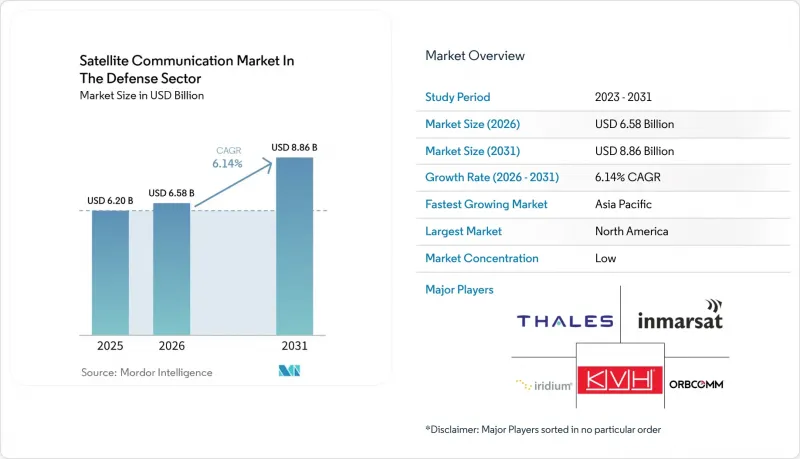
Mordor Intelligence에 의하면, 방위 부문용 위성통신 시장 규모는 2025년 62억 달러로 평가되었습니다. 2026년에는 65억 8,000만 달러로 확대되어 2026-2031년에 걸쳐 CAGR 6.14%로 성장을 지속하여, 2031년에는 88억 6,000만 달러에 이를 것으로 예측됩니다.
본 보고서는 유형(지상 장비, 서비스), 플랫폼(육상 부대, 해군, 항공기), 주파수 대역(L대역, S대역, C대역, X대역, Ku대역, Ka대역, Q/V대역, 광통신), 용도(C3, ISR, 원격 감지, 재난 구호, ELINT/SIGINT), 지역별로 분류되어 있습니다. 시장 전망은 금액(달러) 기준으로 제시되어 있습니다.
방위 부문용 위성통신 시장 동향과 전망
네트워크 중심 전쟁에서 실시간 데이터 링크에 대한 수요 증가
네트워크 중심 작전은 중단 없는 저지연 연결에 의존하고 있지만, 기존의 정지 궤도 위성 아키텍처로는 전술 최전선에서 이러한 요건을 충족하는 데 어려움을 겪고 있습니다. 미국 국방부는 저지구 궤도, 중지구 궤도, 정지 궤도의 자산을 연계하여 단일 고장 지점을 제거하고, 방해에 강한 위성 군집 개발에 2억 4,800만 달러를 배정했습니다. ThinKom의 Ka2517과 같은 다중 궤도 단말기는 이미 SES의 O3b mPOWER MEO 네트워크와 정지 궤도(GEO) 오버레이 간에 동적 로밍을 입증했으며, 의도적인 방해 상황에서도 통신 연결을 유지하고 있습니다. 우크라이나에서의 전투 경험은 군용 게이트웨이를 뒷받침하는 상용 통신 용량의 가치를 재확인시켜 주었으며, 상용 위성 통신(SATCOM)을 “최후의 수단으로서의 이중화"가 아니라 “최전선의 자산"로 취급하도록 작전 교리의 개정을 촉구했습니다. 현재 소프트웨어 정의 무선(SDR)에는 적응형 누링 기능이 통합되어 있어, 전파 방해 발생이 급증할 때에도 부대는 간섭이 적은 채널로 전환할 수 있습니다. 또한, 컨스텔레이션 수준의 라우팅 알고리즘이 트래픽 부하를 분산시켜 지연 시간의 상한을 유지합니다. 센서 퓨전이 각 플랫폼에 보급됨에 따라, 운영자는 하드웨어 업데이트를 강요하지 않으면서도 대역폭의 유연성을 보장하는 ‘서비스형(as-a-service)"계약을 선호하는 경향이 있습니다.
안전한 위성통신(SATCOM)이 필요한 무인 시스템의 보급
무인 항공기, 해상 함정, 지상 로봇을 통해 시야 외(BVLOS) 환경에서도 안정적인 통신 연결에 대한 전장 내 수요가 증가하고 있습니다. L3Harris의 “Hawkeye III Lite VSAT"는 몇 분 만에 여러 궤도를 자동으로 포착하고, 이동 중에도 고해상도 비디오 스트림을 유지할 수 있는 견고한 신형 단말기의 대표적인 예입니다. 인공지능(AI)이 탑재된 페이로드로 인해 데이터 양이 급증하고 있어, 지연을 줄이기 위해 더 높은 주파수의 Ka 대역이나 레이저 크로스링크의 도입이 요구되고 있습니다. Orbit Communication Systems의 슬림형 MPT 안테나는 플랫폼의 기동성을 높이기 위해 관성 항법 장치를 통합하는 한편, 고도 정보 보증 기준에 부합하는 암호화 기능을 제공합니다. 보안 대책이 미흡한 통신 링크는 차량 해킹으로 이어질 수 있으므로, 군사 기관의 구매 담당자들은 임시 임대 계약이라 하더라도 주파수 호핑 및 양자 내성 암호화 계층을 강력히 요구하고 있습니다. 이에 대해 상용 사업자는 주파수 대역을 확보하고, 사이버 보안을 강화하며, 우선적인 복구 조항을 마련하는 ‘정부용 요금제"를 신설하여 대응하고 있습니다.
SATCOM 네트워크의 사이버 침입 및 방해에 대한 취약성
전자전 분야에서 적대 세력의 기술적 진보로 인해, 예측 가능한 위성 통과 경로와 표준화된 프로토콜이 노출되고 있습니다. GPS 스푸핑 사례는 출력이 작은 송신기라도 물류 거점을 마비시킬 수 있음을 보여주고 있으며, 반면 민간 운영 시간을 중시하여 구축된 상용 게이트웨이는 군용 견고성 기준을 충족하는 경우가 거의 없습니다. 5G 비지상파 네트워크 규격의 통합은 커버리지를 확대하는 한편, 해커가 도메인 간 프로토콜 핸드셰이크를 악용함으로써 공격 대상 영역을 넓히게 됩니다. 따라서 각국의 국방부는 스펙트럼 확산 방식이나 도청이 어려운 파형, 양자 내성을 갖춘 암호 키의 도입을 가속화하고 있습니다. 이러한 대책으로 인해 단말기의 복잡성과 가격이 상승하여 구형 자산의 교체 시기가 늦어질 가능성이 있습니다.
부문별 분석
2025년, 방위 부문용 위성통신 시장에서 지상 장비는 60.70%의 점유율을 유지했습니다. 이는 2000년대 초반부터 구축되어 온 고정형 및 이동형 안테나, 모뎀, 무전기 등의 방대한 재고에 힘입은 결과입니다. 현재 단말기 업그레이드는 설치 면적을 축소하고 멀티 궤도 로밍을 가능하게 하는 전자 제어 위상 배열을 중심으로 진행되고 있습니다. 소프트웨어 정의 모뎀은 경쟁하는 주파수 대역에서도 연결을 유지하기 위해 실시간으로 파형을 전환합니다. 한편, 포털 기반 관리 제품군을 통해 지휘관은 함대 전체의 연결 상태를 한눈에 파악할 수 있습니다.
한편, 서비스 부문은 7.03%라는 가장 높은 연평균 성장률(CAGR)을 보일 것으로 예측되며, 이는 하드웨어 소유에서 용량 기반 구독 모델로의 전환을 뒷받침하고 있습니다. 나토(NATO)가 SES와 체결한 O3b mPOWER 대역폭 관리 서비스 관련 2억 유로 규모의 계약은 새로운 지상 설비 없이도 확장 가능한 처리량을 요구하는 수요를 상징합니다. 이러한 체계 하에서는 공급업체가 위성의 감가상각, 노후화 위험, 발사 지연을 부담하기 때문에 군은 자금을 사용자 장비나 사이버 방어에 재할당할 수 있게 됩니다. 라이프사이클 분석에 따르면, 콘스텔레이션의 업데이트 주기가 10년 미만일 경우, 해당 서비스 모델이 총 소유 비용(TCO)을 절감하는 것으로 밝혀졌습니다. 이는 현재 많은 LEO(저지구궤도) 기반 시스템이 점차 도달하고 있는 임계치입니다.
2025년 방위 부문용 위성통신 시장 규모에서 지상 플랫폼이 38.10%의 점유율을 차지하며 시장을 주도했습니다. 이는 차량 탑재 시스템과 고정 지휘소에 대한 수십 년에 걸친 투자를 반영한 것입니다. 그러나 중고도·장거리 드론과 회전익식 ISR(정보·감시·정찰) 항공기의 활용 확대에 힘입어, 항공기 탑재 부문이 연평균 성장률(CAGR) 6.74%를 기록하며 성장을 주도하고 있습니다. L3Harris의 하이브리드 무선기는 SATCOM, 기내 통신, 셀룰러 통신을 단일 케이스 내에 통합하여, 이중화를 확보하는 동시에 항공기 탑재 과정을 간소화합니다.
항공기 탑재 부문의 성장은 실시간 센서 스트리밍에 대응하기 위해 기존 Ku대역 돔을 더 가벼운 Ka대역 또는 듀얼 밴드 개구부로 교체하는 유인 항공기 현대화 프로그램에서도 기인하고 있습니다. 의료 이송 및 VIP 임무에 배정된 여객 수송기 편대에서는 현재 상업용 항공기 내 기내 연결에 필적하는 암호화된 광대역 통신이 요구되고 있으며, Gogo Business Aviation과 같은 통합 업체들은 GEO-LEO-ATG 하이브리드 시스템을 군사 사양에 부합하도록 개발하는 데 주력하고 있습니다. 분산 운영 원칙에 따라 출격 빈도가 급증하는 가운데, 대역폭의 유연성은 필수 불가결한 요소가 되었으며, 매니지드 서비스가 표준 도입 수단으로 자리 잡고 있습니다.
지역별 분석
북미는 2025년 수익의 40.80%를 차지했으며, 그 배경에는 다층적인 회복탄력성을 우선시하는 미국의 현대화 프로그램과 상호 운용 가능한 게이트웨이가 필요한 캐나다의 ‘파이브 아이즈"에 대한 헌신이 있습니다. 미국 우주군의 “상업용 보강 우주 예비군(Commercial Augmentation Space Reserve)"모델은 위기 발생 시 상용 용량에 대한 접근을 공식적으로 규정하고 있으며, 대역폭 급증에 대응하고 사이버 우선권을 보장하는 서비스 수준 계약(SLA)이 포함되어 있습니다. 탄탄한 산업 기반을 바탕으로 단말기의 신속한 보급과 안전한 파형 인증이 보장되어, 이 지역은 레이저 크로스링크 및 양자 내성 암호화 도입을 선도하고 있습니다.
아시아태평양은 중국의 베이두(BeiDou) 확장, 인도의 3군 공통 위성통신(SATCOM) 로드맵, 일본의 내각 승인을 마친 X-밴드 업그레이드에 힘입어 7.78%라는 가장 높은 연평균 성장률(CAGR)을 보일 것으로 전망됩니다. 주권에 대한 우려가 국산 프로그램에 대한 자금 지원을 촉진하는 한편, 4개국 간의 합동 훈련이 상호운용성 기준 확립을 추진하고 있습니다. 호주의 장거리 공격 및 해상 초계 플랫폼은 광활한 해양을 횡단하는 위성 백홀에 의존하고 있으며, 이는 GEO-MEO-LEO 하이브리드 위성에 대한 안정적인 수요를 창출하고 있습니다. 이 지역 시장 규모는 2020년대 말까지 40기 이상의 마이크로 위성을 네트워크로 연결하여 영상 중계 및 안전한 통신을 실현하는 것을 목표로 하는 한국의 키로 위성 계획에 힘입어 더욱 강화되고 있습니다.
유럽에서는 안보 긴장이 고조됨에 따라 지출이 가속화되고 있습니다. 독일의 “SATCOMBw 3단계"는 주권적 역량에 기반해 대륙 전체의 전환을 주도하고 있으며, 이에 더해 프랑스의 “시라쿠사 4세"와 영국의 “스카이넷 6"가 이를 보완하고 있습니다. 이들 모두 Ka 대역의 처리량과 전자적 보호를 중시하고 있습니다. 유럽연합(EU)의 ‘IRIS2"이 체계는 민간과 정부 수요를 단일 조달 수단으로 통합하는 것을 목표로 하고 있지만, 회원국 간에는 거버넌스 및 수출 관리에 미치는 영향에 대해 논의가 계속되고 있습니다. SES의 인텔 새트 인수로 인해 GEO 및 MEO 위성군이 유럽의 단일 조직 아래 통합되었으나, 국가 안보 심사 과정에서 기술적 주권을 확보하기 위해 해당 기업의 과거 합작 사업에 대한 면밀한 조사가 진행되고 있습니다.
기타 혜택
- 엑셀 형식 시장 예측(ME) 시트
- 3개월간의 애널리스트 지원
자주 묻는 질문
목차
제1장 서론
제2장 조사 방법
제3장 주요 요약
제4장 시장 구도
제5장 시장 규모 및 성장 예측
제6장 경쟁 구도
제7장 시장 기회 및 향후 전망
KTH 26.07.08According to Mordor Intelligence, the satellite communication market size In The Defense Sector market is expected to grow from USD 6.20 billion in 2025 to USD 6.58 billion in 2026 and is forecast to reach USD 8.86 billion by 2031 at 6.14% CAGR over 2026-2031.
This report is Segmented by Type (Ground Equipment, Services), Platform (Land Forces, Naval Forces, Airborne), Frequency Band (L-Band, S-Band, C-Band, X-Band, Ku-Band, Ka-Band, Q/V and Optical), Application (C3, ISR, Remote Sensing, Disaster Relief, ELINT/SIGINT), and Geography. The Market Forecasts are Provided in Terms of Value (USD).
Insights and Trends of Satellite Communication Market In The Defense Sector
Growing Demand for Real-Time Data Links for Network-Centric Warfare
Net-centric operations hinge on uninterrupted, low-latency connectivity, a requirement that legacy geostationary architectures struggle to satisfy at the tactical edge. The Pentagon has allocated USD 248 million to develop jam-resistant constellations that mesh low-, medium- and geostationary-orbit assets, eliminating single points of failure. Multi-orbit terminals such as ThinKom's Ka2517 already demonstrate dynamic roaming across SES's O3b mPOWER MEO network and GEO overlays, sustaining links even under deliberate interference. Combat experience in Ukraine reinforced the value of commercial capacity backstopping military gateways, prompting doctrine updates that treat commercial SATCOM as a first-line asset rather than last-resort redundancy. Software-defined radios now integrate adaptive nulling so forces can pivot to cleaner channels when jamming spikes, and constellation-level routing algorithms balance traffic loads to maintain latency ceilings. As sensor fusion proliferates across platforms, operators gravitate toward as-a-service contracts that guarantee bandwidth elasticity without forcing hardware refresh.
Proliferation of Unmanned Systems Requiring Secure SATCOM
Unmanned aircraft, maritime vessels and ground robots are escalating theater demand for assured beyond-visual-line-of-sight links. L3Harris's Hawkeye III Lite VSAT exemplifies the new breed of rugged terminals that auto-acquire multiple orbits in minutes and sustain high-definition video streams under movement. Artificial-intelligence-enabled payloads multiply data volumes, compelling adoption of higher-frequency Ka-band and laser cross-links to contain latency. Orbit Communication Systems' low-profile MPT antennas integrate inertial navigation units for platform agility while offering encryption compliant with advanced information assurance standards. Because unsecured links translate into commandeered vehicles, military buyers insist on frequency-hopping, quantum-resistant encryption layers even for interim leases. Commercial operators have responded by carving out government tiers that reserve spectrum, harden cybersecurity and furnish priority restoration clauses.
Cyber-Intrusion and Jamming Vulnerabilities of SATCOM Networks
Adversarial advances in electronic warfare expose predictable satellite passes and standardized protocols. Incidents of GPS spoofing illustrate how even modest power transmitters can paralyze logistics nodes, while commercial gateways built for civilian uptime rarely meet military hardening thresholds. Integration of 5G-non-terrestrial-network standards, though expanding coverage, widens the attack surface as hackers exploit cross-domain protocol handshakes. Defense ministries therefore accelerate fielding of spread-spectrum, low-probability-of-intercept waveforms and quantum-safe encryption keys. These countermeasures elevate terminal complexity and price, potentially delaying replacement of legacy assets.
Other drivers and restraints analyzed in the detailed report include:
- Rapid Deployment of Resilient Small-Satellite Constellations
- Rising Defense Budgets Allocated to SATCOM Modernization
- High Capital and Launch Costs of Next-Gen SATCOM Infrastructure
For complete list of drivers and restraints, kindly check the Table Of Contents.
Segment Analysis
Ground equipment retained 60.70% share of the satellite communication market in the defense sector in 2025, underpinned by the vast inventory of fixed and mobile antennas, modems and transceivers fielded since the early 2000s. Terminal upgrades now center on electronically steered phased arrays that shrink footprint and enable multi-orbit roaming. Software-defined modems execute on-the-fly waveform shifts to maintain connectivity in contested bands, while portal-based management suites give commanders visibility into link health across fleets.
Services, however, are projected to register the strongest 7.03% CAGR, validating the shift from hardware ownership to capacity subscription. NATO's EUR 200 million contract with SES for managed O3b mPOWER bandwidth epitomizes demand for scalable throughput without new ground footprint. Under these constructs, vendors absorb satellite depreciation, obsolescence risk and launch delays, allowing militaries to redirect capital toward user equipment and cyber defense. Lifecycle analytics also reveal that service models cut total cost of ownership when constellation refresh periods fall below 10 years, a threshold many LEO-based systems now approach.
Land platforms dominated the satellite communication market size in the defense sector in 2025 with 38.10% share, reflecting decades of investment in vehicle-mounted systems and fixed command posts. Yet the airborne category leads growth at 6.74% CAGR, propelled by expanded use of medium-altitude long-endurance drones and rotary-wing ISR aircraft. L3Harris hybrid radios combine SATCOM, line-of-sight and cellular links inside a single enclosure, simplifying aircraft integration while ensuring redundancy.
Airborne growth also stems from manned aircraft modernization programs that replace legacy Ku-band radomes with lighter Ka-band or dual-band apertures to support real-time sensor streaming. Passenger-transport fleets assigned to medical evacuation or VIP missions now demand encrypted broadband comparable to commercial inflight connectivity, prompting integrators such as Gogo Business Aviation to adapt GEO-LEO-ATG hybrids for militarized configurations. As sortie rates intensify under distributed-operations doctrine, bandwidth elasticity becomes indispensable, positioning managed services as the default acquisition route.
Complete Report Scope:
- By Type
- Ground Equipment
- Antennas
- Modems and Transceivers
- Terminals (Manpack, Fly-Away, Vehicular)
- Services
- Managed SATCOM Services
- Leasing, Integration and Maintenance
- Ground Equipment
- By Platform
- Land Forces
- Naval Forces
- Airborne (Manned and Unmanned)
- By Frequency Band
- L-band
- S-band
- C-band
- X-band
- Ku-band
- Ka-band
- Q/V and Optical (Laser)
- By Application
- Command, Control and Communications (C3)
- Intelligence, Surveillance and Reconnaissance (ISR)
- Remote Sensing and Earth Observation
- Disaster Relief and Humanitarian Ops
- Electronic Intelligence (ELINT and SIGINT)
- Geography
- North America
- United States
- Canada
- South America
- Brazil
- Rest of South America
- Europe
- Germany
- United Kingdom
- France
- Italy
- Russia
- Rest of Europe
- Asia-Pacific
- China
- India
- Japan
- South Korea
- Australia
- Rest of Asia-Pacific
- Middle East and Africa
- GCC
- Turkey
- Israel
- South Africa
- Rest of Middle East and Africa
- North America
Geography Analysis
North America held 40.80% of 2025 revenue, anchored by U.S. modernization programs that prioritize layered resilience and by Canada's Five Eyes commitments that require interoperable gateways. The U.S. Space Force's Commercial Augmentation Space Reserve model formalizes access to commercial capacity during crises, embedding service-level agreements that guarantee surge bandwidth and cyber priority. Industrial-base depth ensures rapid terminal fielding and secure waveform certification, enabling the region to spearhead adoption of laser cross-links and quantum-safe encryption.
Asia-Pacific is projected to record the fastest 7.78% CAGR, catalyzed by China's BeiDou expansion, India's tri-service SATCOM roadmap and Japan's Cabinet-approved X-band upgrades. Sovereignty concerns drive indigenous program funding while quad-nation exercises push interoperability standards. Australia's long-range strike and maritime patrol platforms rely on satellite backhauls that traverse vast oceanic gaps, creating steady demand for GEO-MEO-LEO hybrids. Regional market depth is further reinforced by South Korea's kilo-satellite plan, which aims to network 40-plus microsats for imagery relay and secure communications by the end of the decade.
Europe accelerates its spend in the wake of heightened security tensions. Germany's SATCOMBw Stage 3 anchors a continental shift toward sovereign capability, complemented by France's Syracuse IV and the UK's Skynet 6, both of which emphasize Ka-band throughput and electronic protection. The European Union's IRIS2 framework seeks to federate commercial and governmental demand into a single procurement vehicle, though member states debate governance and export-control implications. SES's acquisition of Intelsat consolidates GEO and MEO fleets under one European roof, but national security reviews scrutinize the company's historical joint ventures to ensure technology sovereignty.
- Thales Group
- Airbus Defence and Space
- Lockheed Martin Corp.
- Northrop Grumman Corp.
- L3Harris Technologies Inc.
- Inmarsat Communications
- ViaSat Inc.
- Iridium Communications Inc.
- SES Government Solutions
- Cobham PLC
- ST Engineering iDirect
- Hughes Network Systems (EchoStar)
- Eutelsat Communications SA
- OneWeb Ltd.
- KVH Industries Inc.
- ORBCOMM Inc.
- Thuraya (Yahsat)
- General Dynamics Mission Systems
- Gilat Satellite Networks
Additional Benefits:
- The market estimate (ME) sheet in Excel format
- 3 months of analyst support
TABLE OF CONTENTS
1 INTRODUCTION
- 1.1 Study Assumptions and Market Definition
- 1.2 Scope of the Study
2 RESEARCH METHODOLOGY
3 EXECUTIVE SUMMARY
4 MARKET LANDSCAPE
- 4.1 Market Overview
- 4.2 Market Drivers
- 4.2.1 Growing demand for real-time data links for network-centric warfare
- 4.2.2 Proliferation of unmanned systems requiring secure SATCOM
- 4.2.3 Rapid deployment of resilient small-satellite constellations
- 4.2.4 Rising defense budgets allocated to SATCOM modernisation
- 4.2.5 Adoption of laser inter-satellite links to ease RF congestion
- 4.2.6 Integration of 5G-NTN standards into military SATCOM
- 4.3 Market Restraints
- 4.3.1 Cyber-intrusion and jamming vulnerabilities of SATCOM networks
- 4.3.2 High capital and launch costs of next-gen SATCOM infrastructure
- 4.3.3 Orbital-debris mitigation constraints on constellation size
- 4.3.4 RF-spectrum sharing conflict with 5G terrestrial networks
- 4.4 Value / Supply-Chain Analysis
- 4.5 Regulatory Landscape
- 4.6 Technological Outlook
- 4.7 Macroeconomic Impact Assessment
- 4.8 Porter's Five Forces Analysis
- 4.8.1 Threat of New Entrants
- 4.8.2 Bargaining Power of Buyers
- 4.8.3 Bargaining Power of Suppliers
- 4.8.4 Threat of Substitute Products
- 4.8.5 Intensity of Competitive Rivalry
- 4.9 Investment Analysis
5 MARKET SIZE AND GROWTH FORECASTS (VALUE)
- 5.1 By Type
- 5.1.1 Ground Equipment
- 5.1.1.1 Antennas
- 5.1.1.2 Modems and Transceivers
- 5.1.1.3 Terminals (Manpack, Fly-Away, Vehicular)
- 5.1.2 Services
- 5.1.2.1 Managed SATCOM Services
- 5.1.2.2 Leasing, Integration and Maintenance
- 5.1.1 Ground Equipment
- 5.2 By Platform
- 5.2.1 Land Forces
- 5.2.2 Naval Forces
- 5.2.3 Airborne (Manned and Unmanned)
- 5.3 By Frequency Band
- 5.3.1 L-band
- 5.3.2 S-band
- 5.3.3 C-band
- 5.3.4 X-band
- 5.3.5 Ku-band
- 5.3.6 Ka-band
- 5.3.7 Q/V and Optical (Laser)
- 5.4 By Application
- 5.4.1 Command, Control and Communications (C3)
- 5.4.2 Intelligence, Surveillance and Reconnaissance (ISR)
- 5.4.3 Remote Sensing and Earth Observation
- 5.4.4 Disaster Relief and Humanitarian Ops
- 5.4.5 Electronic Intelligence (ELINT and SIGINT)
- 5.5 Geography
- 5.5.1 North America
- 5.5.1.1 United States
- 5.5.1.2 Canada
- 5.5.2 South America
- 5.5.2.1 Brazil
- 5.5.2.2 Rest of South America
- 5.5.3 Europe
- 5.5.3.1 Germany
- 5.5.3.2 United Kingdom
- 5.5.3.3 France
- 5.5.3.4 Italy
- 5.5.3.5 Russia
- 5.5.3.6 Rest of Europe
- 5.5.4 Asia-Pacific
- 5.5.4.1 China
- 5.5.4.2 India
- 5.5.4.3 Japan
- 5.5.4.4 South Korea
- 5.5.4.5 Australia
- 5.5.4.6 Rest of Asia-Pacific
- 5.5.5 Middle East and Africa
- 5.5.5.1 GCC
- 5.5.5.2 Turkey
- 5.5.5.3 Israel
- 5.5.5.4 South Africa
- 5.5.5.5 Rest of Middle East and Africa
- 5.5.1 North America
6 COMPETITIVE LANDSCAPE
- 6.1 Market Concentration
- 6.2 Strategic Moves and Developments
- 6.3 Market Share Analysis
- 6.4 Company Profiles (includes Global level Overview, Market level overview, Core Segments, Financials as available, Strategic Information, Market Rank/Share, Products and Services, Recent Developments)
- 6.4.1 Thales Group
- 6.4.2 Airbus Defence and Space
- 6.4.3 Lockheed Martin Corp.
- 6.4.4 Northrop Grumman Corp.
- 6.4.5 L3Harris Technologies Inc.
- 6.4.6 Inmarsat Communications
- 6.4.7 ViaSat Inc.
- 6.4.8 Iridium Communications Inc.
- 6.4.9 SES Government Solutions
- 6.4.10 Cobham PLC
- 6.4.11 ST Engineering iDirect
- 6.4.12 Hughes Network Systems (EchoStar)
- 6.4.13 Eutelsat Communications SA
- 6.4.14 OneWeb Ltd.
- 6.4.15 KVH Industries Inc.
- 6.4.16 ORBCOMM Inc.
- 6.4.17 Thuraya (Yahsat)
- 6.4.18 General Dynamics Mission Systems
- 6.4.19 Gilat Satellite Networks
7 MARKET OPPORTUNITIES AND FUTURE OUTLOOK
- 7.1 White-space and Unmet-Need Assessment