

|
시장보고서
상품코드
2073496
혈관 폐쇄 기기 : 시장 점유율 분석, 업계 동향 및 통계, 성장 예측(2026-2031년)Vascular Closure Device - Market Share Analysis, Industry Trends & Statistics, Growth Forecasts (2026 - 2031) |
||||||
 Mordor Intelligence
Mordor Intelligence에 의하면, 혈관 폐쇄 기기 시장 규모는 2025년에 17억 7,000만 달러로 평가되었습니다. 2026년 18억 9,000만 달러에서 2031년까지 25억 9,000만 달러에 이를 것으로 예상되며, 예측 기간(2026-2031년) CAGR은 6.56%를 나타낼 전망입니다.
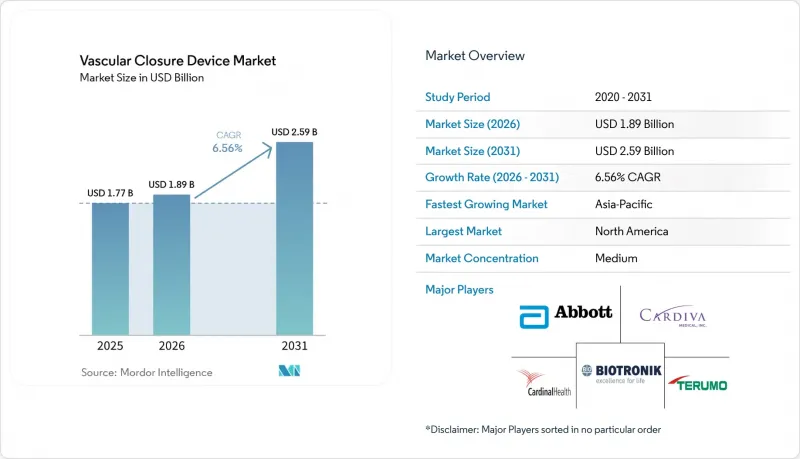
본 보고서는 제품 유형(능동형 근접계 및 수동형 근접계), 재료 구성(콜라겐 계열, PEG/폴리머 계열 등), 접근 경로(대퇴동맥 접근), 시술 유형(중재적 심장학 등), 최종 사용자(병원 등), 지역(북미, 유럽, 아시아태평양 등)별로 분류되어 있습니다. 시장 전망은 금액(달러) 기준으로 제시되어 있습니다.
세계의 혈관 폐쇄 기기 시장 동향 및 인사이트
카테터 관련 시술 증가
경피적 관상동맥 중재술, 구조적 심장 교정술 및 복잡한 말초 혈관 재관류술의 적응증이 확대됨에 따라 시술 건수가 급증하고 있습니다. 애보트사는 2025년 1분기 의료기기 매출이 12.5% 증가한 주요 요인으로 혈관 폐쇄 제품을 꼽았으며, 이는 접근 부위의 건수와 기기 수요 사이에 직접적인 상관관계가 있음을 반영하고 있습니다. 기계적 혈전 제거술이나 하이시스를 이용한 전기생리학적 검사에서는 환자 1명당 여러 개의 천자 부위가 발생하기 때문에 시술자는 다양한 혈관 직경에 대응하면서도 일관된 치료 결과를 얻을 수 있는 폐쇄 시스템을 요구하게 되었습니다. "AMBULATE" 등 임상시험에서 VASCADE MVP 시스템이 수동 압박을 대체했을 때 보행 시작까지 걸리는 시간이 54% 단축된 것이 입증되어, 업무 흐름의 효율성이 확인되었습니다. 이러한 동향들이 맞물리면서 시술 건수 증가는 혈관 폐쇄 기기 시장의 지속적인 성장 동력이 되고 있습니다.
저침습 치료에 대한 관심 증가
병원이나 외래 진료 센터에서는 입원 기간 단축, 감염 위험 감소, 환자 만족도 향상을 도모하기 위해 저침습적 치료가 선호되고 있습니다. 하트 리듬 학회(Heart Rhythm Society)와 미국심장학회(American College of Cardiology)는 확실한 정맥 지혈이 이루어진 경우, 심내 절제술 후 당일 퇴원을 권장하고 있으며, 이는 폐쇄 성능과 진료 효율이 직접적으로 연관되어 있음을 보여줍니다. 테르모의 '심장·혈관 사업'해당 분야의 매출이 15.6% 증가한 것은 이러한 거시적인 변화와 일치하며, 견고한 폐쇄 도구가 카테터 치료의 보급을 얼마나 가속화하고 있는지를 보여줍니다. 영상 내비게이션 기술의 발전으로 인해, 작은 천자 구멍을 통해 치료 가능한 병변의 범위가 더욱 확대됨에 따라, 신속하고 확실하게 접근 부위를 폐쇄할 수 있는 혈관 폐쇄 기기 시장의 솔루션에 대한 의존도가 높아지고 있습니다.
첨단 혈관 폐쇄 기기(VCD)와 수동 압박의 비용 비교
폐쇄 기기 1대당 가격은 보통 200-250달러이지만, 이에 비해 수동 압박의 재료비는 극히 적습니다. 고소득 국가에서는 직원의 근무 시간을 줄임으로써 비용을 절감하고 있지만, 많은 신흥 시장에서는 예산을 절감하기 위해 여전히 수작업에 의존하고 있습니다. 가치 기반 구매(VBP)는 치료 과정 전체의 경제성으로 점차 전환되고 있지만, 자본 부족으로 인해 가격에 대한 민감도는 여전히 높은 편이며, 특히 카테터 사용량이 막 증가하기 시작한 지역에서는 이러한 경향이 두드러집니다. 각 제조업체는 간호 시간 단축 및 입원 기간 단축을 강조한 단계별 제품 라인과 대상 범위를 좁힌 보험 급여 신청 자료를 통해 이에 대응하고 있습니다.
부문별 분석
2025년, 액티브 어프로미터는 혈관 폐쇄 기기 시장의 53.89%를 차지했습니다. 이러한 선도적인 위상은 봉합사를 이용하거나 클립을 사용하는 기전을 통해 동맥 절개 부위를 즉시 봉합함으로써, 항응고 요법을 받고 있는 환자나 대구경 카테터를 사용하는 환자가 몇 시간 이내에 보행이 가능해진다는 점에 기인합니다. 애보트사의 "Perclose ProGlide"는 여러 하이시즈 시험에서 100%의 시술 성공률을 달성하여 이 부문에서의 강점을 입증하고 있습니다. 병원 측은 특히 수술 중 항응고 요법이 필수적인 경우, 이러한 기기가 제공하는 확실한 폐쇄성을 높이 평가했습니다.
패시브형 근접 장치는 시장 점유율은 작지만, 2031년까지 연평균 성장률(CAGR) 8.12%로 성장을 주도하고 있습니다. 헤모네틱스사의 “VASCADE MVP”이와 같은 플러그, 패치, 실란트 시스템은 삽입 과정을 한 번의 누름으로 단축하여, 투시 검사 시간을 줄이고 시술자의 피로를 덜어줍니다. "AMBULATE" 시험 결과, 보행 시작까지 걸리는 시간이 54% 단축된 것으로 확인되었으며, 외래 진료 프로그램에 부합하는 업무 흐름상의 이점이 입증되었습니다. 시술 방식이 간소화되면서 수련 장벽이 낮아져, 중규모 의료기관에서의 도입이 확대되고 있습니다. 규제상의 압박으로 인해 당일 퇴원이 권장되는 가운데, 패시브 어프로미터는 혈관 폐쇄 기기 시장에서 점유율이 확대될 것으로 전망됩니다.
콜라겐 플러그는 2025년에도 50.78%의 시장 점유율을 유지했으며, 이는 30년에 걸친 임상적 정착도를 반영한 것입니다. 테르모사의 "Angio-Seal VIP" 이는 콜라겐 스폰지, 폴리머 앵커 및 봉합사를 채택하고 있으며, 이들이 90일 이내에 일체화되어 흡수됨으로써 예측 가능한 혈관 치유를 가져옵니다. 의사들은 특히 항응고 요법을 받고 있는 환자에서 혈전 형성을 촉진하는 트롬빈을 풍부하게 함유한 콜라겐 매트릭스를 높이 평가했습니다.
폴리글리콜산, 폴리에틸렌글리콜 또는 독자적으로 개발된 폴리머로 제조된 봉합사 및 필라멘트 기기는 연평균 성장률(CAGR) 8.6%로 시장을 확대되고 있습니다. Vivasure사의 "PerQseal Elite" 이 제품은 완전히 생체 흡수성이며, 14-22 Fr TAVR 시스용으로 설계되어 이물질 잔류나 영상상의 아티팩트를 방지합니다. 고분자 소재의 혁신을 통해 용도에 맞는 분해 동태가 실현되어, 영구적인 임플란트를 사용하지 않고도 대구경 부위를 확실하게 봉합할 수 있게 되었습니다. 클립식 금속 시스템은 조영 마커가 추적 영상 진단에 도움이 되는 사례에서 여전히 틈새 용도로만 사용되고 있습니다. 원자재의 다양화는 혈관 폐쇄 기기 시장에서 경쟁적 차별화를 강화하고 있습니다.
지역별 분석
북미는 42.30%의 점유율을 차지하며, 혈관 폐쇄 기기 시장에서 여전히 가장 규모가 큰 지역 구성 요소로 자리 잡고 있습니다. 1인당 시술 건수의 높음, 신기술의 조기 도입, 그리고 견고한 보상 체계가 그 선도적 지위를 뒷받침하고 있습니다. FDA는 2024년, Cordis사의 정맥용 혈관 폐쇄 기기 ‘"MYNX CONTROL"에 510(k) 승인을 부여하고, 해당 지역이 차세대 시스템의 주요 도입 거점으로서의 역할을 강조했습니다. 리콜 사례가 있었음에도 불구하고, 체계적인 교육과 신속한 시판 후 조사를 통해 북미에서는 의료진의 신뢰를 유지하고 있습니다.
아시아태평양은 의료 인프라 확충, 심혈관 의료에 대한 정부 투자, 그리고 협착증이나 판막 질환에 걸리기 쉬운 고령화 인구를 배경으로, 2031년까지 연평균 성장률(CAGR) 7.6%라는 가장 높은 성장률을 기록하고 있습니다. 중국 국가의약품감독관리국은 2023년에 61건의 혁신적인 의료기기 신청 서류를 접수했으며, 이는 국내외 공급업체에 대한 규제 심사 처리가 가속화되고 있음을 보여줍니다. 테르모의 심혈관 분야에서 두 자릿수 매출 성장을 기록했으며, 2025년 초 MicroPort CardioFlow사의 VitaFlow Liberty TAVI가 승인된 것은 이 지역의 활발한 수요를 뒷받침하고 있습니다. 의료기기에 대한 가격 민감도는 여전히 남아 있지만, 민간 보험 및 공공 자금의 확충으로 인해 합리적인 가격에 이용할 수 있게 되고 있습니다.
유럽에서는 의료기기 규정(MDR)으로의 전환이 진행되는 가운데, 확대 속도는 둔화되고 있지만 꾸준한 성장을 유지하고 있습니다. MDR에 따라, 테르모의 "Angio-Seal VIP" 그리고 Vivasure의 "PerQseal Elite" CE 마크를 획득한 것은 제조업체의 적응력을 입증하는 것입니다. 유럽 대륙의 주요 의료 센터에서 요골 접근법의 채택률은 북미보다 높아 대퇴동맥 폐쇄술 건수를 줄이고 있지만, 대구경 구조적 심장 질환 치료 프로그램의 성장이 그 감소분을 상쇄하고 있습니다. 남유럽의 경제적 압박으로 인해 고가 기기들의 보급이 제한되고 있지만, 북유럽의 네트워크가 시술 혁신을 통해 이를 보완하며 혈관 폐쇄 기기 시장을 지탱하고 있습니다.
기타 혜택 :
- 엑셀 형식 시장 예측(ME) 시트
- 3개월간의 애널리스트 지원
자주 묻는 질문
목차
제1장 서론
제2장 조사 방법
제3장 주요 요약
제4장 시장 구도
제5장 시장 규모 및 성장 예측
제6장 경쟁 구도
제7장 시장 기회 및 향후 전망
KTH 26.07.07According to Mordor Intelligence, the vascular closure devices market size was valued at USD 1.77 billion in 2025 and estimated to grow from USD 1.89 billion in 2026 to reach USD 2.59 billion by 2031, at a CAGR of 6.56% during the forecast period (2026-2031).
This report is Segmented by Product Type (Active Approximators and Passive Approximators), Material Composition (Collagen-Based, PEG/Polymer-based, and More), Mode of Access (Femoral Access), Procedure Type (Interventional Cardiology, and More), End-User (Hospitals, and More), Geography (North America, Europe, Asia-Pacific, and More). The Market Forecasts are Provided in Terms of Value (USD).
Global Vascular Closure Device Market Trends and Insights
Increase in Catheterization-Related Procedures
Procedure counts have escalated as indications for percutaneous coronary interventions, structural heart repair, and complex peripheral revascularization broaden. Abbott confirmed that vessel closure products were a key contributor to its 12.5% medical devices revenue growth in Q1 2025, reflecting direct linkage between access-site volumes and device demand. Mechanical thrombectomy and high-sheath electrophysiology cases produce multiple puncture sites per patient, pushing operators toward closure systems that manage varied vessel sizes with consistent outcomes. Trials such as AMBULATE demonstrated a 54% reduction in time to ambulation when the VASCADE MVP system replaced manual compression, underscoring workflow gains. Together, these dynamics position procedural volume growth as a persistent catalyst for the vascular closure devices market.
Growing Preference for Minimally Invasive Interventions
Hospitals and ambulatory centers favor minimally invasive care to trim length of stay, reduce infection risk, and improve patient satisfaction. The Heart Rhythm Society and the American College of Cardiology endorse same-day discharge after intracardiac ablation when secure venous hemostasis is achieved, directly tying closure performance to throughput. Terumo's 15.6% revenue jump in its Cardiac & Vascular Company aligns with this macro-shift and illustrates how robust closure tools accelerate adoption of catheter-based therapies. Imaging navigation improvements further widen the scope of lesions treatable through small punctures, amplifying reliance on vascular closure devices market solutions that seal access quickly and predictably.
High Cost Of Advanced VCDs Versus Manual Compression
A single closure unit often prices between USD 200 and USD 250, contrasted with negligible material cost for manual compression. While high-income systems justify expenditure through staff time savings, many emerging markets still rely on manual pressure to contain budgets. Value-based purchasing is gradually shifting toward total episode economics, but capital scarcity keeps price sensitivity high, especially where catheter volumes are just now scaling. Manufacturers are responding with tiered product lines and targeted reimbursement dossiers that highlight reduced nursing hours and shorter admissions.
Other drivers and restraints analyzed in the detailed report include:
- Aging Population Expanding Cardiovascular Treatment Volumes
- Expansion of Large-Bore TAVR/EVAR Driving Next-Gen Device Demand
- Device-Related Complications And Product Recalls
For complete list of drivers and restraints, kindly check the Table Of Contents.
Segment Analysis
Active approximators controlled 53.89% of the vascular closure devices market in 2025. This leadership derives from their suture-mediated or clip-based mechanisms that lock arteriotomies immediately, enabling anticoagulated or large-bore patients to ambulate within hours. Abbott's Perclose ProGlide illustrates category strength by offering 100% procedural success in multiple high-sheath trials. Hospitals prize the deterministic closure these devices provide, particularly when intra-procedural anticoagulation is mandatory.
Passive approximators occupy a smaller base but are pacing growth at 8.12% CAGR through 2031. Plug, patch, and sealant systems such as Haemonetics' VASCADE MVP shorten deployment to a single push, reducing fluoroscopy and operator fatigue. The AMBULATE study confirmed a 54% decline in time-to-ambulation, showcasing workflow dividends that resonate with outpatient programs. Simplified technique lowers training barriers, raising adoption in mid-volume centers. As regulatory pressures favor same-day discharge, passive approximators are positioned to expand their contribution to the vascular closure devices market.
Collagen plugs retained 50.78% share in 2025, reflecting three decades of clinical familiarity. Terumo's Angio-Seal VIP employs a collagen sponge, a polymer anchor, and a suture that collectively resorb within 90 days, offering predictable vessel healing. Physicians value collagen's thrombin-rich matrix, which accelerates clot formation especially in anticoagulated patients.
Suture and filament devices built from polyglycolic acid, polyethylene glycol, or proprietary polymers are advancing at 8.6% CAGR. Vivasure's PerQseal Elite is entirely bio-absorbable and designed for 14-22 Fr TAVR sheaths, eliminating retained foreign material and imaging artifacts. Polymer innovations provide tailored degradation kinetics, enabling large-bore security without permanent implants. Clip-based metal systems remain a niche for cases where radiopaque markers aid follow-up imaging. Material diversification reinforces competitive differentiation inside the vascular closure devices market.
Complete Report Scope:
- By Product Type
- Active Approximators
- Clip-based Devices
- Suture-based Devices
- Plug-based Devices
- Passive Approximators
- Hemostatic Pads & Patches
- Compression Devices
- Active Approximators
- By Material Composition
- Collagen-based
- PEG / Polymer-based
- Suture / Filament-based
- Metal Clip-based
- By Mode of Access
- Femoral Access
- Large-bore Femoral
- Radial Access
- Other Mode of Access
- By Procedure Type
- Interventional Cardiology
- Peripheral Vascular
- Neurovascular
- Structural Heart / TAVR
- Electrophysiology
- By End User
- Hospitals
- Ambulatory Surgical Centres
- Cath-labs & Out-patient Vascular Centres
- Geography
- North America
- United States
- Canada
- Mexico
- Europe
- Germany
- United Kingdom
- France
- Italy
- Spain
- Rest of Europe
- Asia-Pacific
- China
- Japan
- India
- Australia
- South Korea
- Rest of Asia-Pacific
- Middle East & Africa
- GCC
- South Africa
- Rest of Middle East & Africa
- South America
- Brazil
- Argentina
- Rest of South America
- North America
Geography Analysis
North America, with 42.30% share, remains the largest regional constituent of the vascular closure devices market. High per-capita procedure rates, early technology adoption, and robust reimbursement frameworks underpin leadership. The FDA granted 510(k) clearance for Cordis' MYNX CONTROL venous VCD in 2024, emphasizing the region's role as a primary gateway for next-generation systems. Notwithstanding recalls, North America maintains physician confidence through structured training and rapid post-market surveillance.
Asia-Pacific records the fastest 7.6% CAGR through 2031, spurred by health infrastructure build-out, government investment in cardiovascular care, and an aging population predisposed to stenotic and valvular disease. China's National Medical Products Administration accepted 61 innovative device dossiers in 2023, signaling accelerating regulatory throughput for local and foreign suppliers. Terumo's double-digit cardiovascular revenue growth and MicroPort CardioFlow's VitaFlow Liberty TAVI approval in early 2025 confirm vibrant regional demand. Although device cost sensitivity persists, expanding private insurance and public funding improve affordability.
Europe maintains steady, albeit slower, expansion amid transition to the Medical Device Regulation framework. CE marks awarded to Terumo's Angio-Seal VIP and Vivasure's PerQseal Elite under MDR attest to adaptability of manufacturers. Radial penetration in continental centers is higher than in North America, moderating femoral closure volumes, yet growth in large-bore structural heart programs counterbalances attrition. Economic pressures in Southern Europe constrain premium device uptake, but Northern European networks compensate with procedure innovation, sustaining the vascular closure devices market.
- Abbott Laboratories
- Terumo
- Medtronic
- Haemonetics Corp.
- Teleflex
- Cardinal Health / Cordis
- Beckton Dickinson
- B. Braun
- BIOTRONIK
- Merit Medical Systems
- Vivasure Medical
- Cardiva Medical
- Advanced Vascular Dynamics
- Essential Medical
- InSeal Medical
- Manta (Abbott-Manta)
- Forge Medical
- Rex Medical
- Morrison Medical
- Medeon Biodesign
Additional Benefits:
- The market estimate (ME) sheet in Excel format
- 3 months of analyst support
TABLE OF CONTENTS
1 Introduction
- 1.1 Study Assumptions & Market Definition
- 1.2 Scope of the Study
2 Research Methodology
3 Executive Summary
4 Market Landscape
- 4.1 Market Overview
- 4.2 Market Drivers
- 4.2.1 Increase In Catheterization-Related Procedures
- 4.2.2 Growing Preference for Minimally Invasive Interventions
- 4.2.3 Shift Toward Radial Access in PCI & Electrophysiology
- 4.2.4 Aging Population Expanding CVD Treatment Volumes
- 4.2.5 Expansion Of Large-Bore TAVR/EVAR Driving Next-Gen VCD Demand
- 4.2.6 Out-Patient & Same-Day Discharge Reimbursement Incentives
- 4.3 Market Restraints
- 4.3.1 High Cost of Advanced Vcds Vs. Manual Compression
- 4.3.2 Device-Related Complications & Product Recalls
- 4.3.3 Lengthy Approval Cycles for Bio-Absorbable Polymers
- 4.3.4 Cannibalisation From Low-Cost Radial Compression Bands
- 4.4 Regulatory Landscape
- 4.5 Porter's Five Forces Analysis
- 4.5.1 Threat of New Entrants
- 4.5.2 Bargaining Power of Buyers
- 4.5.3 Bargaining Power of Suppliers
- 4.5.4 Threat of Substitutes
- 4.5.5 Competitive Rivalry
5 Market Size & Growth Forecasts (Value, USD)
- 5.1 By Product Type
- 5.1.1 Active Approximators
- 5.1.1.1 Clip-based Devices
- 5.1.1.2 Suture-based Devices
- 5.1.1.3 Plug-based Devices
- 5.1.2 Passive Approximators
- 5.1.2.1 Hemostatic Pads & Patches
- 5.1.2.2 Compression Devices
- 5.1.1 Active Approximators
- 5.2 By Material Composition
- 5.2.1 Collagen-based
- 5.2.2 PEG / Polymer-based
- 5.2.3 Suture / Filament-based
- 5.2.4 Metal Clip-based
- 5.3 By Mode of Access
- 5.3.1 Femoral Access
- 5.3.2 Large-bore Femoral
- 5.3.3 Radial Access
- 5.3.4 Other Mode of Access
- 5.4 By Procedure Type
- 5.4.1 Interventional Cardiology
- 5.4.2 Peripheral Vascular
- 5.4.3 Neurovascular
- 5.4.4 Structural Heart / TAVR
- 5.4.5 Electrophysiology
- 5.5 By End User
- 5.5.1 Hospitals
- 5.5.2 Ambulatory Surgical Centres
- 5.5.3 Cath-labs & Out-patient Vascular Centres
- 5.6 Geography
- 5.6.1 North America
- 5.6.1.1 United States
- 5.6.1.2 Canada
- 5.6.1.3 Mexico
- 5.6.2 Europe
- 5.6.2.1 Germany
- 5.6.2.2 United Kingdom
- 5.6.2.3 France
- 5.6.2.4 Italy
- 5.6.2.5 Spain
- 5.6.2.6 Rest of Europe
- 5.6.3 Asia-Pacific
- 5.6.3.1 China
- 5.6.3.2 Japan
- 5.6.3.3 India
- 5.6.3.4 Australia
- 5.6.3.5 South Korea
- 5.6.3.6 Rest of Asia-Pacific
- 5.6.4 Middle East & Africa
- 5.6.4.1 GCC
- 5.6.4.2 South Africa
- 5.6.4.3 Rest of Middle East & Africa
- 5.6.5 South America
- 5.6.5.1 Brazil
- 5.6.5.2 Argentina
- 5.6.5.3 Rest of South America
- 5.6.1 North America
6 Competitive Landscape
- 6.1 Market Concentration
- 6.2 Market Share Analysis
- 6.3 Company Profiles (includes Global level Overview, Market level overview, Core Business Segments, Financials, Headcount, Key Information, Market Rank, Market Share, Products and Services, and analysis of Recent Developments)
- 6.3.1 Abbott Laboratories
- 6.3.2 Terumo Corporation
- 6.3.3 Medtronic plc
- 6.3.4 Haemonetics Corp.
- 6.3.5 Teleflex Inc.
- 6.3.6 Cardinal Health / Cordis
- 6.3.7 Becton, Dickinson & Co.
- 6.3.8 B. Braun Melsungen AG
- 6.3.9 Biotronik SE & Co. KG
- 6.3.10 Merit Medical Systems
- 6.3.11 Vivasure Medical Ltd
- 6.3.12 Cardiva Medical Inc.
- 6.3.13 Advanced Vascular Dynamics
- 6.3.14 Essential Medical
- 6.3.15 InSeal Medical
- 6.3.16 Manta (Abbott-Manta)
- 6.3.17 Forge Medical
- 6.3.18 Rex Medical
- 6.3.19 Morrison Medical
- 6.3.20 Medeon Biodesign
7 Market Opportunities & Future Outlook
- 7.1 White-space & Unmet-need Assessment


