|
시장보고서
상품코드
2073518
뉴로포토닉스 : 시장 점유율 분석, 업계 동향 및 통계, 성장 예측(2026-2031년)Neurophotonics - Market Share Analysis, Industry Trends & Statistics, Growth Forecasts (2026 - 2031) |
||||||
 Mordor Intelligence
Mordor Intelligence에 의하면, 뉴로포토닉스 시장 규모는 2025년 19억 달러로 평가되었습니다. 2026년에는 20억 9,000만 달러로 확대되어 2026년부터 2031년에 걸쳐 CAGR 10.24%로 성장을 지속하여, 2031년까지 34억 2,000만 달러에 이를 것으로 예측됩니다.
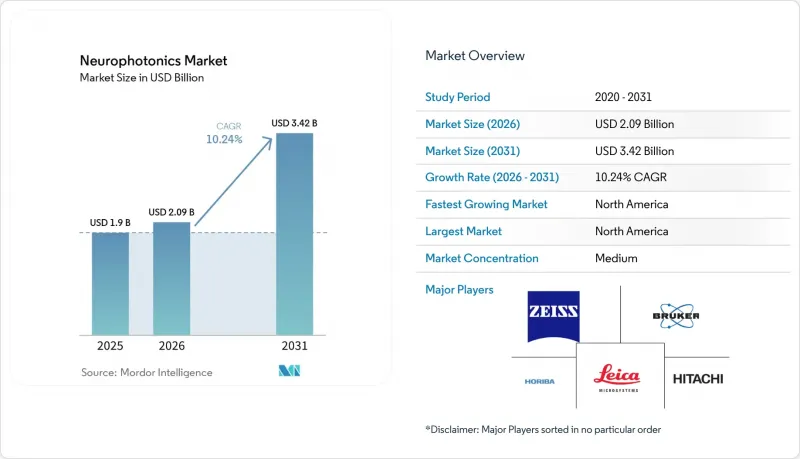
본 보고서는 시스템 유형(현미경, 분광법 등), 용도(조사, 진단, 치료), 최종 사용자(학술·연구 기관, 병원 및 진료소 등) 및 지역별로 분류되어 있습니다. 시장 규모 및 전망은 금액(달러)으로 표시되어 있습니다.
세계의 뉴로포토닉스 시장 동향 및 인사이트
신경계 질환 유병률 증가
세계 평균 수명의 연장에 따라 신경퇴행성 질환과 정신 질환은 사회적·경제적 부담을 가중시키고 있습니다. 5,500만 명 이상이 알츠하이머병을 앓고 있으며, 고령화 사회에서 그 발병률은 계속 증가하고 있습니다. 기능적 근적외선 분광법(fNIRS)과 광생리 조절 기술은 기존의 자기공명영상법(MRI)으로는 비용 대비 효율적인 방법으로 얻을 수 없는 뇌의 산소화 상태에 관한 실시간 데이터를 제공합니다. 캘리포니아 대학교 샌프란시스코 캠퍼스(UCSF)에서 진행된 임상 연구에 따르면, 근적외선 광선 요법 시행 후 미니 정신 상태 검사(MMSE) 점수가 현저히 향상된 것으로 보고되어, 빛을 이용한 치료법의 임상적 유효성이 입증되었습니다. 병원에서는 인지 기능 재활의 진행 상황을 모니터링하기 위해 이 기술을 도입하고 있으며, 한편, 기기 제조업체들은 외래 진료 환경에 적합하고 사용하기 편리한 시스템 개발에 주력하고 있습니다. 환자 수가 증가함에 따라, 뉴로포토닉스 시장은 진단 및 치료 양 분야에서 지속적인 수요를 얻고 있습니다.
뇌 매핑 연구 개발에 대한 정부 자금 확대
미국의 “BRAIN 이니셔티브”는 비퇴화 2광자 현미경법 등 광학 신경 인터페이스의 혁신을 구체적인 대상으로 삼아, 수년에 걸친 연구비를 지원하고 있습니다. 유럽 및 아시아태평양의 유사한 자금 지원 체계를 통해 연구 기관, 장비 제조업체, 임상 센터가 공동 컨소시엄을 구성하여 기술의 성숙을 가속화하고 있습니다. 일본의 "문샷 목표 1" 한편, 2025년에 국내 신경기술 분야 시장 규모가 5억 2,000만 달러에 달했으며, 이는 장기적인 정책적 의지를 보여주었습니다. 이러한 프로그램들은 고위험 프로젝트에 자금을 지원하고, 시범 생산 라인에 보조금을 지급하며, 재현성을 높이는 오픈 액세스형 데이터 저장소를 구축하고 있습니다. 공공 부문의 지원은 동액의 민간 투자를 유치함으로써, 스타트업이 과도한 지분 희석을 초래하지 않으면서도 프로토타입을 규제 기준을 충족하는 시스템으로 확장할 수 있게 해줍니다. 보조금이 기초 과학에서 중개 연구의 주요 단계로 전환됨에 따라, 업계 관계자들은 더 이른 단계에서 상업적 성과를 거둘 수 있게 되었으며, 이는 뉴로포토닉스 시장의 상승세를 뒷받침하고 있습니다.
성인 대뇌피질 영상 촬영에서 나타나는 제한된 침투 깊이
성인의 뇌 조직에서는 빛이 산란되기 때문에 2광자 및 3광자 영상 기법은 깊이 약 2-3 mm의 표층으로 제한됩니다. 파킨슨병이나 난치성 간질과 관련된 피질하 표적에는 여전히 도달할 수 없어, 임상의들은 심부 뇌 전극이나 고자기장 MRI와 같은 대체 방법을 채택할 수밖에 없습니다. 장시간 조사하면 조직 온도가 상승합니다. PhotoniX사의 보고에 따르면, 누적 광조사량이 400 mW를 초과하면 열 손상이 발생하여 이미징 시간이 제한됩니다. 이 문제를 완화하기 위해 연구자들은 파면 성형 광학 시스템과 테라헤르츠 광 자극에 대한 연구를 진행하고 있지만, 상용화까지는 아직 수년이 더 걸릴 것으로 예측됩니다. 한편, 이러한 심도 제한으로 인해 하이엔드 이미징 업체들의 당면한 수익 기회는 제한되고 있습니다.
부문별 분석
2025년, 현미경 플랫폼은 뉴로포토닉스 시장 점유율의 45.05%를 차지하며, 회로 수준 시각화의 주력 모달리티로서의 입지를 확고히 다졌습니다. ZEISS의 FLUOVIEW FV4000MPE와 Bruker의 OptoVolt 모듈은 고속 공진 스캐너와 적응형 광학 기술을 통해 mm 규모의 시야에서 서브마이크론 해상도를 구현하는 대표적인 사례입니다. 그 어느 때보다 정밀한 구조적 인사이트에 대한 수요가, 특히 최고 수준의 신경과학 연구소의 핵심을 이루는 영상 시설에서 건전한 업그레이드 주기를 뒷받침하고 있습니다. 분광법 시스템은 휴대용 하드웨어를 활용한 기능적 혈역학 매핑 분야에 주력함으로써, 2031년까지 11.03%라는 가장 높은 연평균 성장률(CAGR)을 기록하고 있습니다. 형광 수명 이미징과 라만 분광법을 융합한 다중 모드 구성은 화합물과 뇌의 상호작용에 대한 종합적인 프로파일을 원하는 제약 업계 고객들의 관심을 끌고 있습니다. 각 벤더사는 GPU 가속 알고리즘을 통합하여 거의 즉각적인 체적 재구성을 실현함으로써, 연구자들이 데이터 수집 후 처리하는 데 소요되는 시간을 수 시간 가량 단축하고 있습니다. 지속적인 혁신과 증가하는 중개 연구 프로젝트가 맞물리면서, 현미경 하위 카테고리는 더 광범위한 뉴로포토닉스 시장에서 계속해서 중심적인 위치를 차지하고 있습니다.
병원들이 뇌졸중 분류에 병상형 fNIRS를 도입함에 따라, 분광 솔루션 분야의 뉴로포토닉스 시장 규모는 급격히 확대될 전망입니다. 해당 소프트웨어에 내장된 인공지능(AI) 분류기는 3초 이내에 허혈의 동향을 감지하여 즉각적인 조치를 유도합니다. 기업의 움직임도 활발해지고 있습니다. 하마마츠 포토닉스는 NKT 포토닉스를 인수하여 초고속 레이저공급망을 확보한 한편, 라이카 마이크로시스템즈는 인스코픽스(Inscopix)와 공식적으로 판매 제휴를 체결하고, 세포 분해능을 갖춘 미니 현미경 키트의 공동 판매에 나섰습니다. "현미경 메타데이터 워킹그룹" 등으로 구성된 컨소시엄은 3D 이미징 메타데이터 표준을 제정하여 전 세계 코호트 연구에서의 데이터 공유를 촉진하고 있습니다. 이러한 움직임들이 맞물리면서 신규 연구 그룹의 진입 장벽이 낮아졌고, 뉴로포토닉스 시장에서 현미경 기술의 탁월한 위상이 더욱 공고해지고 있습니다.
지역별 분석
북미는 풍부한 연방 정부 자금원과 인간을 대상으로 한 최초의 임상시험을 가속화하는 투명한 규제 절차 덕분에, 2025년에는 전 세계 매출의 42.10%를 차지했습니다. 2024년에 프레시전 뉴로사이언스(Precision Neuroscience)와 클리어포인트 뉴로(Clearpoint Neuro)가 FDA로부터 부여받은 '획기적인 장치' 이번 지정은 혁신적인 플랫폼에 대한 신속한 심사의 좋은 사례입니다. 수술 중 형광 유도 기술에 대한 유리한 보험 급여 정책은 해당 지역 수요를 더욱 공고히 하고 있습니다. 보스턴, 샌프란시스코, 토론토 주변의 탄탄한 벤처 캐피털 생태계는 기업이 정신이 넘치는 인재를 끌어모으며, 초기 상용화에 수반되는 위험을 줄여주고 있습니다. 그러나 높은 장비 가격과 가치 기반 의료(Value-Based Care)의 의무화로 인해, 공급업체들은 자본 예산을 확보하기 위해 탄탄한 의료경제학적 자료를 작성할 수밖에 없는 실정입니다.
아시아태평양은 12.95%라는 가장 높은 연평균 성장률(CAGR)을 기록하고 있으며, 현지 공급망이 성숙해짐에 따라 북미 시장 점유율을 잠식할 태세를 보이고 있습니다. 일본은 180개 이상의 제조업체를 통해 전 세계 포토닉스 생산량의 약 30%를 차지하고 있으며, 이를 통해 규모의 경제가 실현되어 국내 의료기기 조립 제조업체의 부품 원가를 절감하고 있습니다. 중국의 각 성 정부는 뉴로테크놀로지 파크에 자금을 지원하고, 2등급 의료기기의 신속한 등록 절차를 제공함으로써 시장 출시까지 걸리는 기간을 단축하고 있습니다. 인도의 의료용 전자기기용 ‘ '생산 연계형 인센티브 제도'는 부품 제조업체를 유치하여 새로운 수출 거점 형성을 뒷받침하고 있습니다. 호주 신경과학 센터와의 국경을 초월한 학술 제휴를 통해, 중개 연구 기반의 프로토타입이 개발되고 있으며, 지역 내 전문 지식이 확대되고 있습니다.
유럽에서는 정평이 나 있는 연구 중심 대학과 일관된 데이터 개인정보 보호법이 어우러져, 다기관 공동 임상시험을 촉진하는 균형 잡힌 환경이 조성되어 있습니다. 독일은 산학 합동 워킹그룹을 통해 광유전학의 표준화를 추진하고 있는 반면, 영국에서는 뇌졸중 사후 관리에 있어 fNIRS를 이용한 인지 기능 평가에 대한 보험 급여 체계를 시범적으로 도입하고 있습니다. 아시아의 경쟁사들과 맞서고 있는 현지 제조업체들은 워크플로우 통합과 라이프사이클 지원을 중시하는 프리미엄 서비스 모델로 전환하고 있습니다. EU 의료기기 규정에 따른 규제 조화로 인해 문서 작성 부담은 증가하고 있지만, 제품 품질에 대한 기대치가 통일됨에 따라 뉴로포토닉스 공급업체의 유럽 내 유통이 원활해지고 있습니다.
기타 혜택 :
- 엑셀 형식 시장 예측(ME) 시트
- 3개월간의 애널리스트 지원
자주 묻는 질문
목차
제1장 서론
제2장 조사 방법
제3장 주요 요약
제4장 시장 구도
제5장 시장 규모 및 성장 예측
제6장 경쟁 구도
제7장 시장 기회 및 향후 전망
KTH 26.07.07According to Mordor Intelligence, the neurophotonics market size is expected to grow from USD 1.9 billion in 2025 to USD 2.09 billion in 2026 and is forecast to reach USD 3.42 billion by 2031 at 10.24% CAGR over 2026-2031.
This report is Segmented by System Type (Microscopy, Spectroscopy, and More) Application (Research, Diagnostics, and Therapeutics), End User (Academic & Research Institutes, Hospitals & Clinics, and More), and Geography. The Market Sizes and Forecasts are Provided in Terms of Value (USD).
Global Neurophotonics Market Trends and Insights
Rising Prevalence of Neurological Disorders
Neurodegenerative and psychiatric conditions impose growing social and economic burdens as global life expectancy rises. More than 55 million individuals live with Alzheimer's disease, and incidence continues to rise in aging populations. Functional near-infrared spectroscopy (fNIRS) and photobiomodulation techniques provide real-time cerebral oxygenation data that conventional magnetic resonance imaging cannot deliver cost-effectively . Clinical studies at the University of California San Francisco reported notable gains in Mini Mental State Exam scores following near-infrared light therapy, strengthening the clinical case for optical interventions. Hospitals adopt the technology to monitor cognitive rehabilitation progress, while device makers focus on user-friendly systems suited for outpatient environments. As prevalence expands, the neurophotonics market draws sustained demand from both diagnostic and therapeutic workflows.
Expanding Government Funding for Brain-Mapping R&D
The United States BRAIN Initiative earmarks multiyear grants specifically targeting optical neural-interface innovations such as non-degenerate two-photon microscopy. Similar funding frameworks in Europe and Asia-Pacific bring research labs, device makers, and clinical centers into shared consortia, accelerating technology maturation. Japan's Moonshot Goal 1 forecasts a domestic neurotechnology sector worth USD 520 million in 2025, signaling long-term policy commitment. These programs underwrite high-risk projects, subsidize pilot manufacturing lines, and create open-access data repositories that speed reproducibility. Public-sector support draws matching private investment, allowing startups to scale prototypes into regulatory grade systems without prohibitive dilution. As grants transition from basic science to translational milestones, industry players capture earlier commercial payoffs, reinforcing the upward trajectory of the neurophotonics market.
Limited Penetration Depth in Adult Cortical Imaging
Light scatters in adult brain tissue, restricting two-photon and three-photon modalities to superficial layers roughly 2-3 mm deep. Subcortical targets involved in Parkinson's disease or refractory epilepsy remain out of reach, compelling clinicians to adopt alternative modalities such as deep-brain electrodes or high-field MRI. Extended illumination elevates tissue temperature; PhotoniX reports that cumulative light exposure above 400 mW causes thermal damage, capping imaging duration. To mitigate the issue, researchers explore wavefront-shaping optics and terahertz-photon stimulation, yet commercial readiness sits several years away. Meanwhile, the depth limitation curtails immediate revenue potential for high-end imaging vendors.
Other drivers and restraints analyzed in the detailed report include:
- Miniaturization and Portability of Optical Neuro-Imaging Devices
- Rapid Adoption of Optogenetics and fNIRS in Academic Labs
- Integration with Immersive XR and BCI Platforms
- Growth of Neonatal and Peri-Operative Monitoring Use Cases
- High CAPEX and OPEX of Multiphoton Platforms
- Lack of Data-Format Interoperability Across Vendors
- Phototoxicity and Tissue-Heating Risks in Long-Duration Studies
For complete list of drivers and restraints, kindly check the Table Of Contents.
Segment Analysis
Microscopy platforms accounted for 45.05% of neurophotonics market share in 2025, consolidating their role as the workhorse modality for circuit-level visualization. The ZEISS FLUOVIEW FV4000MPE and Bruker OptoVolt modules exemplify how fast resonant scanners and adaptive optics yield sub-micron resolution over millimeter-scale fields. Demand for ever finer structural insight sustains a healthy upgrade cycle, especially within core imaging facilities at top neuroscience institutes. Spectroscopy systems record the fastest 11.03% CAGR to 2031 by tackling functional hemodynamic mapping with portable hardware. Multimodal configurations that fuse fluorescence lifetime imaging with Raman spectroscopy attract pharmaceutical customers seeking comprehensive compound-brain interaction profiles. Vendors integrate GPU-accelerated algorithms to deliver near-instantaneous volumetric reconstructions, saving researchers hours of post-acquisition processing. Sustained innovation coupled with rising translational projects keeps the microscopy sub-category at the spine of the broader neurophotonics market.
The neurophotonics market size for spectroscopy solutions is set to rise sharply as hospitals deploy bedside fNIRS for stroke triage. Artificial-intelligence classifiers embedded in acquisition software flag ischemic trends in under three seconds, guiding immediate intervention. Corporate activity intensifies; Hamamatsu's acquisition of NKT Photonics secures an ultrafast-laser supply chain, while Leica Microsystems formalizes a distribution pact with Inscopix to co-market cellular-resolution miniscope kits. Consortia such as the Microscopy Metadata Working Group finalize 3D-imaging metadata standards, promoting data pooling across global cohort studies. Collectively, these moves lower barriers to entry for new research groups, reinforcing microscopy's pre-eminent place in the neurophotonics market.
Complete Report Scope:
- By System Type
- Microscopy
- Spectroscopy
- Multimodal Platforms
- Other System Types
- By Application
- Research
- Diagnostics
- Therapeutics
- By End-user
- Academic & Research Institutes
- Hospitals & Clinics
- Pharma & Biotech Companies
- By Geography
- North America
- United States
- Canada
- Mexico
- Europe
- Germany
- United Kingdom
- France
- Italy
- Spain
- Rest of Europe
- Asia-Pacific
- China
- Japan
- India
- Australia
- South Korea
- Rest of Asia-Pacific
- Middle East & Africa
- GCC
- South Africa
- Rest of Middle East & Africa
- South America
- Brazil
- Argentina
- Rest of South America
- North America
Geography Analysis
North America generated 42.10% of global revenue in 2025 thanks to deep federal funding pools and a transparent regulatory pathway that accelerates first-in-human studies. The FDA's breakthrough-device designation awarded to Precision Neuroscience and ClearPoint Neuro in 2024 exemplifies swift review for transformative platforms. Favorable reimbursement policies for intraoperative fluorescence guidance further solidify regional demand. Rich venture-capital ecosystems surrounding Boston, San Francisco, and Toronto attract entrepreneurial talent and de-risk early commercial launches. However, high equipment prices and value-based-care mandates compel suppliers to develop robust health-economic dossiers to defend capital budgets.
Asia-Pacific posted the fastest 12.95% CAGR and is poised to erode North American share as local supply chains mature. Japan maintains roughly 30% of global photonics output through more than 180 manufacturers, creating economies of scale that cut bill-of-materials cost for domestic device assemblers. Chinese provincial governments fund neurotechnology parks and offer expedited registrations for Class II medical devices, shortening go-to-market timelines. India's Production-Linked Incentive scheme for medical electronics lures component fabricators, shaping a nascent export hub. Cross-border academic partnerships with Australian neuroscience centers generate translational prototypes, broadening regional expertise.
Europe holds a balanced landscape where established research universities and cohesive data-privacy laws foster collaborative multi-site trials. Germany champions optogenetics standardization through joint industry-academia working groups, while the United Kingdom pilots reimbursement pathways for fNIRS cognitive assessments in stroke follow-up care. Local manufacturers, facing Asian cost competition, pivot to premium service models that emphasize workflow integration and lifecycle support. Regulatory alignment under the EU Medical Device Regulation introduces additional documentation overhead, but also harmonizes product quality expectations, smoothing intra-European distribution for neurophotonics suppliers.
- Carl Zeiss
- Danaher
- Hamamatsu Photonics
- Bruker
- Artinis Medical Systems
- HORIBA
- Hitachi
- Femtonics Ltd.
- Inscopix Inc.
- Cairn Research
- fNIR Devices
- HemoPhotonics
- Thorlabs
- PicoQuant GmbH
- NKT Photonics
- Intelligent Imaging Innovations
- NeuroLight Technologies
- Luxmux Technologies
- Photometrics
- Neuronix Imaging
Additional Benefits:
- The market estimate (ME) sheet in Excel format
- 3 months of analyst support
TABLE OF CONTENTS
1 Introduction
- 1.1 Study Assumptions & Market Definition
- 1.2 Scope of the Study
2 Research Methodology
3 Executive Summary
4 Market Landscape
- 4.1 Market Overview
- 4.2 Market Drivers
- 4.2.1 Rising Prevalence Of Neurological Disorders
- 4.2.2 Expanding Government Funding For Brain-Mapping R&D
- 4.2.3 Miniaturization & Portability Of Optical Neuro-Imaging Devices
- 4.2.4 Rapid Adoption Of Optogenetics & Fnirs In Academic Labs
- 4.2.5 Integration With Immersive Xr & Bci Platforms
- 4.2.6 Growth Of Neonatal/Peri-Operative Monitoring Use-Cases
- 4.3 Market Restraints
- 4.3.1 Limited Penetration Depth In Adult Cortical Imaging
- 4.3.2 High Capex & Opex Of Multiphoton Platforms
- 4.3.3 Lack Of Data-Format Interoperability Across Vendors
- 4.3.4 Phototoxicity & Tissue-Heating Risks In Long-Duration Studies
- 4.4 Value / Supply-Chain Analysis
- 4.5 Regulatory Landscape
- 4.6 Technological Outlook
- 4.7 Porter's Five Forces Analysis
- 4.7.1 Threat of New Entrants
- 4.7.2 Bargaining Power of Buyers
- 4.7.3 Bargaining Power of Suppliers
- 4.7.4 Threat of Substitutes
- 4.7.5 Intensity of Competitive Rivalry
5 Market Size & Growth Forecasts
- 5.1 By System Type
- 5.1.1 Microscopy
- 5.1.2 Spectroscopy
- 5.1.3 Multimodal Platforms
- 5.1.4 Other System Types
- 5.2 By Application
- 5.2.1 Research
- 5.2.2 Diagnostics
- 5.2.3 Therapeutics
- 5.3 By End-user
- 5.3.1 Academic & Research Institutes
- 5.3.2 Hospitals & Clinics
- 5.3.3 Pharma & Biotech Companies
- 5.4 By Geography
- 5.4.1 North America
- 5.4.1.1 United States
- 5.4.1.2 Canada
- 5.4.1.3 Mexico
- 5.4.2 Europe
- 5.4.2.1 Germany
- 5.4.2.2 United Kingdom
- 5.4.2.3 France
- 5.4.2.4 Italy
- 5.4.2.5 Spain
- 5.4.2.6 Rest of Europe
- 5.4.3 Asia-Pacific
- 5.4.3.1 China
- 5.4.3.2 Japan
- 5.4.3.3 India
- 5.4.3.4 Australia
- 5.4.3.5 South Korea
- 5.4.3.6 Rest of Asia-Pacific
- 5.4.4 Middle East & Africa
- 5.4.4.1 GCC
- 5.4.4.2 South Africa
- 5.4.4.3 Rest of Middle East & Africa
- 5.4.5 South America
- 5.4.5.1 Brazil
- 5.4.5.2 Argentina
- 5.4.5.3 Rest of South America
- 5.4.1 North America
6 Competitive Landscape
- 6.1 Market Concentration
- 6.2 Market Share Analysis
- 6.3 Company Profiles (includes Global level Overview, Market level overview, Core Segments, Financials as available, Strategic Information, Market Rank/Share for key companies, Products & Services, and Recent Developments)
- 6.3.1 Carl Zeiss AG
- 6.3.2 Leica Microsystems
- 6.3.3 Hamamatsu Photonics
- 6.3.4 Bruker Corporation
- 6.3.5 Artinis Medical Systems
- 6.3.6 Horiba Ltd.
- 6.3.7 Hitachi Ltd.
- 6.3.8 Femtonics Ltd.
- 6.3.9 Inscopix Inc.
- 6.3.10 Cairn Research
- 6.3.11 fNIR Devices LLC
- 6.3.12 HemoPhotonics
- 6.3.13 Thorlabs Inc.
- 6.3.14 PicoQuant GmbH
- 6.3.15 NKT Photonics
- 6.3.16 Intelligent Imaging Innovations
- 6.3.17 NeuroLight Technologies
- 6.3.18 Luxmux Technologies
- 6.3.19 Photometrics
- 6.3.20 Neuronix Imaging
7 Market Opportunities & Future Outlook
- 7.1 White-space & Unmet-Need Assessment