|
시장보고서
상품코드
2003793
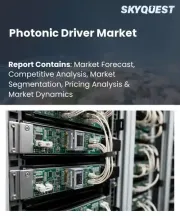
포토닉 드라이버 시장 규모, 점유율 및 성장 분석 : 제품 유형별, 기술별, 용도별, 최종사용자별, 유통 채널별, 지역별 - 업계 예측(2026-2033년)Photonic Driver Market Size, Share, and Growth Analysis, By Product Type (Laser Drivers, LED Drivers), By Technology (Analog Drive, Digital Drive), By Application, By End-user, By Distribution Channel, By Region - Industry Forecast 2026-2033 |
||||||

세계의 포토닉 드라이버 시장 규모는 2024년에 23억 달러로 평가되었고, 2025년 25억 2,000만 달러에서 2033년에는 52억 1,000만 달러로 확대되어 예측 기간(2026-2033년)에 CAGR 9.5%를 보일 전망입니다.
세계 포토닉 드라이버 시장은 광섬유 및 집적 포토닉스와 같은 용도에서 광 신호의 변조 및 제어를 강화하는 전자 회로 및 광전자 회로를 중심으로 성장하고 있습니다. 시장 성장은 주로 통신 및 데이터센터의 고 대역폭 및 저 지연에 대한 수요 증가에 의해 주도되고 있습니다. 포토닉 드라이버는 디지털 정보를 광신호로 효율적으로 변환하여 클라우드 서비스 및 5G 기술의 진보를 뒷받침하고 있습니다. 코히런트 트랜시버에 대한 하이퍼스케일러와의 제휴를 배경으로 시장은 개별 모듈에서 통합 솔루션으로 전환하고 있습니다. 주요 동향으로는 코패키지 광학 및 통합에 대한 집중을 들 수 있습니다. 이는 하이퍼스케일 환경에서 전력 소비를 줄이고 확장성을 향상시켜 다양한 용도에서 첨단 광집적회로 공급업체에게 새로운 기회를 창출하고 있습니다.
세계 포토닉 드라이버 시장의 성장 요인
세계 포토닉 드라이버 시장은 고속 네트워크 인프라의 도입 확대에 따라 괄목할 만한 성장세를 보이고 있습니다. 이를 위해서는 고도의 광 변조와 신호 무결성을 구현할 수 있는 첨단 포토닉 드라이버가 필수적입니다. 이러한 수요의 급증으로 제조업체들은 제품 라인업을 확대하는 동시에 지속적인 개선에 대한 투자를 아끼지 않고 있습니다. 이에 따라 보다 효율적인 드라이버 아키텍처에 대한 연구가 활발히 진행되고 있으며, 호환성을 강화하기 위해 장비 및 부품 공급업체 간의 협력도 강화되고 있습니다. 그 결과, 포토닉 기술을 중심으로 역동적인 생태계가 형성되고 있으며, 공급망 확장을 위한 상업적 인센티브가 강화되어 이들 기술의 성숙이 가속화되고 있습니다.
세계 포토닉 드라이버 시장의 제약 조건
세계 포토닉 드라이버 시장은 제조 공정의 복잡성과 포토닉 부품에 요구되는 엄격한 공차로 인해 큰 제약에 직면해 있습니다. 이러한 문제들은 생산 난이도를 높이고, 수율에 대한 불확실성을 야기하며, 공급업체가 신속하게 생산 능력을 확장하는 능력을 제한하고 있습니다. 또한, 특수한 설비와 숙련된 공정 제어가 필요하기 때문에 개발 기간이 길어지고 인증 주기가 복잡해지고 있습니다. 이로 인해 제조업체들은 대규모 투자에 대해 신중한 태도를 취할 수밖에 없습니다. 그 결과, 비용 절감 속도가 느려지고, 다양한 고객의 니즈에 대응하기 어려워지고 있습니다. 결국, 시장 침투를 저해하고 잠재적인 신규 시장 진출기업들이 포토닉 드라이버 제조에 많은 자원을 투자하는 것을 주저하게 만드는 요인으로 작용하고 있습니다.
세계 포토닉 드라이버 시장 동향
세계 포토닉 드라이버 시장에서는 인공지능(AI) 시스템 통합을 향한 뚜렷한 추세가 나타나고 있으며, 포토닉 기술의 기능성과 효율성이 향상되고 있습니다. 포토닉스 엔지니어와 소프트웨어 개발자의 이러한 협력은 적응 제어 및 예지보전 기능을 갖춘 포토닉 드라이버의 개발을 촉진하고 있습니다. 이러한 혁신은 신호 처리 개선과 전력 및 대역폭 사용 최적화를 통해 복잡한 광 네트워크와 센싱 플랫폼 전반에서 원활한 캘리브레이션을 가능하게 합니다. 그 결과, 새로운 용도 패러다임이 등장하고 있으며, 다양한 세계 시장 수요를 충족시키기 위해 성능, 신뢰성 및 사용자 정의성을 크게 향상시키는 실시간 의사결정이 가능해졌습니다.
자주 묻는 질문
목차
서론
조사 방법
주요 요약
시장 역학과 전망
주요 시장 인사이트
세계의 포토닉 드라이버 시장 규모 : 제품 유형별
세계의 포토닉 드라이버 시장 규모 : 기술별
세계의 포토닉 드라이버 시장 규모 : 용도별
세계의 포토닉 드라이버 시장 규모 : 최종사용자별
세계의 포토닉 드라이버 시장 규모 : 유통 채널별
세계의 포토닉 드라이버 시장 규모 : 지역별
경쟁 정보
주요 기업 개요
결론과 제안
LSH 26.05.06Global Photonic Driver Market size was valued at USD 2.3 Billion in 2024 and is poised to grow from USD 2.52 Billion in 2025 to USD 5.21 Billion by 2033, growing at a CAGR of 9.5% during the forecast period (2026-2033).
The global photonic driver market revolves around electronic and optoelectronic circuits that enhance the modulation and management of light signals in applications such as fiber optics and integrated photonics. The market's growth is primarily fueled by the escalating need for higher bandwidth and reduced latency in telecommunications and data centers. Photonic drivers efficiently convert digital information into optical signals, supporting advancements in cloud services and 5G technology. The landscape has shifted from discrete modules to integrated solutions, driven by collaborations with hyperscalers for coherent transceivers. Key trends include the emphasis on co-packaged optics and integration, which mitigates power consumption and facilitates scalability in hyperscale environments, creating new opportunities for suppliers in advanced photonic integrated circuits across various applications.
Top-down and bottom-up approaches were used to estimate and validate the size of the Global Photonic Driver market and to estimate the size of various other dependent submarkets. The research methodology used to estimate the market size includes the following details: The key players in the market were identified through secondary research, and their market shares in the respective regions were determined through primary and secondary research. This entire procedure includes the study of the annual and financial reports of the top market players and extensive interviews for key insights from industry leaders such as CEOs, VPs, directors, and marketing executives. All percentage shares split, and breakdowns were determined using secondary sources and verified through Primary sources. All possible parameters that affect the markets covered in this research study have been accounted for, viewed in extensive detail, verified through primary research, and analyzed to get the final quantitative and qualitative data.
Global Photonic Driver Market Segments Analysis
Global photonic driver market is segmented by product type, technology, application, end-user, distribution channel and region. Based on product type, the market is segmented into Laser Drivers and LED Drivers. Based on technology, the market is segmented into Analog Drive and Digital Drive. Based on application, the market is segmented into Telecommunication and Consumer Electronics. Based on end-user, the market is segmented into Industrial and Healthcare. Based on distribution channel, the market is segmented into Direct Sales and Distributor Sales. Based on region, the market is segmented into North America, Europe, Asia Pacific, Latin America and Middle East & Africa.
Driver of the Global Photonic Driver Market
The global photonic driver market is experiencing significant growth due to the rising deployment of high-speed network infrastructures, which necessitate advanced photonic drivers that can deliver enhanced optical modulation and signal integrity. This surge in demand compels manufacturers to broaden their product offerings while investing in continuous refinement. In response, there is heightened research into more efficient driver architectures and increased collaboration among equipment and component suppliers to bolster compatibility. Consequently, a dynamic ecosystem is emerging around photonic technologies, fostering stronger commercial incentives for scaling the supply chain and accelerating the maturation of these technologies.
Restraints in the Global Photonic Driver Market
The Global Photonic Driver market faces significant constraints due to the complexity of fabrication processes and the stringent tolerances required for photonic components. These challenges elevate the difficulty of production and create uncertainties in yield, which restrict suppliers' ability to quickly expand their capacity. Additionally, the necessity for specialized equipment and skilled process control prolongs development timelines and complicates qualification cycles, causing manufacturers to exercise caution regarding large-scale investments. As a result, the pace of cost reduction slows, making it difficult to meet diverse customer demands, ultimately hindering market penetration and deterring potential new entrants from investing substantial resources into photonic driver manufacturing.
Market Trends of the Global Photonic Driver Market
The Global Photonic Driver market is experiencing a notable trend towards the integration of artificial intelligence systems, enhancing the functionality and efficiency of photonic technologies. This collaboration between photonics engineers and software developers is driving the development of photonic drivers that offer adaptive control and predictive maintenance capabilities. Such innovations lead to improved signal processing and optimized power and bandwidth usage, facilitating seamless calibration across complex optical networks and sensing platforms. As a result, new application paradigms are emerging, enabling real-time decision-making that significantly enhances performance, reliability, and customization to meet diverse global market demands.
Table of Contents
Introduction
- Objectives of the Study
- Market Definition & Scope
Research Methodology
- Research Process
- Secondary & Primary Data Methods
- Market Size Estimation Methods
Executive Summary
- Global Market Outlook
- Key Market Highlights
- Segmental Overview
- Competition Overview
Market Dynamics & Outlook
- Macro-Economic Indicators
- Drivers & Opportunities
- Restraints & Challenges
- Supply Side Trends
- Demand Side Trends
- Porters Analysis & Impact
- Competitive Rivalry
- Threat of Substitute
- Bargaining Power of Buyers
- Threat of New Entrants
- Bargaining Power of Suppliers
Key Market Insights
- Key Success Factors
- Market Impacting Factors
- Top Investment Pockets
- Ecosystem Mapping
- Market Attractiveness Index 2025
- PESTEL Analysis
- Regulatory Landscape
Global Photonic Driver Market Size by Product Type & CAGR (2026-2033)
- Market Overview
- Laser Drivers
- Single-mode Laser
- Multi-mode Laser
- LED Drivers
- Constant Current Driver
- Constant Voltage Driver
Global Photonic Driver Market Size by Technology & CAGR (2026-2033)
- Market Overview
- Analog Drive
- Digital Drive
Global Photonic Driver Market Size by Application & CAGR (2026-2033)
- Market Overview
- Telecommunication
- Optical Networks
- Data Centers
- Consumer Electronics
- Display Technologies
- Lighting Solutions
Global Photonic Driver Market Size by End-user & CAGR (2026-2033)
- Market Overview
- Industrial
- Manufacturing
- Automotive
- Healthcare
- Diagnostic Equipment
- Surgical Equipment
Global Photonic Driver Market Size by Distribution Channel & CAGR (2026-2033)
- Market Overview
- Direct Sales
- Distributor Sales
Global Photonic Driver Market Size & CAGR (2026-2033)
- North America (Product Type, Technology, Application, End-user, Distribution Channel)
- US
- Canada
- Europe (Product Type, Technology, Application, End-user, Distribution Channel)
- Germany
- Spain
- France
- UK
- Italy
- Rest of Europe
- Asia Pacific (Product Type, Technology, Application, End-user, Distribution Channel)
- China
- India
- Japan
- South Korea
- Rest of Asia-Pacific
- Latin America (Product Type, Technology, Application, End-user, Distribution Channel)
- Mexico
- Brazil
- Rest of Latin America
- Middle East & Africa (Product Type, Technology, Application, End-user, Distribution Channel)
- GCC Countries
- South Africa
- Rest of Middle East & Africa
Competitive Intelligence
- Top 5 Player Comparison
- Market Positioning of Key Players, 2025
- Strategies Adopted by Key Market Players
- Recent Developments in the Market
- Company Market Share Analysis, 2025
- Company Profiles of All Key Players
- Company Details
- Product Portfolio Analysis
- Company's Segmental Share Analysis
- Revenue Y-O-Y Comparison (2023-2025)
Key Company Profiles
- Finisar Corporation
- Company Overview
- Business Segment Overview
- Financial Updates
- Key Developments
- Lumentum Operations LLC
- Company Overview
- Business Segment Overview
- Financial Updates
- Key Developments
- II-VI Incorporated
- Company Overview
- Business Segment Overview
- Financial Updates
- Key Developments
- NeoPhotonics Corporation
- Company Overview
- Business Segment Overview
- Financial Updates
- Key Developments
- Acacia Communications, Inc.
- Company Overview
- Business Segment Overview
- Financial Updates
- Key Developments
- Broadcom Inc.
- Company Overview
- Business Segment Overview
- Financial Updates
- Key Developments
- NTT Electronics Corporation
- Company Overview
- Business Segment Overview
- Financial Updates
- Key Developments
- Infinera Corporation
- Company Overview
- Business Segment Overview
- Financial Updates
- Key Developments
- Oclaro, Inc.
- Company Overview
- Business Segment Overview
- Financial Updates
- Key Developments
- Semtech Corporation
- Company Overview
- Business Segment Overview
- Financial Updates
- Key Developments
- Micron Technology, Inc.
- Company Overview
- Business Segment Overview
- Financial Updates
- Key Developments
- Thorlabs, Inc.
- Company Overview
- Business Segment Overview
- Financial Updates
- Key Developments
- Cisco Systems, Inc.
- Company Overview
- Business Segment Overview
- Financial Updates
- Key Developments
- Intel Corporation
- Company Overview
- Business Segment Overview
- Financial Updates
- Key Developments
- Texas Instruments Incorporated
- Company Overview
- Business Segment Overview
- Financial Updates
- Key Developments
- Analog Devices, Inc.
- Company Overview
- Business Segment Overview
- Financial Updates
- Key Developments
- Coherent Corp.
- Company Overview
- Business Segment Overview
- Financial Updates
- Key Developments
- Teledyne Technologies Incorporated
- Company Overview
- Business Segment Overview
- Financial Updates
- Key Developments
- Renesas Electronics Corporation
- Company Overview
- Business Segment Overview
- Financial Updates
- Key Developments
- Keysight Technologies, Inc.
- Company Overview
- Business Segment Overview
- Financial Updates
- Key Developments