

|
시장보고서
상품코드
2073526
자동 라벨링 기계 : 시장 점유율 분석, 업계 동향 및 통계, 성장 예측(2026-2031년)Automatic Labeling Machine - Market Share Analysis, Industry Trends & Statistics, Growth Forecasts (2026 - 2031) |
||||||
 Mordor Intelligence
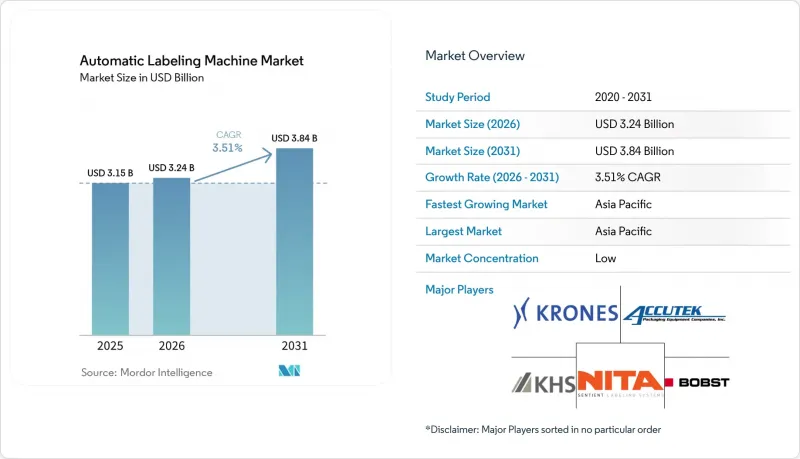
Mordor Intelligence에 의하면, 자동 라벨링 기계 시장 규모는 2025년 31억 5,000만 달러로 평가되었습니다. 2026년 32억 4,000만 달러에서 2031년까지 38억 4,000만 달러로 확대되며 2026년부터 2031년까지 연평균 복합 성장률(CAGR)은 3.51%를 나타낼 전망입니다.
본 보고서는 기술별(압력 감지식, 수축 슬리브 등), 기계 구성별(인라인식, 로터리식, 프린트 앤 어플라이식, 모듈러/하이브리드식), 라벨링 속도별(60 BPM 미만, 61-200 BPM, 201-400 BPM, 400 BPM 초과), 최종 사용자별(음료, 의약품, 퍼스널케어 및 화장품, 기타), 지역별로 분류되어 있습니다. 시장 전망은 금액(달러) 기준으로 제시되어 있습니다.
세계의 자동 라벨링 기계 시장 동향 및 인사이트
의약품 및 의료기기 분야의 시리얼화 및 UDI 규제 강화
제약 및 의료기기 제조업체는 미국의 DSCSA, 유럽의 위조 의약품 지침, 그리고 중국의 2024년 약사법에 부합하기 위해 판매 가능한 모든 단위, 케이스, 팔레트에 고유 식별자를 인쇄해야 합니다. 한때 독립형 기계식 라벨링기에 의존하던 기업들은 2D 데이터 매트릭스 프린터, 비전 검증, 그리고 일련번호를 실시간으로 동기화하는 데이터베이스 연결 기능을 생산 라인에 사후 장착하고 있습니다. 수탁 제조업체들은 수출 인증을 유지하기 위해 이러한 업그레이드를 서둘러 진행하고 있으며, 조달 예산을 일반 포장 설비가 아닌 인쇄·부착 일체형 모듈에 할당하고 있습니다. 이러한 변화로 인해 ISO 9001 및 FDA 21 CFR Part 11 인증을 취득한 공급업체가 우대받고 있습니다. 왜냐하면, 그들은 규제 감사 시에 요구되는 검증 프로토콜을 제공할 수 있기 때문입니다.
수제 음료 시장에서 소량 생산 SKU의 급증
크래프트 맥주 양조장이나 장인 정신을 중시하는 증류소의 경우, 5년 전만 해도 공장당 SKU 수가 고작 20개에 불과했으나 현재는 평균 75개에 달하고 있으며, 이러한 급증으로 인해 미리 인쇄된 라벨의 재고 관리는 경제적으로 비효율적이 되었습니다. 잉크젯 또는 열전사 인쇄와 감압식 부착 기능을 결합한 모듈식 자동 라벨링 기계 플랫폼을 통해, 생산자는 몇 분 만에 그래픽을 변경할 수 있어, 시즌 한정 상품이나 콜라보레이션 상품 생산 시 상품의 구식화를 최소화할 수 있습니다. SwiftColor SCC-4000D와 같은 솔루션은 분당 최대 60피트의 속도로 풀컬러 가변 데이터 라벨을 인쇄할 수 있어, 한정판 음료가 콘셉트 승인 후 며칠 이내에 매대에 진열될 수 있도록 합니다. 이러한 추세는 특산 식품 및 소비자 직접 판매 화장품 분야로도 확산되고 있으며, 중속으로 신속하게 라벨을 교체할 수 있는 라벨 부착기의 수익 기반을 확대되고 있습니다.
고액의 설비 투자(CAPEX) 대 임대 또는 위탁 포장 선택지
자금 조달에 어려움을 겪고 있는 많은 식품 및 퍼스널케어 브랜드들은 설비 임대나 생산 외주를 늘리고, 설비의 직접 구매를 미루고 있습니다. ProMach사에 따르면, 마케팅 담당자들이 기계가 아닌 디지털 캠페인에 자금을 집중한 결과, 2024년에는 임대 관련 문의가 35% 급증했다고 합니다. 도미노 피자의 "Labeling-as-a-Service" 이러한 구독 모델에서는 하드웨어, 소모품, 원격 모니터링이월이용료에 포함되어 있어, 위험이 브랜드 소유주에서 공급업체로 이전되고 있습니다. 이러한 서비스는 이용 기회를 확대하는 한편, 초기 수익을 압박하기 때문에 단기적으로는 자동 라벨링 기계 시장의 성장을 둔화시키는 요인이 되고 있습니다.
부문별 분석
슬리브 부착기 시장은 2025-2031년 연평균 성장률(CAGR) 4.24%를 기록하며, 자동 라벨링 기계 시장의 각 기술 중 가장 빠른 성장세를 보였습니다. 압력 감지식 유닛은 2025년에도 자동 라벨링 기계 시장 점유율의 39.83%를 차지했으며, 규정 준수 표시, 가변 데이터 및 간편한 전환 기능 덕분에 선호되고 있습니다. 풀바디 수축 슬리브는 병에 엠보싱 가공을 할 필요 없이, 위조 방지 기능이나 360도 그래픽을 원하는 에너지 드링크 및 RTD(Ready-to-Drink) 칵테일 브랜드들로부터 주목을 받고 있습니다. 단일 소재로 재활용이 가능하다는 점이 장점인 스트레치 슬리브는 유럽의 생산자 책임 규정을 준수하는 주스 및 유제품 제조업체들로부터 지지를 받고 있습니다. 기존 맥주 생산 라인에서는 라벨 1장당 비용이 저렴하기 때문에 콜드 글루 스테이션이 주류를 이루고 있지만, 고정된 형식으로 인해 SKU 전환 시 가동 중단 시간이 길어지는 문제 때문에 양조업체들은 모듈식 슬리브나 감압식 헤드로의 전환을 추진하고 있습니다. 서보 제어를 활용한 이음매 중첩 트리밍 등의 혁신적인 기술을 통해 필름 폐기량을 15% 줄임으로써, 비용 절감과 지속가능성 목표를 동시에 달성하고 있습니다.
주문형 인쇄의 통합으로 인해 기술적 경계가 재정의되고 있습니다. 도미노사의 N610i 잉크젯 헤드는 기존의 압력 감지식 라벨 부착기에 직접 장착할 수 있으며, 분당 300미터의 가변 데이터 스트림을 지원하여, 인쇄와 라벨링 사이에 존재하던 장벽을 해소하고 있습니다. 압력 감지형 웹에 RFID 인레이를 내장하는 공급업체 덕분에, 물류 사용자는 수동 스캔 없이도 소포를 추적할 수 있게 되어 활용 범위가 넓어지고 있습니다. 이처럼 지속가능성, 장식, 규정 준수가 융합되면서 자동 라벨링 기계 시장의 기술 다양화를 촉진하고 있습니다.
모듈형 및 하이브리드형 시스템은 2026년부터 2031년에 걸쳐 4.52%의 성장률이 예상되며, 이는 2025년 시장 점유율 62.42%를 차지했던 인라인형 주력 기종을 앞지르는 속도입니다. 이러한 프레임은 공통 섀시에 압력 감지식, 접착식 또는 슬리브식 헤드를 장착할 수 있어, 코팩커는 여러 브랜드와 제품에 걸쳐 투자를 분산할 수 있습니다. KHS사의 "Innoket Neo Flex" 설치 면적을 30% 줄이고, 공구 없이도 교체가 가능하도록 함으로써 중규모 유제품 제조업체 및 양조장에서 설비 종합 효율(OEE) 향상에 기여합니다. 600 BPM을 초과하는 로터리 서보식 기계는 대규모 공장에서 여전히 필수적이지만, 제품 포트폴리오의 세분화로 인해 로트 규모가 축소되는 상황에서 가동률이 떨어질 위험이 있습니다. 전자상거래 물류 센터에서는 크기가 변동하는 소포에 대해 동적인 라벨 크기 설정과 배송 데이터가 필요하기 때문에 "프린트 앤 어플라이" 이 방식의 라벨 부착기가 널리 보급되고 있습니다.
구독제 도입으로 초기 비용에 대한 장벽이 해소됨에 따라, 모듈식 시스템과 연동되는 자동 라벨링 기계 시장 규모가 확대되고 있습니다. 각 공급업체는 IoT 진단을 통해 가동 시간을 보장하고, 소모품을 통한 안정적인 수익원을 확보하는 한편, 팬데믹 기간 동안 설비 투자를 중단했던 조달 동결을 피하고 있습니다. 그 결과, 구성 선택은 이제 SKU 변동에 대비해 포장 라인의 미래 경쟁력을 확보하기 위한 전략적 수단이 되었습니다.
지역별 분석
아시아태평양은 2025년에 자동 라벨 부착기 시장 점유율의 40.37%를 차지하며, 연평균 성장률(CAGR) 4.78%로 성장할 것으로 전망됩니다. 중국에서는 개정된 '약사법' 이로 인해 일련번호 부여 대상이 한약으로까지 확대됨에 따라, 지역 내 수천 개의 포장 업체들이 비전 검사 모듈 및 불량품 제거 모듈을 도입할 수밖에 없게 되었습니다. 인도의 수탁 제조업체들은 FDA 기준에 부합하는 수출 사양을 충족하기 위해 고속 생산 라인에 투자하고 있으며, 이를 통해 해당 지역의 생산량에서 우위를 더욱 공고히 하고 있습니다. 일본에서는 확대된 생산자 책임 제도에 따라 라이너리스 라벨의 도입이 가속화되고 있는 반면, 한국에서는 EU 규정을 준수하기 위해 배터리 공급망에서 추적성이 요구되고 있습니다.
북미에서는 전자상거래 물류가 호재를 타고 있으며, 미국의 풀필먼트 센터에서는 AI 비전 및 프린트 앤 어플라이 셀이 도입되고 있습니다. 이로 인해 음료 제조업체들이 장비 교체 주기를 연장하고 있음에도 불구하고, 자동 라벨링 기계 시장의 매출은 증가하고 있습니다. 2026년 DSCSA 최종 마일스톤에 대응하는 제약 생산 라인은 특히 중복성과 검증 능력이 요구되는 위탁 개발·제조 기관(CDMO)을 중심으로 미국 내 설비 현대화를 지속적으로 주도하고 있습니다. 유럽에서는 지속가능성과 규제의 균형이 잘 잡혀 있습니다. 독일, 프랑스, 이탈리아에서는 2030년의 “포장 및 포장 폐기물 규제”재활용 의무를 충족하기 위해 단일 소재 필름과 모듈식 헤드가 채택되었습니다. 음료 제조업체들은 다양한 소재의 슬리브에서 재활용이 가능한 수축 필름으로 전환하고 있으며, 이는 중속 시스템의 매출을 뒷받침하고 있습니다. 스페인과 폴란드의 위탁 포장 업체들은 다국적 브랜드 소유주들에게 서비스를 제공하기 위해 인라인 장비를 임대하고 있으며, 이는 완만하지만 꾸준한 성장을 뒷받침하고 있습니다.
남미에서는 브라질의 음료 부문과 아르헨티나의 의약품 수출을 원동력으로 설비 도입이 점진적으로 증가하고 있지만, 환율 변동으로 인해 임대 및 중고 장비의 유통이 활성화되고 있습니다. 중동 및 아프리카에서는 사우디아라비아의 제네릭 의약품 현지 생산과 남아프리카공화국의 식품 수출에 주력하고 있으며, 비전 검사 기능을 갖춘 중급 기종이 할랄 표시 요건과 EU의 추적성 요건을 모두 충족하고 있습니다. 콜롬비아와 칠레에서는 정부의 우대 조치에 따라 에너지 효율이 높은 라벨링 라인을 도입하는 공장에 세제 혜택이 제공됨에 따라, 주저하던 포장 업체들도 자동화 계획 재개를 단행하고 있습니다. 이 지역 전반에 걸쳐 원격 모니터링과 구독 요금을 결합한 서비스를 제공하는 업체들이 지지를 얻고 있습니다. 이러한 접근 방식을 통해 변환기는 환율 변동이나 예상치 못한 유지보수 비용의 위험으로부터 보호받을 수 있기 때문입니다.
기타 혜택 :
- 엑셀 형식 시장 예측(ME) 시트
- 3개월간의 애널리스트 지원
자주 묻는 질문
목차
제1장 서론
제2장 조사 방법
제3장 주요 요약
제4장 시장 구도
제5장 시장 규모 및 성장 예측
제6장 경쟁 구도
제7장 시장 기회 및 향후 전망
KTH 26.07.07According to Mordor Intelligence, the automatic labeling machine market size is projected to expand from USD 3.15 billion in 2025 and USD 3.24 billion in 2026 to USD 3.84 billion by 2031, registering a CAGR of 3.51% between 2026 to 2031.
This report is Segmented by Technology (Pressure-Sensitive, Shrink-Sleeve, and More), Machine Configuration (In-Line, Rotary, Print-And-Apply, and Modular / Hybrid), Labelling Speed (Less Than 60 BPM, 61-200 BPM, 201-400 BPM, and More Than 400 BPM), End User (Beverages, Pharmaceuticals, Personal Care and Cosmetics, and More), and Geography. The Market Forecasts are Provided in Terms of Value (USD).
Global Automatic Labeling Machine Market Trends and Insights
Stricter Serialization and UDI Rules in Pharma and Med-Device
Pharmaceutical and medical-device producers must imprint unique identifiers on every saleable unit, case, and pallet to comply with the U.S. DSCSA, Europe's Falsified Medicines Directive, and China's 2024 Drug Administration Law. Companies that once relied on standalone mechanical labelers are retrofitting lines with 2D DataMatrix printers, vision verification, and database connectivity that synchronize serial numbers in real time. Contract manufacturers are fast-tracking these upgrades to retain export certifications, diverting procurement budgets toward integrated print-and-apply modules rather than general packaging assets. The shift rewards suppliers certified under ISO 9001 and FDA 21 CFR Part 11 because they can furnish validation protocols required during regulatory audits.
Surge in Craft Beverage Short-Run SKUs
Craft brewers and artisanal distilleries now average 75 distinct SKUs per plant, compared with 20 just five years ago, a proliferation that makes pre-printed label inventories uneconomical. Modular automatic labeling machine platforms that combine inkjet or thermal transfer printing with pressure-sensitive application enable producers to switch graphics in minutes, squeezing obsolescence out of seasonal or collaboration runs. Solutions such as the SwiftColor SCC-4000D deliver full-color, variable-data labels at up to 60 ft/min, letting limited-edition beverages reach shelves within days of concept approval. This trend is spilling into specialty foods and direct-to-consumer cosmetics, broadening the revenue base for mid-speed, quick-change applicators.
High CAPEX Versus Rental or Contract Packaging Options
Cash-constrained food and personal-care brands increasingly rent equipment or outsource production, delaying outright purchases. ProMach noted a 35% jump in rental inquiries during 2024 as marketers funneled capital toward digital campaigns instead of machinery. Subscription models such as Domino's Labeling-as-a-Service bundle hardware, consumables, and remote monitoring into monthly fees, shifting risk from brand owners to suppliers. While these offerings expand access, they compress up-front revenues, tempering automatic labeling machine market growth in the near term.
Other drivers and restraints analyzed in the detailed report include:
- Growth of E-Commerce Fulfillment Centers
- Sustainability-Driven Shift to Linerless Labels
- Volatile Raw-Material (Label Stock) Prices
For complete list of drivers and restraints, kindly check the Table Of Contents.
Segment Analysis
Sleeve applicators expanded at a 4.24% CAGR between 2025 and 2031, the briskest pace among technologies in the automatic labeling machine market. Pressure-sensitive units still delivered 39.83% automatic labeling machine market share in 2025, favored for compliance text, variable data, and easy changeovers. Full-body shrink sleeves attract energy drink and ready-to-drink cocktail brands that seek tamper evidence and 360-degree graphics without bottle embossing. Stretch sleeves, promoted for mono-material recyclability, appeal to juice and dairy processors complying with European producer-responsibility rules. Although cold-glue stations dominate legacy beer lines for their low per-label cost, their rigid format lengthens downtime during SKU switches, nudging brewers toward modular sleeves or pressure-sensitive heads. Innovations such as servo-controlled seam overlap trimming reduce film waste by 15%, aligning cost and sustainability goals.
Print-on-demand integration is redefining technological boundaries. Domino's N610i inkjet head bolts onto existing pressure-sensitive applicators and supports 300 m/min variable-data streams, erasing the historical divide between printing and labeling. Suppliers embedding RFID inlays within pressure-sensitive webs let logistics users track parcels without manual scans, widening application breadth. Sustainability, decoration, and compliance thus coalesce to propel technology diversification within the automatic labeling machine market.
Modular and hybrid systems are projected to grow 4.52% from 2026-2031, outpacing in-line workhorses that owned 62.42% of market share in 2025. These frames accept pressure-sensitive, glue, or sleeve heads on a common chassis, allowing co-packers to amortize investment across multiple brands and products. KHS Innoket Neo Flex cuts footprint by 30% and delivers tool-free changeovers, translating into higher overall equipment effectiveness for midsized dairies and breweries. Rotary-servo machines exceeding 600 BPM remain indispensable in mega-plants but risk under-utilization as portfolio fragmentation shortens run lengths. Print-and-apply boxes proliferate in e-commerce distribution centers where variable-dimension parcels demand dynamic label sizing and shipping data.
The automatic labeling machine market size tied to modular systems is expanding as subscription pricing removes up-front barriers. Vendors guarantee uptime via IoT diagnostics, secure a consumable revenue stream, and sidestep procurement freezes that stalled capital expenditure during pandemic years. As a result, configuration choice is now a strategic lever that can future-proof packaging lines against SKU volatility.
Complete Report Scope:
- By Technology
- Pressure-Sensitive / Self-Adhesive Labelers
- Shrink-Sleeve Labelers
- Glue-Based (Cold Glue, Hot-Melt) Labelers
- Sleeve (Stretch, Heat) Labelers
- In-Mold Labelers
- Other Technologies
- By Machine Configuration
- In-Line Labeling Machines
- Rotary / Rotary-Servo Labelers
- Print-and-Apply Systems
- Modular / Hybrid Systems
- By Labelling Speed
- Less Than 60 BPM
- 61-200 BPM
- 201-400 BPM
- More Than 400 BPM
- By End User
- Food
- Beverages
- Pharmaceuticals
- Personal Care and Cosmetics
- Chemicals and Industrial
- Logistics and E-Commerce
- Other End Users
- By Geography
- North America
- United States
- Canada
- Mexico
- South America
- Brazil
- Argentina
- Rest of South America
- Europe
- Germany
- United Kingdom
- France
- Spain
- Italy
- Rest of Europe
- Asia-Pacific
- China
- Japan
- India
- Australia
- South Korea
- Rest of Asia-Pacific
- Middle East and Africa
- Middle East
- Saudi Arabia
- United Arab Emirates
- Turkey
- Rest of Middle East
- Africa
- South Africa
- Kenya
- Rest of Africa
- Middle East
- North America
Geography Analysis
Asia-Pacific contributed 40.37% of automatic labeling machine market share in 2025 and is forecast to advance at 4.78% CAGR. China's amended Drug Administration Law extends serialization to traditional Chinese medicine, compelling thousands of regional packagers to add vision and reject modules. India's contract manufacturers invest in high-speed lines to meet FDA-aligned export specs, reinforcing the region's volume dominance. Japan's extended producer-responsibility rules accelerate linerless adoption, while South Korea's battery supply chain demands traceability for EU compliance.
North America capitalizes on e-commerce logistics, with U.S. fulfillment centers embedding AI vision and print-and-apply cells that uplift automatic labeling machine market revenue despite beverage producers stretching replacement cycles. Pharmaceutical lines meeting the final 2026 DSCSA milestone continue to drive U.S. upgrades, especially among contract development and manufacturing organizations that require redundant, validated equipment.Europe balances sustainability and regulation. Germany, France, and Italy adopt mono-material films and modular heads to meet the 2030 Packaging and Packaging Waste Regulation recycle mandate. Beverage firms transition from multi-material sleeves to recyclable shrink films, sustaining mid-speed system sales. Contract packers in Spain and Poland lease in-line units to service multinational brand owners, reinforcing modest but steady growth.
South America leverages Brazil's beverage sector and Argentina's pharma exports to support incremental installations, though currency volatility encourages rental or used-equipment channels. Middle East and Africa concentrate on Saudi localization of generics and South African food exports, where mid-range machines with vision inspection satisfy both halal labeling and EU traceability requirements. Government incentives in Colombia and Chile now provide tax abatements for plants that adopt energy-efficient labeling lines, nudging hesitant packagers to revive automation plans. Across these regions, suppliers that bundle remote monitoring with subscription pricing gain traction because the approach shields converters from foreign-exchange swings and unexpected maintenance expenses.
- Krones AG
- Sidel Group (Tetra Laval)
- KHS GmbH
- SACMI Imola SC
- Accutek Packaging Company, Inc.
- ProMach Inc.
- HERMA GmbH
- Domino Printing Sciences PLC
- Fuji Seal International
- Avery Dennison Corporation
- Weber Packaging Solutions
- Markem-Imaje (Dover)
- Videojet Technologies
- P.E. Labellers S.p.A.
- Nita Labeling Systems
- Quadrel Labeling Systems
- Pack Leader Machinery
- World Pack Automation Systems
- Arca Labeling and Marking
- Bobst Group SA
- Sato Holdings Corporation
Additional Benefits:
- The market estimate (ME) sheet in Excel format
- 3 months of analyst support
TABLE OF CONTENTS
1 INTRODUCTION
- 1.1 Study Assumptions and Market Definition
- 1.2 Scope of the Study
2 RESEARCH METHODOLOGY
3 EXECUTIVE SUMMARY
4 MARKET LANDSCAPE
- 4.1 Market Overview
- 4.2 Market Drivers
- 4.2.1 Rising Demand for Smart Packaging Traceability
- 4.2.2 Surge in Craft Beverage Short-Run SKUs
- 4.2.3 Growth of E-Commerce Fulfillment Centers
- 4.2.4 Stricter Serialization and UDI Rules in Pharma and Med-Device
- 4.2.5 Digital Print-On-Demand Integration
- 4.2.6 Sustainability-Driven Shift to Linerless Labels
- 4.3 Market Restraints
- 4.3.1 High CAPEX Versus Rental or Contract Packaging Options
- 4.3.2 Skill Shortage in Controls and Maintenance
- 4.3.3 Volatile Raw-Material (Label Stock) Prices
- 4.3.4 Interoperability Gaps Across Multi-Vendor Lines
- 4.4 Industry Value Chain Analysis
- 4.5 Regulatory Landscape
- 4.6 Impact of Macroeconomic Factors on the Market
- 4.7 Technological Outlook
- 4.8 Porter's Five Forces Analysis
- 4.8.1 Bargaining Power of Suppliers
- 4.8.2 Bargaining Power of Buyers
- 4.8.3 Threat of New Entrants
- 4.8.4 Threat of Substitutes
- 4.8.5 Competitive Rivalry
5 MARKET SIZE AND GROWTH FORECASTS (VALUE)
- 5.1 By Technology
- 5.1.1 Pressure-Sensitive / Self-Adhesive Labelers
- 5.1.2 Shrink-Sleeve Labelers
- 5.1.3 Glue-Based (Cold Glue, Hot-Melt) Labelers
- 5.1.4 Sleeve (Stretch, Heat) Labelers
- 5.1.5 In-Mold Labelers
- 5.1.6 Other Technologies
- 5.2 By Machine Configuration
- 5.2.1 In-Line Labeling Machines
- 5.2.2 Rotary / Rotary-Servo Labelers
- 5.2.3 Print-and-Apply Systems
- 5.2.4 Modular / Hybrid Systems
- 5.3 By Labelling Speed
- 5.3.1 Less Than 60 BPM
- 5.3.2 61-200 BPM
- 5.3.3 201-400 BPM
- 5.3.4 More Than 400 BPM
- 5.4 By End User
- 5.4.1 Food
- 5.4.2 Beverages
- 5.4.3 Pharmaceuticals
- 5.4.4 Personal Care and Cosmetics
- 5.4.5 Chemicals and Industrial
- 5.4.6 Logistics and E-Commerce
- 5.4.7 Other End Users
- 5.5 By Geography
- 5.5.1 North America
- 5.5.1.1 United States
- 5.5.1.2 Canada
- 5.5.1.3 Mexico
- 5.5.2 South America
- 5.5.2.1 Brazil
- 5.5.2.2 Argentina
- 5.5.2.3 Rest of South America
- 5.5.3 Europe
- 5.5.3.1 Germany
- 5.5.3.2 United Kingdom
- 5.5.3.3 France
- 5.5.3.4 Spain
- 5.5.3.5 Italy
- 5.5.3.6 Rest of Europe
- 5.5.4 Asia-Pacific
- 5.5.4.1 China
- 5.5.4.2 Japan
- 5.5.4.3 India
- 5.5.4.4 Australia
- 5.5.4.5 South Korea
- 5.5.4.6 Rest of Asia-Pacific
- 5.5.5 Middle East and Africa
- 5.5.5.1 Middle East
- 5.5.5.1.1 Saudi Arabia
- 5.5.5.1.2 United Arab Emirates
- 5.5.5.1.3 Turkey
- 5.5.5.1.4 Rest of Middle East
- 5.5.5.2 Africa
- 5.5.5.2.1 South Africa
- 5.5.5.2.2 Kenya
- 5.5.5.2.3 Rest of Africa
- 5.5.5.1 Middle East
- 5.5.1 North America
6 COMPETITIVE LANDSCAPE
- 6.1 Market Concentration
- 6.2 Strategic Moves
- 6.3 Market Share Analysis
- 6.4 Company Profiles (Includes Global Level Overview, Market Level Overview, Core Segments, Financials as Available, Strategic Information, Market Rank/Share, Products and Services, and Recent Developments)
- 6.4.1 Krones AG
- 6.4.2 Sidel Group (Tetra Laval)
- 6.4.3 KHS GmbH
- 6.4.4 SACMI Imola SC
- 6.4.5 Accutek Packaging Company, Inc.
- 6.4.6 ProMach Inc.
- 6.4.7 HERMA GmbH
- 6.4.8 Domino Printing Sciences PLC
- 6.4.9 Fuji Seal International
- 6.4.10 Avery Dennison Corporation
- 6.4.11 Weber Packaging Solutions
- 6.4.12 Markem-Imaje (Dover)
- 6.4.13 Videojet Technologies
- 6.4.14 P.E. Labellers S.p.A.
- 6.4.15 Nita Labeling Systems
- 6.4.16 Quadrel Labeling Systems
- 6.4.17 Pack Leader Machinery
- 6.4.18 World Pack Automation Systems
- 6.4.19 Arca Labeling and Marking
- 6.4.20 Bobst Group SA
- 6.4.21 Sato Holdings Corporation
7 MARKET OPPORTUNITIES AND FUTURE OUTLOOK
- 7.1 White-Space and Unmet-Need Assessment


