

|
시장보고서
상품코드
2073547
커넥티드 엔터프라이즈 시장 : 점유율 분석, 업계 동향과 통계, 성장 예측(2026-2031년)Connected Enterprise - Market Share Analysis, Industry Trends & Statistics, Growth Forecasts (2026 - 2031) |
||||||
 Mordor Intelligence
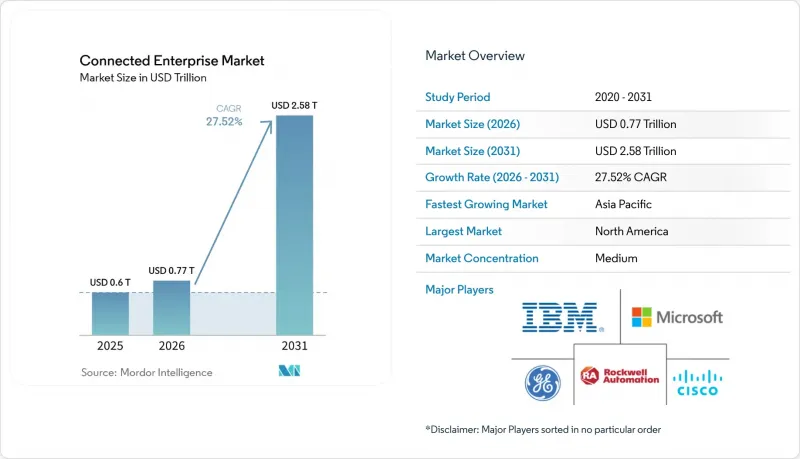
Mordor Intelligence에 의하면, 2026년 커넥티드 엔터프라이즈 시장 규모는 7,700억 달러로 추정되고 있어 2025년 6,000억 달러에서 확대해, 2031년에는 2조 5,800억 달러에 이를 것으로 예측됩니다.
2026년부터 2031년까지의 연평균 성장률(CAGR)은 27.52%가 될 것으로 전망됩니다.
본 보고서는 제공 형태(플랫폼, 솔루션, 서비스), 도입 형태(On-Premise, 클라우드, 하이브리드), 최종 사용자 업종(제조업, 에너지 및 유틸리티 등), 기업 규모(대기업, 중소기업), 연결 기술(Wi-Fi/이더넷, 셀룰러(4G/LTE) 등), 그리고 지역별로 분류되어 있습니다. 시장 전망은 금액(달러) 기준으로 제시되어 있습니다.
전 세계 커넥티드 엔터프라이즈 시장 동향과 인사이트
산업용 IoT 기기 및 센서의 보급
센서 도입이 확대되면서 공장의 경제성이 완전히 달라지고 있습니다. 한 대형 타이어 제조업체는 머신러닝 모델을 기존 설비와 연동함으로써 하루에 1카롤 루피(12만 달러)의 비용 절감을 실현했으며, 또한 새로운 설비를 도입하지 않고도 승용차용 타이어의 일일 생산량을 6만 8,000개에서 7만 3,000개로 늘렸습니다. 엣지 프로세서가 현지에서 피드백 루프를 완성하기 때문에 이상이 감지되면 클라우드와의 왕복 통신을 기다릴 필요 없이 즉시 조치가 실행됩니다. 레트로핏 키트는 장비를 전면 교체하는 것보다 비용이 적게 들기 때문에 사업자는 장비의 수명을 연장하면서 예측 유지보수 엔진에 데이터를 제공할 수 있습니다. 기기 제조업체들은 성능에 관한 전문 지식을 구독 서비스로 수익화함으로써, 하드웨어 수명 주기를 완화하는 새로운 수익원을 개척하고 있습니다. 이 센서의 광범위한 도입이야말로 커넥티드 엔터프라이즈 시장의 성장을 뒷받침하는 가장 큰 원동력입니다.
클라우드 네이티브 도입과 iPaaS의 확대
기업들은 무거운 워크로드를 리전을 넘나들며 자동 확장하고, 필요에 따라 연산 능력을 확장할 수 있는 클라우드 네이티브 스택으로 전환하고 있습니다. 마이크로소프트의 지능형 클라우드 부문은 산업용 IoT 및 분석 워크로드에 힘입어 2025년 1분기에 424억 달러의 매출을 기록했습니다. iPaaS(Integration Platform as a Service)는 수백 가지의 OT 프로토콜과 엔터프라이즈 용도를 통합하여, 자재 추적성과 관련된 이벤트 정보를 ERP, MES, 운송 시스템에 실시간으로 반영합니다. 각 벤더사는 현재 서버나 라이선스를 판매하는 대신, 가동 시간이나 에너지 절감을 보장하는 성과 기반 계약을 판매함으로써, 위험을 공급업체 측으로 전가하는 동시에 수년에 걸친 수익을 확고히 하고 있습니다. 오픈 API는 벤더 종속성을 완화하고, 경쟁적인 조달을 가속화하며, 커넥티드 엔터프라이즈 시장의 추가적인 원동력이 되고 있습니다.
브라운필드 통합에 따른 막대한 설비 투자
수십년전의 기계에 센서, 게이트웨이, 안전한 원격 접속 기능을 사후에 도입하는 것은 자본 예산에 큰 부담을 줍니다. 통합에는 레거시 자산 1대당 1만 2,000달러의 비용이 소요될 수 있으며, 각 거점에서는 수십 대에서 수백 대에 달하는 이러한 기계가 가동되고 있습니다. 중소기업은 사내에 고도의 엔지니어링 노하우가 부족하기 때문에 고액의 비용을 청구하는 전문 통합 업체에 의존할 수밖에 없어 투자 회수 기간이 길어지고 있습니다. 다양한 산업용 프로토콜이 존재하기 때문에 여러 게이트웨이와 맞춤형 미들웨어를 함께 사용해야 하며, 이로 인해 프로젝트 범위가 점점 확대되고 있습니다. 지출을 억제하기 위해 모듈식 개조 키트나 개방형 인터페이스 규격이 등장하고 있지만, 자금 조달의 어려움이 여전히 많은 프로젝트의 지연 요인으로 작용하고 있습니다.
부문별 분석
2025년, 커넥티드 엔터프라이즈 시장 매출액 중 솔루션이 50.72%를 차지했습니다. 이는 개별 기능을 디지털화하는 MES, EAM, CX 제품군이 주도한 결과입니다. 한편, 플랫폼 부문은 연평균 성장률(CAGR) 30.12%로 성장을 주도하고 있는데, 이는 기업들이 분석 기능을 추가하기 전에 우선 데이터 패브릭 및 디바이스 관리 계층에 대한 투자를 우선시하고 있기 때문입니다. 2026년에는 플랫폼 시장 규모가 491억 달러 증가할 것으로 예상되며, 이는 백본에 대한 투자로 구조적 전환이 진행되고 있음을 보여줍니다. 멀티테넌트 아키텍처를 통해 벤더는 고객 간에 연구개발비용을 분산시키면서도 테넌트별로 분리된 데이터 경계를 제공할 수 있기 때문에 플랫폼 분야의 커넥티드 엔터프라이즈 시장 규모는 급속히 확대될 것으로 전망됩니다. 서비스 부문은 절대액 기준으로는 뒤처져 있지만, 성과 보장형으로 전환되고 있어 통합업체가 성과 위험을 부담하는 형태가 되고 있습니다. 플랫폼 중심의 접근 방식을 통해 기업은 전면적인 시스템 교체(포크리프트 업그레이드) 대신 API를 통해 AI 추론, 엣지 오케스트레이션, 위협 모니터링 기능을 통합할 수 있게 됩니다. 디바이스 수명 주기 관리 플랫폼은 10만 대 이상의 자산에 대한 펌웨어 패치 적용을 간소화하여, 현장 방문 없이 가동 시간을 확보합니다. 오픈소스 프레임워크가 성숙해짐에 따라 플랫폼 간의 상호 운용성이 향상되어, 구매자는 기존의 제어 시스템을 “교체”하는 대신, 최고 수준의 분석 도구를 조합할 수 있게 됩니다. 이러한 변화는 벤더 생태계를 강화하고, 데이터 버전 관리, 디지털 트윈 오케스트레이션 또는 역할 기반 워크플로 설정을 전문으로 하는 신규 진출기업들을 뒷받침하며, 커넥티드 엔터프라이즈 시장의 경쟁을 심화시킬 것입니다.
클라우드 도입은 급속한 확장성과 “성장 단계에 따른 과금”라는 경제성 덕분에 2025년에는 시장 규모의 53.02%를 차지했습니다. 그럼에도 불구하고, 지연 시간에 민감한 워크로드와 주권을 중시하는 워크로드로 인해 On-Premise에 대한 수요가 다시 불붙으면서, 하이브리드 솔루션의 연평균 성장률(CAGR)은 30.86%에 달했습니다. 공장이 50밀리초 미만의 응답 시간을 실현하는 로컬 엣지 노드와 모델 훈련용 지역 클라우드를 융합함에 따라, 하이브리드 환경으로 인해 형성된 커넥티드 엔터프라이즈 시장 규모는 2031년까지 1조 1,400억 달러에 달할 가능성이 있습니다. 각 플랫폼 공급업체들은 현재 생산 라인 옆에서 PLC 분석을 실행하고, 요약된 텔레메트리 데이터를 통합된 데이터 레이크에 동기화하는 경량 쿠버네티스 스택을 제공합니다. 하이브리드형 아키텍처에서는 엄선된 데이터 세트만 공장 외부로 전송되므로, 데이터 전송 비용을 절감할 수 있을 뿐만 아니라, 유럽에서 마련되고 있는 AI 법안 등의 규제 감사 시에도 현장에서 데이터의 계보(리니지)를 확인할 수 있습니다. 이를 통해 사업자는 제어권을 포기하지 않고도 클라우드의 확장성을 활용할 수 있습니다. 각 공급업체는 컴퓨팅, 스토리지, 보안 및 비용 목표가 일치하는 곳에 워크로드를 자동으로 배치하는 오케스트레이션 계층을 통해 차별화를 꾀하고 있습니다. 예측 기간 동안, 성공적인 솔루션은 AI를 통합하여 리소스 수요를 예측하고 자율적으로 용량을 재조정함으로써 커넥티드 엔터프라이즈 시장을 더욱 주도해 나갈 것입니다.
지역별 분석
북미는 초기 단계의 사설 5G 시범 사업, 풍부한 브라운필드 개조, 그리고 산업계 스타트업에 대한 견실한 벤처 자금 조달에 힘입어 2025년에는 36.62%의 점유율로 시장을 독점했습니다. 첨단 제조 및 청정 기술 프로젝트에 대한 연방 정부의 인센티브가 배터리 공장 및 반도체 팹에 센서 도입을 촉진하고 있습니다. 해당 지역에 본사를 둔 클라우드 하이퍼스케일러는 AI 지원 데이터 레이크와 프로젝트 리드타임을 단축하는 로우코드 분석 솔루션을 제공하며, 밸류체인을 뒷받침하고 있습니다. 록웰 오토메이션과 마이크로소프트간의 제휴 확대와 같은 전략적 협약은 공장 제어와 클라우드 추론을 통합하여 도입을 가속화하고 있습니다.
아시아태평양은 지속적인 산업화와 정부 주도의 스마트 제조 프로그램의 뒷받침을 받아 32.05%라는 더 가파른 연평균 성장률(CAGR) 곡선을 그리고 있습니다. 중국의 가격 경쟁력이 높은 자동화 추진은 현지 OEM 제조업체들의 혁신을 촉진하고 있는 반면, 인도의 ‘생산 연계형 인센티브(PLI)” 제도는 다국적 기업들에게 연결된 그린필드 공장 건설을 장려하고 있습니다. 현재 일본과 한국에서는 도시 지역의 75%가 5G 서비스 범위에 포함되어 있어, 완전 무선화 공장의 실현이 가능해졌습니다. 지역 통신 사업자는 주파수 대역, 엣지 컴퓨팅, 사이버 보안을 묶은 ‘서비스형 사설 네트워크(PNaaS)”를 제공함으로써 중견 제조업체 시장 진입 장벽을 낮추고 있습니다. 그 결과, 커넥티드 엔터프라이즈 시장에서 2029년까지 아시아태평양의 지출액이 유럽을 넘어설 것으로 전망됩니다.
유럽은 엄격한 ESG 및 사이버 보안 규제의 뒷받침을 받아 확고한 시장 점유율을 유지하고 있습니다. “디지털 운영 복원력법(Digital Operational Resilience Act)”에 따라 금융기관은 OT/IT 인터페이스 강화를 의무화하고 있는 반면, 자동차 OEM 각사는 스코프 3 보고 의무를 이행하기 위해 카본 레저 트윈에 대한 투자를 추진하고 있습니다. 이러한 규제는 성숙한 커넥티드 엔터프라이즈 도입의 상징인, 안전하고 감사 가능한 데이터 파이프라인에 대한 수요를 촉진하고 있습니다. 한편, 중동 및 아프리카와 남미는 여전히 개발도상국이지만, 장래성은 높다고 할 수 있습니다. 만안 지역의 에너지 기업들은 스마트 정유시설 트윈의 시범 운영을 진행하고 있으며, 브라질의 농업 기업들은 농장에 센서를 도입하고, 남아프리카의 광산 기업들은 프라이빗 LTE를 활용한 자율 운반 시스템의 시험을 진행하고 있습니다. 인프라 격차가 해소됨에 따라, 이러한 지역들은 커넥티드 엔터프라이즈 시장에 더 큰 성장을 가져올 것이지만, 현재로서는 3대 대륙의 선도 기업들에게 위협이 될 정도는 아닙니다.
기타 혜택:
- 엑셀 형식 시장 예측(ME) 시트
- 3개월간의 애널리스트 지원
자주 묻는 질문
목차
제1장 서론
제2장 조사 방법
제3장 주요 요약
제4장 시장 구도
제5장 시장 규모와 성장 예측
제6장 경쟁 구도
제7장 투자 분석
제8장 시장 기회와 향후 동향
JHS 26.07.09According to Mordor Intelligence, connected enterprise market size in 2026 is estimated at USD 0.77 trillion, growing from 2025 value of USD 0.6 trillion with 2031 projections showing USD 2.58 trillion, growing at 27.52% CAGR over 2026-2031.
This report is Segmented by Offering (Platforms, Solutions, and Services), Deployment Mode (On-Premise, Cloud, and Hybrid), End-User Vertical (Manufacturing, Energy and Utilities, and More), Enterprise Size (Large Enterprises and Small and Medium Enterprises), Connectivity Technology (Wi-Fi/Ethernet, Cellular (4G/LTE), and More), and Geography. The Market Forecasts are Provided in Terms of Value (USD).
Global Connected Enterprise Market Trends and Insights
Proliferation of Industrial IoT Devices and Sensors
Mounting sensor deployments are rewriting factory economics. A leading tyre producer saved INR 1 crore (USD 120,000) daily by linking machine-learning models with legacy assets, then lifted daily passenger-tyre output from 68,000 to 73,000 units without new equipment. Edge processors close feedback loops locally, so anomalies trigger instant actions instead of waiting for round-trip cloud calls. Retrofit kits cost less than wholesale replacement, letting operators extend gear life while feeding predictive-maintenance engines. Equipment makers monetise performance insights as subscription services, unlocking fresh revenue that cushions hardware cycles. This widespread sensor adoption is the single biggest feedstock for connected enterprise market growth.
Cloud-Native Adoption and iPaaS Expansion
Enterprises are shifting heavy workloads to cloud-native stacks that auto-scale across regions and burst compute on demand. Microsoft's intelligent cloud segment logged USD 42.4 billion revenue in Q1 2025, buoyed by industrial IoT and analytics workloads. Integration Platform as a Service unifies hundreds of OT protocols with enterprise applications, allowing material-traceability events to update ERP, MES, and transport systems in real time. Vendors now sell outcome-based contracts that guarantee uptime or energy savings instead of selling servers or licences, shifting risk toward suppliers but cementing multiyear revenue. Open APIs reduce vendor lock-in and accelerate competitive sourcing, an added driver for the connected enterprise market.
High Capex for Brown-Field Integration
Retrofitting decades-old machinery with sensors, gateways, and secure remote access strains capital budgets. Integration can cost USD 12,000 per legacy asset, and each site runs dozens or hundreds of such machines. SMEs lack in-house engineering depth, so they rely on specialist integrators that charge premium rates, elongating payback cycles. Diverse industrial protocols inflate project scope because multiple gateways and custom middleware must coexist. Modular retrofit kits and open interface standards are emerging to curb spend, yet financing hurdles still delay many projects.
Other drivers and restraints analyzed in the detailed report include:
- Real-Time Supply-Chain Visibility Needs
- Private 5G Networks Enabling Deterministic Latency
- Cybersecurity Skills Shortage and Expanding Attack Surface
For complete list of drivers and restraints, kindly check the Table Of Contents.
Segment Analysis
Solutions held 50.72% of connected enterprise market revenue in 2025, led by MES, EAM, and CX suites that digitalize discrete functions. Platforms, however, headline growth at a 30.12% CAGR as firms invest first in data fabrics and device-management layers before layering analytics. In 2026, the platforms slice is forecast to add USD 49.1 billion, signalling a structural pivot toward backbone investments. The connected enterprise market size for platforms is projected to widen sharply because multi-tenant architectures let vendors amortize R&D across customers while still offering tenant-twinned data boundaries. Services trail in absolute dollars but shift to outcome guarantees, where integrators shoulder performance risk.A platform-centric play allows enterprises to plug in AI inference, edge orchestration, and threat monitoring by API rather than by forklift upgrade. Device-lifecycle platforms simplify firmware patching across 100,000-plus assets, protecting uptime without site visits. As open-source frameworks mature, platforms will interoperate, letting buyers mix best-of-breed analytics with incumbent control systems instead of a rip-and-replace scenario. These shifts reinforce vendor ecosystems and spur new entrants that specialise in data-versioning, digital-twin orchestration, or role-based workflow configuration, deepening competition inside the connected enterprise market.
Cloud deployments formed 53.02% of the value in 2025 due to rapid scaling and pay-as-you-grow economics. Nevertheless, latency-sensitive or sovereign workloads have rekindled on-premises needs, sparking a 30.86% CAGR in hybrid solutions. The connected enterprise market size attributable to hybrid estates could top USD 1.14 trillion by 2031 as factories blend local edge nodes for sub-50 ms response with regional clouds for model training. Platform vendors now ship lightweight Kubernetes stacks that run PLC analytics beside the line, then sync summarized telemetry to centralized lakes.Hybrid blueprints mitigate egress costs, as only curated datasets leave the plant, and regulatory audits -such as Europe's emerging AI Act -can verify lineage on site. Operators thus enjoy cloud elasticity without surrendering control. Suppliers are differentiating through orchestration layers that auto-place workloads wherever compute, storage, security, and cost targets align. Over the forecast, winning propositions will embed AI to forecast resource demand and rebalance capacity autonomously, further propelling the connected enterprise market.
Complete Report Scope:
- By Offering
- Platforms
- Device Management
- Connectivity Management
- Other Platforms
- Solutions
- Manufacturing Execution System
- Enterprise Infrastructure Management
- Customer Experience Management
- Remote Monitoring System
- Asset Performance Management
- Other Solutions (Streaming Analytics, Mobile Workforce, Security)
- Services
- Managed
- Professional
- Platforms
- By Deployment Mode
- On-premise
- Cloud
- Hybrid
- By End-user Vertical
- Manufacturing
- Energy and Utilities
- Oil and Gas
- BFSI
- Retail and E-Commerce
- IT and Telecommunications
- Other End-user Verticals
- By Enterprise Size
- Large Enterprises
- Small and Medium Enterprises (SMEs)
- By Connectivity Technology
- Wi-Fi/Ethernet
- Cellular (4G/LTE)
- Private 5G
- LPWAN (LoRaWAN, NB-IoT)
- By Geography
- North America
- United States
- Canada
- Mexico
- South America
- Brazil
- Argentina
- Chile
- Rest of South America
- Europe
- Germany
- United Kingdom
- France
- Italy
- Spain
- Russia
- Rest of Europe
- Asia-Pacific
- China
- India
- Japan
- South Korea
- Malaysia
- Singapore
- Australia
- Rest of Asia-Pacific
- Middle East and Africa
- Middle East
- United Arab Emirates
- Saudi Arabia
- Turkey
- Rest of Middle East
- Africa
- South Africa
- Nigeria
- Rest of Africa
- Middle East
- North America
Geography Analysis
North America dominated with a 36.62% share in 2025, buoyed by early private-5G pilots, ample brownfield retrofits, and robust venture funding into industrial startups. Federal incentives for advanced manufacturing and clean-tech projects drive sensor deployments in battery plants and semiconductor fabs. Cloud hyperscalers headquartered in the region feed the value chain with AI-ready data lakes and low-code analytics that compress project timelines. Strategic pacts such as Rockwell Automation's expanded alliance with Microsoft integrate factory control and cloud inferencing, accelerating adoption.
Asia-Pacific is on a steeper 32.05% CAGR curve, propelled by continued industrialization and state-led smart-manufacturing programs. China's push for price-competitive automation drives local OEM innovation, while India's Production-Linked Incentive schemes entice multinationals to build connected greenfield plants. 5G coverage now blankets 75% of urban zones across Japan and South Korea, enabling fully wireless factories. Regional operators market private-network-as-a-service offers that bundle spectrum, edge compute, and cybersecurity, lowering barriers for mid-tier manufacturers. As a result, the connected enterprise market is likely to see Asia-Pacific overtake Europe in spend before 2029.
Europe holds a solid share anchored by stringent ESG and cybersecurity mandates. The Digital Operational Resilience Act forces financial institutions to harden OT/IT interfaces, while automotive OEMs invest in carbon-ledger twins to meet Scope 3 reporting duties. These rules spur demand for secure, auditable data pipelines, a hallmark of mature connected enterprise deployments. Meanwhile, the Middle East, Africa, and South America remain nascent but promising. Gulf energy players trial smart-refinery twins, Brazilian agribusiness outfits sensorize plantations, and South African miners test autonomous haulage backed by private LTE. As infrastructure gaps close, these regions will add incremental growth to the connected enterprise market without yet challenging the tri-continental leaders.
- Microsoft Corporation
- IBM Corporation
- General Electric Company
- Cisco Systems, Inc.
- Rockwell Automation, Inc.
- Verizon Communications, Inc.
- Harman International Industries Ltd.
- Jacobs Solutions Inc.
- PTC Inc.
- Amazon Web Services, Inc.
- SAP SE
- Schneider Electric SE
- Siemens AG
- Honeywell International Inc.
- Oracle Corporation
- Fujitsu Ltd.
- Bosch Rexroth AG
- ABB Ltd.
- Ericsson AB
- Hitachi Vantara LLC
- Dell Technologies Inc.
- Huawei Technologies Co. Ltd.
- Zebra Technologies Corp.
- Emerson Electric Co.
- Dassault Systemes SE
Additional Benefits:
- The market estimate (ME) sheet in Excel format
- 3 months of analyst support
TABLE OF CONTENTS
1 INTRODUCTION
- 1.1 Study Assumptions and Market Definition
- 1.2 Scope of the Study
2 RESEARCH METHODOLOGY
3 EXECUTIVE SUMMARY
4 MARKET LANDSCAPE
- 4.1 Market Overview
- 4.2 Market Drivers
- 4.2.1 Proliferation of industrial IoT devices and sensors
- 4.2.2 Cloud-native adoption and iPaaS expansion
- 4.2.3 Real-time, supply-chain visibility needs
- 4.2.4 Private 5G networks enabling deterministic latency
- 4.2.5 GenAI-powered autonomous enterprise workflows
- 4.2.6 ESG-linked digital twins for emissions reporting
- 4.3 Market Restraints
- 4.3.1 High capex for brown-field integration
- 4.3.2 Cyber-security skills shortage and attack surface
- 4.3.3 Fragmented device-firmware-update standards
- 4.3.4 Data-ownership disputes in ESG audits
- 4.4 Industry Value Chain Analysis
- 4.5 Regulatory Landscape
- 4.6 Technological Outlook
- 4.7 Industry Attractiveness - Porter's Five Forces Analysis
- 4.7.1 Threat of New Entrants
- 4.7.2 Bargaining Power of Buyers/Consumers
- 4.7.3 Bargaining Power of Suppliers
- 4.7.4 Threat of Substitute Products
- 4.7.5 Intensity of Competitive Rivalry
- 4.8 Impact of Macroeconomic Factors on the Market
5 MARKET SIZE AND GROWTH FORECASTS (VALUES)
- 5.1 By Offering
- 5.1.1 Platforms
- 5.1.1.1 Device Management
- 5.1.1.2 Connectivity Management
- 5.1.1.3 Other Platforms
- 5.1.2 Solutions
- 5.1.2.1 Manufacturing Execution System
- 5.1.2.2 Enterprise Infrastructure Management
- 5.1.2.3 Customer Experience Management
- 5.1.2.4 Remote Monitoring System
- 5.1.2.5 Asset Performance Management
- 5.1.2.6 Other Solutions (Streaming Analytics, Mobile Workforce, Security)
- 5.1.3 Services
- 5.1.3.1 Managed
- 5.1.3.2 Professional
- 5.1.1 Platforms
- 5.2 By Deployment Mode
- 5.2.1 On-premise
- 5.2.2 Cloud
- 5.2.3 Hybrid
- 5.3 By End-user Vertical
- 5.3.1 Manufacturing
- 5.3.2 Energy and Utilities
- 5.3.3 Oil and Gas
- 5.3.4 BFSI
- 5.3.5 Retail and E-Commerce
- 5.3.6 IT and Telecommunications
- 5.3.7 Other End-user Verticals
- 5.4 By Enterprise Size
- 5.4.1 Large Enterprises
- 5.4.2 Small and Medium Enterprises (SMEs)
- 5.5 By Connectivity Technology
- 5.5.1 Wi-Fi/Ethernet
- 5.5.2 Cellular (4G/LTE)
- 5.5.3 Private 5G
- 5.5.4 LPWAN (LoRaWAN, NB-IoT)
- 5.6 By Geography
- 5.6.1 North America
- 5.6.1.1 United States
- 5.6.1.2 Canada
- 5.6.1.3 Mexico
- 5.6.2 South America
- 5.6.2.1 Brazil
- 5.6.2.2 Argentina
- 5.6.2.3 Chile
- 5.6.2.4 Rest of South America
- 5.6.3 Europe
- 5.6.3.1 Germany
- 5.6.3.2 United Kingdom
- 5.6.3.3 France
- 5.6.3.4 Italy
- 5.6.3.5 Spain
- 5.6.3.6 Russia
- 5.6.3.7 Rest of Europe
- 5.6.4 Asia-Pacific
- 5.6.4.1 China
- 5.6.4.2 India
- 5.6.4.3 Japan
- 5.6.4.4 South Korea
- 5.6.4.5 Malaysia
- 5.6.4.6 Singapore
- 5.6.4.7 Australia
- 5.6.4.8 Rest of Asia-Pacific
- 5.6.5 Middle East and Africa
- 5.6.5.1 Middle East
- 5.6.5.1.1 United Arab Emirates
- 5.6.5.1.2 Saudi Arabia
- 5.6.5.1.3 Turkey
- 5.6.5.1.4 Rest of Middle East
- 5.6.5.2 Africa
- 5.6.5.2.1 South Africa
- 5.6.5.2.2 Nigeria
- 5.6.5.2.3 Rest of Africa
- 5.6.5.1 Middle East
- 5.6.1 North America
6 COMPETITIVE LANDSCAPE
- 6.1 Market Concentration
- 6.2 Strategic Moves
- 6.3 Market Share Analysis
- 6.4 Company Profiles (includes Global level Overview, Market level overview, Core Segments, Financials as available, Strategic Information, Market Rank/Share for key companies, Products and Services, and Recent Developments)
- 6.4.1 Microsoft Corporation
- 6.4.2 IBM Corporation
- 6.4.3 General Electric Company
- 6.4.4 Cisco Systems, Inc.
- 6.4.5 Rockwell Automation, Inc.
- 6.4.6 Verizon Communications, Inc.
- 6.4.7 Harman International Industries Ltd.
- 6.4.8 Jacobs Solutions Inc.
- 6.4.9 PTC Inc.
- 6.4.10 Amazon Web Services, Inc.
- 6.4.11 SAP SE
- 6.4.12 Schneider Electric SE
- 6.4.13 Siemens AG
- 6.4.14 Honeywell International Inc.
- 6.4.15 Oracle Corporation
- 6.4.16 Fujitsu Ltd.
- 6.4.17 Bosch Rexroth AG
- 6.4.18 ABB Ltd.
- 6.4.19 Ericsson AB
- 6.4.20 Hitachi Vantara LLC
- 6.4.21 Dell Technologies Inc.
- 6.4.22 Huawei Technologies Co. Ltd.
- 6.4.23 Zebra Technologies Corp.
- 6.4.24 Emerson Electric Co.
- 6.4.25 Dassault Systemes SE
7 INVESTMENT ANALYSIS
8 MARKET OPPORTUNITIES AND FUTURE TRENDS
- 8.1 White-Space and Unmet-Need Assessment


