

|
시장보고서
상품코드
2073556
북미의 산업용 원심분리기 시장 : 점유율 분석, 업계 동향과 통계, 성장 예측(2026-2031년)North America Industrial Centrifuge - Market Share Analysis, Industry Trends & Statistics, Growth Forecasts (2026 - 2031) |
||||||
 Mordor Intelligence
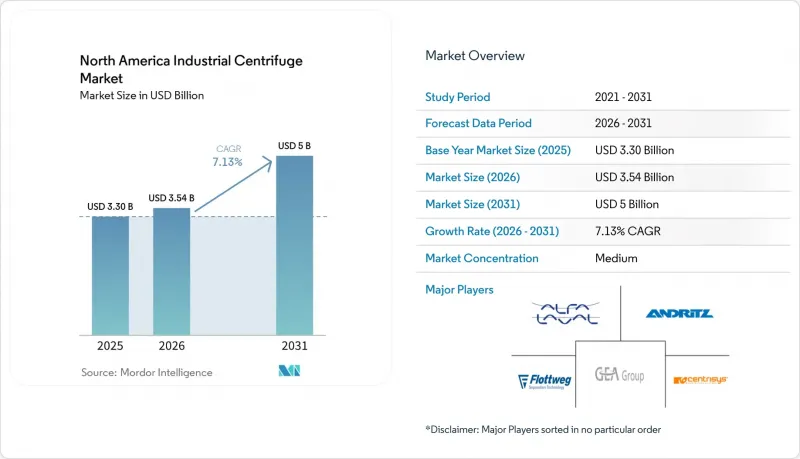
Mordor Intelligence에 의하면, 북미 산업용 원심분리기 시장 규모는 2025년에 33억 달러로 평가되었고 2026년 35억 4,000만 달러에서 2031년까지 50억 달러에 이를 것으로 예측되며, 예측 기간(2026-2031년) CAGR은 7.13%를 나타낼 전망입니다.
본 보고서에서는 업계를 “유형(침전, 여과)”, “설계(수평형, 수직형)”, “운전 모드(배치식, 연속식)”, “산업 분야(식품 및 음료, 제약·생명공학, 상하수도 처리, 화학, 금속 및 광업, 발전 등)”, “지역(미국, 캐나다, 멕시코)”별로 분류하고 있습니다. 시장 전망은 금액(달러) 기준으로 제시되어 있습니다.
북미 산업용 원심분리기 시장 동향 및 분석
미국과 캐나다에서 바이오의약품 생산 능력이 확대됨에 따라 원심분리기 조달 양상이 변화하고 있습니다.
북미의 바이오의약품 부문에서는 국내 생산 거점의 대규모 확충이 진행되고 있으며, 이에 따라 세포 회수, 정제 및 단백질 분리에 사용되는 고속 디스크 스택 분리기와 연속식 데칸터에 대한 수요가 뒷받침되고 있습니다. UCB는 2026년 3월, 조지아주 귀넷 카운티에 46만 제곱피트 규모의 새로운 바이오의약품 단지를 건설하기로 결정했으며, 이를 통해 미국 남동부에 의약품 등급 원심분리기의 새로운 조달 거점을 추가하게 되었습니다. 이러한 유형의 새로운 바이오의약품 시설은 장기적인 가동과 대규모 상업 생산을 염두에 두고 계획되고 있으며, 대규모 처리 능력을 갖춘 신뢰성 높은 분리 장치에 대한 수요가 증가하고 있습니다. 큰 변화 중 하나는 이러한 시설의 상당수가 처음부터 연속식 바이오 제조를 전제로 설계되었으며, 이러한 설계 방침에 따라 배치식 여과를 대체하는 고속 분리 장치가 우선적으로 채택되고 있다는 점입니다. 이러한 레이아웃이 승인되면, 원심분리기에 대한 수요는 플랜트의 가동 기간 내내 생산 라인과 밀접하게 연계된 상태를 유지하는 경향이 있습니다. 따라서 바이오의약품 업계는 북미 산업용 원심분리기 시장에서 가장 확실한 장기 수요의 축 중 하나가 되고 있습니다.
폐수 및 슬러지 감축을 위한 규제 추진이 지속 가능한 인프라 수요를 창출하고 있습니다.
바이오솔리드 처리에 대한 감독이 강화됨에 따라, 지자체 및 산업용 폐수 처리 시스템 전반에서 데칸터 원심분리기에 대한 수요가 유지되고 있습니다. 미국 환경보호청(EPA)은 2024년 1월부터 하수 슬러지 내 40종의 PFAS 분석 대상 물질을 모니터링하기 위한 ‘Method 1633”를 최종 확정하고, 그 후 2024년 12월에 서명된 “Methods Update Rule(분석 방법 업데이트 규칙)”를 통해 이를 40 CFR Part 136에 반영했습니다. 이러한 과정으로 인해 플랜트 운영자는 더욱 강력한 탈수 성능을 발휘해야 하는 압박을 받고 있습니다. 이는 케이크의 건조도가 토양 살포용으로 보내지는 슬러지 내 PFAS 농도에 영향을 미치기 때문입니다. 또한, 규정 준수상의 부담에는 40 CFR Part 503, NPDES 프로그램 및 관련 주 정부의 바이오솔리드 규제도 포함되며, 이들 규정은 원심분리기를 기반으로 한 탈수 라인에 대한 허가 및 성능 검증 기준을 규정하고 있습니다. 건조 고형분 비율의 향상은 운송비 및 처리비 절감으로 이어지기 때문에 더욱 엄격한 연방 규제가 완전히 시행되기 전부터 설비 현대화에 대한 투자 근거를 확고히 하고 있습니다. 이로 인해 폐수 처리 인프라는 북미 산업용 원심분리기 시장에 있어 꾸준한 수요원으로 자리 잡고 있습니다.
높은 설비 투자(CAPEX)와 긴 회수 기간이 중규모 사업자의 도입 속도를 저해하고 있습니다.
높은 도입 비용은 중규모 사업자들 사이에서 도입을 가속화하는 데 있어 여전히 가장 뚜렷한 장벽으로 남아 있습니다. 고급 제약용 디스크 스택 분리기나 대형 도시 하수 슬러지 데칸터는 대개 5년이 넘는 회수 기간이 소요되기 때문에 자본 예산에 제약이 있는 사업자에게는 부담이 됩니다. 이 문제는 도시 하수 처리 분야에서 특히 두드러지는데, 운영상 및 규제 준수상의 필요성이 명백하더라도 요금 개정 승인이나 채권 발행을 통한 자금 조달로 인해 자금 조달까지 18-36개월이 지연될 수 있습니다. 또한, 지난 10년 초반에 나타난 금리 상승 압력으로 인해 프로젝트 평가에 사용되는 자본 비용이 상승하면서, 설비 갱신 프로그램의 승인이 더욱 어려워졌습니다. 이 때문에 일부 사업자는 설비를 조기에 교체하기보다는 구형 기기의 사용 연한을 계속 연장하고 있습니다. 이는 북미 산업용 원심분리기 시장의 성장에 여전히 실질적인 걸림돌이 되고 있습니다.
부문별 분석
2025년, 북미 산업용 원심분리기 시장에서 침강식 원심분리기는 62.2%의 시장 점유율을 차지했습니다. 이는 폐수 처리, 유제품 가공 및 바이오의약품 분야에서 데칸터 및 디스크 스택 시스템의 확고한 활용에 힘입은 결과입니다. 디칸타는 고형분 함량이 높은 도시 하수 슬러지의 처리 주기를 안정적인 기계적 신뢰성을 바탕으로 처리할 수 있기 때문에 이 그룹 내에서 가장 높은 시장 점유율을 유지하고 있습니다. 디스크 스택 방식 유닛은 보다 정밀한 입자 분리 및 현장 세척이 요구되는 제약 및 음료의 정제 공정에서 여전히 최우선 선택지로 자리 잡고 있습니다. 하이드로사이클론과 침전조, 농축조 시스템은 최종 건조도보다 처리 능력이 더 중요시되는 광업 및 펄프·제지 업계에서 1차 탈수 공정에서 계속해서 활용되고 있습니다. 또한, 지속적인 개선 프로그램과 연계된 에너지 감사를 통해 산업 현장에서는 구형 침전 시스템의 교체를 검토하고 있습니다.
여과 원심분리기는 2031년까지 연평균 성장률(CAGR) 8.1%를 나타낼 것으로 예측되며, 북미 산업용 원심분리기 시장에서 가장 빠르게 확대되고 있는 유형입니다. 이러한 성장을 주도하고 있는 것은 배터리용 활물질의 분리 및 정밀 화학물질의 결정화이며, 이러한 분야에서는 구매자들이 더 순도가 높은 건조 고형물과 더 엄격한 공정 제어를 요구하고 있습니다. 2026년 1월 『RSC Advances』지에 게재된 오크리지 국립연구소와 테네시 대학교의 연구 결과에 따르면, 중액 원심 분리법을 통해 리튬 이온 배터리의 블랙매스 회수 효율이 95% 이상을 달성한 것으로 나타났습니다. 이 결과는 고순도 자원 회수 용도에서 여과 방식을 기술적으로 뒷받침하는 것입니다. 따라서 케이크의 순도와 낮은 잔류 수분이 핵심 공정 요건이 되는 특수 화학물질 및 API(의약품 원료) 제조 분야에서 푸셔형 및 필러형 원심분리기에 대한 조달 관심이 높아지고 있습니다.
2025년 현재, 수평형 원심분리기는 북미 산업용 원심분리기 시장 규모의 69.3%를 차지하고 있으며, 이는 하수 슬러지 탈수, 식용유 가공, 광산 폐석 관리 등 지속적인 대량 처리 작업에서 이 기기가 가진 강점을 반영한 것입니다. 이러한 경쟁력은 성숙한 서비스 및 애프터마켓 네트워크를 통해 더욱 강화되고 있으며, 이를 통해 각 운영사 그룹에서 부품의 입수 용이성과 기술자의 숙련도가 향상되고 있습니다. 이러한 도입 실적을 바탕으로 한 경쟁 우위 덕분에, 연속 가동을 하는 플랜트에서 소유 비용의 예측 가능성이 높아집니다. 또한, 이 지역 전체에서 대용량이며 고형분 함량이 높은 처리 과정에서 수평형 시스템이 여전히 표준적인 선택지로 남아 있는 이유도 바로 여기에 있습니다. 알파 라발은 2025년 연차 보고서에서 분리 기술 포트폴리오와 관련해 4,200건 이상의 특허를 보유하고 있다고 밝혔으며, 이는 식품 및 수처리 분야에서 가장 널리 사용되는 설계를 중심으로 한 제품 개발의 깊이를 보여줍니다.
수직형 원심분리기는 2026년부터 2031년까지 연평균 성장률(CAGR) 7.5%로 확대될 것으로 예상되며, 북미 산업용 원심분리기 시장에서 수평형 장치를 능가하는 성장을 보일 것으로 전망됩니다. 수요는 주로 제약 및 생명공학 시설에 집중되어 있으며, 수직형 보울의 형태는 클린룸의 레이아웃에 잘 맞고, GMP 규정 하에서 CIP(정지 세척) 검증 절차를 지원합니다. 또한, 그 형태는 평면 배치나 오염 관리가 더욱 중요시되는 통제된 생산 환경에도 적합합니다. 또 다른 새로운 활용 사례로는 리튬의 직접 추출을 들 수 있습니다. 여기에서는 상온에서 정밀한 액-액 분리를 통해, 기존의 열처리가 필요 없이 판매 가능한 탄산리튬 상당물을 얻을 수 있습니다. 이에 따라 수직형 설계는 첨단 바이오프로세스과 특정 청정 에너지 광물 흐름 모두와 관련이 있습니다.
기타 혜택:
- 엑셀 형식 시장 예측(ME) 시트
- 3개월간의 애널리스트 지원
자주 묻는 질문
목차
제1장 서론
제2장 조사 방법
제3장 주요 요약
제4장 시장 구도
제5장 시장 규모와 성장 예측
제6장 경쟁 구도
제7장 시장 기회와 향후 전망
JHS 26.07.09According to Mordor Intelligence, the north america industrial centrifuge market size was valued at USD 3.30 billion in 2025 and is estimated to grow from USD 3.54 billion in 2026 to reach USD 5 billion by 2031, at a CAGR of 7.13% during the forecast period (2026-2031).
This report Segments the Industry Into Type (Sedimentation, Filtering), Design (Horizontal, Vertical), Operation Mode (Batch, Continuous), Industry (Food and Beverages, Pharmaceutical and Biotech, Water and Wastewater Treatment, Chemical, Metals and Mining, Power Generation, and More), and Geography (United States, Canada, Mexico). The Market Forecasts are Provided in Terms of Value (USD).
North America Industrial Centrifuge Market Trends and Insights
Biopharma Capacity Expansion in the U.S. & Canada Is Reshaping Centrifuge Procurement Patterns
North America's biopharmaceutical sector is going through a large domestic manufacturing build-out, and that is sustaining demand for high-speed disc-stack separators and continuous decanters used in cell harvest, clarification, and protein separation. UCB selected Gwinnett County, Georgia, for a new 460,000-square-foot biologics campus in March 2026, adding another procurement center for pharmaceutical-grade centrifuges in the U.S. Southeast. New biologics sites of this kind are being planned for long operating lives and large commercial volumes, which raises the need for reliable separation equipment that can perform at scale. A major shift is that many of these facilities are being designed around continuous biomanufacturing from the outset, and that design choice favors high-speed separators over batch filtration alternatives. Once those layouts are approved, centrifuge demand tends to stay tied to the production line for the life of the plant. This makes biopharma one of the clearest long-cycle demand anchors for the North America industrial centrifuge market.
Regulatory Push for Wastewater-Sludge Reduction Creates Durable Infrastructure Demand
Tighter oversight of biosolids handling is supporting demand for decanter centrifuges across municipal and industrial wastewater systems. The U.S. Environmental Protection Agency finalized Method 1633 in January 2024 for monitoring 40 PFAS analytes in sewage sludge and later moved to incorporate it into 40 CFR Part 136 through a Methods Update Rule signed in December 2024. This process is pushing plant operators to show stronger dewatering performance because cake dryness affects PFAS concentration in sludge that is sent for land application. The compliance burden also sits alongside 40 CFR Part 503, the NPDES program, and related state biosolids rules, which shape permitting and performance verification for centrifuge-based dewatering trains. Better dry solids content also reduces transport and disposal costs, which strengthens the investment case for equipment upgrades even before stricter federal rules are fully implemented. This keeps wastewater infrastructure as a steady demand source for the North America industrial centrifuge market.
High CAPEX and Long Pay-Back Periods Constrain Adoption Velocity Across Mid-Market Operators
High installed cost remains the clearest barrier to faster adoption across mid-market operators. Premium pharmaceutical disc-stack separators and large municipal sludge decanters often require payback periods that stretch beyond 5 years, which is difficult for operators with constrained capital budgets. The issue is strongest in municipal wastewater, where rate-case approvals and bond financing can delay procurement by 18 to 36 months even when the operating and compliance need is clear. Interest rate pressure from the earlier part of the decade also raised the cost of capital used in project appraisal, which made replacement programs harder to approve. Because of this, some operators continue to extend the life of older equipment instead of renewing fleets on a faster schedule. This remains a practical brake on growth for the North America industrial centrifuge market.
Other drivers and restraints analyzed in the detailed report include:
- Food & Beverage Processors Shifting to Continuous Clarification Drives High-Speed Separator Upgrades
- Energy-Efficiency Mandates Under DOE 50001 Framework Are Accelerating Centrifuge Retrofits
- Competition from Membrane-Based Separation Erodes Centrifuge Addressable Market in Select Applications
For complete list of drivers and restraints, kindly check the Table Of Contents.
Segment Analysis
Sedimentation centrifuges accounted for 62.2% of the North America industrial centrifuge market share in 2025, supported by the entrenched use of decanter and disc-stack systems in wastewater treatment, dairy processing, and biopharma clarification. Decanters retain the widest footprint within this group because they handle high-solids municipal sludge duty cycles with steady mechanical reliability. Disc-stack units remain the premium choice in pharmaceutical and beverage clarification, where tighter particle separation and in-place cleaning are required. Hydrocyclone and clarifier or thickener systems continue to serve primary dewatering stages in mining and pulp and paper operations, where throughput often matters more than final dryness. Energy audits tied to continuous improvement programs are also bringing older sedimentation systems into replacement discussions at industrial sites.
Filtering centrifuges are projected to grow at 8.1% CAGR through 2031, making them the fastest-expanding type in the North America industrial centrifuge market. Growth is being driven by battery-active-material separation and fine-chemical crystallization, where buyers need cleaner dry solids and tighter process control. Research published in RSC Advances in January 2026 by Oak Ridge National Laboratory and the University of Tennessee showed that heavy liquid centrifugal separation achieved more than 95% efficiency in lithium-ion battery black mass recovery. That result gives technical support to the filtering route in high-purity resource recovery applications. Pusher and peeler centrifuges are therefore receiving more procurement attention in specialty chemicals and API manufacturing, where cake purity and low residual moisture are core process requirements.
Horizontal centrifuges held 69.3% of the North America industrial centrifuge market size in 2025, reflecting their strength in continuous high-throughput duties such as sewage sludge dewatering, edible oil processing, and mining tailings management. Their lead is reinforced by a mature service and aftermarket network, which improves parts access and technician familiarity across operator groups. This installed-base advantage keeps ownership costs more predictable for plants that run continuously. It also helps explain why horizontal systems remain the default choice in large-volume and solids-heavy duties across the region. Alfa Laval reported more than 4,200 patents in its separation portfolio in its 2025 annual report, which shows the depth of product development around the designs most used in food and water processing applications.
Vertical centrifuges are forecast to expand at 7.5% CAGR over 2026-2031, outpacing horizontal units in the North America industrial centrifuge market. Demand is centered in pharmaceutical and biotech facilities, where vertical bowl geometries fit cleanroom layouts more easily and support CIP validation in GMP-regulated settings. Their form factor also suits controlled production environments where floor planning and contamination management carry more weight. Another emerging use case is direct lithium extraction, where precise liquid-liquid separation at ambient temperature can support saleable lithium carbonate equivalent without conventional thermal processing. This keeps vertical designs tied to both advanced bioprocessing and selected clean-energy mineral flows.
Complete Report Scope:
- By Type
- Sedimentation
- Clarifier/Thickener
- Decanter
- Disc-stack
- Hydrocyclone
- Other Sedimentation
- Filtering
- Basket
- Scroll-screen
- Peeler
- Pusher
- Other Filtering
- Sedimentation
- By Design
- Horizontal
- Vertical
- By Operation Mode
- Batch
- Continuous
- By Industry
- Food and Beverages
- Pharmaceutical and Biotech
- Water and Wastewater Treatment
- Chemical
- Metals and Mining
- Power Generation
- Pulp and Paper
- Other Industries
- By Country
- United States
- Canada
- Mexico
List of Companies Covered in this Report:
- Alfa Laval AB
- Andritz AG
- GEA Group AG
- Flottweg SE
- Centrisys Corp.
- Ferrum AG
- SPX Flow Inc.
- HAUS Centrifuge Technologies
- Hiller GmbH
- B&P Littleford
- Mitsubishi Kakoki Kaisha
- Pieralisi Group
- FLSmidth & Co.
- US Centrifuge Systems
- Tomoe Engineering
- GN Separation
- Trucent Inc.
- Multotec Pty Ltd
- Separation Equipment Co.
- Centrifuges Unlimited Inc.
Additional Benefits:
- The market estimate (ME) sheet in Excel format
- 3 months of analyst support
TABLE OF CONTENTS
1 Introduction
- 1.1 Study Assumptions & Market Definition
- 1.2 Scope of the Study
2 Research Methodology
3 Executive Summary
4 Market Landscape
- 4.1 Market Overview
- 4.2 Market Drivers
- 4.2.1 Regulatory push for wastewater-sludge reduction
- 4.2.2 Biopharma capacity expansion in the U.S. & Canada
- 4.2.3 Food & beverage processors shifting to continuous clarification
- 4.2.4 Energy-efficiency mandates (DOE 50001) driving retrofits
- 4.2.5 IRA-funded clean-hydrogen hubs needing brine centrifuges
- 4.2.6 Battery-recycling "black-mass" separation demand
- 4.3 Market Restraints
- 4.3.1 High CAPEX & long pay-back periods
- 4.3.2 Competition from membrane-based separation
- 4.3.3 Skilled centrifuge-maintenance talent shortage
- 4.3.4 Bearings supply-chain delays lengthen lead-times
- 4.4 Supply-Chain Analysis
- 4.5 Regulatory Landscape
- 4.6 Technological Outlook
- 4.7 Porter's Five Forces
- 4.7.1 Bargaining Power of Suppliers
- 4.7.2 Bargaining Power of Buyers
- 4.7.3 Threat of New Entrants
- 4.7.4 Threat of Substitutes
- 4.7.5 Intensity of Rivalry
5 Market Size & Growth Forecasts (Value)
- 5.1 By Type
- 5.1.1 Sedimentation
- 5.1.1.1 Clarifier/Thickener
- 5.1.1.2 Decanter
- 5.1.1.3 Disc-stack
- 5.1.1.4 Hydrocyclone
- 5.1.1.5 Other Sedimentation
- 5.1.2 Filtering
- 5.1.2.1 Basket
- 5.1.2.2 Scroll-screen
- 5.1.2.3 Peeler
- 5.1.2.4 Pusher
- 5.1.2.5 Other Filtering
- 5.1.1 Sedimentation
- 5.2 By Design
- 5.2.1 Horizontal
- 5.2.2 Vertical
- 5.3 By Operation Mode
- 5.3.1 Batch
- 5.3.2 Continuous
- 5.4 By Industry
- 5.4.1 Food and Beverages
- 5.4.2 Pharmaceutical and Biotech
- 5.4.3 Water and Wastewater Treatment
- 5.4.4 Chemical
- 5.4.5 Metals and Mining
- 5.4.6 Power Generation
- 5.4.7 Pulp and Paper
- 5.4.8 Other Industries
- 5.5 By Country
- 5.5.1 United States
- 5.5.2 Canada
- 5.5.3 Mexico
6 Competitive Landscape
- 6.1 Market Concentration
- 6.2 Strategic Moves (M&A, JVs, Funding)
- 6.3 Market Share Analysis
- 6.4 Company Profiles (includes Global- & Market-level Overview, Core Segments, Financials, Strategic Info, Products & Services, Recent Developments)
- 6.4.1 Alfa Laval AB
- 6.4.2 Andritz AG
- 6.4.3 GEA Group AG
- 6.4.4 Flottweg SE
- 6.4.5 Centrisys Corp.
- 6.4.6 Ferrum AG
- 6.4.7 SPX Flow Inc.
- 6.4.8 HAUS Centrifuge Technologies
- 6.4.9 Hiller GmbH
- 6.4.10 B&P Littleford
- 6.4.11 Mitsubishi Kakoki Kaisha
- 6.4.12 Pieralisi Group
- 6.4.13 FLSmidth & Co.
- 6.4.14 US Centrifuge Systems
- 6.4.15 Tomoe Engineering
- 6.4.16 GN Separation
- 6.4.17 Trucent Inc.
- 6.4.18 Multotec Pty Ltd
- 6.4.19 Separation Equipment Co.
- 6.4.20 Centrifuges Unlimited Inc.
7 Market Opportunities & Future Outlook
- 7.1 White-space & Unmet-need Assessment


