

|
시장보고서
상품코드
2073582
공조 기기 : 시장 점유율 분석, 업계 동향 및 통계, 성장 예측(2026-2031년)Air Conditioning Equipment - Market Share Analysis, Industry Trends & Statistics, Growth Forecasts (2026 - 2031) |
||||||
 Mordor Intelligence
Mordor Intelligence에 의하면, 공조 기기 시장 규모는 2026년에 1,314억 5,000만 달러로 평가되고 있고 2031년까지 1,707억 4,000만 달러에 이를 것으로 예측되며, CAGR은 5.37%를 나타낼 전망입니다.
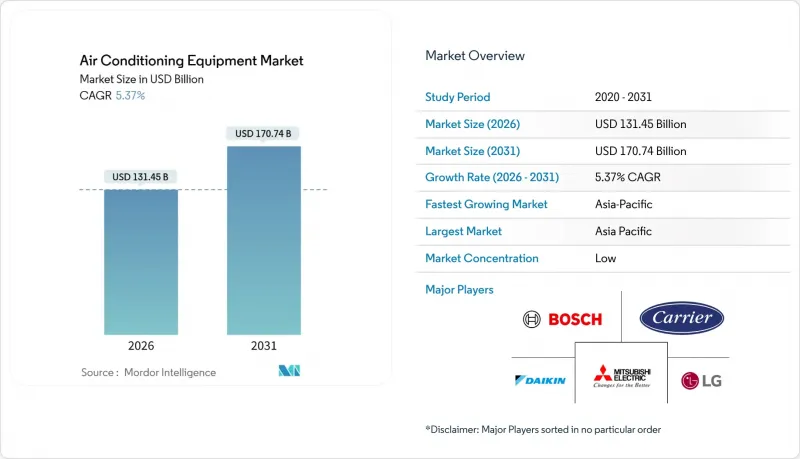
본 보고서는 제품 유형(스플릿형 및 멀티스플릿형 시스템, 가변 냉매 유량(VRF) 시스템 등), 기술(인버터 시스템 및 비인버터 시스템), 최종 사용자(주거용, 상업용, 산업용), 용량(10톤 이하, 11-18톤, 기타), 유통 채널(직접 판매, 기타), 지역별로 분류되어 있습니다. 시장 전망은 금액(달러) 기준으로 제시되어 있습니다.
세계의 공조 기기 시장 동향 및 인사이트
전 세계 기온 상승과 폭염의 빈발
기상 기록에 따르면, 2024년은 지금까지 가장 더운 해로 기록되었으며, 남아시아와 중동에서는 40°C를 넘는 폭염일이 급격히 증가했습니다. 인도의 2선 도시에서는 주택에 대한 보급이 가속화되고 있으며, 해안 지역 병원에서는 열로 인한 시스템 정지를 방지하기 위해 이중화된 칠러 어레이를 도입하고 있습니다. 냉방 일수 증가로 인해 설비 교체 및 용량 증설이 지속적으로 이루어지면서, 공조 기기 시장은 상승세를 유지하고 있습니다. 또한, 열 스트레스가 발생하는 지역의 전력 회사들은 피크 시간대 요금을 재검토하고 있으며, 이에 따라 건물 소유주들이 고효율 VRF나 인버터 시스템을 도입하도록 장려하고 있습니다. 2040년까지 냉방 일수가 20-30% 증가할 것이라는 장기적인 기후 전망은 주기적인 갱신이 아닌 구조적인 수요 증가로 이어질 것입니다.
정부의 에너지 효율 기준 및 냉방 기기에 대한 보조금
미국의 SEER2 기준, 유럽연합(EU)의 에코디자인 규정, 그리고 중국의 GB 21455-2024 요건 강화가 맞물리면서 최소 효율 기준이 더욱 엄격해지고 있습니다. 인도에서는 인버터식 기기의 추가 비용 중 20-30%를 지원하는 보조금 프로그램이, 신흥 아시아 국가들에서는 계절별 에너지 효율 비율(SEER)에 연동된 리베이트 제도가 도입되어 있어, 이로 인해 정속 모델과의 가격 차이가 점차 좁혀지고 있습니다. 각 제조업체들은 제품 라인업을 빠르게 인버터 압축기로 전환하고 있으며, 부품 공급업체들도 가변속 구동 장치의 생산 규모를 확대하고 있어, 공조 기기 시장의 기술 전환이 가속화되고 있습니다. 기준이 강화됨에 따라 비인버터식 유닛의 노후화 주기가 사실상 단축되어, 수익성이 높은 제품으로의 전환 효과가 나타나고 있습니다.
구리 및 반도체 가격 변동이 OEM의 이익률을 압박하고 있습니다.
2024년, 구리 가격은 톤당 1만 200달러에서 9,100달러 사이에서 등락을 거듭하며, 대당 부품 비용을 3-8달러 상승시켜 매출 총이익률을 최대 180베이시스포인트까지 압박했습니다. 파워 모듈의 반도체 리드타임이 26주에 달하고, 인버터 제품의 출시가 지연되고 있습니다. 대기업들은 베트남의 구리관 공장 투자 사례에서 볼 수 있듯이 수직 통합을 통해 리스크 헤지를 하고 있지만, 헤지 능력이 없는 중소 브랜드들은 영업이익률이 마이너스가 될 위험에 직면해 있습니다. 가격 변동이 지속될 경우, 신흥 시장의 가격에 민감한 수요가 위축되어 공조 기기 시장의 단기적인 성장이 제한될 가능성이 있습니다.
부문별 분석
가변 냉매 유량(VRF) 플랫폼은 전체 시장(연평균 성장률 5.37%)에 비해 6.73%의 연평균 성장률이 예상되며, 2026년부터 2031년까지의 기간 동안 공조 기기 시장에서 가장 빠르게 성장하는 부문이 될 것으로 전망됩니다. 신흥국의 주거 환경에서는 단일실 냉방이 주류를 이루고 있기 때문에 매출액 측면에서는 여전히 스플릿형 및 멀티스플릿형이 지배적인 위치를 차지하고 있습니다. 30층 이상의 고층 빌딩 개발업체들은 구역 제어, 에너지 회수, 그리고 바닥 면적 확보를 이유로 VRF를 선호하여 도입하고 있으며, 이로 인해 직접 판매 관계가 강화되고 있습니다.
유틸리티을 통한 리베이트 제도의 확충, 에너지 규제 강화, 그리고 인버터 비용의 하락으로 인해 기존 스플릿형 유닛과 VRF 미니 모듈 간의 가격 차이는 점차 줄어들고 있습니다. 1대의 실외기에 최대 64대의 실내 팬코일을 연결할 수 있는 기능 덕분에, 다목적 용도의 평면도에서 발생하는 다양한 부하에 대응할 수 있습니다. 이와 동시에, 패키지형 옥상 유닛은 북미의 소규모 상업 부문에서 꾸준한 교체 수요를 이끌고 있는 반면, 원심식 및 스크류식 칠러(500톤 이상)는 1도 미만의 온도 안정성이 요구되는 제약 창고나 반도체 제조 공장에 대응하고 있어, 공조 기기 시장에 다양성을 더하고 있습니다.
인버터식 압축기는 2025년 출하 대수의 68.86%를 차지했으며, 연평균 6.53%의 성장률을 보일 것으로 전망되어, 2031년까지 공조 기기 시장 전체에서 점유율을 더욱 확대할 것으로 보입니다. 비인버터 모델은 지방이나 임대 주택에서 여전히 사용되고 있지만, 보조금 제도로 인해 추가 비용 차이가 줄어들면서 그 시장 점유율은 해마다 줄어들고 있습니다.
인공지능(AI)이 탑재된 컨트롤러는 현재 기상 상황, 요금 시간대, 이용 현황을 실시간으로 분석하여 공과금을 8-12% 더 절감하고 있습니다. 수요 반응(Demand Response)의 통합을 통해 건물 소유주는 감소된 부하를 수익으로 전환할 수 있게 됩니다. 고정 속도 시스템은 아프리카나 라틴아메리카와 같이 전압이 불안정한 지역에서는 여전히 유효하지만, 규모의 경제와 정책적 압력에 힘입어 2030년까지 전 세계 인버터 보급률이 80%를 넘어설 것으로 예측됩니다.
지역별 분석
아시아태평양은 2025년 매출의 40.32%를 차지하며 연평균 성장률(CAGR) 8.43%로 성장을 지속해 공조 기기 시장에서 다른 모든 지역을 앞질렀습니다. 중국에서는 주요 도시 시장 포화도가 높아짐에 따라 성장세가 둔화되고 있지만, 인도, 인도네시아, 베트남에서는 폭염과 전력망 접근성 개선을 배경으로 설치 대수가 두 자릿수 성장세를 이어가고 있습니다. 자카르타나 마닐라와 같이 고층 빌딩 건설이 활발한 도시에서는 대형 VRF 시스템이 주류를 이루고 있는 반면, 일본의 성숙한 시장에서는 프리미엄급 공기 청정 기능에 중점을 두고 있습니다. 호주의 상업 부문에서는 2022년 에너지 효율 기준 개정에 대응하기 위해 옥상형 유닛의 개보수 작업이 진행되었습니다.
북미 및 유럽의 공조 기기 시장은 교체 주기, 히트펌프의 보급, 기업의 탄소중립 목표를 배경으로 연간 4-5%의 속도로 성장하고 있습니다. 2024년, 미국의 주거용 스플릿 시스템 출하 대수는 820만 대를 돌파한 반면, “인플레이션 억제법"는 계속해서 히트 펌프로의 개조를 장려하고 있습니다. 2030년까지 비주거용 건축물에 대해 “제로에 가까운 에너지"를 의무화하는 유럽연합(EU)의 규제에 따라 독일, 프랑스, 영국에서는 VRF의 업그레이드가 진행되고 있습니다.
중동 및 아프리카에서는 6-7%의 성장이 예상됩니다. 두바이와 리야드의 지역 냉방 네트워크가 대용량 칠러 수요를 뒷받침하는 한편, 사하라 이남 아프리카에서는 전력 부족을 겪는 지역 사회에서 Off-grid형 태양광 발전 스플릿 시스템이 보급되고 있습니다. 남미 시장은 5-6%의 성장이 예상되며, 브라질의 주택 수요와 전력 보조금의 단계적 폐지에 따른 아르헨티나 상업시설의 개보수 공사가 성장의 견인차 역할을 하고 있습니다. 전반적으로 볼 때, 이러한 지역별 동향이 공조 기기 시장의 다양한 성장 양상을 뒷받침하고 있습니다.
기타 혜택 :
- 엑셀 형식 시장 예측(ME) 시트
- 3개월간의 애널리스트 지원
자주 묻는 질문
목차
제1장 서론
제2장 조사 방법
제3장 주요 요약
제4장 시장 구도
제5장 시장 규모 및 성장 예측
제6장 경쟁 구도
제7장 시장 기회 및 향후 전망
KTH 26.07.08According to Mordor Intelligence, the air conditioning equipment market size is valued at USD 131.45 billion in 2026 and is projected to reach USD 170.74 billion by 2031, reflecting a 5.37% CAGR.
This report is Segmented by Product Type (Split and Multi-Split Systems, Variable Refrigerant Flow Systems, and More), Technology (Inverter Systems, and Non-Inverter Systems), End-User (Residential, Commercial, and Industrial), Capacity (Up To 10 Tons, 11-18 Tons, and More), Distribution Channel (Direct Sales, and More), and Geography. The Market Forecasts are Provided in Terms of Value (USD).
Global Air Conditioning Equipment Market Trends and Insights
Escalating Global Temperatures and Extreme-Heat Frequency
Climate records show 2024 as the hottest year to date, and the frequency of heat days above 40 °C is rising sharply in South Asia and the Middle East. Residential penetration is accelerating in tier-2 Indian cities, and hospitals in the Gulf are adding redundant chiller arrays to avert thermal shutdowns. Higher cooling-degree days ensure sustained equipment replacement and capacity additions, keeping the air conditioning equipment market on an upward trajectory. Utilities in heat-stressed regions are also revising peak tariffs, incentivizing building owners to adopt high-efficiency VRF and inverter systems. Long-term climate projections pointing to 20-30% more cooling-degree days by 2040 translate into structural demand rather than cyclical replacement.
Government Energy-Efficiency Standards and Cooling-Appliance Subsidies
SEER2 thresholds in the United States, Ecodesign rules in the European Union, and upgraded GB 21455-2024 requirements in China collectively tighten minimum efficiency baselines. Subsidy programs covering 20-30% of the incremental inverter cost in India and rebate schemes tied to seasonal energy-efficiency ratios in emerging Asia are closing the price gap with fixed-speed models. Manufacturers are rapidly shifting portfolios to inverter compressors, and component suppliers are scaling variable-speed drives, reinforcing the air conditioning equipment market's technology transition. Tightened standards effectively shorten the obsolescence cycle for non-inverter units, creating a pull-through effect for higher-margin products.
Volatile Copper and Semiconductor Prices Squeezing OEM Margins
Copper prices swung between USD 10,200 and USD 9,100 per metric ton in 2024, adding USD 3-8 to component costs per unit and compressing gross margins by up to 180 basis points. Semiconductor lead times for power modules reached 26 weeks, delaying inverter launches. Large players are hedging through vertical integration, exemplified by a Vietnamese copper-tube mill investment, whereas smaller brands without hedging capacity risk negative operating margins. Persistent volatility could dampen price-sensitive demand in emerging markets, limiting near-term growth in the air conditioning equipment market.
Other drivers and restraints analyzed in the detailed report include:
- Urban High-Rise Construction Surge in Emerging Megacities
- Edge and Hyperscale Data-Center Expansion Boosting Precision Cooling Demand
- Kigali Amendment-Driven Accelerated HFC Phase-Down Compliance Costs
For complete list of drivers and restraints, kindly check the Table Of Contents.
Segment Analysis
Variable refrigerant flow platforms generated a 6.73% CAGR outlook versus the overall 5.37%, making them the fastest-rising segment within the air conditioning equipment market size for the 2026-2031 window. Split and multi-split units still dominate revenue because single-room cooling prevails in emerging residential settings. Developers of 30-plus-story towers prefer VRF for zone control, energy recovery, and floor-space gains, reinforcing direct-sales relationships.
Expanded utility rebates, heightened energy codes, and falling inverter costs are compressing the price delta between traditional split units and VRF mini-modules. The ability to link up to 64 indoor fan-coils to a single outdoor unit supports high diversity loads in mixed-use floorplates. In parallel, packaged rooftop units advance steady replacement demand in North America's light-commercial sector, while centrifugal and screw chillers (>500 tons) address pharmaceutical warehouses and semiconductor fabs that need sub-degree stability, adding diversity to the air conditioning equipment market.
Inverter compressors secured 68.86% of 2025 shipments and are forecast to rise at a 6.53% clip, further raising their share of the overall air conditioning equipment market share by 2031. Non-inverter models linger in rural and rental stock but shrink annually as subsidy programs shrink incremental cost gaps.
Artificial-intelligence-enabled controllers now analyze weather, tariff windows, and occupancy in real time, trimming bills by another 8-12%. Demand-response integration allows building owners to monetize curtailed load. Fixed-speed systems remain viable in voltage-unstable zones of Africa and Latin America, yet global inverter penetration is projected above 80% by 2030, underpinned by scale economics and policy pressure.
Complete Report Scope:
- By Product Type
- Split and Multi-Split Systems
- Variable Refrigerant Flow (VRF) Systems
- Packaged and Rooftop Units
- Chillers
- By Technology
- Inverter Systems
- Non-Inverter Systems
- By End-User
- Residential
- Commercial
- Industrial
- By Capacity (Tons of Refrigeration)
- Up to 10 Tons
- 11 - 18 Tons
- 19 - 26 Tons
- Above 26 Tons
- By Distribution Channel
- Direct Sales
- Dealer / Retail Stores
- Online
- By Geography
- North America
- United States
- Canada
- Mexico
- South America
- Brazil
- Argentina
- Rest of South America
- Europe
- Germany
- France
- United Kingdom
- Italy
- Spain
- Rest of Europe
- Asia-Pacific
- China
- Japan
- India
- South Korea
- Australia
- Rest of Asia-Pacific
- Middle East and Africa
- Middle East
- Saudi Arabia
- United Arab Emirates
- Turkey
- Rest of Middle East
- Africa
- South Africa
- Egypt
- Nigeria
- Rest of Africa
- Middle East
- North America
Geography Analysis
Asia-Pacific delivered 40.32% of 2025 revenue and is on pace for an 8.43% CAGR, outstripping every other region across the air conditioning equipment market. China's growth moderates as tier-1 saturation rises, but India, Indonesia, and Vietnam continue double-digit installation growth driven by extreme heat and improved grid access. High-rise boom towns in Jakarta and Manila specify large VRF backbones, and Japan's mature stock focuses on premium air-purification features. Australia's commercial sector is retrofitting rooftop units to satisfy 2022 energy-efficiency code updates.
North America and Europe air conditioning equipment market expand 4-5% annually on replacement cycles, heat-pump adoption, and corporate net-zero targets. U.S. residential split-system shipments topped 8.2 million in 2024, while the Inflation Reduction Act continues to underwrite heat-pump retrofits. The European Union's near-zero-energy mandate for non-residential buildings by 2030 pushes VRF upgrades in Germany, France, and the United Kingdom.
The Middle East and Africa register 6-7% growth. District-cooling networks in Dubai and Riyadh anchor large-capacity chiller demand, while off-grid solar splits penetrate power-deficient communities in Sub-Saharan Africa. South American markets grow 5-6%, led by Brazilian residential demand and Argentine commercial retrofits following electricity-subsidy phaseouts. Altogether, regional dynamics reinforce the diversified growth profile of the air conditioning equipment market.
- Daikin Industries Ltd.
- Gree Electric Appliances Inc. of Zhuhai
- Midea Group Co., Ltd.
- Carrier Global Corporation
- Trane Technologies plc
- Johnson Controls International plc
- Mitsubishi Electric Corporation
- LG Electronics Inc.
- Samsung Electronics Co., Ltd.
- Haier Smart Home Co., Ltd.
- Panasonic Holdings Corporation
- Lennox International Inc.
- Fujitsu General Ltd.
- Toshiba Carrier Corporation
- Hitachi-Johnson Controls Air Conditioning, Inc.
- Rheem Manufacturing Company
- Bosch Thermotechnology GmbH
- Hisense International Co., Ltd.
- AUX Group Co., Ltd.
Additional Benefits:
- The market estimate (ME) sheet in Excel format
- 3 months of analyst support
TABLE OF CONTENTS
1 INTRODUCTION
- 1.1 Study Assumptions and Market Definition
- 1.2 Scope of the Study
2 RESEARCH METHODOLOGY
3 EXECUTIVE SUMMARY
4 MARKET LANDSCAPE
- 4.1 Market Overview
- 4.2 Market Drivers
- 4.2.1 Escalating Global Temperatures and Extreme-Heat Frequency
- 4.2.2 Government Energy-Efficiency Standards and Cooling-Appliance Subsidies
- 4.2.3 Urban High-Rise Construction Surge in Emerging Megacities
- 4.2.4 Edge and Hyperscale Data-Center Expansion Boosting Precision Cooling Demand
- 4.2.5 AI-Enabled Predictive-Maintenance Contracts Lowering Lifecycle Costs
- 4.2.6 Growing Demand for Off-Grid Solar-Powered Split AC Units in Power-Deficit Regions
- 4.3 Market Restraints
- 4.3.1 Volatile Copper and Semiconductor Prices Squeezing OEM Margins
- 4.3.2 Kigali Amendment-Driven Accelerated HFC Phase-Down Compliance Costs
- 4.3.3 Chronic Shortage of Certified HVAC Technicians for Inverter and VRF Systems
- 4.3.4 Grid Decarbonization Policies Favoring Passive and District-Cooling Alternatives
- 4.4 Industry Supply-Chain Analysis
- 4.5 Regulatory Landscape
- 4.6 Technological Outlook
- 4.7 Porter's Five Forces Analysis
- 4.7.1 Bargaining Power of Suppliers
- 4.7.2 Bargaining Power of Buyers
- 4.7.3 Threat of New Entrants
- 4.7.4 Threat of Substitutes
- 4.7.5 Intensity of Competitive Rivalry
- 4.8 Impact of Macroeconomic Factors on the Market
5 MARKET SIZE AND GROWTH FORECASTS (VALUE)
- 5.1 By Product Type
- 5.1.1 Split and Multi-Split Systems
- 5.1.2 Variable Refrigerant Flow (VRF) Systems
- 5.1.3 Packaged and Rooftop Units
- 5.1.4 Chillers
- 5.2 By Technology
- 5.2.1 Inverter Systems
- 5.2.2 Non-Inverter Systems
- 5.3 By End-User
- 5.3.1 Residential
- 5.3.2 Commercial
- 5.3.3 Industrial
- 5.4 By Capacity (Tons of Refrigeration)
- 5.4.1 Up to 10 Tons
- 5.4.2 11 - 18 Tons
- 5.4.3 19 - 26 Tons
- 5.4.4 Above 26 Tons
- 5.5 By Distribution Channel
- 5.5.1 Direct Sales
- 5.5.2 Dealer / Retail Stores
- 5.5.3 Online
- 5.6 By Geography
- 5.6.1 North America
- 5.6.1.1 United States
- 5.6.1.2 Canada
- 5.6.1.3 Mexico
- 5.6.2 South America
- 5.6.2.1 Brazil
- 5.6.2.2 Argentina
- 5.6.2.3 Rest of South America
- 5.6.3 Europe
- 5.6.3.1 Germany
- 5.6.3.2 France
- 5.6.3.3 United Kingdom
- 5.6.3.4 Italy
- 5.6.3.5 Spain
- 5.6.3.6 Rest of Europe
- 5.6.4 Asia-Pacific
- 5.6.4.1 China
- 5.6.4.2 Japan
- 5.6.4.3 India
- 5.6.4.4 South Korea
- 5.6.4.5 Australia
- 5.6.4.6 Rest of Asia-Pacific
- 5.6.5 Middle East and Africa
- 5.6.5.1 Middle East
- 5.6.5.1.1 Saudi Arabia
- 5.6.5.1.2 United Arab Emirates
- 5.6.5.1.3 Turkey
- 5.6.5.1.4 Rest of Middle East
- 5.6.5.2 Africa
- 5.6.5.2.1 South Africa
- 5.6.5.2.2 Egypt
- 5.6.5.2.3 Nigeria
- 5.6.5.2.4 Rest of Africa
- 5.6.5.1 Middle East
- 5.6.1 North America
6 COMPETITIVE LANDSCAPE
- 6.1 Market Concentration
- 6.2 Strategic Moves
- 6.3 Market Share Analysis
- 6.4 Company Profiles (includes Global Level Overview, Market Level Overview, Core Segments, Financials as Available, Strategic Information, Market Rank/Share for Key Companies, Products and Services, and Recent Developments)
- 6.4.1 Daikin Industries Ltd.
- 6.4.2 Gree Electric Appliances Inc. of Zhuhai
- 6.4.3 Midea Group Co., Ltd.
- 6.4.4 Carrier Global Corporation
- 6.4.5 Trane Technologies plc
- 6.4.6 Johnson Controls International plc
- 6.4.7 Mitsubishi Electric Corporation
- 6.4.8 LG Electronics Inc.
- 6.4.9 Samsung Electronics Co., Ltd.
- 6.4.10 Haier Smart Home Co., Ltd.
- 6.4.11 Panasonic Holdings Corporation
- 6.4.12 Lennox International Inc.
- 6.4.13 Fujitsu General Ltd.
- 6.4.14 Toshiba Carrier Corporation
- 6.4.15 Hitachi-Johnson Controls Air Conditioning, Inc.
- 6.4.16 Rheem Manufacturing Company
- 6.4.17 Bosch Thermotechnology GmbH
- 6.4.18 Hisense International Co., Ltd.
- 6.4.19 AUX Group Co., Ltd.
7 MARKET OPPORTUNITIES AND FUTURE OUTLOOK
- 7.1 White-Space and Unmet-Need Assessment


