|
시장보고서
상품코드
2073625
북미의 밴 시장 : 점유율 분석, 업계 동향과 통계, 성장 예측(2026-2031년)North America Van - Market Share Analysis, Industry Trends & Statistics, Growth Forecasts (2026 - 2031) |
||||||
 Mordor Intelligence
Mordor Intelligence에 의하면, 북미 밴 시장은 2025년에 499억 4,000만 달러 규모가 되어, 2026년 518억 9,000만 달러에서 2031년까지 628억 3,000만 달러에 이를 것으로 예측되며, 예측 기간(2026-2031년) CAGR은 3.90%를 나타낼 전망입니다.
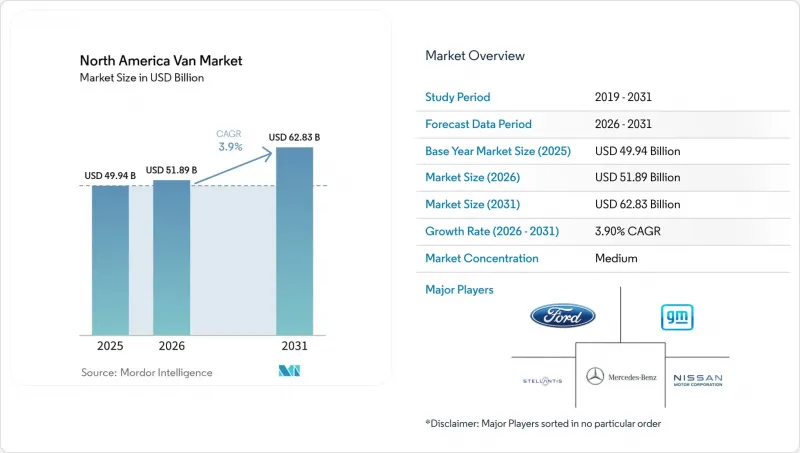
본 보고서는 구동 방식(하이브리드차 및 전기차, 내연기관), 차종(화물 밴, 승용 밴 등), 최종 사용자(라스트 마일 배송 및 소포, 현장 서비스 및 유틸리티 등), 적재량(2톤 이하, 2-3톤, 기타), 배터리 주행 거리, 그리고 국가별로 분류되어 있습니다. 시장 전망은 금액(달러) 및 수량(대)으로 제시되어 있습니다.
북미 밴 시장 동향과 인사이트
소포 전자상거래의 급성장과 라스트 마일 배송의 급증
2024년, 미국에서는 전자상거래 소포 배송량이 크게 증가했습니다. 이러한 증가로 인해 배송 시간대 제약이 더욱 엄격해지면서, 사업자들은 적재 용량을 극대화하면서도 주택가 도로를 원활하게 주행할 수 있는 소형 밴을 활용할 수밖에 없게 되었습니다. 아마존이 2030년까지 리비안(Rivian)의 밴 10만 대를 도입하겠다고 약속한 것은 전기화를 위한 운송 능력 확보의 청사진이 되었습니다. 페덱스와 UPS도 독자적인 다년 계약을 통해 이러한 추세에 동참하고 있지만, 전력망에 대응할 수 있는 배송 거점을 구축해야 하는 과제는 여전히 남아 있습니다. 국립재생에너지연구소(NREL)에 따르면, 도시 지역의 배송용 밴 일부를 전기차로 전환하려면 여러 개의 대규모 발전소 출력에 필적할 정도의 충전 부하가 대폭 증가해야 합니다. 전력 요금 변동 위험에 대응하기 위해 각 배송 업체들은 태양광 발전 및 에너지 저장 솔루션을 전략적으로 동일 부지 내에 설치하고 있습니다. 배송 거점을 마이크로그리드로 전환함으로써, 피크 시간대의 요금을 절감할 수 있을 뿐만 아니라 부가 서비스를 통한 수익 기회도 창출할 수 있습니다.
IRA(인플레이션 억제법)에 기반한 국내 전기차 및 배터리 투자
인플레이션 억제법(IRA)에 따르면, 최종 조립 및 주요 배터리 부품이 북미에서 제조된 것을 조건으로, 대상 대형 상용차 1대당 최대 4만 달러의 세액 공제가 제공됩니다. 해당 법이 시행된 첫 해에는 대상 차량의 대다수가 세액 공제 전액을 적용받았으며, 이를 통해 총 소유 비용(TCO) 산정에서 이 제도가 얼마나 중요한지 여실히 드러났습니다. 이러한 인센티브의 급증은 수많은 배터리 관련 발표를 촉진했습니다. 특히 주목할 만한 점은 오하이오주에서 LG와 혼다가 추진하는 합작 사업과 캔자스주에서 파나소닉이 사업을 확장하고 있다는 사실입니다. 물류 경로를 단축하고 부품을 현지에서 조달함으로써, 국내 OEM 각사는 수주부터 납품까지의 리드타임을 단축하고, 향후 몇 년간 규제 기준이 강화될 전망인 가운데 속도 면에서 경쟁 우위를 확보하고 있습니다.
급속 충전기 수요 및 요금 급증
수요가 가장 많은 달에는 상업용 요금 체계에 따라 막대한 수요 요금이 부과되는 경우가 종종 있습니다. 대용량 충전기를 사용하는 여러 대의 밴을 보유한 차량 기지에서는 매월 막대한 수요 요금을 지불해야 할 가능성이 있습니다. 이로 인해 연료비 절감 효과가 줄어들게 되어, 전기차(EV)의 투자 회수 기간이 일반적인 교체 시기를 넘어 길어지게 됩니다. 관리형 충전 프로그램 가입 현황은 여전히 고르지 않은 상태이며, 대상 법인 고객 중 참여하고 있는 곳은 극히 일부에 불과합니다. 이 때문에 차량 보유 기업들은 부하 완충 장치로서 고가의 현장용 배터리에 투자할 수밖에 없습니다. 한편, 캘리포니아주의 AB 2061 법안과 같은 입법 조치는 여전히 진전이 없는 상태이며, 사업자들은 요금 체계의 복잡성을 스스로 해결해야 하는 상황입니다.
부문별 분석
2025년 판매 대수 기준, 내연기관 구동 시스템은 73.45%의 점유율을 유지했으나, 전기차(EV) 및 하이브리드차는 북미 밴 시장에서 연평균 성장률(CAGR) 8.25%로 성장하고 있으며, 이는 시장 전체 성장률의 2배에 해당합니다. 전기 배송 부문에서는 배터리식 전기 밴(BEV)이 주류를 이루고 있으며, 1달러당 주행 거리 지표가 개선됨에 따라 플러그인 하이브리드 차량보다 BEV가 더 선호되는 추세입니다. 현재의 인센티브 제도에 힘입어 북미의 BEV 밴 시장은 상당한 성장이 예상됩니다. 연료전지차의 시범 운행 차량은 여전히 소규모이지만, 특히 국가 차원의 노력에 힘입어 그린 수소의 비용이 낮아지고 있어 장거리 용도로 유망시되고 있습니다.
내연기관의 경우, 경량 차량 부문에서는 가솔린이나 CNG(압축 천연가스)로의 전환이 진행되고 있지만, 중량 차량 부문에서는 토크와 급유 속도의 장점 때문에 여전히 디젤이 선호되고 있습니다. 그러나 에너지 밀도가 향상됨에 따라 디젤 차량이 가진 적재량 면에서의 우위는 점차 줄어들고 있습니다. 이러한 동향은 고체 전지의 상업적 도입이 제한적으로 시작되고 있다는 점을 감안할 때, 시장의 잠재적인 전환점을 시사하고 있습니다.
2025년 인도 대수 중 화물용 차량이 차지하는 비율은 64.01%로, 라스트 마일 분야에서의 우위를 반영하고 있습니다. 한편, 특수 용도 밴(냉장차, 캠핑카, 구급차 등)은 2031년까지 연평균 성장률(CAGR)이 6.24%로, 가장 빠른 보급률을 보이고 있습니다. 캐리어(Carrier) 및 써모킹(Thermo King)의 전기식 운송용 냉동 장치는 구동 에너지를 공급하거나 보조 배터리 팩을 활용함으로써 적재량을 다소 줄여주며, 화주가 캘리포니아주 및 뉴욕주의 공회전 규제를 쉽게 준수할 수 있도록 지원합니다. 캠핑카로 개조하는 것은 현재 메르세데스-벤츠의 “eSprinter”에서 완전한 공장 옵션으로 제공되며, 조용한 Off-grid 운용을 실현하기 위해 라이프스타일 부문 고객들이 프리미엄 가격을 지불할 의향이 있음을 반영하고 있습니다.
그러나 특수 용도의 전동화 분야에서는 중량 범위에 관한 해결되지 않은 상충 관계에 직면해 있습니다. 구급차 개조 업체들은 전용 NFPA 규격이 없는 상황에서 고전압 의료 시스템 인증을 취득해야 하기 때문에 이로 인해 승인 절차가 장기화되어 생산 대수가 제한되고 있습니다. 특정 용도에 특화된 통합에 조기에 투자하는 OEM은 이처럼 규제가 엄격한 고부가가치 틈새 시장에서 평균 이상의 이익률을 달성할 것으로 전망됩니다.
기타 혜택:
- 엑셀 형식 시장 예측(ME) 시트
- 3개월간의 애널리스트 지원
자주 묻는 질문
목차
제1장 서론
제2장 조사 방법
제3장 주요 요약
제4장 주요 업계 동향
제5장 시장 구도
제6장 시장 규모와 성장 예측
제7장 경쟁 구도
제8장 시장 기회와 향후 전망
제9장 CEO가 직면하는 중요 전략적 과제
JHS 26.07.09According to Mordor Intelligence, the north american van market was valued at USD 49.94 billion in 2025 and estimated to grow from USD 51.89 billion in 2026 to reach USD 62.83 billion by 2031, at a CAGR of 3.90% during the forecast period (2026-2031).
This report is Segmented by Propulsion Type (Hybrid and Electric Vehicles, Internal Combustion Engine), Vehicle Type (Cargo Van, Passenger Van, and More), End-User (Last-Mile Delivery and Parcel, Field Services and Utilities, and More), Tonnage Capacity (Up To 2 Tons, 2-3 Tons, and More), Battery Range, and Country. The Market Forecasts are Provided in Terms of Value (USD) and Volume (Units).
North America Van Market Trends and Insights
Parcel E-commerce Boom and Last-Mile Surge
In 2024, the United States experienced significant growth in e-commerce parcel shipments. This increase has tightened delivery windows, prompting operators to utilize smaller vans adept at navigating residential streets while maximizing payload capacity. Amazon's pledge to field 100,000 Rivian vans by 2030 created a blueprint for electrified capacity reservations. FedEx and UPS have echoed this sentiment with their own multi-year orders, yet the challenge of grid-ready depots persists. According to the National Renewable Energy Laboratory, electrifying a portion of urban delivery vans would require a considerable increase in charging load, comparable to the output of multiple utility-scale plants. In response to demand-charge risks, fleets are strategically co-locating solar and storage solutions. This transformation of depots into microgrids not only reduces peak tariffs but also unlocks potential revenue from ancillary services.
IRA-Backed Domestic EV and Battery Investments
The Inflation Reduction Act provides up to USD 40,000 per qualifying heavy-duty commercial vehicle, so long as final assembly and key battery content are North America-based . In the inaugural year following the enactment, a significant majority of eligible units capitalized on the full credit, underscoring its importance in the total-cost-of-ownership equation. This incentive surge catalyzed numerous battery-related announcements, notably featuring LG-Honda's joint venture in Ohio and Panasonic's expansion in Kansas. By shortening logistics routes and sourcing cells locally, domestic OEMs have reduced the order-to-delivery timeline, gaining a competitive speed advantage as compliance benchmarks escalate through the coming years.
Fast-Charger Demand-Charge Spikes
During peak months, commercial tariffs often impose significant demand fees. A depot with multiple vans utilizing high-capacity chargers could face substantial monthly demand charges. This erodes fuel savings and extends the electric vehicle (EV) payback period beyond the typical replacement timeframe. Managed-charging program enrollment remains inconsistent, with only a small portion of eligible commercial clients participating. This has forced fleets to invest in costly on-site batteries as load buffers. Meanwhile, legislative remedies like California's AB 2061 remain stalled, leaving operators to navigate tariff complexities independently.
Other drivers and restraints analyzed in the detailed report include:
- Sub-USD 100 kWh Battery Packs by 2027
- State-Level ZEV and Fleet Mandates
- Up-Front BEV Van Price Premium
For complete list of drivers and restraints, kindly check the Table Of Contents.
Segment Analysis
Internal-combustion drivetrains retained 73.45% of 2025 volumes, but electric and hybrid formats are pacing the North America van market at an 8.25% CAGR, double headline growth. Battery-electric vans dominate the electrified delivery segment, with improving range-per-dollar metrics driving a preference for BEVs over plug-in hybrids. The North American market for BEV vans is expected to grow significantly, supported by the current incentive framework. Although fuel-cell pilot fleets remain small in scale, they show promise for long-range applications, particularly as green hydrogen costs decrease in line with national initiatives.
Internal combustion engines are shifting toward gasoline and CNG options in lighter vehicle classes, while diesel continues to be favored in heavier categories due to its torque and refueling speed advantages. However, advancements in energy density are reducing diesel's payload superiority. This development indicates a potential turning point in the market as solid-state chemistries begin to see limited commercial adoption.
Cargo configurations occupied 64.01% of deliveries in 2025, mirroring last-mile dominance. Specialty vans-refrigerated, camper, and ambulance builds-are, however, posting the quickest uptake at a 6.24% CAGR to 2031. Electric transport-refrigeration units from Carrier and Thermo King draw propulsion energy or tap auxiliary packs, slicing payload yet helping shippers meet anti-idling rules in California and New York . Camper conversions are now a fully factory option on Mercedes-Benz's eSprinter, reflecting the lifestyle segment's willingness to pay premiums for silent off-grid operation.
Yet, specialty electrification faces unresolved weight-range trade-offs. Ambulance upfitters must certify high-voltage medical systems in the absence of a dedicated NFPA standard, lengthening approval cycles and tempering volume. OEMs that invest early in application-specific integrations stand to capture above-average margins in these regulated, high-value niches.
Complete Report Scope:
- By Propulsion Type
- Hybrid and Electric Vehicles
- Battery Electric Vehicle (BEV)
- Plug-in Hybrid Electric Vehicle (PHEV)
- Hybrid Electric Vehicle (HEV)
- Fuel-Cell Electric Vehicle (FCEV)
- Internal Combustion Engine (ICE)
- Diesel
- Gasoline
- CNG and Others
- Hybrid and Electric Vehicles
- By Vehicle Type
- Cargo Van
- Passenger Van
- Specialty Van (Refrigerated, Camper, Ambulance)
- By End-User
- Last-Mile Delivery and Parcel
- Field Services and Utilities
- Rental and Leasing Fleets
- Recreational and Van-Life
- Government and Municipal Fleets
- Corporate Passenger Transport
- By Tonnage Capacity
- Up to 2 Tons
- 2-3 Tons
- 3- 5.5 Tons
- Above 5.5 Tons
- By Battery Range
- Up to 100 miles
- 100-200 miles
- Above 200 miles
- By Country
- United States
- Canada
- Mexico
List of Companies Covered in this Report:
- Mercedes-Benz Group AG
- Ford Motor Company
- General Motors Company
- Stellantis N.V.
- Nissan Motor Co., Ltd.
- Toyota Motor Corporation
- Volkswagen AG
- Rivian Automotive Inc.
- Workhorse Group Inc.
- Kia Corporation
- Isuzu Motors Ltd.
- Hino Motors Ltd.
- SAIC Motor Corp., Ltd.
Additional Benefits:
- The market estimate (ME) sheet in Excel format
- 3 months of analyst support
TABLE OF CONTENTS
1 Introduction
- 1.1 Study Assumptions & Market Definition
- 1.2 Scope of the Study
2 Research Methodology
3 Executive Summary
4 Key Industry Trends
- 4.1 Urbanization, Population & Vehicle/Transit Demand
- 4.2 EV Penetration in Van Market
- 4.3 Fuel vs Electricity Price Spread (per km)
- 4.4 EV vs ICE Total Cost of Ownership Gap
- 4.5 Financing & Ownership Models (Loan, Lease, Subscription)
- 4.6 Battery Chemistry Mix & Pack Energy Density
- 4.7 Home, Workplace & Public Charger Density
- 4.8 Fast-Charging Network Coverage & Power Bands
- 4.9 Alternative Fuels Infrastructure (Hydrogen for FCEVs)
- 4.10 Subsidy & Consumer-Incentive Value
- 4.11 OEM EV Line-up & Model Pipeline
- 4.12 Value-Chain & Distribution-Channel Analysis
- 4.13 Regulatory, Fiscal & Industrial Policy Framework
5 Market Landscape
- 5.1 Market Overview
- 5.2 Market Drivers
- 5.2.1 Parcel E-commerce Boom and Last-Mile Surge
- 5.2.2 IRA-Backed Domestic EV and Battery Investments
- 5.2.3 Sub-USD 100 kWh Battery Packs by 2027
- 5.2.4 State-Level ZEV and Fleet Mandates
- 5.2.5 Skateboard Van Platforms Cut CAPEX 30%
- 5.2.6 Smart-Depot V2G Revenue Stacking
- 5.3 Market Restraints
- 5.3.1 Fast-Charger Demand-Charge Spikes
- 5.3.2 Up-Front BEV Van Price Premium
- 5.3.3 E-Powertrain Service-Tech Shortage
- 5.3.4 Battery Weight Pushes Above 4.5 t GVWR
- 5.4 Value / Supply-Chain Analysis
- 5.5 Regulatory Landscape
- 5.6 Technological Outlook
- 5.7 Porter's Five Forces
- 5.7.1 Threat of New Entrants
- 5.7.2 Bargaining Power of Suppliers
- 5.7.3 Bargaining Power of Buyers
- 5.7.4 Threat of Substitutes
- 5.7.5 Industry Rivalry
6 Market Size & Growth Forecasts (Value (USD) and Volume (Units))
- 6.1 By Propulsion Type
- 6.1.1 Hybrid and Electric Vehicles
- 6.1.1.1 Battery Electric Vehicle (BEV)
- 6.1.1.2 Plug-in Hybrid Electric Vehicle (PHEV)
- 6.1.1.3 Hybrid Electric Vehicle (HEV)
- 6.1.1.4 Fuel-Cell Electric Vehicle (FCEV)
- 6.1.2 Internal Combustion Engine (ICE)
- 6.1.2.1 Diesel
- 6.1.2.2 Gasoline
- 6.1.2.3 CNG and Others
- 6.1.1 Hybrid and Electric Vehicles
- 6.2 By Vehicle Type
- 6.2.1 Cargo Van
- 6.2.2 Passenger Van
- 6.2.3 Specialty Van (Refrigerated, Camper, Ambulance)
- 6.3 By End-User
- 6.3.1 Last-Mile Delivery and Parcel
- 6.3.2 Field Services and Utilities
- 6.3.3 Rental and Leasing Fleets
- 6.3.4 Recreational and Van-Life
- 6.3.5 Government and Municipal Fleets
- 6.3.6 Corporate Passenger Transport
- 6.4 By Tonnage Capacity
- 6.4.1 Up to 2 Tons
- 6.4.2 2-3 Tons
- 6.4.3 3- 5.5 Tons
- 6.4.4 Above 5.5 Tons
- 6.5 By Battery Range
- 6.5.1 Up to 100 miles
- 6.5.2 100-200 miles
- 6.5.3 Above 200 miles
- 6.6 By Country
- 6.6.1 United States
- 6.6.2 Canada
- 6.6.3 Mexico
7 Competitive Landscape
- 7.1 Market Concentration
- 7.2 Strategic Moves
- 7.3 Market Share Analysis
- 7.4 Company Profiles (includes Global Level Overview, Market Level Overview, Core Segments, Financials as Available, Strategic Information, Market Rank/Share for Key Companies, Products and Services, SWOT Analysis, and Recent Developments)
- 7.4.1 Mercedes-Benz Group AG
- 7.4.2 Ford Motor Company
- 7.4.3 General Motors Company
- 7.4.4 Stellantis N.V.
- 7.4.5 Nissan Motor Co., Ltd.
- 7.4.6 Toyota Motor Corporation
- 7.4.7 Volkswagen AG
- 7.4.8 Rivian Automotive Inc.
- 7.4.9 Workhorse Group Inc.
- 7.4.10 Kia Corporation
- 7.4.11 Isuzu Motors Ltd.
- 7.4.12 Hino Motors Ltd.
- 7.4.13 SAIC Motor Corp., Ltd.