

|
시장보고서
상품코드
2073632
북미의 산업용 공기질 관리 시스템 시장 : 점유율 분석, 업계 동향과 통계, 성장 예측(2026-2031년)North America Industrial Air Quality Control Systems - Market Share Analysis, Industry Trends & Statistics, Growth Forecasts (2026 - 2031) |
||||||
 Mordor Intelligence
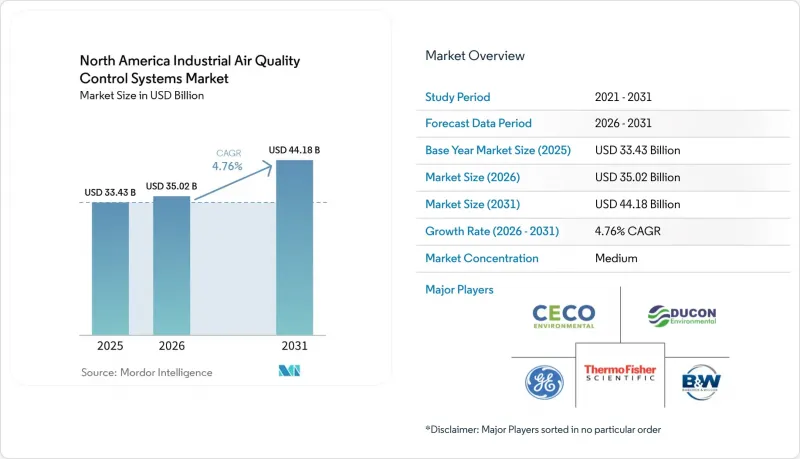
Mordor Intelligence에 의하면, 북미 산업용 공기질 관리 시스템 시장 규모는 2025년 334억 3,000만 달러에서 2026년에는 350억 2,000만 달러로 확대되어 2026년부터 2031년까지 CAGR 4.76%로 성장을 지속하여, 2031년에는 441억 8,000만 달러에 이를 것으로 예측됩니다.
본 보고서는 유형별(정전기 집진 장치, 배연 탈황 장치, 스크러버 등), 대상 오염 물질별(PM, SOx, NOx, VOC 등), 최종 사용 산업별(발전, 시멘트, 철강, 화학제품 및 석유화학제품 등), 그리고 지역별(미국, 캐나다, 멕시코)로 분류되어 있습니다. 시장 전망은 금액(달러) 기준으로 제시되어 있습니다.
북미 산업용 공기질 관리 시스템 시장 동향 및 인사이트
PM2.5 및 오존 규제 강화가 허가·인가의 경제성을 재편하고 있습니다.
미국 환경보호청(EPA)은 2024년 2월, 1차 PM2.5의 연간 기준치를 9.0µg/m3로 하향 조정했습니다. 이에 따라 대규모 산업 배출원에 대한 규제 준수 요건이 즉시 강화되었습니다. 이러한 변경으로 인해, 많은 시설이 플랜트 확장이나 허가 갱신을 계획할 때 의지해 오던 운영상의 여유가 줄어들었습니다. 이전에는 제한적인 배출 제어 업그레이드로 진행할 수 있었던 프로젝트도, 더욱 엄격해진 대기질 심사 하에서 배출량 감축 실적을 입증해야 할 필요성이 더욱 커지고 있습니다. 또한, 2024년 7월부터 댈러스-포트워스, 휴스턴-갤버스턴-브라조리아, 샌안토니오 각 지역이 오존 기준을 충족하지 못한 지역으로 지정되어 “중간 정도”에서 “심각한”로 재분류됨에 따라, 그 압박은 더욱 커졌습니다. 이번 변경에 따라 주요 배출원의 기준치가 연간 50톤으로 하향 조정되었으며, RACT(합리적으로 달성 가능한 최선의 기술) 이행 기한이 2026년으로 앞당겨졌습니다. 북미 대기질 관리 시스템 시장에서 이러한 규제들의 시너지 효과로 인해 필터, 스크러버 및 NOx(질소산화물) 제어에 대한 투자가 현재의 설비 투자 계획 주기에 점차 반영되고 있습니다.
석유 및 가스 업계의 메탄 및 황 대책 강화가 다중 오염 물질 대책에 대한 수요를 확대되고 있습니다.
EPA는 2024년 3월, 석유 및 가스 부문의 메탄 및 VOC(휘발성 유기화합물) 규제에 관한 대규모 규제 패키지를 최종 확정했습니다. 이로 인해, 이는 중공업 분야의 배출 설비에 영향을 미치는 가장 중요한 규정 준수상의 변화 중 하나가 되었습니다. 이 규제는 해당 부문에서 발생하는 미국의 인위적 메탄 배출량의 28%와 인위적 VOC 배출량의 23%를 포괄하고 있습니다. 이 규제에서는 제로 배출 공기압식 컨트롤러의 도입, 여러 개의 우물을 보유한 현장에서 분기별 광학식 가스 이미징 실시, 그리고 특정 탈황 설비에서 발생하는 SO₂ 배출량을 99.9% 감축할 것을 요구하고 있습니다. 이에 따라 가스 처리 및 정제 시설에서는 황 제거, 증기 회수, NOx 저감 및 연속 모니터링을 개별 프로젝트가 아닌 단일 투자 주기의 일부로 평가하는 경향이 강해지고 있으며, 이에 따라 구매 행태에도 변화가 나타나고 있습니다. 캐나다 역시 대규모 배출 사업자에 대한 산업 배출 규제를 강화하고 있으며, 이는 대기 오염 방지 장치의 지역적 조달 기반 확대를 뒷받침하고 있습니다. 그 결과, 북미 공기질 관리 시스템 시장에서는 멕시코만 연안, 퍼미안 분지, 앨버타주, 브리티시컬럼비아주 전역에서 다중 오염 물질 대응 제품에 대한 수요가 증가하고 있습니다.
석탄 화력 발전소의 폐쇄로 인해 기존 설비의 개보수 수요는 감소하고 있지만, 그 속도는 고르지 않습니다.
석탄 화력 발전소의 폐쇄로 인해, 스크러버, SCR 시스템 및 미세먼지 제어 설비의 개보수 공사에서 가장 오래전부터 이어져 온 정기적인 수익원 중 하나가 줄어들고 있습니다. 석탄 화력 발전소는 그동안 규제 준수를 위해 빈번한 업그레이드가 필요했으며, 이것이 애프터마켓 및 교체 수요의 확실한 원천이 되어 왔습니다. 노후화된 발전 설비가 전력망에서 철수함에 따라 중서부, 애팔래치아 지역, 남동부 및 캐나다의 일부 지역에서 설치 대수가 감소하고 있습니다. 그러나 신뢰성에 대한 우려와 연료 가격 변동으로 인해 일부 노후화된 발전 설비가 당초 예상보다 더 오랫동안 가동되고 있기 때문에 이러한 감소 추세에는 여전히 편차가 나타나고 있습니다. 이러한 불균일한 폐지 양상으로 인해 석탄 화력 발전에 대한 의존도가 전반적으로 낮아지고 있음에도 불구하고, 촉매 교체, 배가스 집진기 유지보수, 스크러버 정비 작업은 발전 설비의 일부로서 계속 유지되고 있습니다. 북미 공기질 관리 시스템 시장의 경우, 이러한 영향으로 인해 전력 부문 수요가 급격히 감소하기보다는 가스, 폐기물 발전 및 CCUS 관련 전처리 분야로 수요 구성이 서서히 전환되는 양상을 보이고 있습니다.
부문별 분석
2025년, 북미 공기질 관리 시스템 시장에서 배연 탈황(FGD)은 32.1%의 점유율을 차지하며, 규제 대상인 중공업 시설 전체에서 계속해서 주요 기술 그룹으로서의 위상을 유지했습니다. 이러한 위상은 발전, 정제, 사워가스 처리 각 분야에서 유황 제어에 대한 수요가 지속되고 있음을 반영하며, 이러한 분야에서는 습식, 건식, 반건식 시스템이 각각 서로 다른 운전 조건에 대응하고 있습니다. 습식 FGD는 황 부하가 높고 제거 효율에 대한 요구 사항이 까다로운 대용량 발전소나 정유시설에서 여전히 선호되는 방식입니다. 반건식 시스템은 물 관리가 어렵거나 폐수 처리가 까다로운 산업용 보일러 및 이와 유사한 시설에서 점차 보급되고 있습니다. 이에 따라 북미 공기질 관리 시스템 시장에서 기술 구성이 변화하고 있음에도 불구하고, FGD는 광범위한 도입 실적과 꾸준한 교체 수요를 유지하고 있습니다.
천 및 세라믹 필터는 가장 빠르게 성장하고 있는 유형으로, 이 부문에서 북미 대기 오염 방지 시스템 시장 규모는 2031년까지 연평균 성장률(CAGR) 5.3%로 확대될 것으로 예측됩니다. 수요가 가장 높은 분야는 시멘트 가마, 폐기물 발전 플랜트 및 철강 시설이며, 이러한 시설에서는 더욱 엄격해진 PM 규제 하에서 구형 정전기 집진기로는 일관되게 달성할 수 없는 미세 입자의 포집이 요구되고 있습니다. 펄스 제트식 천 필터는 많은 고온 환경에서도 압력 손실을 허용 범위 내로 억제하면서 매우 높은 집진 효율을 달성할 수 있기 때문에 여전히 매력적인 선택지로 남아 있습니다. 또한 SCR 및 SNCR 시스템은 NOx 배출 규제를 준수하기 위한 시설로서, 특히 인근 대기 유역에서 오존 규제가 강화되고 있는 지역에서 여전히 중요한 역할을 수행하고 있습니다. 정전기 집진기는 여전히 안정적인 유지보수 수익을 창출하고 있지만, 북미 공기질 관리 시스템 업계에서는 개조 결정이 필터, 스크러버 및 통합형 다중 오염 물질 처리 플랫폼으로 점차 전환되고 있어 성장 속도가 둔화되고 있습니다.
기타 혜택:
- 엑셀 형식 시장 예측(ME) 시트
- 3개월간의 애널리스트 지원
자주 묻는 질문
목차
제1장 서론
제2장 조사 방법
제3장 주요 요약
제4장 시장 구도
제5장 시장 규모와 성장 예측
제6장 경쟁 구도
제7장 시장 기회와 향후 전망
JHS 26.07.09According to Mordor Intelligence, the north america industrial air quality control systems market size is expected to grow from USD 33.43 billion in 2025 to USD 35.02 billion in 2026 and is forecast to reach USD 44.18 billion by 2031 at 4.76% CAGR over 2026-2031.
This report is Segmented by Type (Electrostatic Precipitators, Flue-Gas Desulfurization, Scrubbers, and More), Pollutant Controlled (PM, Sox, Nox, VOC, and More), End-User Industry (Power Generation, Cement, Iron and Steel, Chemicals and Petrochemicals, and More), and Geography (United States, Canada, and Mexico). The Market Forecasts are Provided in Terms of Value (USD).
North America Industrial Air Quality Control Systems Market Trends and Insights
Stricter PM2.5 and Ozone Compliance Reshapes Permitting Economics
The U.S. Environmental Protection Agency lowered the primary annual PM2.5 standard to 9.0 µg/m3 in February 2024, which immediately tightened the compliance context for large industrial sources. This change reduced the operating cushion that many facilities had relied on when planning plant expansions or permit renewals. Projects that could once move forward with limited control upgrades now face a stronger need to prove lower emissions performance under stricter air quality review. The pressure increased further when Dallas-Fort Worth, Houston-Galveston-Brazoria, and San Antonio were reclassified from Moderate to Serious ozone nonattainment, effective in July 2024. That change lowered major source thresholds to 50 tons per year and pushed RACT obligations toward 2026 implementation windows. In the North America air quality control systems market, these combined rules are moving filter, scrubber, and NOx-control spending into current capital planning cycles.
Oil and Gas Methane and Sulfur Control Upgrades Expand Multi-Pollutant Demand
The EPA finalized a major package of methane and VOC controls for the oil and natural gas sector in March 2024, making this one of the most important compliance shifts affecting heavy industrial emissions equipment. The rule covers 28% of U.S. anthropogenic methane emissions and 23% of anthropogenic VOC emissions from the sector. It requires zero-emissions pneumatic controllers, quarterly optical gas imaging at multi-well sites, and 99.9% SO2 reduction from certain sweetening units. This is changing purchase behavior because gas processing and refining sites are increasingly evaluating sulfur scrubbing, vapor recovery, NOx reduction, and continuous monitoring as part of one investment cycle rather than as separate projects. Canada is also tightening industrial emissions policy for large emitters, which supports a broader regional procurement base for air quality control equipment. As a result, the North America air quality control systems market is seeing stronger multi-pollutant demand across the Gulf Coast, the Permian Basin, Alberta, and British Columbia.
Coal Retirements Reduce Legacy Retrofit Demand, but the Pace Is Uneven
Coal retirements are reducing one of the oldest recurring revenue pools for scrubbers, SCR systems, and particulate control retrofits. Coal-fired plants historically required frequent compliance upgrades, which made them a dependable source of aftermarket and replacement demand. As older units leave the grid, the installed base becomes smaller across the Midwest, Appalachia, the Southeast, and parts of Canada. The decline is still uneven because reliability concerns and fuel-price shifts have kept some aging units online longer than earlier assumptions suggested. That uneven retirement pattern preserves catalyst replacement, baghouse maintenance, and scrubber service work as part of the fleet even as total coal exposure falls. For the North America air quality control systems market, the effect is a gradual mix shift toward gas, waste-to-energy, and CCUS-related pretreatment rather than a sudden collapse in power-sector demand.
Other drivers and restraints analyzed in the detailed report include:
- CCUS-Ready Cement and Steel Retrofit Wave Creates Pre-Treatment Hardware Demand
- AI-Enabled Optimization and Predictive Maintenance Shifts the Value Proposition
- High Retrofit Capex and Outage Complexity Constrain Project Conversion Rates
For complete list of drivers and restraints, kindly check the Table Of Contents.
Segment Analysis
Flue-gas desulfurization held 32.1% of the North America air quality control systems market share in 2025, which kept it as the leading technology group across regulated heavy industrial sites. Its position reflects the continued need for sulfur control in power generation, refining, and sour-gas processing, where wet, dry, and semi-dry systems each serve different operating conditions. Wet FGD remains the preferred route in large-capacity power and refinery settings where sulfur loads are high and removal efficiency requirements are strict. Semi-dry systems are gaining ground in industrial boilers and similar sites where water handling and wastewater disposal are harder to manage. This leaves FGD with a broad installed base and strong replacement demand even as the technology mix evolves within the North America air quality control systems market.
Fabric and ceramic filters are the fastest-growing type, and the North America air quality control systems market size for this segment is expected to rise at a 5.3% CAGR through 2031. Demand is strongest in cement kilns, waste-to-energy plants, and steel facilities that need finer particulate capture than older electrostatic precipitators can consistently deliver under tighter PM limits. Pulse-jet fabric filters remain attractive because they can achieve very high collection efficiency while keeping pressure drop manageable in many high-temperature settings. SCR and SNCR systems also remain important for facilities managing NOx obligations, especially where ozone compliance is tightening in nearby air basins. Electrostatic precipitators still provide stable maintenance revenue, but growth is slower because more retrofit decisions are shifting toward filters, scrubbers, and integrated multi-pollutant platforms in the North America air quality control systems industry.
Complete Report Scope:
- By Type
- Electrostatic Precipitators (Dry & Wet)
- Flue-Gas Desulfurization (Wet, Dry, Semi-dry)
- Scrubbers (Wet, Dry, Marine)
- Selective Catalytic and Non-Catalytic Reduction
- Fabric/Ceramic Filters
- Mercury and VOC Control Units
- By Pollutant Controlled
- Particulate Matter (PM)
- SOx
- NOx
- Volatile Organic Compounds (VOC)
- Mercury and Air Toxics
- By End-user Industry
- Power Generation
- Cement
- Iron and Steel
- Chemicals and Petrochemicals
- Pulp and Paper
- Waste-to-Energy
- Others (Glass, Mining, etc.)
- By Geography
- United States
- Canada
- Mexico
List of Companies Covered in this Report:
- Babcock & Wilcox Enterprises, Inc.
- CECO Environmental Corp.
- Ducon Technologies Inc.
- GE Vernova Inc.
- ANDRITZ AG
- Fuel Tech, Inc.
- Tri-Mer Corporation
- SLY LLC
- Donaldson Company, Inc.
- Nederman Holding AB
- Anguil Environmental Systems, Inc.
- Camfil AB
- ProcessBarron
- Valmet Oyj
- FLSmidth & Co. A/S
- Mitsubishi Power, Ltd.
- Thermax Limited
- Monroe Environmental Corporation
- Beltran Technologies, Inc.
- Hamon
Additional Benefits:
- The market estimate (ME) sheet in Excel format
- 3 months of analyst support
TABLE OF CONTENTS
1 Introduction
- 1.1 Scope of the Study
- 1.2 Market Definition
- 1.3 Study Assumptions
2 Research Methodology
3 Executive Summary
4 Market Landscape
- 4.1 Market Overview
- 4.2 Recent Trends and Developments
- 4.3 Market Drivers
- 4.3.1 Stricter PM2.5 and ozone compliance
- 4.3.2 Oil and gas methane and sulfur control upgrades
- 4.3.3 CCUS-ready cement and steel retrofit wave
- 4.3.4 AI-enabled optimization and predictive maintenance
- 4.3.5 Tighter permit headroom from lower PM2.5 SILs
- 4.4 Market Restraints
- 4.4.1 Coal retirements reduce legacy retrofit demand
- 4.4.2 High retrofit capex and outage complexity
- 4.4.3 Skilled labor and catalyst lead-time bottlenecks
- 4.5 Supply Chain Analysis
- 4.6 Regulatory Landscape
- 4.7 Technological Outlook
- 4.8 Porter's Five Forces
- 4.8.1 Bargaining Power of Suppliers
- 4.8.2 Bargaining Power of Buyers
- 4.8.3 Threat of New Entrants
- 4.8.4 Threat of Substitutes
- 4.8.5 Intensity of Competitive Rivalry
5 Market Size & Growth Forecasts
- 5.1 By Type
- 5.1.1 Electrostatic Precipitators (Dry & Wet)
- 5.1.2 Flue-Gas Desulfurization (Wet, Dry, Semi-dry)
- 5.1.3 Scrubbers (Wet, Dry, Marine)
- 5.1.4 Selective Catalytic and Non-Catalytic Reduction
- 5.1.5 Fabric/Ceramic Filters
- 5.1.6 Mercury and VOC Control Units
- 5.2 By Pollutant Controlled
- 5.2.1 Particulate Matter (PM)
- 5.2.2 SOx
- 5.2.3 NOx
- 5.2.4 Volatile Organic Compounds (VOC)
- 5.2.5 Mercury and Air Toxics
- 5.3 By End-user Industry
- 5.3.1 Power Generation
- 5.3.2 Cement
- 5.3.3 Iron and Steel
- 5.3.4 Chemicals and Petrochemicals
- 5.3.5 Pulp and Paper
- 5.3.6 Waste-to-Energy
- 5.3.7 Others (Glass, Mining, etc.)
- 5.4 By Geography
- 5.4.1 United States
- 5.4.2 Canada
- 5.4.3 Mexico
6 Competitive Landscape
- 6.1 Market Concentration
- 6.2 Strategic Moves
- 6.3 Market Share Analysis
- 6.4 Company Profiles {(includes Global level Overview, Market level overview, Core Segments, Financials as available, Strategic Information, Market Rank/Share for key companies, Products & Services, and Recent Developments)}
- 6.4.1 Babcock & Wilcox Enterprises, Inc.
- 6.4.2 CECO Environmental Corp.
- 6.4.3 Ducon Technologies Inc.
- 6.4.4 GE Vernova Inc.
- 6.4.5 ANDRITZ AG
- 6.4.6 Fuel Tech, Inc.
- 6.4.7 Tri-Mer Corporation
- 6.4.8 SLY LLC
- 6.4.9 Donaldson Company, Inc.
- 6.4.10 Nederman Holding AB
- 6.4.11 Anguil Environmental Systems, Inc.
- 6.4.12 Camfil AB
- 6.4.13 ProcessBarron
- 6.4.14 Valmet Oyj
- 6.4.15 FLSmidth & Co. A/S
- 6.4.16 Mitsubishi Power, Ltd.
- 6.4.17 Thermax Limited
- 6.4.18 Monroe Environmental Corporation
- 6.4.19 Beltran Technologies, Inc.
- 6.4.20 Hamon
7 Market Opportunities & Future Outlook
- 7.1 White-space and unmet-need assessment


