

|
시장보고서
상품코드
2113327
대기질 관리 시스템 : 시장 점유율 분석, 업계 동향과 통계, 성장 예측(2026-2031년)Air Quality Control System - Market Share Analysis, Industry Trends & Statistics, Growth Forecasts (2026 - 2031) |
||||||
 Mordor Intelligence
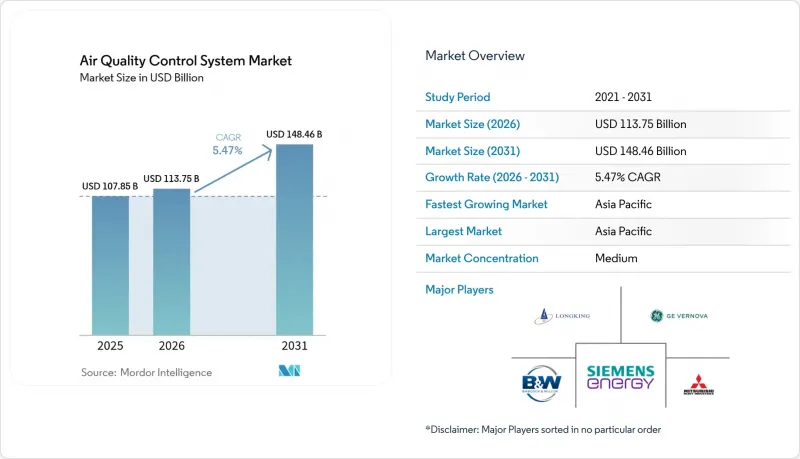
Mordor Intelligence에 따르면 대기질 관리 시스템 시장 규모는 2025년 1,078억 5,000만 달러에서 2026년에는 1,137억 5,000만 달러로 확대되고, 2026년부터 2031년까지 CAGR 5.47%를 기록하며 2031년까지 1,484억 6,000만 달러에 달할 것으로 예측됩니다.
본 보고서는 유형별(정전 집진 장치, 배연 탈황 장치, 스크러버,천/세라믹 필터 등), 구성요소별(하드웨어, 소프트웨어 및 분석, 서비스), 설치 형태별(신규 설치 및 개보수/업그레이드), 용도별(발전, 시멘트, 화학·석유화학, 기타), 그리고 지역별(북미, 유럽, 아시아태평양, 기타)로 분류되어 있습니다.
세계 대기질 관리 시스템 시장의 동향 및 인사이트
대륙을 아우르는 엄격한 배출 상한선이 규정 준수를 위한 즉각적인 투자를 촉진
국제해사기구(IMO)의 2020년 황 배출 규제 및 유럽연합(EU)의 산업 배출 지침에 따라 해운, 전력, 중공업 각 분야에서 규정 준수를 위한 500억 달러 규모의 투자 사이클이 촉발되고 있습니다. 스크러버 개조는 일반적으로 95% 이상의 선박에서 5년 이내에 투자 회수점에 도달하지만, 이에 수반되는 개방형 세정수는 6억 8,000만 유로의 외부 환경 비용을 발생시키고 있으며, 이로 인해 수요가 폐쇄형 시스템으로 이동하고 있습니다. EU의 개폐장치에 대한 SF6 사용 금지 등 보완적인 규제로 인해 청정 공기 절연 기기의 도입이 가속화되고 있으며, Blue GIS 기술은 기존 설계에 비해 CO2 배출량을 30% 감소시키고 있습니다. 이러한 파급 효과는 현재 시멘트 및 철강 산업으로도 확대되고 있으며, 유사한 배출 강도 목표에 따라 미세먼지, 산성 가스, 미량 금속의 포집을 단일 플랫폼에 통합한 종합적인 대기질 관리를 위한 개조가 진행되고 있습니다.
아시아의 석탄에서 가스로의 전환이 개조 기회를 창출
아시아태평양의 정책 입안자들은 석탄 화력 발전소의 완전한 폐지보다 유연성을 우선시하며, 폐지가 아닌 첨단 배출 제어 개조를 요구하고 있습니다. 중국의 전략은 2030년까지 194-245 GW의 재생에너지를 추가로 도입하고, 전환 비용을 1760억 달러 절감함으로써, 바이오매스 혼소 및 그린 암모니아 혼합에 대응할 수 있는 시스템에 대한 강력한 수요를 창출하고 있습니다. 인도에서 의무화된 FGD(배연 탈황 장치) 도입으로 인해 이미 SO₂ 제거 효율이 98%를 초과하고 있어, 대규모 개조에 대한 사업 타당성이 입증되고 있습니다. LNG는 실질적으로 석탄을 대체하지 못하고 있기 때문에 자산 소유자들은 강화되는 규제를 준수하면서도 석탄 발전 용량을 운영하기 위해 다연료 대응 스크러버나 저NOx 버너에 주목하고 있습니다.
원자재 가격 변동과 OECD 국가들의 석탄 프로젝트 축소가 설비의 이익률을 압박하고 있습니다.
스테인리스강, 백금, 팔라듐 가격은 러시아와 남아프리카공화국의 지정학적 혼란에 따라 변동하고 있으며, 선택적 촉매 환원(SCR)의 수명주기 비용의 최대 60%를 차지하는 촉매 교체 비용을 상승시키고 있습니다. 동시에 미국과 유럽에서는 석탄 화력 발전소의 폐쇄가 가속화되면서, 기존 스크러버나 ESP(정전기 집진기) 설치 대상 시장이 축소되고 있습니다. 이러한 요인들이 복합적으로 작용하여 OEM(주문자 상표 부착 생산 업체)의 이익률이 압박받고 있으며, 구매자의 의사결정 주기가 장기화되고 있습니다. 각 공급업체는 헤지 전략을 반영한 조달 및 대체 촉매 제형의 도입, 나아가 연료 전환에 따른 개조 공사를 통해 수요가 견조하게 성장하는 지역에 집중함으로써 이러한 상황에 대응하고 있습니다.
부문 분석
2025년 대기오염 방지 시스템 시장에서 배기가스 탈황(FGD) 시스템은 38.60%를 차지했습니다. 인도의 최신 프로젝트에서는 습식 장치가 98%를 초과하는 SO2 제거율을 달성한 반면, 물 부족이 심각한 지역에서는 반건식 설계가 주목받고 있습니다. 섬유 및 세라믹 필터는 5.86%의 연평균 성장률(CAGR)로 성장을 주도하고 있으며, 99%의 입자 포집률과 최대 1,800°C까지의 가스 흐름에 대한 내구성이 높이 평가받고 있습니다. 시멘트 및 바이오매스 혼소화로 인해 입자 부하가 증가함에 따라, 대기 오염 방지 시스템 시장 내 여과 분야의 시장 규모는 꾸준히 확대될 것으로 예상됩니다.
제품 포트폴리오 또한 여러 오염 물질에 대응하는 구조로 전환되고 있습니다. 폐쇄형 스크러버는 EU 항만에서 문제가 되고 있는 세정수 배출을 줄여주며, 새롭게 등장한 SCR(선택적 촉매 환원) 변형 모델은 NOx를 30ppm 미만으로 억제하여 수소 보일러의 초저배출 기준을 충족합니다. 금액 규모는 작지만, 통합 배출 기준이 적용되는 지역에서는 수은 및 VOC(휘발성 유기 화합물) 제어 모듈에 대한 수요가 증가하고 있어, 공급업체들이 적층 가능한 반응기 배열을 개발하는 데 박차를 가하고 있습니다.
2025년 매출에서 하드웨어가 차지하는 비중은 67.20%로, 이는 반응기, 덕트, 유도 환기 팬의 비용을 반영한 것입니다. 그러나 분석 플랫폼은 연평균 성장률(CAGR) 7.32%로 가장 빠르게 성장하고 있는데, 이는 예측형 배출 모니터링을 통해 규정 준수를 저해하지 않으면서도 기존의 CEMS(연속 배출 가스 측정 시스템)에 비해 50-80%의 비용 절감이 가능하기 때문입니다. 임베디드형 디지털 트윈은 예기치 않은 가동 중단을 줄이고 부품 재고를 절감하는 유지보수 대시보드에 정보를 제공합니다.
또한, 장기 운영 계약에서 부품, 성능 보증, AI를 활용한 인사이트이 패키지화됨에 따라 서비스의 비중도 높아지고 있습니다. 그 결과, SaaS(Software-as-a-Service) 기반 대기질 관리 시스템의 시장 점유율은 매년 소폭 상승하여, 단독 하드웨어의 비중을 압박할 것으로 예측됩니다. 견고한 장비와 클라우드 분석을 융합한 공급업체들은 플랜트 소유주에게 전환 비용을 점차 고정화시키고 있습니다.
지역별 분석
아시아태평양은 2025년에 매출 점유율 42.70%를 차지하고, 2031년까지 연평균 성장률(CAGR)이 6.02%에 달할 것으로 예측되어 명실상부한 선두 주자로 자리매김하고 있습니다. 중국이 전력 시스템의 유연성을 확보하기 위해 석탄 발전 설비를 계속 가동하는 동시에, 바이오매스 및 그린 암모니아 혼소 정책을 발표함에 따라 초저 NOx 버너 및 고효율 스크러버로의 대규모 개조 열풍이 불고 있습니다. 인도의 FGD(배연 탈황) 의무화로 인해 최근 설비 도입을 통해 98%의 제거율을 달성함에 따라, 연간 110만 톤의 SO2 감축이 순조롭게 진행되고 있습니다. 지역 전체적으로는 철강 및 시멘트 산업의 확장에 따라 고온용 패브릭 필터와 건식 흡착제 주입에 대한 수요가 증가하고 있어 지속적인 수주가 예상됩니다. 일본과 한국은 업계 최고 수준의 배출 계수를 요구함으로써 기술 수요를 뒷받침하고 있으며, 국내 OEM 각사의 연구 개발 투자를 촉진하고 있습니다.
북미와 유럽은 성숙해 가고 있지만 여전히 활기찬 개보수 시장을 형성하고 있습니다. EU의 산업 배출 지침 및 프레온 가스의 단계적 폐지에 따라, 기존의 개폐장치나 석탄 화력 발전소의 집진 장치에서 청정 가스 절연 개폐장치(GIS)나 SCR과 탄소 회수를 결합한 하이브리드 시스템으로의 전환이 가속화되고 있습니다. 미국에서는 발전 용량 전환 프로젝트가 버브콕 앤 윌콕스(Babbcock & Wilcox)사의 연료 전환 사례를 반영하고 있으며, 저NOx 버너와 예측형 배출 모니터링을 결합함으로써 기존 시설을 폐기하지 않고도 주 정부의 허가 요건을 충족하고 있습니다. 두 지역 모두 AI를 활용한 유지보수와 탄소 포집의 통합을 우선시하고 있으며, 이를 통해 거래량 증가세가 둔화되고 있는 부분을 상쇄할 수 있는 고부가가치 서비스 계약이 창출되고 있습니다.
중동 및 아프리카는 아시아를 제외하고 가장 큰 성장 잠재력을 지니고 있습니다. 두바이의 폐기물 발전 복합 시설은 13만 5,000가구에 전력을 공급하는 동시에, 고형 폐기물 처리 분야에서 대규모 배기가스 처리의 필요성을 입증하고 있습니다. 사하라 사막 이남 아프리카의 클링커 시장에 새로 진출하는 기업들은 분진이 많고 알칼리도가 높은 환경에 맞춰 설계된 견고한 백 필터와 하이브리드식 정전기 집진기(ESP)가 필요합니다. 예를 들어, 알제리의 제르파 공장은 친환경 시멘트에 중점을 둔 180만 톤의 생산능력을 계획하고 있습니다. 남미는 규제 엄격성 면에서 뒤처져 있지만, 광업 및 금속 프로젝트에서는 수출 시장의 기대에 부응하기 위해 수은 및 산성 가스 배출 제어 장치가 포함되어 있으며, 도입 실적이 점차 확대되고 있습니다.
기타 혜택:
- 엑셀 형식의 시장 예측(ME) 시트
- 3개월간의 애널리스트 지원
자주 묻는 질문
목차
제1장 소개
제2장 조사 방법
제3장 주요 요약
제4장 시장 구도
제5장 시장 규모와 성장 예측
제6장 경쟁 구도
제7장 시장 기회와 향후 전망
KSM 26.08.25According to Mordor Intelligence, the air quality control system market size is expected to grow from USD 107.85 billion in 2025 to USD 113.75 billion in 2026 and is forecast to reach USD 148.46 billion by 2031 at 5.47% CAGR over 2026-2031.
This report is Segmented by Type (Electrostatic Precipitators, Flue-Gas Desulfurization, Scrubbers, Fabric/Ceramic Filters, and More), Component (Hardware, Software and Analytics, and Services), Installation Type (New Build and Retrofit/Upgrade), Application (Power Generation, Cement, Chemicals and Petrochemicals, and More), and Geography (North America, Europe, Asia-Pacific, and More).
Global Air Quality Control System Market Trends and Insights
Stringent Trans-Continental Emission Caps Drive Immediate Compliance Investments
The International Maritime Organization's 2020 sulfur limits and the European Union's Industrial Emissions Directive have triggered a USD 50 billion compliance-driven spending cycle across shipping, power, and heavy industry. Scrubber retrofits typically reach economic break-even inside five years for more than 95% of vessels, yet the associated open-loop wash water has created EUR 680 million in external environmental costs that are steering demand toward closed-loop systems. Complementary regulation, such as the EU F-gas ban on SF6 in switchgear, is accelerating the uptake of clean-air insulated equipment, with Blue GIS technology lowering CO2 footprints by 30% relative to legacy designs. Spill-over effects now reach cement and steel, where similar intensity targets are prompting holistic air quality control retrofits that bundle particulate, acid-gas, and trace-metal capture in one platform.
Coal-to-Gas Transition in Asia Unlocks Retrofit Opportunities
Asia-Pacific policymakers prioritize coal-plant flexibility over outright retirement, requiring sophisticated emission-control retrofits rather than decommissioning. China's strategy allows 194-245 GW of incremental renewable penetration and trims transition costs by USD 176 billion by 2030, creating strong demand for systems that tolerate biomass co-firing and green ammonia blends. India's mandated FGD roll-out already posts SO2 removal efficiency above 98%, underscoring the business case for large-scale retrofits. LNG has not displaced coal materially, so asset owners are turning to multi-fuel-capable scrubbers and low-NOx burners to comply with tightening norms while dispatching coal capacity.
Volatile Raw-Material Prices and Shrinking OECD Coal Pipeline Compress Equipment Margins
Prices for stainless steel, platinum, and palladium move with geopolitical disruptions in Russia and South Africa, inflating catalyst replacement costs representing up to 60% of selective catalytic reduction lifecycle spend. Simultaneously, the United States and Europe are accelerating coal-plant retirements, narrowing the addressable base for traditional scrubber and ESP installations. Combined, these factors squeeze OEM margins and lengthen buyer decision cycles. Suppliers are countering through hedged procurement, alternative catalyst recipe,s and targeting growth regions where fuel-switch retrofits keep demand robust.
Other drivers and restraints analyzed in the detailed report include:
- Accelerated Cement Capacity Additions in Sub-Saharan Africa Create Specialized Demand
- AI-Enabled Predictive Maintenance Reduces Operational Expenditure
- PFAS and Secondary Pollution Concerns Challenge Wet Scrubber Applications
For complete list of drivers and restraints, kindly check the Table Of Contents.
Segment Analysis
Flue-Gas Desulfurization systems accounted for 38.60% of the air quality control system market 2025. Wet units achieve SO2 removal beyond 98% in India's latest projects, while semi-dry designs appeal where water scarcity prevails. Fabric and ceramic filters lead growth at a 5.86% CAGR, favoured for 99% particulate capture and tolerance of gas streams up to 1,800 °C. The air quality control system market size for filtration is forecast to expand steadily as cement and biomass co-firing raise particulate loads.
Product portfolios are also shifting to multi-pollutant architectures. Closed-loop scrubbers mitigate wash-water discharges flagged by EU ports, while emerging SCR variants drive NOx below 30 ppm, meeting ultra-low standards for hydrogen-ready boilers. Though smaller in value, demand for mercury and VOC control modules is rising where integrated limits apply, reinforcing vendor push toward stackable reactor trains.
Hardware comprised 67.20% of 2025 revenue, reflecting the cost of reactors, ducting, and induced-draft fans. However, analytics platforms are the fastest mover at 7.32% CAGR, because predictive emission monitoring can deliver 50-80% cost savings against conventional CEMS without sacrificing compliance. Embedded digital twins lower unplanned outages and feed maintenance dashboards that trim parts inventory.
Services also gain weight as long-term operating contracts bundle parts, performance guarantees, and AI-driven insights. As a result, the air quality control system market share for software-plus-services is projected to inch higher each year, compressing the standalone hardware proportion. Suppliers that marry rugged equipment with cloud analytics are building durable switching costs for plant owners.
Complete Report Scope:
- By Type
- Electrostatic Precipitators (Dry & Wet)
- Flue-Gas Desulfurization (Wet, Dry, Semi-dry)
- Scrubbers (Wet, Dry, Marine)
- Selective Catalytic and Non-Catalytic Reduction
- Fabric/Ceramic Filters
- Mercury and VOC Control Units
- By Component
- Hardware (Reactors, Ductwork, Fans)
- Software and Analytics
- Services (O&M, Retrofit)
- By Installation Type
- New Build
- Retrofit/Upgrade
- By Application
- Power Generation
- Cement
- Iron and Steel
- Chemicals and Petrochemicals
- Pulp and Paper
- Waste-to-Energy
- Others (Glass, Mining, etc.)
- By Geography
- North America
- United States
- Canada
- Mexico
- Europe
- Germany
- France
- United Kingdom
- Italy
- Russia
- Rest of Europe
- Asia-Pacific
- China
- India
- Japan
- South Korea
- ASEAN Countries
- Rest of Asia-Pacific
- South America
- Brazil
- Argentina
- Rest of South America
- Middle East and Africa
- Saudi Arabia
- United Arab Emirates
- South Africa
- Egypt
- Rest of Middle East and Africa
- North America
Geography Analysis
Asia-Pacific's 42.70% revenue share in 2025 makes it the undisputed leader, with a forecast 6.02% CAGR through 2031. China's decision to keep coal capacity online for grid flexibility while co-firing biomass and green ammonia drives an extensive retrofit wave for ultra-low-NOx burners and high-efficiency scrubbers. India's FGD mandate is on track to cut 1.1 million t of SO2 annually after recent installations reached 98% removal. Region-wide, steel and cement expansions reinforce demand for high-temperature fabric filters and dry sorbent injection, ensuring sustained order flow. Japan and South Korea add technology pull by insisting on best-in-class emission factors, spurring R&D investment by domestic OEMs.
North America and Europe form mature yet vibrant retrofit markets. The EU Industrial Emissions Directive and the F-gas phase-out propel swap-outs of legacy switchgear and coal-plant dust collectors with clean-air GIS and SCR-plus-carbon-capture hybrids. In the United States, capacity-conversion projects mirror the Babcock & Wilcox fuel switch, pairing low-NOx burners with predictive emission monitoring to satisfy state permits without abandoning existing sites. Both regions prioritize AI-assisted maintenance and carbon-capture integration, generating high-value service contracts that offset lower volume growth.
The Middle East and Africa present the highest upside outside Asia. Dubai's waste-to-energy complex powers 135,000 homes while proving the case for large-scale flue-gas treatment in solid-waste applications. Sub-Saharan Africa's clinker entrants need robust baghouses and hybrid ESPs tailored for dusty, high-alkali environments. Algeria's Djelfa plant, for example, plans 1.8 million t of capacity with a green-cement slant. South America lags in regulatory rigor, yet mining and metals projects embed mercury and acid-gas controls to meet export-market expectations, slowly broadening the installed base.
- Mitsubishi Heavy Industries
- General Electric
- Babcock & Wilcox
- Siemens Energy
- Thermax
- Fujian Longking
- Hamon Group
- Andritz
- Ducon Technologies
- GEA Bischoff
- Pure Air Solutions
- Tri-Mer Corporation
- Anguil Environmental Systems
- Durr
- CECO Environmental
- Airex Industries
- Albmarle Mercury Control
- KC Cottrell
- Yara Marine Technologies
- Wartsila
Additional Benefits:
- The market estimate (ME) sheet in Excel format
- 3 months of analyst support
TABLE OF CONTENTS
1 Introduction
- 1.1 Study Assumptions & Market Definition
- 1.2 Scope of the Study
2 Research Methodology
3 Executive Summary
4 Market Landscape
- 4.1 Market Overview
- 4.2 Market Drivers
- 4.2.1 Stringent trans-continental emission caps (e.g., IMO 2020, EU IED)
- 4.2.2 Coal-to-gas power-mix shift in Asia driving retrofits
- 4.2.3 Accelerated cement capacity additions in Sub-Saharan Africa
- 4.2.4 AI-enabled predictive maintenance cutting OPEX
- 4.2.5 Green-hydrogen fired boilers requiring ultra-low-NOx AQCS
- 4.3 Market Restraints
- 4.3.1 Volatile raw-material prices (stainless steel, catalysts)
- 4.3.2 Declining coal power pipeline in OECD economies
- 4.3.3 PFAS & secondary pollution concerns for wet scrubbers
- 4.4 Supply-Chain Analysis
- 4.5 Regulatory Landscape
- 4.6 Technological Outlook
- 4.7 Porter's Five Forces
- 4.7.1 Bargaining Power of Suppliers
- 4.7.2 Bargaining Power of Buyers
- 4.7.3 Threat of New Entrants
- 4.7.4 Threat of Substitutes
- 4.7.5 Intensity of Competitive Rivalry
5 Market Size & Growth Forecasts
- 5.1 By Type
- 5.1.1 Electrostatic Precipitators (Dry & Wet)
- 5.1.2 Flue-Gas Desulfurization (Wet, Dry, Semi-dry)
- 5.1.3 Scrubbers (Wet, Dry, Marine)
- 5.1.4 Selective Catalytic and Non-Catalytic Reduction
- 5.1.5 Fabric/Ceramic Filters
- 5.1.6 Mercury and VOC Control Units
- 5.2 By Component
- 5.2.1 Hardware (Reactors, Ductwork, Fans)
- 5.2.2 Software and Analytics
- 5.2.3 Services (O&M, Retrofit)
- 5.3 By Installation Type
- 5.3.1 New Build
- 5.3.2 Retrofit/Upgrade
- 5.4 By Application
- 5.4.1 Power Generation
- 5.4.2 Cement
- 5.4.3 Iron and Steel
- 5.4.4 Chemicals and Petrochemicals
- 5.4.5 Pulp and Paper
- 5.4.6 Waste-to-Energy
- 5.4.7 Others (Glass, Mining, etc.)
- 5.5 By Geography
- 5.5.1 North America
- 5.5.1.1 United States
- 5.5.1.2 Canada
- 5.5.1.3 Mexico
- 5.5.2 Europe
- 5.5.2.1 Germany
- 5.5.2.2 France
- 5.5.2.3 United Kingdom
- 5.5.2.4 Italy
- 5.5.2.5 Russia
- 5.5.2.6 Rest of Europe
- 5.5.3 Asia-Pacific
- 5.5.3.1 China
- 5.5.3.2 India
- 5.5.3.3 Japan
- 5.5.3.4 South Korea
- 5.5.3.5 ASEAN Countries
- 5.5.3.6 Rest of Asia-Pacific
- 5.5.4 South America
- 5.5.4.1 Brazil
- 5.5.4.2 Argentina
- 5.5.4.3 Rest of South America
- 5.5.5 Middle East and Africa
- 5.5.5.1 Saudi Arabia
- 5.5.5.2 United Arab Emirates
- 5.5.5.3 South Africa
- 5.5.5.4 Egypt
- 5.5.5.5 Rest of Middle East and Africa
- 5.5.1 North America
6 Competitive Landscape
- 6.1 Market Concentration
- 6.2 Strategic Moves (M&A, Partnerships, PPAs)
- 6.3 Market Share Analysis (Market Rank/Share for key companies)
- 6.4 Company Profiles (includes Global level Overview, Market level overview, Core Segments, Financials as available, Strategic Information, Products & Services, and Recent Developments)
- 6.4.1 Mitsubishi Heavy Industries
- 6.4.2 General Electric
- 6.4.3 Babcock & Wilcox
- 6.4.4 Siemens Energy
- 6.4.5 Thermax
- 6.4.6 Fujian Longking
- 6.4.7 Hamon Group
- 6.4.8 Andritz
- 6.4.9 Ducon Technologies
- 6.4.10 GEA Bischoff
- 6.4.11 Pure Air Solutions
- 6.4.12 Tri-Mer Corporation
- 6.4.13 Anguil Environmental Systems
- 6.4.14 Durr
- 6.4.15 CECO Environmental
- 6.4.16 Airex Industries
- 6.4.17 Albmarle Mercury Control
- 6.4.18 KC Cottrell
- 6.4.19 Yara Marine Technologies
- 6.4.20 Wartsila
7 Market Opportunities & Future Outlook
- 7.1 White-space & Unmet-need Assessment


