|
시장보고서
상품코드
2097071
분자 바이오센서 : 시장 점유율 분석, 업계 동향 및 통계, 성장 예측(2026-2031년)Molecular Biosensors - Market Share Analysis, Industry Trends & Statistics, Growth Forecasts (2026 - 2031) |
||||||
 Mordor Intelligence
Mordor Intelligence에 의하면, 분자 바이오센서 시장 규모는 2025년에 335억 5,000만 달러로 평가되었습니다. 2026년 365억 5,000만 달러에서 2031년까지 560억 4,000만 달러에 이를 것으로 예상되며, 예측 기간(2026-2031년) CAGR은 8.93%를 나타낼 전망입니다.

본 보고서는 기술별(전기화학식 바이오센서, 광학식 바이오센서, 열식 바이오센서, 압전식 바이오센서), 용도별(의료 진단, 식품 및 음료, 환경 안전, 국방·보안, 기타), 지역별(북미, 유럽, 아시아태평양, 중동 및 아프리카, 남미)로 분류되어 있습니다. 본 보고서에서는 상기 각 부문 시장 규모(백만 달러)를 제시하고 있습니다.
세계의 분자 바이오센서 시장 동향 및 인사이트
포인트 오브 케어(Point-of-Care) 진단의 급속한 보급
의료 네트워크에서는 병상에서의 즉각적인 결과 제공을 중심으로 검사 모델을 재구축하고 있습니다. 2024년 FDA가 시판용 혈당 측정기를 승인함에 따라, 소비자가 자발적으로 당뇨병을 관리할 수 있는 길이 열렸습니다. 병원체, 심장 마커, 대사 관련 데이터를 수분 이내에 제공하는 분자 바이오센서는 응급실이나 지방 진료소에서 ‘진료 접수부터 치료 시작’까지의 시간을 단축합니다. 스마트폰과 연동되는 리더기는 암호화된 검사 결과를 전자 차트에 전송하여 원격 의료 프로그램을 강화하는 동시에 후속 관리 비용을 절감합니다. 이러한 효율화를 통해 검사 업무의 외부 위탁 비용이 대폭 절감되어, 과중한 업무에 시달리고 있는 중앙 검사실에 여유 역량이 생깁니다.
실시간 감지를 위한 IoT와 AI의 통합
엣지 분석을 통해 분자 바이오센서는 수동적인 검출기에서 예측적인 모니터링 장치로 변모하고 있습니다. 홋카이도 대학 연구진은 디바이스 상에서 데이터를 로컬로 처리함으로써 부정맥, 기침, 낙상에 대해 80% 이상의 조기 사건 예측 정확도를 달성한 웨어러블 패치를 실증했습니다. 지속적인 생체 신호 스트림을 활용해 학습된 머신러닝 모델은 증상이 나타나기 몇 시간 전에 상태 악화를 감지하여, 재입원을 줄이는 예방적 관리를 가능하게 합니다. 기기에 내장된 보정 기능으로 센서의 수명이 연장되며, 안전한 클라우드 대시보드에서는 익명화된 데이터가 집계되어 역학적 감시에 활용됩니다.
소형화에 따른 높은 비용과 복잡성
다중 매개변수 분석 장치를 우표 크기의 기판으로 소형화하려면 서브미크론급 리소그래피 기술과 특수 폴리머가 필요합니다. 웨이퍼 본딩 시 미세 유체 채널이 막히면 생산 수율이 떨어지고 불량률이 높아지기 때문에 예산에 제약이 있는 진료소에서는 감당하기 어려울 정도로 단가가 높아집니다. 생체 적합성 있는 밀봉 가공을 지원할 수 있는 전 세계 파운드리 생산 능력이 제한적이기 때문에 1년에 달하는 대기 시간이 발생하고, 상용화 시작이 지연되며, 투자자에게 있어 손익분기점 달성 시기가 미뤄지고 있습니다.
부문 분석
전기화학 센서는 매년 수십억 장의 혈당 측정 스트립을 양산하는 성숙한 스크린 인쇄 전극 라인 덕분에 2025년 분자 바이오센서 시장 점유율의 41.22%를 차지했습니다. 낮은 작동 전압, 빠른 응답 시간, 그리고 표준화된 보험 환급 코드가 1차 진료 현장에서의 지속적인 수요를 뒷받침하고 있습니다. 한편, 광학 센서는 전기화학적 간섭 없이 생체 분자의 결합을 감지하는 나노포토닉 도파관에 힘입어 2031년까지 연평균 성장률(CAGR) 9.88%를 기록할 전망입니다. 한국 연구팀은 AI가 통합된 광학 칩을 이용한 대장암 검출에서 99%의 정확도를 달성했다고 보고했으며, 이는 조기 암 선별 검사에서의 임상적 가능성을 뒷받침하는 것입니다. 열식, 압전식 및 나노기계식 방식은 라벨이 필요 없는 반응 속도 측정이나 온도 의존성 반응과 같은 틈새 요구 사항을 충족하고 있지만, 이 모든 방식을 합쳐도 분자 바이오센서 시장에서의 점유율은 극히 미미합니다.
자원이 제한된 진료소에서는 기존 판독 장치나 일회용 스트립과의 호환성이 있기 때문에 여전히 전기화학적 방식이 선호되고 있습니다. 한편, 정밀 종양학 센터나 제약 기업의 품질 보증(QA) 연구실에서는 하나의 슬라이드 위에서 사이토카인, 호르몬, 바이러스 항원을 다중 측정할 수 있는 표면 플라즈몬 공명(SPR) 장치가 선호되고 있습니다. 이러한 경향의 차이는 비용을 중시하는 대중 시장용 검사와 정밀도가 극히 중요한 전문적 검사가 융합되기보다는 공존하는 미래를 예감하게 합니다. 이에 따라 각 공급업체들은 수요 변화에 대비하기 위해 듀얼 플랫폼 제품을 라인업에 추가하고 있습니다.
지역별 분석
북미는 2025년 분자 바이오센서 시장 매출의 34.08%를 차지했습니다. 이는 확립된 임상시험 인프라, 연속 혈당 모니터링에 대한 광범위한 보험 적용 범위, 그리고 팬데믹 대응 키트에 대한 연방 정부의 지속적인 조달에 힘입은 결과입니다. 보스턴, 미니애폴리스, 샌디에이고의 산학 클러스터에서는 국립보건원(NIH)의 연구비가 스핀아웃 기업에 투입되어, 나노 소재 전극 및 AI 기반 교정 소프트웨어의 상용화가 진행되고 있습니다. 대형 의료기기 제조업체와 클라우드 벤더간의 제휴를 통해, 전자 건강 기록과 원활하게 연동되는 엔드투엔드 모니터링 솔루션의 병원 도입이 가속화되고 있습니다.
아시아태평양에서는 각국의 의료 시스템이 제조 거점에서 혁신의 중심지로 전환됨에 따라, 2031년까지 연평균 성장률(CAGR) 11.62%로 가장 높은 성장률을 나타낼 것으로 예측됩니다. 일본의 디지털 헬스 시장은 개인 건강 기록 통합 및 AI 진단에 대한 정부의 인센티브를 배경으로, 2028년까지 연평균 성장률(CAGR) 7.29%를 나타낼 것으로 전망됩니다. 한국의 AI 헬스케어 분야는 2030년까지 66억 7,000만 달러에 달할 것으로 예측되며, 이는 5G의 광범위한 보급과 90% 이상의 전자건강기록(EHR) 보급률에 힘입어 연평균 성장률(CAGR) 50.8%를 반영한 것입니다. 중국과 인도는 공급망을 확보하고 수입 의존도를 낮추기 위해 국내 센서 제조 공장에 막대한 자금을 투입하고 있으며, 이 지역은 향후 10년 이내에 저비용 전기화학식 스트립을 대량으로 수출할 체제를 갖추고 있습니다. 유럽에서는 ‘그린 딜’에 기반한 환경 모니터링 지침에 따라 회원국 전체에서 수질의 실시간 평가가 의무화되어 있으며, 이로 인해 한 자릿수 중반대의 성장이 지속되고 있습니다. 독일과 북유럽 국가들에서는 스마트 하수 그리드의 시범 운영이 진행되고 있으며, 분자 바이오센서의 데이터를 지자체 대시보드로 전송하여 오염 물질이 집중된 지역을 매핑하고 있습니다. 남미 및 중동 각국 정부는 식품 수출 공급망이나 대규모 집회에서의 건강 모니터링에 분자 바이오센서를 도입하고 있으며, 1인당 의료비 지출이 여전히 낮은 지역에서도 기반이 되는 수요를 창출하고 있습니다. 이러한 지역별 상황은 분자 바이오센서 시장이 더 이상 대서양을 사이에 둔 두 대기업의 독점 시장이 아니라, 지역마다 촉진요인과 규제 발전 속도가 다른 다극적인 시장 구조를 띠고 있음을 여실히 보여주고 있습니다.
기타 혜택 :
- 엑셀 형식 시장 예측(ME) 시트
- 3개월간의 애널리스트 지원
자주 묻는 질문
목차
제1장 서론
제2장 조사 방법
제3장 주요 요약
제4장 시장 구도
제5장 시장 규모 및 성장 예측
제6장 경쟁 구도
제7장 시장 기회 및 향후 전망
KTH 26.08.05According to Mordor Intelligence, the molecule biosensor market size was valued at USD 33.55 billion in 2025 and estimated to grow from USD 36.55 billion in 2026 to reach USD 56.04 billion by 2031, at a CAGR of 8.93% during the forecast period (2026-2031).
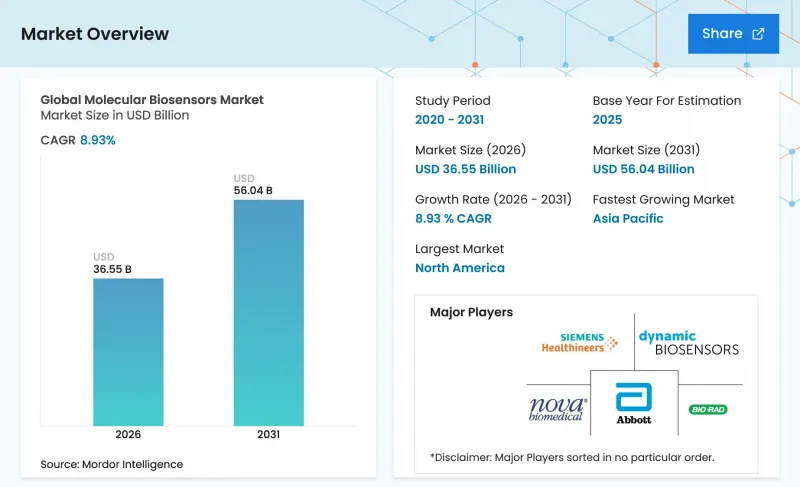
This report is Segmented by Technology (Electrochemical Biosensors, Optical Biosensors, Thermal Biosensors, Piezoelectric Biosensors), Application (Medical Diagnostics, Food and Beverages, Environment Safety, Defense and Security and Others), and Geography (North America, Europe, Asia-Pacific, Middle East and Africa, and South America). The Report Offers the Value (in USD Million) for the Above Segments.
Global Molecular Biosensors Market Trends and Insights
Rapid Adoption of Point-of-Care Diagnostics
Healthcare networks are rebuilding testing models around immediate answers at the bedside. The 2024 FDA clearance of an over-the-counter glucose monitor opened a consumer pathway for self-directed diabetes management. Molecule biosensors that deliver pathogen, cardiac-marker, or metabolic data within minutes reduce admission-to-treatment intervals in emergency departments and rural clinics. Smartphone-linked readers transfer encrypted results to electronic records, strengthening telemedicine programs and lowering follow-up costs. These efficiencies slash laboratory outsourcing expenses and create surplus capacity in overstretched central labs.
Integration of IoT & AI for Real-Time Sensing
Edge analytics transforms molecule biosensors from passive detectors into predictive sentinels. Researchers at Hokkaido University demonstrated a wearable patch that achieved more than 80% early-event prediction accuracy for arrhythmia, coughs, and falls by processing data locally on the device. Machine-learning models trained on continuous biosignal streams detect deterioration hours before symptoms appear, enabling proactive care that lowers readmissions. On-board calibration routines extend sensor lifespans, while secure cloud dashboards aggregate anonymized data for epidemiological surveillance.
High Cost & Complexity of Miniaturization
Shrinking multi-parameter analyzers onto postage-stamp substrates requires sub-micron lithography and exotic polymers. Production yields fall when microfluidic channels clog during wafer bonding, raising scrap rates and pushing per-unit costs beyond the reach of budget-constrained clinics. Limited global foundry capacity with bio-compatible encapsulation creates year-long queue times, delaying commercial launches and extending breakeven horizons for investors.
Other drivers and restraints analyzed in the detailed report include:
- Nanomaterials Boosting Detection Sensitivity
- Stricter Environmental Monitoring Mandates
- Regulatory Hurdles for Clinical Validation
For complete list of drivers and restraints, kindly check the Table Of Contents.
Segment Analysis
Electrochemical sensors captured 41.22% of the 2025 molecule biosensor market share thanks to mature screen-printed electrode lines that churn out billions of glucose strips each year. Low operating voltage, rapid response times, and standardized reimbursement codes underpin continued demand across primary-care settings. Optical sensors, however, are set to log a 9.88% CAGR through 2031, driven by nanophotonic waveguides that register biomolecular binding without electrochemical interference. A Korean research team reported 99% accuracy in colorectal-cancer detection using an AI-enhanced optical chip, underscoring clinical potential for early-stage oncology screening. Thermal, piezoelectric, and nanomechanical modalities serve niche requirements such as label-free kinetics and temperature-indexed reactions, but they collectively account for a modest slice of the molecule biosensor market.
Electrochemical formats remain the preference for resource-limited clinics because they pair with existing readers and disposable strip logistics. Precision oncology centers and pharmaceutical QA labs favor surface-plasmon resonance benches that multiplex cytokines, hormones, and viral antigens on one slide. The divergence hints at a future where cost-sensitive mass-market testing and precision-critical specialty assays coexist rather than converge. Suppliers are therefore expanding catalogues into dual-platform offerings to hedge demand shifts.
Complete Report Scope:
- By Technology (Value)
- Electrochemical Sensors
- Optical Sensors
- Piezoelectric & Acoustic Sensors
- Thermal & Calorimetric Sensors
- Nanomechanical & Cantilever Sensors
- By Product Type (Value)
- Wearable Sensors
- Implantable Sensors
- Disposable Sensors
- Benchtop / Stand-alone Sensors
- By Application (Value)
- Medical Diagnostics
- Environmental Monitoring
- Food & Beverage Safety
- Industrial Process Control
- Agriculture & Livestock
- Defense & Security
- By Geography (Value)
- North America
- United States
- Canada
- Mexico
- Europe
- Germany
- United Kingdom
- France
- Italy
- Spain
- Rest of Europe
- Asia-Pacific
- China
- India
- Japan
- South Korea
- Australia
- Rest of Asia-Pacific
- South America
- Brazil
- Argentina
- Rest of South America
- Middle East and Africa
- GCC
- South Africa
- Rest of Middle East and Africa
- North America
Geography Analysis
North America generated 34.08% of molecule biosensor market revenue in 2025, propelled by established clinical trial infrastructure, extensive payer coverage for continuous glucose monitoring, and sustained federal procurement of pandemic-preparedness kits. Academic-industry clusters in Boston, Minneapolis, and San Diego channel National Institutes of Health grants into spin-outs that commercialize nanomaterial electrodes and AI calibration software. Partnerships between device majors and cloud vendors accelerate hospital adoption of end-to-end monitoring solutions that integrate smoothly with electronic medical records.
Asia-Pacific is forecast to post the fastest 11.62% CAGR through 2031 as national health systems pivot from manufacturing hubs to innovation epicenters. Japan's digital-health market is tracking a 7.29% CAGR through 2028 on the back of government incentives for personal health record integration and AI diagnostics. South Korea's AI health sector is projected to reach USD 6.67 billion by 2030, reflecting 50.8% CAGR powered by ubiquitous 5G coverage and more than 90% electronic medical record penetration. China and India channel sizable funds into domestic sensor fabs to secure supply chains and lower import reliance, positioning the region to generate high-volume exports of low-cost electrochemical strips within the decade. Europe sustains mid-single-digit growth through environmental monitoring directives under the Green Deal, which mandate real-time water-quality assessments across member states. Germany and the Nordics pilot smart wastewater grids that stream molecule biosensor data to municipal dashboards for pollutant hot-spot mapping. South American and Middle-East governments deploy molecule biosensors in food-export supply chains and mass-gathering health surveillance, creating foundational demand even where per-capita healthcare spending remains modest. The geographic mosaic underscores that the molecule biosensor market is no longer a transatlantic duopoly; it is a multi-polarity landscape with localized drivers and differentiated regulatory tempos.
- Abbott Laboratories
- Roche
- Thermo Fisher Scientific
- Siemens Healthineers
- Honeywell International
- Medtronic
- Sensirion
- TDK Corporation
- QIAGEN
- Danaher Corporation (Cepheid etc.)
- Bio-Rad Laboratories
- Agilent Technologies
- Teledyne FLIR
- Hologic
- Yokogawa Electric
Additional Benefits:
- The market estimate (ME) sheet in Excel format
- 3 months of analyst support
TABLE OF CONTENTS
1 Introduction
- 1.1 Study Assumptions & Market Definition
- 1.2 Scope of the Study
2 Research Methodology
3 Executive Summary
4 Market Landscape
- 4.1 Market Overview
- 4.2 Market Drivers
- 4.2.1 Rapid adoption of point-of-care diagnostics
- 4.2.2 Integration of IoT & AI for real-time sensing
- 4.2.3 Nanomaterials boosting detection sensitivity
- 4.2.4 Stricter environmental monitoring mandates
- 4.2.5 Wearable continuous-monitoring biosensors
- 4.2.6 Government pandemic-preparedness funding
- 4.3 Market Restraints
- 4.3.1 High cost & complexity of miniaturization
- 4.3.2 Regulatory hurdles for clinical validation
- 4.3.3 Bioreceptor instability & shelf-life issues
- 4.3.4 Data-privacy concerns around biosensing
- 4.4 Value / Supply-Chain Analysis
- 4.5 Regulatory Landscape
- 4.6 Technological Outlook
- 4.7 Porter's Five Forces
- 4.7.1 Threat of New Entrants
- 4.7.2 Bargaining Power of Suppliers
- 4.7.3 Bargaining Power of Buyers
- 4.7.4 Threat of Substitutes
- 4.7.5 Competitive Rivalry
5 Market Size & Growth Forecasts
- 5.1 By Technology (Value)
- 5.1.1 Electrochemical Sensors
- 5.1.2 Optical Sensors
- 5.1.3 Piezoelectric & Acoustic Sensors
- 5.1.4 Thermal & Calorimetric Sensors
- 5.1.5 Nanomechanical & Cantilever Sensors
- 5.2 By Product Type (Value)
- 5.2.1 Wearable Sensors
- 5.2.2 Implantable Sensors
- 5.2.3 Disposable Sensors
- 5.2.4 Benchtop / Stand-alone Sensors
- 5.3 By Application (Value)
- 5.3.1 Medical Diagnostics
- 5.3.2 Environmental Monitoring
- 5.3.3 Food & Beverage Safety
- 5.3.4 Industrial Process Control
- 5.3.5 Agriculture & Livestock
- 5.3.6 Defense & Security
- 5.4 By Geography (Value)
- 5.4.1 North America
- 5.4.1.1 United States
- 5.4.1.2 Canada
- 5.4.1.3 Mexico
- 5.4.2 Europe
- 5.4.2.1 Germany
- 5.4.2.2 United Kingdom
- 5.4.2.3 France
- 5.4.2.4 Italy
- 5.4.2.5 Spain
- 5.4.2.6 Rest of Europe
- 5.4.3 Asia-Pacific
- 5.4.3.1 China
- 5.4.3.2 India
- 5.4.3.3 Japan
- 5.4.3.4 South Korea
- 5.4.3.5 Australia
- 5.4.3.6 Rest of Asia-Pacific
- 5.4.4 South America
- 5.4.4.1 Brazil
- 5.4.4.2 Argentina
- 5.4.4.3 Rest of South America
- 5.4.5 Middle East and Africa
- 5.4.5.1 GCC
- 5.4.5.2 South Africa
- 5.4.5.3 Rest of Middle East and Africa
- 5.4.1 North America
6 Competitive Landscape
- 6.1 Market Concentration
- 6.2 Market Share Analysis
- 6.3 Company Profiles (includes Global level Overview, Market level overview, Core Segments, Financials as available, Strategic Information, Market Rank/Share for key companies, Products & Services, and Recent Developments)
- 6.3.1 Abbott Laboratories
- 6.3.2 F. Hoffmann-La Roche AG
- 6.3.3 Thermo Fisher Scientific
- 6.3.4 Siemens Healthineers
- 6.3.5 Honeywell International
- 6.3.6 Medtronic plc
- 6.3.7 Sensirion AG
- 6.3.8 TDK Corporation
- 6.3.9 QIAGEN N.V.
- 6.3.10 Danaher Corporation (Cepheid etc.)
- 6.3.11 Bio-Rad Laboratories
- 6.3.12 Agilent Technologies
- 6.3.13 Teledyne FLIR
- 6.3.14 Hologic Inc.
- 6.3.15 Yokogawa Electric Corporation
7 Market Opportunities & Future Outlook
- 7.1 White-space & Unmet-need Assessment