

|
시장보고서
상품코드
2097075
체외수정 : 시장 점유율 분석, 업계 동향과 통계, 성장 예측(2026-2031년)In Vitro Fertilization - Market Share Analysis, Industry Trends & Statistics, Growth Forecasts (2026 - 2031) |
||||||
 Mordor Intelligence
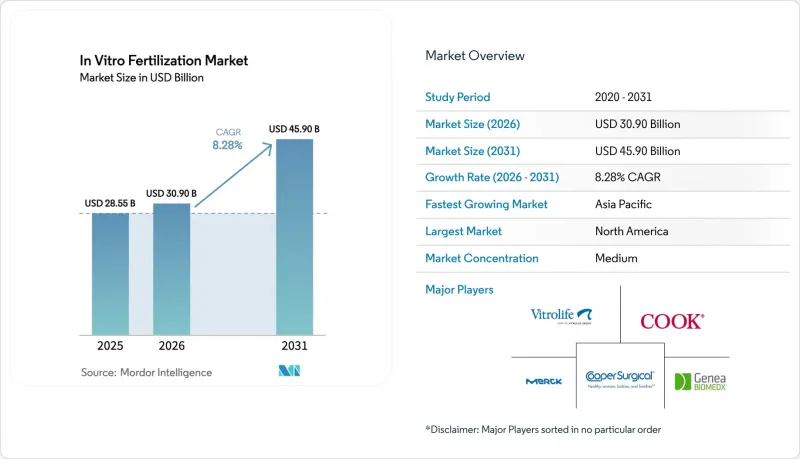
Mordor Intelligence에 의하면, 체외수정 시장 규모는 2025년에 285억 5,000만 달러, 2026년에 309억 달러에서 2031년까지 459억 달러에 이를 것으로 예측되며, 2026-2031년 CAGR 8.28%를 기록할 전망입니다.
본 보고서는 제품별(시약 및 배지, 기기, 소모품·일회용 제품), 주기별(신선 배아 이식 주기-기증자 제외 등), 시술 유형별(기존 체외수정, ICSI를 동반한 체외수정, PGT/PGD를 동반한 체외수정 등), 최종 사용자(불임 치료 클리닉 등), 지역(북미, 유럽, 아시아태평양 등)별로 분류되어 있습니다. 시장 전망은 금액(달러) 기준으로 제시되어 있습니다.
전 세계 체외수정 시장 동향과 인사이트
불임 유병률 및 진단률 상승
세계보건기구(WHO)의 2025년 최신 보고서에 따르면, 현재 성인의 약 17.5%가 불임에 직면해 있으며, 이는 2010년의 15%에서 증가한 수치입니다. 진단 체계가 확충됨에 따라 그동안 간과되었던 사례들이 드러나고 있으며, 특히 인도에서는 2024년 ‘국가 보건 미션’의 일환으로 지역 병원에서 불임 검진이 도입되었습니다. 미국에서는 비만율 상승과 내분비 교란 물질 노출을 배경으로, 2024년에는 15-49세 여성의 13.4%가 불임을 경험하고 있으며, 이는 2015년의 12.1%에서 증가한 수치입니다. 진단을 받은 환자는 치료를 받을 가능성이 높기 때문에 체외수정 시장이 혜택을 보고 있습니다. 이에 대응하여 각 클리닉은 검사 능력과 냉동 보존 인프라를 확충하여 증가하는 환자 수를 수용하고 있습니다. 사회적 편견이 완화되고 보조금도 증가함에 따라, 억눌려 있던 수요가 지속적으로 실제 치료 주기로 전환되어 개발도상국의 시술 건수를 끌어올리고 있습니다.
첫 출산 시 평균 산모 연령의 상승
2023년, 미국의 첫 출산 시 평균 산모 연령은 28.2세에 달했으며, 일부 OECD 회원국에서는 30세 가까이까지 상승했습니다. 이러한 인구 통계학적 변화로 인해 고령 환자는 성공하기까지 많은 시도가 필요하기 때문에 치료 주기 수가 증가하고 있습니다. 일본에서는 2024년 첫 출산의 29.8%가 35세 이상의 산모에 의한 것이었습니다고 보고되었으며, 이에 따라 1주기당 지원금 상한액이 30만 엔(2,000달러)으로 인상되었습니다. 이에 따라 클리닉에서는 자극 프로토콜을 다양화하여 난소 예비능의 저하에 대응하면서도 출산율을 확보하기 위해 ‘미니 체외수정’을 제공합니다. 체외수정 시장에서는 이러한 노화에 따른 치료법이 성장의 핵심이 되고 있으며, 특히 만산(늦은 출산)이 확산되고 있는 동아시아와 남유럽에서 두드러집니다. 각 기기 제조업체들은 이처럼 확대되는 고객층을 확보하기 위해 신체에 부담이 적은 자극 모니터링 도구를 강조하고 있습니다.
부문 분석
2025년에는 기기가 매출의 55.2%를 차지할 것으로 예상되며, 이는 인큐베이터, 마이크로 매니퓰레이터, 레이저 시스템이 예산의 대부분을 차지하는 체외수정(IVF) 실험실의 자본 집약성을 보여줍니다. Vitrolife사의 타임랩스 인큐베이터 'EmbryoScope'(가격 80,000-12만 달러)는 이 프리미엄 부문의 주력 제품으로 자리 잡고 있습니다. 한편, 소모품 및 일회용 제품은 더욱 엄격한 무균 관리 규정에 따라 클리닉들이 일회용 카테터로 전환을 추진함에 따라, 2031년까지 10.21%라는 가장 높은 연평균 성장률(CAGR)을 보일 것으로 전망됩니다. 체외수정 시장에서 소모품 시장 규모는 2031년까지의 증분 수익의 3분의 1을 차지할 것으로 예측됩니다. 재사용 가능한 기기의 세척 절차를 검증하도록 요구하는 규제적 압력으로 인해 일회용 제품으로의 전환이 가속화되고 있는 반면, 사모펀드 투자자들은 소모품 판매에 수반되는 예측 가능한 재주문 주기를 선호하고 있습니다.
오염 관리에 대한 노력이 확산됨에 따라 밀폐형 유리화 장치 및 사전 멸균된 배양 접시에 대한 수요가 증가하고 있습니다. 해밀턴 손(Hamilton Thorn)사는 레이저 보조 부화 기능을 카테터 끝에 통합하여, 장비의 기능성과 일회용 제품을 통한 지속적인 수익을 결합하고 있습니다. 각 공급업체는 서비스 계약과 교체 부품을 세트로 판매함으로써 클리닉을 5년 계약 기간에 묶어두고, 높은 전환 비용을 발생시키고 있습니다. 제조 규모 확대에 따라 단가가 하락함에 따라 중규모 시설에서의 도입이 확산되며, 체외수정 시장이 유지되고 있습니다.
2025년에는 환자들이 자가 생식세포를 선호하고, 기증자 옵션에 비해 검사 비용이 저렴하다는 점 때문에 신선 자가 난자를 이용한 주기가 매출의 34.2%를 차지했습니다. 그러나 기증자 난자를 이용한 주기는 연평균 성장률(CAGR) 10.98%로 증가하며, 이 부문에서 가장 높은 성장세를 보이고 있습니다. 이는 일본의 법적 규제 완화와 40세 이상 여성의 지속적인 수요에 힘입은 결과입니다. 스페인에서는 국경을 넘어 유입되는 환자들에 힘입어 2024년 기증 난자를 이용한 수익이 1억 8,000만 유로(1억 9,500만 달러)에 달했습니다. 체외수정 시장에서 기증 난자의 점유율은 2031년까지 두 자릿수에 이를 것으로 예측됩니다.
동결 배아를 이용한 치료 주기는 유리화 후 생존율이 95%에 달하기 때문에 클리닉은 난소 과자극 증후군의 위험을 최소화하는 단계적 자극 전략을 채택할 수 있게 되었습니다. 크라이오뱅크는 300여 가지 유전성 질환을 포괄하는 유전자 패널에 투자하고 있으며, 이를 통해 품질에 대한 평가가 높아져 프리미엄 가격 책정이 가능해졌습니다. 난자 은행을 설립하거나 제휴를 맺는 클리닉은 공급과 이익률을 확보할 수 있지만, 유럽 및 아시아태평양에서 익명성에 관한 규정이 변화하고 있어 규제 측면은 여전히 불확실한 요소로 남아 있습니다.
지역별 분석
북미는 2025년 매출의 43.1%를 차지했습니다. 이는 2024년 미국에서 실시된 33만 건의 주기 수에 더해, 캘리포니아주, 콜로라도주, 뉴욕주에서 주 차원의 의무화 조치 확대에 힘입은 결과입니다. 고용주가 부담하는 복리후생과 높은 가처분 소득 덕분에 PGT(착상 전 유전자 검사) 및 AI 그레이딩과 같은 프리미엄 추가 서비스의 도입이 지속되고 있습니다. 캐나다에서는 1주기 분의 비용을 주 정부가 부담하는 제도 덕분에 조기 도입이 진행되고 있지만, 많은 환자가 그 이후의 시술 비용을 본인 부담하고 있어 이것이 체외수정 시장을 지탱하고 있습니다. 각 공급업체는 저가 수입품과의 경쟁 속에서 시장 점유율을 지키기 위해 규제 준수 및 종합적인 서비스 계약에 주력하고 있습니다.
유럽에서는 각국의 의료 제도에 따른 치료비 보조와 정자·난자 기증에 관한 자유로운 법적 규제가 국경을 넘어선 환자들을 끌어들이고 있어 꾸준한 성장을 유지하고 있습니다. 스페인과 체코 공화국은 난자 기증의 거점으로 자리 잡고 있으며, 각 클리닉은 다국어를 구사하는 직원을 활용하여 수요를 확보하고 있습니다. 독일에서는 2025년에 난자 기증 합법화에 관한 협의가 진행될 예정이며, 이에 따라 해외로 유출되던 지출이 국내로 환류될 가능성이 있습니다. IVDR(체외진단용 의료기기 규정)에 따른 규제 통합으로 인해 유전자 검사 추가 옵션의 승인 주기는 길어지고 있지만, 일단 승인되면 통일된 규정에 따라 회원국 전체에서의 확장이 간소화됩니다.
아시아태평양은 2031년까지 9.32%라는 가장 높은 연평균 성장률(CAGR)을 나타낼 전망입니다. 중국에서는 민간 클리닉의 면허 요건이 완화되고 도시 지역 근로자 대상 보험 적용 범위가 확대됨에 따라, 2024년에는 53만 사이클의 치료가 완료되어 전년 대비 22% 증가했습니다. 일본에서는 30만 엔(2,000달러)의 보조금 제도를 통해 43세 미만 여성의 진료 이용이 촉진되고 있습니다. 한편, 인도의 지방 도시에서는 중산층을 타겟으로 한 체인점의 급속한 확장이 관찰되고 있습니다. 싱가포르에서의 배양 배지 현지 생산과 중국 내 카테터 성형 공장의 가동으로 인해 운송 지연 및 수입 관세가 경감되어 체외수정 시장이 더욱 활성화되고 있습니다.
기타 혜택:
- 엑셀 형식 시장 예측(ME) 시트
- 3개월간의 애널리스트 지원
자주 묻는 질문
목차
제1장 서론
제2장 조사 방법
제3장 주요 요약
제4장 시장 구도
제5장 시장 규모와 성장 예측
제6장 경쟁 구도
제7장 시장 기회와 향후 전망
KTH 26.08.06According to Mordor Intelligence, the in vitro fertilization market size is projected to be USD 28.55 billion in 2025, USD 30.90 billion in 2026, and reach USD 45.90 billion by 2031, growing at a CAGR of 8.28% from 2026 to 2031.
This report is Segmented by Product (Reagents & Media, Instruments, Consumables & Disposables), Cycle Type (Fresh IVF Cycles - Non-Donor, and More), Procedure Type (Conventional IVF, IVF With ICSI, IVF With PGT/PGD, and More), End User (Fertility Clinics, and More), and Geography (North America, Europe, Asia-Pacific, and More). The Market Forecasts are Provided in Terms of Value (USD)
Global In Vitro Fertilization Market Trends and Insights
Rising Infertility Prevalence and Diagnosis Rates
Roughly 17.5% of adults now face infertility, a rise from 15% in 2010, according to a 2025 World Health Organization update . Improved diagnostic coverage uncovers previously hidden cases, especially in India, where district hospitals added infertility screening under the National Health Mission in 2024. In the United States, 13.4% of women aged 15-49 experienced impaired fecundity in 2024, up from 12.1% in 2015, amid higher obesity rates and endocrine-disruptor exposure . The in vitro fertilization market benefits because diagnosed patients are more likely to pursue treatment. Clinics respond by scaling laboratory capacity and frozen-storage infrastructure to absorb volume. As stigma eases and subsidies rise, pent-up demand continues to convert into active treatment cycles, lifting procedure counts in developing economies.
Increasing Average Maternal Age at First Birth
Mean maternal age at first birth reached 28.2 years in the United States in 2023 and climbed to nearly 30 years in several OECD members, a demographic tilt that inflates cycle volumes because older patients require more attempts for success. Japan reported that 29.8% of first births occurred to mothers aged 35 or older in 2024, prompting subsidy ceilings to rise to JPY 300,000 (USD 2,000) per cycle. Clinics, therefore, diversify stimulation protocols, offering mini-IVF to manage diminished ovarian reserve while protecting live-birth outcomes. The in vitro fertilization market embeds these age-driven treatments as core growth, particularly in East Asia and Southern Europe, where delayed childbearing is widespread. Equipment makers emphasize gentle stimulation monitoring tools to attract this expanding demographic.
Other drivers and restraints analyzed in the detailed report include:
- Technological Leaps in Cryopreservation & Culture Media
- Expansion of Cross-Border Fertility Tourism Networks
- High Treatment Cost and Patchy Insurance Reimbursement
- Supply-Chain Vulnerability in Specialty Reagents & Plastics
For complete list of drivers and restraints, kindly check the Table Of Contents.
Segment Analysis
In 2025, instruments generated 55.2% of revenue, illustrating capital intensity in IVF laboratories where incubators, micromanipulators, and laser systems dominate budgets. Vitrolife's EmbryoScope time-lapse incubator, priced at USD 80,000-120,000, anchors this premium tier. Consumables & disposables, however, post the fastest 10.21% CAGR to 2031 as clinics shift toward single-use catheters under tighter sterility rules. The in vitro fertilization market size for consumables is projected to account for one-third of incremental revenue gains through 2031. Regulatory pressure to validate cleaning procedures for reusable equipment accelerates the switch to disposables, while private-equity investors favor the predictable reorder cycle attached to consumable sales.
A broader push for contamination control drives demand for closed vitrification devices and pre-sterilized culture dishes. Hamilton Thorne integrates laser-assisted hatching into catheter tips, blending instrument functionality with recurring disposable income. Suppliers bundle service contracts and replacement parts to lock in clinics for five-year terms, creating high switching costs. As manufacturing scales, unit prices fall, enlarging adoption among mid-volume centers and sustaining the in vitro fertilization market.
Fresh non-donor cycles retained 34.2% revenue in 2025 owing to patient preference for autologous gametes and lower lab fees versus donor options. Yet donor egg cycles rise at a 10.98% CAGR, the highest within this category, benefiting from legal liberalization in Japan and persistent demand among women over 40. In Spain, donor egg revenues hit EUR 180 million (USD 195 million) in 2024, fueled by cross-border inflows. The in vitro fertilization market share for donor eggs is projected to reach double-digits by 2031.
Thawed-embryo cycles benefit from 95% post-vitrification survival, letting clinics adopt segmented stimulation strategies that minimize ovarian hyperstimulation risk. Cryobanks invest in genetic panels covering 300 inherited conditions, raising perceived quality and allowing premium pricing. Clinics that build or partner with egg banks secure supply and margin, while regulation remains a wild card as anonymity rules evolve across Europe and Asia-Pacific.
Complete Report Scope:
- By Product
- Reagents & Media
- Culture Media
- Cryopreservation Media
- Semen Processing Media
- Instruments
- Imaging Systems
- Incubators & Time-Lapse Chambers
- Cryosystems (LN2 Tanks, Freezers)
- IVF Workstations & Clean-Air Cabinets
- Ovum Aspiration Pumps
- Sperm Separation Systems
- Micromanipulator Systems
- Other Instruments
- Consumables & Disposables
- Pipettes & Tips
- Catheters & Needles
- Culture Dishes & Slides
- Embryo Transfer Sets
- Reagents & Media
- By Cycle Type
- Fresh IVF Cycles - Non-Donor
- Thawed / Frozen IVF Cycles - Non-Donor
- Donor Egg IVF Cycles
- Donor Sperm IVF Cycles
- By Procedure Type
- Conventional IVF
- IVF with ICSI
- IVF with PGT/PGD
- Mini-IVF & Natural-Cycle IVF
- By End User
- Fertility Clinics
- Hospitals & Surgical Centers
- Cryobanks & Research Laboratories
- By Geography
- North America
- United States
- Canada
- Mexico
- Europe
- Germany
- United Kingdom
- France
- Italy
- Spain
- Rest of Europe
- Asia-Pacific
- China
- Japan
- India
- Australia
- South Korea
- Rest of Asia-Pacific
- Middle East and Africa
- GCC
- South Africa
- Rest of Middle East and Africa
- South America
- Brazil
- Argentina
- Rest of South America
- North America
Geography Analysis
North America delivered 43.1% of revenue in 2025, buoyed by 330,000 U.S. cycles performed in 2024 and expanding state mandates in California, Colorado, and New York. Employer-funded benefits and high disposable income sustain premium add-on adoption, including PGT and AI grading. Canada's single-cycle provincial coverage drives early uptake, though many patients pay for subsequent attempts, supporting the in vitro fertilization market. Suppliers focus on regulatory compliance and bundled service contracts to protect their share amid competition from lower-priced imports.
Europe maintains steady growth as national health systems subsidize treatment and liberal gamete-donor laws attract cross-border patients. Spain and the Czech Republic serve as donor-egg hubs, and clinics leverage multilingual staff to capture demand. Germany's 2025 consultation on legalizing egg donation could repatriate outbound spend. Regulatory alignment under the IVDR lengthens approval cycles for genetic-testing add-ons, yet once cleared, uniform rules simplify rollout across member states.
Asia-Pacific posts the highest 9.32% CAGR to 2031. China completed 530,000 cycles in 2024, up 22% year on year, after easing private-clinic licensing and broadening insurance coverage under urban employee plans. Japan's JPY 300,000 (USD 2,000) subsidy stimulates uptake among women under 43, while India's tier-2 cities witness rapid chain expansion targeting the middle class. Localization of culture-media production in Singapore and domestic catheter molding plants in China mitigates shipping delays and import duties, further energizing the in vitro fertilization market.
- Cook Group
- The Cooper Companies
- Merck
- Vitrolife
- Thermo Fisher Scientific
- Hamilton Thorne
- FUJIFILM
- Nikon
- Illumina
- Agilent Technologies
- Natera
- Kitazato Corp.
- Esco Lifesciences
- Ferring Pharmaceuticals
- Genea Biomedx
- INVO Bioscience
- Rocket Medical
- Oxford Gene Technology (Sysmex)
- Boston IVF
- IVI RMA Global
Additional Benefits:
- The market estimate (ME) sheet in Excel format
- 3 months of analyst support
TABLE OF CONTENTS
1 Introduction
- 1.1 Study Assumptions & Market Definition
- 1.2 Scope of the Study
2 Research Methodology
3 Executive Summary
4 Market Landscape
- 4.1 Market Overview
- 4.2 Market Drivers
- 4.2.1 Rising Infertility Prevalence and Diagnosis Rates
- 4.2.2 Increasing Average Maternal Age at First Birth
- 4.2.3 Technological Leaps In Cryopreservation & Culture Media
- 4.2.4 Expansion Of Cross-Border Fertility Tourism Networks
- 4.2.5 AI-Driven Embryo-Selection Platforms Boosting Success Rates
- 4.2.6 Employer-Funded Fertility Benefits In Self-Insured Plans
- 4.3 Market Restraints
- 4.3.1 High Treatment Cost & Patchy Insurance Reimbursement
- 4.3.2 Persistent Ethical & Religious Concerns Over Embryo Handling
- 4.3.3 Regulatory Bottlenecks for Add-On Genetic Screening Tools
- 4.3.4 Supply-Chain Vulnerability in Specialty Reagents & Plastics
- 4.4 Value Chain Analysis
- 4.5 Regulatory Landscape
- 4.6 Technological Outlook
- 4.7 Porter's Five Forces
- 4.7.1 Bargaining Power of Buyers
- 4.7.2 Bargaining Power of Suppliers
- 4.7.3 Threat of New Entrants
- 4.7.4 Threat of Substitutes
- 4.7.5 Competitive Rivalry
5 Market Size & Growth Forecasts (Value, USD)
- 5.1 By Product
- 5.1.1 Reagents & Media
- 5.1.1.1 Culture Media
- 5.1.1.2 Cryopreservation Media
- 5.1.1.3 Semen Processing Media
- 5.1.2 Instruments
- 5.1.2.1 Imaging Systems
- 5.1.2.2 Incubators & Time-Lapse Chambers
- 5.1.2.3 Cryosystems (LN2 Tanks, Freezers)
- 5.1.2.4 IVF Workstations & Clean-Air Cabinets
- 5.1.2.5 Ovum Aspiration Pumps
- 5.1.2.6 Sperm Separation Systems
- 5.1.2.7 Micromanipulator Systems
- 5.1.2.8 Other Instruments
- 5.1.3 Consumables & Disposables
- 5.1.3.1 Pipettes & Tips
- 5.1.3.2 Catheters & Needles
- 5.1.3.3 Culture Dishes & Slides
- 5.1.3.4 Embryo Transfer Sets
- 5.1.1 Reagents & Media
- 5.2 By Cycle Type
- 5.2.1 Fresh IVF Cycles - Non-Donor
- 5.2.2 Thawed / Frozen IVF Cycles - Non-Donor
- 5.2.3 Donor Egg IVF Cycles
- 5.2.4 Donor Sperm IVF Cycles
- 5.3 By Procedure Type
- 5.3.1 Conventional IVF
- 5.3.2 IVF with ICSI
- 5.3.3 IVF with PGT/PGD
- 5.3.4 Mini-IVF & Natural-Cycle IVF
- 5.4 By End User
- 5.4.1 Fertility Clinics
- 5.4.2 Hospitals & Surgical Centers
- 5.4.3 Cryobanks & Research Laboratories
- 5.5 By Geography
- 5.5.1 North America
- 5.5.1.1 United States
- 5.5.1.2 Canada
- 5.5.1.3 Mexico
- 5.5.2 Europe
- 5.5.2.1 Germany
- 5.5.2.2 United Kingdom
- 5.5.2.3 France
- 5.5.2.4 Italy
- 5.5.2.5 Spain
- 5.5.2.6 Rest of Europe
- 5.5.3 Asia-Pacific
- 5.5.3.1 China
- 5.5.3.2 Japan
- 5.5.3.3 India
- 5.5.3.4 Australia
- 5.5.3.5 South Korea
- 5.5.3.6 Rest of Asia-Pacific
- 5.5.4 Middle East and Africa
- 5.5.4.1 GCC
- 5.5.4.2 South Africa
- 5.5.4.3 Rest of Middle East and Africa
- 5.5.5 South America
- 5.5.5.1 Brazil
- 5.5.5.2 Argentina
- 5.5.5.3 Rest of South America
- 5.5.1 North America
6 Competitive Landscape
- 6.1 Market Concentration
- 6.2 Market Share Analysis
- 6.3 Company Profiles (includes Global level Overview, Market level overview, Core Segments, Financials as available, Strategic Information, Market Rank/Share for key companies, Products & Services, and Recent Developments)
- 6.3.1 Cook Group
- 6.3.2 CooperSurgical
- 6.3.3 Merck KGaA (EMD Serono)
- 6.3.4 Vitrolife
- 6.3.5 Thermo Fisher Scientific
- 6.3.6 Hamilton Thorne
- 6.3.7 FUJIFILM Irvine Scientific
- 6.3.8 Nikon
- 6.3.9 Illumina
- 6.3.10 Agilent Technologies
- 6.3.11 Natera
- 6.3.12 Kitazato Corp.
- 6.3.13 Esco Micro
- 6.3.14 Ferring Pharmaceuticals
- 6.3.15 Genea Biomedx
- 6.3.16 INVO Bioscience
- 6.3.17 Rocket Medical PLC
- 6.3.18 Oxford Gene Technology (Sysmex)
- 6.3.19 Boston IVF
- 6.3.20 IVI RMA Global
7 Market Opportunities & Future Outlook
- 7.1 White-Space & Unmet-Need Assessment


