

|
시장보고서
상품코드
2097101
제조업 IoT : 시장 점유율 분석, 업계 동향과 통계, 성장 예측(2026-2031년)Internet-of-Things in Manufacturing - Market Share Analysis, Industry Trends & Statistics, Growth Forecasts (2026 - 2031) |
||||||
 Mordor Intelligence
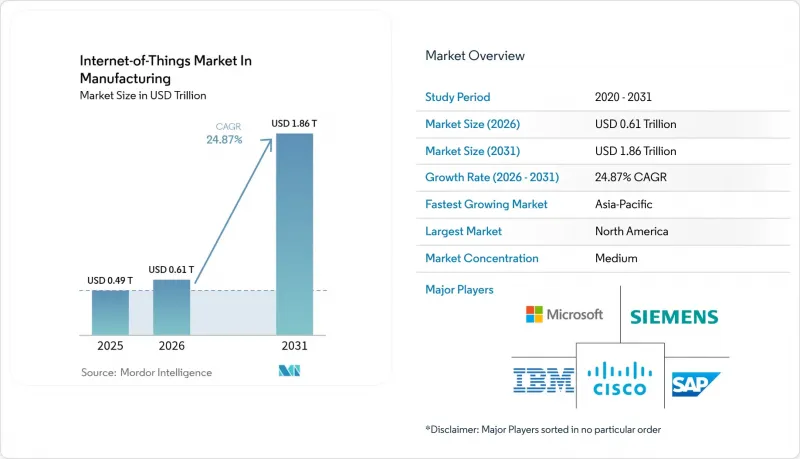
Mordor Intelligence에 의하면, 제조업 IoT 시장 규모는 2025년 4,900억 달러에서 2026년에는 6,100억 달러로 확대되고, 2026-2031년 CAGR 24.87%로 성장을 지속하여 2031년에는 1조 8,600억 달러에 이를 것으로 예측됩니다.
본 보고서는 구성 요소(하드웨어, 소프트웨어, 서비스), 연결 기술(유선 및 무선), 배포 모델(On-Premise, 클라우드 등), 용도(예지보수, 자산 성능 및 OEE 최적화 등), 최종 사용자 산업(자동차 및 전기차 제조, 전자 및 반도체 등), 지역별로 분류되어 있습니다.
전 세계 제조업의 IoT 시장 동향 및 인사이트
독일 및 일본의 개별 생산 공장에서의 프라이빗 5G 및 LPWAN 도입
프라이빗 5G 및 LPWAN 네트워크 도입으로 독일과 일본의 생산 현장은 혁신을 이루고 있습니다. 패킷의 99.99%에서 10밀리초 미만의 지연 시간이 실현되어 시간적 제약이 엄격한 로봇 셀이 지원되는 한편, 네트워크 슬라이싱을 통해 품질 검사용 카메라에 대해 결정론적인 성능이 보장되고 있습니다. 5G 테스트베드를 도입한 각 자동차 제조업체는 예측 유지보수 및 자동 재가공 루프 덕분에 생산성이 최대 245% 향상되고 운영 비용이 최대 90% 절감되었다고 보고하고 있습니다. 프라이빗 네트워크에 연결된 엣지 서버를 통해 현장에서의 분석이 가능해져 클라우드로의 왕복 통신이 불필요해질 뿐만 아니라 데이터 주권도 유지됩니다.
EU·미국의 디지털 추적성 규제가 센서 도입 촉진
EU의 ‘디지털 제품 여권’ 및 이에 준하는 미국의 규제에서는 모든 산업 제품에 대해 일련번호가 포함된 수명 주기 데이터의 제공이 의무화되어 있습니다. 각 제조업체는 원산지, 구성, 공정 매개변수를 자동으로 기록하기 위해 IoT 센서를 탑재하고 있습니다. 선행 도입 기업에서는 거점 간 실시간 자재 흐름을 가시화할 수 있어, 예기치 못한 가동 중단이 25% 감소하고 재고를 30% 줄이는 데 성공했습니다. 규정 준수에 그치지 않고, 이 동일한 인프라는 지속적인 개선 대시보드에도 활용되어 병목 현상을 가시화하고 즉시 시정 조치를 취할 수 있게 됩니다.
인도 레거시 공장의 IPv4 주소 고갈
브라운필드 시설은 새로운 장치의 급증에 대응할 수 없는 구식 제어 시스템에 의존하고 있습니다. IPv4 주소 블록은 고갈되었으며, IPv6으로의 업그레이드에는 펌웨어, 교육, 가동 중단 시간 보상을 포함해 대기업 1곳당 평균 240만 달러의 비용이 소요됩니다. 이러한 비용과 통합상의 장벽으로 인해, 인도의 급성장하는 제조업 회랑에서 센서의 광범위한 도입이 지연되고 있습니다.
부문 분석
2025년 기준, 소프트웨어는 제조업 내 IoT 시장 점유율의 50.60%를 차지하며, 원시 데이터의 센서 스트림을 실행 가능한 권고 사항으로 변환하는 인텔리전스 계층으로서의 역할을 계속 수행하고 있습니다. 공장에서는 수천 개에 달하는 이종 노드에 대한 안전한 온보딩, 펌웨어 업데이트 및 정책 적용이 필요하기 때문에 디바이스 관리 플랫폼이 주류를 이루고 있습니다. 분석 엔진은 고장 예측, 자산 성능에 대한 인사이트력, 적응형 공정 제어에 대한 수요를 반영하여 가장 빠르게 성장하는 틈새 시장을 형성하고 있습니다. 2026-2031년 서비스 매출은 연평균 성장률(CAGR) 22.95%를 기록하며, 하드웨어 및 소프트웨어 매출을 모두 상회할 것으로 전망됩니다. 이는 통합 업체가 복잡한 개조 공사 및 교육 프로그램을 총괄하기 때문입니다. 게이트웨이와 산업용 PC는 여전히 엣지 계층의 기반을 이루고 있지만, 센서의 단가는 지속적으로 하락하고 있어 새로운 계측 지점의 개척으로 이어지고 있습니다. 물리적 감지 및 구동에는 하드웨어가 필수적이지만, 투자의 초점은 유연한 구독형 소프트웨어 스택으로 이동하고 있습니다.
시스템 통합사업자들은 현재 단일 통합 제품군 대신, 광범위한 생태계에서 조달한 조합 가능한 빌딩 블록을 결합하고 있습니다. 이러한 변화로 인해 상호 운용성이 향상되고, 개념 증명(PoC)의 배포가 가속화되고 있습니다. 디바이스 수가 증가함에 따라 공격 표면도 확대되므로, 새로운 소프트웨어가 출시될 때마다 사이버 보안 모듈이 번들로 제공됩니다. 제조업체들은 24시간 365일 모니터링 및 제로데이 패치 적용을 관리형 서비스 파트너에 점점 더 의존하고 있으며, 정기적인 소프트웨어 사용료와 회선 가용성 보장이 더욱 밀접하게 연계되고 있습니다.
2025년에는 무선 통신이 커넥티비티 매출의 63.40%를 차지할 전망입니다. 그중에서도 5G는 연평균 성장률(CAGR) 37.8%로 급성장할 것으로 예측됩니다. 이는 1 Gb/s의 처리량, 10밀리초 미만의 지연 시간, 네트워크 슬라이싱을 모두 갖추고 있어 머신 비전, 이동 로봇, AR을 활용한 유지보수를 지원하기 때문입니다. NB-IoT나 LoRaWAN과 같은 LPWAN 기술은 에너지 제약이 있는 센서가 킬로미터 규모의 범위에서 소용량 패킷을 전송해야 하는 요구를 충족시킵니다. 전자기 간섭이 심한 장소나 결정론적 동작이 필수적인 상황에서는 유선 백본이 여전히 중요한 역할을 하고 있으며, TSN으로의 업그레이드를 통해 표준 이더넷이 마이크로초 단위의 동기화를 실현합니다. 동일한 플랜트 내에서 5G와 결정론적 이더넷이 공존함으로써, 배선을 중복시키지 않고 계층화된 서비스 수준을 실현할 수 있습니다.
단거리 블루투스 LE 모듈은 비용이 매우 저렴하며, 공구 식별 태그나 작업자의 위치 정보 서비스와 같은 특수한 역할을 담당하고 있습니다. 새롭게 등장하고 있는 5G-TSN 융합 프로파일은 모션 제어 루프와 클라우드 백홀을 모두 단일 네트워크로 커버할 것을 약속하며, 이는 스위치 캐비닛의 간소화로 이어집니다. 그러나 반도체 부족과 인증 대기 문제로 인해 이러한 첨단 칩의 도입이 지연되고 있으며, 공급 부족 시 기존 프로토콜로 전환할 수 있는 멀티패스 아키텍처의 중요성이 부각되고 있습니다.
지역별 분석
북미는 2025년 제조업 IoT 시장 매출의 32.95%를 차지했습니다. 조기 도입, 견고한 산업용 IT 생태계, 그리고 자동화에 대한 세제 혜택이 도입을 뒷받침하고 있습니다. 미국의 공장에서는 숙련된 노동력 부족을 보완하고, 국내로 복귀한 생산 라인을 되찾기 위해 IoT를 도입하고 있습니다. OEM 기업들은 사용량 기반 렌탈 모델을 지원하기 위해 계측 하드웨어를 통합하는 경향이 강해지고 있으며, 이를 통해 공급업체와 고객 간의 유대를 강화하는 동시에 현금 흐름을 원활하게 하고 있습니다.
아시아태평양은 2026년부터 2031년까지 연평균 성장률(CAGR) 25.18%를 나타낼 것으로 예측되며, 이는 세계에서 가장 빠른 속도입니다. 중국은 전국 규모의 스마트 제조 단지에 자금을 투입하고 있는 반면, 일본은 인구 감소에도 불구하고 생산량을 유지하기 위해 5G와 로봇 공학을 융합하고 있습니다. 인도의 디지털 팩토리 프로그램은 진전을 보이고 있지만, 기존 시설(브라운필드)에서 IPv4 주소 고갈로 인해 합리적인 가격의 IPv6 게이트웨이가 등장할 때까지는 하이퍼스케일 구축 속도가 둔화되고 있습니다. 한국은 자국의 통신 인프라를 활용하여, 하이엔드 전자기기 생산 라인에서 5G 대응 협동 로봇 및 AI를 활용한 품질 관리 시범 운영을 추진하고 있습니다. 유럽은 독일의 ‘인더스트리 4.0’, 프랑스의 ‘알리앙스 인더스트리 뒤 퓨처’, 이탈리아의 ‘트랜지션 4.0’과 같은 인센티브 제도가 설비 갱신을 위한 공동 자금 조달을 수행함으로써 여전히 큰 점유율을 유지하고 있습니다. EU의 ‘디지털 제품 여권’ 요건에 따라 센서 네트워크를 통해 재료의 출처 정보를 파악하는 것이 의무화되어 있습니다. 현지 벤더들은 디지털 주권을 보호하고 EU 외부 클라우드에 대한 의존도를 낮추는 개방형 아키텍처 플랫폼을 추진하고 있습니다. 북유럽 국가들은 에너지 효율이 높은 운영을 우선시하는 반면, 남유럽 국가들은 부흥 자금을 자동화 현대화에 투입하고 있습니다. 중동에서는 사우디아라비아와 UAE가 주도하여 캠퍼스 전역에 프라이빗 5G를 구축한 첨단 제조 구역으로의 다각화 계획을 추진하고 있습니다. 아프리카에서는 남아프리카공화국이 통신 환경이 안정적인 지역에서 스마트 플랜트 개조를 시범적으로 실시하고 있으며, 이는 주변 국가들에게 선례가 되고 있습니다.
기타 혜택:
- 엑셀 형식 시장 예측(ME) 시트
- 3개월간의 애널리스트 지원
자주 묻는 질문
목차
제1장 서론
제2장 조사 방법
제3장 주요 요약
제4장 시장 구도
제5장 시장 규모와 성장 예측
제6장 경쟁 구도
제7장 시장 기회와 향후 전망
KTH 26.08.06According to Mordor Intelligence, the internet of Things in the manufacturing market size is expected to grow from USD 0.49 trillion in 2025 to USD 0.61 trillion in 2026 and is forecast to reach USD 1.86 trillion by 2031 at 24.87% CAGR over 2026-2031.
This report is Segmented by Component (Hardware, Software, and Services), Connectivity Technology (Wires and Wireless), Deployment Model (On-Premise, Cloud, and More), Application (Predictive Maintenance, Asset Performance and OEE Optimisation, and More), End-User Vertical (Automotive and EV Manufacturing, Electronics and Semiconductors, and More), and Geography
Global Internet-of-Things in Manufacturing Market Trends and Insights
Private 5G and LPWAN roll-outs in German and Japanese discrete factories
The introduction of private 5G and LPWAN networks is transforming production floors in Germany and Japan. Latency below 10 ms for 99.99% of packets supports time-critical robotic cells, while network slicing guarantees deterministic performance for quality-inspection cameras. Automotive manufacturers adopting 5G testbeds report productivity jumps of up to 245% and operating-cost cuts of as much as 90% thanks to predictive maintenance and automated re-work loops. Edge servers attached to the private networks enable on-site analytics, removing cloud round-trips and maintaining data sovereignty.
EU/US digital-traceability mandates driving sensor adoption
The EU Digital Product Passport and comparable US rules require serialised, life-cycle data for every industrial good. Manufacturers are embedding IoT sensors to log provenance, composition, and process parameters automatically. Early movers achieve 25% fewer unplanned stoppages and 30% leaner inventory because live material flow is visible across sites.Beyond compliance, the same infrastructure feeds continuous-improvement dashboards that expose bottlenecks for immediate remediation.
IPv4 address exhaustion in legacy Indian plants
Brownfield facilities rely on outdated control systems that cannot accommodate the flood of new devices. IPv4 blocks are depleted, and IPv6 upgrades cost on average USD 2.4 million per large enterprise, including firmware, training, and downtime allowances. These expenses and integration hurdles delay broad-scale sensor roll-outs in India's fast-growing manufacturing corridor.
Other drivers and restraints analyzed in the detailed report include:
- Equipment-as-a-Service models requiring embedded IoT metering
- Workforce-safety wearables mandated in Australia and Canada
- Shortage of TSN-certified chipsets for retrofit Ethernet
For complete list of drivers and restraints, kindly check the Table Of Contents.
Segment Analysis
Software held 50.60% of the Internet of Things in manufacturing market share in 2025 and remains the intelligence layer that converts raw sensor streams into actionable recommendations. Device-management platforms dominate because factories need secure onboarding, firmware updates, and policy enforcement for thousands of heterogeneous nodes. Analytics engines form the fastest-growing niche, reflecting demand for failure prediction, asset performance insights, and adaptive process controls. Services revenue is set to outpace both hardware and software with a 22.95% CAGR from 2026-2031, as integrators orchestrate complex retrofits and training programs. Gateways and industrial PCs still underpin the edge tier, while sensor unit prices continue to decline and unlock new measurement points.Hardware remains indispensable for physical sensing and actuation, yet the investment focus is shifting toward flexible subscription-based software stacks.
System integrators now assemble composable building blocks sourced from broad ecosystems rather than monolithic suites. That shift improves interoperability and accelerates proof-of-concept deployments. Cybersecurity modules are bundled with every new software drop because attack surfaces grow with device counts. Manufacturers increasingly rely on managed-service partners for 24/7 monitoring and zero-day patching, tightening the link between recurring software fees and guaranteed line availability.
Wireless links captured 63.40% of connectivity revenue in 2025. Within the basket, 5G is forecast to surge at a 37.8% CAGR because its blend of 1 Gb/s throughput, sub-10 ms latency, and network slicing supports machine vision, mobile robots, and AR-assisted maintenance. LPWAN variants such as NB-IoT and LoRaWAN address energy-constrained sensors that transmit small packets at kilometre-scale range. The wired backbone keeps a firm role where electromagnetic interference is high or deterministic behaviour is mandatory; TSN upgrades extend standard Ethernet to micro-second synchronisation.The coexistence of 5G and deterministic Ethernet inside the same plant enables tiered service levels without duplicated cabling.
Short-range Bluetooth LE modules cost pennies and fill specialised roles like tool-identification tags or operator location services. Emerging 5G-TSN convergence profiles promise single-network coverage for both motion-control loops and cloud back-haul, simplifying switch cabinets. Yet silicon shortages and certification queues slow adoption of these advanced chips, highlighting the importance of multi-path architectures that can fall back to legacy protocols during supply crunches.
Complete Report Scope:
- By Component
- Hardware
- Sensors and Actuators
- RFID and BLE Tags
- Industrial Gateways and Edge Devices
- PLCs and Industrial PCs
- Software
- Device and Network Management
- Data Management and Analytics
- Application Security
- Services
- Professional Consulting
- System Integration and Deployment
- Managed Services
- Hardware
- By Connectivity Technology
- Wired
- Industrial Ethernet (Profinet, EtherCAT, Modbus-TCP)
- Time-Sensitive Networking (TSN)
- Wireless
- Wi-Fi 6/6E
- Cellular (4G/LTE, 5G)
- LPWAN (NB-IoT, Cat-M, LoRa)
- Short-Range (Bluetooth LE, Zigbee)
- Satellite and High-Altitude Platforms
- Wired
- By Deployment Model
- On-Premise
- Cloud
- Hybrid / Edge-Cloud
- By Application
- Predictive Maintenance
- Asset Performance and OEE Optimisation
- Process and Energy Optimisation
- Workforce and Safety Management
- Supply-Chain and Logistics Visibility
- Quality and Compliance Analytics
- By End-User Vertical
- Automotive and EV Manufacturing
- Electronics and Semiconductors
- Food, Beverage and FMCG
- Chemicals and Materials
- Heavy Machinery and Industrial Equipment
- Pharmaceuticals and Life-Sciences
- Metals and Mining
- Others (Textiles, Pulp and Paper, etc.)
- By Geography
- North America
- United States
- Canada
- South America
- Brazil
- Argentina
- Rest of South America
- Europe
- Germany
- United Kingdom
- France
- Italy
- Spain
- Rest of Europe
- Middle East
- UAE
- Saudi Arabia
- South Africa
- Asia Pacific
- China
- Japan
- India
- South Korea
- Rest of Asia Pacific
- North America
Geography Analysis
North America generated 32.95% of 2025 revenue for the Internet of Things in manufacturing market. Early adoption, strong industrial IT ecosystems, and tax incentives for automation propel deployments. US factories deploy IoT to offset skilled-labor shortages and to reclaim reshored product lines. OEMs increasingly integrate metering hardware to support usage-based rental models, deepening supplier-customer ties while smoothing cash-flow.
Asia Pacific is projected to grow at a 25.18% CAGR from 2026-2031, the fastest worldwide. China funds nationwide smart-manufacturing parks, while Japan blends 5G with robotics to maintain output despite demographic decline. India's digital-factory programs advance, yet IPv4 exhaustion in brownfield sites slows hyperscale roll-outs until affordable IPv6 gateways arrive. South Korea leverages its telecom infrastructure to pilot 5G-enabled cobots and AI-powered quality control on high-end electronics lines.Europe maintains a sizable share as Germany's Industrie 4.0, France's Alliance Industrie du Futur, and Italy's Transition 4.0 incentives co-finance upgrades. The EU Digital Product Passport requirement compels sensor networks to capture materials genealogy. Local vendors champion open-architecture platforms that protect digital sovereignty and reduce dependence on non-EU clouds. Nordics prioritize energy-efficient operations, while Southern Europe channels recovery funds into automation modernisation. The Middle East, led by Saudi Arabia and the UAE, channels diversification plans into advanced manufacturing zones equipped with campus-wide private 5G. In Africa, South Africa pilots smart-plant retrofits where connectivity is stable, setting precedents for neighbouring economies.
- Cisco Systems Inc.
- Siemens AG
- IBM Corporation
- Microsoft Corporation
- SAP SE
- PTC Inc.
- Schneider Electric SE
- Honeywell International Inc.
- Rockwell Automation Inc.
- Bosch Rexroth AG
- ABB Ltd.
- GE Digital (General Electric)
- Emerson Electric Co.
- Mitsubishi Electric Corp.
- Hitachi Vantara LLC
- Huawei Technologies Co. Ltd.
- Advantech Co. Ltd.
- Fanuc Corp.
- Hexagon AB
- Dassault Systemes SE
- Oracle Corp.
- Fujitsu Ltd.
- Yokogawa Electric Corp.
- Zebra Technologies Corp.
Additional Benefits:
- The market estimate (ME) sheet in Excel format
- 3 months of analyst support
TABLE OF CONTENTS
1 INTRODUCTION
- 1.1 Study Assumptions and Market Definition
- 1.2 Scope of the Study
2 RESEARCH METHODOLOGY
3 EXECUTIVE SUMMARY
4 MARKET LANDSCAPE
- 4.1 Market Overview
- 4.2 Market Drivers
- 4.2.1 Private 5G and LPWAN Roll-outs in German and Japanese Discrete Factories
- 4.2.2 EU/US Digital-Traceability Mandates Driving Sensor Adoption
- 4.2.3 Equipment-as-a-Service Models Requiring Embedded IoT Metering (N. America)
- 4.2.4 Workforce-Safety Wearables Mandated in Australia and Canada
- 4.2.5 Edge-cloud Hybrid Analytics for Real-time Decision-making
- 4.2.6 Digital-twin Integration for Process Optimization
- 4.3 Market Restraints
- 4.3.1 IPv4 Address Exhaustion in Legacy Indian Plants
- 4.3.2 Shortage of TSN-Certified Chipsets for Retrofit Ethernet
- 4.3.3 Integration Complexity with Aging Control Systems
- 4.3.4 Skills Gap in Advanced Industrial Analytics
- 4.4 Value Chain Analysis
- 4.5 Regulatory and Technological Outlook
- 4.6 Porter's Five Forces Analysis
- 4.6.1 Bargaining Power of Suppliers
- 4.6.2 Bargaining Power of Buyers
- 4.6.3 Threat of New Entrants
- 4.6.4 Threat of Substitutes
- 4.6.5 Intensity of Competitive Rivalry
5 MARKET SIZE AND GROWTH FORECASTS (VALUE)
- 5.1 By Component
- 5.1.1 Hardware
- 5.1.1.1 Sensors and Actuators
- 5.1.1.2 RFID and BLE Tags
- 5.1.1.3 Industrial Gateways and Edge Devices
- 5.1.1.4 PLCs and Industrial PCs
- 5.1.2 Software
- 5.1.2.1 Device and Network Management
- 5.1.2.2 Data Management and Analytics
- 5.1.2.3 Application Security
- 5.1.3 Services
- 5.1.3.1 Professional Consulting
- 5.1.3.2 System Integration and Deployment
- 5.1.3.3 Managed Services
- 5.1.1 Hardware
- 5.2 By Connectivity Technology
- 5.2.1 Wired
- 5.2.1.1 Industrial Ethernet (Profinet, EtherCAT, Modbus-TCP)
- 5.2.1.2 Time-Sensitive Networking (TSN)
- 5.2.2 Wireless
- 5.2.2.1 Wi-Fi 6/6E
- 5.2.2.2 Cellular (4G/LTE, 5G)
- 5.2.2.3 LPWAN (NB-IoT, Cat-M, LoRa)
- 5.2.2.4 Short-Range (Bluetooth LE, Zigbee)
- 5.2.3 Satellite and High-Altitude Platforms
- 5.2.1 Wired
- 5.3 By Deployment Model
- 5.3.1 On-Premise
- 5.3.2 Cloud
- 5.3.3 Hybrid / Edge-Cloud
- 5.4 By Application
- 5.4.1 Predictive Maintenance
- 5.4.2 Asset Performance and OEE Optimisation
- 5.4.3 Process and Energy Optimisation
- 5.4.4 Workforce and Safety Management
- 5.4.5 Supply-Chain and Logistics Visibility
- 5.4.6 Quality and Compliance Analytics
- 5.5 By End-User Vertical
- 5.5.1 Automotive and EV Manufacturing
- 5.5.2 Electronics and Semiconductors
- 5.5.3 Food, Beverage and FMCG
- 5.5.4 Chemicals and Materials
- 5.5.5 Heavy Machinery and Industrial Equipment
- 5.5.6 Pharmaceuticals and Life-Sciences
- 5.5.7 Metals and Mining
- 5.5.8 Others (Textiles, Pulp and Paper, etc.)
- 5.6 By Geography
- 5.6.1 North America
- 5.6.1.1 United States
- 5.6.1.2 Canada
- 5.6.2 South America
- 5.6.2.1 Brazil
- 5.6.2.2 Argentina
- 5.6.2.3 Rest of South America
- 5.6.3 Europe
- 5.6.3.1 Germany
- 5.6.3.2 United Kingdom
- 5.6.3.3 France
- 5.6.3.4 Italy
- 5.6.3.5 Spain
- 5.6.3.6 Rest of Europe
- 5.6.4 Middle East
- 5.6.4.1 UAE
- 5.6.4.2 Saudi Arabia
- 5.6.4.3 South Africa
- 5.6.5 Asia Pacific
- 5.6.5.1 China
- 5.6.5.2 Japan
- 5.6.5.3 India
- 5.6.5.4 South Korea
- 5.6.5.5 Rest of Asia Pacific
- 5.6.1 North America
6 COMPETITIVE LANDSCAPE
- 6.1 Market Concentration
- 6.2 Strategic Moves and MandA
- 6.3 Market Share Analysis
- 6.4 Company Profiles (includes Global level Overview, Market level overview, Core Segments, Financials, Strategic Info, Market Rank/Share, Products and Services, Recent Developments)
- 6.4.1 Cisco Systems Inc.
- 6.4.2 Siemens AG
- 6.4.3 IBM Corporation
- 6.4.4 Microsoft Corporation
- 6.4.5 SAP SE
- 6.4.6 PTC Inc.
- 6.4.7 Schneider Electric SE
- 6.4.8 Honeywell International Inc.
- 6.4.9 Rockwell Automation Inc.
- 6.4.10 Bosch Rexroth AG
- 6.4.11 ABB Ltd.
- 6.4.12 GE Digital (General Electric)
- 6.4.13 Emerson Electric Co.
- 6.4.14 Mitsubishi Electric Corp.
- 6.4.15 Hitachi Vantara LLC
- 6.4.16 Huawei Technologies Co. Ltd.
- 6.4.17 Advantech Co. Ltd.
- 6.4.18 Fanuc Corp.
- 6.4.19 Hexagon AB
- 6.4.20 Dassault Systemes SE
- 6.4.21 Oracle Corp.
- 6.4.22 Fujitsu Ltd.
- 6.4.23 Yokogawa Electric Corp.
- 6.4.24 Zebra Technologies Corp.
7 MARKET OPPORTUNITIES AND FUTURE OUTLOOK
- 7.1 White-space and Unmet-need Assessment


