

|
시장보고서
상품코드
2097111
미국의 건설용 에폭시 접착제 : 시장 점유율 분석, 업계 동향과 통계, 성장 예측(2026-2031년)American Epoxy Adhesives for Construction - Market Share Analysis, Industry Trends & Statistics, Growth Forecasts (2026 - 2031) |
||||||
 Mordor Intelligence
Mordor Intelligence에 의하면, 2026년 미국의 건설용 에폭시 접착제 시장 규모는 2억 6,288만 달러로 추정되고 있어 2025년 2억 4,873만 달러에서 2031년에는 3억 4,672만 달러에 이를 것으로 예측됩니다.
또한, 2026년부터 2031년까지의 연평균 성장률(CAGR)은 5.69%를 나타낼 전망입니다.
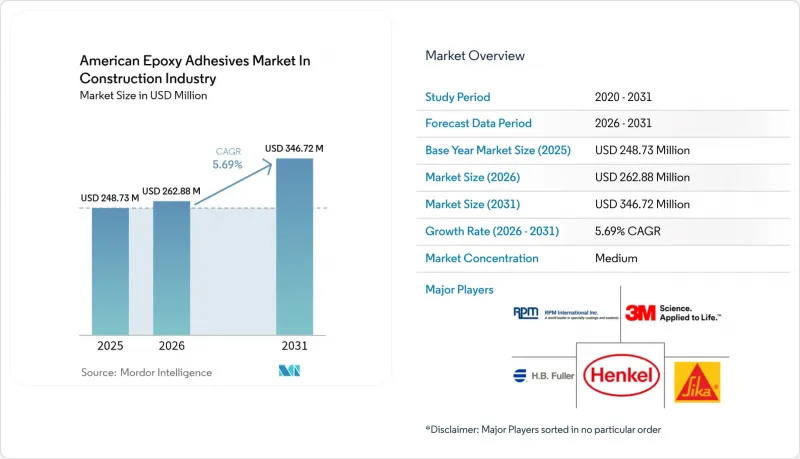
본 보고서는 제품 유형(1액형 및 이액형), 기술(반응형, 용제계 등), 최종 사용자용도(주거용 및 상업용), 그리고 지역(북미(미국, 캐나다, 멕시코) 및 남미 (브라질, 아르헨티나, 칠레, 기타 남미 국가들))별로 분류되어 있습니다. 시장 전망은 금액(달러) 기준으로 제시되어 있습니다.
미국의 건설용 에폭시 접착제 시장 동향 및 인사이트
미국 전역의 인프라 주도 건설 붐
인프라 투자로 인해 미국의 건설용 에폭시 접착제 시장은 더욱 고성능의 배합으로 나아가고 있습니다. '미국 인프라 투자 및 고용법'에서는 도로 및 교량 개보수에 막대한 자금이 배정되어 있으며, 데크 전체 교체보다 에폭시 주입 공법이 우선시됨에 따라 미세한 균열에 침투하는 저점도 수지에 대한 수요가 증가하고 있습니다. 캐나다의 ‘Investing in Canada Infrastructure Program’에서는 구조용 에폭시로 접착된 조립식 모듈의 사용이 의무화된 교통 프로젝트에 자금이 지원되고 있습니다. 남미에서는 미국개발은행(IDB)의 자금 지원을 받는 컨세션 사업에서 부식성 토양 속의 터빈 기초나 파이프라인 접합부에 에폭시 그라우트가 사용되고 있습니다. 프로젝트가 온대 기후에서 적도 기후로 이동함에 따라, 배합 개발자는 고온 환경에서의 타설에 대응하기 위해 사용 온도 범위를 넓히고 포트 라이프를 연장해야 합니다. 작업 시간의 연장은 대규모 교량 슬래브 타설 시 폐기물을 최소화하고, 접착 신뢰성을 유지하면서 공사의 경제성을 향상시킵니다.
조립식 및 모듈식 건축 시스템의 급속한 보급
공장 관리 환경 하에서 로봇을 이용한 정밀한 비드 형상 도포가 가능해짐에 따라, 프리캐스트 공법이 미국의 건설용 에폭시 접착제 시장의 성장을 주도하고 있습니다. 2024년에는 미국 내 모듈러 주택 착공 건수가 증가했습니다. 이러한 주택에는 120°C에서 경화되는 1액형 필름 접착제가 사용되어, 현장에서의 혼합 실수 위험을 제거하고 있습니다. 시카(Seeka)사의 2024년 연차 보고서에 따르면, 텍사스주 및 온타리오주의 주요 제조업체와의 제휴에 힘입어 프리팹 관련 접착제 매출이 증가하고 있습니다. 공장의 자동화로 사이클 타임은 단축되지만, 택트 타임의 리듬에 동기화되는 예측 가능한 경화 프로파일을 갖춘 에폭시 수지도 요구됩니다. 공급업체는 모듈 제조업체와 공동 개발을 진행하고, 운송 시의 진동이나 크레인에 의한 인양 하중 하에서 접합부를 검증함으로써 재주문을 확보해야 합니다.
비스페놀 A 및 에피클로로히드린 원자재 가격 변동
2024년, 아시아 지역의 비스페놀 A 가격은 큰 변동을 보였습니다. 한편, 미국 멕시코만 연안 지역에서는 프로파일렌 공급 부족을 배경으로 에피클로로히드린의 계약 가격이 상승했습니다. 이러한 에피클로로히드린 가격의 급등은 60일간공급 계약에 묶여 있는 배합 제조업체의 이익률에 압박을 가하고 있습니다. 다우 케미칼은 2024년 4분기 에폭시 수지의 수익성이 하락했으나, 그 원인으로 판매 가격 상승을 상회하는 원료 가격 급등을 꼽고 있습니다. 이에 대응하여 대형 제조업체들은 업스트림 공정으로의 통합을 추진하거나, 다년에 걸친 인수 계약을 체결하고 있습니다. 한편, 틈새 시장 업체들은 바이오 수지 시장으로의 진출을 추진하고 있습니다. 이러한 수지는 가격이 높은 편이며, 석유화학제품 가격 변동에 대한 완충재 역할을 합니다. 시장에서 지속되는 변동성으로 인해 운전 자금 수요는 높은 수준을 유지하고 있습니다. 그 결과, 소규모 신규 진출기업의 위험 감수 능력이 제한되면서 미국의 건설용 에폭시 접착제 시장의 연평균 성장률(CAGR)은 소폭 둔화되고 있습니다.
부문 분석
2025년에는 2액형 에폭시가 매출의 66.78%를 차지했습니다. 이러한 우위는 상온 경화성과 25 MPa를 초과하는 중첩 전단 강도에 의해 뒷받침되며, 교량 오버레이 및 커튼월 고정 시 필수적인 요소로 자리매김하고 있습니다. 시공업체 측은 실패로 인한 비용이 인건비 추가분을 훨씬 상회하기 때문에 혼합 작업의 부담을 스스로 감수하고 있습니다. 한편, 1액형 에폭시는 잠복형 촉매를 통해 패널 프레스 오븐과 통합 가능한 공장용 경화 일정이 실현됨에 따라 연평균 성장률(CAGR) 6.08%로 시장을 확대되고 있습니다. 헨켈의 'Loctite EA 9497' 필름용 접착제를 통해 온타리오주의 모듈식 건축업체들은 계량 펌프를 사용하지 않고도 철골 프레임을 접착할 수 있게 되어, 현장에서 흔히 발생하는 실수를 방지하고 있습니다. 습기 경화형 및 냉동 프리믹스 제품은 콜드체인 물류나 강도 발현이 느린 점으로 인해 보급이 제한되는 틈새 시장에서 역할을 하고 있습니다.
1액형 시스템은 간단한 카트리지 도포만으로도 적용이 가능한 주택 건설업체에게 매력적이지만, 경화 온도가 높기 때문에 현재는 온도가 제어되는 공장이나 따뜻한 계절로 사용이 제한되고 있습니다. 알케마(Arkema)사의 90°C에서 경화되는 에폭시 수지는 교차 적층 목재(CLT) 생산 라인을 대상으로 하며, 온도를 낮춤으로써 현장에서의 활용 범위가 확대될 것임을 시사하고 있습니다. 앞으로 자동화 및 조립식 건축의 보급으로 인해 2031년까지 2액형 제품 시장 점유율이 몇 퍼센트 포인트 하락할 것으로 예측됩니다. 이는 미국의 건설용 에폭시 접착제 시장이 신뢰성과 공정 편의성을 겸비한 열활성형 및 필름형으로 전환되고 있기 때문입니다.
기타 혜택:
- 엑셀 형식 시장 예측(ME) 시트
- 3개월간의 애널리스트 지원
자주 묻는 질문
목차
제1장 서론
제2장 조사 방법
제3장 주요 요약
제4장 시장 구도
제5장 시장 규모와 성장 예측
제6장 경쟁 구도
제7장 시장 기회와 향후 전망
KTH 26.08.06According to Mordor Intelligence, the american epoxy adhesives market size in Construction Industry market size in 2026 is estimated at USD 262.88 million, growing from 2025 value of USD 248.73 million with 2031 projections showing USD 346.72 million, growing at 5.69% CAGR over 2026-2031.
This report is Segmented by Product Type (One-Component and Two-Component), Technology (Reactive, Solvent-Borne, and More), End-User Application (Residential and Commercial), and Geography (North America [United States, Canada, and Mexico] and South America [Brazil, Argentina, Chile, and Rest of South America]). The Market Forecasts are Provided in Terms of Value (USD).
American Epoxy Adhesives for Construction Market Trends and Insights
Infrastructure-Led Construction Boom Across the Americas
Infrastructure spending is steering the American epoxy adhesives market toward higher-performance formulations. The U.S. Infrastructure Investment and Jobs Act allocates significant funds to road and bridge upgrades and prioritizes epoxy injection over full deck replacement, lifting demand for low-viscosity resins that penetrate micro-cracks. Canada's Investing in Canada Infrastructure Program earmarks funding for transit projects that mandate prefabricated modules bonded with structural epoxies. South American concessions funded by the Inter-American Development Bank, with epoxy grouts anchoring turbine bases and pipeline joints in corrosive soils. As projects migrate from temperate to equatorial climates, formulators must widen service-temperature windows and extend pot life to accommodate hot-weather placement. Longer open times also minimize waste in large bridge-deck pours, improving job economics while maintaining bond reliability.
Rapid Adoption of Prefabricated and Modular Building Systems
Prefabrication is propelling growth across the American epoxy adhesives market as factory-controlled environments enable robotic dispensing of precise bead geometries. U.S. modular housing starts climbed in 2024, each using one-component film adhesives that cure at 120 °C and remove the risk of on-site mixing errors. Sika's 2024 annual report shows prefab-related adhesive sales rising, supported by partnerships with volumetric manufacturers in Texas and Ontario. Factory automation shortens cycle time, but it also demands epoxies with predictable cure profiles that synchronize with takt-time rhythms. Suppliers must co-develop with module builders, validating joints under shipping vibration and crane-lift loads to win repeat business.
Volatility in Bisphenol-A and Epichlorohydrin Raw-Material Prices
In 2024, Bisphenol-A prices in Asia experienced significant swings. Meanwhile, contracts for epichlorohydrin on the U.S. Gulf Coast rose, driven by tight propylene supplies. This surge in epichlorohydrin prices has put pressure on margins for formulators bound by 60-day supply contracts. Dow Chemical, in Q4 2024, faced a decline in epoxy-resin profitability, attributing it to feedstock inflation outpacing increases in selling prices. In response, major producers are either backward-integrating or entering into multiyear offtake agreements. On the other hand, niche players are venturing into bio-based resins. These resins, though pricier, offer a buffer against fluctuations in petrochemical prices. The ongoing volatility in the market is keeping working capital requirements elevated. This, in turn, is tempering the risk appetite of smaller entrants, leading to a slight deceleration in the CAGR of the American epoxy adhesives market.
Other drivers and restraints analyzed in the detailed report include:
- Shift from Mechanical Fastening to High-Performance Bonding
- 3-D Concrete Printing Requiring Structural Epoxy Formulations
- Stringent VOC and Chemical-Exposure Regulations in the United States and Canada
For complete list of drivers and restraints, kindly check the Table Of Contents.
Segment Analysis
Two-component epoxies controlled 66.78% of revenue in 2025, a dominance underpinned by ambient-temperature cure and greater than 25 MPa lap-shear strength, making them indispensable for bridge overlays and curtain-wall anchoring. Contractors absorb the mixing burden because failure costs dwarf labor premiums. However, one-component grades are expanding at a 6.08% CAGR as latent catalysts deliver factory-friendly cure schedules that integrate with panel-press ovens. Henkel's Loctite EA 9497 film adhesive allows Ontario modular builders to bond steel frames without metering pumps, eliminating common field errors. Moisture-cure and frozen pre-mix products occupy niche roles where cold-chain logistics or slow strength development limit broader uptake.
One-component systems appeal to residential builders needing simple cartridge application, though elevated cure temperatures currently confine them to climate-controlled plants or warm seasons. Arkema's 90 °C cure epoxy targets cross-laminated timber production lines, demonstrating how temperature reductions can unlock broader field usage. Looking ahead, automation and prefab adoption are expected to shave some percentage points from the two-component share by 2031 as the American epoxy adhesives market shifts toward heat-activated or film formats that merge reliability with process simplicity.
Complete Report Scope:
- By Product Type
- One-Component
- Two-Component
- By Technology
- Reactive
- Solvent-borne
- UV Cured Adhesives
- Water-borne
- By End-User Application
- Residential
- Commercial
- By Geography
- North America
- United States
- Canada
- Mexico
- South America
- Brazil
- Argentina
- Chile
- Rest of South America
- North America
List of Companies Covered in this Report:
- 3M
- Arkema Group
- Ashland
- Dow
- Dymax Corporation
- H.B. Fuller Company
- Henkel AG & Co. KGaA
- Hexcel Corporation
- Hexion
- Huntsman International LLC
- ITW Performance Polymers
- Jowat SE
- MAPEI S.p.A.
- Parker Hannifin Corp
- Permabond
- RPM International Inc.
- Sika AG
- Wacker Chemie AG
Additional Benefits:
- The market estimate (ME) sheet in Excel format
- 3 months of analyst support
TABLE OF CONTENTS
1 Introduction
- 1.1 Study Assumptions and Market Definition
- 1.2 Scope of the Study
2 Research Methodology
3 Executive Summary
4 Market Landscape
- 4.1 Market Overview
- 4.2 Market Drivers
- 4.2.1 Infrastructure-led construction boom across the Americas
- 4.2.2 Rapid adoption of prefabricated and modular building systems
- 4.2.3 Shift from mechanical fastening to high-performance bonding
- 4.2.4 3-D concrete printing requiring structural epoxy formulations
- 4.2.5 Brazil's PPP tax incentives accelerating epoxy demand in civil works
- 4.3 Market Restraints
- 4.3.1 Volatility in bisphenol-A and epichlorohydrin raw-material prices
- 4.3.2 Stringent VOC/chem-exposure regulations in United States and Canada
- 4.3.3 Shortage of certified applicators for two-component systems
- 4.4 Value Chain Analysis
- 4.5 Porter's Five Forces
- 4.5.1 Bargaining Power of Suppliers
- 4.5.2 Bargaining Power of Buyers
- 4.5.3 Threat of New Entrants
- 4.5.4 Threat of Substitutes
- 4.5.5 Degree of Competition
5 Market Size and Growth Forecasts (Value)
- 5.1 By Product Type
- 5.1.1 One-Component
- 5.1.2 Two-Component
- 5.2 By Technology
- 5.2.1 Reactive
- 5.2.2 Solvent-borne
- 5.2.3 UV Cured Adhesives
- 5.2.4 Water-borne
- 5.3 By End-User Application
- 5.3.1 Residential
- 5.3.2 Commercial
- 5.4 By Geography
- 5.4.1 North America
- 5.4.1.1 United States
- 5.4.1.2 Canada
- 5.4.1.3 Mexico
- 5.4.2 South America
- 5.4.2.1 Brazil
- 5.4.2.2 Argentina
- 5.4.2.3 Chile
- 5.4.2.4 Rest of South America
- 5.4.1 North America
6 Competitive Landscape
- 6.1 Market Concentration
- 6.2 Strategic Moves
- 6.3 Market Share (%)/Ranking Analysis
- 6.4 Company Profiles (includes Global level Overview, Market level overview, Core Segments, Financials as available, Strategic Information, Market Rank/Share, Products and Services, and Recent Developments)
- 6.4.1 3M
- 6.4.2 Arkema Group
- 6.4.3 Ashland
- 6.4.4 Dow
- 6.4.5 Dymax Corporation
- 6.4.6 H.B. Fuller Company
- 6.4.7 Henkel AG & Co. KGaA
- 6.4.8 Hexcel Corporation
- 6.4.9 Hexion
- 6.4.10 Huntsman International LLC
- 6.4.11 ITW Performance Polymers
- 6.4.12 Jowat SE
- 6.4.13 MAPEI S.p.A.
- 6.4.14 Parker Hannifin Corp
- 6.4.15 Permabond
- 6.4.16 RPM International Inc.
- 6.4.17 Sika AG
- 6.4.18 Wacker Chemie AG
7 Market Opportunities and Future Outlook
- 7.1 White-space and Unmet-Need Assessment


