

|
시장보고서
상품코드
2097165
디지털 중합효소 연쇄반응 : 시장 점유율 분석, 업계 동향 및 통계, 성장 예측(2026-2031년)Digital Polymerase Chain Reaction - Market Share Analysis, Industry Trends & Statistics, Growth Forecasts (2026 - 2031) |
||||||
 Mordor Intelligence
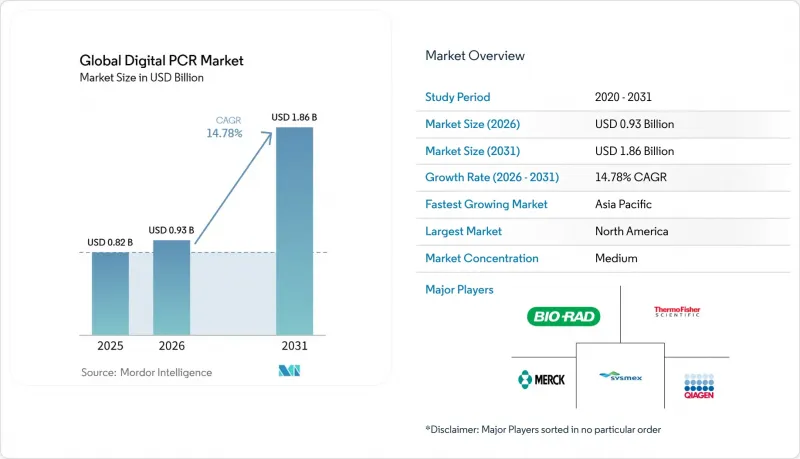
Mordor Intelligence에 의하면, 세계의 디지털 중합효소 연쇄반응 시장 규모는 2025년 8억 2,000만 달러로 평가되었습니다. 2026년에는 9억 3,000만 달러로 확대되어 2026년부터 2031년에 걸쳐 CAGR 14.78%로 성장을 지속하여, 2031년에는 18억 6,000만 달러에 이를 것으로 예측됩니다.
본 보고서는 구성 요소별(디지털 중합효소 연쇄반응 장비(드롭렛형 플랫폼 등), 소모품 및 시약, 기타), 기술별(드롭렛 디지털 중합효소 연쇄반응, 기타), 용도별(임상 진단(종양학, 기타), 연구(유전자 발현 분석, 기타), 기타), 최종 사용자별(병원 및 임상 실험실, 기타), 지역별(북미, 유럽, 기타)로 분류되어 있습니다.
세계의 디지털 중합효소 연쇄반응 시장 동향 및 인사이트
정밀 종양학이 주도하는 액체 생검 대응 분석법
디지털 중합효소 연쇄반응 플랫폼은 현재 임상적으로 활용 가능한 수준에서 순환 종양 DNA를 검출할 수 있게 되었으며, 종양 전문의는 침습적인 조직 채취 없이도 전이성 질환을 실시간으로 모니터링할 수 있게 되었습니다. 유럽의 93개 기관을 대상으로 한 다기관 공동 표준화 연구를 통해, 분석 프로토콜이 일상적인 도입에 충분한 성숙도에 도달했음이 확인되었습니다. MIT의 연구에 따르면, 프라이머를 이용한 농축법을 통해 ctDNA 신호를 60배 더 증폭할 수 있어, 위음성률을 낮추고 액체 생검 모니터링 대상 환자층을 확대할 수 있는 것으로 나타났습니다. 이러한 발전들이 결합되면서, 디지털 중합효소 연쇄반응은 탐색적 연구 도구에서 정밀 종양학 분야의 보험 적용이 가능한 1차 진단법으로 전환되고 있습니다.
절대 정량을 활용한 전 세계 AMR 감시 프로그램의 확대
각국의 공중보건 기관은 디지털 중합효소 연쇄반응을 폐수 검사 시스템에 통합하고 있습니다. 이는 이 기술이 고도로 희석된 환경 매트릭스 내에서도 내성균을 정량할 수 있기 때문입니다. 유럽의 컨소시엄에서는 현재 디지털 중합효소 연쇄반응과 전장 유전체 염기서열 분석을 결합한 이중 검사 파이프라인을 의무화하고 있으며, 신속한 정량에 이어 상세한 내성 프로파일링이 수행되도록 보장하고 있습니다. 호주 및 뉴질랜드의 검사 기관에서는 각 시설에서 독자적으로 개발한 qPCR 방법을 대체하여 표준화된 디지털 중합효소 연쇄반응 프로토콜이 도입된 결과, 검사 기관 간의 비교 가능성이 향상되었다고 보고되고 있습니다. 도시 하수 프로그램이 확대됨에 따라, 하루 수천 건의 검체에 대해 분석의 일관성을 유지할 수 있는 시약 카트리지에 대한 수요가 증가하고 있습니다.
높은 초기 투자 비용과 시료당 시약 비용
장비 도입 가격은 약 3만 8,000달러부터 시작되며, 연간 유지보수비, 전용 소모품, 전문 인력에 대한 교육비를 포함하면 비용은 더욱 높아집니다. 새로운 시약 번들을 통해 최대 5개의 분석을 한 번의 실행으로 통합하여 비용을 43% 절감할 수 있지만, 지역 병원에서 검사당 총 비용은 여전히 고처리량 qPCR의 2-3배를 초과하고 있습니다. 스타트업 기업들은 비용 균형을 달성하는 데 필요한 장기적인 연구개발 주기를 감당하기 위해 종종 9자리 규모의 벤처 자금을 조달하고 있으며, 이는 급속한 지역 확장을 제한하는 자본 집약성을 여실히 드러내고 있습니다. 따라서 신흥 시장에서는 공급업체가 단계적 가격 책정이나 시약 대여 제도를 도입하지 않는 한, 다목적 혈액 검사 기기나 생화학 분석 기기가 예산의 우선 대상이 됩니다.
부문 분석
2025년에는 소모품 및 시약이 매출의 대부분을 차지하며, 디지털 중합효소 연쇄반응 시장 점유율의 67.35%를 기록했습니다. 이는 정기적인 키트 구매가 공급업체의 수익성을 뒷받침하고 있기 때문입니다. 이러한 주도적인 지위는 검사실이 매일 보충해야 하는 특수한 액적 안정화 화학 물질에서 기인합니다. 규제 대상 검사에서 검증 요건을 충족하는 제네릭 대체품은 존재하지 않습니다. 폐수 역학 및 분산형 종양 센터가 다중 측정 워크플로우를 계획함에 따라 소모품 수요는 더욱 증가하고 있으며, 일괄 구매 계약이 촉진되어 공급업체의 주문 가시성이 향상되고 있습니다. 혁신도 급증하고 있습니다. 2025년에 출시된 ‘Vericheck ddPCR Empty-Full Capsid Kit’는 단일 분석으로 AAV의 두 가지 매개변수를 평가할 수 있어, 세포 치료제의 로트 릴리스 일정을 효율화하고 첨단 치료 분야에서 적용 가능한 이용 사례를 확대되고 있습니다.
소프트웨어 및 서비스 분야는 규모는 작지만, 엔드투엔드 유전체 데이터 관리를 요구하는 검사 기관에 힘입어 2031년까지 연평균 성장률(CAGR) 14.14%로 성장할 전망입니다. 검체 추적, 분석 매개변수, HIPAA 준수 결과 보고를 통합하는 클라우드 플랫폼은 대규모 On-Premise IT 투자 없이도 새로운 IVDR 데이터 무결성 규정을 준수합니다. 그 결과, 소프트웨어 구독은 공급업체에게 자본 설비 구매에 따른 경기 변동을 완화하는 안정적인 수익원을 제공합니다. 임상 현장에서는 감사 추적 기능이 FDA 21 CFR Part 11 요건을 준수함으로써 규정 준수 장벽을 낮추고, 분석법 검증 주기를 가속화합니다. 2031년까지는 장비 임대에 클라우드 분석 기능이 번들로 제공되는 형태가 표준 조달 모델이 되어, 고객 락인을 강화하는 동시에 실험실의 생산성을 향상시킬 가능성이 있습니다.
2025년, 디지털 중합효소 연쇄반응 시장에서 드롭렛 시스템은 64.78%의 매출 점유율을 유지했습니다. 이는 주로 이 방식이 최대 2만 개의 오일 캡슐화 파티션을 생성하여, 복잡한 미세 가공 없이도 통계적 정확도를 높일 수 있기 때문입니다. 선구자인 Bio-Rad사는 10년에 걸친 동료 심사 검증 연구의 성과를 활용하여 분석 성능에 대한 구매자의 우려를 해소했습니다. 산업 사용자들은 벡터 유전체, 잔류 숙주 세포 DNA 및 저사본수 바이러스 오염 물질을 정량하기 위한 간단한 드롭렛 워크플로우를 높이 평가했습니다. 그러나 이 아키텍처는 유수 유화 현상에 의존하기 때문에 소모품 비용 증가와 화학 폐기물이 발생하며, 일부 지속가능성 프로그램에서는 이를 줄여야 할 필요성이 제기되고 있습니다.
마이크로플루이딕스 칩 플랫폼은 유리나 폴리머 기판에 마이크로 챔버를 직접 가공함으로써 유분 현탁액을 배제하고, 반응당 시약 사용량을 줄여 연평균 성장률(CAGR) 15.50%를 기록할 전망입니다. 나노 소재를 이용한 코팅은 증폭 효율과 유체 제어를 향상시켜, 신용카드 크기의 카세트 내에 검체 전처리, 증폭, 판독을 통합한 현장 진단용 카트리지를 실현합니다. 또한, 이 아키텍처는 병렬 처리에도 적합합니다. 5,000-1만 개의 마이크로 리액터를 갖춘 칩은 단일 분자 수준의 감도를 유지하면서 여러 환자의 검체를 동시에 처리할 수 있습니다. 마이크로플루이딕스식 리더의 가격은 기존의 액적 생성 장치보다 약 30% 저렴하기 때문에 설비 투자 추이에 변화가 나타나고 있으며, 중소득 국가의 첫 구매자들도 도입할 수 있게 되었습니다. 액적 시스템은 여전히 대량 처리를 수행하는 종양학 연구소에서 자리 잡고 있지만, 마이크로플루이딕스 기술은 휴대성과 시료당 비용 절감을 추구하는 신규 사용자를 끌어들이고 있습니다.
지역별 분석
북미는 보험사의 환급 정책, FDA의 동반 진단 승인, 그리고 2028년까지 서모피셔사가 실시할 20억 달러 규모의 생명과학 분야 생산 능력 확대를 배경으로, 2025년에는 디지털 중합효소 연쇄반응 시장 점유율의 43.10%를 차지하며 시장을 독점했습니다. 이 지역의 대학 부속 의료 센터에서는 NIH(미국 국립보건원)의 정밀의료 보조금을 직접 장비 조달에 충당하는 한편, 민간 검사 기관에서는 대량 구매 할인을 확보하기 위해 시약 정기 발주 계약을 협상하고 있습니다. 그 결과, 각 공급업체들은 북미 규제 당국의 승인을 우선시하고 있으며, 종양학 및 이식 관련 분석법을 전 세계 출시보다 1년이나 앞서 미국 시장에 출시하고 있습니다. 이로 인해 북미 디지털 중합효소 연쇄반응 시장 규모는 예측 기간 동안 선두 자리를 유지할 것으로 전망됩니다.
아시아태평양은 18.92%라는 지역별 최고 연평균 성장률(CAGR)을 나타낼 전망입니다. 이는 중국에서 성(省) 차원에서 유전체 인프라에 자금을 지원하고, 인도에서 민간 부문이 NABL 인증 임상 실험실에 적극적으로 투자하고 있는 상황을 반영한 것입니다. 중국의 ‘건강 중국 2030’ 계획에 기반한 정책 이니셔티브에서는 첨단 분자진단 기술에 자금이 배정되고 있는 반면, 현지 제조업체들은 세계 벤더와 제휴하여 시약의 현지 생산을 추진함으로써 비용 절감을 도모하고 있습니다. 일본과 한국은 디지털 중합효소 연쇄반응을 국가 암 검진 시범 사업 및 희귀질환 신생아 선별 검사에 도입함으로써 지역 내 성장세를 뒷받침하고 있습니다. 장비와 다년간의 시약 계약을 묶은 정부 입찰을 통해, 처음으로 장비를 구매하는 사업자 시장 진입이 가속화되고 있습니다. 유럽에서는 IVDR(체외진단용 의료기기 규정)에 따라 EU 전역에서 분자진단의 성능 평가 자료가 표준화됨에 따라 꾸준한 확대가 이어지고 있습니다. 독일, 프랑스, 영국은 수요의 3대 거점으로 자리 잡고 있으며, 바이오의약품 거점이자 자금력이 탄탄한 의료 체계를 갖춘 이들 국가에서는 종양 센터나 중앙 검사실에서 디지털 중합효소 연쇄반응이 도입되고 있습니다. EU의 신흥 경제국에서는 지역 통합 정책 자금을 활용하여 진단 인프라 현대화가 진행되고 있으며, 시약 소비량을 최소화하는 마이크로플루이딕스 플랫폼이 자주 선정되고 있습니다. 한편, 중동 및 아프리카 및 남미에서는 3차 의료기관이나 공중보건 기관을 대상으로 한 시범 프로젝트를 통해 도입이 초기 단계에 있으며, 비용 장벽이 완화되면 본격적인 조달 주기로 전환될 가능성이 있습니다.
기타 혜택 :
- 엑셀 형식 시장 예측(ME) 시트
- 3개월간의 애널리스트 지원
자주 묻는 질문
목차
제1장 서론
제2장 조사 방법
제3장 주요 요약
제4장 시장 구도
제5장 시장 규모 및 성장 예측
제6장 경쟁 구도
제7장 시장 기회 및 향후 전망
KTH 26.08.05According to Mordor Intelligence, the global digital pCR market size is expected to grow from USD 0.82 billion in 2025 to USD 0.93 billion in 2026 and is forecast to reach USD 1.86 billion by 2031 at 14.78% CAGR over 2026-2031.
This report is Segmented by Component (Digital PCR Instruments [Droplet-Based Platforms, and More], Consumables and Reagents, and More), by Technology (Droplet Digital PCR, and More), by Application (Clinical Diagnostics [Oncology, and More], Research [Gene Expression Analysis, and More], and More), by End-User (Hospitals and Clinical Laboratories, and More), by Geography (North America, Europe, and More).
Global Digital Polymerase Chain Reaction Market Trends and Insights
Precision Oncology Push for Liquid Biopsy-Ready Assays
Digital PCR platforms now detect circulating-tumor DNA at clinically actionable levels, enabling oncologists to monitor metastatic disease in real time without invasive tissue sampling. Multicenter European standardization covering 93 institutions confirms that assay protocols are mature enough for routine adoption. Research from MIT indicates that primer-based enrichment can further amplify ctDNA signals by 60-fold, reducing false-negative rates and widening the eligible patient base for liquid biopsy monitoring. Together, these gains shift digital PCR from an exploratory research tool toward a reimbursable frontline diagnostic in precision oncology.
Growing Global AMR Surveillance Programs Using Absolute Quantification
National public-health agencies integrate digital PCR into wastewater-testing grids because the technology quantifies resistant organisms even in heavily diluted environmental matrices. European consortia now require dual testing pipelines that pair digital PCR with whole-genome sequencing, ensuring rapid quantification followed by detailed resistance profiling. Australian and New Zealand laboratories reported higher inter-laboratory comparability once standardized digital PCR protocols replaced lab-developed qPCR methods. As urban wastewater programs expand, demand rises for reagent cartridges that maintain analytical consistency across thousands of daily samples.
High Capital & Per-Sample Reagent Costs
Instrument entry prices start around USD 38,000 and escalate when annual maintenance, proprietary consumables and specialized staff training are included. Even though new reagent bundles consolidate up to five assays into one run and cut costs by 43%, the total per-test expense still exceeds high-throughput qPCR by 2-3 times in community hospitals. Start-ups often raise nine-figure venture rounds to cover the long R&D cycle needed to reach cost parity, underlining the capital intensity that limits rapid geographic expansion. Emerging-market budgets therefore prioritize multipurpose hematology or chemistry analyzers unless vendors introduce tiered pricing or reagent-rental schemes.
Other drivers and restraints analyzed in the detailed report include:
- Decentralization of Molecular Testing Through Compact Benchtop dPCR
- Mainstream Reimbursement Approvals in US and EU
- Throughput Limitations vs. qPCR & NGS for Population-Scale Testing
For complete list of drivers and restraints, kindly check the Table Of Contents.
Segment Analysis
Consumables & Reagents dominated revenue in 2025, holding 67.35% of the digital PCR market share as recurring kit purchases underpin vendor profitability. This leadership stems from specialized droplet-stabilizing chemistries that laboratories must replenish daily; no generic substitutes meet validation requirements for regulated assays. Consumable demand rises further as wastewater epidemiology and decentralized oncology centers schedule multi-run workflows, stimulating bulk-purchase agreements that increase order visibility for suppliers. Innovation also surges: the 2025 Vericheck ddPCR Empty-Full Capsid Kit delivers dual-parameter AAV assessments in one assay, streamlining cell-therapy lot release timetables and expanding addressable use cases in advanced therapies.
Software & Services, though beginning from a smaller base, will expand at a 14,14% CAGR through 2031, propelled by laboratories that want end-to-end genomic data management. Cloud platforms that integrate sample tracking, assay parameters and HIPAA-compliant result reporting match new IVDR data-integrity rules without heavy on-premises IT investments. As a result, software subscriptions offer vendors an annuity revenue stream that cushions cyclicality in capital-equipment purchases. In clinical contexts, audit-trail functionality aligns with FDA 21 CFR Part 11 mandates, lowering compliance hurdles and accelerating assay validation cycles. By 2031, cloud analytics bundled with instrument leases could become a default procurement model, fostering tighter customer lock-in while improving lab productivity.
Droplet systems maintained 64.78% revenue share of the digital PCR market in 2025, largely because the format delivers up to 20,000 oil-encapsulated partitions that drive statistical precision without complex microfabrication. Early mover Bio-Rad capitalized on a decade of peer-reviewed validation studies, easing buyer concerns related to analytical performance. Industrial users appreciate the straightforward droplet workflow to quantify vector genomes, residual host-cell DNA and low-copy viral contaminants. Yet the architecture's dependence on oil-water emulsification introduces consumable overhead and chemical waste that some sustainability programs flag for reduction.
Microfluidic chip platforms will post a 15.50% CAGR by machining microchambers directly into glass or polymer substrates, eliminating oil suspensions and reducing reagent volume per reaction. Nanomaterial coatings improve amplification efficiency and fluidic control, enabling point-of-care cartridges that consolidate sample prep, amplification and readout inside credit-card-sized cassettes. The architecture also lends itself to parallelization; chips with 5,000 to 10,000 microreactors process multiple patient samples simultaneously while preserving single-molecule sensitivity. Capital spending shifts as microfluidic readers cost about 30% less than traditional droplet generators, making entry feasible for first-time purchasers in middle-income economies. Although droplet systems remain entrenched in high-volume oncology labs, microfluidics attracts new users needing portability and lower per-sample cost.
Complete Report Scope:
- By Component
- Digital PCR Instruments
- Droplet-based Platforms
- Chip-based Platforms
- Consumables & Reagents
- Software & Services
- Digital PCR Instruments
- By Technology
- Droplet Digital PCR (ddPCR)
- BEAMing Digital PCR
- Microfluidic Digital PCR
- By Application
- Clinical Diagnostics
- Oncology
- Infectious Disease Testing
- Genetic Disorders
- Research
- Gene Expression Analysis
- Copy Number Variation
- Forensics
- Other Applications
- Clinical Diagnostics
- By End-user
- Hospitals & Clinical Laboratories
- Academic & Research Institutes
- Pharmaceutical & Biotechnology Companies
- Contract Research Organizations
- Others
- By Geography
- North America
- United States
- Canada
- Mexico
- Europe
- Germany
- United Kingdom
- France
- Italy
- Spain
- Rest of Europe
- Asia-Pacific
- China
- Japan
- India
- Australia
- South Korea
- Rest of Asia-Pacific
- Middle East and Africa
- GCC
- South Africa
- Rest of Middle East and Africa
- South America
- Brazil
- Argentina
- Rest of South America
- North America
Geography Analysis
North America dominated in 2025 by capturing 43.10% of digital PCR market share on the strength of payer reimbursement policies, FDA companion-diagnostic approvals and a USD 2 billion life-sciences capacity expansion by Ther-mo Fisher through 2028. The region's academic-medical centers channel NIH precision-medicine grants directly into instrument procurement, while commercial laboratories negotiate reagent standing orders that secure volume discounts. Suppliers consequently prioritize North-American regulatory clearances, releasing oncology and transplant assays in the U.S. market a full year before global rollout. As a result, digital PCR market size in North America is projected to retain lead status throughout the forecast window.
Asia-Pacific will post the highest regional CAGR at 18.92%, reflecting China's provincial funding for genomics infrastructure and India's aggressive private-sector investments in NABL-accredited clinical labs. Policy initiatives under China's Healthy China 2030 blueprint earmark funding for advanced molecular diagnostics, while local manufacturers collaborate with global vendors to localize reagent production and lower costs. Japan and South Korea supplement regional momentum by integrating digital PCR into national cancer screening pilots and rare-disease newborn tests. Government tenders that bundle instruments with multiyear reagent contracts accelerate market accession for first-time buyers. Europe maintains steady expansion as the IVDR standardizes performance-evaluation dossiers for molecular diagnostics across the bloc. Germany, France and the United Kingdom constitute tri-core demand clusters where biopharma hubs and well-funded health systems adopt digital PCR in oncology centers and central laboratories. Emerging EU economies leverage Cohesion-policy funds to modernize diagnostic infrastructure, often selecting microfluidic platforms that minimize reagent consumption. Meanwhile, Middle East & Africa and South America display early-stage adoption curves with pilot projects in tertiary hospitals and public-health institutes that could transition to full procurement cycles once cost barriers ease.
- Bio-Rad Laboratories
- Thermo Fisher Scientific
- QIAGEN
- Sysmex
- Danaher
- Merck
- Agilent Technologies
- Standard BioTools
- Takara Bio
- Meridian Bioscience
- JN Medsys
- Stilla Technologies
- Avance Biosciences
- RainDance Technologies
- Analytik Jena GmbH
- Combinati Inc.
- NIPD Genetics
- Quantabio
- Precigenome LLC.
Additional Benefits:
- The market estimate (ME) sheet in Excel format
- 3 months of analyst support
TABLE OF CONTENTS
1 Introduction
- 1.1 Study Assumptions & Market Definition
- 1.2 Scope of the Study
2 Research Methodology
3 Executive Summary
4 Market Landscape
- 4.1 Market Overview
- 4.2 Market Drivers
- 4.2.1 Precision Oncology Push for Liquid Biopsy-Ready Assays
- 4.2.2 Growing Global AMR Surveillance Programs Using Absolute Quantification
- 4.2.3 Decentralization of Molecular Testing Through Compact Benchtop dPCR
- 4.2.4 Mainstream Reimbursement Approvals in U.S. & EU (e.g., Medicare, NICE)
- 4.2.5 Biopharma Shift To Cell & Gene Therapy Potency Tests (CAR-T, AAV)
- 4.2.6 Expansion Of Wastewater-Based Epidemiology Post-Covid-19
- 4.3 Market Restraints
- 4.3.1 High Capital & Per-Sample Reagent Costs
- 4.3.2 Throughput Limitations Vs. qPCR & NGS for Population-Scale Testing
- 4.3.3 Scarcity of Regulatory-Cleared IVD Test Menus Beyond Oncology
- 4.3.4 IP Fragmentation Slowing Cross-Platform Kit Compatibility
- 4.4 Value / Supply-Chain Analysis
- 4.5 Regulatory Landscape
- 4.6 Technological Outlook
- 4.7 Porter's Five Forces Analysis
- 4.7.1 Threat of New Entrants
- 4.7.2 Bargaining Power of Buyers
- 4.7.3 Bargaining Power of Suppliers
- 4.7.4 Threat of Substitute Products
- 4.7.5 Intensity of Competitive Rivalry
5 Market Size & Growth Forecasts (Value)
- 5.1 By Component
- 5.1.1 Digital PCR Instruments
- 5.1.1.1 Droplet-based Platforms
- 5.1.1.2 Chip-based Platforms
- 5.1.2 Consumables & Reagents
- 5.1.3 Software & Services
- 5.1.1 Digital PCR Instruments
- 5.2 By Technology
- 5.2.1 Droplet Digital PCR (ddPCR)
- 5.2.2 BEAMing Digital PCR
- 5.2.3 Microfluidic Digital PCR
- 5.3 By Application
- 5.3.1 Clinical Diagnostics
- 5.3.1.1 Oncology
- 5.3.1.2 Infectious Disease Testing
- 5.3.1.3 Genetic Disorders
- 5.3.2 Research
- 5.3.2.1 Gene Expression Analysis
- 5.3.2.2 Copy Number Variation
- 5.3.3 Forensics
- 5.3.4 Other Applications
- 5.3.1 Clinical Diagnostics
- 5.4 By End-user
- 5.4.1 Hospitals & Clinical Laboratories
- 5.4.2 Academic & Research Institutes
- 5.4.3 Pharmaceutical & Biotechnology Companies
- 5.4.4 Contract Research Organizations
- 5.4.5 Others
- 5.5 By Geography
- 5.5.1 North America
- 5.5.1.1 United States
- 5.5.1.2 Canada
- 5.5.1.3 Mexico
- 5.5.2 Europe
- 5.5.2.1 Germany
- 5.5.2.2 United Kingdom
- 5.5.2.3 France
- 5.5.2.4 Italy
- 5.5.2.5 Spain
- 5.5.2.6 Rest of Europe
- 5.5.3 Asia-Pacific
- 5.5.3.1 China
- 5.5.3.2 Japan
- 5.5.3.3 India
- 5.5.3.4 Australia
- 5.5.3.5 South Korea
- 5.5.3.6 Rest of Asia-Pacific
- 5.5.4 Middle East and Africa
- 5.5.4.1 GCC
- 5.5.4.2 South Africa
- 5.5.4.3 Rest of Middle East and Africa
- 5.5.5 South America
- 5.5.5.1 Brazil
- 5.5.5.2 Argentina
- 5.5.5.3 Rest of South America
- 5.5.1 North America
6 Competitive Landscape
- 6.1 Market Concentration
- 6.2 Market Share Analysis
- 6.3 Company Profiles (includes Global level Overview, Market level overview, Core Segments, Financials as available, Strategic Information, Market Rank/Share for key companies, Products & Services, and Recent Developments)
- 6.3.1 Bio-Rad Laboratories Inc.
- 6.3.2 Thermo Fisher Scientific Inc.
- 6.3.3 QIAGEN N.V.
- 6.3.4 Sysmex Corporation
- 6.3.5 Danaher Corporation (Cepheid)
- 6.3.6 Merck KGaA
- 6.3.7 Agilent Technologies Inc.
- 6.3.8 Standard BioTools
- 6.3.9 Takara Bio Inc.
- 6.3.10 Meridian Bioscience
- 6.3.11 JN Medsys
- 6.3.12 Stilla Technologies
- 6.3.13 Avance Biosciences
- 6.3.14 RainDance Technologies
- 6.3.15 Analytik Jena GmbH
- 6.3.16 Combinati Inc.
- 6.3.17 NIPD Genetics
- 6.3.18 Quantabio
- 6.3.19 Precigenome LLC.
7 Market Opportunities & Future Outlook
- 7.1 White-space & Unmet-need Assessment


