
|
시장보고서
상품코드
2122778
중합효소 연쇄반응 시장 : 시장 점유율 분석, 업계 동향 및 통계, 성장 예측(2026-2031년)Polymerase Chain Reaction - Market Share Analysis, Industry Trends & Statistics, Growth Forecasts (2026 - 2031) |
||||||
 Mordor Intelligence
Mordor Intelligence에 의하면, 중합효소 연쇄반응(PCR) 시장 규모는 2025년 163억 9,000만 달러로 평가되었고, 2026년에는 176억 4,000만 달러로 추정되고, 2031년까지 270억 7,000만 달러에 이를 것으로 예상되며, 2026-2031년 CAGR 8.94%로 성장할 전망입니다.
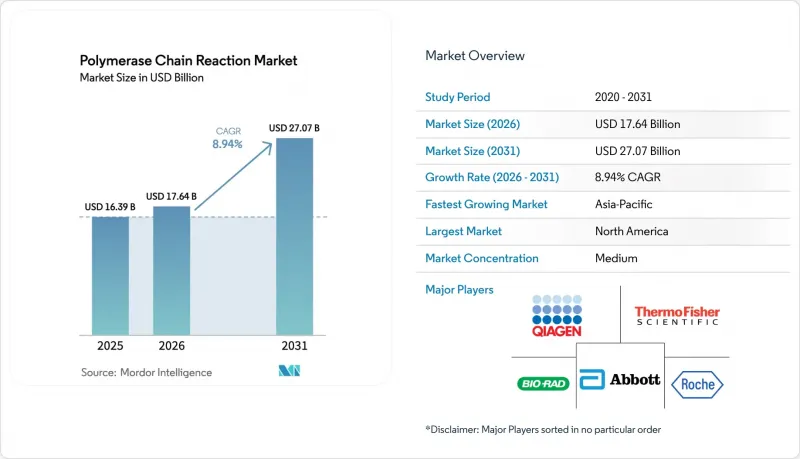
본 보고서는 제품 유형별(장비, 시약 및 소모품, 소프트웨어 및 서비스), 기술별(기존/표준 PCR, 실시간/QPCR 등), 용도별(임상 진단 등), 적응증별(감염증 등), 최종 사용자별(병원 및 진료소 등), 지역별(북미 등)로 분류되어 있습니다. 시장 전망은 금액(달러) 기준으로 제시되어 있습니다.
세계의 중합효소 연쇄반응(PCR) 시장 동향 및 인사이트
코로나19 이후 감염병 검사 급증
대유행 기간 동안 구축된 호흡기 바이러스 감시 체계는 현재 영구적인 안전 조치로 기능하고 있으며, 중합효소연쇄반응(PCR) 시장 전체 수요를 뒷받침하고 있습니다. 미국 질병통제예방센터(CDC)의 30억 달러 규모의 ‘호흡기 바이러스 대응 프로그램’은 주립 연구소에 대해 인플루엔자, SARS-CoV-2, RSV를 한 번의 검사로 검출하는 멀티플렉스 qPCR 패널 확충을 위한 자금을 지원하고 있습니다. 2026년 1월, Cepheid사의 6종 병원체를 검출하는 위장관용 카트리지가 FDA 승인을 획득한 것은 ‘샘플 투 앤서(sample-to-answer)’ 방식의 시스템이 검사 항목의 폭 측면에서 중앙 검사실에 필적할 수 있음을 보여줍니다. 따라서 분산형 검사를 통해 총 반응량은 높은 수준을 유지하면서 수익은 통합형 소모품으로 재분배되고 있습니다. 이러한 요인들이 결합되어 중합효소 연쇄반응(PCR) 시장의 안정적인 기반을 확보하고, 선택적 수술의 주기적인 침체로 인한 영향을 완화하고 있습니다.
암 및 유전성 질환 진단 수요 증가
액체 생검용 PCR 분석법은 미세 잔류 병변 및 치료 내성을 모니터링하는 것으로, 2025년 3월 FDA가 로슈사의 ‘cobas EGFR Mutation Test v2’에 대한 적응증 확대를 승인함으로써 그 유효성이 입증되었습니다. 동반 진단 승인을 통해 PCR 바이오마커가 표적 치료와 연계되고, 이 기술이 신약 개발 경제에 통합됨에 따라 중합효소 연쇄반응 시장의 성장이 촉진되고 있습니다. 척수성 근위축증 및 중증 복합형 면역결핍증에 대한 신생아 선별 검사의 확대에 따라 일상적인 검사 건수가 증가하고 있습니다. 한편, 보험 환급의 불균형으로 인해 공급업체들은 검사 비용을 보조하여 치료 가능한 환자층을 확대하려는 제약 파트너와 제휴하여 검사를 묶어 판매하도록 유도받고 있습니다.
높은 설비 투자 및 소모품 비용
디지털 PCR 기기의 정가는 80,000-15만 달러이며, 중규모 검사 시설의 경우 연간 유지보수비와 시약비로 25,000-4만 달러가 추가로 발생하기 때문에 저소득 지역에서의 도입이 제한되고 있습니다. 제네릭 마스터믹스는 브랜드 제품보다 최대 40% 저렴하지만, 일괄 구매로 인해 많은 검사실이 독자적인 생태계에 얽매이게 되어 시장 경쟁이 저해되고 있습니다. 리스나 시약 대여와 같은 선택지는 비용을 분산시켜 주지만, 최소 구매 수량 요건이 부과되기 때문에 계절적 수요 감소 시기에 검사실에 부담이 가중되어, 신흥국 시장에서 중합효소연쇄반응(PCR) 시장 침투를 제한하고 있습니다.
부문 분석
2025년 매출의 68.24%를 시약 및 소모품이 차지했으며, 이는 PCR 시장에 뿌리내린 ‘면도기와 면도날’ 비즈니스 모델을 반영합니다. 독자적인 사양의 마스터믹스는 높은 이익률을 유지하고 있지만, 가격에 민감한 지역에서는 제네릭 제품이 12-15%의 점유율을 차지하며 이익률을 압박하고 있습니다. 폐쇄형 시스템 카트리지는 판매 증대를 보장하는 한편, EU에서는 지속가능성 세금의 대상이 되어 플레이트 재사용 프로그램 및 생분해성 플라스틱으로의 전환이 촉진되고 있습니다. 장비의 성장은 교체 주기가 8-10년으로 장기화됨에 따라 둔화되고 있지만, 도입 기반의 포화로 인해 소모품 수요는 견조한 추세를 보이고 있습니다.
소프트웨어 및 서비스는 2031년까지 연평균 성장률(CAGR) 11.97%를 나타낼 것으로 예측되며, 연구소가 추적성, 규정 준수 자동화 및 여러 거점 간의 데이터 통합을 우선시함에 따라 하드웨어를 상회하는 성장률을 보일 것으로 전망됩니다. 검사실당 연간 15,000-5만 달러 규모의 클라우드 대시보드 구독은 70% 이상의 매출 총이익률을 가져와 수익원을 인포매틱스 분야로 전환시키는 동시에 PCR 시장 전체의 규모를 확대되고 있습니다. 보고 가능한 결과마다 요금을 부과하는 성과 기반 계약은 벤더의 인센티브를 실험실의 처리 능력과 연동시켜 장기적인 정기 수익원을 확립하고 있습니다.
2025년에는 실시간 정량 플랫폼이 기술 수익의 54.84%를 차지했으며, CPT 코드의 보급과 기술자의 숙련도에 힘입어 일상적인 진단의 기반이 되고 있습니다. 그러나 형광 채널의 단계적 업그레이드는 더 이상 대규모 장비 교체를 촉진하지 못하며, qPCR의 성장률은 임상 시장의 평균 수준에 머물고 있습니다. 대조적으로, 디지털 PCR(dPCR)은 2031년까지 연평균 성장률(CAGR) 12.73%로 확대될 것으로 전망됩니다. 이는 미세 잔류 병변(MRD) 검사나 이식 거부 반응 모니터링에서 프리미엄 보험 적용을 정당화하는 단일 분자 분해능을 활용하고 있기 때문입니다. qPCR 모드와 dPCR 모드를 전환할 수 있는 하이브리드 장비는 설비 투자 예산을 절감하고, 미래를 대비한 검사 메뉴를 확보함으로써 보수적인 검사실에서도 디지털 기술을 부분적으로 도입하도록 촉진하고 있습니다.
멀티플렉스 PCR은 최대 22종의 병원체를 검출하는 증후군별 검사 패널이 규제 당국의 승인을 받으면서 확대되고 있으며, 진단까지의 긴 과정을 단축하고 경험적 항생제 투여를 억제하고 있습니다. 기존의 엔드포인트 PCR은 정량화가 필요하지 않아, 예산 제약이 큰 법의학 및 수의학 분야에서 계속해서 사용되고 있습니다. 이러한 변화들이 맞물리면서, qPCR의 성장이 둔화되고 있음에도 불구하고 중합효소 연쇄반응(PCR) 시장은 건전한 상태를 유지하고 있습니다.
지역별 분석
북미는 2025년 매출의 38.41%를 차지했으며, 전 세계에서 가장 높은 지역별 PCR 시장 점유율을 유지했습니다. 메디케어(Medicare)의 보상 범위 확대와 26만 개가 넘는 CLIA 인증 실험실의 존재로 인해 소모품 수요는 견조한 추세를 보이고 있습니다. FDA의 ‘실험실 개발 검사(LDT) 규정’으로 인해 사전 검증된 키트에 대한 수요가 증가하는 한편, 캐나다의 ‘범캐나다 보건 데이터 전략’은 PCR 검사 항목과 조달을 표준화하여 일괄 구매를 통한 비용 절감 효과를 높이고 있습니다. 멕시코는 2025년에 지방 분자 검사실의 설비 갱신에 7억 달러를 배정하여, 감염병 검사 대상 범위를 확대하고 시약 수요를 늘리려 하고 있습니다.
유럽은 꾸준히 성장하고 있지만, EU의 ‘일회용 플라스틱 지침’에 따라 8-12%의 플라스틱 세금이 부과됨에 따라, 여전히 일회용 플레이트를 사용하고 있는 검사실의 경우 비용 측면에서의 부담이 커지고 있습니다. 독일과 프랑스에서는 순환 종양 DNA에 대한 디지털 PCR 검사에 대한 보험 환급이 이루어지고 있어, 프리미엄 검사의 검사 건수를 끌어올리고 있습니다. 한편, 영국의 국민보건서비스(NHS)는 2025년에 1차 진료에서 PCR 기반의 약리유전학을 도입하여 약물 부작용을 줄였습니다. 그러나 GDPR(EU 개인정보보호규정)(일반 데이터 보호 규정)에 따른 데이터 전송 제한으로 인해 다국적 바이오뱅크 간의 협력이 지연되고 있으며, 통합된 PCR 곡선에 의존하는 AI 모델의 훈련이 늦어지고 있습니다.
아시아태평양은 2031년까지 연평균 성장률(CAGR) 11.22%를 나타낼 것으로 예측되며, 이는 세계에서 가장 빠른 성장률입니다. 중국의 ‘건강 중국 2030’ 계획에서는 원격 의료를 통해 연계되는 지역 PCR 허브를 포함한 정밀의료 인프라에 1,260억 달러를 투자할 예정입니다. 인도의 ‘국가 보건 미션’은 2024-2025년 지역 병원에 1,200대의 GeneXpert 장비를 도입하여 결핵 PCR 검사 커버리지를 72%로 높였습니다. 일본은 2025년 4월, 대장암 및 위암에 대한 액체 생검 PCR의 보험 적용을 승인하여, 이를 통해 연간 약 18만 명의 적격 환자가 추가되었습니다. 한국에서는 350개 병원의 PCR 검사 결과를 국가 클라우드에 집약하고 있으며, 한편 호주에서는 검사법 승인 기간을 절반으로 단축하여 공급업체 시장 진입을 가속화하고 있습니다. 주요 경제권 이외의 지역에서는 GCC 국가, 남아프리카, 브라질이 감염병 대책을 위해 PCR 검사에 투자하고 있지만, 기술자 부족과 전력 공급 불안정으로 인해 아프리카 및 라틴아메리카 일부 지역에서는 처리 능력이 제한되어 있어, 중합효소연쇄반응(PCR) 시장 규모 확대를 저해하고 있습니다.
기타 혜택 :
- 엑셀 형식 시장 예측(ME) 시트
- 3개월간의 애널리스트 지원
자주 묻는 질문
목차
제1장 서론
제2장 조사 방법
제3장 주요 요약
제4장 시장 구도
제5장 시장 규모 및 성장 예측
제6장 경쟁 구도
제7장 시장 기회 및 향후 전망
AJY 26.09.07According to Mordor Intelligence, the polymerase chain reaction market size is expected to increase from USD 16.39 billion in 2025 to USD 17.64 billion in 2026 and reach USD 27.07 billion by 2031, growing at a CAGR of 8.94% over 2026-2031.
This report is Segmented by Product Type (Instruments, Reagents & Consumables, Software & Services), Technology (Conventional/Standard PCR, Real-Time/QPCR, and More), Application (Clinical Diagnostics, and More), Indication (Infectious Diseases, and More), End User (Hospitals & Clinics, and More), and Geography (North America, and More). The Market Forecasts are Provided in Terms of Value (USD).
Global Polymerase Chain Reaction Market Trends and Insights
Surge in Infectious-Disease Testing Post-COVID
Respiratory-virus surveillance built during the pandemic now functions as a permanent safeguard, sustaining demand across the polymerase chain reaction market. The CDC's USD 3 billion Respiratory Virus Response program funds state laboratories to expand multiplex qPCR panels that detect influenza, SARS-CoV-2, and RSV in one run. January 2026 FDA clearance for Cepheid's six-pathogen gastrointestinal cartridge demonstrates that sample-to-answer systems can rival central labs in menu breadth. Decentralized testing therefore redistributes revenue toward integrated consumables while keeping total reaction volumes high. Together, these forces secure a stable baseline for the polymerase chain reaction market, cushioning it against cyclical downturns in elective procedures.
Rising Oncology & Genetic-Disorder Diagnostics Demand
Liquid-biopsy PCR assays monitor minimal residual disease and therapy resistance, validated by the FDA's March 2025 label expansion of Roche's cobas EGFR Mutation Test v2. Companion-diagnostic approvals link PCR biomarkers to targeted therapies, embedding the technology in drug-development economics and bolstering polymerase chain reaction market growth. Expanded newborn screening for spinal muscular atrophy and severe combined immunodeficiency widens routine testing volumes, while uneven reimbursement spurs vendors to bundle assays with pharmaceutical partners willing to subsidize testing to enlarge treatable patient pools.
High Capital & Consumable Costs
Digital PCR instruments list at USD 80,000-150,000, while annual service and reagents add USD 25,000-40,000 for mid-volume sites, constraining uptake in lower-income regions. Generic master mixes undercut branded reagents by up to 40%, but bundled purchasing locks many labs into proprietary ecosystems that resist price competition. Leasing and reagent-rental options spread costs yet impose minimum-volume thresholds that punish laboratories during seasonal demand dips, limiting polymerase chain reaction market penetration in frontier economies.
Other drivers and restraints analyzed in the detailed report include:
- Technological Advances in qPCR & dPCR Platforms
- AI-Driven Assay Design & Cloud-Based Analytics Adoption
- Competition from NGS & Isothermal Amplification
For complete list of drivers and restraints, kindly check the Table Of Contents.
Segment Analysis
Reagents and consumables produced 68.24% of 2025 revenue, reflecting razor-and-blade economics embedded in the polymerase chain reaction market. Proprietary master mixes command sticky margins, though generic alternatives have seized 12-15% share in price-sensitive regions, compressing profits. Closed-system cartridges guarantee pull-through yet face sustainability taxes in the EU, spurring a pivot toward plate-reuse programs and biodegradable plastics. Instruments growth moderates as replacement cycles lengthen to 8-10 years, but installed-base saturation secures steady consumable demand.
Software and services are forecast to grow at 11.97% CAGR through 2031, outpacing hardware as laboratories prioritize traceability, automated compliance, and multi-site data integration. Annual cloud-dashboard subscriptions of USD 15,000-50,000 per lab carry gross margins above 70%, shifting profit pools toward informatics and bolstering overall polymerase chain reaction market size. Outcome-based contracts that charge per reportable result also align vendor incentives with laboratory throughput, embedding long-term annuity streams.
Real-time quantitative platforms delivered 54.84% of technology revenue in 2025, anchoring routine diagnostics due to widespread CPT codes and technician familiarity. However, incremental fluorescence-channel upgrades no longer spur large-scale fleet replacements, leaving qPCR growth near clinical-market averages. Digital PCR, by contrast, will climb at a 12.73% CAGR through 2031, leveraging single-molecule resolution that justifies premium coverage for minimal-residual-disease testing and transplant-rejection surveillance. Hybrid instruments that toggle between qPCR and dPCR modes preserve capital budgets and future-proof menus, nudging conservative labs toward partial digital adoption.
Multiplex PCR expands as regulators approve syndromic panels detecting up to 22 pathogens, shortening diagnostic odysseys and curbing empiric antibiotic use. Conventional endpoint PCR persists in forensic and veterinary settings where quantification is unnecessary and budget constraints dominate. Together these shifts maintain a healthy polymerase chain reaction market even as qPCR growth decelerates.
Complete Report Scope:
- By Product Type
- Instruments
- Reagents & Consumables
- Software & Services
- By Technology
- Conventional / Standard PCR
- Real-Time / qPCR
- Digital PCR
- Multiplex & Other PCR
- By Application
- Clinical Diagnostics
- Genetic Testing
- Drug Discovery & Research
- Forensic Sciences
- Environmental & Food Testing
- Agricultural & Veterinary
- By Indication
- Infectious Diseases
- Oncology & Liquid Biopsy
- Genetic Disorders
- Other Indications
- By End User
- Hospitals & Clinics
- Diagnostic Reference Labs
- Pharmaceutical & Biotechnology Companies
- Academic & Research Institutes
- Contract Research Organizations
- Forensic & Security Agencies
- Others
- By Geography
- North America
- United States
- Canada
- Mexico
- Europe
- Germany
- France
- United Kingdom
- Italy
- Spain
- Rest of Europe
- Asia-Pacific
- China
- Japan
- India
- South Korea
- Australia
- Rest of Asia-Pacific
- Middle East & Africa
- GCC
- South Africa
- Rest of Middle East & Africa
- South America
- Brazil
- Argentina
- Rest of South America
- North America
Geography Analysis
North America retained 38.41% of 2025 revenue, the highest regional polymerase chain reaction market share worldwide. Medicare reimbursement expansions and over 260,000 CLIA-certified labs keep consumable demand robust. The FDA's laboratory-developed test rule increases demand for pre-validated kits, while Canada's Pan-Canadian Health Data Strategy standardizes PCR menus and procurement, enhancing bulk-buy leverage. Mexico earmarked USD 700 million in 2025 to upgrade rural molecular labs, expanding infectious-disease coverage and reagent pull-through.
Europe grows steadily but confronts 8-12% plastics levies under the EU Single-Use Plastics Directive, adding cost pressure for labs clinging to disposable plates. Germany and France reimburse digital PCR for circulating-tumor DNA, stimulating premium-test volumes, while the UK's National Health Service rolled out PCR-based pharmacogenomics in primary care in 2025, reducing adverse-drug reactions. GDPR's data-transfer limits, however, slow multinational biobank collaborations, delaying AI model training that depends on pooled PCR curves.
Asia-Pacific is projected to post an 11.22% CAGR through 2031, the fastest worldwide. China's Healthy China 2030 dedicates USD 126 billion to precision-medicine infrastructure, including regional PCR hubs linked via telemedicine. India's National Health Mission deployed 1 200 GeneXpert instruments to district hospitals between 2024 and 2025, raising tuberculosis PCR coverage to 72%. Japan approved liquid-biopsy PCR reimbursement for colorectal and gastric cancers in April 2025, adding around 180 000 eligible patients a year. South Korea aggregates PCR results from 350 hospitals onto a national cloud, while Australia halves assay-approval timelines, accelerating vendor entry. Outside core economies, GCC states, South Africa, and Brazil invest in PCR for epidemic control, but technician shortages and power instability limit throughput in parts of Africa and Latin America, tempering polymerase chain reaction market size gains.
- Abbott Laboratories
- Agilent Technologies
- Becton Dickinson & Co.
- bioMerieux
- Bio-Rad Laboratories
- Danaher
- Eppendorf
- Roche
- Fluidigm / Standard BioTools
- Illumina
- LGC Group
- Merck
- New England Biolabs
- Promega Corp.
- QIAGEN
- Revvity Inc
- Stilla Technologies
- Takara Bio
- Thermo Fisher Scientific
Additional Benefits:
- The market estimate (ME) sheet in Excel format
- 3 months of analyst support
TABLE OF CONTENTS
1 Introduction
- 1.1 Study Assumptions & Market Definition
- 1.2 Scope of the Study
2 Research Methodology
3 Executive Summary
4 Market Landscape
- 4.1 Market Overview
- 4.2 Market Drivers
- 4.2.1 Surge in Infectious-Disease Testing Post-COVID
- 4.2.2 Rising Oncology & Genetic-Disorder Diagnostics Demand
- 4.2.3 Technological Advances in qPCR & dPCR Platforms
- 4.2.4 Increased Life-Science R&D & Personalized-Medicine Funding
- 4.2.5 AI-Driven Assay Design & Cloud-Based Analytics Adoption
- 4.2.6 Field-Deployable Microfluidic PCR for Agri-Biosecurity
- 4.3 Market Restraints
- 4.3.1 High Capital & Consumable Costs
- 4.3.2 Competition from NGS & Isothermal Amplification
- 4.3.3 Sustainability Taxes on Single-Use PCR Plastics (EU)
- 4.3.4 GDPR Limits on Cloud PCR Data-Sharing
- 4.4 Value / Supply-Chain Analysis
- 4.5 Regulatory Landscape
- 4.6 Technological Outlook
- 4.7 Porter's Five Forces Analysis
- 4.7.1 Bargaining Power of Buyers
- 4.7.2 Bargaining Power of Suppliers
- 4.7.3 Threat of New Entrants
- 4.7.4 Threat of Substitutes
- 4.7.5 Intensity of Competitive Rivalry
5 Market Size & Growth Forecasts (Value in USD)
- 5.1 By Product Type
- 5.1.1 Instruments
- 5.1.2 Reagents & Consumables
- 5.1.3 Software & Services
- 5.2 By Technology
- 5.2.1 Conventional / Standard PCR
- 5.2.2 Real-Time / qPCR
- 5.2.3 Digital PCR
- 5.2.4 Multiplex & Other PCR
- 5.3 By Application
- 5.3.1 Clinical Diagnostics
- 5.3.2 Genetic Testing
- 5.3.3 Drug Discovery & Research
- 5.3.4 Forensic Sciences
- 5.3.5 Environmental & Food Testing
- 5.3.6 Agricultural & Veterinary
- 5.4 By Indication
- 5.4.1 Infectious Diseases
- 5.4.2 Oncology & Liquid Biopsy
- 5.4.3 Genetic Disorders
- 5.4.4 Other Indications
- 5.5 By End User
- 5.5.1 Hospitals & Clinics
- 5.5.2 Diagnostic Reference Labs
- 5.5.3 Pharmaceutical & Biotechnology Companies
- 5.5.4 Academic & Research Institutes
- 5.5.5 Contract Research Organizations
- 5.5.6 Forensic & Security Agencies
- 5.5.7 Others
- 5.6 By Geography
- 5.6.1 North America
- 5.6.1.1 United States
- 5.6.1.2 Canada
- 5.6.1.3 Mexico
- 5.6.2 Europe
- 5.6.2.1 Germany
- 5.6.2.2 France
- 5.6.2.3 United Kingdom
- 5.6.2.4 Italy
- 5.6.2.5 Spain
- 5.6.2.6 Rest of Europe
- 5.6.3 Asia-Pacific
- 5.6.3.1 China
- 5.6.3.2 Japan
- 5.6.3.3 India
- 5.6.3.4 South Korea
- 5.6.3.5 Australia
- 5.6.3.6 Rest of Asia-Pacific
- 5.6.4 Middle East & Africa
- 5.6.4.1 GCC
- 5.6.4.2 South Africa
- 5.6.4.3 Rest of Middle East & Africa
- 5.6.5 South America
- 5.6.5.1 Brazil
- 5.6.5.2 Argentina
- 5.6.5.3 Rest of South America
- 5.6.1 North America
6 Competitive Landscape
- 6.1 Market Concentration
- 6.2 Market Share Analysis
- 6.3 Company Profiles (includes Global level Overview, Market level overview, Core Segments, Financials as available, Strategic Information, Market Rank/Share for key companies, Products and Services, and Recent Developments)
- 6.3.1 Abbott Laboratories
- 6.3.2 Agilent Technologies
- 6.3.3 Becton Dickinson & Co.
- 6.3.4 bioMerieux SA
- 6.3.5 Bio-Rad Laboratories
- 6.3.6 Danaher
- 6.3.7 Eppendorf SE
- 6.3.8 F. Hoffmann-La Roche Ltd
- 6.3.9 Fluidigm / Standard BioTools
- 6.3.10 Illumina Inc.
- 6.3.11 LGC Group
- 6.3.12 Merck KGaA (Sigma-Aldrich)
- 6.3.13 New England Biolabs
- 6.3.14 Promega Corp.
- 6.3.15 QIAGEN N.V.
- 6.3.16 Revvity Inc
- 6.3.17 Stilla Technologies
- 6.3.18 Takara Bio Inc.
- 6.3.19 Thermo Fisher Scientific
7 Market Opportunities & Future Outlook
- 7.1 White-space & Unmet-need Assessment