

|
시장보고서
상품코드
2097179
아시아태평양의 헬리콥터 : 시장 점유율 분석, 업계 동향과 통계, 성장 예측(2026-2031년)Asia-Pacific Helicopters - Market Share Analysis, Industry Trends & Statistics, Growth Forecasts (2026 - 2031) |
||||||
 Mordor Intelligence
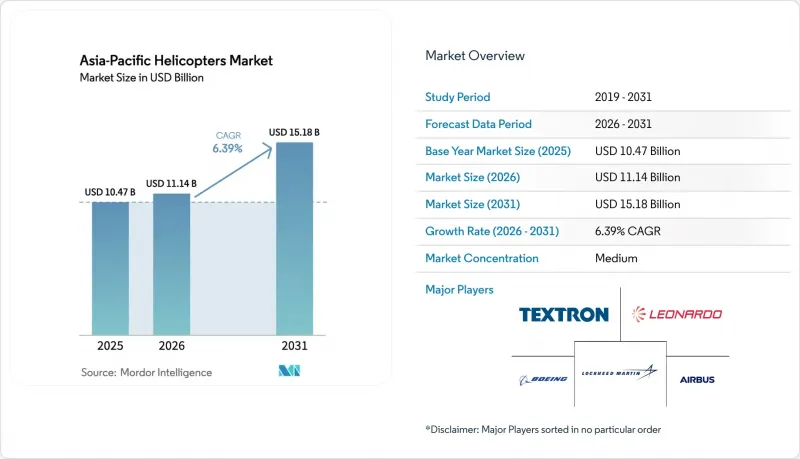
Mordor Intelligence에 의하면, 아시아태평양의 헬리콥터 시장 규모는 2025년 104억 7,000만 달러에서 2026년에는 111억 4,000만 달러로 확대되고, 2026-2031년 CAGR 6.39%로 성장을 지속하여 2031년까지 151억 8,000만 달러에 이를 것으로 예측됩니다.
본 보고서는 최대 이륙 중량(경량, 중형, 중량급), 용도(군사, 민간·상용), 엔진 유형(피스톤, 터보샤프트), 최종 용도(전투, 해양 에너지, 응급 의료 서비스, 법 집행·공공 안전 등), 지역(중국, 인도, 일본, 한국 등)별로 분류되어 있습니다. 시장 전망은 금액(달러) 기준으로 제시되어 있습니다.
아시아태평양의 헬리콥터 시장 동향과 인사이트
차세대 eVTOL에서 영감을 얻은 로터 기술
당초 eVTOL 실증기를 위해 시제품으로 제작된 가변 피치 복합재 블레이드는 기존 터빈 기종 모델의 진동과 소음을 최대 40%까지 저감시켜, 소음에 민감한 도시 공역에서의 임무 범위를 확대했습니다. 시코르스키사는 ‘레이더 X’ 연구에서 파생된 능동형 진동 제어 시스템을 양산형 S-76D 기체에 탑재하여 객실 내 소음을 78데시벨까지 낮춘 결과, 2025년 싱가포르에서 새로운 해양 계약을 수주했습니다. 도쿄의 주간 소음 제한치인 85데시벨을 배경으로, 일본의 각 운영사들 사이에서 이 시스템의 도입이 급속히 진행되고 있습니다. 한국항공우주산업(KAI)은 틸트로터용 복합재 블레이드 기술을 자사의 경무장 헬리콥터에 통합하여, 15%의 경량화를 통해 고고도 성능 향상을 목표로 하고 있습니다. 이러한 개량이 양산 기체에 도입됨에 따라, 아시아태평양의 헬리콥터 시장은 본격적인 eVTOL 인증을 기다리지 않고도 운용상의 유연성을 확보하게 될 것입니다.
해상 풍력 발전의 O&M을 위한 기체 교체;
대만에서는 2035년까지 20.7 GW의 해상 풍력 발전 용량을 확보할 전망이며, 기술자를 해상 30-80 km 지점까지 수송하기 위해 약 45대의 전용 헬리콥터가 필요하게 됩니다. 오스트에드(AustED)사는 2024년 브리스토(Bristow)사와 계약을 체결하여 그레이터 창화(Greater Changhua) 해역에서 시코르스키 S-92의 지속적인 운용 지원을 확보했습니다. 일본은 6개의 촉진 구역을 지정했으며, 3GW의 용량을 유지하기 위해 아키타와 지바에 헬리콥터 기지를 설립할 계획입니다. 울산 근교에 위치한 한국의 부유식 풍력 발전 현장에서는 25노트의 바람 속에서도 호버링이 가능한 대형 헬리콥터가 필요합니다. 호주는 2025년에 깁스랜드 구역의 인가를 취득했으며, 2029년까지 8-10대의 항공기에 대한 미래 수요가 발생할 전망입니다.
심각한 조종사 부족
인도네시아, 태국, 말레이시아 3개국에서는 2028년까지 총 약 450명의 헬리콥터 조종사가 추가로 필요하지만, 양성 인원은 크게 부족합니다. 싱가포르 규제 당국은 2025년 지역 전체의 양성 부족률을 22%로 추산하고 있습니다. 인도네시아에서는 2024년에 신규 조종사 면허를 취득한 인원이 고작 87명에 그쳐, 수요인 150명에 훨씬 미치지 못했고, 그 결과 12대의 인도 일정이 지연되었습니다. 말레이시아의 비행 학교에서는 교관 부족이 여전히 지속되는 가운데, 2024년에 34명의 조종사를 졸업시켰습니다. 2025년에 인가된 태국의 두 곳의 새로운 비행 학교는 2027년까지 정원에 도달하지 못할 전망입니다. 필리핀은 여전히 해외 비행 학교에 의존하고 있으며, 이로 인해 사업자 비용에 수습생 1인당 8만 달러가 추가되고 있습니다.
부문 분석
2025년 아시아태평양의 헬리콥터 시장 규모에서 경량급은 8,820대를 차지하며, 연평균 성장률(CAGR) 8.82%로 성장할 전망이며, 이는 중량급 중 가장 높은 성장률입니다. 비행 학교와 기업들은 로빈슨 R44, R66 및 벨 505 모델을 선호하고 있으며, 이들 기종의 연료 소비량은 비행 시간당 350달러로 중형 터빈 기종의 3분의 1 수준입니다. 로빈슨사는 2024년에 아시아태평양에 142대의 피스톤 엔진 헬리콥터를 납품했는데, 그 중 60%는 중국, 인도, 호주의 훈련 학교용이며, 이들 지역에서는 여전히 수요가 공급 능력의 제약을 받고 있습니다. 벨 505의 도입은 인도네시아와 필리핀의 전세 항공사에서 급증하고 있으며, 140만 달러인 이 기종의 가격은 에어버스 H125보다 18% 저렴합니다.
중형 헬리콥터는 더 큰 적재량과 항속 거리가 필요한 국방 및 해양 에너지 관련 임무 덕분에 2025년 아시아태평양의 헬리콥터 시장 점유율의 48.23%를 계속 차지하고 있습니다. 레오나르도 AW139와 시코르스키 S-76은 2024년에 총 89대가 인도되며 여전히 주력 기종으로서의 위상을 유지하고 있습니다. 대형 헬리콥터의 활용은 여전히 틈새 분야에 머물러 있으며, 호주와 말레이시아의 장거리 석유 플랫폼에서 운용되고 있는 CHC사의 S-92 14대가 주를 이루고 있습니다. 규제 완화도 소형 헬리콥터에 호재가 되고 있습니다. 일본은 2025년에 상업용 조종사의 단발기 비행 경험 요건을 1,200시간으로 낮추기로 했으며, 이를 통해 비행 학교 졸업생 수를 늘리고 소형 헬리콥터 수요를 더욱 촉진하게 되었습니다.
2025년, 중국, 인도, 일본이 현대화 프로그램을 추진한 결과, 군사 임무는 아시아태평양의 헬리콥터 시장 규모의 58.89%를 차지했습니다. 한편, 관광 산업의 회복과 기업들이 시간적 제약이 엄격한 셔틀 편을 우선시하는 추세에 따라, 민간 및 상업 활동은 2031년까지 연평균 성장률(CAGR) 7.94%로 확대될 것으로 예측됩니다. 태국의 전세 운항사는 2024년에 헬리콥터 11대를 증강하여, 리조트 셔틀 사업에서 매출이 140% 증가했다고 보고했습니다.
기업의 헬리콥터 이용은 도로 정체가 일정을 차질시키는 인도의 2차 산업 지역으로도 확대되고 있습니다. 2024년에는 푸네-아메다바드 및 코임바토르 노선에서 H125 및 Bell 407GXi 총 9대가 취항했습니다. 대만에서는 해상 풍력 발전 관련 서비스가 상업적 수요를 끌어올려, 2025년에는 8대의 전용 헬리콥터가 운용·유지보수(O&M) 업무를 시작했습니다. 홋카이도와 오키나와의 관광 비행 사업자는 H125를 5대 추가한 결과, 2025년 성수기에 95%의 탑승률을 달성했습니다. 이처럼 활용 사례가 확대되고 있는 것은 아시아태평양의 헬리콥터 시장에서 국방 예산을 뛰어넘는 견조한 수요를 뒷받침하고 있습니다.
기타 혜택:
- 엑셀 형식 시장 예측(ME) 시트
- 3개월간의 애널리스트 지원
자주 묻는 질문
목차
제1장 서론
제2장 조사 방법
제3장 주요 요약
제4장 시장 구도
제5장 시장 규모와 성장 예측
제6장 경쟁 구도
제7장 시장 기회와 향후 전망
KTH 26.08.06According to Mordor Intelligence, the Asia-Pacific helicopters market size is expected to grow from USD 10.47 billion in 2025 to USD 11.14 billion in 2026 and is forecasted to reach USD 15.18 billion by 2031 at a 6.39% CAGR over 2026-2031.
This report is Segmented by Maximum Take-Off Weight (Light, Medium, and Heavy), Application (Military, and Civil and Commercial), Engine Type (Piston and Turboshaft), End-Use Sector (Combat, Offshore Energy, Emergency Medical Services, Law Enforcement and Public Safety, and More), and Geography (China, India, Japan, South Korea, and More). The Market Forecasts are Provided in Terms of Value (USD).
Asia-Pacific Helicopters Market Trends and Insights
Next-Generation EVTOL-inspired Rotor Tech
Variable-pitch composite blades, first prototyped for eVTOL demonstrators, have reduced vibration and noise in legacy turbine models by up to 40%, thereby extending mission reach in noise-sensitive urban airspace. Sikorsky fitted active vibration control derived from Raider X research to production S-76D aircraft, lowering cabin noise to 78 decibels and winning new offshore contracts in Singapore during 2025. Tokyo's 85-decibel daytime limit incentivizes rapid adoption across Japanese operators. Korea Aerospace Industries is integrating tilt-rotor composite blade expertise into its Light Armed Helicopter, aiming for a 15% weight reduction that enhances high-altitude performance. As these upgrades migrate into serial production, the Asia-Pacific helicopters market gains operational flexibility without waiting for full-scale eVTOL certification.
Fleet Modernization For Offshore Wind O&M
Taiwan expects to have 20.7 GW of offshore wind by 2035, requiring roughly 45 dedicated rotorcraft to ferry technicians 30-80 km offshore. Orsted contracted Bristow in 2024 for continuous Sikorsky S-92 support at the Greater Changhua fields. Japan has designated six promotion zones and plans to establish helicopter bases in Akita and Chiba to maintain a 3 GW capacity. South Korea's floating wind sites near Ulsan require heavy-class helicopters capable of hovering in 25-knot winds. Australia cleared the Gippsland zone in 2025, creating future demand for 8-10 aircraft by 2029.
Persistent Pilot Shortage
Indonesia, Thailand, and Malaysia jointly require approximately 450 additional helicopter pilots by 2028, yet the training output lags significantly. Singapore's regulator estimated a regional training deficit of 22% in 2025. Indonesia licensed only 87 new pilots in 2024, compared to a demand for 150, which delayed the delivery of 12 aircraft. Malaysian flight schools graduated 34 pilots in 2024, despite instructor shortages persisting. Two new Thai academies approved in 2025 will not reach capacity until 2027. The Philippines still relies on foreign schools, adding USD 80,000 per trainee to operator costs.
Other drivers and restraints analyzed in the detailed report include:
- Asian Med-Evac PPP Expansion
- Localized Defense Procurement
- Currency-Driven CAPEX Volatility
For complete list of drivers and restraints, kindly check the Table Of Contents.
Segment Analysis
The light-class segment accounted for 8,820 units within the Asia-Pacific helicopters market size in 2025 and is set to grow at an 8.82% CAGR, the fastest among weight classes. Flight academies and corporations prefer the Robinson R44, R66, and Bell 505 models, which cost USD 350 per flight hour, one-third the burn of a medium turbine. Robinson delivered 142 piston helicopters to the Asia-Pacific region in 2024, 60% of which were destined for training academies in China, India, and Australia, where demand remains capacity-constrained. Bell 505 adoption surged across Indonesian and Philippine charter firms, its USD 1.4 million price undercutting an Airbus H125 by 18%.
Medium-sized helicopters still commanded 48.23% of the 2025 Asia-Pacific helicopters market share, thanks to defense and offshore energy missions that require greater payload and range. Leonardo AW139 and Sikorsky S-76 remained the mainstay with 89 combined deliveries in 2024. Heavy-class usage remains niche, centered on CHC's 14 S-92s, which serve long-range oil platforms in Australia and Malaysia. Regulatory easing also favors light helicopters. Japan reduced the single-engine experience threshold for commercial pilots to 1,200 hours in 2025, accelerating throughput for flight schools and further stimulating demand for light helicopters.
Military missions accounted for 58.89% of the Asia-Pacific helicopters market size in 2025, as China, India, and Japan advanced their modernization programs. Civil and commercial activities, however, are forecast to climb at a 7.94% CAGR through 2031 as tourism rebounds and corporates prioritize time-critical shuttle links. Thai charter operators added 11 helicopters in 2024 and reported 140% revenue growth on resort transfers.
Corporate usage is spreading to India's tier-2 industrial corridors, where road congestion undermines schedules. Nine H125 and Bell 407GXi aircraft entered service on Pune-Ahmedabad and Coimbatore routes in 2024. Offshore wind services lifted commercial demand in Taiwan, where eight dedicated helicopters began operations and maintenance (O&M) duties in 2025. Scenic operators in Hokkaido and Okinawa reached 95% load factors in peak 2025 seasons after adding five H125s. This broadening use case pipeline underpins a durable demand floor beyond defense budgets in the Asia-Pacific helicopters market.
Complete Report Scope:
- By Maximum Take-off Weight
- Light
- Medium
- Heavy
- By Application
- Military
- Civil and Commercial
- By Engine Type
- Piston Engine
- Turboshaft Engine
- By End-Use Sector
- Combat
- Offshore Energy
- Emergency Medical Services (EMS)
- Law Enforcement and Public Safety
- Tourism and VIP Charter
- Search and Rescue (SAR)
- Utility and Aerial Work
- Intelligence, Surveillance, and Reconnaissance (ISR)
- By Geography
- China
- India
- Japan
- South Korea
- Australia
- Indonesia
- Thailand
- Rest of Asia-Pacific
List of Companies Covered in this Report:
- Airbus Helicopters (Airbus SE)
- Textron Inc.
- Leonardo S.p.A.
- Lockheed Martin Corporation
- The Boeing Company
- Kawasaki Heavy Industries, ltd.
- Korea Aerospace Industries, Ltd.
- Hindustan Aeronautics Limited
- Rostec
- Robinson Helicopter Company
- Enstrom Helicopter Corp.
- MD Helicopters, LLC
- Kaman Corporation
- Mitsubishi Heavy Industries, Ltd.
Additional Benefits:
- The market estimate (ME) sheet in Excel format
- 3 months of analyst support
TABLE OF CONTENTS
1 INTRODUCTION
- 1.1 Study Assumptions and Market Definition
- 1.2 Scope of the Study
2 RESEARCH METHODOLOGY
3 EXECUTIVE SUMMARY
4 MARKET LANDSCAPE
- 4.1 Market Overview
- 4.2 Market Drivers
- 4.2.1 Next-generation eVTOL-inspired rotor technology spill-over
- 4.2.2 Rapid fleet modernization for offshore wind O&M in Asia-Pacific
- 4.2.3 Asian med-evac public-private partnerships (PPPs) expansion
- 4.2.4 Rising localized defense procurement programs in India and Japan
- 4.2.5 Recovery of tourism-linked heli-charter operations post-COVID
- 4.2.6 Military shift toward multi-role medium-lift platforms
- 4.3 Market Restraints
- 4.3.1 Persistent pilot shortage in emerging ASEAN markets
- 4.3.2 Currency-driven capex volatility for import-heavy operators
- 4.3.3 Urban air mobility (UAM) regulatory uncertainty crowding investment
- 4.3.4 Escalating ESG pressure against fossil-fuel rotorcraft
- 4.4 Value Chain Analysis
- 4.5 Regulatory Outlook
- 4.6 Technological Outlook
- 4.7 Porter's Five Forces Analysis
- 4.7.1 Bargaining Power of Suppliers
- 4.7.2 Bargaining Power of Buyers
- 4.7.3 Threat of New Entrants
- 4.7.4 Threat of Substitute Products
- 4.7.5 Intensity of Competitive Rivalry
5 MARKET SIZE AND GROWTH FORECASTS (VALUE)
- 5.1 By Maximum Take-off Weight
- 5.1.1 Light
- 5.1.2 Medium
- 5.1.3 Heavy
- 5.2 By Application
- 5.2.1 Military
- 5.2.2 Civil and Commercial
- 5.3 By Engine Type
- 5.3.1 Piston Engine
- 5.3.2 Turboshaft Engine
- 5.4 By End-Use Sector
- 5.4.1 Combat
- 5.4.2 Offshore Energy
- 5.4.3 Emergency Medical Services (EMS)
- 5.4.4 Law Enforcement and Public Safety
- 5.4.5 Tourism and VIP Charter
- 5.4.6 Search and Rescue (SAR)
- 5.4.7 Utility and Aerial Work
- 5.4.8 Intelligence, Surveillance, and Reconnaissance (ISR)
- 5.5 By Geography
- 5.5.1 China
- 5.5.2 India
- 5.5.3 Japan
- 5.5.4 South Korea
- 5.5.5 Australia
- 5.5.6 Indonesia
- 5.5.7 Thailand
- 5.5.8 Rest of Asia-Pacific
6 COMPETITIVE LANDSCAPE
- 6.1 Market Concentration
- 6.2 Strategic Moves
- 6.3 Market Share Analysis
- 6.4 Company Profiles (includes Global level Overview, Market level overview, Core Segments, Financials as available, Strategic Information, Market Rank/Share for key companies, Products and Services, and Recent Developments)
- 6.4.1 Airbus Helicopters (Airbus SE)
- 6.4.2 Textron Inc.
- 6.4.3 Leonardo S.p.A.
- 6.4.4 Lockheed Martin Corporation
- 6.4.5 The Boeing Company
- 6.4.6 Kawasaki Heavy Industries, ltd.
- 6.4.7 Korea Aerospace Industries, Ltd.
- 6.4.8 Hindustan Aeronautics Limited
- 6.4.9 Rostec
- 6.4.10 Robinson Helicopter Company
- 6.4.11 Enstrom Helicopter Corp.
- 6.4.12 MD Helicopters, LLC
- 6.4.13 Kaman Corporation
- 6.4.14 Mitsubishi Heavy Industries, Ltd.
7 MARKET OPPORTUNITIES AND FUTURE OUTLOOK
- 7.1 White-space and Unmet-need Assessment


