

|
시장보고서
상품코드
2097197
중동 및 아프리카의 AI, 사이버 보안 및 빅데이터 분석 : 시장 점유율 분석, 업계 동향과 통계, 성장 예측(2026-2031년)MEA AI, Cybersecurity and Big Data Analytics - Market Share Analysis, Industry Trends & Statistics, Growth Forecasts (2026 - 2031) |
||||||
 Mordor Intelligence
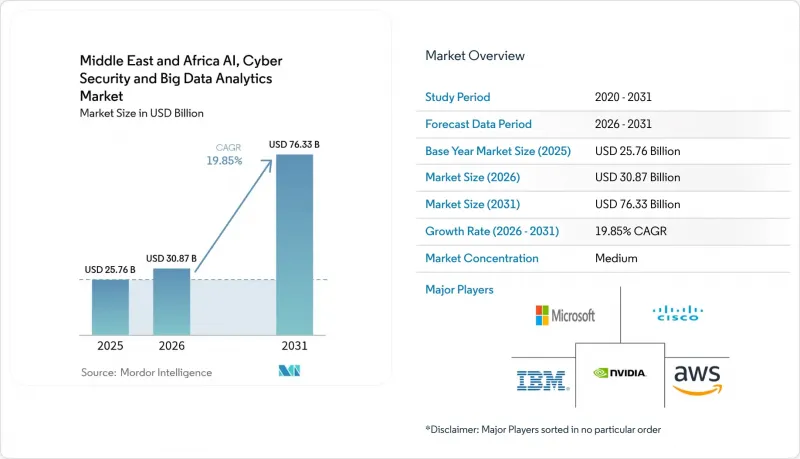
Mordor Intelligence에 의하면, 중동 및 아프리카의 AI, 사이버 보안 및 빅데이터 분석 시장 규모는 2025년에 257억 6,000만 달러로 평가되었고, 2026년 308억 7,000만 달러에서 2031년까지 763억 3,000만 달러에 이를 것으로 추정되고 있어 예측 기간(2026-2031년) CAGR은 19.85%를 나타낼 전망입니다.
본 보고서는 구성 요소(하드웨어, 소프트웨어, 서비스), 보안 유형(네트워크 등), 분석 유형(데이터 탐색 및 시각화 등), 최종 사용자 산업(IT 및 통신 등), 최종 사용자 기업 규모(대기업, 중소기업) 및 지역(UAE 등)별로 분류되어 있습니다. 시장 전망은 금액(달러) 기준으로 제시되어 있습니다.
중동 및 아프리카(MEA)의 AI, 사이버 보안 및 빅데이터 분석 시장 동향과 인사이트
GCC 전역에서 확대되고 있는 정부 주도 AI 펀드가 지역 혁신을 변화시키고 있습니다.
GCC의 국부펀드는 2024년부터 2025년에 걸쳐 AI 투자액을 5배로 확대했습니다. 그 대표적인 예로, AI 인프라에 1,000억 달러를 투자하는 것을 목표로 하는 아부다비의 MGX와, 벤처 파트너십에 400억 달러를 배정하는 사우디아라비아의 공공투자기금(PIF)을 들 수 있습니다. 투자는 국내 모델 훈련, 데이터센터용량 확대, 아랍어를 중심으로 한 언어 연구를 우선시하고 있으며, 3억 5,000만 명의 아랍어 사용자에게 문화적으로 적합한 솔루션을 제공할 수 있는 현지 벤더 생태계를 구축하고 있습니다. 또한, 정부 자본은 데이터 상주 요건 준수를 보장하면서 기술 이전을 가속화하는 합작 투자를 통해 해외 파트너를 유치하고 있습니다.
‘클라우드 퍼스트’ 방침의 가속화가 공공 부문의 디지털 전환을 추진하고 있습니다.
사우디아라비아의 DEEM 프로그램은 237개 기관에 걸쳐 있는 175개의 데이터센터를 통합하여 13억 3,000만 달러의 비용 절감을 실현했습니다. 이는 클라우드 도입 의무화가 가져오는 재정적 및 운영상의 이점을 여실히 보여줍니다. UAE와 카타르에서도 유사한 노력이 진행 중이며, 정부 워크로드를 현지 하이퍼스케일 지역으로 이전하는 것이 의무화되어 있습니다. 이에 따라 제로 트러스트 제어, 클라우드 액세스 보안 브로커(CASB), 자동화된 규정 준수 관리에 대한 조달이 급증하고 있습니다.
아랍어를 모국어로 하는 AI 인재 및 데이터 라벨링 전문 지식의 부족이 도입 속도를 제한하고 있습니다.
조사 대상 기업 중 AI 도입 준비가 완벽하다고 응답한 곳은 불과 12%에 그쳤으며, 이는 모델 미세 조정에 필요한 고품질 코퍼스를 구축할 수 있는 아랍어 원어민 데이터 사이언스자나 어노테이터가 부족함을 반영합니다. 이러한 병목 현상으로 인해 개념 증명(PoC) 단계가 장기화되고, 매니지드 서비스에 대한 의존도가 높아지고 있습니다.
부문 분석
소프트웨어 부문은 기업 보안 아키텍처의 기반이 되는 SIEM, XDR 및 가시화 솔루션의 정착에 힘입어 2025년 매출의 48.18%를 차지했습니다. 그러나 지역 전반의 인력 부족에 대응하여 조직들이 컨설팅, 통합 및 연중무휴 24시간 관리형 감지 서비스를 조달함에 따라, 서비스 부문은 연평균 성장률(CAGR) 21.78%로 증가액의 대부분을 창출할 전망입니다. 중동 및 아프리카의 AI, 사이버 보안 및 빅데이터 분석 시장 내 서비스 부문 점유율은 하이퍼스케일러들이 새로운 가용성 영역을 완성하고 GPU-as-a-Service 클러스터를 가동함에 따라 확대될 것으로 예측됩니다.
하드웨어의 성장은 자본 집약도가 높다는 점으로 인해 둔화되고 있으며, 기업들은 GPU 감가상각 비용을 서비스 제공업체에 전가하는 종량제 모델을 선호하는 경향을 보이고 있습니다. 그 결과, 연중무휴 24시간 가동이 의무화된 BFSI(은행 및 금융 및 보험) 및 의료 분야에서 매니지드 보안 및 AIOps 구독 서비스가 핵심 제공 수단으로 자리 잡고 있습니다.
통신 사업자들이 시그널링 스톰 및 DDoS 공격에 대한 5G 인프라의 내성을 강화한 결과, 2025년에는 네트워크 보호 도구 시장 점유율이 28.55%를 차지했습니다. 공공 부문의 ‘클라우드 우선’ 정책과 기업의 하이브리드 전략으로 인해 멀티 클라우드 환경 전반에 걸친 지속적인 보안 태세 관리가 요구됨에 따라, 클라우드 보안 시장은 연평균 성장률(CAGR) 20.92%를 기록할 전망입니다. 중동 및 아프리카의 AI, 사이버 보안 및 빅데이터 분석 시장 내 클라우드 보안 분야 규모는 최대 200만 AED의 벌금이 부과되는 정보 유출 통지 의무법에 따라 더욱 확대되고 있으며, 이로 인해 이사회는 통합된 관리를 우선시하도록 압박받고 있습니다.
API, OT 및 ID 계층의 융합으로 통합 정책 엔진이 추진되는 한편, 생성형 AI 용도에서 발생하는 ‘환각’이나 ‘프롬프트 주입’ 위험을 감지하기 위한 전용 모델 무결성 스캐너가 등장하고 있습니다.
기타 혜택:
- 엑셀 형식 시장 예측(ME) 시트
- 3개월간의 애널리스트 지원
자주 묻는 질문
목차
제1장 서론
제2장 조사 방법
제3장 주요 요약
제4장 시장 구도
제5장 시장 규모와 성장 예측
제6장 경쟁 구도
제7장 시장 기회와 향후 동향
KTH 26.08.06According to Mordor Intelligence, the middle east and Africa AI, Cybersecurity, and Big Data Analytics market size was valued at USD 25.76 billion in 2025 and estimated to grow from USD 30.87 billion in 2026 to reach USD 76.33 billion by 2031, at a CAGR of 19.85% during the forecast period (2026-2031).
This report is Segmented by Component (Hardware, Software, Services), Security Type (Network, and More), Analytics Type (Data Discovery and Visualization, and More), End-User Industry (IT and Telecom, and More), End-User Enterprise Size (Large Enterprises, Smes), and Geography (UAE, and More). The Market Forecasts are Provided in Terms of Value (USD).
MEA AI, Cybersecurity and Big Data Analytics Market Trends and Insights
Expanding sovereign AI funds across the GCC transforms regional innovation
GCC sovereign wealth vehicles quintupled AI allocations during 2024-25, exemplified by Abu Dhabi's MGX targeting USD 100 billion for AI infrastructure and Saudi Arabia's Public Investment Fund earmarking USD 40 billion for venture partnerships . Investment prioritizes domestic model training, data-center capacity, and Arabic-centric language research, creating local vendor ecosystems able to serve 350 million Arabic speakers with culturally relevant solutions. Sovereign capital also crowds in foreign partners through joint ventures that accelerate technology transfer while ensuring data residency compliance.
Accelerated cloud-first mandates drive public-sector digital transformation
Saudi Arabia's DEEM program consolidated 175 data centers across 237 entities and saved USD 1.33 billion, showcasing the fiscal and operational gains of mandatory cloud adoption. Parallel initiatives in the UAE and Qatar mandate migration of government workloads to local hyperscale regions, prompting a surge in procurement for zero-trust controls, cloud access security brokers, and automated compliance management.
Scarcity of Arabic AI talent and data-labeling expertise limits deployment speed
Only 12% of enterprises surveyed feel fully prepared for AI adoption, reflecting shortages of native Arabic data scientists and annotators able to curate high-quality corpora for model fine-tuning. This bottleneck prolongs proof-of-concept phases and elevates the dependence on managed services.
Other drivers and restraints analyzed in the detailed report include:
- Retail and BFSI race for hyper-personalized CX
- 5G-IoT proliferation fuels edge analytics demand
- Fragmented legacy OT networks hinder zero-trust rollouts
For complete list of drivers and restraints, kindly check the Table Of Contents.
Segment Analysis
Software retained 48.18% of 2025 revenue due to entrenched SIEM, XDR, and visualization deployments that anchor enterprise security architectures. Yet services will generate the bulk of incremental value at a 21.78% CAGR as organizations procure consulting, integration, and 24/7 managed detection in response to region-wide talent gaps. The Middle East and Africa AI, Cybersecurity, and Big Data Analytics market share for services is projected to widen once hyperscalers complete new availability zones and activate GPU-as-a-Service clusters.
Hardware growth tempers because of high capital intensity, with enterprises favoring consumption-based models that shift GPU depreciation to service providers. Consequently, managed security and AIOps subscriptions become core delivery mechanisms across BFSI and healthcare cohorts confronting 24/7 uptime mandates.
Network protection tools held a 28.55% stake in 2025 as telecom operators hardened 5G infrastructure against signaling storms and DDoS attacks. Cloud security will log a 20.92% CAGR because public-sector cloud-first edicts and enterprise hybrid strategies require continuous posture management across multi-cloud estates. The Middle East and Africa AI, Cybersecurity, and Big Data Analytics market size for cloud security is further amplified by mandatory breach-notification laws carrying fines up to AED 2 million, pushing boards to prioritize centralized controls.
Convergence of API, OT, and identity layers drives unified policy engines, while specialized model-integrity scanners emerge to detect hallucination or prompt-injection risks in generative AI applications.
Complete Report Scope:
- By Component
- Hardware
- AI Accelerators (GPU/ASIC)
- Edge Devices and Sensors
- Software
- Security Platforms (SIEM/XDR/SASE)
- Analytics and Visualization Suites
- Services
- Professional (Consulting, Integration)
- Managed (MSSP, AIOps, DAaaS)
- Hardware
- By Security Type
- Network
- Cloud
- Application
- End-point
- Wireless / IoT
- Other Emerging (API, OT)
- By Analytics Type
- Data Discovery and Visualization
- Advanced / Predictive Analytics
- Real-time Streaming Analytics
- By End-user Industry
- IT and Telecom
- Retail and e-Commerce
- Public Sector and Smart Cities
- BFSI
- Manufacturing and Construction
- Healthcare and Life Sciences
- Energy and Utilities
- Transport and Logistics
- Other Industries (Education, Media)
- By End-user Enterprise Size
- Large Enterprises
- SMEs
- By Country
- United Arab Emirates
- Saudi Arabia
- Qatar
- Turkey
- Egypt
- South Africa
List of Companies Covered in this Report:
- Microsoft Corporation
- NVIDIA Corporation
- Amazon Web Services, Inc.
- Cisco Systems, Inc.
- IBM Corporation
- SAP SE
- Oracle Corporation
- Palo Alto Networks, Inc.
- Trend Micro Incorporated
- Fortinet, Inc.
- Check Point Software Technologies Ltd.
- Darktrace plc
- SAS Institute Inc.
- QlikTech International AB
- Teradata Corporation
- Tableau Software LLC (Salesforce, Inc.)
- TIBCO Software Inc.
- AvidBeam Technologies
- Synapse Technology Corporation
- NEC Corporation
- StarLink
Additional Benefits:
- The market estimate (ME) sheet in Excel format
- 3 months of analyst support
TABLE OF CONTENTS
1 INTRODUCTION
- 1.1 Market Definition and Study Assumptions
- 1.2 Scope of the Study
2 RESEARCH METHODOLOGY
3 EXECUTIVE SUMMARY
4 MARKET LANDSCAPE
- 4.1 Market Overview
- 4.2 Market Drivers
- 4.2.1 Expanding sovereign AI funds across GCC
- 4.2.2 Accelerated cloud-first mandates in public sector
- 4.2.3 Retail and BFSI race for hyper-personalized CX
- 4.2.4 5G-IoT proliferation fuelling edge analytics demand
- 4.2.5 Mandatory data-localization and cyber-resilience regulations
- 4.2.6 Rise of GenAI-powered Arabic large language models
- 4.3 Market Restraints
- 4.3.1 Scarcity of Arabic AI talent and data-labeling expertise
- 4.3.2 Fragmented legacy OT networks hindering zero-trust roll-outs
- 4.3.3 High TCO for silicon-heavy GPU infrastructure
- 4.3.4 Escalating geopolitical cyber-risk raising insurance premiums
- 4.4 Value Chain Analysis
- 4.5 Evaluation of Critical Regulatory Framework
- 4.6 Impact Assessment of Key Stakeholders
- 4.7 Technological Outlook
- 4.8 Porter's Five Forces Analysis
- 4.8.1 Bargaining Power of Suppliers
- 4.8.2 Bargaining Power of Consumers
- 4.8.3 Threat of New Entrants
- 4.8.4 Threat of Substitutes
- 4.8.5 Intensity of Competitive Rivalry
- 4.9 Impact of Macro-economic Factors
5 MARKET SIZE AND GROWTH FORECASTS (VALUE)
- 5.1 By Component
- 5.1.1 Hardware
- 5.1.1.1 AI Accelerators (GPU/ASIC)
- 5.1.1.2 Edge Devices and Sensors
- 5.1.2 Software
- 5.1.2.1 Security Platforms (SIEM/XDR/SASE)
- 5.1.2.2 Analytics and Visualization Suites
- 5.1.3 Services
- 5.1.3.1 Professional (Consulting, Integration)
- 5.1.3.2 Managed (MSSP, AIOps, DAaaS)
- 5.1.1 Hardware
- 5.2 By Security Type
- 5.2.1 Network
- 5.2.2 Cloud
- 5.2.3 Application
- 5.2.4 End-point
- 5.2.5 Wireless / IoT
- 5.2.6 Other Emerging (API, OT)
- 5.3 By Analytics Type
- 5.3.1 Data Discovery and Visualization
- 5.3.2 Advanced / Predictive Analytics
- 5.3.3 Real-time Streaming Analytics
- 5.4 By End-user Industry
- 5.4.1 IT and Telecom
- 5.4.2 Retail and e-Commerce
- 5.4.3 Public Sector and Smart Cities
- 5.4.4 BFSI
- 5.4.5 Manufacturing and Construction
- 5.4.6 Healthcare and Life Sciences
- 5.4.7 Energy and Utilities
- 5.4.8 Transport and Logistics
- 5.4.9 Other Industries (Education, Media)
- 5.5 By End-user Enterprise Size
- 5.5.1 Large Enterprises
- 5.5.2 SMEs
- 5.6 By Country
- 5.6.1 United Arab Emirates
- 5.6.2 Saudi Arabia
- 5.6.3 Qatar
- 5.6.4 Turkey
- 5.6.5 Egypt
- 5.6.6 South Africa
6 COMPETITIVE LANDSCAPE
- 6.1 Market Concentration
- 6.2 Strategic Moves
- 6.3 Market Share Analysis
- 6.4 Company Profiles (includes Global level Overview, Market level overview, Core Segments, Financials as available, Strategic Information, Market Rank/Share for key companies, Products and Services, and Recent Developments)
- 6.4.1 Microsoft Corporation
- 6.4.2 NVIDIA Corporation
- 6.4.3 Amazon Web Services, Inc.
- 6.4.4 Cisco Systems, Inc.
- 6.4.5 IBM Corporation
- 6.4.6 SAP SE
- 6.4.7 Oracle Corporation
- 6.4.8 Palo Alto Networks, Inc.
- 6.4.9 Trend Micro Incorporated
- 6.4.10 Fortinet, Inc.
- 6.4.11 Check Point Software Technologies Ltd.
- 6.4.12 Darktrace plc
- 6.4.13 SAS Institute Inc.
- 6.4.14 QlikTech International AB
- 6.4.15 Teradata Corporation
- 6.4.16 Tableau Software LLC (Salesforce, Inc.)
- 6.4.17 TIBCO Software Inc.
- 6.4.18 AvidBeam Technologies
- 6.4.19 Synapse Technology Corporation
- 6.4.20 NEC Corporation
- 6.4.21 StarLink
7 MARKET OPPORTUNITIES AND FUTURE TRENDS
- 7.1 White-space and Unmet-need Assessment


