

|
시장보고서
상품코드
2097199
제네릭 의약품 : 시장 점유율 분석, 업계 동향과 통계, 성장 예측(2026-2031년)Generic Drugs - Market Share Analysis, Industry Trends & Statistics, Growth Forecasts (2026 - 2031) |
||||||
 Mordor Intelligence
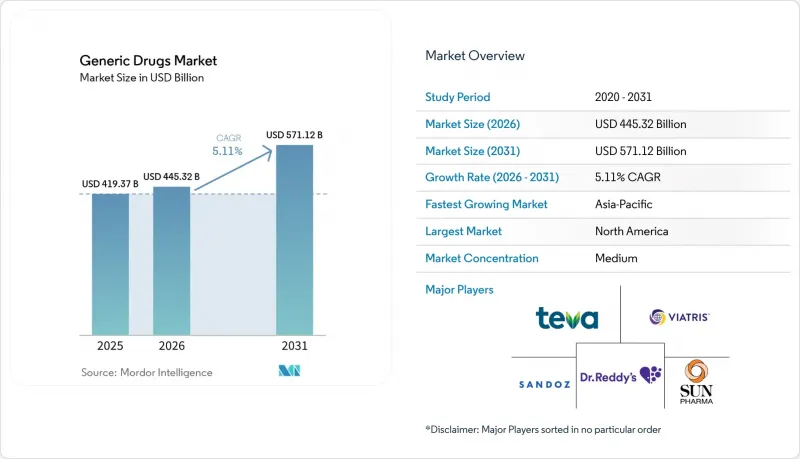
Mordor Intelligence에 의하면, 제네릭 의약품 시장 규모는 2025년 4,193억 7,000만 달러, 2026년 4,453억 2,000만 달러에서 2031년까지 5,711억 2,000만 달러로 확대되고, 2026-2031년 CAGR 5.11%를 나타낼 것으로 예측됩니다.
본 보고서는 제제 유형(일반 제네릭, 전문 제네릭, 바이오시밀러, 복합 제네릭), 치료 분야(순환기계 등), 투여 경로(경구, 주사제 등), 유통 채널(소매 약국 등) 및 지역(북미, 유럽, 아시아태평양, 중동 및 아프리카, 남미)별로 분류되어 있습니다. 시장 전망은 금액(달러) 기준으로 제시되어 있습니다.
세계 제네릭 의약품 시장 동향과 인사이트
2026년 이후 블록버스터 의약품의 특허 만료
2026년부터 2028년 사이에 예정된 특허 만료로 인해, 연간 약 400억 달러 규모의 브랜드 의약품 매출이 제네릭 의약품 시장으로 유입될 것으로 예측됩니다. 시타글립틴, 아피사반, 다비가트란, 치카그레롤이 상위권을 차지하고 있으며, 선출원자는 6개월 이내에 오리지널 의약품 판매량의 최대 70%를 확보할 가능성이 있습니다. 현재, 독점권이 만료되면 처방 지침에 따라 30일간의 대체 투여 규칙이 적용되므로, 브랜드에 대한 충성도가 유지되는 기간이 단축되고 있습니다. 당뇨병, 항응고제, 심혈관 질환 각 부문에서 독점권이 소멸됨에 따라, 2028년까지 150억 달러 상당의 조달 예산이 제네릭 의약품 공급업체로 이동할 것으로 예측됩니다.
의료 예산에 대한 압박 증가
미국 메디케어·메디케이드 서비스 센터(CMS)는 2026년 시행을 목표로 지출액이 높은 10종 의약품의 협상 가격을 38%-79% 인하하여, 저비용 치료법에 대한 지불자의 선호도를 더욱 강화하고 있습니다. 유럽 당국은 기준 가격 제도를 유지하고 있는 반면, 신흥 시장에서는 더 큰 폭의 가격 인하를 확보하기 위해 입찰 주기를 연장하고 있습니다. 아시아태평양에서는 정부의 일괄 구매 프로그램을 통해 입찰 전 가격 대비 50% 이상의 비용 절감이 실현되었으며, 그 자금이 병원 인프라 구축에 재투자되고 있습니다. 이러한 조치로 인해 유병률이 높은 만성 질환 분야에서 브랜드 의약품 지출이 감소하는 동시에 제네릭 의약품의 조달량이 확대되고 있습니다.
치열한 경쟁에 따른 심각한 가격 하락
4개 이상의 진출기업이 동시에 제품을 출시하면 제네릭 의약품 가격은 90% 하락합니다. 이러한 경향은 2020년부터 2024년에 걸쳐 200개의 분자에서 관찰되었습니다. 메디케어의 협상 가격에 따라 메디케이드 및 민간 보험사에서도 유사한 가격 인하가 가속화될 것으로 예상되며, 2025년까지 아토르바스타틴의 미국 소매 가격은 1정당 0.03달러까지 떨어질 전망입니다. 독점 기간은 초기 진출기업을 보호하지만, 경쟁이 확대되면 6개월 이내에 이익률이 무너집니다. 각 기업은 복잡한 제네릭 의약품이나 바이오시밀러로의 전환을 통해 이러한 압박을 상쇄하려 하고 있지만, 각 후보 제품마다 1,000만-5,000만 달러의 개발비가 필요하기 때문에 포트폴리오의 리스크가 높아지고 있습니다.
부문 분석
2025년 매출의 62.31%를 단순 제네릭이 차지할 것으로 예상되며, 그 주된 요인은 고혈압, 당뇨병, 고지혈증 치료에 사용되는 대량 판매 경구용 고형제입니다. 바이오시밀러는 휴미라의 미국 판매량의 45%를 차지하는 8개의 아달리무맙 제품이 주도하며, 2031년까지 연평균 성장률(CAGR) 6.89%를 기록할 전망입니다. 전문의약품 및 복합 제네릭 의약품은 1,000만-1,500만 달러의 개발 투자가 필요하지만, 기준 가격의 40%-60%를 유지할 수 있기 때문에 단순 제네릭 의약품의 가격이 한계 비용에 근접하더라도 이익률의 안정성을 확보할 수 있습니다.
상호 대체성 인정은 소매 현장에서의 도입을 가속화하고 있습니다. 2024년 ‘Cyltezo’의 적응증 확대로 인해 처방 의사의 개입 없이 약국 수준에서 대체가 가능해져, 보다 광범위한 접근성이 촉진될 것입니다. 메디케어 어드밴티지 플랜에서는 대상 처방전의 80%에 대해 바이오시밀러 조제가 의무화되어 있지만, 민간 보험 플랜에서는 참조 생물학적 제제를 우대하는 리베이트 계약으로 인해 그 비율은 50%에 그치고 있습니다. 보험사가 비용 절감 목표에 맞추어 약제 목록을 조정하는 가운데, 제네릭 의약품 시장은 자가면역 질환, 종양학, 대사성 질환 치료를 아우르는 확대되는 바이오시밀러 파이프라인의 혜택을 받고 있습니다.
심혈관계 약물은 수십 년간 사용되어 온 스타틴과 베타 차단제가 증가하는 만성 질환 유병률에 지속적으로 대응하고 있어, 2025년에도 매출 점유율 56.73%를 유지했습니다. 한편, 종양학 분야는 베바시주맙, 트라스투주맙, 리툭시맙 바이오시밀러의 확산에 힘입어 치료 분야 중 가장 높은 연평균 성장률(CAGR) 7.34%를 나타낼 것으로 예측됩니다. 종양학 분야의 신규 진입으로 인해 병원 처방약 목록에서 제네릭 의약품 시장 점유율이 강화되고 있으며, 바이오시밀러 도입으로 환자 1인당 연간 최대 20만 달러의 화학요법 비용이 절감되고 있습니다.
2024년 FDA가 승인한 이마티닙, 엘로티닙, 니로티닙의 제네릭 의약품으로 인해 대체 파이프라인에 참조 제품의 매출액이 30억 달러 추가되었습니다. 병원에서는 정맥주사 센터의 업무 흐름을 유지하면서, 보험사가 급여 대상으로 지정하는 항암제 바이오시밀러를 적극적으로 도입하고 있습니다. 대조적으로, 항감염제의 성장은 약물 적정 사용 프로그램에 의해 억제되고 있으며, 중추신경계(CNS) 약물은 한계 원가에 가까운 수준에서 거래되고 있어 신규 진입의 여지는 극히 적습니다. 호흡기 계통 제네릭 의약품은 흡입 기술을 통해 성장세를 보이고 있으며, 플루티카손·살메테롤 및 부데소니드·포르모테롤 흡입제는 견조한 판매량 증가가 예상됩니다.
지역별 분석
북미는 메디케어 파트 D 및 메디케이드의 구매력을 바탕으로 2025년에는 매출의 42.76%를 차지했습니다. FDA는 2024년에 76종의 1세대 제네릭 의약품을 승인했으며, 이로 인해 브랜드 의약품 매출 중 80억 달러가 대체 대상이 되었습니다. 캐나다 가격심사위원회는 15종 의약품의 상한가를 인하하여 국경을 넘는 차익 거래를 억제했습니다. 멕시코의 COFEPRIS는 생물학적 동등성 심사 기간을 10개월로 단축하여 지역 내 공급 체계를 강화했습니다. 예측 기간 동안, 미국의 ‘인플레이션 억제법’에 따른 협상 대상은 10개 품목에서 60개 품목으로 확대될 것으로 예상되며, 이에 따라 지불 주체의 협상력이 강화되어 제네릭 의약품의 채택이 촉진될 것입니다.
아시아태평양은 2031년까지 연평균 성장률(CAGR) 7.89%를 나타낼 것으로 예측되며, 제네릭 의약품 시장에서 가장 빠른 지역 성장을 보이고 있습니다. 인도의 20억 달러 규모의 ‘생산 연계형 인센티브’는 원료의약품(API)의 자급자족을 촉진하고 있는 반면, 중국의 품질 균일성 평가는 임상시험 능력을 갖춘 제조업체를 중심으로 업계를 재편하고 있습니다. 일본은 2025년까지 대체율 목표를 85%로 상향 조정했으며, 호주의 의약품 급여 제도(PBS)는 2024년에 120개의 분자를 추가하여 접근성을 확대했습니다. 이러한 정책 전환으로 인해 승인이 가속화되고, 급성장 중인 만성 질환 분야에서 시장 침투가 심화되고 있습니다.
유럽에서는 독일의 AMNOG 기준 가격 제도나, 2025년까지 아달리무맙의 80%를 제네릭 의약품으로 대체하도록 의무화하는 프랑스의 바이오시밀러 할당 제도와 같은 비용 억제책을 통해 안정적인 성장을 유지하고 있습니다. 유럽의약품청(EMA)은 2024년에 45개의 제네릭 의약품 및 바이오시밀러를 승인했으며, 여기에는 기준 매출액 30억 유로에 해당하는 우스테키누맙 및 베바시주맙 제품이 포함되어 있습니다. 중동 및 아프리카 시장에서는 조달 다각화를 위해 WHO의 사전 인증 제도가 채택되고 있는 반면, 남아프리카공화국에서는 세계 펀드의 입찰에서 HIV 및 결핵 치료용 제네릭 의약품이 우선적으로 선정되고 있습니다. 남미에서는 브라질의 생물학적 동등성 시험 기간 단축이 호재로 작용하고 있는 반면, 아르헨티나에서는 거시경제의 변동으로 인해 현지 기업들이 공급 공백을 메우려는 움직임이 나타나고 있습니다.
기타 혜택:
- 엑셀 형식 시장 예측(ME) 시트
- 3개월간의 애널리스트 지원
자주 묻는 질문
목차
제1장 서론
제2장 조사 방법
제3장 주요 요약
제4장 시장 구도
제5장 시장 규모와 성장 예측
제6장 경쟁 구도
제7장 시장 기회와 향후 전망
KTH 26.08.06According to Mordor Intelligence, the generic drugs market size is projected to expand from USD 419.37 billion in 2025 and USD 445.32 billion in 2026 to USD 571.12 billion by 2031, registering a CAGR of 5.11% between 2026 to 2031.
This report is Segmented by Drug Type (Simple Generics, Specialty Generics, Biosimilars, Complex Generics), Therapeutic Area (Cardiovascular, and More), Route of Administration (Oral, Injectable, and More), Distribution Channel (Retail Pharmacies, and More), and Geography (North America, Europe, Asia-Pacific, Middle East & Africa, South America). The Market Forecasts are Provided in Terms of Value (USD).
Global Generic Drugs Market Trends and Insights
Expiry of Blockbuster Drug Patents Post-2026
Patent expiries scheduled between 2026 and 2028 are expected to release approximately USD 40 billion in annual branded revenue to the generic drugs market. Sitagliptin, apixaban, dabigatran, and ticagrelor top the list, and first-to-file applicants can capture up to 70% of originator volume within six months. Formularies now impose 30-day substitution rules once exclusivity lapses, shrinking brand-loyalty windows. As diabetes, anticoagulation, and cardiovascular categories lose exclusivity, procurement budgets worth USD 15 billion are expected to shift to generic suppliers by 2028.
Escalating Pressure on Healthcare Budgets
The U.S. Centers for Medicare & Medicaid Services cut negotiated prices for 10 high-spend drugs by 38%-79% for 2026 implementation, reinforcing payer preference for low-cost therapies. European authorities maintain reference-pricing frameworks, while emerging markets extend tender cycles to secure deeper discounts. In the Asia-Pacific region, government bulk-purchase programs deliver savings exceeding 50% of pre-tender prices, redirecting funds toward hospital infrastructure upgrades. These measures decrease branded spend and allocate larger volumes to generics across high-prevalence chronic diseases.
Severe Price Erosion from Intense Competition
Generic prices fall by 90% when four or more entrants launch simultaneously, a pattern observed across 200 molecules from 2020 to 2024. Medicare's negotiated pricing is expected to accelerate similar cuts at Medicaid and commercial payers, compressing atorvastatin U.S. retail prices to USD 0.03 per tablet by 2025. Exclusivity periods cushion early entrants, but widespread competition collapses margins within six months. Firms offset pressure by pivoting toward complex generics and biosimilars; however, each candidate requires USD 10 million-USD 50 million in development expenditures, thereby heightening portfolio risk.
Other drivers and restraints analyzed in the detailed report include:
- Favorable Government Initiatives & Reimbursement Policies
- Accelerated FDA ANDA Approvals Under GDUFA III
- Nitrosamine Impurity Compliance Costs
For complete list of drivers and restraints, kindly check the Table Of Contents.
Segment Analysis
Simple generics accounted for 62.31% of 2025 revenue, primarily driven by high-volume oral solids for the treatment of hypertension, diabetes, and hyperlipidemia. Biosimilars, led by eight adalimumab products capturing 45% of Humira's U.S. volume, will expand at a 6.89% CAGR through 2031. Specialty and complex generics require USD 10 million-USD 15 million in development investment yet preserve 40%-60% of reference pricing, offering margin stability when simple-generic prices approach marginal cost.
Interchangeability designations accelerate uptake in retail settings; Cyltezo's 2024 label expansion permits pharmacy-level substitution without prescriber intervention, driving broader access. Medicare Advantage plans now require biosimilar dispensing in 80% of eligible prescriptions, while commercial plans stand at 50% due to rebate contracts that favor reference biologics. As payers align formularies with cost-containment goals, the generic drugs market benefits from an expanding biosimilar pipeline covering autoimmune, oncology, and metabolic therapies.
Cardiovascular agents retained 56.73% revenue share in 2025 as decades-old statins and beta-blockers continue to serve rising chronic-disease prevalence. Oncology, however, is projected to record a 7.34% CAGR, the fastest among therapeutic categories, driven by bevacizumab, trastuzumab, and rituximab biosimilar penetration. Oncology additions strengthen the generic drugs market share in hospital formularies, where biosimilars reduce chemotherapy costs by up to USD 200,000 per patient annually.
FDA approvals for generic imatinib, erlotinib, and nilotinib in 2024 added USD 3 billion in reference-product volume to the substitution pipeline. Hospitals readily adopt oncology biosimilars that maintain infusion-center workflows and earn payer coverage. In contrast, anti-infective growth is tempered by stewardship programs, while CNS drugs trade near marginal cost, leaving minimal room for new entrants. Respiratory generics gain traction through inhalable technologies, with fluticasone-salmeterol and budesonide-formoterol inhalers projecting robust volume growth.
Complete Report Scope:
- By Drug Type
- Simple Generics
- Specialty Generics
- Biosimilars
- Complex Generics
- By Therapeutic Area
- Cardiovascular
- Oncology
- Anti-Infective
- Central Nervous System
- Endocrine/Metabolic
- Respiratory
- Others
- By Route of Administration
- Oral
- Injectable
- Topical
- Inhalable
- Other Route of Administration
- By Distribution Channel
- Retail Pharmacies
- Hospital Pharmacies
- Online Pharmacies
- Other Distribution Channel
- By Geography
- North America
- United States
- Canada
- Mexico
- Europe
- Germany
- United Kingdom
- France
- Italy
- Spain
- Rest of Europe
- Asia-Pacific
- China
- Japan
- India
- Australia
- South Korea
- Rest of Asia-Pacific
- Middle East & Africa
- GCC
- South Africa
- Rest of Middle East & Africa
- South America
- Brazil
- Argentina
- Rest of South America
- North America
Geography Analysis
North America secured 42.76% revenue in 2025, underpinned by Medicare Part D and Medicaid purchasing power. The FDA authorized 76 first-generation generics in 2024, releasing USD 8 billion in branded sales for substitution. Canada's price review board trimmed ceiling prices for 15 drugs, lessening cross-border arbitrage. Mexico's COFEPRIS cut bioequivalence review times to 10 months, strengthening regional supply. Over the forecast period, U.S. Inflation Reduction Act negotiations are expected to widen from 10 to 60 drugs, thereby magnifying payer leverage and reinforcing the adoption of generics.
The Asia-Pacific region is projected to record a 7.89% CAGR through 2031, representing the fastest regional growth in the generic drugs market. India's USD 2 billion Production-Linked Incentive stimulates API self-reliance, while China's consistency evaluations consolidate manufacturers around those with clinical-trial capacity. Japan lifted substitution targets to 85% by 2025, and Australia's Pharmaceutical Benefits Scheme added 120 molecules in 2024, expanding access. These policy shifts accelerate approvals and deepen penetration across rapidly growing chronic disease segments.
Europe maintains stable growth through cost-containment tools, such as Germany's AMNOG reference pricing and France's biosimilar quotas, which mandate 80% substitution for adalimumab by 2025. EMA cleared 45 generics and biosimilars in 2024, including ustekinumab and bevacizumab products worth EUR 3 billion in reference sales. Middle East and Africa markets adopt the WHO prequalification to diversify procurement, while South Africa prioritized HIV and tuberculosis generics in Global Fund tenders. South America benefits from Brazil's shortened bioequivalence timelines; however, Argentina's macroeconomic volatility prompts local firms to fill supply gaps.
- Alvogen
- Apotex
- Aurobindo Pharma Ltd.
- Cipla
- Dr. Reddy's Laboratories Ltd.
- Endo International
- Fresenius
- Glenmark Pharmaceuticals
- Hikma Pharmaceuticals
- KRKA d.d.
- Lupin
- Nichi-Iko Pharmaceutical Co., Ltd.
- Sandoz Group AG
- Sawai Pharmaceutical Co., Ltd.
- Stada Arzneimittel
- Sun Pharmaceuticals Industries
- Teva Pharmaceutical Industries
- Torrent Pharmaceuticals
- Viatris
- Zydus Lifesciences Ltd.
Additional Benefits:
- The market estimate (ME) sheet in Excel format
- 3 months of analyst support
TABLE OF CONTENTS
1 Introduction
- 1.1 Study Assumptions & Market Definition
- 1.2 Scope of the Study
2 Research Methodology
3 Executive Summary
4 Market Landscape
- 4.1 Market Overview
- 4.2 Market Drivers
- 4.2.1 Expiry of Blockbuster Drug Patents Post-2026
- 4.2.2 Escalating Pressure on Healthcare Budgets
- 4.2.3 Favorable Government Initiatives & Reimbursement Policies
- 4.2.4 Accelerated FDA ANDA Approvals Under GDUFA III
- 4.2.5 Rise of Complex Generics (Drug-Device Combinations)
- 4.2.6 AI-Driven Bioequivalence Modeling Shortening Development Cycles
- 4.3 Market Restraints
- 4.3.1 Severe Price Erosion from Intense Competition
- 4.3.2 Supply-Chain Quality Issues & Product Recalls
- 4.3.3 API Manufacturing Concentration Outside Asia
- 4.3.4 Nitrosamine Impurity Compliance Costs
- 4.4 Regulatory Landscape
- 4.5 Technological Outlook
- 4.6 Porter's Five Forces Analysis
- 4.6.1 Threat of New Entrants
- 4.6.2 Bargaining Power of Buyers
- 4.6.3 Bargaining Power of Suppliers
- 4.6.4 Threat of Substitutes
- 4.6.5 Competitive Rivalry
5 Market Size & Growth Forecasts
- 5.1 By Drug Type
- 5.1.1 Simple Generics
- 5.1.2 Specialty Generics
- 5.1.3 Biosimilars
- 5.1.4 Complex Generics
- 5.2 By Therapeutic Area
- 5.2.1 Cardiovascular
- 5.2.2 Oncology
- 5.2.3 Anti-Infective
- 5.2.4 Central Nervous System
- 5.2.5 Endocrine/Metabolic
- 5.2.6 Respiratory
- 5.2.7 Others
- 5.3 By Route of Administration
- 5.3.1 Oral
- 5.3.2 Injectable
- 5.3.3 Topical
- 5.3.4 Inhalable
- 5.3.5 Other Route of Administration
- 5.4 By Distribution Channel
- 5.4.1 Retail Pharmacies
- 5.4.2 Hospital Pharmacies
- 5.4.3 Online Pharmacies
- 5.4.4 Other Distribution Channel
- 5.5 By Geography
- 5.5.1 North America
- 5.5.1.1 United States
- 5.5.1.2 Canada
- 5.5.1.3 Mexico
- 5.5.2 Europe
- 5.5.2.1 Germany
- 5.5.2.2 United Kingdom
- 5.5.2.3 France
- 5.5.2.4 Italy
- 5.5.2.5 Spain
- 5.5.2.6 Rest of Europe
- 5.5.3 Asia-Pacific
- 5.5.3.1 China
- 5.5.3.2 Japan
- 5.5.3.3 India
- 5.5.3.4 Australia
- 5.5.3.5 South Korea
- 5.5.3.6 Rest of Asia-Pacific
- 5.5.4 Middle East & Africa
- 5.5.4.1 GCC
- 5.5.4.2 South Africa
- 5.5.4.3 Rest of Middle East & Africa
- 5.5.5 South America
- 5.5.5.1 Brazil
- 5.5.5.2 Argentina
- 5.5.5.3 Rest of South America
- 5.5.1 North America
6 Competitive Landscape
- 6.1 Market Concentration
- 6.2 Market Share Analysis
- 6.3 Company Profiles (includes Global level Overview, Market-level Overview, Core Segments, Financials, Strategic Information, Market Rank/Share, Products & Services, Recent Developments)
- 6.3.1 Alvogen
- 6.3.2 Apotex Inc.
- 6.3.3 Aurobindo Pharma Ltd.
- 6.3.4 Cipla Ltd.
- 6.3.5 Dr. Reddy's Laboratories Ltd.
- 6.3.6 Endo International plc
- 6.3.7 Fresenius Kabi AG
- 6.3.8 Glenmark Pharmaceuticals Ltd.
- 6.3.9 Hikma Pharmaceuticals plc
- 6.3.10 KRKA d.d.
- 6.3.11 Lupin Ltd.
- 6.3.12 Nichi-Iko Pharmaceutical Co., Ltd.
- 6.3.13 Sandoz Group AG
- 6.3.14 Sawai Pharmaceutical Co., Ltd.
- 6.3.15 STADA Arzneimittel AG
- 6.3.16 Sun Pharmaceutical Industries Ltd.
- 6.3.17 Teva Pharmaceutical Industries Ltd.
- 6.3.18 Torrent Pharmaceuticals Ltd.
- 6.3.19 Viatris Inc.
- 6.3.20 Zydus Lifesciences Ltd.
7 Market Opportunities & Future Outlook
- 7.1 White-space & Unmet-need Assessment


