

|
시장보고서
상품코드
2097202
암 생검 : 시장 점유율 분석, 업계 동향 및 통계, 성장 예측(2026-2031년)Cancer Biopsy - Market Share Analysis, Industry Trends & Statistics, Growth Forecasts (2026 - 2031) |
||||||
 Mordor Intelligence
에 의하면, 암 생검 시장 규모는 2025년에 333억 6,000만 달러로 평가되었습니다. 2026년 371억 2,000만 달러에서 2031년까지 631억 7,000만 달러에 이를 것으로 예상되며, 예측 기간(2026-2031년) CAGR은 11.27%를 나타낼 전망입니다.
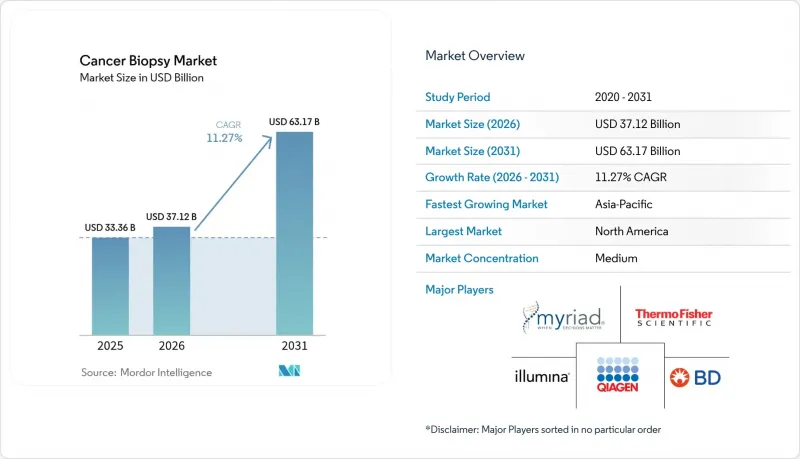
본 보고서는 제품별(기기, 키트 및 소모품 등), 시술별(조직 생검(코어 바늘 등) 및 체액 생검(혈액, 소변 등)), 암 유형별(유방암, 대장암, 자궁경부암, 폐암 등), 최종 사용자별(병원, 진단실험실 등), 지역별(북미, 유럽, 아시아태평양 등)로 분류되어 있습니다. 시장 전망은 금액(달러) 기준으로 제시되어 있습니다.
세계의 암 생검 시장 동향 및 인사이트
전 세계 암 부담 증가와 고령화
암 발생률은 2040년까지 47% 증가할 것으로 예측되며, 이러한 변화로 인해 진단 서비스 제공업체의 장기적 목표 시장이 확대되고 있습니다. 중국 등 시장에서는 3차원 CT 재구성을 기반으로 한 전국적인 폐암 프로토콜이 이미 도입되어, 조기 발견률 향상과 선별 검사 건수 증가로 이어지고 있습니다. 암을 앓으면서도 장수하는 고령 환자층 증가와 신흥 경제국에서의 만성 질환 대응 인프라 확충이 맞물리면서, 조직 검사 및 체액 검사 모두에서 수요 곡선은 가파른 상승세를 유지하고 있습니다. 생존자 수 증가 또한 분자 수준에서 잔존 병변에 대한 정기적인 모니터링을 지속시키는 요인이 되어, 초기 진단 후 검사 이용을 촉진하고 있습니다. 인구 규모 단위의 선별 검사가 표준화됨에 따라, 보험사 측은 조기 발견을 단순한 추가 비용이 아닌 비용 절감 전략으로 인식하기 시작했습니다.
NGS를 활용한 체액 생검의 기술적 진보
차세대 염기서열 분석과 혈액 기반 검사법의 융합으로, 현재는 혈장 1병만으로도 종합적인 유전체 프로파일링이 가능해졌습니다. 2024년 11월, 비소세포폐암의 동반진단 용도로 ‘FoundationOne Liquid CDx’가 FDA 승인을 받은 것은 이 플랫폼의 임상적 타당성을 입증한 것이었습니다. 옥스포드 나노포어(Oxford Nanopore)사의 실시간 시퀀싱 기술은 2시간 이내에 구조적 변이 및 메틸화 시그니처를 검출할 수 있어, 검체 채취부터 치료 결정까지의 피드백 루프를 단축하고 있습니다. MRD-EDGE 워크플로우와 같은 학술적 실증 사례를 통해 분석 감도가 100만 분의 1 수준까지 향상되어 재발의 조기 감지가 가능해졌습니다. 이러한 혁신을 통해 암 생검 시장은 단순한 확정 진단 도구에서 질병 경과 관리를 수행하는 플랫폼으로 그 위상을 변화시키고 있습니다.
고액의 검사 비용과 불균일한 보험 적용
종합적인 액체 생검 패널의 비용은 검체 1개당 3,000달러를 초과하는 경우가 많으며, 이 가격은 북미나 서유럽 이외의 많은 지불 주체에게 여전히 감당하기 어려운 수준입니다. 본인 부담금이 여전히 일반적인 신흥국에서는 보험 보급률이 낮아, 질병 부담이 높음에도 불구하고 검사 이용이 제한되고 있습니다. 미국에서도 민간 보험사는 메디케어보다 최대 2년 늦게 보험 적용을 승인하는 경우가 많아, 검사 기관에 수익 격차가 발생하고 있습니다. 또한 검사 기관은 자동 추출 장치나 시퀀싱 장치 도입에 막대한 초기 투자를 감수해야 하며, 이러한 비용이 소규모 지역 사업자 시장 진입을 가로막고 있습니다. 공급망의 규모 확대와 경쟁으로 인해 키트 가격이 하락하기 전까지는 경제적 장벽이 이 기술의 광범위한 보급을 지연시킬 것입니다.
부문 분석
바늘을 사용하는 기기는 2025년 매출의 38.02%를 차지했으며, 이는 병원 내 조직 채취에서 그 역할이 확고히 자리 잡았음을 반영합니다. 그러나 검사 기관들이 인적 오류를 줄이고 고정비를 변동비로 전환하는 자동화된 카트리지 방식의 프로토콜로 전환함에 따라, 암 생검용 키트 및 소모품 시장 규모는 2026년부터 2031년까지 연평균 성장률(CAGR) 12.05%로 성장할 것으로 예측됩니다. QIAGEN사가 2026년 출시를 발표한 ‘QIAsymphony Connect’는 1교대당 192개의 검체를 처리할 수 있어, 검사당 시약 수요를 견인함과 동시에 지속적인 수익 모델을 확립할 것입니다.
장비는 여전히 필수적이지만, 구매자들이 고수익성 소모품 분야에 예산을 할당함에 따라 가격 압박에 직면하고 있습니다. AI 엔진이 추가된 ‘Ingenuity Pathway Analysis’와 같은 소프트웨어 및 바이오정보학 제품군은 변이 주석 처리 시간을 단축하고 벤더 종속성을 강화합니다. 가이드 시스템 및 진공 보조 장치는 촉각 피드백과 조직 양이 중요한 틈새 시술 분야를 차지하고 있으며, 이 분야의 성장은 꾸준하지만 눈부신 수준은 아닙니다. 예측 기간 동안, cfDNA 채취 튜브에서 시퀀싱 카트리지에 이르는 소모품 라인의 확장은 의료 제공업체들이 검사당 예측 가능한 비용 구조를 선호함에 따라, 전체 암 생검 시장 매출에서 차지하는 비중을 높여갈 것입니다.
2025년에도 조직 생검은 여전히 암 생검 시장 점유율의 65.12%를 차지했지만, 기술의 성숙에 따라 체액 검사 기법이 지출에서 더 큰 비중을 차지하게 될 것입니다. 코어 바늘 생검은 진단적 수율과 환자의 불편감 사이에서 균형을 잘 맞추고 있어, 많은 고형 종양에서 여전히 선호되고 있습니다. 세침 흡인 생검은 해부학적으로 접근하기 어려운 부위의 검사에 적합하지만, 멀티오믹스 프로파일링에 활용할 수 있는 검체량은 제한적입니다.
복잡한 병변에 대해서는 외과적 절제가 계속 시행되고 있지만, 다학제적 종양 검토 회의에서 혈액 검사의 신뢰성이 높아짐에 따라 그 빈도는 감소하는 추세입니다. 체액 검사 분야에서는 지속적인 검체 채취의 용이성과 최근의 규제 승인을 배경으로 혈액 검사가 주류를 이루고 있습니다. 비뇨기계 암의 경우 소변을 이용한 검사 워크플로가 확대되고 있으며, 타액 및 뇌척수액 프로파일링에 대한 연구가 진행됨에 따라 생검이 어려운 다른 적응증에 대해서도 검사 항목이 확대되고 있습니다. 향후 5년 동안 초기 비침습적 선별 검사에 이어 조직을 통한 확인을 진행하는 하이브리드 방식이 일반화될 것이며, 1차 선택지인 외과적 생검 건수는 점차 감소하고, 설비 투자 예산은 고처리량 혈장 검사실로 전환될 것입니다.
지역별 분석
북미는 메디케어의 보험 적용, 15개 주에서의 바이오마커 검사 의무화, 그리고 FDA의 지속적인 의료기기 승인 흐름에 힘입어 2025년에는 전 세계 매출의 38.35%를 차지했습니다. 캐나다는 주 간에 통일된 환급 제도와 증가하는 정밀의료 시범 프로젝트의 혜택을 받고 있는 반면, 멕시코의 의료기기 수출 거점은 경쟁력 있는 가격으로 일회용 생검 키트를 공급하고 있습니다. 아시아태평양은 가장 빠르게 성장하는 시장으로, 2031년까지 연평균 성장률(CAGR) 14.03%로 성장을 지속하고, 있습니다. 중국에서 폐암 검진을 위한 3차원 CT 재구성 프로토콜 및 AI를 활용한 결절 우선순위 지정은 이미 각 성의 의료 센터로 확대되어, 검사 건수 증가와 일괄 조달 입찰 창출로 이어지고 있습니다. 인도에서는 AIIMS가 주도하는 지역 병원에 대한 딥러닝 진단 기술 도입이 자원이 제한된 환경에서 획기적인 도입 사례를 보여주고 있는 반면, 일본에서는 Guardant360 CDx가 동반 진단법으로 승인됨에 따라 국내 종양 의료가 국제 기준에 부합하게 되었습니다.
유럽에서는 국경을 초월한 연구 프로그램과 조화로운 CE-IVD 규제의 뒷받침을 받아 보다 꾸준한 속도로 발전하고 있습니다. AI를 활용한 조직병리학의 보급에 더해, 영국과 프랑스의 국가 차원 유전체 이니셔티브가 분자 생검 접근법의 보다 광범위한 도입을 뒷받침하고 있습니다. 그러나 회원국 간의 보험 급여 제도 격차로 인해 민간 검사 기관은 체액 검사가 완전히 공공 자금 지원 대상이 되기까지 종종 수년에 달하는 승인 절차를 겪어야 합니다. 중동 및 아프리카에서는 GCC(걸프협력회의)의 종합적 암 센터에 대한 투자와 인근 국가들로부터의 표적 의료 관광에 힘입어 완만한 확대세가 나타나고 있습니다. 사하라 이남 아프리카의 진단 역량 면에서는 남아프리카공화국이 주도적인 입지를 차지하고 있는 반면, 다른 많은 아프리카 시장에서는 시퀀싱 인프라가 부족하여 체액 생검이 널리 이용 가능해지기까지의 기간이 길어지고 있습니다.
남미의 전망은 밝지만, 변동이 심한 상황입니다. 브라질은 분자 스크리닝을 포함한 국가 암 대책 계획에 공적 자금을 투입하고 있으며, 아르헨티나의 생의학 클러스터에서는 비용 절감을 목적으로 시약의 현지 생산을 시범적으로 추진하고 있습니다. 그러나 환율 변동과 규제 차이로 인해 다국적 공급업체의 국경을 넘는 사업 확장이 정체될 가능성이 있습니다.
전반적으로 지리적 동향은 암 생검 시장이 신흥 경제국으로 서서히 재균형화되고 있음을 시사하지만, 2030년까지는 북미 및 유럽의 지불자 제도가 고부가가치 검사의 수익을 계속 뒷받침할 것입니다.
기타 혜택 :
- 엑셀 형식 시장 예측(ME) 시트
- 3개월간의 애널리스트 지원
자주 묻는 질문
목차
제1장 서론
제2장 조사 방법
제3장 주요 요약
제4장 시장 구도
제5장 시장 규모 및 성장 예측
제6장 경쟁 구도
제7장 시장 기회 및 향후 전망
KTH 26.08.05According to Mordor Intelligence, the cancer biopsy market size was valued at USD 33.36 billion in 2025 and estimated to grow from USD 37.12 billion in 2026 to reach USD 63.17 billion by 2031, at a CAGR of 11.27% during the forecast period (2026-2031).
This report is Segmented by Product (Instruments, Kits and Consumables, and More), Procedure (Tissue Biopsy [Core Needle, and More], and Liquid Biopsy [Blood, Urine and More]), Cancer Type (Breast, Colorectal, Cervical, Lung, and More), End User (Hospitals, Diagnostic Laboratories, and More), and Geography (North America, Europe, Asia-Pacific, and More). The Market Forecasts are Provided in Terms of Value (USD).
Global Cancer Biopsy Market Trends and Insights
Rising Global Oncology Burden & Ageing Population
Cancer incidence is expected to rise 47% by 2040, a shift that is enlarging the long-run addressable base for diagnostic providers. In markets such as China, a national lung-cancer protocol built on three-dimensional CT reconstruction has already improved early-stage detection rates and driven screening volumes higher. The combination of older patient cohorts living longer with cancer and expanding chronic-disease infrastructure in emerging economies keeps the demand curve steep for both tissue and liquid tests. Growing survivor populations also sustain repeated molecular residual-disease monitoring, bolstering test utilisation after initial diagnosis. As population-scale screening becomes standard, payors are increasingly viewing early detection as a cost-containment strategy rather than an incremental expense.
Technological Advances in NGS-Enabled Liquid Biopsy
The convergence of next-generation sequencing with blood-based assays now allows comprehensive genomic profiling from a single tube of plasma. FDA endorsement of FoundationOne Liquid CDx for non-small-cell lung cancer companion uses in November 2024 underscored the platform's clinical validity. Oxford Nanopore's real-time sequencing can detect structural variants and methylation signatures in under two hours, narrowing the feedback loop between sampling and treatment decisions. Academic demonstrators such as the MRD-EDGE workflow have pushed analytic sensitivity to parts-per-million ranges, enabling earlier relapse detection. These innovations are repositioning the cancer biopsy market from a confirmatory tool into a longitudinal disease-management platform.
High Test Costs & Patchy Reimbursement Coverage
Comprehensive liquid biopsy panels often exceed USD 3,000 per sample, a price still out of reach for many payors outside North America and Western Europe. In emerging economies where out-of-pocket spending remains common, limited insurance penetration suppresses test utilisation despite high disease burden. Even in the United States, commercial insurers frequently trail Medicare by up to two years before granting coverage, creating revenue gaps for laboratories. Laboratories also face heavy upfront capital expenditures for automated extraction and sequencing instruments, costs that discourage market entry by smaller regional players. Until supply-chain scale and competition compress kit pricing, economic barriers will slow uniform adoption.
Other drivers and restraints analyzed in the detailed report include:
- Patient Demand for Minimally-Invasive Diagnostics
- Reimbursement Wins & Regulatory Green-Lights for ctDNA Tests
- Procedural & Sampling-Error Risks (False Negatives)
For complete list of drivers and restraints, kindly check the Table Of Contents.
Segment Analysis
Needle-based devices captured 38.02% of 2025 revenue, reflecting their entrenched role in hospital-based tissue collection. The cancer biopsy market size for kits and consumables, however, is projected to grow at a 12.05% CAGR between 2026 and 2031 as laboratories pivot toward automated, cartridge-driven protocols that reduce human error and turn fixed costs into variable costs. QIAGEN's QIAsymphony Connect, announced for 2026 launch, can run 192 samples in a single shift, driving per-test reagent demand and anchoring a recurring revenue model.
Instruments remain essential but face price compression as buyers allocate budgets toward high-margin consumable streams. Software and bioinformatics suites such as Ingenuity Pathway Analysis, now expanded with an AI engine, improve variant annotation turnaround and reinforce vendor lock-in. Guidance systems and vacuum-assisted devices occupy niche procedure types where tactile feedback or tissue volume is critical; growth here is steady but not spectacular. Over the forecast window, consumable line-extensions-from cfDNA collection tubes to sequencing cartridges-will account for a rising share of overall cancer biopsy market revenue as providers favor predictable cost-per-test economics.
Tissue biopsies still accounted for 65.12% of cancer biopsy market share in 2025, yet liquid procedures will capture a growing slice of spending as technology matures. Core needle extraction remains preferred for many solid tumours because it balances diagnostic yield against patient discomfort. Fine-needle aspiration supports anatomically challenging sites but delivers limited material for multi-omic profiling.
Surgical excisions continue for complex lesions but are declining in frequency as blood-based assays gain confidence among multidisciplinary tumour boards. On the liquid side, blood tests dominate given the ease of serial sampling and recent regulatory wins. Urine-based workflows are scaling in urological cancers, and research into saliva and cerebrospinal fluid profiling extends test menus to other hard-to-biopsy indications. Throughout the next five years, hybrid pathways-initial non-invasive screen followed by tissue confirmation-will become common, gradually reducing the volume of first-line surgical biopsies and redirecting capital budgets to high-throughput plasma labs.
Complete Report Scope:
- By Product
- Instruments
- Kits & Consumables
- Software & Bioinformatics
- Needle-based Devices
- Vacuum-assisted Devices
- Guidance Systems
- By Procedure
- Tissue Biopsy
- Core Needle
- Fine-Needle Aspiration
- Surgical Excisional
- Liquid Biopsy
- Blood
- Urine
- Saliva
- Cerebrospinal Fluid
- Tissue Biopsy
- By Cancer Type
- Breast
- Lung
- Colorectal
- Prostate
- Cervical
- Pancreatic
- Melanoma
- Others
- By End User
- Hospitals
- Diagnostic Laboratories
- Ambulatory Surgical Centres
- Cancer Research Institutes
- Geography
- North America
- United States
- Canada
- Mexico
- Europe
- Germany
- United Kingdom
- France
- Italy
- Spain
- Rest of Europe
- Asia-Pacific
- China
- Japan
- India
- South Korea
- Australia
- Rest of Asia-Pacific
- Middle East and Africa
- GCC
- South Africa
- Rest of Middle East and Africa
- South America
- Brazil
- Argentina
- Rest of South America
- North America
Geography Analysis
North America generated 38.35% of global revenue in 2025, buoyed by Medicare coverage, biomarker mandates in 15 states and a constant stream of FDA device approvals. Canada benefits from unified reimbursement across provinces and a growing roster of precision-medicine pilot projects, while Mexico's medical-device export corridor supplies disposable biopsy kits at competitive prices. Asia-Pacific is the fastest-expanding theatre, logging a 14.03% CAGR through 2031. China's three-dimensional CT reconstruction pathway for lung-cancer screening and AI-assisted nodule triage has already scaled to provincial centres, lifting test volumes and creating bulk-procurement tenders. India's AIIMS-led deployment of deep-learning diagnostics into district hospitals showcases leap-frog adoption in resource-limited settings, while Japan's approval of Guardant360 CDx as a companion assay aligns domestic oncology care with global standards.
Europe advances at a steadier pace, aided by cross-border research programs and harmonised CE-IVD regulation. Uptake of AI-enabled histopathology, along with national genomics initiatives in the United Kingdom and France, supports broader adoption of molecular biopsy approaches. Nevertheless, reimbursement disparities among member states mean private laboratories often face multi-year approval cycles before liquid tests are fully funded. The Middle East and Africa region is experiencing moderate expansion, driven by GCC investments in comprehensive cancer centres and targeted tourism from neighbouring countries. South Africa leads sub-Saharan diagnostics capacity, whereas many other African markets lack sequencing infrastructure, extending the time to widespread liquid biopsy availability.
South America's outlook is positive yet volatile. Brazil is directing public funds toward national cancer-control plans that include molecular screening components, and Argentina's biomedical cluster is piloting local reagent manufacturing to lower costs. Currency fluctuations and regulatory heterogeneity, however, can stall cross-border expansion for multinational vendors.
Collectively, geographic trends signal a gradual rebalancing of the cancer biopsy market toward emerging economies, although North American and European payor systems will continue to anchor premium test revenue through 2030.
- Illumina
- QIAGEN
- Thermo Fisher Scientific
- Guardant Health
- Roche
- Hologic
- Danaher
- Beckton Dickinson
- Agilent Technologies
- Sysmex
- Myriad Genetics
- Exact Sciences
- Natera
- Bio-Rad Laboratories
- LabCorp
- Quest Diagnostics
- ANGLE
- Biocept
- Lucence Diagnostics
- GRAIL LLC
Additional Benefits:
- The market estimate (ME) sheet in Excel format
- 3 months of analyst support
TABLE OF CONTENTS
1 Introduction
- 1.1 Study Assumptions & Market Definition
- 1.2 Scope of the Study
2 Research Methodology
3 Executive Summary
4 Market Landscape
- 4.1 Market Overview
- 4.2 Market Drivers
- 4.2.1 Rising Global Oncology Burden & Ageing Population
- 4.2.2 Technological Advances In NGS-Enabled Liquid Biopsy
- 4.2.3 Patient Demand For Minimally-Invasive Diagnostics
- 4.2.4 Reimbursement Wins & Regulatory Green-Lights For Ctdna Tests
- 4.2.5 Real-Time Nanopore Sequencing & AI-Augmented Analytics
- 4.2.6 Point-Of-Care Biopsy Kits For Low-Resource Settings
- 4.3 Market Restraints
- 4.3.1 High Test Costs & Patchy Reimbursement Coverage
- 4.3.2 Procedural & Sampling-Error Risks (False Negatives)
- 4.3.3 Genomic-Data Privacy / Ownership Concerns
- 4.3.4 Liquid-Biopsy Sensitivity Gaps In Early-Stage Solid Tumours
- 4.4 Technological Outlook
- 4.5 Porter's Five Forces
- 4.5.1 Threat of New Entrants
- 4.5.2 Bargaining Power of Buyers
- 4.5.3 Bargaining Power of Suppliers
- 4.5.4 Threat of Substitutes
- 4.5.5 Intensity of Competitive Rivalry
5 Market Size & Growth Forecasts (Value, USD)
- 5.1 By Product
- 5.1.1 Instruments
- 5.1.2 Kits & Consumables
- 5.1.3 Software & Bioinformatics
- 5.1.4 Needle-based Devices
- 5.1.5 Vacuum-assisted Devices
- 5.1.6 Guidance Systems
- 5.2 By Procedure
- 5.2.1 Tissue Biopsy
- 5.2.1.1 Core Needle
- 5.2.1.2 Fine-Needle Aspiration
- 5.2.1.3 Surgical Excisional
- 5.2.2 Liquid Biopsy
- 5.2.2.1 Blood
- 5.2.2.2 Urine
- 5.2.2.3 Saliva
- 5.2.2.4 Cerebrospinal Fluid
- 5.2.1 Tissue Biopsy
- 5.3 By Cancer Type
- 5.3.1 Breast
- 5.3.2 Lung
- 5.3.3 Colorectal
- 5.3.4 Prostate
- 5.3.5 Cervical
- 5.3.6 Pancreatic
- 5.3.7 Melanoma
- 5.3.8 Others
- 5.4 By End User
- 5.4.1 Hospitals
- 5.4.2 Diagnostic Laboratories
- 5.4.3 Ambulatory Surgical Centres
- 5.4.4 Cancer Research Institutes
- 5.5 Geography
- 5.5.1 North America
- 5.5.1.1 United States
- 5.5.1.2 Canada
- 5.5.1.3 Mexico
- 5.5.2 Europe
- 5.5.2.1 Germany
- 5.5.2.2 United Kingdom
- 5.5.2.3 France
- 5.5.2.4 Italy
- 5.5.2.5 Spain
- 5.5.2.6 Rest of Europe
- 5.5.3 Asia-Pacific
- 5.5.3.1 China
- 5.5.3.2 Japan
- 5.5.3.3 India
- 5.5.3.4 South Korea
- 5.5.3.5 Australia
- 5.5.3.6 Rest of Asia-Pacific
- 5.5.4 Middle East and Africa
- 5.5.4.1 GCC
- 5.5.4.2 South Africa
- 5.5.4.3 Rest of Middle East and Africa
- 5.5.5 South America
- 5.5.5.1 Brazil
- 5.5.5.2 Argentina
- 5.5.5.3 Rest of South America
- 5.5.1 North America
6 Competitive Landscape
- 6.1 Market Concentration
- 6.2 Market Share Analysis
- 6.3 Company Profiles (includes Global level Overview, Market level overview, Core Segments, Financials as available, Strategic Information, Market Rank/Share for key companies, Products & Services, and Recent Developments)
- 6.3.1 Illumina Inc.
- 6.3.2 QIAGEN NV
- 6.3.3 Thermo Fisher Scientific
- 6.3.4 Guardant Health
- 6.3.5 F. Hoffmann-La Roche AG
- 6.3.6 Hologic Inc.
- 6.3.7 Danaher Corporation
- 6.3.8 Becton, Dickinson & Company
- 6.3.9 Agilent Technologies
- 6.3.10 Sysmex Corporation
- 6.3.11 Myriad Genetics
- 6.3.12 Exact Sciences
- 6.3.13 Natera Inc.
- 6.3.14 Bio-Rad Laboratories
- 6.3.15 Labcorp
- 6.3.16 Quest Diagnostics
- 6.3.17 ANGLE PLC
- 6.3.18 Biocept Inc.
- 6.3.19 Lucence Diagnostics
- 6.3.20 GRAIL LLC
7 Market Opportunities & Future Outlook
- 7.1 White-space & Unmet-Need Assessment


