|
시장보고서
상품코드
2097265
자동차용 IoT 시장 : 점유율 분석, 업계 동향 및 통계, 성장 예측(2025-2030년)Automotive IoT - Market Share Analysis, Industry Trends & Statistics, Growth Forecasts (2025 - 2030) |
||||||
 Mordor Intelligence
Mordor Intelligence에 의하면, 자동차용 IoT 시장 규모는 2025년에 1,898억 7,000만 달러가 되어, 2030년까지 4,416억 7,000만 달러에 이를 것으로 예측되며, 동기 사이에서 CAGR 18.39%로 성장할 전망입니다.
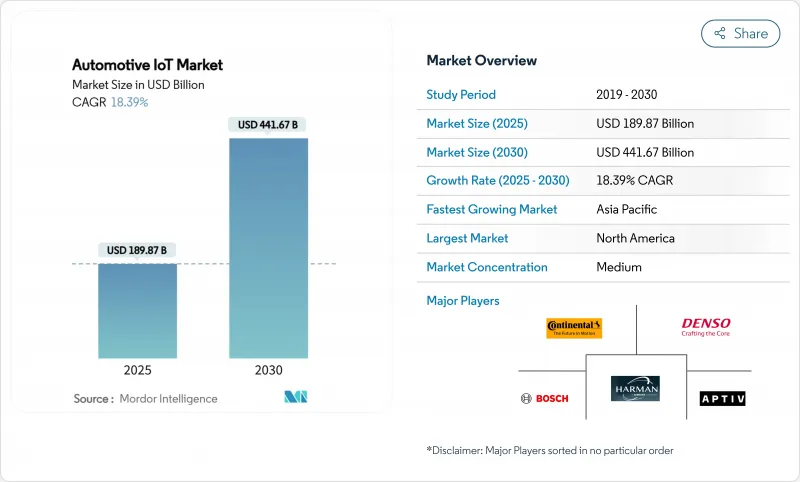
본 보고서는 구성 요소별(하드웨어, 소프트웨어, 서비스), 연결 형태별(임베디드형, 테더링형, 통합형), 용도별(텔레매틱스, 인포테인먼트 및 차량 내 서비스, ADAS(첨단 운전자 지원 시스템) 및 안전, 차량 관리, 예측 유지보수), 네트워크 기술별(셀룰러, 블루투스/BLE, 기타), 지역별로 분류되어 있습니다. 시장 예측은 금액(달러) 기준으로 제시되어 있습니다.
전 세계 자동차용 IoT 시장 동향 및 인사이트
소프트웨어 정의 차량(SDV)으로의 OEM의 급속한 전환
각 자동차 제조업체는 중앙 집중형 도메인 컨트롤러를 핵심으로 하는 전기 및 전자(E/E) 아키텍처 재구축을 추진하고 있습니다. 이를 통해 무선 업데이트(OTA)를 통한 기능 배포가 가능해지며, 개발 주기 단축 및 구독 수익 창출이 실현됩니다. BMW는 이미 전 차종에 대해 분기별 소프트웨어 릴리스를 전개하고 있으며, 이는 테슬라가 오랫동안 이어온 업데이트 주기를 반영한 것입니다. 또한, 중앙 집중형 네트워크를 통해 하드웨어의 다양성이 단순화되어 부품 원가 절감과 현장 진단 정확도 향상으로 이어집니다. 각 공급업체들도 이에 대응하고 있습니다. 보쉬(Bosch)는 2024년에 33억 9,000만 달러를 투자해 차량용 클라우드 플랫폼을 확장했으며, 콘티넨탈(Continental)은 엔지니어링 인력의 40%를 소프트웨어 관련 직무로 재교육했습니다. 이러한 움직임은 경쟁 우위가 기계적 기술력에서 지속적인 소프트웨어 혁신으로 이동하고 있음을 보여주며, 자동차용 IoT 시장 전체 수요를 뒷받침하고 있습니다.
eCall 및 텔레매틱스 관련 규제 의무화
유럽연합(EU)은 2018년 3월 이후 형식 승인을 받은 모든 신차에 대해 중대한 충돌 사고 발생 시 자동으로 응급 서비스에 신고하는 시스템인 ‘eCall’의 탑재를 의무화하고 있으며, 이를 통해 평균 대응 시간이 최대 50% 단축됩니다. 중국, 브라질, 인도에서도 유사한 규제가 시행되고 있으며, 인도의 AIS-140 규제는 상용차 차량군도 대상으로 하고 있습니다. 규제 준수는 필수적이므로, 거시경제가 침체된 시기에도 수요량은 보장됩니다. 이를 통해 규모의 경제가 실현되고, 부품 가격이 하락하며, 중가대 부문에서의 IoT 보급이 확대됩니다. 그 결과, 재량 지출이 둔화되더라도 자동차용 IoT 시장은 유지될 것입니다.
CAN 버스를 통한 레거시 통합의 지속적인 병목 현상
컨트롤러 영역 네트워크(CAN)의 통신 속도는 최대 10 Mbps 정도에 그치고 있으며, 이 상한선이 고해상도 센서 퓨전 및 지속적인 데이터 업로드를 제약하고 있습니다. 자동차용 이더넷으로의 전환에는 안전상 중요한 도메인에 대한 광범위한 재검증이 필요하며, 플랫폼 프로그램 기간이 여러 모델 연도에 걸쳐 진행되는 경우도 드물지 않습니다. 폭스바겐은 MEB 아키텍처에 중앙 집중식 네트워크를 사후 적용하기 위해 3년 동안 20억 유로를 지출했으며, 이는 이러한 전환에 드는 막대한 비용을 여실히 보여줍니다. 이러한 지연으로 인해 데이터 집약적 기능의 도입이 둔화되면서, 자동차용 IoT 시장의 총 잠재 시장 규모(TAV)가 일시적으로 정체되고 있습니다.
부문 분석
2024년에도 하드웨어는 자동차용 IoT 시장 매출의 46.83%를 차지하고 있으며, 이는 모든 커넥티드 플랫폼에 포함된 센서, 게이트웨이, 안테나가 뒷받침하고 있습니다. 한편, 서비스 부문은 가장 빠른 성장세를 보이고 있으며, 각 OEM 업체들이 데이터 대시보드, 기능 잠금 해제, 예측 유지보수 구독 서비스를 상용화함에 따라 2030년까지 연평균 성장률(CAGR) 20.94%로 확대될 것으로 전망됩니다. 서비스와 연계된 자동차용 IoT 시장 규모는 내비게이션, 엔터테인먼트, 보험 부가 서비스 분야의 ‘주행 거리 기반 과금(pay-as-you-drive)’ 모델의 확산을 반영하고 있습니다. 하드웨어의 상품화는 모듈의 평균 판매 가격(ASP) 하락과 플랫폼 간 호환성 향상에서 드러나며, Tier 1 공급업체의 이익률을 압박하고 있습니다.
테슬라의 수직 통합형 풀스택 아키텍처는 소프트웨어 수익을 극대화하며, 동종 업계 경쟁사들이 앞다퉈 따라 하려는 벤치마크를 확립하고 있습니다. 이에 대응해 콘티넨탈(Continental)은 소프트웨어 오케스트레이션을 위한 조직 개편을 단행했고, 보쉬(Bosch)는 미들웨어 및 툴체인 강화에 33억 9,000만 달러를 배정했습니다. 이러한 움직임은 서비스 중심의 자동차용 IoT 시장에서 점유율을 확보하기 위한 것으로, 이 시장에서는 고객 생애 가치(CLV)가 출하 대수가 아닌 월간 활성 사용자 수에 좌우됩니다. 차별화가 어려운 하드웨어 생산의 외주화는 더욱 진행될 전망이며, 이를 통해 클라우드 분석, 머신러닝을 통한 개인화, 차량 내 앱 생태계에 자원을 재배분할 수 있게 될 것입니다.
2024년에는 커넥티드카의 51.34%에 내장형 모뎀이 탑재되고, 이는 스마트폰 테더링의 번거로움에서 벗어나 원활하고 상시 연결이 가능한 서비스에 대한 소비자 수요가 뒷받침되었음을 보여줍니다. 내장형 옵션과 연계된 자동차용 IoT 시장 점유율은 데이터 흐름 및 보안 키를 관리하고자 하는 자동차 제조업체의 의지에 힘입어 성장하고 있습니다. 내장형 베이스밴드 보드와 교체 가능한 통신 프론트엔드를 결합한 통합 지원 아키텍처는 연평균 성장률(CAGR) 20.45%로 확대되고 있습니다. 이는 미래 기술 대응과 비용 관리의 균형을 맞추며, 전면적인 재설계 없이도 5G 및 위성 통신 모듈을 교체할 수 있게 해줍니다.
대표적인 사례로, 포드가 2024년형 ‘F-150 Lightning’에서 임베디드형 5G로 전환한 결과, 커넥티드 서비스 등록 건수가 60% 증가했고, 연결성과 관련된 보증 청구 건수가 절반으로 줄었습니다. 테더링형 솔루션은 저가 차량이나 애프터마켓에서의 사후 개조에서는 여전히 채택되고 있지만, 사용자 경험의 격차가 수익 확대 가능성을 제한하고 있습니다. 5G 커버리지가 확대됨에 따라, 통합 플랫폼은 내장형 SIM의 지속성과 모듈식 RF 프론트엔드의 유연성을 결합하여 이러한 격차를 해소할 것으로 기대되며, 자동차용 IoT 시장을 더욱 활성화시킬 것입니다.
지역별 분석
북미는 2024년 기준 자동차용 IoT 시장 점유율의 39.45%를 차지하며 확고한 리더십을 유지하고 있습니다. 성숙한 5G 커버리지, 구독 모델에 대한 소비자의 수용, 그리고 견고한 데이터 거버넌스 프레임워크가 도입을 뒷받침하고 있습니다. BMW, 제너럴 모터스(GM), 현대자동차 등이 참여하는 고출력 충전 사업과 같은 자동차 제조업체와 기술 기업의 제휴는 협력적인 인프라 접근 방식을 보여주며, 새로운 데이터 서비스 시장 출시 주기를 단축시키고 있습니다. 정책 측면에서는 개인정보 보호에 대한 관심이 높아지고 있으며, 제안된 ‘자동차 데이터 개인정보 보호 및 자율주행법(Auto Data Privacy and Autonomy Act)’에 따르면 국경을 넘는 데이터 전송에 명시적인 동의가 의무화되어, 각 OEM 업체들은 암호화 강화 및 국내 데이터 처리를 강요받게 됩니다. 이러한 조치는 신뢰를 확보하는 한편, 규정 준수 비용을 증가시키며, 그 부담을 감당할 수 있는 것은 대규모 플랫폼뿐이므로 기존 기업에 유리하게 작용합니다.
아시아태평양은 가장 빠르게 성장하는 지역으로, 2030년까지 연평균 성장률(CAGR)이 21.78%를 나타낼 것으로 전망됩니다. 중국에서는 신에너지차의 보급률이 경차 판매의 40%를 초과하며, 모든 차종이 무선 진단(OTA)을 위해 정부 서버에 데이터를 기록하도록 의무화되어 있습니다. 트레이드인 보조금 및 부가가치세 환급으로 인해 차량 교체 주기는 더욱 가속화되고 있습니다. 인도에서는 Bharat NCAP의 안전 평가 별점 부여를 커넥티비티 지원 현황과 연계하는 준비가 진행 중이며, 여기에는 V2X 지원 지표가 포함될 가능성이 있습니다. 급성장하는 4G+ 네트워크를 활용하면서도 가격에 민감한 수요에 대응하기 위해, 현지 기반의 텔레매틱스 서비스 제공업체들이 등장하고 있습니다. BYD나 SAIC 등 지역 OEM들은 기존 헤드 유닛과 동등한 부품 원가로 IoT 게이트웨이를 통합하고 있으며, 이는 자동차용 IoT 시장의 성장세를 더욱 강화할 구조적인 비용 우위를 입증하고 있습니다.
유럽은 매출액 기준 3위이지만, 전 세계 규제 방향을 주도하고 있습니다. ‘eCall’ 의무화로 커넥티비티 기반이 마련된 반면, 향후 시행될 ‘데이터법’은 소유권을 명확히 하여 제3자 서비스 생태계의 활성화로 이어질 가능성이 있습니다. FORVIA와 같은 공급업체는 아시아 자동차 제조업체와 제휴하여 헝가리에 조립 거점을 설립하고, EU 전역으로의 수출을 위한 IoT 탑재 콕핏의 현지 생산을 확보하고 있습니다. UNECE WP.29에 기반한 사이버 보안 인증으로 인해 지속적인 패치 관리가 의무화되었으며, 소프트웨어 업데이트 기능이 중요시되고 있습니다. 자동차 판매 대수는 전반적으로 정체되어 있지만, 프리미엄 커넥티드 옵션의 탑재율이 높아짐에 따라 자동차용 IoT 시장은 꾸준히 확대되고 있습니다.
기타 혜택:
- 엑셀 형식 시장 예측(ME) 시트
- 3개월간의 애널리스트 지원
자주 묻는 질문
목차
제1장 서론
제2장 조사 방법
제3장 주요 요약
제4장 시장 구도
제5장 시장 규모와 성장 예측
제6장 경쟁 구도
제7장 시장 기회와 향후 전망
JHS 26.08.05According to Mordor Intelligence, the automotive ioT market size stands at USD 189.87 billion in 2025 and is forecast to reach USD 441.67 billion by 2030, advancing at an 18.39% CAGR in that period.
This report is Segmented by Component (Hardware, Software, and Services), Connectivity Form (Embedded, Tethered, and Integrated), Application (Telematics, Infotainment and In-Car Services, Advanced Driver Assistance Systems and Safety, Fleet Management, Predictive Maintenance), Network Technology (Cellular, Bluetooth/BLE, and More), and Geography. The Market Forecasts are Provided in Terms of Value (USD).
Global Automotive IoT Market Trends and Insights
Rapid OEM Shift toward Software-Defined Vehicles
Automakers are rebuilding electrical-electronic (E/E) architectures around centralized domain controllers that allow feature deployment through over-the-air updates, shortening development cycles and unlocking subscription revenues. BMW already pushes quarterly software releases to its full range, mirroring Tesla's long-running update cadence. Centralized networks also simplify hardware variants, lowering bill-of-materials costs and improving in-field diagnostics accuracy. Suppliers are responding: Bosch invested USD 3.39 billion in 2024 to scale its vehicle-cloud platform, while Continental re-skilled 40% of its engineering staff toward software roles. These moves illustrate how competitive advantage is shifting from mechanical prowess to continuous software innovation, reinforcing demand across the Automotive IoT market.
Mandatory eCall and Telematics Regulations
The European Union requires every new car type-approved after March 2018 to ship with eCall, a system that automatically contacts emergency services after a severe crash, cutting average response times by up to 50%. China, Brazil and India enforce comparable rules, and India's AIS-140 mandate covers commercial fleets as well. Because compliance is non-negotiable, volumes are guaranteed even during macroeconomic downturns. This creates scale economies that reduce component prices and broaden IoT inclusion across mid-price segments, sustaining the Automotive IoT market even when discretionary spending slows.
Persistent CAN Bus Legacy Integration Bottlenecks
Controller Area Network links top out near 10 Mbps, a ceiling that constrains high-resolution sensor fusion and continuous data upload. Migrating to automotive Ethernet demands extensive re-validation of safety-critical domains, often stretching platform programs by multiple model years. Volkswagen spent EUR 2 billion over three years to retrofit a centralized network into its MEB architecture, illustrating the substantial transition cost. The lag slows adoption of data-rich functions and temporarily caps total addressable value within the Automotive IoT market.
Other drivers and restraints analyzed in the detailed report include:
- Falling Cost of Automotive-Grade Cellular Modules
- Expansion of High-Bandwidth V2X Edge-Cloud Infrastructure
- Data-Ownership Disputes between OEMs, Dealers and Fleets
For complete list of drivers and restraints, kindly check the Table Of Contents.
Segment Analysis
Hardware still delivered 46.83% of Automotive IoT market revenue in 2024, anchored by sensors, gateways, and antennas bundled with every connected platform. Services, however, deliver the fastest upside, advancing at 20.94% CAGR to 2030 as OEMs commercialize data dashboards, feature unlocks, and predictive maintenance subscriptions. The Automotive IoT market size attached to services reflects the widening acceptance of pay-as-you-drive models for navigation, entertainment, and insurance add-ons. Hardware commoditization is visible in falling module ASPs and rising cross-platform interchangeability, compressing margins for tier-one suppliers.
Tesla's vertically integrated full-stack architecture maximizes software capture and sets a benchmark that peers are racing to emulate. Continental responded by reorganizing toward software orchestration, while Bosch earmarked USD 3.39 billion to accelerate middleware toolchains. These moves are designed to secure share of a services-heavy Automotive IoT market, where customer lifetime value depends on active monthly users rather than unit shipments. Outsourcing of non-differentiated hardware production is likely to intensify, freeing resources for cloud analytics, machine-learning personalization, and in-cabin app ecosystems.
Embedded modems equipped 51.34% of connected cars in 2024, confirming consumer appetite for seamless always-on services free from smartphone tethering hassles. The Automotive IoT market share attached to embedded options is supported by automaker desire to control data flows and security keys. Integration-ready architectures, combining embedded baseband boards with replaceable communication front-ends, are accelerating at 20.45% CAGR. They strike a balance between future-proofing and cost control, enabling 5G or satellite module swaps without full redesigns.
Case in point: Ford's switch to embedded 5G in the 2024 F-150 Lightning drove a 60% jump in connected-service enrollment and halved connectivity-related warranty claims. Tethered solutions persist in low-cost vehicles and aftermarket retrofits, but user experience gaps limit incremental revenue potential. As 5G coverage expands, integrated platforms will likely bridge the divide by combining the permanence of embedded SIMs with modular RF front-end flexibility, further lifting the Automotive IoT market.
Complete Report Scope:
- By Component
- Hardware
- Software
- Services
- By Connectivity Form
- Embedded
- Tethered
- Integrated
- By Application
- Telematics
- Infotainment and In-Car Services
- Advanced Driver Assistance Systems (ADAS) and Safety
- Fleet Management
- Predictive Maintenance
- By Network Technology
- Cellular (3G/4G/5G)
- Wi-Fi / Wi-Fi HaLow
- Bluetooth / BLE
- Satellite and GNSS
- NFC and UWB
- by Geography
- North America
- United States
- Canada
- Mexico
- Europe
- Germany
- United Kingdom
- France
- Italy
- Spain
- Russia
- Rest of Europe
- Asia-Pacific
- China
- Japan
- India
- South Korea
- Australia
- Rest of Asia-Pacific
- Middle East and Africa
- Middle East
- United Arab Emirates
- Saudi Arabia
- Turkey
- Rest of Middle East
- Africa
- South Africa
- Nigeria
- Rest of Africa
- Middle East
- South America
- Brazil
- Argentina
- Rest of South America
- North America
Geography Analysis
North America maintains clear leadership with a 39.45% Automotive IoT market share in 2024. Mature 5G coverage, consumer acceptance of subscription models and robust data-governance frameworks underpin adoption. Automaker-tech coalitions such as the high-power charging venture involving BMW, General Motors, Hyundai and others demonstrate a coordinated infrastructure approach that shortens go-to-market cycles for new data services. Policy focus is intensifying on privacy; the proposed Auto Data Privacy and Autonomy Act would require explicit consent for cross-border data transfers, compelling OEMs to reinforce encryption and in-country processing. These measures ensure trust yet raise compliance costs that only large platforms can absorb, favoring incumbents.
Asia-Pacific is the fastest-growing region, posting a 21.78% CAGR through 2030. China's new energy vehicle penetration exceeds 40% of light-vehicle sales and every model must log data to government servers for over-the-air diagnostics. Trade-in subsidies and value-added tax rebates further accelerate replacement cycles. India is preparing to tie Bharat NCAP safety stars to connectivity readiness, which may include V2X handling metrics. Localized telematics service providers are emerging to navigate pricing sensitivities while leveraging fast-growing 4G+ networks. Regional OEMs such as BYD and SAIC integrate IoT gateways at bill-of-materials parity with legacy head units, confirming structural cost advantages that amplify Automotive IoT market momentum.
Europe ranks third in revenue but sets global regulatory tone. The eCall mandate created baseline connectivity while the upcoming Data Act clarifies ownership, potentially unlocking third-party service ecosystems. Suppliers like FORVIA are coupling with Asian OEMs to establish assembly hubs in Hungary, ensuring localized production of IoT-equipped cockpits for export across the EU. Cybersecurity certification under UNECE WP.29 forces continuous patch management, pushing software-update capabilities to the fore. Although overall vehicle sales remain flat, higher attach rates for premium connected options keep the Automotive IoT market expanding steadily.
- Robert Bosch GmbH
- Continental AG
- Denso Corporation
- Aptiv plc
- Harman International Industries Incorporated
- Visteon Corporation
- Verizon Communications Inc.
- AT&T Inc.
- NXP Semiconductors N.V.
- Intel Corporation
- Qualcomm Incorporated
- Vodafone Group Public Limited Company
- Huawei Technologies Co., Ltd.
- International Business Machines Corporation
- LG Electronics Inc.
- Valeo SE
- ZF Friedrichshafen AG
- TomTom N.V.
- Garmin Ltd.
- Sierra Wireless, Inc.
Additional Benefits:
- The market estimate (ME) sheet in Excel format
- 3 months of analyst support
TABLE OF CONTENTS
1 INTRODUCTION
- 1.1 Study Assumptions and Market Definition
- 1.2 Scope of the Study
2 RESEARCH METHODOLOGY
3 EXECUTIVE SUMMARY
4 MARKET LANDSCAPE
- 4.1 Market Overview
- 4.2 Market Drivers
- 4.2.1 Rapid OEM shift toward software-defined vehicles
- 4.2.2 Mandatory e-Call and telematics regulations (EU, CN, BR, IN)
- 4.2.3 Falling cost of automotive-grade cellular modules
- 4.2.4 Expansion of high-bandwidth V2X edge-cloud infrastructure
- 4.2.5 Rise of usage-based insurance telematics partnerships
- 4.2.6 Growing demand for over-the-air (OTA) cybersecurity updates
- 4.3 Market Restraints
- 4.3.1 Persistent CAN bus legacy integration bottlenecks
- 4.3.2 Data-ownership disputes between OEMs, dealers and fleets
- 4.3.3 Semiconductor supply-chain geopolitical volatility
- 4.3.4 Limited ROI for connected-vehicle services in emerging markets
- 4.4 Supply-Chain Analysis
- 4.5 Technological Outlook
- 4.6 Regulatory Landscape
- 4.7 Porter's Five Forces Analysis
- 4.7.1 Threat of New Entrants
- 4.7.2 Bargaining Power of Suppliers
- 4.7.3 Bargaining Power of Buyers
- 4.7.4 Threat of Substitutes
- 4.7.5 Industry Rivalry
5 MARKET SIZE AND GROWTH FORECASTS (VALUE)
- 5.1 By Component
- 5.1.1 Hardware
- 5.1.2 Software
- 5.1.3 Services
- 5.2 By Connectivity Form
- 5.2.1 Embedded
- 5.2.2 Tethered
- 5.2.3 Integrated
- 5.3 By Application
- 5.3.1 Telematics
- 5.3.2 Infotainment and In-Car Services
- 5.3.3 Advanced Driver Assistance Systems (ADAS) and Safety
- 5.3.4 Fleet Management
- 5.3.5 Predictive Maintenance
- 5.4 By Network Technology
- 5.4.1 Cellular (3G/4G/5G)
- 5.4.2 Wi-Fi / Wi-Fi HaLow
- 5.4.3 Bluetooth / BLE
- 5.4.4 Satellite and GNSS
- 5.4.5 NFC and UWB
- 5.5 by Geography
- 5.5.1 North America
- 5.5.1.1 United States
- 5.5.1.2 Canada
- 5.5.1.3 Mexico
- 5.5.2 Europe
- 5.5.2.1 Germany
- 5.5.2.2 United Kingdom
- 5.5.2.3 France
- 5.5.2.4 Italy
- 5.5.2.5 Spain
- 5.5.2.6 Russia
- 5.5.2.7 Rest of Europe
- 5.5.3 Asia-Pacific
- 5.5.3.1 China
- 5.5.3.2 Japan
- 5.5.3.3 India
- 5.5.3.4 South Korea
- 5.5.3.5 Australia
- 5.5.3.6 Rest of Asia-Pacific
- 5.5.4 Middle East and Africa
- 5.5.4.1 Middle East
- 5.5.4.1.1 United Arab Emirates
- 5.5.4.1.2 Saudi Arabia
- 5.5.4.1.3 Turkey
- 5.5.4.1.4 Rest of Middle East
- 5.5.4.2 Africa
- 5.5.4.2.1 South Africa
- 5.5.4.2.2 Nigeria
- 5.5.4.2.3 Rest of Africa
- 5.5.4.1 Middle East
- 5.5.5 South America
- 5.5.5.1 Brazil
- 5.5.5.2 Argentina
- 5.5.5.3 Rest of South America
- 5.5.1 North America
6 COMPETITIVE LANDSCAPE
- 6.1 Market Concentration
- 6.2 Strategic Moves
- 6.3 Market Share Analysis
- 6.4 Company Profiles (includes Global level Overview, Market level overview, Core Segments, Financials as available, Strategic Information, Market Rank/Share, Products and Services, Recent Developments)
- 6.4.1 Robert Bosch GmbH
- 6.4.2 Continental AG
- 6.4.3 Denso Corporation
- 6.4.4 Aptiv plc
- 6.4.5 Harman International Industries Incorporated
- 6.4.6 Visteon Corporation
- 6.4.7 Verizon Communications Inc.
- 6.4.8 AT&T Inc.
- 6.4.9 NXP Semiconductors N.V.
- 6.4.10 Intel Corporation
- 6.4.11 Qualcomm Incorporated
- 6.4.12 Vodafone Group Public Limited Company
- 6.4.13 Huawei Technologies Co., Ltd.
- 6.4.14 International Business Machines Corporation
- 6.4.15 LG Electronics Inc.
- 6.4.16 Valeo SE
- 6.4.17 ZF Friedrichshafen AG
- 6.4.18 TomTom N.V.
- 6.4.19 Garmin Ltd.
- 6.4.20 Sierra Wireless, Inc.
7 MARKET OPPORTUNITIES AND FUTURE OUTLOOK
- 7.1 White-space and Unmet-Need Assessment