

|
시장보고서
상품코드
2097290
잠복 결핵 감염 진단 시장 : 점유율 분석, 업계 동향 및 통계, 성장 예측(2025-2030년)Latent Tuberculosis Infection Detection - Market Share Analysis, Industry Trends & Statistics, Growth Forecasts (2025 - 2030) |
||||||
 Mordor Intelligence
Mordor Intelligence에 의하면, 잠복 결핵 감염 진단 시장 규모는 2025년에 19억 1,000만 달러가 되고, 2030년까지 25억 3,000만 달러에 이를 것으로 예측되며, 이 기간 CAGR은 5.74%가 됩니다.
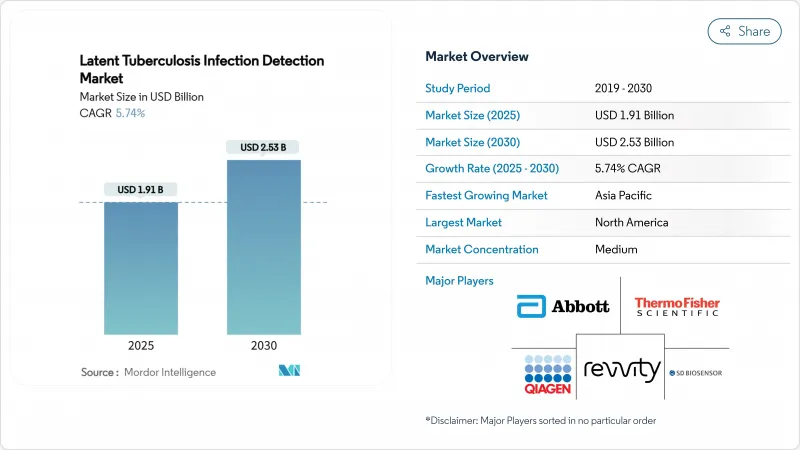
본 보고서는 검사 방법별(투베르쿨린 피부 반응, 인터페론-γ 방출 측정법, 기타 신흥 검사법), 검체 유형별(혈액, 기타), 기술 플랫폼(ELISA 기반 IGRA, 화학발광 면역측정법, 형광 면역측정법 등), 최종 사용자별(병원 등), 지역별로 분류되어 있습니다. 시장 전망은 금액(달러) 기준으로 제시되어 있습니다.
전 세계 잠복 결핵 감염(LTBI) 진단 시장 동향 및 인사이트
정부 자금 지원에 의한 잠복 결핵 감염(LTBI) 선별 검사 의무화
현재, 국가 및 주 정부 기관은 의료 종사자, 면역 결핍 환자, 그리고 결핵 유행이 심각한 지역에서 온 이민자들을 대상으로 잠복 결핵 검사의 정기적 실시를 의무화하고 있습니다. 2024년 CDC 예방 서비스 업데이트에 따라, 의료보험개혁법(Affordable Care Act) 하에서 이러한 검사에 대한 본인 부담금이 폐지되어 안정적인 수요 증가로 이어지고 있습니다. 콜로라도주와 로드아일랜드주 등 미국 각 주에서는 연례 선별 검사 규정이 시행되고 있으며, 캘리포니아주에서는 병원 대상으로 주 전역에 결핵 위험 평가 도구를 도입하고 있습니다. 유럽연합(EU) 전역에서 시행되고 있는 유사한 정책은 규정 준수를 기반으로 한 견고한 체계를 제공하며, 일관된 검사 건수를 확보함으로써 잠복 결핵 감염 진단 시장을 경기 변동의 영향으로부터 보호하고 있습니다. IGRA 검사는 단 한 번의 내원만으로 검사가 완료되는 워크플로우와 BCG 백신 접종군에서 높은 정확도를 갖추고 있어 가장 큰 혜택을 보고 있습니다.
이민자·난민 대상 의료 프로그램 확대
지속되는 지정학적 불안정으로 인해 망명 신청자들 사이에서 결핵에 대한 경계심이 높아지고 있습니다. 2024년 11월에 발표된 WHO 지침에서는 도착 시 체계적인 선별 검사를 권장하고 있으며, 이에 따라 유럽, 캐나다, 호주에서는 활동성 결핵과 잠복 결핵을 모두 대상으로 하는 알고리즘 도입이 진행되고 있습니다. ECDC 데이터에 따르면, 2023년에 선별 검사를 받은 우크라이나 난민의 결핵 신고율은 10만 명당 16.9건으로, 수용국의 평균보다 2배 이상 높은 수치입니다. 한국에서 실시된 이민자를 대상으로 한 IGRA 시범 프로그램에서는 치료를 받지 않은 IGRA 양성 참가자에서 10만 인년당 312.5건의 잠복 감염 발생률이 밝혀져 조기 발견의 중요성이 재확인되었습니다. 이러한 연구 결과를 바탕으로 국경 진료소의 휴대용 IGRA 분석 장비에 대한 자금 지원이 가속화되고 있으며, 이는 잠복 결핵 감염 진단 시장의 확대에 기여하고 있습니다.
정제 단백질 유도체(PPD) 항원공급 부족
제조상의 병목 현상으로 인해 투베르쿨린 피부 검사공급이 정기적으로 제한되고 있습니다. 많은 저·중소득 국가(LMIC)의 선별 프로그램은 비용상의 이유로 피부 검사에 의존하고 있기 때문에 재고 부족은 감시 일정을 교란시키고 검사 지연을 확대하며, 정기적인 프로그램에 대한 신뢰를 훼손하게 됩니다. 공급 부족으로 인해 이해관계자들은 IGRA를 대안으로 고려하는 경우가 많지만, 전환에는 설비 투자가 필요하며, 그 과정에서 발생하는 공백 기간으로 인해 잠복 결핵 감염 진단 시장의 성장세가 둔화되고 있습니다.
부문 분석
2024년, 투베르쿨린 피부 반응 검사는 잠복 결핵 감염 진단 시장 규모의 54.38% 점유율을 유지했으나, IGRA는 연평균 성장률(CAGR) 9.46%를 기록하며 피부 반응 검사의 우위를 꾸준히 잠식해 나갈 전망입니다. 비용을 중시하는 공공 프로그램에서는 여전히 피부 반응 검사 키트 구매가 이어지고 있지만, 2회의 내원이 필요한 워크플로우와 주관적인 판정 등 운영상의 단점이 그 장기적인 유용성을 저해하고 있습니다. 선진국, 기업 건강보험 제도, 면역학 클리닉에서는 1회의 내원만으로 정확한 결과를 얻을 수 있는 IGRA의 도입이 점점 늘어나고 있습니다. WHO의 2024년판 진단 흐름도에서는 분자 신속 진단법이 알고리즘의 최상위에 위치하고 있으며, 이 방침은 엑스레이 검사에서 이상이 확인된 후 IGRA를 통한 확정 진단을 간접적으로 권장하는 것입니다.
잠복 결핵 감염 진단 시장에서는 현재 새로운 바이오마커 검사가 초기 상업적 시범 단계에 접어들었습니다. 재조합 항원 칵테일과 숙주 RNA 시그니처는 잠복 감염과 활동성 감염을 구별하는 것을 목표로 하며, 이러한 기능을 통해 임상 검사 과정을 단축할 가능성이 있습니다. T세포 대사 패널을 검증 중인 학술 컨소시엄은 유망한 민감도를 보고하고 있으나, 규제 당국의 승인까지 소요되는 기간을 고려할 때 광범위한 도입은 2030년 이후가 될 것으로 전망됩니다.
2024년, 잠복 결핵 감염 진단 시장에서 채혈 검사의 점유율은 62.57%를 차지했으며, 이 검사 방식은 2030년까지 연평균 성장률(CAGR) 8.52%로 시장을 주도하고 있습니다. 정맥 채혈은 IGRA의 자동화 워크플로우를 지원하고, 화학 검사 패널의 동시 실시를 가능하게 하며, 판독자 간의 편차를 최소화합니다. 혈장의 신속한 분리 및 마이크로플루이딕스 카트리지를 통해 보건소에서도 현장에서 검체를 처리할 수 있게 되어, 농촌 지역으로의 보급 범위가 확대되고 있습니다.
피부 검사는 채혈이 현실적으로 어려운 소아과나 현장 검진 활동에서 여전히 이용되고 있습니다. 연구자들은 HIV 양성자나 매우 어린 대상 집단에서 진단 정확도를 높이기 위해 타액이나 대변 검체를 검토하고 있습니다. 초기 결과는 유망하지만, 검증 대상 집단의 규모는 여전히 작아, 이러한 대체 방법은 잠복 결핵 감염 진단 시장에서 틈새 시장 수준에 머물러 있습니다.
지역별 분석
2024년, 북미는 잠복 결핵 감염 진단 시장 규모의 32.49%를 차지했습니다. 이는 연방 정부의 보험 적용 의무화 및 의료 종사자에 대한 OSHA(직업안전보건청)의 규정 준수 검사가 주도하고 있습니다. 민간 보험사들은 일제히 IGRA 비용을 보상하고 있으며, 이는 투베르쿨린 피부 반응 검사에서 IGRA로 꾸준히 전환되는 추세를 뒷받침하고 있습니다. 캐나다의 이민자 건강 검진에는 IGRA 선별 검사가 포함되어 있어 수요를 더욱 공고히 하고 있습니다.
아시아태평양은 인도, 중국, 인도네시아가 잠재 감염 선별 검사를 통합한 국가 결핵 퇴치 프로그램에 투자하고 있어, 2030년까지 연평균 성장률(CAGR) 7.52%로 확대될 것으로 예측됩니다. 한국에서 이민자를 대상으로 실시된 IGRA 시범 사업에서는 높은 재활성화 위험이 확인되어, 지역 정책 입안자들에게 혈액 검사법의 광범위한 도입을 촉구하고 있습니다. 지방 진료소에서 AI를 활용한 X선 분류 시스템의 도입은 새로운 의뢰 환자 유입을 창출하여, 잠복 결핵 감염 진단 시장의 검사 건수를 끌어올리고 있습니다.
유럽에서는 이민자 및 난민을 대상으로 한 체계적인 건강 검진을 통해 여전히 큰 시장 점유율을 유지하고 있습니다. 우크라이나에서 입국하는 사람들에 대한 체계적인 선별 검사를 통해 2023년에는 1,247건의 결핵 사례가 확인되었으며, 선별 검사 대상 집단에서 잠복 결핵 감염의 진단률은 10만 명당 16.9건이었습니다. 여러 국가에서 보상 제도의 통합으로 인해 IGRA의 안정적인 조달이 가능해졌으며, 시장의 회복력이 유지되고 있습니다. 중동 및 아프리카, 남미에서는 경제 성장에 따른 검사실 설비 현대화로 장기적인 성장이 예상되지만, 예산 제약과 시약 공급의 불안정성이 단기적인 잠복 결핵 감염 진단 시장의 확대를 억제하고 있습니다.
기타 혜택:
- 엑셀 형식 시장 예측(ME) 시트
- 3개월간의 애널리스트 지원
자주 묻는 질문
목차
제1장 서론
제2장 조사 방법
제3장 주요 요약
제4장 시장 구도
제5장 시장 규모와 성장 예측
제6장 경쟁 구도
제7장 시장 기회와 향후 전망
JHS 26.08.07According to Mordor Intelligence, the latent tuberculosis infection detection market size stands at USD 1.91 billion in 2025 and is forecast to reach USD 2.53 billion by 2030, reflecting a 5.74% CAGR over the period.
This report is Segmented by Test Method (Tuberculin Skin Test, Interferon-Gamma Release Assays, Other Emerging Tests), Sample Type (Blood, Other), Technology Platform (ELISA-Based IGRA, Chemiluminescence Immunoassay, Fluorescence Immunoassay, and More), End-User (Hospitals, and More), and Geography. The Market Forecasts are Provided in Terms of Value (USD).
Global Latent Tuberculosis Infection Detection Market Trends and Insights
Government-funded LTBI screening mandates
National and state agencies now require routine latent tuberculosis testing for healthcare workers, immunocompromised patients, and immigrants from high-burden regions. The 2024 CDC preventive-service update removed out-of-pocket costs for these tests under the Affordable Care Act, catalyzing stable demand. U.S. states such as Colorado and Rhode Island enforce annual screening rules, and California has rolled out statewide TB risk-assessment tools for hospitals. Comparable policies across the European Union provide a compliance-driven backbone, anchoring consistent test volumes that buffer the latent tuberculosis infection detection market from economic cycles. IGRAs benefit most, given their single-visit workflow and accuracy in BCG-vaccinated cohorts.
Expansion of migrant & refugee health programs
Continued geopolitical instability has heightened TB vigilance among asylum seekers. WHO guidance published in November 2024 recommends structured screening on arrival, prompting adoption of dual active-TB and latent-TB algorithms in Europe, Canada, and Australia. ECDC data show Ukrainian refugees screened in 2023 presented TB notification rates of 16.9 per 100,000, more than double host-country averages. South Korea's pilot IGRA program in immigrants revealed latent infection incidence of 312.5 per 100,000 person-years among untreated IGRA-positive participants, reinforcing the importance of early detection. These findings are accelerating funding for portable IGRA analyzers at border clinics, contributing to latent tuberculosis infection detection market expansion.
Supply shortages of purified protein derivative antigens
Manufacturing bottlenecks periodically constrain tuberculin skin-test availability. Because many LMIC screening programs rely on skin tests for cost reasons, stockouts disrupt surveillance schedules, widen testing backlogs, and erode confidence in routine programs. While shortages often push stakeholders to evaluate IGRA alternatives, transition requires capital investment, creating interim gaps that temper latent tuberculosis infection detection market momentum.
Other drivers and restraints analyzed in the detailed report include:
- Rising uptake of IGRAs in low-incidence countries
- Bundled reimbursement for LTBI diagnostics
- High per-test IGRA cost in LMICs
For complete list of drivers and restraints, kindly check the Table Of Contents.
Segment Analysis
In 2024 the tuberculin skin test retained 54.38% share of the latent tuberculosis infection detection market size, while IGRAs recorded a 9.46% CAGR that will steadily erode the dominance of skin testing. Cost-sensitive public programs continue purchasing skin-test kits, yet operational drawbacks-two-visit workflow and subjective reading-dampen their long-term utility. Developed nations, employer health plans, and immunology clinics increasingly select IGRAs for single-visit accuracy. The WHO 2024 diagnostic pathway places molecular rapid diagnostics at the head of the algorithm, a policy that indirectly favors IGRA confirmation after abnormal radiography.
The latent tuberculosis infection detection market now sees novel biomarker assays entering early commercial pilots. Recombinant antigen cocktails and host-RNA signatures seek to distinguish latent from active infection, a feature that could shorten clinical work-ups. Academic consortia testing T-cell metabolism panels report promising sensitivity, but regulatory approval timelines place widespread rollout beyond 2030.
Blood draws accounted for 62.57% of the latent tuberculosis infection detection market share in 2024, and this format leads growth at 8.52% CAGR to 2030. Venous sampling supports automated IGRA workflows, allows simultaneous chemistry panels, and minimizes inter-reader variability. Rapid plasma separation and microfluidic cartridges now let health posts process samples on site, widening rural reach.
Skin-based tests linger in pediatric and field campaigns where phlebotomy is impractical. Researchers explore saliva and stool matrices to improve diagnosis in HIV-positive and very young cohorts. While early results are encouraging, validation cohorts remain small, keeping these alternatives a niche within the latent tuberculosis infection detection market.
Complete Report Scope:
- By Test Method
- Tuberculin Skin Test (TST)
- Interferon-Gamma Release Assays (IGRA)
- Other Emerging Tests
- By Sample Type
- Blood
- Other (e.g., skin)
- By Technology Platform
- ELISA-based IGRA
- Chemiluminescence Immunoassay (CLIA)
- Fluorescence Immunoassay (FIA)
- Lateral Flow / Point-of-Care Assay
- Molecular Diagnostics (PCR/NGS)
- By End-user
- Hospitals
- Diagnostic Laboratories
- Public Health Agencies
- Others
- By Geography
- North America
- United States
- Canada
- Mexico
- Europe
- Germany
- United Kingdom
- France
- Italy
- Spain
- Rest of Europe
- Asia-Pacific
- China
- Japan
- India
- Australia
- South Korea
- Rest of Asia-Pacific
- Middle East and Africa
- GCC
- South Africa
- Rest of Middle East and Africa
- South America
- Brazil
- Argentina
- Rest of South America
- North America
Geography Analysis
North America controlled 32.49% of latent tuberculosis infection detection market size in 2024, anchored by federal coverage mandates and OSHA compliance testing for healthcare workers. Private insurers uniformly reimburse IGRAs, driving a steady migration from tuberculin skin tests. Canada's immigration physicals incorporate IGRA screening, further solidifying demand.
Asia-Pacific is forecast to expand at 7.52% CAGR through 2030 as India, China, and Indonesia invest in national TB elimination programs that integrate latent infection screening. South Korea's immigrant IGRA pilot confirmed high reactivation risk, nudging regional policymakers toward widespread use of blood-based assays. Deployment of AI-enabled X-ray triage in rural clinics creates fresh referral flows, boosting latent tuberculosis infection detection market test volumes.
Europe maintains substantial share through structured migrant and refugee health checks. Systematic screening of Ukrainian arrivals recorded 1,247 TB cases in 2023, with latent infection detection rates of 16.9 per 100,000 among screened cohorts. Multi-country reimbursement alignment underlines stable procurement of IGRAs, sustaining marketplace resilience. The Middle East, Africa, and South America present long-term upside as economic growth funds laboratory upgrades, although budget constraints and intermittent reagent supply temper near-term latent tuberculosis infection detection market acceleration.
- QIAGEN
- Revvity
- Abbott Laboratories
- Thermo Fisher Scientific
- Danaher
- Bio-Rad Laboratories
- Hologic
- SD Biosensor Inc.
- Beijing Wantai Biological Pharmacy
- Creative Diagnostics
- Lionex GmbH
- Serum Institute of India Pvt Ltd
- ZeptoMetrix Corp.
- R-Biopharm
- GenoScreen SAS
- Alpha Laboratories Ltd
- Ansh Labs
- Arkray
- Tulip Diagnostics
- Diasorin SpA
Additional Benefits:
- The market estimate (ME) sheet in Excel format
- 3 months of analyst support
TABLE OF CONTENTS
1 Introduction
- 1.1 Study Assumptions and Market Definition
- 1.2 Scope of the Study
2 Research Methodology
3 Executive Summary
4 Market Landscape
- 4.1 Market Overview
- 4.2 Market Drivers
- 4.2.1 Government-Funded LTBI Screening Mandates
- 4.2.2 Expansion Of Migrant & Refugee Health Programs
- 4.2.3 Rising Uptake Of Igras In Low-Incidence Countries
- 4.2.4 Bundled Reimbursement For TB/Latent TB Diagnostics
- 4.2.5 AI-Assisted Triage Tools Boosting Test Demand
- 4.2.6 Targeted LTBI Control In Immunocompromised Populations
- 4.3 Market Restraints
- 4.3.1 Supply Shortages Of Purified Protein Derivative (PPD) Antigens
- 4.3.2 High Per-Test Cost Of IGRAS in LMICs
- 4.3.3 False-Positive Rates Among BCG-Vaccinated Cohorts
- 4.3.4 Limited Lab Capacity For High-Throughput ELISA IGRA Analysis
- 4.4 Value / Supply-Chain Analysis
- 4.5 Regulatory Landscape
- 4.6 Technology Outlook
- 4.7 Porter's Five Forces Analysis
- 4.7.1 Bargaining Power of Suppliers
- 4.7.2 Bargaining Power of Buyers
- 4.7.3 Threat of New Entrants
- 4.7.4 Threat of Substitutes
- 4.7.5 Intensity of Competitive Rivalry
5 Market Size and Growth Forecasts (Value-USD)
- 5.1 By Test Method
- 5.1.1 Tuberculin Skin Test (TST)
- 5.1.2 Interferon-Gamma Release Assays (IGRA)
- 5.1.3 Other Emerging Tests
- 5.2 By Sample Type
- 5.2.1 Blood
- 5.2.2 Other (e.g., skin)
- 5.3 By Technology Platform
- 5.3.1 ELISA-based IGRA
- 5.3.2 Chemiluminescence Immunoassay (CLIA)
- 5.3.3 Fluorescence Immunoassay (FIA)
- 5.3.4 Lateral Flow / Point-of-Care Assay
- 5.3.5 Molecular Diagnostics (PCR/NGS)
- 5.4 By End-user
- 5.4.1 Hospitals
- 5.4.2 Diagnostic Laboratories
- 5.4.3 Public Health Agencies
- 5.4.4 Others
- 5.5 By Geography
- 5.5.1 North America
- 5.5.1.1 United States
- 5.5.1.2 Canada
- 5.5.1.3 Mexico
- 5.5.2 Europe
- 5.5.2.1 Germany
- 5.5.2.2 United Kingdom
- 5.5.2.3 France
- 5.5.2.4 Italy
- 5.5.2.5 Spain
- 5.5.2.6 Rest of Europe
- 5.5.3 Asia-Pacific
- 5.5.3.1 China
- 5.5.3.2 Japan
- 5.5.3.3 India
- 5.5.3.4 Australia
- 5.5.3.5 South Korea
- 5.5.3.6 Rest of Asia-Pacific
- 5.5.4 Middle East and Africa
- 5.5.4.1 GCC
- 5.5.4.2 South Africa
- 5.5.4.3 Rest of Middle East and Africa
- 5.5.5 South America
- 5.5.5.1 Brazil
- 5.5.5.2 Argentina
- 5.5.5.3 Rest of South America
- 5.5.1 North America
6 Competitive Landscape
- 6.1 Market Concentration
- 6.2 Market Share Analysis
- 6.3 Company Profiles (includes Global level Overview, Market level overview, Core Segments, Financials as available, Strategic Information, Market Rank/Share for key companies, Products and Services, and Recent Developments)
- 6.3.1 QIAGEN N.V.
- 6.3.2 Revvity
- 6.3.3 Abbott Laboratories
- 6.3.4 Thermo Fisher Scientific Inc.
- 6.3.5 Danaher Corp
- 6.3.6 Bio-Rad Laboratories Inc.
- 6.3.7 Hologic Inc.
- 6.3.8 SD Biosensor Inc.
- 6.3.9 Beijing Wantai Biological Pharmacy
- 6.3.10 Creative Diagnostics
- 6.3.11 Lionex GmbH
- 6.3.12 Serum Institute of India Pvt Ltd
- 6.3.13 ZeptoMetrix Corp.
- 6.3.14 R-Biopharm AG
- 6.3.15 GenoScreen SAS
- 6.3.16 Alpha Laboratories Ltd
- 6.3.17 Ansh Labs
- 6.3.18 ARKRAY Inc.
- 6.3.19 Tulip Diagnostics (P) Ltd
- 6.3.20 Diasorin SpA
7 Market Opportunities & Future Outlook
- 7.1 White-space & Unmet-need Assessment


