

|
시장보고서
상품코드
2097302
VTOL UAV(무인항공기) 시장 : 점유율 분석, 업계 동향 및 통계, 성장 예측(2025-2030년)VTOL UAV - Market Share Analysis, Industry Trends & Statistics, Growth Forecasts (2025 - 2030) |
||||||
 Mordor Intelligence
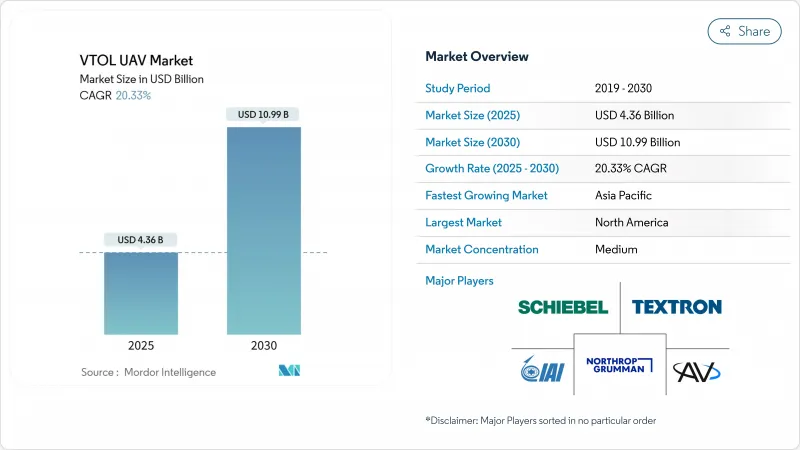
Mordor Intelligence에 의하면, VTOL UAV(무인항공기) 시장 규모는 2025년에 43억 6,000만 달러에 이르고, 2030년까지 109억 9,000만 달러로 확대한다고 예측되고 있어 CAGR은 20.33%를 나타낼 전망입니다.
본 보고서는 추진 방식별(전기식, 하이브리드 전기식 등), 항속 거리별(단거리, 중거리 등), 용도별(ISR, 화물·보급 등), 중량 등급별(마이크로/나노, 미니, 전술용 등), 조작 모드별(자율형 및 원격 조종형), 지역별(북미, 유럽, 아시아태평양 등)로 분류되어 있습니다. 시장 전망은 금액(달러) 기준으로 제시되어 있습니다.
전 세계 VTOL UAV(무인항공기) 시장 동향 및 인사이트
분쟁 지역에서의 지속적인 ISR 수요
전자전 활동이 활발한 전투 지역에서는 호버링이 가능하고, 저고도 기동성이 뛰어나며, GPS에 의존하지 않고 운용할 수 있는 VTOL UAV(무인항공기)가 유리합니다. Shield AI의 V-BAT는 우크라이나에서 격렬한 전파 방해 상황 속에서도 ‘부크’ 시스템을 감지하고, 정밀 사격을 위한 좌표를 중계함으로써 그 유효성을 입증했습니다. 영국 육군의 ‘프로젝트 콜버스’는 취약한 MALE 고정익기를 대체하기 위해 24시간의 항속 시간을 목표로 하고 있으며, 이는 ISR(정보·감시·정찰) 교리에서 생존성과 지속성이 더 이상 단순한 고도보다 더 중요시되고 있음을 여실히 보여줍니다.
원정 부대에서의 활주로 비의존형 병참 지원 수요
분산형 작전의 전개로 인해 군은 손상되었거나 존재하지 않는 활주로를 우회할 수밖에 없게 되었습니다. VTOL UAV(무인항공기)는 의료 물자, 탄약 및 정밀 순항형 무기를 전방 부대로 직접 수송합니다. 미국 해병대의 ‘유기 정밀 화력-로터링(Organic Precision Fires-Loitering)’ 프로그램은 분대 수준의 보급 및 공격을 목적으로 하는 4로터 기체 시스템에 자금을 지원하고 있습니다. 한편, Heven Drones의 수소 동력 ‘레이더(Raider)’는 23kg의 탑재물을 최대 12시간 동안 저소음 모드로 운반할 수 있어, NATO가 추구하는 강인한 공급망 구축에 부합합니다.
배터리 제약에 따른 비행 시간 제한
기존 리튬이온(Li-ion) 배터리 팩을 사용할 경우 멀티로터의 비행 시간은 20-35분에 그치기 때문에 탑재물 선정 시 타협을 피할 수 없습니다. 고체 배터리나 리튬-황(Li-S) 배터리는 최대 60%의 에너지 증대가 기대되지만, 제조 규모 확대와 안전 인증 획득이 여전히 장벽으로 작용하고 있어 당분간은 하이브리드식 파워트레인이 주류를 이어갈 전망입니다.
부문 분석
2024년, 하이브리드 전기 항공기는 VTOL UAV(무인항공기) 시장에서 34.45%의 점유율을 차지하며 시장을 주도했습니다. 이는 정숙성이 뛰어난 전기에 의한 양력과, 연료 효율이 우수한 순항 성능 간의 균형이 높이 평가된 결과입니다. 이 점유율은 시장 규모 15억 달러에 해당하지만, 수소 연료전지 플랫폼은 현재 규모는 작으나 2030년까지 연평균 성장률(CAGR) 23.32%를 나타낼 것으로 예측됩니다.
하이브리드 추진 시스템은 순수 전기 기체가 직면한 항속 거리 한계를 해소하고, 내연 기관에 비해 음향 시그니처를 저감할 수 있어 조달 수요를 모으고 있습니다. VerdeGo Aero의 연료 소비량을 60% 줄인 VH-3를 포함한 성공적인 실증 비행은 장거리 ISR 순찰의 실현 가능성을 입증하고 있습니다. 수소 추진이 더욱 빠르게 성장하고 있는 배경에는 높은 에너지 밀도가 있습니다. United Therapeutics는 2025년에 유인 수소 VTOL의 첫 비행에 성공하여 600km를 넘는 무공해 비행 거리를 입증했습니다. 이는 비밀 화물 수송에 있어 매우 중요한 요소입니다.
중거리 모델(100-500 km)은 2024년 VTOL UAV(무인항공기) 시장 점유율의 38.87%를 차지하며, 17억 달러 규모 시장을 지탱했습니다. 이러한 우위는 전장 내 대대 수준의 병참 및 ISR(정보·감시·정찰) 수요와 부합합니다.
그러나 500 km를 초과하는 장거리 시스템은 군이 적의 A2/AD(대공·방공) 권역 밖에서 ISR 및 공격을 모색하고 있기 때문에 2030년까지 연평균 성장률(CAGR) 21.67%로 성장을 지속하고, 있습니다. Shield AI의 V-BAT에 탑재된 위성 데이터 링크 등의 업그레이드로 인해 지상국 없이도 비행 반경이 확대되면서, 조달 동향은 더 장거리 도달이 가능한 플랫폼으로 전환되고 있습니다.
지역별 분석
북미는 지속적인 연구개발(R&D) 자금과 규제 명확화에 힘입어 2024년 VTOL UAV(무인항공기) 시장 점유율의 28.65%를 차지했습니다. FAA(연방항공청)의 새로운 파워 리프트 규정 및 연방항공특별규정 제120호는 조기 상용 서비스로의 길을 열어주며, 해당 지역의 리더십을 강화하고 있습니다. 그러나 희토류 공급에 대한 우려가 지속되고 있으며, ‘바이 아메리칸(Buy American)’ 정책에 따른 자석 조달 의무 등이 향후 10년 후반의 성장을 둔화시킬 가능성이 있습니다.
아시아태평양은 인도-태평양 지역의 긴장 고조를 배경으로 2030년까지 연평균 성장률(CAGR) 23.47%로 확대되고 있습니다. 대만이 48,750대라는 사상 최대 규모의 군용급 드론을 발주한 것은 해당 지역의 긴박한 상황을 여실히 보여주고 있으며, 한편 중국의 틸트로터형 프로토타입은 수직 이착륙 분야에서 향후 대등한 경쟁이 펼쳐질 것임을 시사하고 있습니다. 일본과 한국의 상업용 프로젝트는 방위 분야를 넘어 고객 기반을 더욱 확대되고 있습니다.
유럽에서는 2024년에 채택된 EASA의 통합 프레임워크 하에서 꾸준한 도입이 진행되고 있습니다. 스웨덴의 NATO 연계형 스웜 프로그램과 영국의 BVLOS(시야 외 비행) 회랑 승인은 동맹의 요건과 진보적인 규제가 비교적 제한적인 국방 예산과 공존하고 있음을 보여줍니다. 환경 규제로 인해 유럽의 요구 사항은 수소 및 하이브리드 플랫폼으로 전환되고 있으며, 이는 OEM의 로드맵에도 영향을 미치고 있습니다.
기타 혜택:
- 엑셀 형식 시장 예측(ME) 시트
- 3개월간의 애널리스트 지원
자주 묻는 질문
목차
제1장 서론
제2장 조사 방법
제3장 주요 요약
제4장 시장 구도
제5장 시장 규모와 성장 예측
제6장 경쟁 구도
제7장 시장 기회와 향후 전망
JHS 26.08.07According to Mordor Intelligence, the VTOL UAV market size reached USD 4.36 billion in 2025 and is projected to advance to USD 10.99 billion by 2030, reflecting a 20.33% CAGR.
This report is Segmented by Propulsion Type (Electric, Hybrid-Electric, and More), Range (Short-Range, Medium-Range, and More), Application (ISR, Cargo/Resupply, and More), Weight Class (Micro/Nano, Mini, Tactical, and More), Mode of Operation (Autonomous and Remotely Piloted), and Geography (North America, Europe, Asia-Pacific, and More). The Market Forecasts are Provided in Terms of Value (USD).
Global VTOL UAV Market Trends and Insights
Persistent ISR Demand in Contested Environments
Combat theaters with dense electronic-warfare activity favor VTOL UAVs that can hover, maneuver at low altitude, and operate without GPS reliance. Shield AI's V-BAT proved this in Ukraine by detecting Buk systems and relaying coordinates for precision fires even under heavy jamming. The British Army's Project Corvus targets 24-hour endurance to replace vulnerable MALE fixed-wing assets, underscoring how survivability and persistence now outweigh sheer altitude in ISR doctrine.
Demand for Runway-Independent Logistics for Expeditionary Forces
Distributed operations compel militaries to bypass damaged or non-existent runways. VTOL UAVs carry medical supplies, ammunition, and precision loitering munitions directly to forward units. The US Marine Corps Organic Precision Fires-Loitering program funds quad-rotor systems for squad-level resupply and strike, while Heven Drones' hydrogen-powered Raider flies 23 kg payloads for up to 12 hours in silent mode, aligning with NATO calls for resilient supply chains.
Limited Endurance Due to Battery Constraints
Conventional lithium-ion (Li-ion) packs yield 20-35 minute multirotor endurance, forcing payload trade-offs. Solid-state and lithium-sulfur (Li-S) chemistries promise up to 60% more energy, but manufacturing scale and safety certification remain hurdles, keeping hybrid powertrains dominant in the near term.
Other drivers and restraints analyzed in the detailed report include:
- Modernization Programs Replacing Legacy Helicopters with VTOL UAVs
- Increased Defense Spending on Unmanned Combat Systems
- Regulatory Hurdles for BVLOS Operations in Shared Airspace
For complete list of drivers and restraints, kindly check the Table Of Contents.
Segment Analysis
Hybrid-electric aircraft led the VTOL UAV market with a 34.45% share in 2024, reflecting their balance between quiet electric lift and fuel-efficient cruise. This share translates into USD 1.5 billion of the market's size, while hydrogen fuel-cell platforms, though smaller today, are forecasted to post a 23.32% CAGR through 2030.
Hybrid propulsion attracts procurement because it addresses endurance caps that pure electric craft face and reduces acoustic signatures compared with internal-combustion engines. Successful demo flights, including VerdeGo Aero's 60% fuel-saving VH-3, prove feasibility for long-range ISR patrols. Hydrogen propulsion's faster growth owes to its higher energy density; United Therapeutics flew the first piloted hydrogen VTOL in 2025, showcasing zero-emission endurance beyond 600 km, a critical factor for covert cargo runs.
Medium-range models (100 to 500 km) captured 38.87% of the VTOL UAV market share in 2024, anchoring USD 1.7 billion of the market's size. Their supremacy aligns with battalion-level logistics and ISR needs inside the theater.
However, long-range systems above 500 km are clocking a 21.67% CAGR to 2030 as militaries seek standoff ISR and strike beyond adversary A2/AD bubbles. Upgrades such as satellite datalinks on Shield AI's V-BAT extend flight radius without ground stations, shifting procurement toward deeper-reach platforms.
Complete Report Scope:
- By Propulsion Type
- Electric
- Hybrid-Electric
- Internal Combustion
- Hydrogen Fuel-Cell
- By Range
- Short-Range (Less than 100 km)
- Medium-Range (100 to 500 km)
- Long-Range (Greater than 500 km)
- By Application
- Intelligence, Surveillance, and Reconnaissance (ISR)
- Cargo/Resupply
- Anti-Submarine Warfare (ASW)
- Others
- By Weight Class
- Micro/Nano (Less than 20 kg)
- Mini (20 to 150 kg)
- Tactical (150 to 600 kg)
- Medium-Altitude Long-Endurance (MALE) (Greater than 600 kg)
- By Mode of Operation
- Autonomous
- Remotely Piloted
- By Geography
- North America
- United States
- Canada
- Mexico
- Europe
- United Kingdom
- France
- Germany
- Italy
- Russia
- Rest of Europe
- Asia-Pacific
- China
- India
- Japan
- South Korea
- Rest of Asia-Pacific
- South America
- Brazil
- Argentina
- Rest of South America
- Middle East and Africa
- Middle East
- Saudi Arabia
- United Arab Emirates
- Rest of Middle East
- Africa
- South Africa
- Rest of Africa
- Middle East
- North America
Geography Analysis
North America controlled 28.65% of the VTOL UAV market share in 2024, buoyed by sustained R&D funding and regulatory clarity. The new FAA powered-lift rule and Special Federal Aviation Regulation 120 provide pathways for early commercial services, reinforcing regional leadership. However, continued rare-earth supply concerns and Buy-American magnet mandates could temper growth in the decade's second half.
Asia-Pacific is advancing at a 23.47% CAGR to 2030, driven by escalating Indo-Pacific tensions. Taiwan's record order of 48,750 military-grade drones underscores the region's urgency, while Chinese tilt-rotor prototypes hint at future peer-to-peer competitions in vertical lift. Commercial projects in Japan and South Korea further widen the customer base beyond defense.
Europe enjoys steady adoption under a harmonized EASA framework adopted in 2024. Sweden's NATO-aligned swarm program and the UK's BVLOS corridor approvals show that alliance requirements and progressive regulation coexist with comparatively modest defense budgets. Environmental mandates shape European requirements toward hydrogen and hybrid platforms, influencing OEM roadmaps.
- Northrop Grumman Corporation
- Schiebel Corporation
- AeroVironment, Inc.
- Textron Inc.
- Israel Aerospace Industries Ltd.
- Airbus SE
- Lockheed Martin Corporation
- Elbit Systems Ltd.
- Insitu, Inc. (The Boeing Company)
- BAYKAR A.S.
- Saab AB
- Shield AI Inc.
- DeltaQuad
- Ukrspecsystems LLC
- ideaForge Technology Pvt. Ltd.
Additional Benefits:
- The market estimate (ME) sheet in Excel format
- 3 months of analyst support
TABLE OF CONTENTS
1 INTRODUCTION
- 1.1 Study Assumptions and Market Definition
- 1.2 Scope of the Study
2 RESEARCH METHODOLOGY
3 EXECUTIVE SUMMARY
4 MARKET LANDSCAPE
- 4.1 Market Overview
- 4.2 Market Drivers
- 4.2.1 Persistent ISR demand in contested environments
- 4.2.2 Demand for runway-independent logistics for expeditionary forces
- 4.2.3 Modernization programs replacing legacy helicopters with VTOL UAVs
- 4.2.4 Increased defense spending on unmanned combat systems
- 4.2.5 Modular hybrid-electric propulsion enabling acoustic stealth
- 4.2.6 NATO push for organic sensor-to-shooter VTOL swarms
- 4.3 Market Restraints
- 4.3.1 Limited endurance due to battery constraints
- 4.3.2 Regulatory hurdles for BVLOS operations in shared airspace
- 4.3.3 Vulnerability to drone-kill laser systems
- 4.3.4 Supply-chain constraints in rare-earth motors
- 4.4 Value Chain Analysis
- 4.5 Regulatory Landscape
- 4.6 Technological Outlook
- 4.7 Porter's Five Forces Analysis
- 4.7.1 Threat of New Entrants
- 4.7.2 Bargaining Power of Suppliers
- 4.7.3 Bargaining Power of Buyers
- 4.7.4 Threat of Substitutes
- 4.7.5 Intensity of Competitive Rivalry
5 MARKET SIZE AND GROWTH FORECASTS (VALUE)
- 5.1 By Propulsion Type
- 5.1.1 Electric
- 5.1.2 Hybrid-Electric
- 5.1.3 Internal Combustion
- 5.1.4 Hydrogen Fuel-Cell
- 5.2 By Range
- 5.2.1 Short-Range (Less than 100 km)
- 5.2.2 Medium-Range (100 to 500 km)
- 5.2.3 Long-Range (Greater than 500 km)
- 5.3 By Application
- 5.3.1 Intelligence, Surveillance, and Reconnaissance (ISR)
- 5.3.2 Cargo/Resupply
- 5.3.3 Anti-Submarine Warfare (ASW)
- 5.3.4 Others
- 5.4 By Weight Class
- 5.4.1 Micro/Nano (Less than 20 kg)
- 5.4.2 Mini (20 to 150 kg)
- 5.4.3 Tactical (150 to 600 kg)
- 5.4.4 Medium-Altitude Long-Endurance (MALE) (Greater than 600 kg)
- 5.5 By Mode of Operation
- 5.5.1 Autonomous
- 5.5.2 Remotely Piloted
- 5.6 By Geography
- 5.6.1 North America
- 5.6.1.1 United States
- 5.6.1.2 Canada
- 5.6.1.3 Mexico
- 5.6.2 Europe
- 5.6.2.1 United Kingdom
- 5.6.2.2 France
- 5.6.2.3 Germany
- 5.6.2.4 Italy
- 5.6.2.5 Russia
- 5.6.2.6 Rest of Europe
- 5.6.3 Asia-Pacific
- 5.6.3.1 China
- 5.6.3.2 India
- 5.6.3.3 Japan
- 5.6.3.4 South Korea
- 5.6.3.5 Rest of Asia-Pacific
- 5.6.4 South America
- 5.6.4.1 Brazil
- 5.6.4.2 Argentina
- 5.6.4.3 Rest of South America
- 5.6.5 Middle East and Africa
- 5.6.5.1 Middle East
- 5.6.5.1.1 Saudi Arabia
- 5.6.5.1.2 United Arab Emirates
- 5.6.5.1.3 Rest of Middle East
- 5.6.5.2 Africa
- 5.6.5.2.1 South Africa
- 5.6.5.2.2 Rest of Africa
- 5.6.5.1 Middle East
- 5.6.1 North America
6 COMPETITIVE LANDSCAPE
- 6.1 Market Concentration
- 6.2 Strategic Moves
- 6.3 Market Share Analysis
- 6.4 Company Profiles (includes Global level Overview, Market level overview, Core Segments, Financials as available, Strategic Information, Market Rank/Share for key companies, Products and Services, and Recent Developments)
- 6.4.1 Northrop Grumman Corporation
- 6.4.2 Schiebel Corporation
- 6.4.3 AeroVironment, Inc.
- 6.4.4 Textron Inc.
- 6.4.5 Israel Aerospace Industries Ltd.
- 6.4.6 Airbus SE
- 6.4.7 Lockheed Martin Corporation
- 6.4.8 Elbit Systems Ltd.
- 6.4.9 Insitu, Inc. (The Boeing Company)
- 6.4.10 BAYKAR A.S.
- 6.4.11 Saab AB
- 6.4.12 Shield AI Inc.
- 6.4.13 DeltaQuad
- 6.4.14 Ukrspecsystems LLC
- 6.4.15 ideaForge Technology Pvt. Ltd.
7 MARKET OPPORTUNITIES AND FUTURE OUTLOOK
- 7.1 White-Space and Unmet-Need Assessment


