|
시장보고서
상품코드
2097304
다층 판지 시장 : 점유율 분석, 업계 동향 및 통계, 성장 예측(2025-2030년)Multi-layer Paperboard - Market Share Analysis, Industry Trends & Statistics, Growth Forecasts (2025 - 2030) |
||||||
 Mordor Intelligence
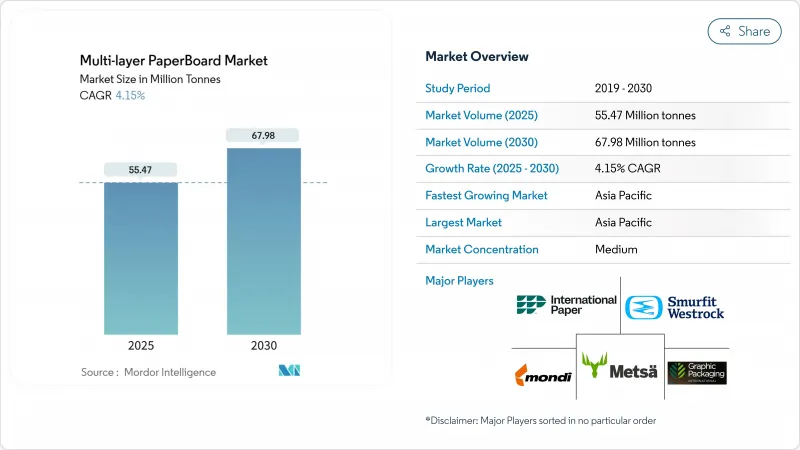
Mordor Intelligence에 의하면, 다층 판지 시장 규모는 2025년에 5,547만 톤이 되어, 2030년까지 6,798만 톤에 이르고, CAGR 4.15%로 확대될 것으로 예측됩니다.
본 보고서는 등급별(접이식 상자용 판지, 무표백 황산 펄프 판지 등), 원료 출처별(미사용 펄프, 재생 펄프), 최종 용도별(식품 및 음료 포장, 화장품 및 퍼스널케어, 의약품 등), 지역별로 분류되어 있습니다. 시장 전망은 수량(톤) 기준으로 제시되어 있습니다.
전 세계 다층 판지 시장 동향 및 인사이트
전자상거래 주도 하에 섬유계 2차 포장의 폭발적인 확대
세계 온라인 소매 시장은 지속적으로 확대되고 있으며, 각 소포에는 견고하고 인쇄 가능한 2차 포장이 요구되고 있습니다. 아마존을 비롯한 마켓플레이스에서는 여러 거점을 경유하는 운송 중 찌그러짐이나 습기에 견딜 수 있는 높은 기중의 판지가 지정되고 있어, 이에 따라 다층 구조에 대한 수요가 가속화되고 있습니다. International Paper의 산업용 포장 부문은 2023년에 156억 달러의 매출을 기록하며, 풀필먼트 네트워크에서 섬유 제품이 차지하는 핵심적인 역할을 부각시켰습니다. 접이식 판지 및 고형 표백 황산 펄프 등급은 브랜드가 ‘개봉 시 첫인상’에 요구하는 인쇄면을 제공할 수 있어 시장 점유율을 확대되고 있습니다. 북미의 생산 능력 확충에 힘입어 2023년 포장용지 생산량은 4.8% 증가했으며, 이는 전자상거래 처리량 곡선을 반영한 결과입니다. 미사용 펄프와 재생 펄프의 균형을 적절히 맞출 수 있는 제조업체는 사용 후 골판지(OCC) 가격 변동에 대응하면서 온라인 판매업체를 위한 리드 타임을 단축하고 있습니다.
브랜드 소유자의 플라스틱 대체 노력
주요 소비재 기업들은 2030년까지 모든 소매용 포장을 재활용 가능하거나 재사용 가능하게 만들겠다고 공약하고 있으며, 이를 통해 장기적인 섬유 수요가 보장되고 있습니다. Graphic Packaging은 2023년 한 해 동안만 4억 5,000만 개의 플라스틱 포장을 감축했음을 확인했으며, 그 분량을 재활용 가능한 판지로 전환하고 있습니다. 현재 조달 정책에서는 진열상의 매력이 훼손되지 않는 한, 가격 프리미엄이 발생하더라도 인증된 섬유 소재가 우선적으로 채택되고 있습니다. WestRock은 2024년 제품 포트폴리오의 97.8%가 이미 재활용 또는 퇴비화 기준을 충족하며, 이는 고객의 로드맵과 일치한다고 밝혔습니다. 이러한 자발적인 목표는 플라스틱에 벌금을 부과하는 EPR(확대 생산자 책임) 요금 증가라는 배경 위에서 수립되었으며, 기업의 비전 선언문을 강제력 있는 비용 차이로 전환하고 있습니다.
만성적인 폐지(OCC) 가격 변동
재생 펄프 비용은 한 분기 동안 40% 이상 변동하는 경우가 많아, 재생 소재 함유 등급의 예산 수립을 어렵게 만들고 있습니다. 수출처가 잉여 골판지 상자를 흡수하거나, 계절적인 전자상거래 수요 급증으로 인해 국내 수요가 높아지면 공급 부족이 발생합니다. 유럽제지산업연합회(CEPI) 보고서에 따르면, 2023년 재생 섬유 소비량은 7% 감소했으며, 이는 원료 공급 흐름이 불안정해지고 있음을 여실히 보여줍니다. 통합형 그룹은 미사용 펄프의 비율을 조정하여 가격 변동에 대한 완충 효과를 도모하고 있지만, 2차 섬유에 의존하는 제지 공장은 가격 급등 시 EBITDA의 급격한 감소에 직면하고 있습니다.
부문 분석
2024년, 다층 판지 시장에서 접이식 상자용 판지는 39.68%라는 최대 점유율을 유지했습니다. 이 제품은 인쇄의 선명도와 적당한 강성이 요구되는 일용소비재에 사용되고 있습니다. 이 부문은 전자상거래(EC)에서 매력적인 가정 내 상품 진열에 대한 수요와, 연한 색상의 기재를 선호하는 규제상의 탈잉크 요건의 혜택을 받고 있습니다. 무표백 황산 펄프 판지는 규모는 작지만 5.43%라는 가장 높은 연평균 성장률(CAGR)을 기록하고 있습니다. 이는 고급 화장품이나 프리미엄 과자가 재생 원료에서 비롯된 불순물이 없는 새하얀 표면을 요구하기 때문입니다. 무표백 판지 및 코팅 무표백 크라프트지는 음료 용기나 DIY 공구 등 강도가 중요한 포장재에 공급되고 있지만, 브랜드 소유자가 매장 내 미관을 중시하게 됨에 따라 그 성장률은 프리미엄 등급에 뒤처지고 있습니다. MFC(다층 복합판)를 통해 실현되는 경량화는 프리미엄 제품의 차별화를 한층 더 촉진하며, 모서리 압축 강도를 유지하면서 판 두께를 얇게 만들 수 있게 합니다. 레토르트 대응 및 열밀봉용 배리어 소재를 위한 자체 코팅 라인을 보유한 제조업체는 특히 저추출물 인증을 요구하는 제약 감사 기준을 준수하는 경우 더 높은 가공 마진을 확보할 수 있습니다.
지역별 분석
2024년에는 아시아태평양이 43.15%라는 최대 점유율을 차지했습니다. 이는 중국의 포장 붐과 인도의 제네릭 의약품 제조 분야에서 블리스터 팩의 성장이 주도한 결과입니다. 연평균 성장률(CAGR) 5.37%를 기록한 이 지역의 성장은 가처분 소득 증가와 전자기기 조립 라인의 이전에 기인하며, 이 두 요인은 모두 내부 포장 상자 및 소매용 외부 포장 상자에 대한 수요를 뒷받침하고 있습니다. 북미는 성숙한 시장이지만, 옴니채널 소매를 통한 꾸준한 수요 증가가 나타나고 있으며, 퀵커머스 사업자들은 완충재와 반품 대응 설계를 요구하고 있습니다. 유럽 수요는 에너지 가격 급등이 제지 공장의 수익성을 압박하고 있어 성장세가 비교적 완만하지만, 유럽 대륙은 규제 측면의 혁신을 주도하며, 향후 전 세계로 확산될 EPR(확대 생산자 책임) 및 PFAS 규제를 도입하고 있습니다. 남미의 제지 공장은 유칼립투스 활엽수가 가진 비용 면에서의 우위를 활용하여, 국내 FMCG(일용소비재) 시장과 미국으로의 수출을 모두 뒷받침하고 있습니다. 중동 및 아프리카는 신흥 시장으로, 인프라 투자와 인구 증가에 힘입어 낮은 수준에서 1인당 포장재 사용량이 증가하고 있습니다. 전 세계 주요 기업들은 복잡한 수입 관세를 극복하기 위해 현지 가공업체와의 제휴를 더욱 확대되고 있습니다.
기타 혜택:
- 엑셀 형식 시장 예측(ME) 시트
- 3개월간의 애널리스트 지원
자주 묻는 질문
목차
제1장 서론
제2장 조사 방법
제3장 주요 요약
제4장 시장 구도
제5장 시장 규모와 성장 예측
제6장 경쟁 구도
제7장 시장 기회와 향후 전망
JHSAccording to Mordor Intelligence, the multi-Layer paperboard market size stood at 55.47 million tonnes in 2025 and is forecast to reach 67.98 million tonnes by 2030, expanding at a 4.15% CAGR.
This report is Segmented by Grade (Folding Boxboard, Solid Bleached Sulfate Board, and More), Raw Material Source (Virgin Fiber, Recycled Fiber), End-Use Application (Food and Beverages Packaging, Cosmetics and Personal Care, Pharmaceuticals, and More), and Geography. The Market Forecasts are Provided in Terms of Volume (Tonnes).
Global Multi-layer Paperboard Market Trends and Insights
E-commerce-led explosion in fiber-based secondary packaging
Global online retail continues to scale, and each parcel demands robust, printable secondary packaging. Amazon and other marketplaces specify heavier-basis paperboard that resists crush and moisture during multi-node shipping, accelerating demand for multi-ply constructions. International Paper's Industrial Packaging segment recorded USD 15.6 billion sales in 2023, underscoring fiber's central role in fulfilment networks. Folding Boxboard and Solid Bleached Sulfate grades win share because they offer the print surfaces brands need for unboxing impressions. Capacity additions in North America lifted packaging paper output by 4.8% in 2023, mirroring e-commerce volume curves. Producers that can balance virgin and recycled furnish navigate Old Corrugated Container (OCC) volatility while trimming lead times for online sellers.
Brand-owner plastics-substitution commitments
Leading consumer-goods companies pledge that every retail pack will be recyclable or reusable by 2030, locking in long-term fiber demand. Graphic Packaging verified the elimination of 450 million plastic packs in 2023 alone, channeling that volume into recyclable paperboard. Procurement policies now prefer certified fiber even at price premiums, provided shelf appeal remains intact. WestRock disclosed that 97.8% of its 2024 portfolio already meets recyclability or compostability benchmarks, aligning with customers' roadmaps. The voluntary goals sit atop a rising layer of EPR fees that penalize plastics, converting corporate vision statements into enforceable cost differentials.
Chronic OCC price volatility
Recovered fiber costs often swing more than 40% within one quarter, complicating budgets for recycled-content grades. Supply tightness arises when export buyers absorb surplus containers, or when seasonal e-commerce surges elevate domestic demand. The Confederation of European Paper Industries reported a 7% drop in recycled-fiber consumption during 2023, underscoring destabilised feedstock flows. Integrated groups buffer volatility by dialing virgin-pulp ratios up or down, but mills dependent on secondary fiber face sharp EBITDA compression during spikes.
Other drivers and restraints analyzed in the detailed report include:
- Surplus virgin-fiber capacity in LATAM lowering input costs
- Lightweighting tech (micro-fibrillated cellulose layers)
- Converting-line bottlenecks for >3-ply boards
For complete list of drivers and restraints, kindly check the Table Of Contents.
Segment Analysis
Folding Boxboard retained the largest 39.68% share of the Multi-Layer Paperboard market in 2024, serving fast-moving consumer goods that reward print clarity and moderate rigidity. The segment benefits from e-commerce's need for attractive in-home presentation and from regulatory de-inking requirements that favor light-colored substrates. Solid Bleached Sulfate Board, though smaller, records the fastest 5.43% CAGR because luxury cosmetics and premium confectionery demand bright white surfaces free of recycled contaminants. Solid Unbleached Board and Coated Unbleached Kraft supply strength-critical packs for beverage carriers and DIY tools, but they trail premium grades in growth as brand owners elevate shelf aesthetics. Lightweighting enabled by MFC further differentiates premium offerings, allowing down-gauging while upholding edge crush ratings. Producers with in-house coating lines for retortable or heat-seal barriers monetize higher conversion margins, especially when aligned with pharmaceutical audits that certify low extractables.
Complete Report Scope:
- By Grade
- Folding Boxboard (FBB)
- Solid Bleached Sulfate Board (SBS)
- Coated Unbleached Kraft (CUK)
- White-lined Chipboard (WLC)
- Solid Unbleached Board (SUB)
- By Raw Material Source
- Virgin Fiber
- Recycled Fiber
- By End-use Application
- Food and Beverages Packaging
- Cosmetics and Personal Care
- Pharmaceuticals
- Household and Consumer Goods
- Industrial and Electronics
- By Geography
- North America
- United States
- Canada
- Mexico
- South America
- Brazil
- Argentina
- Rest of South America
- Europe
- Germany
- United Kingdom
- France
- Italy
- Russia
- Rest of Europe
- Asia-Pacific
- China
- India
- Japan
- South Korea
- Indonesia
- Thailand
- Rest of Asia-Pacific
- Middle East and Africa
- Middle East
- Saudi Arabia
- United Arab Emirates
- Turkey
- Rest of Middle East
- Africa
- South Africa
- Egypt
- Rest of Africa
- Middle East
- North America
Geography Analysis
Asia-Pacific generated the lion's 43.15% share in 2024, led by China's packaging boom and India's blister-pack growth in generics manufacturing. Regional expansion at 5.37% CAGR stems from climbing disposable incomes and relocation of electronics assembly lines, both driving inner cartons and retail-ready outers. North America, although mature, enjoys steady uplift from omnichannel retail, with quick-commerce players demanding cushioning and return-ready designs. European demand grows more modestly as energy-price pressure hampers mill economics, yet the continent anchors regulatory innovation, adopting EPR and PFAS curves that later migrate worldwide. South American mills leverage hardwood eucalyptus cost advantages to feed both domestic FMCG and export linkages into the United States. Middle East and Africa represent nascent nodes, where infrastructure spend and population growth raise per-capita packaging usage from a low base; global majors increasingly partner with local converters to navigate complex import tariffs.
- International Paper Company
- Smurfit Westrock plc
- Mondi plc
- Graphic Packaging Holding Co.
- Metsa Board Corporation
- Stora Enso Oyj
- Billerud AB
- Nippon Paper Industries Co., Ltd.
- Oji Holdings Corporation
- Rengo Co., Ltd.
- Mayr-Melnhof Karton AG
- Huhtamaki Oyj
- Georgia-Pacific LLC
- Packaging Corporation of America
- Nine Dragons Paper (Holdings) Ltd.
- Lee and Man Paper Manufacturing Ltd.
- Asia Pulp and Paper (APP)
- Clearwater Paper Corporation
- JK Paper Ltd.
- ITC Limited - Paperboards and Specialty Papers Div.
- Sappi Limited
- Klabin S.A.
Additional Benefits:
- The market estimate (ME) sheet in Excel format
- 3 months of analyst support
TABLE OF CONTENTS
1 INTRODUCTION
- 1.1 Study Assumptions and Market Definition
- 1.2 Scope of the Study
2 RESEARCH METHODOLOGY
3 EXECUTIVE SUMMARY
4 MARKET LANDSCAPE
- 4.1 Market Overview
- 4.2 Market Drivers
- 4.2.1 E-commerce led explosion in fiber-based secondary packaging
- 4.2.2 Brand-owner plastics-substitution commitments (2030 targets)
- 4.2.3 Surplus virgin-fiber capacity in LATAM lowering input costs
- 4.2.4 Lightweighting tech (micro-fibrillated cellulose layers)
- 4.2.5 Retail-ready multipacks for hard-to-recycle SKU sizes
- 4.2.6 Extended Producer Responsibility (EPR) fees favoring fiber
- 4.3 Market Restraints
- 4.3.1 Chronic OCC (old-corrugated-container) price volatility
- 4.3.2 Converting-line bottlenecks for >3-ply boards
- 4.3.3 PFAS phase-out raising barrier-coating costs
- 4.3.4 Growing digitalisation cutting print and graphical board demand
- 4.4 Industry Value Chain Analysis
- 4.5 Regulatory Landscape
- 4.6 Technological Outlook
- 4.7 Porter's Five Forces Analysis
- 4.7.1 Bargaining Power of Suppliers
- 4.7.2 Bargaining Power of Buyers
- 4.7.3 Threat of New Entrants
- 4.7.4 Threat of Substitutes
- 4.7.5 Competitive Rivalry
5 MARKET SIZE AND GROWTH FORECASTS (VOLUME)
- 5.1 By Grade
- 5.1.1 Folding Boxboard (FBB)
- 5.1.2 Solid Bleached Sulfate Board (SBS)
- 5.1.3 Coated Unbleached Kraft (CUK)
- 5.1.4 White-lined Chipboard (WLC)
- 5.1.5 Solid Unbleached Board (SUB)
- 5.2 By Raw Material Source
- 5.2.1 Virgin Fiber
- 5.2.2 Recycled Fiber
- 5.3 By End-use Application
- 5.3.1 Food and Beverages Packaging
- 5.3.2 Cosmetics and Personal Care
- 5.3.3 Pharmaceuticals
- 5.3.4 Household and Consumer Goods
- 5.3.5 Industrial and Electronics
- 5.4 By Geography
- 5.4.1 North America
- 5.4.1.1 United States
- 5.4.1.2 Canada
- 5.4.1.3 Mexico
- 5.4.2 South America
- 5.4.2.1 Brazil
- 5.4.2.2 Argentina
- 5.4.2.3 Rest of South America
- 5.4.3 Europe
- 5.4.3.1 Germany
- 5.4.3.2 United Kingdom
- 5.4.3.3 France
- 5.4.3.4 Italy
- 5.4.3.5 Russia
- 5.4.3.6 Rest of Europe
- 5.4.4 Asia-Pacific
- 5.4.4.1 China
- 5.4.4.2 India
- 5.4.4.3 Japan
- 5.4.4.4 South Korea
- 5.4.4.5 Indonesia
- 5.4.4.6 Thailand
- 5.4.4.7 Rest of Asia-Pacific
- 5.4.5 Middle East and Africa
- 5.4.5.1 Middle East
- 5.4.5.1.1 Saudi Arabia
- 5.4.5.1.2 United Arab Emirates
- 5.4.5.1.3 Turkey
- 5.4.5.1.4 Rest of Middle East
- 5.4.5.2 Africa
- 5.4.5.2.1 South Africa
- 5.4.5.2.2 Egypt
- 5.4.5.2.3 Rest of Africa
- 5.4.5.1 Middle East
- 5.4.1 North America
6 COMPETITIVE LANDSCAPE
- 6.1 Market Concentration
- 6.2 Strategic Moves
- 6.3 Market Share Analysis
- 6.4 Company Profiles (includes Global level Overview, Market level overview, Core Segments, Financials as available, Strategic Information, Market Rank/Share for key companies, Products and Services, and Recent Developments)
- 6.4.1 International Paper Company
- 6.4.2 Smurfit Westrock plc
- 6.4.3 Mondi plc
- 6.4.4 Graphic Packaging Holding Co.
- 6.4.5 Metsa Board Corporation
- 6.4.6 Stora Enso Oyj
- 6.4.7 Billerud AB
- 6.4.8 Nippon Paper Industries Co., Ltd.
- 6.4.9 Oji Holdings Corporation
- 6.4.10 Rengo Co., Ltd.
- 6.4.11 Mayr-Melnhof Karton AG
- 6.4.12 Huhtamaki Oyj
- 6.4.13 Georgia-Pacific LLC
- 6.4.14 Packaging Corporation of America
- 6.4.15 Nine Dragons Paper (Holdings) Ltd.
- 6.4.16 Lee and Man Paper Manufacturing Ltd.
- 6.4.17 Asia Pulp and Paper (APP)
- 6.4.18 Clearwater Paper Corporation
- 6.4.19 JK Paper Ltd.
- 6.4.20 ITC Limited - Paperboards and Specialty Papers Div.
- 6.4.21 Sappi Limited
- 6.4.22 Klabin S.A.
7 MARKET OPPORTUNITIES AND FUTURE OUTLOOK
- 7.1 White-space and Unmet-need Assessment