

|
시장보고서
상품코드
2097359
석유 및 가스 산업용 디지털 전환(DX) 시장 : 시장 점유율 분석, 산업 동향 및 통계 데이터, 성장 예측(2026-2031년)Digital Transformation in the Oil & Gas Industry - Market Share Analysis, Industry Trends & Statistics, Growth Forecasts (2026 - 2031) |
||||||
 Mordor Intelligence
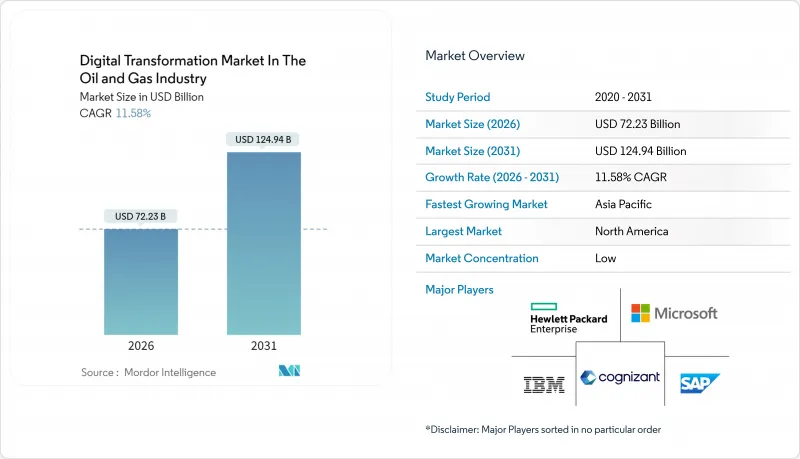
Mordor Intelligence에 의하면, 석유 및 가스 산업용 디지털 전환(DX) 시장은 2026년에 721억 8,000만 달러 규모에 이를 것으로 추정되고, 2031년까지 1,248억 9,000만 달러까지 확대될 것으로 예측되며, 예측 기간 중 CAGR 11.59%로 성장할 전망입니다.

본 보고서는 컴포넌트별(하드웨어, 소프트웨어, 서비스), 기술별(애널리틱스, 인공지능 및 머신러닝, IoT 등), 용도별(업스트림 공정, 미드스트림 공정, 다운스트림 공정), 배포 방식별(온프레미스, 클라우드) 및 지역별로 분류되어 있습니다. 시장 전망은 금액(달러) 기준으로 제시되어 있습니다.
세계의 석유 및 가스 산업용 디지털 전환(DX) 시장 동향 및 인사이트
예지 보전 및 자율 운전을 위한 인공지능(AI) 및 머신러닝 도입
머신러닝은 지하 모델 생성 주기를 수개월에서 수주일로 단축하고, 비트 하중 및 회전 속도의 폐루프 제어를 가능하게 함으로써 시추공당 비용을 절감하고 시추의 경제성을 혁신하고 있습니다. SLB사와 Equinor사는 브라질 연안에서 자율 방향성 시추를 실증하고, 시추 기간을 15% 단축함으로써 자동화 성숙도의 다음 단계를 보여주었습니다. 예지 보전 역시 마찬가지로 큰 투자 효과를 가져오고 있으며, 전동 잠수 펌프의 알고리즘이 고장 징후를 미연에 방지함으로써 연간 생산량을 수십만 배럴 증가시키고 있습니다. 세계경제포럼(WEF)의 ‘세계 라이트하우스 네트워크’로 선정된 사우디 아람코의 인공지능 인프라는 얌부 정유시설의 온실가스 배출 강도를 23% 줄이고, 크라이스 정유시설의 유지보수 비용을 30% 절감했습니다. 이러한 성과는 인공지능이 운영 비용 절감과 배출량 감축이라는 이중의 이점을 가져다준다는 것을 입증하고 있으며, 탄소 가격 제도가 새로운 지역으로 확대됨에 따라 이러한 성과는 필수적인 요소가 될 것입니다.
실시간 자산 모니터링을 위한 산업용 IoT 및 엣지 컴퓨팅
현재 수천 개의 센서 노드가 유정 입구, 압축기, 파이프라인 구간에 그물망처럼 배치되어 있으며, 위성 통신이 두절된 경우에도 이상 감지 모델을 실행하는 로컬 엣지 서버로 데이터를 스트리밍하고 있습니다. 크라이스 스마트필드(Krais SmartField)에서는 상시 가동되는 산업용 IoT 모니터링이 수작업 순찰을 대체한 결과, 전력 사용량을 18% 절감하고 점검 시간을 40% 단축하는 데 성공했습니다. 드론이나 웨어러블 단말기를 엣지 분석과 결합함으로써 점검 시간을 최대 90% 단축할 수 있으며, 숙련된 인력을 부가가치가 더 높은 업무에 투입할 수 있게 됩니다. 또한, 엣지 아키텍처는 위성에서 전송되는 경보에 거의 실시간으로 대응하는 메탄 누출 감지 네트워크의 기반이 되고 있으며, 새로운 감지 규제가 시행됨에 따라 이 기능은 점점 더 중요해지고 있습니다. ISO 15926-6:2024 데이터 교환 표준을 준수함으로써, 별도의 맞춤형 통합 없이도 센서의 텔레메트리 데이터를 다중 벤더 디지털 트윈에 공급할 수 있게 되어 도입이 가속화되고 있습니다.
운영 기술(OT)과 정보 기술(IT)의 융합에서 나타나는 사이버 보안 취약점
많은 분산 제어 시스템 및 감시 제어 시스템은 네트워크 연결이 존재하지 않았던 시대에 설계되었기 때문에 인증, 암호화, 침입 감지 기능을 갖추고 있지 않습니다. 미국 국립표준기술연구소(NIST)의 SP 800-82에는 대책 지침이 제시되어 있지만, 에어 갭(air gap)이 적용된 플랫폼을 사후에 개조하려면 소규모 생산 업체에게는 부족한 자본이 필요합니다. 해상 시설의 위성 통신 회선은 공격 대상 영역을 확대시켜, 공격자가 원격으로 안전 인터록을 조작하거나 생산을 방해할 수 있게 합니다. 규제 당국은 현재 모든 장치를 인증하는 제로 트러스트 아키텍처의 도입을 강력히 요구하고 있지만, 이러한 프레임워크에는 정보 기술(IT) 팀과 운영 기술(OT) 팀 간의 공동 거버넌스가 필수적입니다. 기업이 이러한 격차를 해소할 때까지 이사회는 생산 자산을 클라우드 분석에 연결하는 모든 프로젝트를 엄격히 검토하게 될 것이며, 본래라면 효율성 향상으로 이어졌을 도입이 지연될 것입니다.
부문별 분석
서비스 매출은 연평균 성장률(CAGR) 12.62%로 확대되고 있으며, 그 성장률은 소프트웨어를 상회하고 있습니다. 이는 도입의 성패가 시스템 통합, 사이버 보안 강화 및 직원 교육에 달려 있기 때문입니다. 2025년에도 소프트웨어는 디지털 전환 시장에서 44.53%의 점유율을 차지하며 여전히 주도적인 위치를 유지했습니다. 이는 저류층 시뮬레이터, 디지털 트윈 및 IoT 미들웨어에 대한 수요가 지속되고 있음을 반영합니다. 그러나 사업자들은 데이터를 맥락에 맞게 해석하고 워크플로우를 재구축할 수 있는 분야의 전문가가 없다면, 라이선스만으로는 가치를 창출할 수 없습니다는 사실을 깨달았습니다. 하이브리드 클라우드와 엣지 아키텍처가 점점 더 복잡해짐에 따라, 인프라를 모니터링하고, 모델을 재조정하며, 사이버 사고에 대응하는 매니지드 서비스에 대한 필요성이 더욱 높아지고 있습니다. 견고한 센서나 고성능 컴퓨팅 클러스터에는 여전히 하드웨어 투자가 필요하지만, 확장 가능한 클라우드 플랫폼이 온프레미스 데이터센터를 대체함에 따라 그 성장세는 둔화되고 있습니다. 변혁 프로그램이 확대됨에 따라 자문, 도입, 성과 기반 매니지드 서비스를 융합한 벤더들이 예산의 더 큰 비중을 차지하게 될 것이며, 예측 기간의 나머지 기간 동안에도 서비스 분야의 성장률이 소프트웨어 분야를 계속해서 상회할 것으로 전망됩니다.
장기적으로는 사업자들이 변혁을 한정된 프로그램이 아닌 지속적인 노력으로 인식함에 따라, 서비스 및 소프트웨어에 대한 지출 비중이 확대될 전망입니다. 생산성 향상이나 배출량 감축 목표에 보상을 연계하는 성과 연계형 계약은 벤더의 인센티브와 사업자의 성과를 일치시켜 전략적 관계를 심화시킵니다. 이러한 요인들로 인해 디지털 전환 시장에서 서비스의 규모는 2031년까지 소프트웨어 지출과 어깨를 나란히 할 가능성이 있는 것으로 보입니다. 이에 따라 시스템 통합사업자와 대형 유전 서비스 기업들은 하드웨어 조달액이 정체된 이후에도 전문 지식을 확보하고 안정적인 수익원을 확보하기 위해 틈새 소프트웨어 기업을 인수하고 있습니다. 이러한 변화로 인해 조직적인 변혁 관리와 프로세스 재구성이 이사회 차원의 우선 과제로 자리 잡고 있습니다.
2025년 지출 중 IoT 도입이 26.37%를 차지했으나, 가장 큰 가치의 이동은 연간 13.01%의 성장률을 보이는 인공지능 및 머신러닝으로 옮겨가고 있습니다. 일상적인 대시보드를 통한 모니터링은 시추, 생산, 정제에 걸친 의사결정을 자동화하는 예측 분석 및 처방 분석으로 대체되고 있습니다. 생성형 AI 어시스턴트는 수십 년에 걸친 기술 문서를 분석하여 몇 초 이내에 문제 해결 절차를 제안할 수 있게 되었습니다. 이러한 비약적인 발전으로 인해 평균 복구 시간(MTTR)이 단축되고 가동률이 향상되고 있습니다. 블록체인과 분산 원장 기술은 여전히 틈새 영역에 머물러 있으며, 상품 거래나 합작 투자 회계와 같은 이용 사례로 제한되어 있습니다. 빅데이터 플랫폼은 기반이 되지만, 독립형 솔루션으로 도입되기보다는 부가가치가 높은 AI 솔루션에 통합되는 사례가 늘고 있습니다. 사업자가 데이터 거버넌스를 확립함에 따라 AI의 점유율은 확대될 것입니다. 그 알고리즘은 지속적으로 학습하며, 새로운 센서 스트림과 도메인별 데이터셋을 모두 활용하기 때문입니다. 이러한 급증은 디지털 전환 시장 규모 확대가 더 이상 단순한 연결성뿐만 아니라 인지 기능과 자동화에 의해 뒷받침되고 있음을 입증합니다.
시장 역학은 물리 법칙에 기반한 제약을 반영한 사전 학습 모델을 보유한 벤더에게 유리하게 작용하고 있습니다. 이를 통해 데이터가 부족한 환경에서도 정확한 예측에 필요한 데이터 양을 줄일 수 있습니다. 이러한 모델은 엣지 컴퓨팅과 결합될 때 더욱 큰 우위를 발휘하여, 클라우드 지연 없이 자동 유정 폐쇄와 같은 안전상 중요한 의사결정을 현장에서 실행할 수 있게 합니다. 향후 5년 동안, 증산에 따른 회수율이 프로젝트의 경제성에 지대한 영향을 미치는 고비용 해양 자산 분야에서 자율 운영이 표준이 될 것입니다. 그 결과, 인공지능은 예산에서 차지하는 비중이 점점 더 커져, 가치 창출의 주요 원동력으로서 IoT를 능가할 것으로 예측됩니다.
지역별 분석
북미는 데이터 기반 완성 설계에 의존하는 셰일 사업자와 증기 주입법(SAGD)을 최적화하는 오일샌드 생산업체에 힘입어, 2025년 지출에서 33.53%라는 최대 점유율을 유지했습니다. 도입의 기세는 풍부한 디지털 인재, 클라우드 리전의 손쉬운 이용 가능성, 그리고 효율성 향상을 높이 평가하는 금융 시장에 의해 뒷받침되고 있습니다. 이 지역의 엄격한 자본 관리 방침으로 인해 사업자들은 비용 상승 환경 속에서도 생산량을 유지하기 위해 예측 유지보수 및 자율 시추 도입을 서두르고 있습니다. 또한, 미국 연방 정부의 메탄 규제로 인해 배출량 모니터링 소프트웨어 도입이 가속화되고 있으며, 규정 준수(컴플라이언스)와 수익성이 밀접하게 연관되어 있습니다.
아시아태평양은 12.68%라는 가장 높은 연평균 성장률(CAGR)을 기록하고 있으며, 중국, 인도, 동남아시아의 국영 석유 회사들이 액화천연가스(LNG) 수출 일정과 확대되는 전력 부문의 탈탄소화 공약에 대응하기 위해 레거시 자산을 갱신해 나가는 과정에서 구조적인 현대화의 물결에 직면하고 있습니다. 각국 정부는 국내 클라우드 대안을 장려하고 있지만, 데이터를 현지화하는 합작 투자를 통해 세계 하이퍼스케일러와의 제휴는 여전히 활발합니다. 지역 내 인력 부족을 배경으로 시스템 통합사업자들은 직원 교육을 포함한 턴키 솔루션 제공을 추진하고 있습니다. 사이버 위협에 대한 인식 제고와 유럽으로 화물을 선적하기 전에 탄소 강도를 문서화해야 할 필요성으로 인해 디지털 관련 예산은 더욱 확대되고 있습니다. 이러한 요인들이 복합적으로 작용하여 향후 5년 동안 아시아태평양의 디지털 전환 시장 규모에서 점유율이 확대될 전망입니다.
유럽에서는 엄격한 배출권 거래 제도에 따른 비용과 북해의 생산량 감소로 인해 지출의 상당 부분이 배출량 최적화에 할당되고 있습니다. 사업자들은 자산의 수명을 연장하기 위해 예측 유지보수 솔루션과 저류층 최적화를 위한 인공지능을 도입하고 있습니다. 한편, 사우디 아람코나 아부다비 국영 석유공사(ADNOC)와 같은 중동의 거대 기업들은 디지털 전환을 국가의 다각화 전략으로 삼고, 주력 프로젝트에 4차 산업혁명 기술을 접목하여 ‘세계 라이트하우스 네트워크’ 인증을 획득했습니다. 남미와 아프리카의 현재 점유율은 작지만, 브라질의 심해 개발 프로젝트나 서아프리카의 프론티어 광구에서는 개발 비용을 절감하기 위해 자율 운영에 크게 의존하고 있습니다. 전반적으로 경쟁 환경과 규제상의 압박으로 인해 모든 지역에서 디지털 투자가 확대될 것으로 확실시되며, 그중에서도 아시아태평양은 북미와의 격차를 가장 빠르게 좁혀가고 있습니다.
기타 혜택 :
- Excel 형식 시장 예측(ME) 시트
- 3개월간의 애널리스트 지원
자주 묻는 질문
목차
제1장 서론
제2장 분석 방법
제3장 주요 요약
제4장 시장 구도
제5장 시장 규모 및 성장률 예측
제6장 경쟁 구도
제7장 시장 기회 및 향후 전망
AJY 26.08.07According to Mordor Intelligence, the digital transformation market in the Oil & Gas Industry reached a market size of USD 72.18 billion in 2026 and is projected to climb to USD 124.89 billion by 2031, advancing at an 11.59% CAGR during the forecast period.
This report is Segmented by Component (Hardware, Software, and Services), Technology (Analytics, Artificial Intelligence and Machine Learning, Internet of Things, and More), Application (Upstream, Midstream, and Downstream), Deployment Mode (On-Premises, and Cloud), and Geography. The Market Forecasts are Provided in Terms of Value (USD).
Insights and Trends of Digital Transformation Market in the Oil & Gas Industry
Artificial Intelligence And Machine Learning Adoption For Predictive Maintenance And Autonomous Operations
Machine learning is reshaping drilling economics by compressing subsurface-modeling cycles from months to weeks and by enabling closed-loop control of weight on bit and rotary speed that lowers cost per well. SLB and Equinor demonstrated autonomous directional drilling off Brazil, trimming drilling duration by 15% and signaling the next phase of automation maturity. Predictive maintenance delivers equally compelling payback as electric submersible pump algorithms preempt failure signatures, adding hundreds of thousands of barrels in annual output. Saudi Aramco's artificial intelligence infrastructure, recognized by the World Economic Forum's Global Lighthouse Network, cut greenhouse-gas intensity at Yanbu Refinery by 23% and maintenance cost at Khurais by 30%. These results prove that artificial intelligence produces dual benefits of lower operating cost and reduced emissions, outcomes that will become mandatory as carbon-price schemes spread to new regions.
Industrial Internet Of Things And Edge Computing For Real-Time Asset Monitoring
Thousands of sensor nodes now blanket wellheads, compressors, and pipeline segments, streaming data to local edge servers that execute anomaly-detection models even when satellite links drop. The Khurais smart field achieved an 18% cut in power use and a 40% reduction in inspection time once always-on Industrial Internet of Things monitoring replaced manual rounds. Coupling drones and wearables with edge analytics slashes inspection duration by up to 90%, freeing skilled labor for higher-value tasks. Edge architectures also underpin methane-leak detection grids that respond to satellite alerts in near real time, a capability becoming critical as new detection rules take effect. Adoption is accelerating because ISO 15926-6:2024 data-exchange compliance now guarantees that sensor telemetry can feed multi-vendor digital twins without custom integration.
Cybersecurity Vulnerabilities In Operational Technology And Information Technology Convergence
Many distributed-control and supervisory-control systems were engineered before network connectivity existed, leaving them without authentication, encryption, or intrusion detection. The National Institute of Standards and Technology's SP 800-82 offers mitigation guidance, but retrofitting air-gapped platforms requires capital that smaller producers lack. Satellite links on offshore facilities widen the attack surface, letting adversaries manipulate safety interlocks or disrupt production at distance. Regulators now urge zero-trust architectures that authenticate every device, yet these frameworks demand joint governance by information-technology and operational-technology teams. Until companies close this gap, boards will scrutinize any project that connects production assets to cloud analytics, slowing rollouts that would otherwise lift efficiency.
Other drivers and restraints analyzed in the detailed report include:
- Cloud Migration Enabling Scalable Data Integration And Advanced Analytics
- Energy Transition Mandates Driving Emissions Monitoring And Carbon-Intensity Optimization
- Legacy System Integration Complexity And High Upfront Costs
For complete list of drivers and restraints, kindly check the Table Of Contents.
Segment Analysis
Services revenue is expanding at a 12.62% CAGR, surpassing software in growth because implementation success hinges on system integration, cybersecurity hardening, and workforce training. Software still led with 44.53% digital transformation market share in 2025, reflecting ongoing demand for reservoir simulators, digital twins, and Internet of Things middleware. Yet operators discovered that licenses alone do not yield value without domain specialists who contextualize data and remodel workflows. The growing complexity of hybrid cloud and edge architectures intensifies the requirement for managed services that monitor infrastructure, recalibrate models, and respond to cyber incidents. Hardware spending remains necessary for ruggedized sensors and high-performance compute clusters, but growth moderates as scalable cloud platforms displace on-premise data centers. As transformation programs scale, vendors blending advisory, implementation, and outcome-based managed services will capture a rising portion of budgets, positioning services to continue outpacing software for the remainder of the forecast window.
Longer term, the services-to-software spending ratio is set to widen because operators treat transformation as a continuous journey rather than a finite program. Performance-based contracts that peg fees to production-uplift or emissions-cut targets align vendor incentives with operator outcomes, deepening strategic relationships. These factors suggest that the digital transformation market size for services could approach parity with software spending before 2031. System integrators and oilfield-services majors are therefore acquiring niche software firms to lock in domain expertise and secure annuity revenue streams once hardware procurement flattens. The shift elevates organizational change-management and process re-engineering to board-level priorities.
Internet of Things deployments delivered 26.37% of 2025 spending, but the largest value migration is shifting toward artificial intelligence and machine learning, which are growing at 13.01% per year. Routine dashboarding is giving way to predictive and prescriptive analytics that automate decision-making across drilling, production, and refining. Generative artificial intelligence assistants now parse decades of engineering documents to propose troubleshooting steps within seconds, a leap that reduces mean-time-to-repair and lifts uptime. Blockchain and distributed ledgers remain niche, limited to commodity trading and joint-venture accounting use cases. Big-data platforms, though foundational, are increasingly bundled inside higher-value artificial intelligence offerings instead of being deployed as standalone solutions. As operators master data governance, artificial intelligence's share will expand because its algorithms learn continuously, exploiting every new sensor stream and domain dataset. The surge confirms that digital transformation market size growth is now anchored in cognition and automation rather than connectivity alone.
Market dynamics favor vendors with pre-trained models that embed physics-based constraints, reducing the data required for accurate predictions in sparse environments. Those models gain further advantage when coupled with edge computing, enabling safety-critical decisions such as automatic well shut-ins to occur locally without cloud latency. Over the next five years, autonomous operations will become standard on high-cost offshore assets where incremental recovery has oversized impact on project economics. Consequently, artificial intelligence is expected to absorb an ever-greater slice of budgets, overtaking Internet of Things as the primary engine of value.
Complete Report Scope:
- By Component
- Hardware
- Software
- Services
- By Technology
- Analytics
- Artificial Intelligence and Machine Learning
- Internet of Things
- Cloud and Edge Computing
- Industrial Robotics
- Cybersecurity
- Other Technologies
- By Application
- Upstream
- Midstream
- Downstream
- By Deployment Mode
- On-Premise
- Cloud
- By Geography
- North America
- United States
- Canada
- Mexico
- South America
- Brazil
- Argentina
- Rest of South America
- Europe
- United Kingdom
- Norway
- Germany
- Rest of Europe
- Asia-Pacific
- China
- India
- Japan
- South Korea
- Rest of Asia-Pacific
- Middle East
- United Arab Emirates
- Saudi Arabia
- Rest of Middle East
- Africa
- South Africa
- Kenya
- Rest of Africa
- North America
Geography Analysis
North America retained the largest slice of 2025 spending at 33.53%, propelled by shale operators that rely on data-driven completion designs and oil-sands producers optimizing steam-assisted gravity drainage. Adoption momentum benefits from deep pools of digital talent, ready availability of cloud regions, and financial markets that reward efficiency gains. The region's capital discipline pushes operators to embrace predictive maintenance and autonomous drilling to sustain output in a cost-inflation environment. United States federal methane rules also accelerate uptake of emissions-monitoring software, intertwining compliance and profitability considerations.
Asia-Pacific, registering the fastest 12.68% CAGR, is undergoing a structural modernization wave as national oil companies in China, India, and Southeast Asia revamp legacy assets to meet liquefied natural gas export schedules and expanding power-sector decarbonization pledges. Governments encourage domestic cloud alternatives, but partnerships with global hyperscalers still flourish through joint ventures that localize data. Regional talent gaps spur system integrators to bundle turnkey solutions that include workforce training. Rising cyber-threat awareness and the need to document carbon intensity before shipping cargoes to Europe further lift digital budgets. Collectively, these factors will elevate Asia-Pacific's share of digital transformation market size over the next five years.
Europe directs a sizable portion of spend toward emissions-optimization because of stringent trading-scheme costs and dwindling North Sea production. Operators deploy predictive-maintenance suites and reservoir-optimization artificial intelligence to stretch asset life. Meanwhile, Middle Eastern giants such as Saudi Aramco and Abu Dhabi National Oil Company treat digital transformation as national-diversification strategy, embedding Fourth Industrial Revolution technologies in flagship projects and earning Global Lighthouse Network recognition. South America and Africa presently contribute smaller shares, but Brazil's deepwater campaign and West Africa's frontier acreage rely heavily on autonomous operations to cut development cost. Overall, competitive dynamics and regulatory pressure ensure that every region will deepen digital investment, with Asia-Pacific narrowing the gap on North America fastest.
- IBM Corporation
- Microsoft Corporation
- Schlumberger NV
- Halliburton Company
- Baker Hughes Company
- Honeywell International Inc.
- Siemens AG
- SAP SE
- Oracle Corporation
- Cisco Systems, Inc.
- Cognizant Technology Solutions Corporation
- Hewlett Packard Enterprise Company
- Infosys Limited
- Fujitsu Limited
- Hitachi, Ltd.
- ABB Ltd.
- Emerson Electric Co.
- Schneider Electric SE
- Rockwell Automation, Inc.
- Accenture plc
- Amazon Web Services, Inc.
- PTC Inc.
- Kongsberg Digital AS
- Yokogawa Electric Corporation
- Weatherford International plc
- Aspen Technology, Inc.
- C3.ai, Inc.
- Aker Solutions ASA
- AVEVA Group plc
Additional Benefits:
- The market estimate (ME) sheet in Excel format
- 3 months of analyst support
TABLE OF CONTENTS
1 INTRODUCTION
- 1.1 Study Assumptions and Market Definition
- 1.2 Scope of the Study
2 RESEARCH METHODOLOGY
3 EXECUTIVE SUMMARY
4 MARKET LANDSCAPE
- 4.1 Market Overview
- 4.2 Impact of Macroeconomic Factors on the Market
- 4.3 Market Drivers
- 4.3.1 IoT-Enabled Operational Efficiency Push
- 4.3.2 Predictive-Maintenance Led OPEX Reduction
- 4.3.3 Asset-Lifecycle Extension via Digital Twins
- 4.3.4 Decarbonization Regulations Demanding Real-Time Data
- 4.3.5 Reservoir CO2 Monitoring Mandates
- 4.3.6 Quantum-Ready Seismic Inversion Pilots
- 4.4 Market Restraints
- 4.4.1 Interoperability and Legacy SCADA Lock-In
- 4.4.2 Up-Front CAPEX and ROI Uncertainty
- 4.4.3 Digital-Skill Attrition in Remote Basins
- 4.4.4 Edge-Compute Cyber-Insurance Gaps
- 4.5 Industry Value / Supply-Chain Analysis
- 4.6 Regulatory Landscape
- 4.7 Technological Outlook
- 4.8 Porter's Five Forces Analysis
- 4.8.1 Threat of New Entrants
- 4.8.2 Bargaining Power of Suppliers
- 4.8.3 Bargaining Power of Buyers
- 4.8.4 Threat of Substitutes
- 4.8.5 Industry Rivalry
- 4.9 Emerging Use Cases of Digital Transformation
- 4.9.1 Well-Site Monitoring
- 4.9.2 Chemical-Injection Automation
- 4.9.3 Tank-Level Monitoring
- 4.9.4 Pump Monitoring
- 4.9.5 Pipeline Condition Monitoring
- 4.9.6 Environmental Monitoring
- 4.9.7 Hazard Management
- 4.9.8 AI-Based Surveillance and Monitoring
- 4.9.9 Simulation Models
5 MARKET SIZE AND GROWTH FORECASTS (VALUE)
- 5.1 By Component
- 5.1.1 Hardware
- 5.1.2 Software
- 5.1.3 Services
- 5.2 By Technology
- 5.2.1 Analytics
- 5.2.2 Artificial Intelligence and Machine Learning
- 5.2.3 Internet of Things
- 5.2.4 Cloud and Edge Computing
- 5.2.5 Industrial Robotics
- 5.2.6 Cybersecurity
- 5.2.7 Other Technologies
- 5.3 By Application
- 5.3.1 Upstream
- 5.3.2 Midstream
- 5.3.3 Downstream
- 5.4 By Deployment Mode
- 5.4.1 On-Premise
- 5.4.2 Cloud
- 5.5 By Geography
- 5.5.1 North America
- 5.5.1.1 United States
- 5.5.1.2 Canada
- 5.5.1.3 Mexico
- 5.5.2 South America
- 5.5.2.1 Brazil
- 5.5.2.2 Argentina
- 5.5.2.3 Rest of South America
- 5.5.3 Europe
- 5.5.3.1 United Kingdom
- 5.5.3.2 Norway
- 5.5.3.3 Germany
- 5.5.3.4 Rest of Europe
- 5.5.4 Asia-Pacific
- 5.5.4.1 China
- 5.5.4.2 India
- 5.5.4.3 Japan
- 5.5.4.4 South Korea
- 5.5.4.5 Rest of Asia-Pacific
- 5.5.5 Middle East
- 5.5.5.1 United Arab Emirates
- 5.5.5.2 Saudi Arabia
- 5.5.5.3 Rest of Middle East
- 5.5.6 Africa
- 5.5.6.1 South Africa
- 5.5.6.2 Kenya
- 5.5.6.3 Rest of Africa
- 5.5.1 North America
6 COMPETITIVE LANDSCAPE
- 6.1 Market Concentration
- 6.2 Strategic Moves
- 6.3 Market Share Analysis
- 6.4 Company Profiles (includes Global Level Overview, Market Level Overview, Core Segments, Financials as available, Strategic Information, Market Rank/Share, Products and Services, Recent Developments)
- 6.4.1 IBM Corporation
- 6.4.2 Microsoft Corporation
- 6.4.3 Schlumberger NV
- 6.4.4 Halliburton Company
- 6.4.5 Baker Hughes Company
- 6.4.6 Honeywell International Inc.
- 6.4.7 Siemens AG
- 6.4.8 SAP SE
- 6.4.9 Oracle Corporation
- 6.4.10 Cisco Systems, Inc.
- 6.4.11 Cognizant Technology Solutions Corporation
- 6.4.12 Hewlett Packard Enterprise Company
- 6.4.13 Infosys Limited
- 6.4.14 Fujitsu Limited
- 6.4.15 Hitachi, Ltd.
- 6.4.16 ABB Ltd.
- 6.4.17 Emerson Electric Co.
- 6.4.18 Schneider Electric SE
- 6.4.19 Rockwell Automation, Inc.
- 6.4.20 Accenture plc
- 6.4.21 Amazon Web Services, Inc.
- 6.4.22 PTC Inc.
- 6.4.23 Kongsberg Digital AS
- 6.4.24 Yokogawa Electric Corporation
- 6.4.25 Weatherford International plc
- 6.4.26 Aspen Technology, Inc.
- 6.4.27 C3.ai, Inc.
- 6.4.28 Aker Solutions ASA
- 6.4.29 AVEVA Group plc
7 MARKET OPPORTUNITIES AND FUTURE OUTLOOK
- 7.1 White-Space and Unmet-Need Assessment


