

|
시장보고서
상품코드
2097360
자율주행차 : 시장 점유율 분석, 업계 동향 및 통계, 성장 예측(2025-2030년)Autonomous Vehicle - Market Share Analysis, Industry Trends & Statistics, Growth Forecasts (2025 - 2030) |
||||||
 Mordor Intelligence
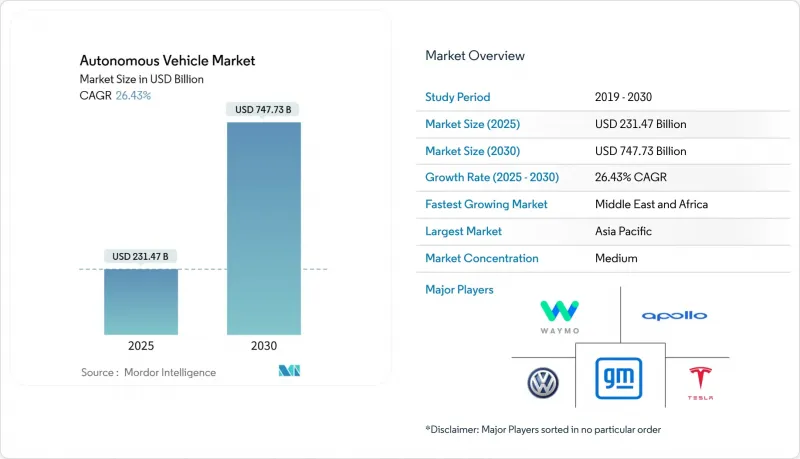
Mordor Intelligence에 의하면, 자율주행차 시장 규모는 2025년에 2,314억 7,000만 달러로 평가되었고 2030년까지 7,477억 3,000만 달러에 이를 것으로 예측됩니다.
2025-2030년 연평균 성장률(CAGR) 26.43%로 성장할 것으로 전망됩니다.
본 보고서는 자동화 수준(레벨 1 : 운전 보조, 레벨 2 : 부분 자동화 등), 차종(승용차 및 상용차), 추진 방식(내연기관 등), 모빌리티 형태(개인 소유 및 공유), 구성 요소(하드웨어 등), 그리고 지역별로 분류되어 있습니다. 시장 전망은 금액(달러) 기준으로 제시되어 있습니다.
세계의 자율주행차 시장 동향 및 인사이트
EU 및 중국에서 ADAS를 중심으로 한 안전 규제에 대한 정부의 의무화 조치
두 지역 모두에서 엄격한 ADAS 안전 규제로 인해 자율주행차 업계는 소프트웨어 검증 주기를 가속화할 수밖에 없게 되었으며, 그 결과 공급업체의 수익 창출 시기가 앞당겨지고 있습니다. 유럽연합 집행위원회의 국경을 초월한 테스트베드 프로그램과 중국 내 여러 도시에서의 로보택시 허가는 벤더들에게 승인 절차에 대한 명확한 로드맵을 사실상 제시하고 있으며, 2025년에는 연구개발비가 증가했습니다. 그 결과로 눈에 띄는 변화로, 주요 개발 기업들은 지역별 고유 요건을 충족하기 위해 코드베이스를 분할하고 있어, 기능 세트는 중복되지만 완전히 동일하지는 않은 상태가 발생하고 있습니다. 이러한 분리로 인해 소프트웨어의 총량이 미묘하게 증가하게 되며, 이는 향후 유지보수 비용과 인력 수요에 영향을 미치게 될 것입니다.
아시아 메가시티에서의 로보택시 시범 사업 급속한 확대
우한이나 상하이 등의 도시에서는 현재 로보택시 요금이 기존 차량 호출 서비스보다 저렴합니다. 이러한 추세는 모든 지역에서 운전자가 완전히 배제되기 전이라도, 자율주행 기반의 공유 모빌리티가 사람이 운전하는 대체 수단을 능가할 가능성이 있음을 보여줍니다. 이러한 비용 차이는 주로 차고지 방식의 차량 관리와 비성수기 유휴 시간 단축을 통해 실현되고 있으며, 이는 기존 택시에서는 재현하기 어려운 접근 방식입니다. 주목할 점은 자율주행차에 대한 초기 논의에서 종종 간과되어 왔던 저소득층 통근자들이 이러한 저렴한 요금 덕분에 주요 고객층으로 부상하고 있으며, 그 결과 일반 시민들의 수용이 예상보다 빠르게 확산될 가능성이 있다는 것입니다.
미국 내 주별 자율주행차 규제의 불일치가 상업적 규모로의 확장을 지연시키고 있다.
29개 주가 독자적인 자율주행차 규제를 제정하고 있어, 여러 주에서 사업을 전개하는 서비스 제공업체는 보고 체계, 운전자 모니터링 체계, 보험 체계를 각각 다른 형태로 유지해야 하며, 이로 인해 간접비가 증가하여 결과적으로 단기간에 확보할 수 있는 자율주행차 시장 점유율이 제한되고 있습니다. 증거에 따르면, 일부 개발업체는 현재 규제가 완화된 지역으로만 서비스 전개 경로를 선정하고 있으며, 그 결과 의도치 않게 수요가 높은 특정 화물 운송 경로가 소외되고 있습니다. 여기서 도출되는 새로운 교훈은 통일된 프레임워크의 부재가 투자를 실증 시험이 아닌 시뮬레이션으로 간접적으로 유도하여 개발 일정을 장기화시킬 가능성이 있다는 점입니다.
부문 분석
2024년에는 레벨 1(운전 지원) 기능이 자율주행차 시장 점유율의 45.21%를 차지했으나, 레벨 5(완전 자율주행)는 2030년까지 연평균 성장률(CAGR) 27.23%를 나타낼 것으로 예측되어, 자동화 레벨이 상승함에 따라 그 격차는 급속히 좁혀질 것입니다. 조건부 및 고도화된 자동화 기능에 대한 법적 규제가 명확해짐에 따라, 공급업체들은 중복 설계된 조향 및 제동 서브시스템의 인증을 추진하도록 촉진받고 있으며, 이에 따라 하드웨어 매출이 즉시 증가하고 있습니다. 또한, 보험사들이 특정 주행 모드에서 제조업체에 책임을 전가하도록 보험료율표를 재검토하고 있다는 미묘한 영향도 있는데, 이는 향후 최종 사용자를 대상으로 한 보험료 인하로 이어질 가능성을 시사합니다.
고급차 구매층의 레벨 3에 대한 관심이 높아짐에 따라, 차량당 개발비 상각액이 감소하여 간접적으로 레벨 4 자율주행차의 연구개발 자금이 충당되고 있습니다. '퍼스널 파일럿(레벨 3)'을 탑재한 BMW 7 시리즈 등의 모델은 얼리 어답터들이 프리미엄 가격을 기꺼이 지불하고 있음을 보여주며, 그 이익 마진이 지속적인 지도 제작 비용을 상쇄하는 데 기여하고 있습니다. 또한, 레벨 3 차량에서 수집된 파일럿 모드 데이터는 레벨 4 트럭에 사용되는 머신러닝 모델에 활용되어, 부문 전반에 걸친 데이터 수집 주기를 단축시키고 있습니다.
2024년, 승용차는 자율주행차 시장 점유율의 78.92%를 차지했습니다. 그러나 많은 자동차 제조업체들은 현재 자율주행을 일회성 하드웨어 업그레이드가 아닌 지속적인 소프트웨어 구독의 기회로 간주하며, 비즈니스 모델을 장기적인 수익원으로 전환하고 있습니다. 무선 업데이트(OTA)를 통해 기능의 수명 주기가 연장되고, 구매자가 수명 주기 중반에 새로운 기능이 추가되기를 기대함에 따라 평균 소유 기간이 길어질 가능성이 있습니다. 부분 자율주행 서비스에 가입하는 가구가 늘어남에 따라, 애프터마켓 공급업체의 경우 기존 내비게이션 하드웨어에 대한 수요가 감소할 가능성이 있어, 액세서리 시장의 재편이 예상됩니다.
상용차는 2030년까지 연평균 성장률(CAGR) 25.72%를 나타낼 것으로 예측되며, 물류 및 화물 운송 분야에서의 자율주행 도입이 가속화됨에 따라 시장 규모 확대 측면에서 승용차를 앞지를 것으로 전망됩니다. 인력 부족과 법정 운전 시간 제한으로 인해, 특히 장거리 운송 노선에서 자율주행은 차량 운영 업체에게 경제적으로 매력적인 선택지가 되고 있습니다. 예상치 못한 부수적 효과로, 트럭에 자율주행이 도입됨에 따라 차량 기지가 로봇 정비 도구에 투자하게 되고, 이를 통해 야드 전체의 운영이 현대화될 것으로 예측됩니다.
지역별 분석
2024년, 아시아태평양은 46.52%의 점유율로 자율주행차 시장을 주도했습니다. 이는 주로 중국 내 여러 도시에 걸친 로보택시의 대규모 도입과 광범위한 5G 인프라 구축 덕분입니다. 부처 간 협력을 통한 정부의 지원으로 시험, 보험, 사이버 보안에 관한 승인 절차가 효율화되어 프로젝트 소요 기간이 대폭 단축되었습니다. 새로운 동향으로, 2선 도시에서는 기존 대중교통의 업그레이드를 건너뛰고 직접 자율주행 셔틀을 도입하는 움직임이 나타나고 있으며, 이는 주요 대도시권을 넘어 시장으로의 보급이 진행되고 있음을 보여줍니다. 한편, 일본이나 싱가포르 등의 국가들은 학계와 자율주행 산업의 전문 지식을 결합한 컨소시엄 주도 모델을 활용하고 있어, 제한된 예산에도 불구하고 연구 개발을 효율적으로 확대할 수 있게 되었습니다.
중동 및 아프리카는 가장 빠르게 성장하는 지역으로, 2025년부터 2030년까지 연평균 성장률(CAGR) 28.11%를 나타낼 것으로 예측됩니다. 특히 아랍에미리트(UAE)에서는 국가 전략상 자율주행차가 스마트시티 목표의 핵심으로 자리 잡고 있으며, 두바이에서는 2030년까지 전체 이동의 25%를 자율주행으로 실현하는 것을 목표로 하고 있습니다. 자율주행차 전용 차선을 갖춘 전용 인프라는 기존의 도시 구조에 사후적으로 추가된 시스템에 비해 이 지역에 우위를 제공합니다. 의외의 이점으로는 이 지역의 맑은 날씨가 이어지는 사막 기후가 고정밀 센서 데이터를 제공하여 비전 시스템의 검증을 가속화하고 있다는 점을 들 수 있습니다.
북미는 아시아에 비해 자율주행차 시장 점유율은 작지만, 탄탄한 자본 시장과 기술 클러스터를 보유하고 있어 여전히 매우 중요한 지역입니다. 5G-V2X 회랑에 대한 연방 정부의 보조금과 활기찬 스타트업 파이프라인이 혁신의 추진력을 뒷받침하고 있지만, 주별 규제가 제각각이어서 전국적인 확대는 지연되고 있습니다. 대규모 라이드셰어 플랫폼이 존재하기 때문에 규제가 명확해지는 대로 즉시 상용화가 가능해집니다. 근본적인 변화로, 트럭 운송을 중시하는 각 주가 공통 지침을 중심으로 결속하고 있어, 사실상 전국적인 기준을 향한 상향식(bottom-up)의 방향이 시사되고 있습니다.
기타 혜택 :
- 엑셀 형식 시장 예측(ME) 시트
- 3개월간의 애널리스트 지원
자주 묻는 질문
목차
제1장 서론
제2장 조사 방법
제3장 주요 요약
제4장 시장 구도
제5장 시장 규모 및 성장 예측
제6장 경쟁 구도
제7장 시장 기회 및 향후 전망
KTH 26.08.05According to Mordor Intelligence, the autonomous vehicle market size is valued at USD 231.47 billion in 2025 and is projected to reach USD 747.73 billion by 2030, expanding at a compound annual growth rate (CAGR) of 26.43% during 2025-2030.
This report is Segmented by Level of Automation (Level 1 - Driver Assistance, Level 2 - Partial Automation, and More), Vehicle Type (Passenger Cars and Commercial Vehicles), Propulsion Type (Internal Combustion Engine and More), Mobility Form (Personal Ownership and Shared Mobility), Component (Hardware and More), and Geography. The Market Forecasts are Provided in Terms of Value (USD).
Global Autonomous Vehicle Market Trends and Insights
Government Mandates for ADAS-Centric Safety Regulations in the EU and China
Stringent ADAS safety rules in both regions are pushing the autonomous car industry to accelerate software validation cycles, which in turn drives earlier supplier revenue. The European Commission's cross-border testbed program and China's multi-city robo taxi permits are effectively giving vendors clear roadmaps for approval gates, encouraging higher R&D outlays in 2025. An observable consequence is that leading developers are partitioning their codebases to meet region-specific requirements, creating overlapping but not identical feature sets. This segregation subtly increases total software volume, which later influences maintenance costs and talent needs.
Rapid Expansion of Robo Taxi Pilots Across Asian Megacities
Robo taxi fares in cities like Wuhan and Shanghai are now lower than those of traditional ride-hailing services. This trend underscores the potential of autonomous shared mobility to outpace human-driven alternatives, even prior to the complete removal of drivers in all districts. The cost gap is mainly achieved through depot-style fleet management and lower off-peak idle time, an approach that is difficult for traditional taxis to replicate. A notable inference is that lower-income commuters, often overlooked in early AV narratives, are becoming target customers due to these cheaper fares, potentially widening public acceptance faster than anticipated.
Patchwork State-Level AV Regulations in the United States Delay Commercial Scale
With 29 states legislating unique autonomous rules, multi-state service providers must maintain varied reporting, driver-monitoring, and insurance structures, inflating overhead and thereby limiting the autonomous vehicles market share they can capture quickly. Evidence shows that some developers now pick launch corridors strictly within permissive clusters, which unintentionally sidelines certain high-demand freight lanes. An emerging takeaway is that the lack of a unified framework indirectly channels investment toward simulation rather than on-road testing, potentially stretching development timelines.
Other drivers and restraints analyzed in the detailed report include:
- Falling LiDAR and AI Compute Costs Are Unlocking Mass-Market Level 3 Launches
- Power-Efficient Automotive SoCs Enabling In-Vehicle Edge AI
- Public Mistrust Intensified by High-Profile Robo Taxi Incidents in China
For complete list of drivers and restraints, kindly check the Table Of Contents.
Segment Analysis
Level 1 (Driver Assistance) features held 45.21% of the autonomous vehicle market share in 2024, but Level 5 (Full Automation) is projected to grow at a 27.23% CAGR through 2030, meaning higher automation will narrow the gap quickly. Legislative clarity for conditional and high-automation functions encourages suppliers to certify redundant steering and braking subsystems, raising immediate hardware revenue. A subtle effect is that insurers are revising actuarial tables to shift liability to manufacturers for specific modes, hinting at future premium reductions for end users.
Growing interest in Level 3 from luxury buyers brings down development amortization per unit, indirectly funding Level 4 autonomous car research. Models such as the BMW 7-Series with Personal Pilot Level 3 illustrate that early adopters pay premium prices, a margin that helps offset ongoing mapping costs. Additionally, pilot-mode data harvested from Level 3 vehicles is feeding machine-learning models used in Level 4 trucks, shortening data-collection loops across segments.
Passenger cars commanded 78.92% of the autonomous vehicle market share during 2024. Yet, many OEMs now view autonomy as a recurring software subscription opportunity rather than a one-time hardware upgrade, shifting the business model toward long-term revenue streams. Over-the-air updates extend feature life cycles, which could lengthen average ownership as buyers anticipate new capabilities mid-cycle. As more households subscribe to partial autonomy, aftermarket suppliers may see declining demand for traditional navigation hardware, suggesting a reshaping of accessory markets.
Commercial vehicles are projected to grow at a 25.72% CAGR through 2030, outpacing passenger cars in market size expansion as autonomy adoption accelerates in logistics and freight segments. Labor shortages and mandated driving-hour limits make autonomy economically compelling for fleet operators, especially in long-haul corridors. An unexpected by-product is that depots invest in robotic maintenance tools to match truck autonomy, thereby modernizing entire yard operations.
Complete Report Scope:
- By Level of Automation
- Level 1- Driver Assistance
- Level 2 - Partial Automation
- Level 3 - Conditional Automation
- Level 4 - High Automation
- Level 5 - Full Automation
- By Vehicle Type
- Passenger Cars
- Commercial Vehicles
- By Propulsion Type
- Internal Combustion Engine (ICE)
- Battery Electric Vehicles (BEV)
- Hybrid Electric Vehicles (HEV)
- By Mobility Form
- Personal Ownership
- Shared Mobility (Robo-Taxi, Shuttle)
- By Component
- Hardware
- Sensors (LiDAR, RADAR, Cameras, Ultrasonic, IMU)
- Computing Platforms (SoCs, GPUs)
- Actuators and Control Systems
- Software
- Perception and Planning Suites
- Mapping and Localization Engines
- Driver Monitoring and HMI
- Services
- Integration and Validation
- Remote Operation and Tele-operation
- Hardware
- Geography
- North America
- United States
- Canada
- Rest of North America
- South America
- Brazil
- Argentina
- Rest of South America
- Europe
- Germany
- France
- United Kingdom
- Italy
- Spain
- Rest of Europe
- Asia-Pacific
- China
- Japan
- South Korea
- India
- Rest of Asia-Pacific
- Middle East and Africa
- South Africa
- Egypt
- United Arab Emirates
- Saudi Arabia
- Turkey
- Rest of Middle East and Africa
- North America
Geography Analysis
Asia-Pacific led the autonomous vehicle market in 2024 with a 46.52% share, driven largely by China's expansive multi-city robo taxi deployments and widespread 5G infrastructure. Coordinated government support across ministries enables streamlined testing, insurance, and cybersecurity approvals, significantly reducing project timelines. An emerging trend is that second-tier cities are bypassing traditional public transport upgrades by adopting autonomous shuttles directly, signaling market diffusion beyond major urban hubs. Meanwhile, countries like Japan and Singapore leverage consortium-led models combining academic and autonomous industry expertise, allowing efficient R&D scaling despite smaller budgets.
The Middle East and Africa are the fastest-growing regions, projected to grow at a 28.11% CAGR from 2025 to 2030. National strategies, particularly in the United Arab Emirates, place autonomous vehicles at the heart of smart-city goals, with Dubai aiming for 25% of all trips to be autonomous by 2030. Purpose-built infrastructure with autonomous vehicle lanes gives the region an edge over retrofitted systems in legacy urban layouts. A surprising benefit is that the region's clear-weather desert conditions deliver high-fidelity sensor data, accelerating vision system validation.
North America remains pivotal because of its deep capital markets and technology clusters, despite holding a smaller autonomous vehicle market share than Asia. Federal grants for 5G-V2X corridors and a vibrant startup pipeline sustain innovation momentum, even as fragmented state rules slow nationwide scaling. The presence of large ride-hailing platforms offers immediate commercial distribution once regulatory clarity emerges. An underlying shift is that trucking-focused states are coalescing around common guidelines, hinting at a bottom-up path to de facto national standards.
- Waymo LLC
- Tesla, Inc.
- General Motors Co. (Cruise LLC)
- Baidu Inc. (Apollo)
- Toyota Motor Corporation
- Volkswagen AG
- Mercedes-Benz Group AG
- BMW AG
- Nissan Motor Co. Ltd.
- Volvo Car AB
- Hyundai Motor Group
- BYD Company Ltd.
- Pony.ai Inc.
- AutoX Inc.
- Uber Technologies Inc.
- Aptiv PLC
- Mobileye Global Inc.
- NVIDIA Corporation
- Magna International Inc.
- Continental AG
Additional Benefits:
- The market estimate (ME) sheet in Excel format
- 3 months of analyst support
TABLE OF CONTENTS
1 Introduction
- 1.1 Study Assumptions & Market Definition
- 1.2 Scope of the Study
2 Research Methodology
3 Executive Summary
4 Market Landscape
- 4.1 Market Overview
- 4.2 Market Drivers
- 4.2.1 Government Mandates for ADAS-Centric Safety Regulations in EU and China
- 4.2.2 Rapid Expansion of Robo-Taxi Pilots across Asian Mega-Cities
- 4.2.3 Falling LiDAR and AI Compute Costs Unlocking Mass-Market L3 Launches
- 4.2.4 Power-Efficient Automotive SoCs Enabling In-Vehicle Edge AI
- 4.2.5 5G-V2X Corridor Roll-outs in North American Freight Networks
- 4.2.6 Fleet Decarbonization Targets Accelerating Autonomous Middle-Mile Logistics in Europe
- 4.3 Market Restraints
- 4.3.1 Patchwork State-Level AV Regulations in the United States Delay Commercial Scale
- 4.3.2 Public Mistrust Intensified by High-Profile Robo Taxi Incidents in China
- 4.3.3 Automotive-Grade AI Chip Shortages and Fab Capacity Constraints
- 4.3.4 High-Definition Map Maintenance Costs in Emerging Markets
- 4.4 Value / Supply-Chain Analysis
- 4.5 Regulatory Outlook
- 4.6 Technological Outlook
- 4.7 Porter's Five Forces
- 4.7.1 Threat of New Entrants
- 4.7.2 Bargaining Power of Buyers
- 4.7.3 Bargaining Power of Suppliers
- 4.7.4 Threat of Substitutes
- 4.7.5 Intensity of Competitive Rivalry
5 Market Size & Growth Forecasts (Value and Volume)
- 5.1 By Level of Automation
- 5.1.1 Level 1- Driver Assistance
- 5.1.2 Level 2 - Partial Automation
- 5.1.3 Level 3 - Conditional Automation
- 5.1.4 Level 4 - High Automation
- 5.1.5 Level 5 - Full Automation
- 5.2 By Vehicle Type
- 5.2.1 Passenger Cars
- 5.2.2 Commercial Vehicles
- 5.3 By Propulsion Type
- 5.3.1 Internal Combustion Engine (ICE)
- 5.3.2 Battery Electric Vehicles (BEV)
- 5.3.3 Hybrid Electric Vehicles (HEV)
- 5.4 By Mobility Form
- 5.4.1 Personal Ownership
- 5.4.2 Shared Mobility (Robo-Taxi, Shuttle)
- 5.5 By Component
- 5.5.1 Hardware
- 5.5.1.1 Sensors (LiDAR, RADAR, Cameras, Ultrasonic, IMU)
- 5.5.1.2 Computing Platforms (SoCs, GPUs)
- 5.5.1.3 Actuators and Control Systems
- 5.5.2 Software
- 5.5.2.1 Perception and Planning Suites
- 5.5.2.2 Mapping and Localization Engines
- 5.5.2.3 Driver Monitoring and HMI
- 5.5.3 Services
- 5.5.3.1 Integration and Validation
- 5.5.3.2 Remote Operation and Tele-operation
- 5.5.1 Hardware
- 5.6 Geography
- 5.6.1 North America
- 5.6.1.1 United States
- 5.6.1.2 Canada
- 5.6.1.3 Rest of North America
- 5.6.2 South America
- 5.6.2.1 Brazil
- 5.6.2.2 Argentina
- 5.6.2.3 Rest of South America
- 5.6.3 Europe
- 5.6.3.1 Germany
- 5.6.3.2 France
- 5.6.3.3 United Kingdom
- 5.6.3.4 Italy
- 5.6.3.5 Spain
- 5.6.3.6 Rest of Europe
- 5.6.4 Asia-Pacific
- 5.6.4.1 China
- 5.6.4.2 Japan
- 5.6.4.3 South Korea
- 5.6.4.4 India
- 5.6.4.5 Rest of Asia-Pacific
- 5.6.5 Middle East and Africa
- 5.6.5.1 South Africa
- 5.6.5.2 Egypt
- 5.6.5.3 United Arab Emirates
- 5.6.5.4 Saudi Arabia
- 5.6.5.5 Turkey
- 5.6.5.6 Rest of Middle East and Africa
- 5.6.1 North America
6 Competitive Landscape
- 6.1 Market Concentration
- 6.2 Strategic Moves
- 6.3 Market Share Analysis
- 6.4 Company Profiles (Includes Global Level Overview, Market Level Overview, Core Segments, Financials as Available, Strategic Information, Market Rank/Share for Key Companies, Products and Services, SWOT Analysis, and Recent Developments)
- 6.4.1 Waymo LLC
- 6.4.2 Tesla, Inc.
- 6.4.3 General Motors Co. (Cruise LLC)
- 6.4.4 Baidu Inc. (Apollo)
- 6.4.5 Toyota Motor Corporation
- 6.4.6 Volkswagen AG
- 6.4.7 Mercedes-Benz Group AG
- 6.4.8 BMW AG
- 6.4.9 Nissan Motor Co. Ltd.
- 6.4.10 Volvo Car AB
- 6.4.11 Hyundai Motor Group
- 6.4.12 BYD Company Ltd.
- 6.4.13 Pony.ai Inc.
- 6.4.14 AutoX Inc.
- 6.4.15 Uber Technologies Inc.
- 6.4.16 Aptiv PLC
- 6.4.17 Mobileye Global Inc.
- 6.4.18 NVIDIA Corporation
- 6.4.19 Magna International Inc.
- 6.4.20 Continental AG
7 Market Opportunities & Future Outlook
- 7.1 White-Space & Unmet-Need Assessment


