
|
시장보고서
상품코드
2117581
자율주행차 훈련 데이터 생성용 생성형 AI 시장 : 점유율 분석, 업계 동향과 통계, 성장 예측(2026-2031년)Generative AI In Autonomous Vehicle Training Data Generation - Market Share Analysis, Industry Trends & Statistics, Growth Forecasts (2026 - 2031) |
||||||
 Mordor Intelligence
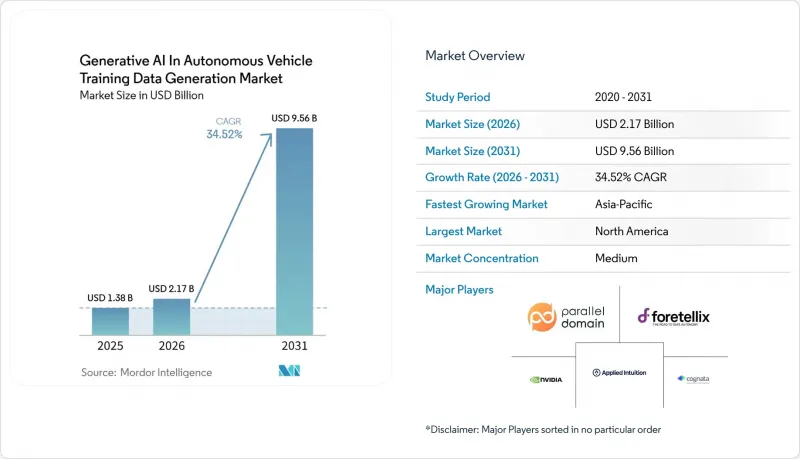
Mordor Intelligence에 의하면, 자율주행차 훈련 데이터 생성용 생성형 AI시장 규모는 2025년 13억 8,000만 달러에서 2026년에는 21억 7,000만 달러로 확대되어 2031년까지 95억 6,000만 달러에 이를 것으로 예상되고 있어 2026년부터 2031년까지 CAGR 34.52%로 성장할 전망입니다.
본 보고서는 제공 분야(소프트웨어 플랫폼 및 툴, 서비스), 데이터 모달리티(이미지, 동영상 등), 용도(ADAS 테스트 등), 최종 사용자(자동차 OEM, Tier 1 공급업체 등), 도입 형태(On-Premise 등), 지역(북미, 유럽 등)별로 분류되어 있습니다. 시장 전망은 금액(달러) 기준으로 제시되어 있습니다.
자율주행차 훈련 데이터 생성용 생성형 AI의 세계 동향 및 인사이트
안전한 합성 훈련 시나리오에 대한 수요 증가
자율주행차 훈련 데이터 생성용 생성형 AI 시장을 견인하는 요인은 우선 물리적 차량 데이터의 경우 광범위하고 안전한 모델 훈련을 뒷받침할 만큼 충분한 빈도로 드문 주행 이벤트가 나타나지 않는다는 단순한 사실입니다. 긴급 차량과의 상호 작용, 보행자의 갑작스러운 움직임, 악천후 및 비정상적인 도로상의 충돌은 모두 도입 준비에 중요하지만, 자연스러운 주행 상황에서는 발생 빈도가 너무 낮기 때문에 도로 데이터 수집만으로는 균형 잡힌 훈련 라이브러리를 구축할 수 없습니다. NVIDIA는 2025년에 Cosmos 월드 기반 모델 및 관련 물리적 AI 데이터셋을 출시하여, 개발자가 지도, 깊이, 기상 데이터를 입력으로 다양한 주행 클립을 생성할 수 있도록 함으로써 이러한 롱테일 커버리지 문제를 직접 해결했습니다. 또한 CARLA는 2025년에 Cosmos Transfer를 오픈소스 시뮬레이션 플랫폼에 통합하여, 많은 개발자층이 생성형 합성 워크플로우에 접근할 수 있도록 했습니다. 안전성 검증에 대한 압박으로 인해 이 과제에 대한 대응은 더욱 시급해졌습니다. ISO/TS 5083:2025에서는 고수준 자율주행 시스템 도입 전에 시나리오의 포괄성과 추적 가능성이 보장된 테스트에 대해 보다 명확한 요구 사항이 규정되어 있기 때문입니다.
실세계 데이터 수집 비용 상승 및 확장성 제약
자율주행차 훈련 데이터 생성용 생성형 AI 시장은 실제 센서 스트림을 양산 규모로 수집, 정제, 라벨링 및 검증하는 데 드는 비용이 급등하고 있는 점에서도 혜택을 보고 있습니다. 현대 차량들은 1대당 하루 최대 4TB의 원시 센서 데이터를 생성할 수 있지만, 드문 에지 케이스나 센서 간 컨텍스트에 관한 유용한 그라운드 트루스(실측값)를 확보하는 것은 원시 데이터 양을 확보하는 것보다 여전히 훨씬 더 어렵습니다. 합성 데이터 생성은 사전에 어노테이션이 적용된 출력을 가능하게 하고, 새로운 시나리오 라이브러리에 필요한 수동 라벨링을 줄임으로써 비용 구조를 혁신합니다. Applied Intuition에 따르면, 2025년에는 수백 페타바이트의 훈련 데이터를 처리하고 5,000만 건의 시뮬레이션을 지원했다고 합니다. 이는 자율주행 프로그램에서 대규모 데이터 인프라가 얼마나 높은 비용과 운영 부담을 초래하고 있는지를 보여줍니다. 따라서 자체적으로 차량 규모 수준의 데이터 운영 체계를 구축할 수 없는 Tier 1 공급업체나 중규모 개발 기업에게 있어, 관리형 합성 데이터 파이프라인의 매력이 높아지고 있습니다.
합성 데이터와 실제 센서 데이터 간의 검증 격차
자율주행차 훈련 데이터 생성용 생성형 AI 시장의 주요 제약은 여전히 합성 출력과 실제 운행 환경에서의 센서 동작 간 격차에 있습니다. 생성된 시나리오로 학습된 모델이라 하더라도, 시뮬레이션에서는 완전히 재현할 수 없는 미묘한 노이즈 패턴, 반사율의 영향, 대기 조건에 직면할 경우 성능이 저하될 가능성이 있습니다. 2025년에 발표된 자율주행 데이터셋의 안전성에 관한 조사에서도 새로운 안전 보증 프레임워크 하에서 데이터의 계보와 모델의 영향을 추적 가능하게 할 필요성이 강조되었으며, 이로 인해 합성 데이터 파이프라인의 문서화 부담이 증가하고 있습니다. NVIDIA의 NuRec API는 실제 차량 데이터로부터 고충실도 3D 환경을 재구성함으로써 이러한 격차의 일부를 메우는 데 도움이 되지만, 검증에는 여전히 전문적인 엔지니어링 워크플로가 필수적입니다. 센서 모달리티 전반에 걸쳐 표준화된 전이 벤치마크가 더 보편화되기 전까지는 그 도입이 잠재적 수요가 시사하는 만큼 빠르게 진행되지는 않을 것입니다.
부문 분석
2025년에는 소프트웨어 플랫폼 및 도구가 74.32%의 점유율을 차지하며, 이는 자율주행차 훈련 데이터 생성용 생성형 AI 시장이 여전히 외부 위탁보다 플랫폼 소유에 중점을 두고 있음을 나타냅니다. 초기 구매자들은 시나리오 생성, 어노테이션 관리 및 데이터 큐레이션 시스템에 중점을 두어 왔습니다. 이러한 도구는 사내 엔지니어링 워크플로우와 가장 밀접하게 연관되어 있으며, 팀이 운영 설계 영역, 센서 구성 및 에지 케이스 로직을 더 세밀하게 제어할 수 있기 때문입니다. 이러한 추세는 확장 가능한 API, 구성 가능한 환경, 그리고 하류 모델 학습 파이프라인과의 통합을 제공할 수 있는 벤더에게 유리하게 작용합니다. 또한 OEM 및 Tier 1 공급업체가 시나리오 설계 및 검증의 핵심 논리를 자사 조직 내에 유지하고자 하는 의향을 반영하고 있습니다.
2031년까지 서비스 시장은 연평균 성장률(CAGR) 34.67%로 확대될 것으로 예상되며, 대규모 합성 데이터 프로그램을 운영하기 위해 필요한 사내 팀을 보유하지 않은 고객이 늘어남에 따라 이 부문에서 가장 빠르게 성장하는 분야가 될 전망입니다. 따라서 자율주행차 훈련 데이터 생성용 생성형 AI 시장은 순수한 소프트웨어 조달에서 플랫폼 접근 및 관리된 실행이 통합된 하이브리드 모델로 전환되고 있습니다. 기초 모델 훈련을 위해 원시 데이터(플릿 로그)에서 페타바이트 규모의 데이터 세트를 큐레이션하는 Applied Intuition사의 ‘Data Engine’은 플랫폼 벤더들이 이미 소프트웨어 라이선스를 중심으로 정기적인 서비스 계층을 구축하고 있음을 보여줍니다. 훈련 후의 조정 및 평가 작업이 점점 더 전문화됨에 따라, 많은 고객은 모든 워크플로우 구성 요소를 자체적으로 보유하기보다는 납기 속도와 품질 보증을 중시할 것이므로 서비스 수요는 증가할 전망입니다.
2025년에는 멀티모달 센서 데이터가 45.67%의 점유율을 차지하며, 이는 자율주행차 훈련 데이터 생성용 생성형 AI 시장의 구매자들이 단일 모달리티의 출력보다 센서 간의 일관성을 더 중요하게 여긴다는 사실을 뒷받침합니다. 자율주행차의 지각 시스템은 카메라, 레이더, LiDAR 중 어느 하나를 단독으로 작동시키는 것이 아니기 때문에 모든 스트림에서 기하학적 관계, 타이밍 및 물체의 거동이 일관성을 보일 때 합성 데이터의 유용성은 높아집니다. 이것이 바로 멀티모달 스택이 플랫폼 포지셔닝 및 시나리오 설계의 중심이 되고 있는 이유입니다. 또한, 이미지와 동영상이 여전히 중요하지만, 이들이 단독으로 워크플로우에서 가장 가치 있는 부분을 정의하지 않게 된 이유도 여기에 설명되어 있습니다.
동적인 장면의 이해는 정확한 공간 표현에 크게 의존하기 때문에 LiDAR 포인트 클라우드 생성 시장은 2031년까지 연평균 성장률(CAGR) 34.53%를 나타낼 것으로 예측됩니다. ICRA 2025에서 발표된 LidarDM에 대한 연구에서는 생성된 세계가 어떻게 보다 현실적인 LiDAR 시뮬레이션 워크플로우를 지원할 수 있는지가 제시되었습니다. NVIDIA의 ‘Cosmos Predict-2’는 2025년에 다중 모드 세계 모델링을 확장하고, 더 강력한 움직임과 객체 제어 기능을 갖춘 미래 세계 상태의 동영상을 생성함으로써, 합성 센서 출력 간의 더욱 풍부한 동기화를 가능하게 했습니다. ISO/TS 21934-2:2024 역시 이러한 방향을 지지하고 있습니다. 이는 충돌 전 기술 시뮬레이션을 위한 가상 환경에서 테스트 및 증거 생성을 위해 더 광범위한 모달리티를 포괄해야 하기 때문입니다.
지역별 분석
2025년, 북미는 자율주행차 훈련 데이터 생성용 생성형 AI 시장 점유율의 32.12%를 차지하며, 지역별로는 가장 큰 기여를 한 지역이 되었습니다. 이 지역은 자율주행차(AV) 개발자, 시뮬레이션 플랫폼 벤더, GPU 인프라 공급업체가 밀집해 있다는 이점이 있으며, 미국이 상용화의 주요 거점입니다. Applied Intuition, NVIDIA, Parallel Domain, Foretellix는 모두 이 생태계의 깊이를 뒷받침하고 있으며, Applied Intuition은 2025년에 5,000만 건의 시뮬레이션을 수행할 것이라고 보고하는 한편, 전 세계 6곳에 새로운 거점을 확장했습니다. 또한, 다양한 이용 사례에 걸친 방대한 양의 합성 검증 데이터가 필요한 진행 중인 자율주행 프로그램에 있어 여전히 가장 큰 거점 역할을 하고 있습니다. 국경을 초월한 상용 자율주행 프로그램으로 인해 테스트 및 물류 이용 사례에서의 운영 범위가 확대됨에 따라 멕시코도 규모는 작지만 중요한 역할을 수행하고 있습니다.
아시아태평양은 2031년까지 연평균 성장률(CAGR) 36.32%를 나타낼 것으로 예측되며, 자율주행차 훈련 데이터 생성용 생성형 AI 시장에서 지역별 가장 빠른 성장 속도를 보일 것으로 전망됩니다. 이 지역의 성장은 중국의 자율주행에 대한 산업적 노력, 일본의 상용차 분야에 대한 집중, 그리고 한국의 ADAS(첨단 운전자 보조 시스템) 공급 기반 확대에 힘입고 있습니다. 한국의 SUM사는 2025년에 ‘Abyss’ 데이터 운영 플랫폼을 출시하여 실제 주행 데이터를 국가 자율주행 데이터 기준에 부합하는 AI 대응 자산으로 변환하고 있으며, 이는 현지 역량 구축이 시범 사업 단계를 넘어섰음을 보여줍니다. 또한 일본과 인도에서도 주행 경로 프로그램 및 물류 자율주행을 위한 노력이 합성 테스트 및 훈련 컨텐츠에 대한 보다 체계적인 수요를 창출하며 성장세를 뒷받침하고 있습니다.
유럽은 탄탄한 OEM 및 Tier 1 공급업체 기반과 더욱 엄격한 규제 환경을 모두 갖추고 있어, 금액 기준으로 여전히 2위 지역 시장으로 자리 잡고 있습니다. 영국은 2026년 2월 12억 달러 규모의 시리즈 D 자금 조달을 완료하고, 런던에서 상용 로보택시 시험의 기반으로 ‘GAIA’ 월드 모델을 활용하고 있는 Wayve를 통해 지역 내 입지를 강화하고 있습니다. 독일은 OEM 생태계 및 dSPACE와 같은 벤더를 통해 계속해서 해당 지역의 산업 활동 상당 부분을 뒷받침하고 있습니다. 한편, 프랑스는 AVSimulation을 통해 시뮬레이션 역량을 강화하고 있습니다. 남미, 중동 및 아프리카는 현지 자율주행차(AV) 차량군의 규모와 인프라가 여전히 제한적이기 때문에 자율주행차 훈련 데이터 생성용 생성형 AI 시장에서 여전히 소규모 점유율에 머물러 있지만, 클라우드 기반 워크플로우 덕분에 연구 및 물류 프로그램 진입 장벽은 점차 낮아지고 있습니다.
기타 혜택:
- 엑셀 형식 시장 예측(ME) 시트
- 3개월간의 애널리스트 지원
자주 묻는 질문
목차
제1장 서론
제2장 조사 방법
제3장 주요 요약
제4장 시장 구도
제5장 시장 규모와 성장 예측
제6장 경쟁 구도
제7장 시장 기회와 향후 전망
JHS 26.09.03According to Mordor Intelligence, the generative AI in autonomous vehicle training data generation market size is expected to increase from USD 1.38 billion in 2025 to USD 2.17 billion in 2026 and reach USD 9.56 billion by 2031, growing at a CAGR of 34.52% over 2026-2031.
This report is Segmented by Offering (Software Platforms and Tools, and Services), Data Modality (Image, Video, and More), Application (ADAS Testing, and More), End Use (Automotive OEMs, Tier 1 Suppliers, and More), Deployment Mode (On-Premises, and More), and Geography (North America, Europe, and More). The Market Forecasts are Provided in Terms of Value (USD).
Global Generative AI In Autonomous Vehicle Training Data Generation Market Trends and Insights
Growing Need for Safe Synthetic Training Scenarios
The generative AI in autonomous vehicle training data generation market is being pushed first by the simple fact that rare driving events do not appear often enough in physical fleet data to support broad and safe model training. Emergency vehicle interactions, sudden pedestrian movement, heavy weather, and unusual road conflicts all matter for deployment readiness, but they appear too infrequently in natural driving to build balanced training libraries from road collection alone. NVIDIA released Cosmos world foundation models and a related physical AI dataset in 2025 to let developers generate varied driving clips from map, depth, and weather inputs, directly addressing this long-tail coverage problem. CARLA also integrated Cosmos Transfer into its open-source simulation platform in 2025, which widened access to generative synthetic workflows across a large developer base. Safety validation pressure adds more urgency because ISO/TS 5083:2025 sets clearer expectations for scenario coverage and traceable testing before deployment of higher-level autonomous systems.
Rising Cost and Scalability Constraints of Real-World Data Collection
The generative AI in autonomous vehicle training data generation market is also benefiting from the rising cost of collecting, cleaning, labeling, and validating real-world sensor streams at a production scale. Modern fleets can generate up to 4 TB of raw sensor data per vehicle per day, yet usable ground truth for rare edge cases and cross-sensor context remains much harder to secure than raw volume. Synthetic generation changes the cost structure by enabling pre-annotated outputs and reducing the manual labeling needed for new scenario libraries. Applied Intuition said it processed hundreds of petabytes of training data and supported 50 million simulations in 2025, which shows how expensive and operationally demanding large-scale data infrastructure has become for autonomy programs. That makes managed synthetic data pipelines more attractive for Tier 1 suppliers and mid-sized developers that cannot build fleet-scale data operations on their own.
Verification Gap Between Synthetic and Real-World Sensor Data
The main restraint on the generative AI in autonomous vehicle training data generation market remains the gap between synthetic outputs and real sensor behavior in deployment conditions. Models trained on generated scenarios can still underperform when they meet subtle noise patterns, reflectance effects, and atmospheric conditions that the simulation does not fully reproduce. Research on dataset safety in autonomous driving published in 2025 also stressed that data lineage and model impact must remain traceable under emerging safety assurance frameworks, which raises the documentation burden for synthetic pipelines. NVIDIA's NuRec APIs help close part of that gap by reconstructing high-fidelity 3D environments from real fleet data, but validation still depends on specialized engineering workflows. Until standardized transfer benchmarks become more common across sensor modalities, adoption will continue to move more slowly than the underlying demand suggests.
Other drivers and restraints analyzed in the detailed report include:
- Expansion of ADAS and Autonomous Driving Programs
- Shortage of Real-World Edge Case Training Data
- High Cost of Physics-Based Simulation Infrastructure
For complete list of drivers and restraints, kindly check the Table Of Contents.
Segment Analysis
Software platforms and tools held 74.32% share in 2025, which shows that the generative AI in autonomous vehicle training data generation market still rests first on platform ownership rather than outsourced execution. Early buyers have focused on scenario generation, annotation control, and data curation systems because these tools sit closest to internal engineering workflows and give teams greater control over operational design domains, sensor configurations, and corner-case logic. This pattern favors vendors that can provide extensible APIs, configurable environments, and integration with downstream model training pipelines. It also reflects a preference among OEMs and Tier 1 suppliers to keep the core logic of scenario design and validation inside their own organizations.
Services are projected to expand at a 34.67% CAGR through 2031, making it the fastest-growing part of this segment as more customers lack the internal teams needed to run synthetic data programs at scale. The generative AI in autonomous vehicle training data generation market is therefore shifting from pure software procurement toward blended models where platform access and managed execution move together. Applied Intuition's Data Engine, which curates petabyte-scale datasets from raw fleet logs for foundation model training, shows how platform vendors are already building recurring service layers around software licenses. As post-training, calibration, and evaluation work grows more specialized, service demand is likely to rise because many customers need delivery speed and quality assurance more than they need ownership of every workflow component.
Multimodal sensor data commanded 45.67% share in 2025, which confirms that buyers in the generative AI in autonomous vehicle training data generation market value cross-sensor consistency more than single-modality output. Autonomous perception systems do not operate on camera, radar, or LiDAR in isolation, so synthetic data is more useful when geometry, timing, and object behavior remain aligned across all streams. This explains why multimodal stacks have become central to platform positioning and scenario design. It also explains why images and videos remain important but no longer define the highest-value part of the workflow on their own.
LiDAR point cloud generation is projected to grow at a 34.53% CAGR through 2031, as dynamic scene understanding relies heavily on precise spatial representation. Research presented at ICRA 2025 on LidarDM showed how generated worlds can support more realistic LiDAR simulation workflows. NVIDIA's Cosmos Predict-2 extended multimodal world modeling in 2025 by generating future-world-state videos with stronger motion and object control, enabling richer synchronization across synthetic sensor outputs. ISO/TS 21934-2:2024 also supports this direction because virtual environments for pre-crash technology simulation require broader modality coverage for testing and evidence generation.
Complete Report Scope:
- By Offering
- Software Platforms and Tools
- Services
- By Data Modality
- Image
- Video
- LiDAR Point Cloud
- Radar
- Multimodal Sensor Data
- By Application
- ADAS Testing
- Autonomous Vehicle Development
- AI and ML Model Training
- Safety and Compliance Validation
- Design Validation
- By End Use
- Automotive OEMs
- Tier 1 Suppliers
- Technology Companies
- Research Institutions
- By Deployment Mode
- On-Premises
- Cloud-Based
- Hybrid
- By Geography
- North America
- United States
- Canada
- Mexico
- South America
- Brazil
- Argentina
- Rest of South America
- Europe
- Germany
- United Kingdom
- France
- Italy
- Spain
- Russia
- Rest of Europe
- Asia-Pacific
- China
- Japan
- India
- South Korea
- Australia
- Rest of Asia-Pacific
- Middle East
- Saudi Arabia
- United Arab Emirates
- Turkey
- Rest of Middle East
- Africa
- South Africa
- Egypt
- Rest of Africa
- North America
Geography Analysis
North America held 32.12% of the generative AI in autonomous vehicle training data generation market share in 2025, which made it the largest regional contributor. The region benefits from a dense mix of AV developers, simulation platform vendors, and GPU infrastructure suppliers, with the United States serving as the main center for commercialization. Applied Intuition, NVIDIA, Parallel Domain, and Foretellix all support that ecosystem depth, and Applied Intuition reported 50 million simulations in 2025 while expanding to six new global offices. The United States also remains the largest base for active autonomous-driving programs that require high volumes of synthetic validation data across multiple use cases. Mexico adds a smaller but relevant role as cross-border commercial autonomy programs widen the operating corridor for testing and logistics use cases.
Asia-Pacific is projected to expand at 36.32% CAGR through 2031, giving it the fastest regional pace in the generative AI in autonomous vehicle training data generation market. Growth in the region is being supported by China's industrial push into autonomous driving, Japan's efforts in commercial vehicles, and South Korea's expanding ADAS supply base. South Korea's SUM launched the Abyss data operating platform in 2025 to convert real-world driving data into AI-ready assets aligned with national autonomous-driving data standards, indicating that local capability-building is moving beyond pilot work. Japan and India also add momentum as corridor programs and logistics autonomy efforts create more structured demand for synthetic testing and training content.
Europe remains the second-largest regional market in value terms because it combines a deep OEM and Tier 1 supplier base with a stricter regulatory setting. The United Kingdom strengthens regional depth through Wayve, which secured a USD 1.2 billion Series D round in February 2026 and is using its GAIA world model as the base for commercial robotaxi trials in London. Germany continues to anchor much of the region's industrial activity through its OEM ecosystem and vendors such as dSPACE, while France adds simulation capability through AVSimulation. South America, the Middle East, and Africa still represent smaller positions in the generative AI in autonomous vehicle training data generation market because local AV fleet scale and infrastructure remain limited, though cloud-based workflows are lowering entry barriers for research and logistics programs.
- NVIDIA Corporation
- Applied Intuition Inc.
- Cognata Ltd.
- Parallel Domain Inc.
- Foretellix Ltd.
- Ansys Inc.
- The MathWorks, Inc.
- dSPACE GmbH
- Siemens Digital Industries Software
- Dassault Systemes SE
- Altair Engineering Inc.
- Autodesk, Inc.
- Unity Software Inc.
- IPG Automotive GmbH
- AVSimulation SAS
- rFpro Limited
- aiMotive
- Elektrobit Automotive GmbH
- Scale AI, Inc.
Additional Benefits:
- The market estimate (ME) sheet in Excel format
- 3 months of analyst support
TABLE OF CONTENTS
1 INTRODUCTION
- 1.1 Study Assumptions and Market Definition
- 1.2 Scope of the Study
2 RESEARCH METHODOLOGY
3 EXECUTIVE SUMMARY
4 MARKET LANDSCAPE
- 4.1 Market Overview
- 4.2 Market Drivers
- 4.2.1 Growing Need for Safety-Critical Edge-Case and Rare-Event Training Data
- 4.2.2 Rising Cost and Scalability Challenges of Real-World Data Collection and Annotation
- 4.2.3 Expansion of ADAS and Autonomous Driving AI Development Programs
- 4.2.4 Shortage of Real-World Rare Event Data
- 4.2.5 Foundation Model Enabled Scenario Generation
- 4.2.6 Growing Demand for Diverse, Continuously Updated, and Multimodal AI Training Datasets
- 4.3 Market Restraints
- 4.3.1 Verification Gap Versus Real-World Driving Conditions
- 4.3.2 High Cost of Physics-Accurate Simulation Stacks
- 4.3.3 Fragmented Scenario Standards and Interoperability
- 4.3.4 GPU and Cloud Compute Dependency
- 4.4 Value Chain Analysis
- 4.5 Regulatory and Standards Landscape
- 4.6 Technological Outlook
- 4.7 Porter's Five Forces Analysis
- 4.7.1 Bargaining Power of Suppliers
- 4.7.2 Bargaining Power of Buyers
- 4.7.3 Threat of New Entrants
- 4.7.4 Threat of Substitutes
- 4.7.5 Competitive Rivalry
5 MARKET SIZE AND GROWTH FORECASTS (VALUE)
- 5.1 By Offering
- 5.1.1 Software Platforms and Tools
- 5.1.2 Services
- 5.2 By Data Modality
- 5.2.1 Image
- 5.2.2 Video
- 5.2.3 LiDAR Point Cloud
- 5.2.4 Radar
- 5.2.5 Multimodal Sensor Data
- 5.3 By Application
- 5.3.1 ADAS Testing
- 5.3.2 Autonomous Vehicle Development
- 5.3.3 AI and ML Model Training
- 5.3.4 Safety and Compliance Validation
- 5.3.5 Design Validation
- 5.4 By End Use
- 5.4.1 Automotive OEMs
- 5.4.2 Tier 1 Suppliers
- 5.4.3 Technology Companies
- 5.4.4 Research Institutions
- 5.5 By Deployment Mode
- 5.5.1 On-Premises
- 5.5.2 Cloud-Based
- 5.5.3 Hybrid
- 5.6 By Geography
- 5.6.1 North America
- 5.6.1.1 United States
- 5.6.1.2 Canada
- 5.6.1.3 Mexico
- 5.6.2 South America
- 5.6.2.1 Brazil
- 5.6.2.2 Argentina
- 5.6.2.3 Rest of South America
- 5.6.3 Europe
- 5.6.3.1 Germany
- 5.6.3.2 United Kingdom
- 5.6.3.3 France
- 5.6.3.4 Italy
- 5.6.3.5 Spain
- 5.6.3.6 Russia
- 5.6.3.7 Rest of Europe
- 5.6.4 Asia-Pacific
- 5.6.4.1 China
- 5.6.4.2 Japan
- 5.6.4.3 India
- 5.6.4.4 South Korea
- 5.6.4.5 Australia
- 5.6.4.6 Rest of Asia-Pacific
- 5.6.5 Middle East
- 5.6.5.1 Saudi Arabia
- 5.6.5.2 United Arab Emirates
- 5.6.5.3 Turkey
- 5.6.5.4 Rest of Middle East
- 5.6.6 Africa
- 5.6.6.1 South Africa
- 5.6.6.2 Egypt
- 5.6.6.3 Rest of Africa
- 5.6.1 North America
6 COMPETITIVE LANDSCAPE
- 6.1 Market Concentration
- 6.2 Strategic Moves
- 6.3 Market Share Analysis
- 6.4 Company Profiles (includes Global Level Overview, Market Level Overview, Core Segments, Financials as available, Strategic Information, Market Rank/Share, Products and Services, Recent Developments)
- 6.4.1 NVIDIA Corporation
- 6.4.2 Applied Intuition Inc.
- 6.4.3 Cognata Ltd.
- 6.4.4 Parallel Domain Inc.
- 6.4.5 Foretellix Ltd.
- 6.4.6 Ansys Inc.
- 6.4.7 The MathWorks, Inc.
- 6.4.8 dSPACE GmbH
- 6.4.9 Siemens Digital Industries Software
- 6.4.10 Dassault Systemes SE
- 6.4.11 Altair Engineering Inc.
- 6.4.12 Autodesk, Inc.
- 6.4.13 Unity Software Inc.
- 6.4.14 IPG Automotive GmbH
- 6.4.15 AVSimulation SAS
- 6.4.16 rFpro Limited
- 6.4.17 aiMotive
- 6.4.18 Elektrobit Automotive GmbH
- 6.4.19 Scale AI, Inc.
7 MARKET OPPORTUNITIES AND FUTURE OUTLOOK
- 7.1 White-Space and Unmet-Need Assessment