

|
시장보고서
상품코드
2097376
정위수술 기기 : 시장 점유율 분석, 업계 동향 및 통계, 성장 예측(2026-2031년)Stereotactic Surgery Devices - Market Share Analysis, Industry Trends & Statistics, Growth Forecasts (2026 - 2031) |
||||||
 Mordor Intelligence
Mordor Intelligence에 의하면, 정위수술 기기 시장 규모는 2025년에 292억 1,000만 달러로 평가되었습니다. 2026년 304억 6,000만 달러에서 2031년까지 375억 8,000만 달러에 이를 것으로 예상되며, 예측 기간(2026-2031년) CAGR은 4.28%를 나타낼 전망입니다.
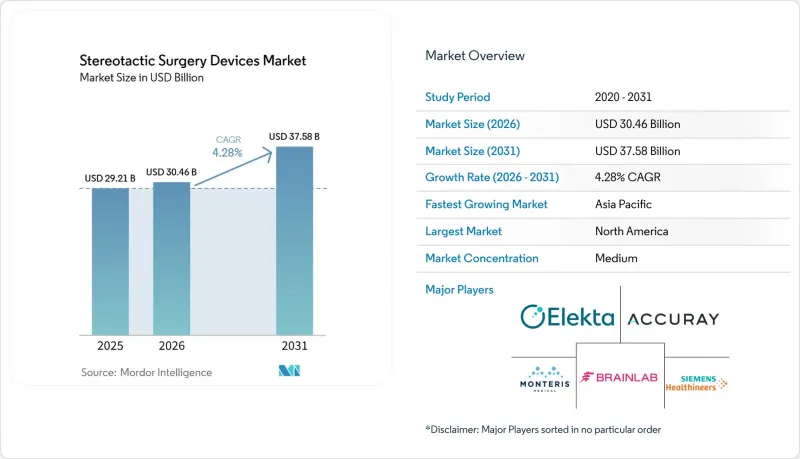
본 보고서는 제품 유형(선형 가속기 시스템, 감마나이프 시스템, 사이버나이프 및 로봇 방사선 수술 시스템 등), 용도(뇌종양, 동정맥 기형 등), 기술(프레임 기반 시스템 등), 최종 사용자(병원, 외래수술센터(ASC) 등) 및 지역별로 분류되어 있습니다. 시장 전망은 금액(달러) 기준으로 제시되어 있습니다.
세계의 정위수술 기기 시장 동향 및 인사이트
두개내 종양 및 기능적 장애 유병률 증가
고령화에 따라 정밀한 방사선 수술이 필요한 환자가 꾸준히 증가하는 한편, 영상 진단 기술의 발전으로 병변이 더 조기 단계에서 발견되고 있습니다. 임상 연구에 따르면, 고령자 집단에서 수막종의 정위 치료의 국소 제어율은 97.1%이며, 과거에는 수술이 불가능하다고 여겨졌던 환자들에게도 이 치료법이 적합하다는 것이 확인되었습니다. 파킨슨병이나 본태성 진전 등의 운동 장애에 대해서도, 하드웨어를 이용한 심부 뇌 자극 장치를 피하는 비침습적 정위 치료로의 전환이 진행되고 있습니다. 신흥 경제국에서는 MRI 검사 이용 기회가 증가함에 따라 검출률이 향상되고 있으며, 이로 인해 여러 지역에 걸친 수요 곡선이 강화되고 있습니다. 종양학과 기능성 질환의 사례가 이처럼 중첩됨에 따라 이용률이 시너지 효과를 내며 높아지고, 의료 제공업체의 수익 구조가 안정화되고 있습니다.
개두술에서 저침습 방사선 수술로의 전환
정위수술은 입원 기간 단축 및 합병증 감소를 실현하면서도 동등한 종양 제어 효과를 가져오기 때문에 병원에서는 수술 프로토콜 재검토가 진행되고 있습니다. 비용 조사에 따르면, 중환자실 입원 일수에서 현저한 감소 효과가 확인되었으며, 환자들도 기존의 개두술보다 외래에서 회복하는 것을 선호하는 추세를 보이고 있습니다. 이러한 추세는 개두술에 따른 합병증 위험이 높은 두개저 병변에서 특히 두드러집니다. 사전 동의 논의의 초점이 삶의 질(QOL) 지표로 옮겨감에 따라, 환자 의뢰 패턴은 뇌신경외과 수술실에서 방사선 치료실로 이동하고 있으며, 정위 치료 프로토콜이 첫 번째 선택으로 자리 잡아가고 있습니다.
방사선 수술 플랫폼의 설비 투자(CAPEX) 및 유지비
MRI 대응 감마나이프실의 초기 도입 비용은 약 984만 달러에 달할 전망입니다. 한편, 사이버나이프실에는 최소 320만 달러가 필요하며, 여기에 설비 정비비가 추가됩니다. LINAC의 연간 유지비는 구매 가격의 평균 3.13%를 차지하여 운영 예산에 부담을 주고 있습니다. 소규모 병원에서는 손익분기점에 도달할 수 있는 환자 수를 확보하는 데 어려움을 겪고 있어, 저소득 지역에서의 신규 도입이 지연되고 있습니다. 리스나 여러 시설 간의 장비 공유와 같은 새로운 형태도 등장하고 있지만, 자금 조달의 장벽은 여전히 남아 있습니다.
부문 분석
2025년, LINAC 플랫폼은 정위수술 기기 시장에서 37.46%의 점유율을 차지하며, 다양한 종양 부위와 분할 조사법에 대응할 수 있는 범용성을 두드러지게 보여주었습니다. 병원 측은 추가 설비 투자 없이 기존 방사선 치료와 정위 부스트 조사 모두를 지원하는 듀얼 유스 설계를 높이 평가했습니다. 2024년에 발표된 Evo 시스템과 같은 AI 탑재 신모델은 세션 시간을 단축하면서도 서브mm급 정밀도를 실현할 것으로 기대됩니다.
사이버나이프 및 기타 로봇 장비는 연평균 성장률(CAGR) 7.44%를 나타낼 것으로 예측되며, 프레임리스 방식이 제공하는 편의성과 정교한 빔 제어를 추구하는 의료 기관들의 관심을 끌고 있습니다. 감마나이프는 순수한 두개내 치료 프로그램에서 여전히 지지를 얻고 있는 반면, 양성자 및 중이온 치료 시스템은 소아 의료 분야에서 틈새 시장을 공고히 하고 있습니다. 도입 주기가 진행됨에 따라 많은 의료 기관이 ‘허브 앤 스포크(hub-and-spoke)’ 모델을 채택하고 있습니다. 이는 주요 시설에 최첨단 로봇 치료실을 설치하고, 주변 클리닉에는 소형 LINAC 위성 장치를 설치하는 것으로, 예산을 초과하지 않으면서 정위수술 장비 시장의 보급 범위를 확대하는 전략입니다.
2025년 시점에서 뇌종양은 정위수술 기기 시장 규모의 44.69%를 차지했으며, 이는 수십 년에 걸친 치료 프로토콜의 정교화와 확고한 치료 성과 데이터를 반영한 것입니다. 현재, 다학제 전문가로 구성된 종양 위원회에서는 소수 전이성 질환의 관리를 위해 정위 방사선 수술과 전신 요법을 병행하고 있습니다.
한편, 기능적 뇌신경외과는 연평균 성장률(CAGR) 8.37%로 예측되는 급성장 분야입니다. 파킨슨병의 진전에 대한 MRI 유도 집속 초음파 치료가 FDA 승인을 받음에 따라 보험 적용 범위가 확대되었고, 더 많은 의료 기관이 기능적 뇌신경외과 진료 과목을 추가하게 되었습니다. 간질 병소나 정신 질환 관련 회로에 대한 방사선 외과적 절제술은 현재 임상시험 단계에 접어들었으며, 향후 수요가 급증할 것으로 예측됩니다. 이에 따라 정위수술용 의료기기 시장 전체의 수익 구성이 재편될 가능성이 있습니다.
지역별 분석
북미는 2025년, 풍부한 보험 환급 자금, 조기 임상 도입, 그리고 다학제적 종양 검토회의 긴밀한 네트워크에 힘입어 정위수술 기기 시장에서 39.86%의 점유율을 유지했습니다. 견고한 임상시험 생태계 덕분에 프로토콜 업데이트와 공급업체 및 의료 제공업체 간의 공동 개발 계약이 가속화되고 있습니다.
유럽은 성숙해 가면서도 안정적인 시장 환경에 있으며, 비용 대비 효과에 대한 심사가 조달 방침을 좌우하고 있습니다. 각국의 의료 제도에서는 장기적인 삶의 질(QOL) 데이터 수집이 중시되고 있으며, 이에 따라 의료 기관은 부작용을 최소화하는 적응형 영상 진단 기능을 갖춘 플랫폼을 선호하는 추세입니다. 중국의 의료기기 규제 개정에 따라 국내 조립업체와의 제휴에 적극적인 다국적 벤더들에게 문호가 열렸으며, 이러한 정책 전환은 공급망 재구축으로 이어질 가능성이 있습니다.
아시아태평양은 성장의 핵심이며, 소형 LINAC실을 갖춘 종양학 분야의 거대 체인에 민간 자본이 투자되고 있어 연평균 성장률(CAGR) 6.04%의 성장이 예상됩니다. 중동 및 아프리카 및 남미는 시장이 아직 발전 단계에 있지만, 자금 조달의 장벽을 극복하기 위해 민관 협력을 구축해 나가고 있습니다. 전반적으로 수요는 인구 동향의 호재와 인프라 구축이 맞물려 발전하고 있는 지역으로 이동하고 있으며, 이에 따라 전 세계 정위수술 기기 시장은 기존의 유럽·미국 중심 시장에서 점차 다각화되고 있습니다.
기타 혜택 :
- 엑셀 형식 시장 예측(ME) 시트
- 3개월간의 애널리스트 지원
자주 묻는 질문
목차
제1장 서론
제2장 조사 방법
제3장 주요 요약
제4장 시장 구도
제5장 시장 규모 및 성장 예측
제6장 경쟁 구도
제7장 시장 기회 및 향후 전망
KTH 26.08.05According to Mordor Intelligence, the stereotactic surgery devices market size was valued at USD 29.21 billion in 2025 and is estimated to grow from USD 30.46 billion in 2026 to reach USD 37.58 billion by 2031, at a CAGR of 4.28% during the forecast period (2026-2031).
This report is Segmented by Product Type (Linear Accelerator Systems, Gamma Knife Systems, Cyberknife & Robotic Radiosurgery Systems, and More), Application (Brain Tumours, Arteriovenous Malformations, and More), Technology (Frame-Based Systems, and More), End User (Hospitals, Ambulatory Surgery Centres, and More), and Geography. The Market Forecasts are Provided in Terms of Value (USD).
Global Stereotactic Surgery Devices Market Trends and Insights
Rising Prevalence of Intracranial Tumors & Functional Disorders
Aging populations are creating a steady pipeline of patients requiring precision radiosurgery, while advancements in imaging are uncovering lesions at earlier stages.Clinical studies report a 97.1% local control rate for stereotactic treatment of meningiomas in elderly cohorts, confirming its suitability for patients once considered inoperable. Movement disorders such as Parkinson's disease and essential tremor are also shifting toward non-invasive stereotactic options that avoid hardware-based deep-brain stimulators. In emerging economies, the increasing availability of MRI scans is driving higher detection rates, thereby reinforcing a multi-regional demand curve. These overlaps between oncology and functional cases are compounding utilization and smoothing the revenue profile for providers.
Shift Toward Minimally Invasive Radiosurgery Over Craniotomy
Hospitals are rewriting surgical pathways as stereotactic procedures deliver comparable tumor control with shorter stays and fewer complications. Cost studies show notable savings in intensive-care days, while patients favor outpatient recovery over traditional craniotomy. The trend is especially visible in skull-base lesions, where open surgery carries high morbidity. As informed-consent discussions pivot to quality-of-life metrics, referral patterns are moving from neurosurgical theaters to radiation suites, cementing stereotactic protocols as first-line options.
CAPEX & Upkeep Costs of Radiosurgery Platforms
A Gamma Knife suite with MRI support can cost approximately USD 9.84 million upfront. At the same time, a CyberKnife room requires at least USD 3.2 million, plus additional build-out expenses-annual maintenance averages 3.13% of the purchase price for LINACs, straining operating budgets. Smaller hospitals struggle to reach break-even case volumes, delaying new installations in lower-income regions. Leasing and multi-institutional equipment sharing are emerging, yet financing hurdles persist.
Other drivers and restraints analyzed in the detailed report include:
- Image-Guided & MRI-LINAC Tech Breakthroughs
- Reimbursement Expansion to Essential Tremor & OCD
- Shortage of Trained Neuro-Radiosurgeons in LICs
For complete list of drivers and restraints, kindly check the Table Of Contents.
Segment Analysis
LINAC platforms held a 37.46% share of the stereotactic surgery devices market in 2025, underscoring their versatility across various tumor sites and fractionation schemes. Hospitals value the dual-use design that supports both conventional radiotherapy and stereotactic boosts without additional capital expenditure. New AI-enabled versions, such as the Evo system showcased in 2024, promise sub-millimeter accuracy while trimming session times.
CyberKnife and other robotic units, projected to grow at 7.44% CAGR, lure centers seeking frameless convenience and intricate beam choreography. The Gamma Knife retains loyalty in pure cranial programs, whereas proton and heavy-ion systems secure niche slots in pediatric applications. As procurement cycles progress, many institutions adopt a hub-and-spoke model: a high-end robotic suite at the flagship site and compact LINAC satellites in feeder clinics, a strategy that broadens the footprint of the stereotactic surgery devices market without overshooting budgets.
Brain tumors represented 44.69% of the stereotactic surgery devices market size in 2025, reflecting decades of protocol refinement and robust outcome data. Multi-disciplinary tumor boards now combine stereotactic radiosurgery with systemic therapies to manage oligometastatic disease.
Functional neurosurgery, however, is the rising star with an 8.37% CAGR forecast. FDA clearance of MRI-guided focused ultrasound for Parkinson's tremor expanded payer coverage, prompting more centers to add functional service lines. Radiosurgical ablation of epileptogenic foci and psychiatric circuits is entering trial pipelines, hinting at future demand spikes that could reshape the revenue mix across the stereotactic surgery devices market.
Complete Report Scope:
- By Product Type
- Linear Accelerator (LINAC) Systems
- Gamma Knife Systems
- CyberKnife & Robotic Radiosurgery Systems
- Proton/Heavy-Ion Beam Systems
- Stereotactic Frames
- Frameless Navigation Systems
- By Application
- Brain Tumours
- Arteriovenous Malformations (AVM)
- Functional Neurosurgery (Parkinson's, Epilepsy, Tremor)
- Spine & Extracranial Metastases
- Biopsy & Diagnostic Guidance
- By Technology
- Frame-based Systems
- Frameless / Image-guided Systems
- Robotic Radiosurgery Platforms
- MRI-guided Adaptive Systems
- By End User
- Hospitals
- Ambulatory Surgery Centres
- Cancer & Radiotherapy Centres
- Academic & Research Institutes
- By Geography
- North America
- United States
- Canada
- Mexico
- Europe
- Germany
- United Kingdom
- France
- Italy
- Spain
- Rest of Europe
- Asia-Pacific
- China
- Japan
- India
- Australia
- South Korea
- Rest of Asia-Pacific
- Middle East and Africa
- GCC
- South Africa
- Rest of Middle East and Africa
- South America
- Brazil
- Argentina
- Rest of South America
- North America
Geography Analysis
North America retained a 39.86% share of the stereotactic surgery devices market in 2025, supported by deep reimbursement pools, early clinical adoption, and a dense network of multidisciplinary tumor boards. Robust clinical-trial ecosystems accelerate protocol updates and vendor-provider co-development contracts.
Europe presents a mature but steady landscape where cost-effectiveness audits shape procurement. National health systems emphasize the collection of longitudinal quality-of-life data, prompting providers to favor platforms with adaptive imaging that minimizes toxicity. China's revised medical-device regulations have opened doors for multinational vendors willing to partner with domestic assemblers, a policy shift that could recalibrate supply chains.
The Asia-Pacific region is the growth nucleus, forecasted to grow at a 6.04% CAGR, as private capital sponsors oncology mega-chains equipped with compact LINAC rooms. The Middle East & Africa and South America are nascent but are building public-private alliances to circumvent capital hurdles. Collectively, demand is migrating toward regions where demographic tailwinds and infrastructure roll-outs align, diversifying the global stereotactic surgery devices market beyond its traditional Western core.
- Elekta
- Siemens Healthineers
- Accuray
- Brain Lab
- Monteris Medical
- Medtronic
- Huiheng Medical
- Hitachi
- ViewRay Inc.
- ZAP Surgical Systems
- Mevion Medical Systems
- Ion Beam Applications (IBA)
- GE Healthcare
- Adeor Medical
- FHC Inc.
- Surgical Theater Inc.
- Shinva Medical Instrument
- Changchun Xuyang
- Optivus Proton Therapy
Additional Benefits:
- The market estimate (ME) sheet in Excel format
- 3 months of analyst support
TABLE OF CONTENTS
1 Introduction
- 1.1 Study Assumptions and Market Definition
- 1.2 Scope of the Study
2 Research Methodology
3 Executive Summary
4 Market Landscape
- 4.1 Market Overview
- 4.2 Market Drivers
- 4.2.1 Rising Prevalence Of Intracranial Tumours & Functional Disorders
- 4.2.2 Shift Toward Minimally-Invasive Radiosurgery Over Craniotomy
- 4.2.3 Image-Guided & MRI-LINAC Tech Breakthroughs
- 4.2.4 Reimbursement Expansion To Essential Tremor & OCD
- 4.2.5 Roll-Out Of Compact LINAC Pods In Private Oncology Chains
- 4.2.6 AI-Driven Adaptive Planning Cuts Treatment Time <15 Min
- 4.3 Market Restraints
- 4.3.1 CAPEX & Upkeep Costs Of Radiosurgery Platforms
- 4.3.2 Shortage Of Trained Neuro-Radiosurgeons In Lics
- 4.3.3 Proton-Therapy Pull From Payers Worried About Healthy-Tissue Dose
- 4.3.4 Cobalt-60 Reload Supply Bottlenecks For Gamma Knife
- 4.4 Value / Supply-Chain Analysis
- 4.5 Regulatory Landscape
- 4.6 Technology Outlook
- 4.7 Porter's Five Forces Analysis
- 4.7.1 Bargaining Power of Suppliers
- 4.7.2 Bargaining Power of Buyers
- 4.7.3 Threat of New Entrants
- 4.7.4 Threat of Substitutes
- 4.7.5 Intensity of Competitive Rivalry
5 Market Size and Growth Forecasts (Value-USD)
- 5.1 By Product Type
- 5.1.1 Linear Accelerator (LINAC) Systems
- 5.1.2 Gamma Knife Systems
- 5.1.3 CyberKnife & Robotic Radiosurgery Systems
- 5.1.4 Proton/Heavy-Ion Beam Systems
- 5.1.5 Stereotactic Frames
- 5.1.6 Frameless Navigation Systems
- 5.2 By Application
- 5.2.1 Brain Tumours
- 5.2.2 Arteriovenous Malformations (AVM)
- 5.2.3 Functional Neurosurgery (Parkinson's, Epilepsy, Tremor)
- 5.2.4 Spine & Extracranial Metastases
- 5.2.5 Biopsy & Diagnostic Guidance
- 5.3 By Technology
- 5.3.1 Frame-based Systems
- 5.3.2 Frameless / Image-guided Systems
- 5.3.3 Robotic Radiosurgery Platforms
- 5.3.4 MRI-guided Adaptive Systems
- 5.4 By End User
- 5.4.1 Hospitals
- 5.4.2 Ambulatory Surgery Centres
- 5.4.3 Cancer & Radiotherapy Centres
- 5.4.4 Academic & Research Institutes
- 5.5 By Geography
- 5.5.1 North America
- 5.5.1.1 United States
- 5.5.1.2 Canada
- 5.5.1.3 Mexico
- 5.5.2 Europe
- 5.5.2.1 Germany
- 5.5.2.2 United Kingdom
- 5.5.2.3 France
- 5.5.2.4 Italy
- 5.5.2.5 Spain
- 5.5.2.6 Rest of Europe
- 5.5.3 Asia-Pacific
- 5.5.3.1 China
- 5.5.3.2 Japan
- 5.5.3.3 India
- 5.5.3.4 Australia
- 5.5.3.5 South Korea
- 5.5.3.6 Rest of Asia-Pacific
- 5.5.4 Middle East and Africa
- 5.5.4.1 GCC
- 5.5.4.2 South Africa
- 5.5.4.3 Rest of Middle East and Africa
- 5.5.5 South America
- 5.5.5.1 Brazil
- 5.5.5.2 Argentina
- 5.5.5.3 Rest of South America
- 5.5.1 North America
6 Competitive Landscape
- 6.1 Market Concentration
- 6.2 Market Share Analysis
- 6.3 Company profiles (includes Global level Overview, Market level overview, Core Segments, Financials as available, Strategic Information, Market Rank/Share for key companies, Products and Services, and Recent Developments)
- 6.3.1 Elekta AB
- 6.3.2 Siemens Healthineers
- 6.3.3 Accuray Inc.
- 6.3.4 Brainlab AG
- 6.3.5 Monteris Medical
- 6.3.6 Medtronic plc
- 6.3.7 Huiheng Medical
- 6.3.8 Hitachi Ltd.
- 6.3.9 ViewRay Inc.
- 6.3.10 ZAP Surgical Systems
- 6.3.11 Mevion Medical Systems
- 6.3.12 Ion Beam Applications (IBA)
- 6.3.13 GE Healthcare
- 6.3.14 Adeor Medical AG
- 6.3.15 FHC Inc.
- 6.3.16 Surgical Theater Inc.
- 6.3.17 Shinva Medical Instrument
- 6.3.18 Changchun Xuyang
- 6.3.19 Optivus Proton Therapy
7 Market Opportunities & Future Outlook
- 7.1 White-space & Unmet-Need Assessment


