

|
시장보고서
상품코드
2097384
하이드로겔 드레싱 : 시장 점유율 분석, 업계 동향과 통계, 성장 예측(2026-2031년)Hydrogel Dressing - Market Share Analysis, Industry Trends & Statistics, Growth Forecasts (2026 - 2031) |
||||||
 Mordor Intelligence
Mordor Intelligence에 의하면, 하이드로겔 드레싱 시장 규모는 2025년 8억 9,000만 달러에서 2026년에는 9억 5,000만 달러로 확대되고, 2031년까지 12억 7,000만 달러에 이를 것으로 예측되며, 2026-2031년 CAGR 5.98%를 기록할 전망입니다.
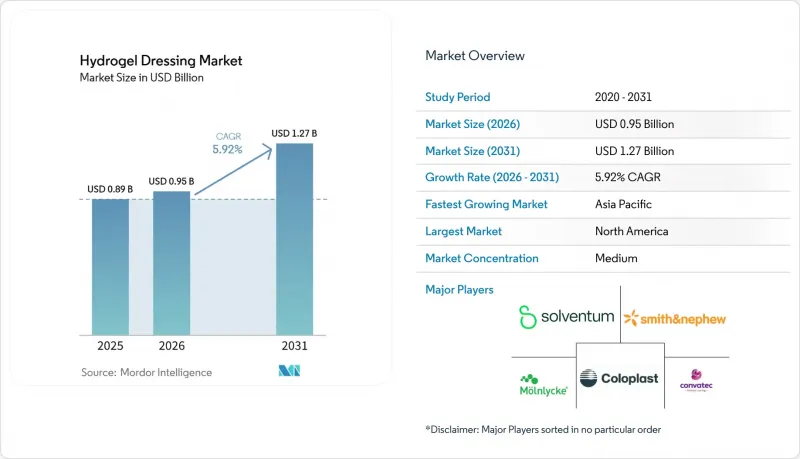
본 보고서는 제품 유형(비정질 하이드로겔 드레싱, 함침형 하이드로겔 드레싱, 시트형 하이드로겔 드레싱), 원재료(합성 하이드로겔, 천연 하이드로겔, 반합성 하이드로겔), 용도(만성 상처 및 급성 상처), 최종 사용자(병원, 재택치료 등), 지역(북미 등)별로 분류되어 있습니다. 시장 전망은 금액(달러) 기준으로 제시되어 있습니다.
전 세계 하이드로겔 드레싱 시장 동향 및 인사이트
만성 상처 유병률 증가
당뇨병성 족부 궤양, 욕창 및 정맥성 하지 궤양은 현재 전 세계적으로 4,000만 명 이상에게 영향을 미치고 있으며, 미국 내 치료비는 연간 500억 달러를 초과합니다. 국제 당뇨병성 족부 병변 워킹그룹은 2024년, 당뇨병성 족부 궤양 진단 후 1년 내 사망률이 일부 암과 동등한 수준이라고 지적했습니다. 그러나 고위험 환자 중 수분 균형을 유지하는 드레싱을 사용하는 비율은 절반에도 미치지 못하는 것이 현실입니다. 하이드로겔은 습윤 환경을 유지함으로써 자가 용해성 데브리드먼트를 촉진하고, 드레싱 교체 빈도를 매일에서 3일에 한 번으로 줄여줍니다. 하이드로겔이 거즈를 대체함으로써 요양 시설에서는 인건비 절감이 실현되어, 정액제 도입을 뒷받침하고 있습니다. 이러한 요인들이 복합적으로 작용하여 하이드로겔 드레싱 시장의 기초적인 수요를 높이고 있습니다.
거즈에서 근거 기반의 첨단 드레싱으로의 전환
NICE 및 상처 치유 학회의 지침에서는 습윤 치유와 상피화 촉진이 강조되고 있지만, 비용 문제를 고려하여 일부 병원에서는 도입이 더딘 실정입니다. 포괄 지급 제도에서는 드레싱 비용이 처치 코드에 포함되기 때문에 조달 부서는 입원 기간 단축이나 재입원 감소로 이어지는 선택지를 우선시하고 있습니다. 하이드로겔은 삼출액이 적거나 중간 정도인 상처에 특히 유용하지만, 삼출액이 많은 궤양에는 여전히 흡수성 폼이 필요합니다. 이러한 보험 지급 제도의 변화가 선진 지역 전체의 하이드로겔 드레싱 시장 성장세를 뒷받침하고 있습니다.
기존 드레싱에 비해 높은 단가 및 제조 비용
하이드로겔의 소매 가격은 개당 3-15달러로, 거즈의 0.10-0.50달러를 훨씬 상회하여 저소득 지역에서는 높은 가격에 놀라기도 합니다. 의료용 히알루론산과 같은 특수 폴리머는 1Kg당 최대 500달러에 달하기 때문에 원자재비가 가장 큰 비용 요인으로 작용합니다. 멸균 포장에 1개당 0.50-2달러가 추가로 발생하며, 이러한 비용은 대량으로 사용되는 만성 상처 치료 과정에서 누적됩니다. 2024년 『Journal of Wound Care』 저널의 연구에 따르면, 교체 횟수 감소와 감염 감소가 높은 재료비를 상쇄했기 때문에 거즈에 비해 총 치료 비용이 18% 낮은 것으로 여전히 나타났습니다. 그러나 인도와 동남아시아에서는 가격이 여전히 장벽으로 작용하여, 도시 지역 병원 이외의 곳에서 하이드로겔 드레싱 시장의 확산을 제한하고 있습니다.
부문 분석
2025년 시점에서 비정질 제제는 하이드로겔 드레싱 시장의 64.55% 점유율을 차지하고 있으며, 이는 불규칙한 공동이나 터널 형태의 상처를 채울 수 있는 능력을 반영합니다. 한편, 시트형 제품은 연평균 성장률(CAGR) 8.25%로 성장하고 있습니다. 이는 화상 치료 분야에서 조직을 냉각시키고 간호 시간을 단축할 수 있는 성형된 패드가 선호되기 때문입니다. 비정형 겔은 2차 고정이 필요하여 작업량이 증가하지만, 임상의는 수분량을 정밀하게 조절하면서 박리된 조직을 채울 수 있습니다. 시트형 하이드로겔은 균일한 두께를 유지하며 피부에 부드럽게 밀착되므로, 드레싱 교체 횟수를 주당 최대 2회까지 줄여 환자의 편안함을 향상시킵니다.
어떤 형태이든 규제 준수는 엄격하며, ISO 10993 시험에는 제제 1개당 최대 10만 달러의 비용이 소요됩니다. FDA는 2025년에 양 콜라겐 시트형 하이드로겔을 승인하며, 동등성이 입증되면 새로운 생체 재료도 510(k) 절차를 통과할 수 있음을 확인했습니다. 시트형 하이드로겔은 삼출액 처리 성능이 뛰어난 실리콘 폼과의 경쟁에 직면해 있지만, 자가 용해성 데브리드먼트가 필요한 경우에는 여전히 선호되고 있으며, 두 형태 모두 하이드로겔 드레싱 시장에서 필수적인 존재로 남아 있습니다.
2025년에는 폴리에틸렌글리콜과 폴리아크릴아미드가 재현성이 높은 기계적 특성과 멸균 적합성을 제공함에 따라, 합성 폴리머가 하이드로겔 드레싱 시장의 60.53%를 차지했습니다. 합성 골격과 생체 활성을 지닌 키토산 및 히알루론산을 결합한 하이브리드 블렌드는 연평균 성장률(CAGR) 8.85%로 확대되고 있습니다. 천연 성분은 세포 신호 전달과 성장 인자 유지를 개선하며, 초기 연구에서는 치유 촉진으로 이어지고 있습니다. 배치 간 편차와 높은 비용이 여전히 순수 천연 젤의 보급을 제약하고 있지만, 하이브리드 제품은 합성 소재의 내구성을 유지함으로써 이러한 문제를 완화하고 있습니다.
공급망 리스크가 전략을 좌우하고 있습니다. 히알루론산 시장에서 중국의 지배적 지위는 제조업체를 지정학적 변동 위험에 노출시키고 있으며, 다원 조달을 촉진하고 있습니다. ISO 13485 감사는 간접비 증가를 초래하지만, 오염된 로트로 인한 리콜을 미연에 방지할 수 있습니다. 그 결과, 회복력과 생체 활성이 중요시되면서 하이드로겔 드레싱 시장에서 하이브리드 제품의 매출 점유율은 확대될 전망입니다.
지역별 분석
2025년, 북미는 하이드로겔 드레싱 시장의 40.13%를 차지했습니다. 이는 견조한 보험 환급과 스마트 드레싱의 초기 시범 사업이 주도한 결과입니다. 메디케어 코드에서는 여전히 하이드로겔이 대상에 포함되어 있지만, 일괄 지급 제도의 도입으로 비용 부담이 의료 제공업체에게 전가되면서 데이터 기반의 조달이 진행되고 있습니다. 캐나다 각 주의 처방약 목록은 서로 다릅니다. 온타리오주에서는 재택 간호 시 사용되는 하이드로겔 비용이 공적 자금으로 충당되는 반면, 앨버타주에서는 사전 승인이 필요하여 도입 현황에 차이가 나타나고 있습니다. 멕시코는 의료 관광 및 사회보험 적용 범위 확대의 혜택을 받고 있으며, 미국 공급업체로부터의 수입이 증가하고 있습니다.
유럽은 여전히 큰 시장 규모를 유지하고 있지만, 엄격한 의료기기 규정 2017/745의 절차를 준수하고 있습니다. 독일에서는 ‘Hilfsmittelverzeichnis(의료 보조 기구 목록)’에 등재된 드레싱에 대해서는 보험 환급이 이루어지지만, 등재되지 않은 제품에 대해서는 사례별로 승인이 필요합니다. 영국에서는 NHS 공급망을 통해 일원화된 조달이 이루어지고 있으며, NICE의 2024년 검토에서 하이드로겔을 우선적으로 채택할 충분한 근거가 인정되지 않아 도입 속도가 둔화되고 있습니다. 프랑스의 LPPR(의약품 가격 정책) 절차에는 최대 18개월이 소요될 수 있어 전액 환급이 지연되고 있습니다. 남유럽 국가들에서는 예산 부족으로 인해 도입 속도가 둔화되고 있습니다.
아시아태평양은 중국, 인도, 일본, 호주, 한국의 주도 하에 9.51%라는 가장 높은 연평균 성장률(CAGR)을 기록하고 있습니다. 중국은 클래스 II 승인 기간을 약 12-15개월로 단축함에 따라, Winner Medical 등 국내 주요 기업들은 수출을 전년 대비 12.6% 증가시킬 수 있었습니다. 인도의 클래스 B 등록 제도는 다국적 기업에 대해 임상시험 의무 없이 시장 진입을 허용하는 반면, 일본의 PMDA는 판매 승인 보유자(MAH) 제도를 통해 클래스 II 신고를 인정하고 있습니다. 호주의 1인당 상처 관리 지출액이 높고, 한국의 승인 절차가 가속화됨에 따라 양국은 프리미엄 제품에 있어 매력적인 진출 거점이 되고 있으며, 하이드로겔 드레싱 시장의 동쪽으로의 이동을 뒷받침하고 있습니다.
걸프 국가들에서는 의료 관광객을 수용하는 사립 병원을 대상으로 프리미엄 드레싱이 수입되고 있지만, 공공 입찰에서는 여전히 거즈 제품이 주류를 이루고 있습니다. 남아프리카공화국의 관민 이원제는 시장을 양분하고 있으며, 브라질의 ANVISA는 저위험 의료기기를 신속하게 승인하고 있지만, 예산 제약으로 인해 전국적인 확산은 제한적입니다. 아르헨티나의 환율 변동 및 타국의 가격 통제로 인해 시장 침투는 고르지 않지만, 당뇨병 유병률의 상승은 하이드로겔 드레싱 시장 수요를 여전히 끌어올리고 있습니다.
기타 혜택:
- 엑셀 형식 시장 예측(ME) 시트
- 3개월간의 애널리스트 지원
자주 묻는 질문
목차
제1장 서론
제2장 조사 방법
제3장 주요 요약
제4장 시장 구도
제5장 시장 규모와 성장 예측
제6장 경쟁 구도
제7장 시장 기회와 향후 전망
KTH 26.08.06According to Mordor Intelligence, the hydrogel dressing market size is expected to increase from USD 0.89 billion in 2025 to USD 0.95 billion in 2026 and reach USD 1.27 billion by 2031, growing at a CAGR of 5.98% over 2026-2031.
This report is Segmented by Product Type (Amorphous Hydrogel Dressings, Impregnated Hydrogel Dressings, and Sheet Hydrogel Dressings), Raw Material (Synthetic Hydrogels, Natural Hydrogels, and Semi-Synthetic Hydrogels), Application (Chronic Wounds and Acute Wounds), End User (Hospitals, Home Healthcare, and More), and Geography (North America, and More). The Market Forecasts are Provided in Terms of Value (USD).
Global Hydrogel Dressing Market Trends and Insights
Rising Prevalence of Chronic Wounds
Diabetic foot ulcers, pressure ulcers, and venous leg ulcers now affect more than 40 million people worldwide, and United States treatment costs exceed USD 50 billion annually. The International Working Group on the Diabetic Foot noted in 2024 that 1-year mortality after a diabetic foot ulcer diagnosis matches some cancers. Yet, fewer than half of high-risk patients receive moisture-balanced dressings. Hydrogels maintain moist environments that accelerate autolytic debridement and lower nursing frequency from daily changes to three-day intervals. Skilled-nursing facilities experience labor reductions when hydrogel replaces gauze, supporting its adoption in capitated payment systems. These factors collectively raise baseline demand in the hydrogel dressing market
Shift from Gauze to Evidence-Based Advanced Dressings
Guidelines from NICE and the Wound Healing Society emphasize moist healing and faster epithelialization, but cost sensitivity slows uptake in some hospitals. Bundled payments fold dressing costs into procedure codes, prompting procurement to favor options that shorten stays and cut readmissions. Hydrogels prove particularly valuable in low-to-moderate exudate wounds, though high-exudate ulcers still require absorbent foams. These reimbursement shifts add momentum to the hydrogel dressing market across developed regions.
High Unit and Manufacturing Cost Versus Conventional Dressings
Hydrogels retail at USD 3-15 per unit, far above the USD 0.10-0.50 for gauze, causing sticker shock in low-income settings. Specialty polymers like medical-grade hyaluronic acid cost up to USD 500 per kilogram, making materials the most significant expense driver. Sterile packaging adds another USD 0.50-2.00 per unit, and these costs compound across high-volume chronic-wound regimens. A 2024 Journal of Wound Care study still showed an 18% lower total episode cost than gauze, because fewer changes and infections offset the material premium. Yet price remains a barrier in India and Southeast Asia, limiting penetration of the hydrogel dressing market outside urban hospitals.
Other drivers and restraints analyzed in the detailed report include:
- Innovation in Antimicrobial & Stimuli-Responsive Hydrogels
- Growing Surgical & Burn Caseloads
- Limited Absorption for Heavy-Exudate Wounds
For complete list of drivers and restraints, kindly check the Table Of Contents.
Segment Analysis
Amorphous formulations held 64.55% of the hydrogel dressing market share in 2025, reflecting their ability to fill irregular cavities and tunnel wounds. Sheet variants, however, are growing at 8.25% CAGR because burn units prefer pre-formed pads that cool tissue and reduce nursing time. Amorphous gels require secondary retention, which increases labor, but they permit clinicians to pack undermined tissue with precise moisture control. Sheet hydrogels deliver a uniform thickness and adhere gently, reducing dressing changes by up to 2 per week and improving patient comfort.
Regulatory compliance is strict across formats: ISO 10993 testing adds up to USD 100,000 per formulation. The FDA cleared a sheep-collagen sheet hydrogel in 2025, confirming that novel biomaterials can pass through the 510(k) pathway when equivalence is demonstrated. Sheet hydrogels face competition from silicone foams with better exudate handling, yet remain favored where autolytic debridement is required, keeping both formats integral to the hydrogel dressing market.
Synthetic polymers accounted for 60.53% of the hydrogel dressing market in 2025, as polyethylene glycol and polyacrylamide offer reproducible mechanical properties and sterilization compatibility. Hybrid blends of synthetic backbones with bioactive chitosan or hyaluronic acid are advancing at an 8.85% CAGR. Natural components improve cell signaling and growth-factor retention, leading to faster healing in early studies. Batch variability and higher costs still constrain pure natural gels, yet hybrids mitigate these issues by keeping synthetic durability.
Supply-chain risks shape strategy. China's dominance in hyaluronic acid exposes producers to geopolitical swings, prompting multisource procurement. ISO 13485 audits add overhead yet prevent recalls from contaminated lots. The resulting emphasis on resilience and bioactivity will likely expand hybrid revenue share within the hydrogel dressing market.
Complete Report Scope:
- By Product Type
- Amorphous Hydrogel Dressings
- Impregnated Hydrogel Dressings
- Sheet Hydrogel Dressings
- By Raw Material
- Synthetic Hydrogels
- Natural Hydrogels
- Semi-synthetic / Hybrid Hydrogels
- By Application
- Chronic Wounds
- Diabetic Foot Ulcers
- Pressure Ulcers
- Venous Leg Ulcers
- Acute Wounds
- Burns
- Surgical & Traumatic Wounds
- Chronic Wounds
- By End User
- Hospitals
- Home Healthcare
- Ambulatory Surgical Centers
- Other End Users
- By Geography
- North America
- United States
- Canada
- Mexico
- Europe
- Germany
- United Kingdom
- France
- Italy
- Spain
- Rest of Europe
- Asia-Pacific
- China
- India
- Japan
- Australia
- South Korea
- Rest of Asia-Pacific
- Middle East and Africa
- GCC
- South Africa
- Rest of Middle East and Africa
- South America
- Brazil
- Argentina
- Rest of South America
- North America
Geography Analysis
North America accounted for 40.13% of the hydrogel dressing market in 2025, driven by robust reimbursement and early smart-dressing pilots. Medicare codes still cover hydrogels, yet bundled payments pass cost pressure to providers, prompting data-backed purchasing. Canada's provincial formularies vary; Ontario funds hydrogels in home care, whereas Alberta requires prior authorization, creating uneven uptake. Mexico benefits from medical tourism and expanding social-insurance coverage, boosting imports from United States suppliers.
Europe remains sizable but governed by strict Medical Device Regulation 2017/745 processes. Germany reimburses listed dressings through the Hilfsmittelverzeichnis, while unlisted products need case approvals. The United Kingdom purchases centrally through NHS Supply Chain, and NICE's 2024 review found insufficient evidence to prefer hydrogels, which has slowed adoption. France's LPPR process can take up to 18 months, delaying full reimbursement. Southern Europe shows slower uptake due to tighter budgets.
Asia-Pacific posts the highest CAGR of 9.51%, driven by China, India, Japan, Australia, and South Korea. China reduced Class II approval timelines to about 12-15 months, letting domestic leaders such as Winner Medical raise exports 12.6% year-on-year. India's Class B registration system welcomes multinationals without mandated clinical trials, while Japan's PMDA allows Class II notifications through a Marketing Authorization Holder structure. Australia's high per-capita wound-care spend and South Korea's accelerating approvals make both countries attractive launch pads for premium offerings, reinforcing the hydrogel dressing market's pivot eastward.
Gulf states import premium dressings for private hospitals serving medical tourists, yet public tenders remain gauze-heavy. South Africa's dual public-private system creates a split market, while Brazil's ANVISA fast-tracks low-risk devices yet budget constraints limit nationwide roll-out. Currency volatility in Argentina and price controls elsewhere keep penetration uneven, but rising diabetes rates still add incremental volumes to the hydrogel dressing market.
- Advanced Medical Solutions Group
- Alliqua BioMedical / NEXGEL Inc.
- Axelgaard Manufacturing
- B. Braun
- BSN Medical
- Cardinal Health
- Coloplast
- Convatec
- DermaRite Industries
- Hollister
- Integra LifeSciences Holdings
- Johnson & Johnson
- Medline Industries
- Molnlycke Health Care
- Hartmann Group
- Procyon Corp. (AMERX)
- Smiths Group
- Solventum Corporation
- Winner Medical Co. Ltd
- Zhende Medical Co. Ltd
Additional Benefits:
- The market estimate (ME) sheet in Excel format
- 3 months of analyst support
TABLE OF CONTENTS
1 Introduction
- 1.1 Study Assumptions & Market Definition
- 1.2 Scope of the Study
2 Research Methodology
3 Executive Summary
4 Market Landscape
- 4.1 Market Overview
- 4.2 Market Drivers
- 4.2.1 Rising Prevalence of Chronic Wounds
- 4.2.2 Shift from Gauze to Evidence-Based Dressings
- 4.2.3 Innovation in Antimicrobial & Stimuli-Responsive Hydrogels
- 4.2.4 Growing Surgical & Burn Cases Worldwide
- 4.2.5 Outpatient-care Payment Reforms Favoring Low-Nurse-Time Dressings
- 4.2.6 Sensor-Integrated Smart Hydrogels Enabling Tele-Wound Care
- 4.3 Market Restraints
- 4.3.1 High Unit & Manufacturing Cost Versus Conventional Dressings
- 4.3.2 Limited Absorption for Heavy-Exudate Wounds
- 4.3.3 Supply-Chain Volatility for Specialty Polymers
- 4.3.4 Extra Regulatory Hurdles for Drug-Device Combination Hydrogels
- 4.4 Supply-Chain Analysis
- 4.5 Regulatory Landscape
- 4.6 Technological Outlook
- 4.7 Porter's Five Forces
- 4.7.1 Threat of New Entrants
- 4.7.2 Bargaining Power of Suppliers
- 4.7.3 Bargaining Power of Buyers
- 4.7.4 Threat of Substitutes
- 4.7.5 Intensity of Competitive Rivalry
5 Market Size & Growth Forecasts (Value, USD)
- 5.1 By Product Type
- 5.1.1 Amorphous Hydrogel Dressings
- 5.1.2 Impregnated Hydrogel Dressings
- 5.1.3 Sheet Hydrogel Dressings
- 5.2 By Raw Material
- 5.2.1 Synthetic Hydrogels
- 5.2.2 Natural Hydrogels
- 5.2.3 Semi-synthetic / Hybrid Hydrogels
- 5.3 By Application
- 5.3.1 Chronic Wounds
- 5.3.1.1 Diabetic Foot Ulcers
- 5.3.1.2 Pressure Ulcers
- 5.3.1.3 Venous Leg Ulcers
- 5.3.2 Acute Wounds
- 5.3.2.1 Burns
- 5.3.2.2 Surgical & Traumatic Wounds
- 5.3.1 Chronic Wounds
- 5.4 By End User
- 5.4.1 Hospitals
- 5.4.2 Home Healthcare
- 5.4.3 Ambulatory Surgical Centers
- 5.4.4 Other End Users
- 5.5 By Geography
- 5.5.1 North America
- 5.5.1.1 United States
- 5.5.1.2 Canada
- 5.5.1.3 Mexico
- 5.5.2 Europe
- 5.5.2.1 Germany
- 5.5.2.2 United Kingdom
- 5.5.2.3 France
- 5.5.2.4 Italy
- 5.5.2.5 Spain
- 5.5.2.6 Rest of Europe
- 5.5.3 Asia-Pacific
- 5.5.3.1 China
- 5.5.3.2 India
- 5.5.3.3 Japan
- 5.5.3.4 Australia
- 5.5.3.5 South Korea
- 5.5.3.6 Rest of Asia-Pacific
- 5.5.4 Middle East and Africa
- 5.5.4.1 GCC
- 5.5.4.2 South Africa
- 5.5.4.3 Rest of Middle East and Africa
- 5.5.5 South America
- 5.5.5.1 Brazil
- 5.5.5.2 Argentina
- 5.5.5.3 Rest of South America
- 5.5.1 North America
6 Competitive Landscape
- 6.1 Market Concentration
- 6.2 Market Share Analysis
- 6.3 Company Profiles (includes Global level Overview, Market level overview, Core Segments, Financials as available, Strategic Information, Market Rank/Share for key companies, Products & Services, and Recent Developments)
- 6.3.1 Advanced Medical Solutions Group
- 6.3.2 Alliqua BioMedical / NEXGEL Inc.
- 6.3.3 Axelgaard Manufacturing
- 6.3.4 B. Braun Melsungen AG
- 6.3.5 BSN Medical (Essity)
- 6.3.6 Cardinal Health Inc.
- 6.3.7 Coloplast A/S
- 6.3.8 ConvaTec Group PLC
- 6.3.9 DermaRite Industries LLC
- 6.3.10 Hollister Incorporated
- 6.3.11 Integra LifeSciences Holdings
- 6.3.12 Johnson & Johnson (Ethicon)
- 6.3.13 Medline Industries, Inc.
- 6.3.14 Molnlycke Health Care AB
- 6.3.15 Paul Hartmann AG
- 6.3.16 Procyon Corp. (AMERX)
- 6.3.17 Smith & Nephew plc
- 6.3.18 Solventum Corporation
- 6.3.19 Winner Medical Co. Ltd
- 6.3.20 Zhende Medical Co. Ltd
7 Market Opportunities & Future Outlook
- 7.1 White-space & Unmet-need Assessment


