

|
시장보고서
상품코드
2121735
하이드로겔 : 시장 점유율 분석, 업계 동향과 통계, 성장 예측(2026-2031년)Hydrogel - Market Share Analysis, Industry Trends & Statistics, Growth Forecasts (2026 - 2031) |
||||||
 Mordor Intelligence
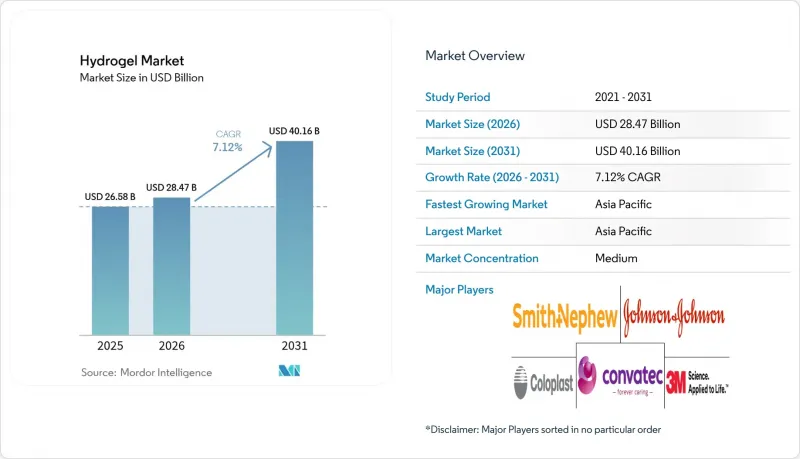
Mordor Intelligence에 따르면 하이드로겔 시장 규모는 2025년에 265억 8,000만 달러, 2026년에 284억 7,000만 달러에 달하며, 2031년까지 401억 6,000만 달러에 달할 것으로 예측되고 있으며, 2026-2031년에 CAGR 7.12%로 성장할 것으로 전망되고 있습니다.
이 보고서는 구조별(반결정성, 비결정성, 결정성),소재별(폴리아크릴레이트, 폴리아크릴아미드, 실리콘, 기타), 최종사용자 산업별(퍼스널 케어·위생용품, 의약품·의료, 식품, 농업, 기타), 지역별(아시아태평양, 북미, 유럽, 기타)로 분류되어 있습니다. 시장 예측은 금액(달러) 기준으로 제시되어 있습니다.
글로벌 하이드로겔 시장의 동향 및 인사이트
일회용 위생용품에서의 이용 확대
전 세계 하이드로겔 소비량은 주로 기저귀와 여성 위생용품에 의해 주도되었습니다. 특히 아시아태평양은 소득 증가와 프리미엄 초박형 제품으로의 전환에 힘입어 이 소비량의 대부분을 차지했습니다. 전략적 노력의 일환으로, 중국 제조사들은 가교 밀도를 높여 면적당 중량을 줄이는 데 성공했습니다. 이러한 혁신으로 코어 부분이 얇아져, 결과적으로 포장 비용 절감과 착용감 향상을 실현했습니다. 베이징이 추진하는 ‘건강 중국 2030’ 구상 하에서는 농촌 가구가 위생적인 생리용품을 이용할 수 있도록 하는 목표가 설정되어 있습니다. 이 목표를 지원하기 위해 새로운 폴리아크릴레이트 생산 라인에 막대한 투자가 이루어지고 있습니다. 한편, 유럽의 ‘확대 생산자 책임(EPR)’ 규제로 인해 셀룰로오스-하이드로겔 혼합 소재로의 전환이 가속화되고 있습니다. 90일 이내에 분해되는 이러한 혼합 소재는 바이오 기반 공급업체들에게 향후 수익 확대를 위한 유리한 입지를 마련해 주고 있습니다. 이러한 동향의 결과로, 위생용 하이드로겔 수요는 견고한 성장세를 보이고 있습니다. 이러한 성장은 중국의 과잉 생산 능력으로 인한 단가 하락에도 불구하고 지속되고 있습니다.
실리콘 하이드로겔 콘택트렌즈 수요 확대
2025년에 처방된 소프트 렌즈 중 실리콘 하이드로겔 제품이 큰 비중을 차지했습니다. 이는 처방 의사들이 100Dk/t를 초과하는 산소 투과성을 중요시하고 있음을 반영합니다. 매출 성장을 지원하고 있는 것은 표면의 수분 함량을 유지하면서 실리콘 채널을 삽입함으로써 장시간 착용 시의 편안함을 유지하는 ‘수분 구배 기술’입니다. 일본에서는 2025년에 2가지 유형의 자외선 차단 기능이 탑재된 실리콘 하이드로겔 일회용 렌즈가 승인되어, 꾸준히 성장하고 있는 소아용 및 근시 진행 억제라는 틈새 시장을 개발했습니다. ISO 18369에서는 산소 투과성, 탄성률, 지질 침착에 관한 지표의 공개가 의무화되어 있으며, 이에 따라 기존 하이드로겔 제품의 시장 철수가 가속화되고 있습니다. 한편 중국에서는 소아용 오르토케라토지의 보급이 진행되고 있으며, 실리콘 하이드로겔 소재의 오르토케라토지 렌즈는 이미 소아용 처방에서 상당한 점유율을 차지하고 있으며, 지역을 초월한 보급 가능성이 부각되고 있습니다.
폼·알긴산염 드레싱과의 경쟁
2025년, 폴리우레탄 폼은 하이드로겔을 제치고 고급 상처 치료 시장에서 큰 점유율을 확보했습니다. 임상의들은 삼출액이 많은 궤양 치료에 폼을 선호하여 사용했습니다. 한편, 칼슘 알지네이트는 응고 시간이 짧다는 장점 덕분에 수술실 진료 관행에 영향을 미치며 지혈 부문에서 지지를 넓혔습니다. 한 리뷰에서는 폼과 하이드로겔의 치료 성공률이 동등하다는 점이 지적되어, 하이드로겔의 가격적 우위는 약화되었습니다. 5일에 한 번만 간호 관리가 필요한 실리콘 테두리 폼은 인력 부족이 만연한 상황에서 큰 우위를 발휘했습니다. 감염 예방 강화를 위해 은이나 요오드를 배합한 하이드로겔 제조사는 추가 비용이 발생하므로 특히 화상 센터나 종양학과 병동 이외의 분야에서는 경쟁 여지가 좁아지고 있습니다.
부문 분석
반결정성 등급은 상처 피복재의 낮은 수치부터 연골 스캐폴드의 높은 수치에 이르는 인장 탄성률을 활용하여, 2025년 매출의 45.56%를 차지했습니다. 이러한 장점은 가교 밀도와 결정 도메인 크기의 정밀한 조정에 기인합니다. 한편, 비결정질 계열 제품은 연평균 성장률(CAGR) 8.01%를 기록했습니다. 이는 약물전달 부문의 전문가들이 반결정질 매트릭스에서는 저해되는 빠른 확산 속도를 추구하기 때문입니다. 하이드로겔 시장에서는 경피 흡수 패치에 대한 비결정질 제형의 수요가 크게 증가할 것으로 전망됩니다. 동시에, 반결정질 조성물은 농업 부문에서 입지를 유지하고 있으며, 며칠에 걸쳐 수분을 방출한다는 점에서 비결정질 계열 제품보다 우수한 성능을 발휘하고 있습니다. 결정성 하이드로겔은 취성으로 인해 거부율이 높아 시장 점유율이 제한적이어서 여전히 틈새 시장으로 남아 있습니다. 규제 당국의 승인으로 비결정성 제품의 채택이 촉진되고 있으며, 비침습적 치료법 개발 파이프라인에 대한 투자가 활발해지고 있습니다.
상업적 측면에서는 각 공급업체들이 구조를 전략적으로 혼합하여, 투과성을 높이는 비결정질 영역과 우수한 하중 지지 능력을 갖춘 미세결정질 영역을 융합하고 있습니다. 이러한 혼합 제품은 정형외과용 임플란트 시장에서 고가 대에서 거래되고 있습니다. 아시아의 공급업체들은 급성장하는 상처 관리 부문에서 기계적 성능이 매우 중요하다는 점을 인식하고, 생산 능력 확대를 추진하고 있습니다. 대조적으로, 아프리카의 농업 전문가들은 점적 관개에서 긴 수명을 높이 평가하여 반결정질 분말을 선호하여 사용하고 있습니다. 이러한 다양한 구조적 상황은 명확한 가치 창출원을 만들어내며, 공급업체들은 상품 가격 변동 속에서도 이익률을 유지할 수 있게 되었습니다.
지역별 분석
아시아태평양은 2025년에 세계 수요의 41.10%를 차지하며, 2031년까지 연평균 성장률(CAGR) 8.02%로 확대될 것으로 전망됩니다. 중국은 장쑤성과 광둥성의 폴리아크릴레이트 및 실리콘 하이드로겔 산업 클러스터에 막대한 투자를 단행하여 공급 안정성을 강화하는 동시에 비용 측면에서의 우위를 확립하고 있습니다. 인도에서는 기저귀 수요가 급증하고 있으며, 대기업의 대규모 공장 투자를 유치함으로써 수입 관세를 사실상 회피하고 있습니다. 일본의 콘택트렌즈 산업은 새로운 건강 가이드라인에 따라 1일용 실리콘 하이드로겔 렌즈로 중심을 옮기고 있습니다. 한편, 한국에서는 스마트워치의 심전도(ECG) 기능을 위해 전도성 하이드로겔 전극 개발이 진행되고 있습니다. 아세안(ASEAN)에서는 가뭄 피해를 입은 벼 재배 지역에 하이드로겔에 대한 보조금이 지급되어 지역 시장에서의 보급이 촉진되고 있습니다.
2025년에는 FDA가 신속 심사 절차인 510(k) 경로를 활용하는 여러 하이드로겔 의료기기를 승인함에 따라 북미가 매출의 큰 비중을 차지했습니다. 메디케어의 첨단 상처 피복재에 대한 보험 급여가 병원내 도입을 지원하고 있습니다. 그러나 캐나다에서는 ‘치료한 상처 1건당 비용’을 중시하는 금액 기반 입찰 제도가 도입되어, 공급업체들은 임상 결과 검증으로 이끌리고 있습니다. 멕시코에서는 하이드로겔을 사용하는 아보카도 생산자에 대한 주 정부의 세액 공제가 물 부족으로 어려움을 겪는 대수층을 보전할 뿐만 아니라, NAFTA 지역내에서 농업용 하이드로겔의 틈새 시장을 개발하고 있습니다.
수요의 상당 부분을 차지하는 유럽에서는 생분해성에 관한 엄격한 기준이 특징이며, 셀룰로오스나 전분을 그래프트화한 소재의 구매가 촉진되고 있습니다. EU의 의료기기 규정은 규정 준수상의 장벽을 완화하고 있으며, 상처 관리 부문에서 규제에 대한 전문 지식을 갖춘 기존 기업에게 유리하게 작용하고 있습니다. 브렉시트 이후, 각 기업은 MHRA에 이중 신청을 해야 하는 상황에 직면하게 되어, 신규 진입 기업의 시장 진입에 시간이 더 소요되고 있습니다. 북유럽 국가들에서는 공공사업자가 지역 난방용으로 하이드로겔 기반 상변화 시스템을 시험하고 있으며, 더 광범위한 열 저장 가능성을 시사하고 있습니다.
시장 점유율이 낮은 남미에서는 브라질의 사탕수수를 활용한 노력을 통해 연간 상당한 양의 물 절약 효과를 거두고 있습니다. 한편, 아르헨티나에서는 보조금이 없는 가격 급등이 보급을 저해하고 있지만, 정부 주도의 시범 사업을 통해 이러한 잠재적 수요를 발굴할 가능성이 있습니다. 중동 및 아프리카의 시장 점유율은 합쳐서 작지만, 사우디아라비아의 하이드로겔을 활용한 온실 프로젝트 추진과 남아프리카공화국에서 가뭄 피해를 입은 옥수수 농업 종사자들에게 컨디셔너를 배포한 사례가 주목받고 있습니다(다만, 물류상 과제는 존재합니다).
기타 혜택
- 엑셀 형식의 시장 예측(ME) 시트
- 3개월간의 애널리스트 지원
자주 묻는 질문
목차
제1장 서론
제2장 조사 방법
제3장 개요
제4장 시장 구도
제5장 시장 규모와 성장 예측
제6장 경쟁 구도
제7장 시장 기회와 향후 전망
KSA 26.09.03According to Mordor Intelligence, the hydrogel market size is projected to be USD 26.58 billion in 2025, USD 28.47 billion in 2026, and reach USD 40.16 billion by 2031, growing at a CAGR of 7.12% from 2026 to 2031.
This report is Segmented by Structure (Semi-Crystalline, Amorphous, and Crystalline), Material (Polyacrylate, Polyacrylamide, Silicone, and Other Materials), End-User Industry (Personal Care and Hygiene, Pharmaceuticals and Healthcare, Food, Agriculture, and Other End-User Industries), and Geography (Asia-Pacific, North America, Europe, and More). The Market Forecasts are Provided in Terms of Value (USD).
Global Hydrogel Market Trends and Insights
Expanding Use in Disposable Hygiene Products
Global consumption of hydrogels was primarily driven by diaper and feminine-care products. Notably, the Asia-Pacific region accounted for a significant portion of this volume, fueled by rising incomes and a shift towards premium ultra-thin formats. In a strategic move, Chinese manufacturers achieved a reduction in basis weight by increasing crosslink density. This innovation led to thinner cores, resulting in reduced packaging costs and enhanced comfort. Under Beijing's Healthy China 2030 initiative, a target has been set for rural households to have access to hygienic menstrual products. To support this goal, significant investments are being funneled into new polyacrylate production lines. Meanwhile, Europe's Extended Producer Responsibility regulations are accelerating a shift towards cellulose-hydrogel blends. These blends, which decompose within 90 days, position bio-based suppliers advantageously for future gains. As a result of these dynamics, the demand for hygiene-grade hydrogels is witnessing robust growth. This growth persists despite a slip in unit prices, a consequence of overcapacity in China.
Growing Demand for Silicone-Hydrogel Contact Lenses
Silicone-hydrogel designs represented a significant portion of the soft lenses dispensed in 2025, reflecting prescriber preference for oxygen transmissibility over 100 Dk/t. Revenue momentum rests on water-gradient technology that preserves surface water content while embedding silicone channels to maintain comfort during extended wear. Japan cleared two UV-blocking silicone-hydrogel disposables in 2025, tapping pediatric and myopia-control niches that grow steadily. ISO 18369 now requires public disclosure of oxygen permeability, modulus, and lipid-deposition metrics, accelerating the retirement of legacy hydrogels. China is simultaneously expanding orthokeratology for children; silicone-hydrogel ortho-k lenses already own a notable share of pediatric prescriptions, underlining cross-regional adoption potential.
Competition from Foam and Alginate Dressings
In 2025, polyurethane foams secured a significant share of the advanced wound-care market, surpassing hydrogels. Clinicians leaned towards foams for treating heavily exuding ulcers. Meanwhile, calcium alginates gained traction in hemostasis, benefiting from faster clotting times that influenced operating-room practices. A review highlighted comparable healing rates between foams and hydrogels, diminishing the latter's price advantage. Silicone-border foams, requiring nursing attention only once every five days, offered a significant edge amid prevalent staffing shortages. Hydrogel manufacturers, incorporating silver or iodine for enhanced infection control, face a tighter competitive margin, especially outside burn centers and oncology wards, due to the added costs.
Other drivers and restraints analyzed in the detailed report include:
- Regulatory Push for Water-Saving Agricultural Inputs
- Proliferation of Conductive Hydrogel Sensors for Wearable Electronics
- Regulatory Scrutiny on Micro-Plastic Shedding and Landfill Impact
For complete list of drivers and restraints, kindly check the Table Of Contents.
Segment Analysis
Semi-crystalline grades generated 45.56% of 2025 revenue, leveraging tensile moduli ranging from low values in wound dressings to higher values in cartilage scaffolds. These advantages stemmed from precise adjustments in crosslink density and crystalline domain size. Meanwhile, amorphous variants clock an 8.01% CAGR, as drug-delivery experts pursue the rapid diffusion rates that semi-crystalline matrices hinder. The hydrogel market is set to see a significant uptick for amorphous formulations in transdermal patches. At the same time, semi-crystalline compositions maintain their foothold in agriculture, where they outperform their amorphous counterparts by releasing water over a span of several days. Crystalline hydrogels remain a niche player, as their brittleness leads to high rejection rates, limiting their market share. Regulatory endorsements are boosting the adoption of amorphous variants, spurring investments in non-invasive therapeutic pipelines.
On the commercial front, suppliers are strategically blending structures, merging amorphous domains for enhanced permeability with micro-crystalline regions for superior load-bearing capabilities. This blend commands a premium in the orthopedic implant market. Asian suppliers are ramping up capacity, recognizing the paramount importance of mechanical performance in the burgeoning wound-care sector. In contrast, African agronomists favor semi-crystalline powders for drip irrigation, valuing their extended field life. This diverse structural landscape creates distinct value pools, allowing vendors to safeguard their margins even amidst commodity price fluctuations.
Complete Report Scope:
- By Structure
- Semi-crystalline
- Amorphous
- Crystalline
- By Material
- Polyacrylate
- Polyacrylamide
- Silicone
- Other Materials
- By End-user Industry
- Personal Care and Hygiene
- Pharmaceuticals and Healthcare
- Food
- Agriculture
- Other End-user Industries
- By Geography
- Asia-Pacific
- China
- India
- Japan
- South Korea
- ASEAN Countries
- Rest of Asia-Pacific
- North America
- United States
- Canada
- Mexico
- Europe
- Germany
- United Kingdom
- France
- Italy
- Russia
- NORDIC Countries
- Rest of Europe
- South America
- Brazil
- Argentina
- Rest of South America
- Middle East and Africa
- Saudi Arabia
- South Africa
- Rest of Middle East and Africa
- Asia-Pacific
Geography Analysis
Asia-Pacific anchored 41.10% of global demand in 2025 and is projected to expand at an 8.02% CAGR through 2031. China invests heavily in polyacrylate and silicone-hydrogel clusters in Jiangsu and Guangdong, bolstering supply security and asserting cost leadership. India witnesses a diaper boom, attracting substantial plant investments from major companies, effectively sidestepping import duties. Japan's contact-lens sector pivots to daily disposable silicone-hydrogels in light of new health guidelines. Meanwhile, South Korea advances conductive hydrogel electrodes for smartwatch ECG functionalities. ASEAN initiatives are subsidizing hydrogels in drought-stricken rice regions, boosting regional market adoption.
North America accounted for a significant share of revenue in 2025, driven by the FDA's nod to multiple hydrogel devices leveraging the expedited 510(k) pathway. Medicare's reimbursement for advanced dressings spurs hospital uptake. However, Canada introduces value-based tenders emphasizing cost-per-healed-wound, steering suppliers towards clinical outcome validation. In Mexico, state tax credits for avocado producers using hydrogels not only conserve stressed aquifers but also carve out an agri-hydrogel niche in the NAFTA region.
Europe, holding a notable share of demand, is characterized by stringent biodegradability standards, pushing purchases towards cellulose and starch-grafted chemistries. The EU's Medical Device Regulation eases compliance hurdles, favoring established players with regulatory acumen in wound care. Post-Brexit, companies face dual filings under MHRA, elongating market entry for newcomers. In the Nordics, utilities are testing hydrogel-based phase-change systems for district heating, hinting at a broader thermal-storage potential.
South America, with a modest share, sees Brazil's sugarcane initiative conserving significant volumes of water annually. While Argentina grapples with higher unsubsidized prices dampening uptake, government-led pilots might tap into this dormant demand. The Middle East and Africa, together contributing a small share, spotlight Saudi Arabia's boost to hydrogel-driven greenhouse projects and South Africa's distribution of conditioners to drought-stricken maize farmers, albeit with logistical challenges.
- 3M
- Alcon
- Ashland
- Axelgaard Manufacturing Co., Ltd.
- Cardinal Health
- Coloplast Ltd
- Convatec
- CooperVision
- DSM
- Essity Health & Medical
- Hannox International Corp.
- HOYA Corporation
- Johnson and Johnson
- Molnlycke Health Care AB
- PAUL HARTMANN AG
- Sekisui Kasei
- Smith+Nephew
Additional Benefits:
- The market estimate (ME) sheet in Excel format
- 3 months of analyst support
TABLE OF CONTENTS
1 Introduction
- 1.1 Study Assumptions and Market Definition
- 1.2 Scope of the Study
2 Research Methodology
3 Executive Summary
4 Market Landscape
- 4.1 Market Overview
- 4.2 Market Drivers
- 4.2.1 Expanding use in disposable hygiene products
- 4.2.2 Growing demand for silicone-hydrogel contact lenses
- 4.2.3 Regulatory push for water-saving agricultural inputs
- 4.2.4 Proliferation of conductive hydrogel sensors for wearable electronics
- 4.2.5 4D-printed smart hydrogel implants for minimally-invasive therapies
- 4.3 Market Restraints
- 4.3.1 Competition from foam and alginate dressings
- 4.3.2 Regulatory scrutiny on micro-plastic shedding and landfill impact
- 4.3.3 ESG pressure over high energy-intensity hydrogel manufacturing
- 4.4 Value Chain Analysis
- 4.5 Porter's Five Forces
- 4.5.1 Bargaining Power of Buyers
- 4.5.2 Bargaining Power of Suppliers
- 4.5.3 Threat of New Entrants
- 4.5.4 Threat of Substitutes
- 4.5.5 Competitive Rivalry
5 Market Size and Growth Forecasts (Value)
- 5.1 By Structure
- 5.1.1 Semi-crystalline
- 5.1.2 Amorphous
- 5.1.3 Crystalline
- 5.2 By Material
- 5.2.1 Polyacrylate
- 5.2.2 Polyacrylamide
- 5.2.3 Silicone
- 5.2.4 Other Materials
- 5.3 By End-user Industry
- 5.3.1 Personal Care and Hygiene
- 5.3.2 Pharmaceuticals and Healthcare
- 5.3.3 Food
- 5.3.4 Agriculture
- 5.3.5 Other End-user Industries
- 5.4 By Geography
- 5.4.1 Asia-Pacific
- 5.4.1.1 China
- 5.4.1.2 India
- 5.4.1.3 Japan
- 5.4.1.4 South Korea
- 5.4.1.5 ASEAN Countries
- 5.4.1.6 Rest of Asia-Pacific
- 5.4.2 North America
- 5.4.2.1 United States
- 5.4.2.2 Canada
- 5.4.2.3 Mexico
- 5.4.3 Europe
- 5.4.3.1 Germany
- 5.4.3.2 United Kingdom
- 5.4.3.3 France
- 5.4.3.4 Italy
- 5.4.3.5 Russia
- 5.4.3.6 NORDIC Countries
- 5.4.3.7 Rest of Europe
- 5.4.4 South America
- 5.4.4.1 Brazil
- 5.4.4.2 Argentina
- 5.4.4.3 Rest of South America
- 5.4.5 Middle East and Africa
- 5.4.5.1 Saudi Arabia
- 5.4.5.2 South Africa
- 5.4.5.3 Rest of Middle East and Africa
- 5.4.1 Asia-Pacific
6 Competitive Landscape
- 6.1 Market Concentration
- 6.2 Strategic Moves
- 6.3 Market Share(%)/Ranking Analysis
- 6.4 Company Profiles (includes Global Overview, Market Overview, Core Segments, Financials, Strategic Information, Products and Services, Recent Developments)
- 6.4.1 3M
- 6.4.2 Alcon
- 6.4.3 Ashland
- 6.4.4 Axelgaard Manufacturing Co., Ltd.
- 6.4.5 Cardinal Health
- 6.4.6 Coloplast Ltd
- 6.4.7 Convatec
- 6.4.8 CooperVision
- 6.4.9 DSM
- 6.4.10 Essity Health & Medical
- 6.4.11 Hannox International Corp.
- 6.4.12 HOYA Corporation
- 6.4.13 Johnson and Johnson
- 6.4.14 Molnlycke Health Care AB
- 6.4.15 PAUL HARTMANN AG
- 6.4.16 Sekisui Kasei
- 6.4.17 Smith+Nephew
7 Market Opportunities and Future Outlook
- 7.1 White-space and Unmet-Need Assessment


