

|
시장보고서
상품코드
2097402
결절성 양진 치료제 : 시장 점유율 분석, 업계 동향과 통계, 성장 예측(2026-2031년)Prurigo Nodularis Therapeutics - Market Share Analysis, Industry Trends & Statistics, Growth Forecasts (2026 - 2031) |
||||||
 Mordor Intelligence
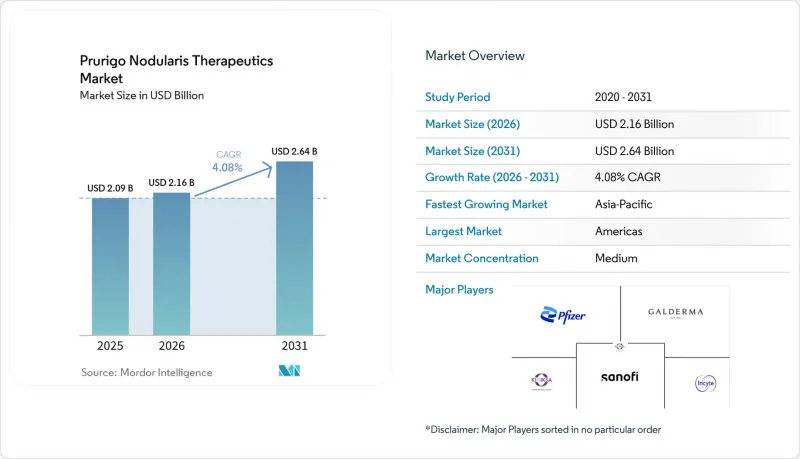
Mordor Intelligence에 의하면, 결절성 양진 치료제 시장 규모는 2025년 20억 9,000만 달러에서 2026년에는 21억 6,000만 달러로 확대되고, 2031년까지 26억 4,000만 달러에 이를 것으로 예측되며, 2026-2031년 CAGR 4.08%를 기록할 전망입니다.
본 보고서는 약물 분류별(코르티코스테로이드, 항히스타민제, 항경련제, 생물학적 제제, 기타), 투여 경로(외용, 경구, 주사), 최종 사용자 환경(병원, 전문 클리닉, 재택 간호), 지역(북미, 유럽, 아시아태평양, 중동 및 아프리카, 남미)별로 분류되어 있습니다. 시장 예측은 금액(달러)으로 표시되어 있습니다.
전 세계 결절성 가려움증 치료제 시장 동향 및 인사이트
희귀질환용 생물학적 제제에 대한 규제상의 호재(미국 및 EU)
신속 승인 절차 및 희귀질환에 대한 인센티브로 인해, 심한 가려움증이나 난치성 병변을 치료하는 약물의 경우, 신청부터 시판까지의 기간이 단축되고 있습니다. 2024년 2월 네모리주맙이 미국에서 우선 심사를 거쳐 승인된 사례는 전신 치료 옵션이 제한적이었던 성인 환자에게 우선 심사를 통해 효과적인 생물학적 제제를 더 신속하게 시장에 출시할 수 있음을 보여주었습니다. 2025년 2월 영국의 승인은 국경을 초월한 규제 조화라는 추세를 더욱 공고히 했으며, 이를 통해 임상의의 조기 이해 촉진과 보험사의 조율된 심사가 현재 지원되고 있습니다. 이러한 선례들은 임상적으로 의미 있는 가려움증 완화 및 의사의 평가 척도에 기반한 승인 기준을 명확히 하고 있으며, 업스트림 사이토카인 신호 전달을 표적으로 하는 약물에 유리하게 작용합니다. 또한, 스폰서는 수수료 면제 및 독점 판매 기간을 통해 경제적 이익도 얻을 수 있으며, 이를 통해 결절성 가려움증 치료제 시장에서 후기 개발 단계에 있는 자산의 위험 조정 후 수익 프로파일이 개선됩니다. 일관된 평가 지표와 신뢰할 수 있는 환자 보고 결과를 활용하는 신청 서류가 늘어남에 따라 신청의 질이 향상되고, 후속 작용기전을 가진 약물의 심사 주기 또한 더 예측하기 쉬워집니다.
원격 피부과 진료 및 전자 약국을 통한 조제의 급속한 확대
동기식 및 비동기식 원격 피부과 진료는 혼잡한 진료소 밖에서 정기적인 경과 관찰이나 영상 기반 진료 선별을 수행함으로써 전문의의 진료 범위를 확대되고 있습니다. 동료 심사를 거친 연구에 따르면, ‘저장 및 전달(store-and-forward)’ 방식의 워크플로는 대면 진료 수요를 줄이고, 의료 서비스가 부족한 지역에서 급성기 진료 이용을 다소 감소시키는 것으로 나타났으며, 이를 통해 전신 요법의 시작 및 모니터링을 위한 진료 체계를 유지할 수 있게 됩니다. 전문 약국 네트워크는 미리 약제가 충전된 주사기의 택배 서비스를 제공하며, 온라인 교육 모델과 연계되어 있습니다. 이를 통해 생물학적 제제 주사제의 복약 순응도가 향상되고, 치료의 지속성이 안정적으로 유지됩니다. 또한, 자동 주사기 방식은 진료소에서의 주사에 비해 1회당 투여 비용을 절감하므로, 결절성 가려움증 치료제 시장에서 지불 주체의 인센티브와 재택 간호 이용이 일치하게 됩니다. 진료소가 복약 순응도를 높이기 위해 원격 분류 및 원격 기록 시스템을 도입함으로써, 피부과 팀은 대면 진료 시간을 복잡한 증상의 악화나 동반 질환 대응에 할애할 수 있습니다. 이러한 통합 모델을 통해 전문 의료 센터에서 멀리 떨어진 지역에 거주하는 환자에 대해서도 일관된 후속 관리가 가능해지며, 표적 생물학적 제제나 후기 단계의 저분자 약물을 중심으로 한 만성 질환 관리 워크플로가 안정화됩니다.
생물학적 제제의 높은 비용과 지급 기관에 의한 이용 규제
생물학적 제제의 정가 및 진료 장소별 비용은 여전히 엄격한 감시 대상이며, 이로 인해 치료 시작을 지연시키는 단계적 치료나 사전 승인 요건이 유지되고 있습니다. 메디케어 파트 B의 환급 체계에서는 평균 판매 가격 산정식이 채택되어 있으나, 이에 지연이 발생하기 때문에 ‘구매·청구’ 방식에 따른 신약 도입 시 의료 제공업체의 수익성에 압박을 가할 가능성이 있습니다. 바이오시밀러에 관한 연방 정부의 분석 및 정책 논의는 접근성을 유지하면서 지출을 줄이는 것을 목적으로 하고 있으며, 이는 안정적인 이익률에 의존하여 후속 연구 자금을 조달하고 있는 혁신적인 기업들에게 불확실성을 초래하고 있습니다. 또한, 보험사의 규제는 보험 플랜의 유형에 따라 다르기 때문에 동일한 환자 프로파일이라 하더라도 보험 적용 범위에 따라 접근 경로가 달라질 수 있습니다. 이러한 요인들로 인해 신규 생물학적 제제의 보급이 지연될 가능성이 있으며, 치료가 재택 자가 투여로 전환되는 경향이 강해지고 있습니다. 보험사는 재택 치료에서 총비용 절감을 도모하고 있습니다. 결절성 가려움증 치료제 시장은 환자 지원 프로그램 확충 및 보험 플랜의 선호도에 맞춘 제공 모델 조정을 통해 이러한 제약을 지속적으로 극복해 나가고 있습니다.
부문 분석
2025년, 생물학적 제제는 결절성 가려움증 치료제 시장의 45.34%를 차지할 것으로 예상되며, 2031년까지 결절성 가려움증 치료제 시장 규모는 연평균 성장률(CAGR) 7.49%로 확대될 것으로 전망됩니다. 업스트림 사이토카인을 표적으로 하는 치료법은 대증 요법에 비해 가려움증 억제 및 질환 관리를 개선하고 있습니다. 따라서 피부과 클리닉에서는 초기 치료로 효과가 충분하지 않은 경우, 중등도에서 중증 환자를 IL-31RA 및 IL-4/IL-13 억제제로 전환하고 있습니다. 네모리주맙의 승인으로, 독자적인 IL-31 작용기전이 일상 진료에 도입되어, 이미 확립된 IL-4/IL-13 바이오로직스와 더불어 명확한 치료 순서 선택지가 생겼습니다. 경증 사례에서는 외용 코르티코스테로이드나 기타 국소 요법이 여전히 1차 선택이지만, 난치성 가려움증이나 지속성 결절에 대해 전신 요법이 시작되면, 이러한 요법들은 주로 보조 요법으로서 기능합니다. 항히스타민제는 이 질환에서 비히스타민성 경로가 가려움증 신호 전달을 주도하고 있기 때문에 그 유용성이 제한적이며, 중증 사례의 관리 전략에서는 주변적인 위치에 머물고 있습니다.
경구 투여를 선호하는 환자나 주사로 인한 장벽에 직면한 환자를 위한 대안으로, 저분자 화합물의 개발이 진행되고 있습니다. JAK-STAT 신호 전달을 조절하는 경구제는 여러 사이토카인에 의해 활성화되는 하류 경로를 차단하도록 설계되어 있어, 이를 통해 다양한 표현형에 걸친 치료 반응의 폭을 넓힐 수 있을 것으로 기대됩니다. 발표된 총설에서는 이러한 약제가 후기 임상시험을 거쳐 성숙해짐에 따라, 장기 사용 시 용량 최적화와 안전성 모니터링이 극히 중요하다는 점이 강조되고 있습니다. 증거가 축적됨에 따라 임상의들은 전신성 약물과 표적화된 국소 치료를 조합하여 병변의 소실을 촉진하고 재발 위험을 낮추는 병용 전략을 검토하고 있습니다. 따라서 결절성 가려움증 치료제 시장은 생물학적 제제를 핵심으로 하며, 경구제의 진입으로 투여 방법의 선택지가 확대되는 구조를 형성하고 있으며, 이는 환자의 선호도와 보험사의 방침에 부합하는 복약 순응도 패턴을 뒷받침합니다.
지역별 분석
2025년, 결절성 가려움증 치료제 시장 중 북미가 42.11%를 차지했습니다. 이는 성숙한 전문 약국 시스템과 표적 면역학 약물에 대한 임상의들의 폭넓은 지식을 반영한 것입니다. 미국에서 네모리주맙의 보험 적용은 빠르게 진행되어, 출시 직후 상당 비율의 민간 보험 가입자가 1차 선택 약제로서 이 생물학적 제제에 접근할 수 있게 되었습니다. 이로 인해 결절성 가려움증 치료제 시장의 초기 성장세가 더욱 강화되었습니다. 캐나다의 경우, 연방 정부의 승인 후에도 각 주별 처방약 목록 등재 시기가 달라 접근성과 관련된 주요 이정표 간격이 벌어지는 경우가 있어 시장 규모는 비교적 작은 임베디드니다.
서유럽 전역에서는 국가 차원의 평가가 진행됨에 따라 피부과 네트워크가 새로운 생물학적 제제를 도입하고 있으며, 2025년 초 영국의 승인이 임상의들의 조기 도입을 뒷받침했습니다. 독일 및 북유럽 국가에서는 면역매개성 질환을 대상으로 한 표적형 생물학적 제제의 보급 실적이 있어, 예산 절차가 완료되는 대로 결절성 가려움증 치료 시작을 원활하게 수용할 가능성이 있습니다. 남유럽 시장에서는 지역별 의사 결정 과정과 현지 예산 제약으로 인해 진전이 다소 더딘 편이지만, 전문 의료 센터가 조기 도입자가 되는 사례가 많이 관찰됩니다. 원격 피부과 프로그램의 확대에 따라, 진료소는 대면 진료 시간을 전신성 질환의 치료 시작이나 복잡한 동반 질환 관리에 할애할 수 있게 되었으며, 이는 결절성 가려움증 치료제 시장에서 안정적인 사용 패턴을 뒷받침하고 있습니다.
아시아태평양은 표적화된 제품 출시와 의료 서비스가 미치지 못하는 지역에 전문의의 접근성을 확대하는 데 기여하는 원격 피부과 서비스의 확대에 힘입어, 연평균 성장률(CAGR) 5.24%로 가장 빠른 성장을 기록할 것으로 예측됩니다. 2025년 호주의 규제 당국 승인은 상업적 확장의 길을 열어줄 것이며, 자금 조달 결정이 임상 현장의 실무와 부합한다면 그 확장은 가속화될 가능성이 있습니다. 일본은 염증성 질환에 대한 생물학적 제제의 도입에 풍부한 경험을 보유하고 있으며, 해당 시장에서 원개발 기업의 존재가 임상의에 대한 교육 및 환자 도입을 뒷받침하고 있습니다. 중동 및 아프리카 및 남미에서는 의료 체계와 보험 급여의 제약으로 인해 도입이 여전히 초기 단계에 머물러 있지만, 일부 민간 의료 기관에서는 생물학적 제제를 활용한 치료 요법을 관리하는 체계를 구축해 나가고 있습니다. 콜드체인 배송을 위한 공급망이 확대되고 재택 지원이 정착됨에 따라, 결절성 가려움증 치료제 시장에서 지역 간 접근성 격차는 점차 줄어들 것으로 예측됩니다.
기타 혜택:
- 엑셀 형식 시장 예측(ME) 시트
- 3개월간의 애널리스트 지원
자주 묻는 질문
목차
제1장 서론
제2장 조사 방법
제3장 주요 요약
제4장 시장 구도
제5장 시장 규모와 성장 예측
제6장 경쟁 구도
제7장 시장 기회와 향후 전망
KTH 26.08.06According to Mordor Intelligence, the prurigo nodularis therapeutics market size is expected to increase from USD 2.09 billion in 2025 to USD 2.16 billion in 2026 and reach USD 2.64 billion by 2031, growing at a CAGR of 4.08% over 2026-2031.
This report is Segmented by Drug Class (Corticosteroids, Antihistamines, Anticonvulsants, Biologics, Others), Route of Administration (Topical, Oral, Injectable), End-User Setting (Hospitals, Specialty Clinics, Home-Care), and Geography (North America, Europe, Asia-Pacific, Middle East & Africa, South America). Market Forecasts are in Value (USD).
Global Prurigo Nodularis Therapeutics Market Trends and Insights
Regulatory Tailwinds for Orphan & Rare-Disease Biologics (US & EU)
Accelerated pathways and rare-disease incentives are compressing time from submission to launch for therapies that address severe pruritus and refractory lesions. Nemolizumab's U.S. priority review approval in February 2024 showcased how priority review can move efficacious biologics to market on faster timelines for adult patients who had limited systemic options. U.K. authorization in February 2025 reinforced the trend of cross-border regulatory convergence that now supports earlier clinician familiarity and coordinated payer reviews. These precedents clarify approvability criteria rooted in clinically meaningful itch reduction and physician assessment scales, which benefit agents that target upstream cytokine signaling. Sponsors also gain economic benefits through fee waivers and exclusivity windows, which improve the risk-adjusted return profiles of late-stage assets in the prurigo nodularis therapeutics market. As more dossiers leverage consistent endpoints and robust patient-reported outcomes, submission quality rises, and review cycles become more predictable for follow-on mechanisms.
Rapid Expansion of Tele-Dermatology & E-Pharmacy Fulfillment
Synchronous and asynchronous teledermatology is expanding specialist reach by triaging routine follow-ups and image-based consultations outside crowded clinics. Peer-reviewed work demonstrates that store-and-forward workflows can lower in-person demand and modestly reduce acute care visits in underserved communities, which preserves capacity for systemic initiation and monitoring. Specialty pharmacy networks supply home delivery of prefilled injectors and align with virtual education models, which improve adherence and support stable persistence for injectable biologics. Autoinjector formats also reduce per-dose administration costs compared with clinic-based injections, which aligns payer incentives with home-care use in the prurigo nodularis therapeutics market. As clinics implement tele-triage and remote documentation for adherence, dermatology teams can allocate in-person time to complex flares and comorbidities. This integrated model enables consistent follow-up for patients who live far from specialist centers, which stabilizes chronic-care workflows around targeted biologics and late-stage small molecules.
High Biologic Therapy Cost & Payer Utilization Controls
Biologic list prices and site-of-care costs continue to draw intense scrutiny, which sustains step-therapy and prior authorization requirements that delay treatment starts. Medicare Part B reimbursement mechanics use average sales price formulas that adjust with a lag, which can pressure provider economics for buy-and-bill launches. Federal analyses and policy discussions on biosimilars aim to reduce spending while maintaining access, which creates uncertainty for innovators that rely on stable margins to fund follow-on research. Payer controls also vary across plan types, which means that the same patient profile can experience different access pathways depending on coverage. These factors can slow uptake novel biologics and shift more care to home-based self-administration, where payers seek lower total costs. The prurigo nodularis therapeutics market continues to navigate these constraints by expanding patient support programs and by aligning delivery models to plan preferences.
Other drivers and restraints analyzed in the detailed report include:
- IL-31 / OSM Pathway Breakthroughs Accelerating Novel MoA Pipeline
- Rise of Patient-Advocacy Rare-Disease Registries Speeding Clinical Trial Enrollment
- Heterogeneous Disease Phenotypes Complicate Endpoint Standardization in Trials
For complete list of drivers and restraints, kindly check the Table Of Contents.
Segment Analysis
Biologics captured 45.34% of the prurigo nodularis therapeutics market in 2025, and the prurigo nodularis therapeutics market size for biologics is projected to expand at a 7.49% CAGR through 2031. Targeting upstream cytokines has improved itch control and disease management compared with symptomatic regimens, which is why dermatology clinics are transitioning moderate-to-severe patients to IL-31RA and IL-4/IL-13 blockade once initial measures fall short. Nemolizumab's approval brought a distinct IL-31 mechanism into routine practice and created clear sequencing options alongside an established IL-4/IL-13 biologic. Topical corticosteroids and other local therapies remain a first step in mild presentations, but they function mainly as adjuncts once systemic therapy begins for refractory itch and persistent nodules. Antihistamines have limited utility because non-histaminergic circuits drive itch signaling in this disease, which keeps them peripheral to control strategies for severe cases.
Small-molecule programs are advancing to offer alternatives for patients who prefer oral routes or who face injection barriers. Oral agents that modulate JAK-STAT signaling are designed to intercept downstream pathways activated by multiple cytokines, which could broaden responsiveness across phenotypes. Published reviews highlight that dose optimization and safety monitoring are central to long-term use as these agents mature through late-stage trials. As evidence accumulates, clinicians are considering combination strategies that pair systemic agents with targeted topical care to enhance clearance and lower flare risk. The prurigo nodularis therapeutics market is therefore organizing around a biologics-led core with oral entrants providing greater choice on delivery, which supports adherence patterns that suit patient preferences and payer policies.
Complete Report Scope:
- By Drug Class
- Topical Corticosteroids
- Capsaicin Cream
- Antihistamines
- Anticonvulsants
- Antidepressants
- NK-1 Receptor Antagonists
- Biologics
- Opiate Receptor Modulators
- Others (Phototherapy, Cryotherapy, etc.)
- By Route of Administration
- Topical
- Oral
- Subcutaneous / Intramuscular Injection
- By End-User Setting
- Hospitals
- Specialty Dermatology Clinics
- Home-care / Self-administration
- By Geography
- North America
- United States
- Canada
- Mexico
- Europe
- Germany
- United Kingdom
- France
- Italy
- Spain
- Rest of Europe
- Asia-Pacific
- China
- India
- Japan
- South Korea
- Australia
- Rest of Asia-Pacific
- Middle East & Africa
- GCC
- South Africa
- Rest of Middle East & Africa
- South America
- Brazil
- Argentina
- Rest of South America
- North America
Geography Analysis
North America accounted for 42.11% of the prurigo nodularis therapeutics market in 2025, reflecting mature specialty pharmacy systems and broad clinician familiarity with targeted immunology agents. U.S. coverage for nemolizumab advanced rapidly, with first-line biologic access extending to a substantial share of commercially insured lives soon after launch, which reinforced early momentum in the prurigo nodularis therapeutics market. Canada contributes a smaller base due to provincial variations in formulary timing, which can space out access milestones after federal authorization.
Across Western Europe, dermatology networks are integrating new biologics as national-level assessments advance, and the U.K. authorization in early 2025 helped catalyze earlier clinician adoption. Germany and the Nordics have experience scaling targeted biologics across immune-mediated diseases, which can help absorb prurigo nodularis starts once budget processes conclude. Southern European markets proceed more gradually due to regional decision layers and local budget constraints, though specialist centers often become early adopters. As teledermatology programs expand, clinics can reserve in-person capacity for systemic starts and complex comorbidity management, which supports stable use patterns in the prurigo nodularis therapeutics market.
Asia-Pacific is expected to post the fastest growth at a 5.24% CAGR, supported by targeted launches and scaling teledermatology that helps extend specialist reach to underserved areas. Australia's regulatory clearance in 2025 created a path for commercial rollout that can accelerate once funding decisions align with clinical practice. Japan has deep experience with biologics for inflammatory conditions, and the presence of the original developer in that market supports clinician education and patient onboarding. The Middle East & Africa and South America remain early in adoption due to capacity and reimbursement constraints, though selected private centers are building capability to manage biologic regimens. As supply chains for cold-chain delivery expand and home-based support normalizes, regional gaps in access should narrow within the prurigo nodularis therapeutics market.
- Bayer
- Celgene Corp. (Bristol Myers Squibb)
- Galderma
- GlaxoSmithKline
- Hikma Pharmaceuticals
- Incyte Corp.
- Johnson & Johnson
- Kiniksa Pharmaceuticals Ltd.
- Maruho Co. Ltd.
- Mayne Pharma Group Ltd.
- Menlo Therapeutics Inc.
- Merck
- Novartis
- Pfizer
- Regeneron Pharmaceuticals
- Sanofi
- Takeda Pharmaceutical Co.
- Teva Pharmaceutical Industries
- Torii Pharmaceutical Co. Ltd.
- Trevi Therapeutics Inc.
- VYNE Therapeutics Inc.
Additional Benefits:
- The market estimate (ME) sheet in Excel format
- 3 months of analyst support
TABLE OF CONTENTS
1 Introduction
- 1.1 Study Assumptions & Market Definition
- 1.2 Scope of the Study
2 Research Methodology
3 Executive Summary
4 Market Landscape
- 4.1 Market Overview
- 4.2 Market Drivers
- 4.2.1 Growing PN diagnosis & treatment rates in high-income countries
- 4.2.2 Regulatory tailwinds for orphan & rare-disease biologics (US & EU)
- 4.2.3 Rapid expansion of tele-dermatology & e-pharmacy fulfilment
- 4.2.4 IL-31 / OSM pathway breakthroughs accelerating novel MoA pipeline
- 4.2.5 Convergence of neuro-immunology biomarkers enabling companion diagnostics
- 4.2.6 Rise of patient-advocacy rare-disease registries speeding clinical trial enrolment
- 4.3 Market Restraints
- 4.3.1 High biologic therapy cost & payer utilisation controls
- 4.3.2 Limited dermatology capacity in public health systems (APAC, Africa)
- 4.3.3 Heterogeneous disease phenotypes complicate endpoint standardisation in trials
- 4.3.4 Supply-chain fragility for biologic fill-finish capacity
- 4.4 Value Chain Analysis
- 4.5 Regulatory Landscape
- 4.6 Technological Outlook
5 Market Size & Growth Forecasts (Value, USD)
- 5.1 By Drug Class
- 5.1.1 Topical Corticosteroids
- 5.1.2 Capsaicin Cream
- 5.1.3 Antihistamines
- 5.1.4 Anticonvulsants
- 5.1.5 Antidepressants
- 5.1.6 NK-1 Receptor Antagonists
- 5.1.7 Biologics
- 5.1.8 Opiate Receptor Modulators
- 5.1.9 Others (Phototherapy, Cryotherapy, etc.)
- 5.2 By Route of Administration
- 5.2.1 Topical
- 5.2.2 Oral
- 5.2.3 Subcutaneous / Intramuscular Injection
- 5.3 By End-User Setting
- 5.3.1 Hospitals
- 5.3.2 Specialty Dermatology Clinics
- 5.3.3 Home-care / Self-administration
- 5.4 By Geography
- 5.4.1 North America
- 5.4.1.1 United States
- 5.4.1.2 Canada
- 5.4.1.3 Mexico
- 5.4.2 Europe
- 5.4.2.1 Germany
- 5.4.2.2 United Kingdom
- 5.4.2.3 France
- 5.4.2.4 Italy
- 5.4.2.5 Spain
- 5.4.2.6 Rest of Europe
- 5.4.3 Asia-Pacific
- 5.4.3.1 China
- 5.4.3.2 India
- 5.4.3.3 Japan
- 5.4.3.4 South Korea
- 5.4.3.5 Australia
- 5.4.3.6 Rest of Asia-Pacific
- 5.4.4 Middle East & Africa
- 5.4.4.1 GCC
- 5.4.4.2 South Africa
- 5.4.4.3 Rest of Middle East & Africa
- 5.4.5 South America
- 5.4.5.1 Brazil
- 5.4.5.2 Argentina
- 5.4.5.3 Rest of South America
- 5.4.1 North America
6 Competitive Landscape
- 6.1 Market Concentration
- 6.2 Market Share Analysis
- 6.3 Company Profiles
- 6.3.1 Bayer AG
- 6.3.2 Celgene Corp. (Bristol Myers Squibb)
- 6.3.3 Galderma SA
- 6.3.4 GlaxoSmithKline plc
- 6.3.5 Hikma Pharmaceuticals plc
- 6.3.6 Incyte Corp.
- 6.3.7 Johnson & Johnson
- 6.3.8 Kiniksa Pharmaceuticals Ltd.
- 6.3.9 Maruho Co. Ltd.
- 6.3.10 Mayne Pharma Group Ltd.
- 6.3.11 Menlo Therapeutics Inc.
- 6.3.12 Merck & Co. Inc.
- 6.3.13 Novartis AG
- 6.3.14 Pfizer Inc.
- 6.3.15 Regeneron Pharmaceuticals Inc.
- 6.3.16 Sanofi SA
- 6.3.17 Takeda Pharmaceutical Co.
- 6.3.18 Teva Pharmaceutical Industries Ltd.
- 6.3.19 Torii Pharmaceutical Co. Ltd.
- 6.3.20 Trevi Therapeutics Inc.
- 6.3.21 VYNE Therapeutics Inc.
7 Market Opportunities & Future Outlook
- 7.1 White-space & Unmet-Need Assessment


