

|
시장보고서
상품코드
2097440
중탄산나트륨 : 시장 점유율 분석, 업계 동향과 통계, 성장 예측(2026-2031년)Sodium Bicarbonate - Market Share Analysis, Industry Trends & Statistics, Growth Forecasts (2026 - 2031) |
||||||
 Mordor Intelligence
Mordor Intelligence에 의하면, 중탄산나트륨 시장 규모는 2025년에 50억 8,000만 달러로 평가되었고, 2026년 52억 7,000만 달러에서 2031년까지 68억 2,000만 달러에 이를 것으로 예측되며, 예측 기간(2026-2031년) CAGR은 5.21%를 나타낼 전망입니다.
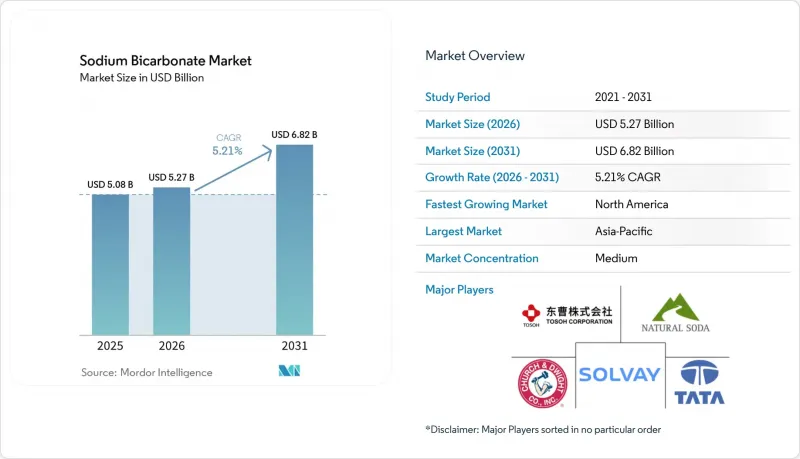
본 보고서는 등급(의약품 등급, 식품 등급, 공업용 등급, 사료용 등급), 형태(분말, 액체, 결정, 펠릿), 용도(식품 및 음료, 의약품, 동물사료 등) 및 지역(북미, 유럽, 아시아태평양, 남미, 중동 및 아프리카)별로 분류되어 있습니다. 시장 전망은 금액(달러) 및 수량(톤) 단위로 제시되어 있습니다.
전 세계 중탄산나트륨 시장 동향 및 인사이트
배기가스 처리 및 배출 규제에 대한 수요 증가
중탄산나트륨 시장은 폐기물 발전소 및 산업용 연소 시설에서의 배출 규제 강화로 인해 혜택을 보고 있습니다. 중탄산나트륨을 이용한 건식 흡착제 주입은 물을 사용하지 않는 산성 가스 처리 방법이 필요하며, 개조 공사가 간편해야 하는 현장에서 점점 더 선호되고 있습니다. 『RSC Advances』지에 게재된 조사에 따르면, 온도 대 산소비가 1 이상이고 산소 함유량이 5%를 초과하는 조건에서 중탄산나트륨을 이용한 SO₂ 및 NO 제거 효율이 90% 이상을 달성한 것으로 나타났습니다. 또한, 2025년 공학 조사에서는 폐기물 발전 플랜트에서 회수된 CO₂를 이용하여 현장에서 중탄산나트륨을 제조하는 것이 경제적으로 실현 가능하다는 사실이 밝혀졌습니다. 이를 통해 물류 비용을 절감할 수 있을 뿐만 아니라, 중탄산나트륨 시장 내에서 내부 수요를 창출할 수 있습니다. 2026년 2월, 유럽 집행위원회는 배출권 거래 제도 내 소다회 기준치를 개정했습니다. 이는 규제 대상 산업 환경에서 중탄산나트륨의 활용을 촉진하는 보다 광범위한 규정 준수 배경을 뒷받침하는 조치입니다.
식품 가공 및 제빵 분야에서의 용도 확대
중탄산나트륨 시장은 제빵, 제과 및 가공식품 제조에서 이 화합물이 수행하는 폭넓은 기능적 역할 덕분에 계속해서 혜택을 보고 있습니다. 식품용 중탄산나트륨은 팽창제, pH 완충제, 산도 조절제로 기능하기 때문에 많은 포장 식품 카테고리에서 중요한 역할을 수행하고 있습니다. 미국 농무부가 2025년에 발표한 기술 보고서에서는 육류 제품, 구운 과자, 베이킹 믹스, 코코아 가공 분야에서 그 사용이 확인되었을 뿐만 아니라, 유럽연합(EU)에서 식품 첨가물 E500(ii)로 승인되어 있다는 점도 지적되었습니다. 2025년, 식품 등급 중탄산나트륨은 시장 점유율 35.48%를 차지하며 중탄산나트륨 시장을 주도했습니다. 이는 좁은 단일 용도가 아닌 폭넓은 수요를 반영한 것입니다. 중탄산나트륨 시장의 이 분야에서는 할랄이나 코셔 등의 품질 인증을 취득한 제조업체일수록 대형 식품 제조업체로부터 우선 공급업체로서의 지위를 확보하기 쉬운 상황입니다.
대체 배기가스 제어 기술과의 경쟁
중탄산나트륨 시장은 여전히 확립된 배기가스 처리 기술과의 경쟁에 직면해 있습니다. 석회를 사용하는 습식 배기가스 탈황(FGD) 시스템은 여전히 많은 대규모 석탄 화력 발전소에 도입되어 있어, 이로 인해 중탄산나트륨의 건식 주입은 개보수 프로젝트나 습식 시스템의 실용성이 낮은 산업 시설로 제한되고 있습니다. 이러한 제약은 북미에서 가장 두드러지며, 배출 규제가 강화되고 있음에도 불구하고 습식 FGD 설비의 도입 규모는 여전히 대규모로 유지되고 있습니다. 또한, 중탄산나트륨 시장은 폐기물 발전 시설에서의 선택적 촉매 환원(SCR) 시스템 및 활성탄 주입 기술과도 경쟁하고 있습니다. 이러한 기술들은 특정 오염 물질에 대해 동일한 배출 규제 대응 예산을 할당할 수 있기 때문입니다. 그럼에도 불구하고, 운영의 간편성, 물에 대한 의존도 저하, 도입의 신속성을 중시하는 사업자에게는 중탄산나트륨이 여전히 매력적인 선택지로 남아 있습니다.
부문 분석
2025년 시점에서 식품 등급은 중탄산나트륨 시장 규모의 35.48%를 차지하며, 본 조사에서 가장 큰 등급 부문으로 나타났습니다. 이러한 주도적 지위는 제빵, 유제품, 스낵, 음료 등의 용도에서 팽창제, pH 완충제, 산도 조절제로 널리 사용되고 있는 데 기인합니다. 미국 농무부의 2025년 기술 보고서는 여러 식품 카테고리에서의 취급 및 사용을 확인함과 동시에, EU에서의 E500(ii) 승인에 대해서도 언급하고 있습니다. 의약품 등급은 중탄산나트륨 시장에서 가장 빠르게 성장하고 있는 등급 부문으로, 2026년부터 2031년까지 연평균 성장률(CAGR) 6.55%를 나타낼 것으로 예측됩니다.
Tata Chemicals Europe이 노스위치에 6,000만 유로를 투자한 것은 현재공급 격차가 해소되기 전에 생산자들이 의약품 등급 생산에 막대한 자본을 투입하고 있음을 보여줍니다. 산업용 등급 및 사료용 등급은 나머지 생산량을 차지하고 있으며, 중공업 용도 및 가축 영양과 밀접하게 관련되어 있어 탄산수소나트륨 업계에서 여전히 중요한 위치를 차지하고 있습니다. 산업용 등급은 배기가스 처리, 제지, 섬유 제조, 소화 용도로 사용되며, 경기 변동의 영향을 받기는 하지만 광범위한 수요와 밀접하게 연관되어 있습니다. 사료용 등급은 반추위 완충제, 전해질 조절제, 수산 양식용 pH 조절제 역할을 하며, 2025년 『Indian Journal of Animal Nutrition』에 게재된 연구에서는 비육장의 어린 양에 대한 그 성능상의 이점이 입증되었습니다.
지역별 분석
2025년, 아시아태평양은 중탄산나트륨 시장의 38.31%를 차지하며 최대 지역 부문이 되었습니다. 이 지역의 우위는 중국공급 규모와 식품, 산업용, 사료용, 의약품용 등급에 걸친 폭넓은 수요에 기인합니다. Tata Chemicals가 2025 회계연도에 미타푸르에서 14만 MT 규모의 신규 중탄산나트륨 생산 능력을 가동함에 따라, 인도는 중탄산나트륨 시장에서 두 번째로 중요한 성장 거점으로 부상하고 있습니다. 일본과 한국은 여전히 품질을 중시하는 시장으로, 저사양의 범용 제품보다 식품용 및 의약품용 원료에 대한 수요가 더 강합니다. Inner Mongolia Boyuan의 알라샨코우 프로젝트에서 신규 생산 능력을 증강한 것은 중탄산나트륨 시장에서 해당 지역공급 기반이 여전히 확대되고 있음을 보여줍니다.
북미는 중탄산나트륨 시장에서 가장 빠르게 성장하는 지역으로, 2031년까지 연평균 성장률(CAGR) 6.48%로 확대될 것으로 전망됩니다. 미국에서는 배출 규제 강화, 의약품 공급망의 일부 현지화 추진, 그리고 클린 라벨 식품 원료에 대한 안정적인 수요가 성장 동력이 되고 있습니다. 캐나다와 멕시코는 식품 가공 및 동물사료 수요를 통해 보다 안정적인 기반을 제공하며, 프로젝트 기반의 산업용 소비와의 균형을 유지하는 데 기여하고 있습니다. 유럽은 중탄산나트륨 시장에서 성숙 단계에 접어들었으나 여전히 중요한 지역으로, 독일, 프랑스, 영국이 의약품 및 배기가스 처리 수요를 뒷받침하고 있습니다. 이곳에서도 정책적 지원이 중요하며, 배출에 관한 EU의 규제 체계나 이산화탄소를 이용하여 소다회로부터 제조된 중탄산나트륨에 대한 영국의 기후 변화세(Climate Change Levy) 면제(2026년 봄 발효 예정) 등이 그 예로 꼽힙니다.
남미, 중동 및 아프리카는 중탄산나트륨 시장에서 여전히 장기적인 성장이 예상되는 지역입니다. 브라질과 아르헨티나에서는 축산 및 사료 용도를 통해 수요가 뒷받침되고 있으며, 콜롬비아와 페루에서는 향후 식품 등급의 사용이 확대될 가능성이 있는 대규모 포장 식품 산업의 기반이 구축되고 있습니다. 중동에서는 UAE와 사우디아라비아가 화학 처리 및 폐수 처리 생산 능력을 강화하고 있어, 이것이 중탄산나트륨 수요를 뒷받침하고 있습니다. 아프리카에서는 남아프리카공화국, 나이지리아, 모로코, 이집트에서 식품, 산업, 수처리 등 각 용도로 수요가 나타나고 있으며, 현재 높은 수입 의존도로 인해 중탄산나트륨 시장에서 향후 현지 생산 능력에 대한 투자 여지가 남아 있습니다.
기타 혜택:
- 엑셀 형식 시장 예측(ME) 시트
- 3개월간의 애널리스트 지원
자주 묻는 질문
목차
제1장 서론
제2장 조사 방법
제3장 주요 요약
제4장 시장 구도
제5장 시장 규모와 성장 예측
제6장 경쟁 구도
제7장 시장 기회와 향후 전망
KTH 26.08.06According to Mordor Intelligence, the sodium bicarbonate market size was valued at USD 5.08 billion in 2025 and estimated to grow from USD 5.27 billion in 2026 to reach USD 6.82 billion by 2031, at a CAGR of 5.21% during the forecast period (2026-2031).
This report is Segmented by Grade (Pharma Grade, Food Grade, Industrial Grade, and Feed Grade), Form (Powder, Liquid, Crystal, and Pallets), Application (Food and Beverages, Pharmaceuticals, Animal Feed, and More), and Geography (North America, Europe, Asia-Pacific, South America, and Middle East and Africa). The Market Forecasts are Provided in Terms of Value (USD) and Volume (Tons).
Global Sodium Bicarbonate Market Trends and Insights
Growing Demand for Flue Gas Treatment and Emission Control
The sodium bicarbonate market is gaining from tighter emissions control rules at waste-to-energy plants and industrial combustion facilities. Dry sorbent injection using sodium bicarbonate is increasingly preferred where operators need a water-free acid-gas treatment route with simpler retrofit needs. Research published in RSC Advances showed that sodium bicarbonate achieved SO2 and NO removal efficiencies above 90% when the temperature-to-oxygen ratio stayed above 1 and oxygen content exceeded 5%. A 2025 engineering study also found that producing sodium bicarbonate on site from captured CO2 at waste-to-energy plants is economically viable, which can lower logistics costs and create captive demand inside the sodium bicarbonate market. In February 2026, the European Commission revised soda ash benchmark values under the emissions trading framework, which supports the broader compliance backdrop that is favoring sodium bicarbonate in regulated industrial settings.
Rising Applications in Food Processing and Bakery Production
The sodium bicarbonate market continues to benefit from the compound's wide functional role in bakery, confectionery, and processed food manufacturing. Food-grade sodium bicarbonate serves as a leavening agent, pH buffer, and acidity regulator, which keeps it relevant across many packaged food categories. A 2025 technical report from the U.S. Department of Agriculture confirmed its use in meat products, baked goods, baking mixes, and cocoa processing, and also noted its authorization in the European Union as food additive E500(ii). Food grade led the sodium bicarbonate market with a 35.48% share in 2025, which reflects broad demand rather than a narrow single-use base. In this part of the sodium bicarbonate market, producers with halal, kosher, and other quality credentials are better placed to win preferred-supplier status with large food manufacturers.
Competition from Alternative Emission Control Technologies
The sodium bicarbonate market still faces competition from established flue gas treatment technologies. Wet flue gas desulfurization systems that use limestone remain embedded in many large coal power plants, which limits sodium bicarbonate dry injection to retrofit projects and to industrial units where wet systems are less practical. This restraint is strongest in North America, where the installed base of wet FGD equipment remains large even as emissions requirements become tighter. The sodium bicarbonate market also competes with selective catalytic reduction systems and activated carbon injection at waste-to-energy sites, because those technologies can draw from the same compliance budgets for certain pollutants. Even so, sodium bicarbonate remains attractive where operators value simple handling, lower water dependence, and quicker implementation.
Other drivers and restraints analyzed in the detailed report include:
- Preference for Non-Toxic and Environmentally Friendly Chemicals
- Increasing Demand for High-Purity Specialty Grades
- Stringent Quality Requirements for Pharmaceutical and Food Grades
For complete list of drivers and restraints, kindly check the Table Of Contents.
Segment Analysis
Food grade accounted for 35.48% of the sodium bicarbonate market size in 2025, making it the largest grade segment in the study. Its leadership comes from broad use as a leavening agent, pH buffer, and acidity regulator across bakery, dairy, snack food, and beverage applications. The U.S. Department of Agriculture's 2025 technical report confirmed its handling and use across several food categories and also referenced its EU authorization as E500(ii). Pharma grade is the fastest-growing grade segment in the sodium bicarbonate market and is projected to grow at a 6.55% CAGR from 2026 to 2031.
Tata Chemicals Europe's EUR 60 million investment in Northwich shows how producers are committing large capital to pharmaceutical-grade output before the current supply gap narrows. Industrial grade and feed grade made up the balance of volume and remained important to the sodium bicarbonate industry because they are tied to heavy industrial use and to livestock nutrition. Industrial grade serves flue gas treatment, paper processing, textile manufacturing, and fire suppression, which links it closely to cyclical but broad demand. Feed grade works as a rumen buffer, an electrolyte regulator, and an aquaculture pH agent, and a 2025 study in the Indian Journal of Animal Nutrition supported its performance benefits in feedlot lambs.
Complete Report Scope:
- By Grade
- Pharma Grade
- Food Grade
- Industrial Grade
- Feed Grade
- By Form
- Powder
- Liquid
- Crystal
- Pallets
- By Applications
- Food and Beverages
- Pharmaceuticals
- Animal Feed
- Water Treatment
- Industrial
- Others
- By Geography
- North America
- United States
- Canada
- Mexico
- Rest of North America
- Europe
- Germany
- United Kingdom
- France
- Italy
- Spain
- Netherlands
- Sweden
- Poland
- Belgium
- Rest of Europe
- Asia-Pacific
- China
- India
- Japan
- Australia
- South Korea
- Vietnam
- Indonesia
- Thailand
- Singapore
- Rest of Asia-Pacific
- South America
- Brazil
- Argentina
- Chile
- Peru
- Colombia
- Rest of South America
- Middle East and Africa
- United Arab Emirates
- Saudi Arabia
- South Africa
- Nigeria
- Egypt
- Morocco
- Turkey
- Rest of Middle East and Africa
- North America
Geography Analysis
Asia-Pacific accounted for 38.31% of the sodium bicarbonate market in 2025, making it the largest regional segment. The region's lead comes from China's scale in supply and from broad demand across food, industrial, feed, and pharmaceutical grades. India is emerging as the second major growth center in the sodium bicarbonate market after Tata Chemicals commissioned 140,000 MT of new bicarbonate capacity at Mithapur in FY2025. Japan and South Korea remain quality-sensitive markets, with stronger demand for food-grade and pharmaceutical-grade material than for low-spec commodity volumes. New capacity additions at Inner Mongolia Boyuan's Alashankou project show that the regional supply base in the sodium bicarbonate market is still expanding.
North America is the fastest-growing region in the sodium bicarbonate market and is projected to expand at a 6.48% CAGR through 2031. The United States is benefiting from tighter emissions compliance, a push to localize parts of the pharmaceutical supply chain, and steady demand for cleaner-label food ingredients. Canada and Mexico provide more stable support through food processing and animal feed demand, which helps balance project-based industrial consumption. Europe remains a mature but important part of the sodium bicarbonate market, with Germany, France, and the United Kingdom anchoring pharmaceutical and flue gas treatment demand. Policy support also matters here, including the EU regulatory framework on emissions and the UK Climate Change Levy exemption for sodium bicarbonate produced from soda ash using carbon dioxide, which takes effect in Spring 2026.
South America and the Middle East and Africa remain longer-horizon growth regions in the sodium bicarbonate market. Brazil and Argentina support demand through livestock and feed applications, while Colombia and Peru are building larger packaged food bases that can lift food-grade use over time. In the Middle East, the UAE and Saudi Arabia are adding chemical processing and wastewater treatment capacity that supports sodium bicarbonate demand. In Africa, South Africa, Nigeria, Morocco, and Egypt show demand across food, industrial, and water treatment uses, and current import dependence leaves room for future local capacity investment in the sodium bicarbonate market.
- Solvay S.A.
- Church and Dwight Co., Inc.
- Tata Chemicals Limited
- Natural Soda LLC
- Tosoh Corporation
- AGC Inc.
- Ciech S.A.
- Sisecam
- Novacap Group
- Ciner Group
- Bashkir Soda Company
- Kazan Soda Elektrik Uretim A.S.
- Nirma Limited
- Genesis Energy, L.P.
- J.M. Huber Corporation
- Inner Mongolia Yuanxing Energy Co., Ltd.
- Shandong Haihua Group Co., Ltd.
- Qingdao Soda Ash Co., Ltd.
- Tokuyama Corporation
- Asahi Kasei Corporation
Additional Benefits:
- The market estimate (ME) sheet in Excel format
- 3 months of analyst support
TABLE OF CONTENTS
1 INTRODUCTION
- 1.1 Study Assumptions and Market Definition
- 1.2 Scope of the Study
2 RESEARCH METHODOLOGY
3 EXECUTIVE SUMMARY
4 MARKET LANDSCAPE
- 4.1 Market Overview
- 4.2 Market Drivers
- 4.2.1 Growing Demand for Flue Gas Treatment and Emission Control
- 4.2.2 Rising Applications in Food Processing and Bakery Production
- 4.2.3 Preference for Non-Toxic and Environmentally Friendly Chemicals
- 4.2.4 Increasing Demand for High-Purity Specialty Grades
- 4.2.5 Growth in Industrial Cleaning Applications
- 4.2.6 Increasing Demand in Animal Feed and Livestock Industries
- 4.3 Market Restraints
- 4.3.1 Competition from Alternative Emission Control Technologies
- 4.3.2 Stringent Quality Requirements for Pharmaceutical and Food Grades
- 4.3.3 Rising Transportation, Freight, and Global Logistics Costs
- 4.3.4 Increasing Energy, Water, and Utility Expenses in Sodium Bicarbonate Manufacturing
- 4.4 Supply Chain Outlook
- 4.5 Regulatory Landscape
- 4.6 Technological Outlook
- 4.7 Porter's Five Forces
- 4.7.1 Bargaining Power of Suppliers
- 4.7.2 Bargaining Power of Buyers
- 4.7.3 Threat of New Entrants
- 4.7.4 Threat of Substitutes
- 4.7.5 Competitive Rivalry
5 MARKET SIZE AND GROWTH FORECASTS (VALUE AND VOLUME)
- 5.1 By Grade
- 5.1.1 Pharma Grade
- 5.1.2 Food Grade
- 5.1.3 Industrial Grade
- 5.1.4 Feed Grade
- 5.2 By Form
- 5.2.1 Powder
- 5.2.2 Liquid
- 5.2.3 Crystal
- 5.2.4 Pallets
- 5.3 By Applications
- 5.3.1 Food and Beverages
- 5.3.2 Pharmaceuticals
- 5.3.3 Animal Feed
- 5.3.4 Water Treatment
- 5.3.5 Industrial
- 5.3.6 Others
- 5.4 By Geography
- 5.4.1 North America
- 5.4.1.1 United States
- 5.4.1.2 Canada
- 5.4.1.3 Mexico
- 5.4.1.4 Rest of North America
- 5.4.2 Europe
- 5.4.2.1 Germany
- 5.4.2.2 United Kingdom
- 5.4.2.3 France
- 5.4.2.4 Italy
- 5.4.2.5 Spain
- 5.4.2.6 Netherlands
- 5.4.2.7 Sweden
- 5.4.2.8 Poland
- 5.4.2.9 Belgium
- 5.4.2.10 Rest of Europe
- 5.4.3 Asia-Pacific
- 5.4.3.1 China
- 5.4.3.2 India
- 5.4.3.3 Japan
- 5.4.3.4 Australia
- 5.4.3.5 South Korea
- 5.4.3.6 Vietnam
- 5.4.3.7 Indonesia
- 5.4.3.8 Thailand
- 5.4.3.9 Singapore
- 5.4.3.10 Rest of Asia-Pacific
- 5.4.4 South America
- 5.4.4.1 Brazil
- 5.4.4.2 Argentina
- 5.4.4.3 Chile
- 5.4.4.4 Peru
- 5.4.4.5 Colombia
- 5.4.4.6 Rest of South America
- 5.4.5 Middle East and Africa
- 5.4.5.1 United Arab Emirates
- 5.4.5.2 Saudi Arabia
- 5.4.5.3 South Africa
- 5.4.5.4 Nigeria
- 5.4.5.5 Egypt
- 5.4.5.6 Morocco
- 5.4.5.7 Turkey
- 5.4.5.8 Rest of Middle East and Africa
- 5.4.1 North America
6 COMPETITIVE LANDSCAPE
- 6.1 Market Concentration
- 6.2 Strategic Moves
- 6.3 Market Ranking Analysis
- 6.4 Company Profiles (Includes Global-level Overview, Market-level Overview, Core Segments, Financials, Strategic Info, Market Rank/Share, Products & Services, Recent Developments)
- 6.4.1 Solvay S.A.
- 6.4.2 Church and Dwight Co., Inc.
- 6.4.3 Tata Chemicals Limited
- 6.4.4 Natural Soda LLC
- 6.4.5 Tosoh Corporation
- 6.4.6 AGC Inc.
- 6.4.7 Ciech S.A.
- 6.4.8 Sisecam
- 6.4.9 Novacap Group
- 6.4.10 Ciner Group
- 6.4.11 Bashkir Soda Company
- 6.4.12 Kazan Soda Elektrik Uretim A.S.
- 6.4.13 Nirma Limited
- 6.4.14 Genesis Energy, L.P.
- 6.4.15 J.M. Huber Corporation
- 6.4.16 Inner Mongolia Yuanxing Energy Co., Ltd.
- 6.4.17 Shandong Haihua Group Co., Ltd.
- 6.4.18 Qingdao Soda Ash Co., Ltd.
- 6.4.19 Tokuyama Corporation
- 6.4.20 Asahi Kasei Corporation


