

|
시장보고서
상품코드
2099314
북미의 중탄산나트륨 : 시장 점유율 분석, 업계 동향 및 통계, 성장 예측(2026-2031년)North America Sodium Bicarbonate - Market Share Analysis, Industry Trends & Statistics, Growth Forecasts (2026 - 2031) |
||||||
 Mordor Intelligence
Mordor Intelligence에 의하면, 북미의 중탄산나트륨 시장 규모는 2025년 9억 1,230만 달러로 평가되었습니다. 2026년 9억 4,528만 달러에서 2031년까지 11억 5,000만 달러로 확대되고 2026년부터 2031년에 걸쳐 CAGR 4.02%를 나타낼 전망입니다.
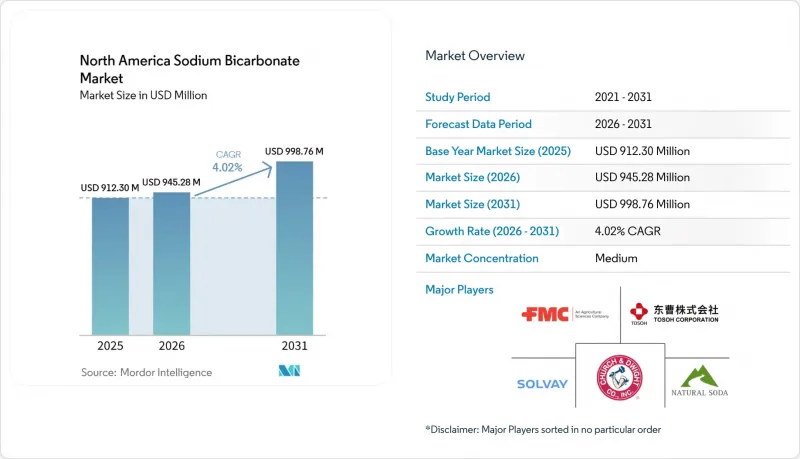
본 보고서는 등급(의약품 등급, 식품 등급, 공업용 등급, 사료용 등급), 형태(분말, 액체, 결정, 펠릿), 용도(식품 및 음료, 의약품, 동물사료, 수처리, 공업용, 기타), 지역(미국, 캐나다, 멕시코, 기타 북미 국가)별로 분류되어 있습니다. 시장 전망은 금액(달러) 기준으로 제시되어 있습니다.
북미의 중탄산나트륨 시장 동향과 인사이트
식품 및 음료 업계의 활발한 수요
식품 및 음료 부문은 북미의 중탄산나트륨 시장에서 여전히 가장 큰 수요 기반을 차지하고 있지만, 그 수요 구성은 더 높은 순도와 더 엄격한 사양이 요구되는 제품으로 점차 전환되고 있습니다. 식품 제조업체들은 제빵 제품, 유제품 및 포장 식품의 배합에 계속해서 탄산수소나트륨을 사용하고 있으며, 배합 담당자들이 이미 그 기능성과 취급 특성을 잘 알고 있기 때문에 이 원료는 확고한 입지를 유지하고 있습니다. 북미의 중탄산나트륨 시장은 관련 소비자용 제품에 대한 수요로부터도 혜택을 받고 있습니다. 처치 앤 드와이트(Church & Dwight)사가 베이킹소다를 10배 더 많이 배합한 ‘ARM and HAMMER Fresh’ 세탁 세제를 2026년에 출시하겠다고 발표한 것은 베이킹소다에 대한 기존의 인지도에 기반하여 제품 개발이 상업적 활용의 폭을 지속적으로 넓혀가고 있음을 보여줍니다. 또한, 처치 앤 드와이트(Church & Dwight)사는 탄산수소나트륨 사업과 동물 영양 사업이 2025년 실적에 크게 기여했다고 보고했는데, 이는 수요가 특정 좁은 식품 하위 부문에만 국한되지 않는다는 관점을 뒷받침합니다. FDA 승인과 확립된 식품 용도는 북미의 중탄산나트륨 시장을 지속적으로 뒷받침하고 있으며, 각 제조업체들은 ‘클린 라벨’ 재처방에 적합한 친숙한 원료를 찾고 있습니다. 따라서 가치 창출의 초점은 단순히 판매량 증가뿐만 아니라, 식품 규격을 준수하는 등급의 안정적인 공급에 맞추어져 있습니다.
산업용 배기가스 제어 분야에서 배기가스 처리 기술 채택 확대
산업용 배기가스 제어는 북미의 중탄산나트륨 시장에 지속적인 수요층을 더하고 있습니다. 이는 많은 시설이 단순한 선호가 아닌 규제 준수의 필요성에 기반하여 구매하고 있기 때문입니다. 미국 환경보호청(EPA)은 여러 산업 배출원을 아우르는 산성 가스 및 관련 배출물을 규제하는 연소·소각 규정을 통해 이 용도의 형성을 지속하고 있습니다. 이러한 규제 체계는 특히 사업자가 강력한 산성 가스 제거 능력과 관리 가능한 잔류물량, 그리고 신뢰할 수 있는 재료 처리를 필요로 하는 상황에서 건식 흡착제 주입에 대한 수요를 뒷받침하고 있습니다. 또한, 북미의 탄산수소나트륨 시장은 산업용 등급공급이 다른 최종 용도에 공급되는 것과 동일한 지역 생산 거점에 의해 뒷받침되고 있다는 점에서도 혜택을 받고 있습니다. 이를 통해 규제 준수 일정이 엄격해질 때에도 조달상의 마찰을 줄일 수 있습니다. 이는 배기가스 규제 대책에 대한 구매 패턴이 공장 개보수나 업그레이드에 따라 파도처럼 변동하는 경우가 많으며, 인근에 공급원이 있어 대응 체계를 갖출 수 있다는 점에서 중요한 의미를 지닙니다. 그 결과, 산업용 수요의 존재로 인해 북미의 탄산수소나트륨 시장은 식품 및 의료 분야 수요량에만 의존하지 않는 보다 균형 잡힌 수요 구성을 실현하고 있습니다.
소다회 가격 변동과 에너지 집약적 전환의 경제성
트로나 공급이 풍부한 상황이라 하더라도, 탄산수소나트륨 생산은 여전히 소다회 확보 가능성과 가공 비용에 좌우되기 때문에 북미의 탄산수소나트륨 시장은 원료 및 제조 비용의 변동 위험에 노출되어 있습니다. 완전 통합형 생산자는 보다 명확한 완충 능력을 보유하고 있지만, 구매 원료에 대한 의존도가 높은 사업자는 조달 상황의 변화에 더 큰 영향을 받기 쉬운 상태입니다. 북미의 탄산수소나트륨 시장에서 이러한 차이는 대규모 업스트림 부문과 연계된 공급업체와 소규모 제조에 특화된 사업자 간의 실적 격차를 확대시킬 가능성이 있습니다. 또한, 비용 변동은 하류 부문의 가격 책정을 복잡하게 만듭니다. 식품, 의약품, 산업 분야의 구매자들이 비용 상승분을 반드시 같은 속도로 흡수하는 것은 아니기 때문입니다. 이러한 압박은 탄산수소나트륨이 더 단순한 대체품과 경쟁하는 용도에서 더욱 두드러집니다. 그 결과, 전환의 경제성은 통합도가 낮은 사업자가 어느 정도의 속도로 규모를 확대할 수 있는지에 있어 여전히 현실적인 제약 요인으로 작용하고 있습니다.
부문 분석
2025년, 식품용 등급은 북미의 중탄산나트륨 시장 점유율의 42.56%를 차지하며, 해당 지역에서 가장 큰 등급으로서의 지위를 유지했습니다. 이러한 주도적 지위는 탄산수소나트륨이 제빵, 유제품, 가공식품 제조 분야에서 폭넓게 활용되고 있음을 반영합니다. 북미의 탄산수소나트륨 시장은 산업용 등급 및 사료용 등급으로부터도 꾸준한 지지를 얻고 있으며, 산업용 등급은 배기가스 규제 및 수처리와 관련이 있고, 사료용 등급은 유제품 및 쇠고기의 영양 관리와 관련이 있습니다. 이러한 구성은 특정 최종 시장에 대한 의존도를 낮추어 북미의 중탄산나트륨 시장의 등급 구성이 균형을 유지하는 데 기여하고 있습니다. 또한 이는 식품용 등급의 주도적 지위가 판매량의 규모와 폭넓은 고객 기반 모두에 의해 뒷받침되고 있음을 의미합니다.
의약품 등급은 2031년까지 연평균 성장률(CAGR) 5.02%를 나타낼 것으로 예측되며, 북미의 중탄산나트륨 시장에서 가장 빠르게 확대되고 있는 등급이 될 것입니다. 이러한 성장은 혈액 투석용 농축액 수요 및 제산제 관련 용도에 기인하며, 이 두 가지 모두 미국의 신장 질환 환자 수 증가의 혜택을 받고 있습니다. 따라서 북미의 중탄산나트륨 업계에서는 판매량 기준 최대 등급과 매출액 기준 가장 빠르게 성장하는 등급 사이에 뚜렷한 양극화가 나타나고 있습니다. 이러한 차이가 중요한 이유는 의약품용 공급이 단순한 대량 생산 규모보다 문서화, 순도 보증 및 검증된 시스템에 크게 의존하기 때문입니다. 북미의 중탄산나트륨 시장에서 이미 이러한 기준을 충족하는 공급업체는 단기간 내에 따라잡기 어려운 우위를 점하고 있습니다.
기타 혜택 :
- 엑셀 형식 시장 예측(ME) 시트
- 3개월간의 애널리스트 지원
자주 묻는 질문
목차
제1장 서론
제2장 조사 방법
제3장 주요 요약
제4장 시장 구도
제5장 시장 규모 및 성장 예측
제6장 경쟁 구도
제7장 시장 기회 및 향후 전망
KTH 26.08.10According to Mordor Intelligence, the North America sodium bicarbonate market size is projected to expand from USD 912.30 million in 2025 and USD 945.28 million in 2026 to USD 1.15 billion by 2031, registering a CAGR of 4.02% from 2026 to 2031.
This report is Segmented by Grade (Pharma Grade, Food Grade, Industrial Grade, and Feed Grade), Form (Powder, Liquid, Crystal, and Pellets), Application (Food and Beverages, Pharmaceuticals, Animal Feed, Water Treatment, Industrial, and Others), and Geography (United States, Canada, Mexico, and Rest of North America). The Market Forecasts are Provided in Terms of Value (USD).
North America Sodium Bicarbonate Market Trends and Insights
Strong Demand From The Food And Beverage Industry
The food and beverage sector remains the largest base of demand for the North America sodium bicarbonate market, but the composition of that demand is shifting toward higher purity and more tightly specified supply. Food manufacturers continue to use sodium bicarbonate across bakery, dairy, and packaged food formulations, and the material keeps a strong position because formulators already know its functionality and handling profile. The North America sodium bicarbonate market is also benefiting from adjacent consumer product demand, as Church and Dwight announced the 2026 launch of ARM and HAMMER Fresh Laundry Detergent with 10x more baking soda, which shows how product development continues to widen commercial use around established baking soda familiarity. Church and Dwight also reported that sodium bicarbonate and animal nutrition businesses were key contributors to its 2025 performance, which supports the view that demand is not limited to one narrow food subsegment. FDA acceptance and established food use continue to support the North America sodium bicarbonate market, where manufacturers want familiar ingredients that fit clean label reformulation paths. That keeps value creation centered less on tonnage growth alone and more on reliable delivery of food compliant grades.
Expanding Flue Gas Treatment Adoption In Industrial Emissions Control
Industrial emissions control is adding a durable demand layer to the North America sodium bicarbonate market because many installations buy on compliance need rather than discretionary preference. The US Environmental Protection Agency continued to shape this application through combustion and incineration rules that govern acid gas and related emissions across multiple industrial sources. That regulatory framework supports dry sorbent injection demand, especially where operators need strong acid gas removal with manageable residue volumes and dependable material handling. The North America sodium bicarbonate market also gains from the fact that industrial-grade supply can be supported by the same regional production base that serves other end uses, which helps reduce procurement friction when compliance schedules tighten. This matters because emissions control buying patterns often move in waves as plants retrofit or upgrade, and the presence of nearby supply improves readiness. As a result, industrial applications give the North America sodium bicarbonate market a more balanced demand mix that does not depend only on food or healthcare volumes.
Soda Ash Price Volatility And Energy Intensive Conversion Economics
Even with strong trona access, the North America sodium bicarbonate market still faces exposure to feedstock and conversion economics because sodium bicarbonate production remains tied to soda ash availability and processing cost. Producers that are fully integrated have a clearer buffer, but participants that rely more on purchased input remain more exposed to shifts in procurement conditions. In the North America sodium bicarbonate market, this difference can widen the performance gap between large upstream linked suppliers and smaller conversion focused operators. Cost swings also complicate downstream pricing because food, pharma, and industrial buyers do not always absorb increases at the same pace. That pressure becomes more pronounced in applications where sodium bicarbonate competes with lower complexity alternatives. As a result, conversion economics remain a practical restraint on how quickly less integrated participants can scale.
Other drivers and restraints analyzed in the detailed report include:
- Higher Consumption In Hemodialysis And Antacid Formulations
- Abundant Natural Soda Ash Resources In The United States
- Increasing Energy, Water, And Utility Expenses In Sodium Bicarbonate Manufacturing
For complete list of drivers and restraints, kindly check the Table Of Contents.
Segment Analysis
Food grade held 42.56% of the North America sodium bicarbonate market share in 2025, which kept it as the largest grade in the region. That leadership reflects broad use across bakery, dairy, and packaged food manufacturing, where sodium bicarbonate remains a standard and familiar functional ingredient. The North America sodium bicarbonate market also continues to draw stable support from industrial and feed grades, with industrial grade tied to emissions control and water treatment and feed grade tied to dairy and beef nutrition. This mix reduces dependence on any one end market and helps the grade structure of the North America sodium bicarbonate market stay balanced. It also means that food grade leadership rests on both volume depth and wide customer reach.
Pharma grade is projected to grow at a 5.02% CAGR through 2031, which makes it the fastest expanding grade in the North America sodium bicarbonate market. Growth is tied to hemodialysis concentrate demand and antacid-related use, both of which benefit from the scale of the United States renal care base. The North America sodium bicarbonate industry therefore shows a clear split between its largest grade by volume and its fastest grade by value-linked growth. That distinction matters because pharma supply depends more on documentation, purity assurance, and validated systems than on bulk scale alone. In the North America sodium bicarbonate market, suppliers that already meet these standards hold an advantage that is difficult to narrow quickly.
Complete Report Scope:
- By Grade
- Pharma Grade
- Food Grade
- Industrial Grade
- Feed Grade
- By Form
- Powder
- Liquid
- Crystal
- Pallets
- By Applications
- Food and Beverages
- Pharmaceuticals
- Animal Feed
- Water Treatment
- Industrial
- Others
- By Geography
- United States
- Canada
- Mexico
- Rest of North America
List of Companies Covered in this Report:
- Solvay Inc.
- Church and Dwight Co., Inc.
- Natural Soda LLC
- Genesis Alkali
- Ciner Resources LP
- Natrium Products, Inc.
- Hawkins, Inc.
- Tosoh Corporation
- Novacap Group
- Tata Chemicals Limited
- CIECH S.A.
- AGC Inc.
- FMC Corporation
- Nirma Limited
- Sisecam
- Jost Chemical Co.
- CF Industries Holdings, Inc.
- GHCL Limited
- Bashkir Soda Company
- Inner Mongolia Yuanxing Energy Co., Ltd.
Additional Benefits:
- The market estimate (ME) sheet in Excel format
- 3 months of analyst support
TABLE OF CONTENTS
1 INTRODUCTION
- 1.1 Study Assumptions and Market Definition
- 1.2 Scope of the Study
2 RESEARCH METHODOLOGY
3 EXECUTIVE SUMMARY
4 MARKET LANDSCAPE
- 4.1 Market Overview
- 4.2 Market Drivers
- 4.2.1 Strong Demand from the Food & Beverage Industry
- 4.2.2 Expanding Flue Gas Treatment Adoption in Industrial Emissions Control
- 4.2.3 Higher Consumption in Hemodialysis and Antacid Formulations
- 4.2.4 Abundant Natural Soda Ash Resources in the United States
- 4.2.5 Growing Demand for Eco-Friendly Cleaning Products
- 4.2.6 Increasing Industrial Research and Development and Product Innovation
- 4.3 Market Restraints
- 4.3.1 Soda Ash Price Volatility and Energy-Intensive Conversion Economics
- 4.3.2 Increasing Energy, Water, and Utility Expenses in Sodium Bicarbonate Manufacturing
- 4.3.3 Competition From Alternative Neutralizing and Sorbent Ingredients
- 4.3.4 Stringent Quality and Traceability Requirements for High-Purity Grades
- 4.4 Supply Chain Outlook
- 4.5 Regulatory Landscape
- 4.6 Technological Outlook
- 4.7 Porter's Five Forces
- 4.7.1 Bargaining Power of Suppliers
- 4.7.2 Bargaining Power of Buyers
- 4.7.3 Threat of New Entrants
- 4.7.4 Threat of Substitutes
- 4.7.5 Competitive Rivalry
5 MARKET SIZE AND GROWTH FORECASTS (VALUE)
- 5.1 By Grade
- 5.1.1 Pharma Grade
- 5.1.2 Food Grade
- 5.1.3 Industrial Grade
- 5.1.4 Feed Grade
- 5.2 By Form
- 5.2.1 Powder
- 5.2.2 Liquid
- 5.2.3 Crystal
- 5.2.4 Pallets
- 5.3 By Applications
- 5.3.1 Food and Beverages
- 5.3.2 Pharmaceuticals
- 5.3.3 Animal Feed
- 5.3.4 Water Treatment
- 5.3.5 Industrial
- 5.3.6 Others
- 5.4 By Geography
- 5.4.1 United States
- 5.4.2 Canada
- 5.4.3 Mexico
- 5.4.4 Rest of North America
6 COMPETITIVE LANDSCAPE
- 6.1 Market Concentration
- 6.2 Strategic Moves
- 6.3 Market Ranking Analysis
- 6.4 Company Profiles (Includes Global-level Overview, Market-level Overview, Core Segments, Financials, Strategic Info, Market Rank/Share, Products & Services, Recent Developments)
- 6.4.1 Solvay Inc.
- 6.4.2 Church and Dwight Co., Inc.
- 6.4.3 Natural Soda LLC
- 6.4.4 Genesis Alkali
- 6.4.5 Ciner Resources LP
- 6.4.6 Natrium Products, Inc.
- 6.4.7 Hawkins, Inc.
- 6.4.8 Tosoh Corporation
- 6.4.9 Novacap Group
- 6.4.10 Tata Chemicals Limited
- 6.4.11 CIECH S.A.
- 6.4.12 AGC Inc.
- 6.4.13 FMC Corporation
- 6.4.14 Nirma Limited
- 6.4.15 Sisecam
- 6.4.16 Jost Chemical Co.
- 6.4.17 CF Industries Holdings, Inc.
- 6.4.18 GHCL Limited
- 6.4.19 Bashkir Soda Company
- 6.4.20 Inner Mongolia Yuanxing Energy Co., Ltd.


