

|
시장보고서
상품코드
2097460
독일의 폐기물 유래 재생 가스 시장 : 시장 점유율 분석, 업계 동향 및 통계, 성장 예측(2026-2031년)Germany Renewable Gas From Waste - Market Share Analysis, Industry Trends & Statistics, Growth Forecasts (2026 - 2031) |
||||||
 Mordor Intelligence
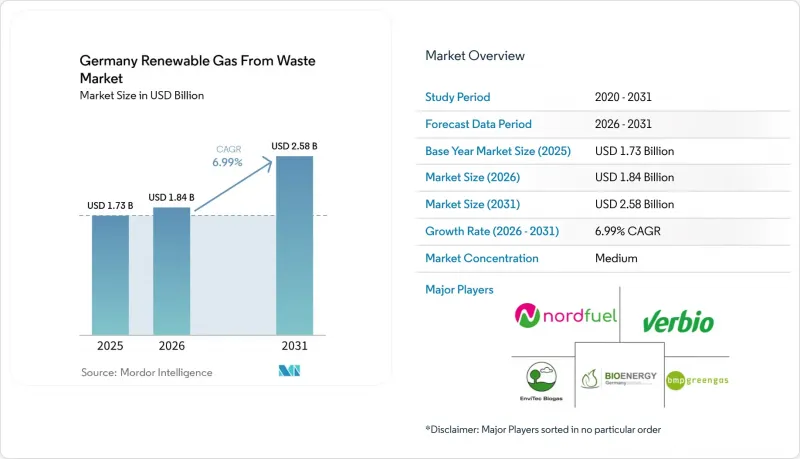
Mordor Intelligence에 의하면, 독일의 폐기물 유래 재생 가스 시장 규모는 2025년 17억 3,000만 달러로 평가되었고, 2026년에는 18억 4,000만 달러로 확대될 것으로 추정되고, 2031년까지 25억 8,000만 달러에 이를 것으로 예상되며, 2026-2031년 CAGR 6.99%로 성장할 전망입니다.
본 보고서는 원료별(도시 고형 폐기물, 식품 폐기물 등), 기술별(혐기성 소화, 가스화, 열분해 등), 가스 유형별(바이오가스, 합성가스 등), 용도별(발전, 계통 연계 등), 구성 요소별(가스 회수, 소화조 및 발효 등)로 분류되어 있습니다. 시장 예측은 금액(달러) 기준으로 제시되어 있습니다.
독일의 폐기물 유래 재생 가능 가스 시장 동향 및 인사이트
EEG(재생에너지법)의 고정 가격 임베디드 제도 종료에 따라, 바이오가스 차량이 바이오메탄으로 전환을 추진하며 송전망 공급으로 이행하고 있습니다.
독일의 20년에 걸친 EEG 지원 체계는 2000-2012년 바이오가스 시설 건설의 대규모 붐을 뒷받침했으나, 바로 그 건설 주기가 현재 독일의 폐기물 유래 재생 가능 가스 시장에서 개조 수요를 형성하고 있습니다. 초기 확장 단계에서 가동을 시작한 플랜트는 2025-2028년 단계적으로 고정가격 임베디드 제도의 지원을 잃게 되며, 사업자에게는 발전만 하던 것에서 바이오메탄 생산으로의 전환이 직접적인 인센티브가 되고 있습니다. 많은 소유주에게 설비 업그레이드와 계통 연계는 자산의 가동을 유지하기 위한 가장 확실한 수단이 되고 있습니다. 이는 운송용 연료 수요, 가스 시장에서의 판매, 그리고 ‘건축물 에너지법’에 따른 미래 난방 수요에 대한 접근을 가능하게 하기 때문입니다. 따라서 독일의 폐기물 유래 재생 가능 가스 시장에서 유닛, 가스 정화 시스템 및 연결 인프라에 대한 투자는 단순한 선택적 현대화가 아니라, 수익 보호 조치의 만료에 대응하기 위한 조치인 것입니다. EnviTec사는 자사의 ‘EnviThan’ 업그레이드 라인에 대해, 슐레스비히-홀슈타인주 및 브란덴부르크주의 시설과 관련된 계약 업무를 포함하여 EEG 전환 프로젝트에서의 수요가 증가하고 있다고 밝혔습니다. 또한 FNR도 EEG 제도에서 탈퇴하는 플랜트를 대상으로 한 기술적·재정적 지침을 통해 바이오메탄 전환 과정을 지속적으로 지원하고 있습니다.
온실가스(GHG) 할당제가 운송용 연료 분야의 바이오메탄 수요를 3배로 끌어올릴 전망
온실가스(GHG) 할당제는 연료 유통업체에 저탄소 가스 연료를 구매해야 할 직접적인 규정 준수 이유를 제공함으로써, 독일의 폐기물 유래 재생 가능 가스 시장에서 가장 강력한 수요 견인 요인 중 하나가 되고 있습니다. 독일은 2040년까지 목표를 59%로 상향 조정하는 개정 할당 경로를 승인함으로써, 바이오메탄 생산자들에게 운송 수요에 관한 보다 명확한 정책 전망을 제공했습니다. 바이오메탄은 이 제도에서 부가가치를 창출합니다. 폐기물 유래 가스는 ‘선진 바이오연료’ 범주에 해당하기 때문에 배출 감축 1톤당 더 높은 탈탄소 가치가 인정되기 때문입니다. 유럽연합(EU)에 따르면, 운송 부문의 바이오메탄 수요는 2018년부터 2023년 사이에 3배로 증가하여 10TWh에 육박했습니다. 또한 규제 요건이 강화됨에 따라 전년 대비 최대 10%의 성장세를 이어가고 있습니다. 2026년부터 이중 산정이 폐지됨에 따라 검증 가능한 국내 폐기물 유래 공급의 입지가 개선될 것이며, 이를 통해 독일 폐기물 유래 재생 가능 가스 시장에서 진정한 생산자의 가격 형성이 강화될 전망입니다. 선진 바이오연료의 할당 비율은 2026년 2%에서 2040년까지 8%로 상향 조정될 예정이며, 이에 따라 운송 부문은 계속해서 폐기물 유래 재생 가능 가스의 장기적인 판로로 자리매김하게 될 것입니다.
GasNZV 송전망 접근 규정의 만료가 장기적인 투자 불확실성을 야기하고 있습니다.
2025년 말 GasNZV의 만료는 독일의 폐기물 유래 재생 가능 가스 시장에서 가장 명백한 단기적인 정책 공백을 초래했습니다. 이전 체계에서는 개발업자에게 명확한 접속권, 비용 분담 규칙 및 수용 의무가 규정되어 있었으며, 이는 자산 수명 전반에 걸친 시스템 개조 및 주입 프로젝트에 대한 자금 조달을 뒷받침해 왔습니다. 업계 단체는 이에 상응하는 명확한 후속 제도가 없는 상태에서 보다 광범위한 EnWG 체계로 회귀하게 되면, 투자의 확실성이 훼손되고 신규 프로젝트의 접속 위험이 높아질 것이라고 경고했습니다. EnWG 제118조 제4항에 따른 경과 조치에 따라, 2026년 12월 31일까지 선납금을 납부한 프로젝트는 여전히 보호받고 있지만, 그 기한 이후에 시작되는 프로젝트의 불확실성은 완전히 해소되지 않았습니다. 이 때문에 법적 틀이 명확해질 때까지 신규 프로젝트의 착수가 주춤하는 반면, 기존 프로젝트는 빠른 속도로 추진되고 있어 단기적인 파이프라인이 축소되고 있습니다. 따라서 독일의 폐기물 유래 재생 가능 가스 시장에는 여전히 수요에 의한 지지세가 있습니다. 하지만 계통 연계의 확실성이 수요 증가를 따라가지 못하고 있어, 발전 용량 증설 시기는 점점 더 불균일해지고 있습니다.
부문 분석
2025년 독일의 폐기물 유래 재생 가능 가스 시장에서 농업 잔여물은 원료 기준 29.4%를 차지하며 최대 원료원이 되었습니다. 이러한 우위는 EEG(재생에너지법)의 지원 하에 오랫동안 농장 규모의 바이오가스 시설이 구축되어 온 점, 그리고 안정적인 원료 공급이 가능한 복합 농업 지역이 널리 존재한다는 점을 반영합니다. 2024년 12월에 최종 개정된 비료 조례에서는 가축 분뇨에서 유래한 유기질 질소의 시비 상한선을 연간 170kg(총질소)/ha로 유지하고 있으며, 이로 인해 대규모 농장에서 실용적인 폐기물 관리 기법으로서 소화 처리의 지속적인 활용이 촉진되고 있습니다. 또한, EU의 메탄 프레임워크에 따라 축산 관련 에너지 사업에 대한 감시 요건이 강화됨에 따라, 가축 분뇨는 독일의 폐기물 유래 재생 가능 가스 산업에서 더욱 명확한 역할을 담당하게 되었습니다.
식품 폐기물은 2031년까지 연평균 성장률(CAGR) 7.2%로 증가할 것으로 예측되며, 독일의 폐기물 유래 재생 가능 가스 시장에서 가장 빠르게 성장하는 원료가 될 전망입니다. 이러한 성장 추세는 EU의 음식물 쓰레기 분리 수거 의무화에 힘입은 것으로, 이로 인해 2024년 이후 지자체 및 상업시설에서 확보되는 유기물 공급원이 확대되었습니다. 식품 가공 잔여물, 소매업에서 발생하는 유기물, 도시 지역의 식품 폐기물은 그 양이 집중되어 있고 메탄 수율도 대부분의 경우 매력적이기 때문에 농업 폐기물과는 다른 성장 패턴을 보이고 있습니다. 양조장, 유제품 공장, 식품 공장에서 발생하는 산업용 유기 폐기물은 안정적인 수거 체계와 예측 가능한 성분을 갖추고 있어 그 매력이 높아지고 있습니다. 하수 슬러지와 매립 가스는 여전히 확립된 원료이지만, RED III에 따른 더욱 엄격한 지속가능성 규제로 인해 장기적인 원료 구성에 대한 기여도가 제한될 가능성이 있습니다. 전반적으로 농업 잔여물이 여전히 현재의 주축을 이루고 있지만, 독일의 폐기물 유래 재생 가능 가스 시장은 어떤 단일 원료에 대한 의존도도 점차 낮아지고 있습니다.
2025년, 독일의 폐기물 유래 재생 가능 가스 시장에서 혐기성 소화는 46.3%를 차지하며 주요 기술로서의 입지를 공고히 했습니다. 이러한 주도적 지위는 EEG(재생에너지법) 시대에 구축된 대규모 설비군에서 비롯된 것으로, 당시 혐기성 소화는 농업 폐기물 및 혼합 유기 폐기물의 주요 전환 경로로 기능했습니다. 단기적인 생산 능력의 대부분은 기존 설비의 확장, 개보수 또는 최적화를 통해 창출되므로, 기존 설비 기반은 여전히 중요한 역할을 하고 있습니다. 동시에, 바이오가스 정제 시스템은 2031년까지 연평균 성장률(CAGR) 7.7%를 나타낼 것으로 예측되며, 이는 독일의 폐기물 유래 재생 가능 가스 시장에서 기술 카테고리 중 가장 빠른 성장률입니다. 이러한 급속한 성장은 EEG의 종료 주기와 직접적인 관련이 있습니다. 발전만 수행하는 방식에서 전환하는 플랜트는 송전망 품질의 가스 기준을 충족하기 위해 설비 업그레이드가 필요하기 때문입니다.
EnviTec사의 2025년 및 2026년 모듈형 ‘EnviThan’ 압력 스윙 흡착 장치 수주 동향을 살펴보면, 개조 열풍이 확산됨에 따라 신규 고객들이 정제 분야에 진입하고 있음을 알 수 있습니다. 매립지 가스 회수, 가스화, 열분해는 여전히 규모는 작지만, 기존의 농업이나 지자체에 의한 소화 처리를 기반으로 하는 범위를 넘어 원료의 유연성을 확대하기 위해 주목받고 있습니다. 이는 독일의 폐기물 유래 재생 가능 가스 산업에서 중요한 의미를 지닙니다. 산업 폐기물 발생 사업자나 지방자치단체가 보다 다양한 물질 흐름에 대응할 수 있는 방안을 모색하고 있기 때문입니다. 개정된 ‘산업 배출 지침’ 또한 대규모 축산 시설에서의 농업 관련 혐기성 소화 투자를 뒷받침할 전망이며, 다른 기술이 발전하는 와중에도 이 핵심 기술이 의미 있는 규모를 유지하는 데 기여할 것입니다. 그 결과로 예상되는 것은 소화 기술이 급속히 대체되는 것이 아니라, 업그레이드가 성장을 주도하는 한편 소화 기술이 시장 도입 규모의 중심을 유지하는 보다 다층적인 기술 조합입니다.
기타 혜택 :
- 엑셀 형식 시장 예측(ME) 시트
- 3개월간의 애널리스트 지원
자주 묻는 질문
목차
제1장 서론
제2장 조사 방법
제3장 주요 요약
제4장 시장 구도
제5장 시장 규모 및 성장 예측
제6장 경쟁 구도
제7장 시장 기회 및 향후 전망
AJY 26.08.07According to Mordor Intelligence, the Germany renewable gas from waste market size is expected to increase from USD 1.73 billion in 2025 to USD 1.84 billion in 2026 and reach USD 2.58 billion by 2031, growing at a CAGR of 6.99% over 2026-2031.
This report is Segmented by Feedstock (Municipal Solid Waste, Food Waste, and More), by Technology (Anaerobic Digestion, Gasification, Pyrolysis, and More), by Gas Type (Biogas, Syngas, and More), by Application (Electricity Generation, Grid Injection, and More), and by Component (Gas Collection, Digesters & Fermentation, and More). The Market Forecasts are Provided in Terms of Value (USD).
Germany Renewable Gas From Waste Market Trends and Insights
EEG Tariff Expiry Converting Biogas Fleet Toward Biomethane Grid Injection
Germany's 20-year EEG support framework backed a large wave of biogas construction between 2000 and 2012, and that same build cycle is now shaping retrofit demand in Germany renewable gas from waste market. Plants commissioned during the earlier expansion phase are losing fixed-tariff support in successive waves between 2025 and 2028, leaving operators with a direct incentive to shift from power-only generation to biomethane production. For many owners, upgrading and grid injection have become the clearest way to keep assets operating because they open access to transport fuel demand, gas market sales, and future heating demand under the Buildings Energy Act. That is why spending on upgrading units, gas-cleaning systems, and connection infrastructure is not simply optional modernization in the Germany renewable gas from waste market, but a response to expiring revenue protection. EnviTec stated that its EnviThan upgrading line was seeing stronger demand from EEG conversion projects, including contracted work linked to Schleswig-Holstein and Brandenburg sites. FNR also continued to support the biomethane conversion pathway through technical and funding guidance aimed at plants leaving the EEG regime.
GHG Quota System Driving Tripled Biomethane Demand in Transport Fuels
The GHG quota regime has become one of the strongest demand anchors for the Germany renewable gas from waste market because it gives fuel distributors a direct compliance reason to buy low-carbon gaseous fuels. Germany approved a revised quota pathway that raised the target to 59% by 2040, providing biomethane producers with a clearer policy horizon for transport demand. Biomethane adds extra value within that system because waste-based gas qualifies under the advanced biofuels framework and therefore earns stronger decarbonization value per tonne of avoided emissions. Demand for biomethane in transport tripled between 2018 and 2023, reaching close to 10TWh, and continued rising by as much as 10% year over year as compliance requirements tightened, according to the European Union (EU). The upcoming removal of double-counting from 2026 should improve the position of verifiable domestic waste-based supply, thereby strengthening price formation for genuine producers in the German renewable gas-from-waste market. The advanced biofuels sub-quota is due to rise from 2% in 2026 to 8% by 2040, keeping transport as a long-term outlet for renewable gas from waste.
Expiry of GasNZV Grid Access Regulation Creating Long-Term Investment Uncertainty
The expiry of GasNZV at the end of 2025 created the clearest near-term policy gap in Germany renewable gas from waste market. The earlier framework gave developers explicit connection rights, cost-sharing rules, and acceptance obligations, which supported financing for upgrading systems and injection projects over long asset lives. Industry groups warned that reverting to the broader EnWG framework without an equally clear successor would weaken investment certainty and increase connection risk for new projects. A transitional clause under Section 118(4) EnWG still protects projects that submit advance payments by December 31, 2026, but it does not fully solve the visibility problem for projects launched after that window. This has compressed the near-term pipeline, as existing projects are being rushed forward while new project origination is slowing until the legal framework becomes clearer. The Germany renewable gas from waste market, therefore, still has demand support. Still, the timing of capacity additions is becoming more uneven because grid access certainty is not keeping pace with demand growth.
Other drivers and restraints analyzed in the detailed report include:
- Buildings Energy Act Creating a Large New Biomethane Demand in the Heating Sector
- Rising European Union ETS Carbon Prices Narrowing the Biomethane-to-Fossil-Gas Cost Gap
- High Capital Expenditure and Aging Biogas Infrastructure Increasing Modernization Challenges
For complete list of drivers and restraints, kindly check the Table Of Contents.
Segment Analysis
Agricultural residues accounted for 29.4% of the feedstock base in the Germany renewable gas from waste market in 2025, making them the largest feedstock base. That lead reflects the country's long-term build-out of farm-scale biogas under EEG support and the strong presence of mixed-farming regions with steady substrate availability. The fertilizer ordinance, last amended in December 2024, keeps the cap on organic nitrogen application from livestock manure at 170kg total N/ha/year, which supports continued use of digestion as a practical waste management route for larger farms. Animal manure is also gaining a clearer role in the German renewable gas from waste industry because the EU methane framework has tightened monitoring requirements for livestock-linked energy operations.
Food waste is projected to grow at a 7.2% CAGR through 2031, making it the fastest-growing feedstock in the German renewable gas-from-waste market. The growth path is supported by the EU requirement for separate biowaste collection, which widened the available pipeline of municipal and commercial organic material from 2024 onward. Food processing residues, retail organics, and urban food waste offer a different growth profile from farm waste because volumes are concentrated and methane yields are often attractive. Industrial organic waste from breweries, dairies, and food plants is increasingly attractive because it offers reliable off-take structures and a predictable composition. Sewage sludge and landfill gas remain established inputs, but tighter sustainability rules under RED III may limit their contribution to the long-run mix. The broader effect is that the Germany renewable gas from waste market is becoming less dependent on any single feedstock, even though agricultural residues remain the current anchor.
Anaerobic digestion accounted for 46.3% of Germany renewable gas from waste market in 2025, confirming its position as the dominant technology. That leadership comes from the large installed fleet built under the EEG era, where digestion served as the core conversion route for agricultural and mixed organic waste. The installed base still matters because most near-term capacity comes from extending, retrofitting, or optimizing existing assets. At the same time, biogas upgrading systems are forecast to grow at a 7.7% CAGR through 2031, the fastest among the technology categories in the German renewable gas-from-waste market. This faster growth is directly tied to the EEG exit cycle, since plants moving away from power-only generation need to upgrade their equipment to meet grid-quality gas standards.
EnviTec's contract flow for modular EnviThan pressure swing adsorption units in 2025 and 2026 showed that first-time customers are entering the upgrading space as the retrofit wave expands. Landfill gas recovery, gasification, and pyrolysis are still smaller, but they are gaining attention because they widen feedstock flexibility beyond the traditional farm and municipal digestion base. This matters in the German renewable gas from waste industry because industrial waste generators and local authorities are looking for routes that can handle more varied material streams. The revised Industrial Emissions Directive is also likely to support more farm-linked anaerobic digestion investment at larger livestock sites, helping the core technology maintain meaningful scale even as other routes develop. The likely outcome is not a quick replacement of digestion, but a more layered technology mix where upgrading captures growth while digestion holds the installed-volume center of the market.
Complete Report Scope:
- By Feedstock
- Municipal Solid Waste (MSW)
- Agricultural Residues
- Animal Manure
- Industrial Organic Waste
- Sewage Sludge
- Food Waste
- Others
- By Technology
- Anaerobic Digestion
- Landfill Gas Recovery
- Gasification
- Pyrolysis
- Biogas Upgrading Systems
- Others
- By Gas Type
- Biogas
- Biomethane / Renewable Natural Gas (RNG)
- Syngas
- By Application
- Electricity Generation
- Combined Heat & Power (CHP)
- Grid Injection
- Transportation Fuel
- Industrial Heating
- Residential & Commercial Heating
- Others
- By Component
- Gas Collection Systems
- Digesters & Fermentation Systems
- Gas Processing & Upgrading Units
- Compressors & Storage Systems
- Power Generation Equipment
- Monitoring & Control Systems
- Others
List of Companies Covered in this Report:
- EnviTec Biogas AG
- Verbio SE
- bmp greengas GmbH
- Nordfuel GmbH
- BioEnergie Tauberfranken GmbH & Co. KG
- Loick Bioenergie GmbH
- Arcus Greencycling Technologies GmbH
- Landwarme GmbH
- Viessmann BioEnergy GmbH
- REVIS Bioenergy GmbH
- TURN2X GmbH
- BioConstruct GmbH
- Agrikomp GmbH
- PlanET Biogas Group GmbH
- Weltec Biopower GmbH
- BALANCE Erneuerbare Energien GmbH
- Schmack Biogas GmbH
- Krieg & Fischer Ingenieure GmbH
- NAWARO BioEnergie AG
- Erdgas Sudwest Bio-LNG GmbH
Additional Benefits:
- The market estimate (ME) sheet in Excel format
- 3 months of analyst support
TABLE OF CONTENTS
1 Introduction
- 1.1 Study Assumptions & Market Definition
- 1.2 Scope of the Study
2 Research Methodology
3 Executive Summary
4 Market Landscape
- 4.1 Market Overview
- 4.2 Market Drivers
- 4.2.1 EEG Tariff Expiry Converting Biogas Fleet Toward Biomethane Grid Injection
- 4.2.2 GHG Quota System Driving Tripled Biomethane Demand in Transport Fuels
- 4.2.3 Buildings Energy Act Creating a Large New Biomethane Demand in the Heating Sector
- 4.2.4 Rising European Union ETS Carbon Prices Narrowing the Biomethane-to-Fossil-Gas Cost Gap
- 4.2.5 European Union Methane Regulation and Fertilizer Ordinance Pushing Livestock Farms Toward Biogas
- 4.2.6 REPowerEU Mandate Requiring Germany's Proportional Biomethane Scale-Up Contribution
- 4.3 Market Restraints
- 4.3.1 Expiry of GasNZV Grid Access Regulation Creating Long-Term Investment Uncertainty
- 4.3.2 High Capital Expenditure and Aging Biogas Infrastructure Increasing Modernization Challenges
- 4.3.3 Lack of Gas Grid Access for Remote Biogas Plants Constraining Biomethane Conversion
- 4.3.4 Declining Wholesale Electricity Prices and Ineffective EEG Tendering Reducing Revenue Diversification
- 4.4 Value / Supply-Chain Analysis
- 4.5 Regulatory Landscape
- 4.6 Technological Outlook
- 4.7 Porter's Five Forces
- 4.7.1 Threat of New Entrants
- 4.7.2 Bargaining Power of Suppliers
- 4.7.3 Bargaining Power of Buyers
- 4.7.4 Threat of Substitutes
- 4.7.5 Industry Rivalry
- 4.8 Digital Feedstock Management and Process Optimization Improving Renewable Gas Plant Efficienc
- 4.9 Organic Waste Diversion and Segregation Policies Supporting Feedstock Supply Growth
- 4.10 Impact of Geopolitical Events on the Market
5 Market Size & Growth Forecasts
- 5.1 By Feedstock
- 5.1.1 Municipal Solid Waste (MSW)
- 5.1.2 Agricultural Residues
- 5.1.3 Animal Manure
- 5.1.4 Industrial Organic Waste
- 5.1.5 Sewage Sludge
- 5.1.6 Food Waste
- 5.1.7 Others
- 5.2 By Technology
- 5.2.1 Anaerobic Digestion
- 5.2.2 Landfill Gas Recovery
- 5.2.3 Gasification
- 5.2.4 Pyrolysis
- 5.2.5 Biogas Upgrading Systems
- 5.2.6 Others
- 5.3 By Gas Type
- 5.3.1 Biogas
- 5.3.2 Biomethane / Renewable Natural Gas (RNG)
- 5.3.3 Syngas
- 5.4 By Application
- 5.4.1 Electricity Generation
- 5.4.2 Combined Heat & Power (CHP)
- 5.4.3 Grid Injection
- 5.4.4 Transportation Fuel
- 5.4.5 Industrial Heating
- 5.4.6 Residential & Commercial Heating
- 5.4.7 Others
- 5.5 By Component
- 5.5.1 Gas Collection Systems
- 5.5.2 Digesters & Fermentation Systems
- 5.5.3 Gas Processing & Upgrading Units
- 5.5.4 Compressors & Storage Systems
- 5.5.5 Power Generation Equipment
- 5.5.6 Monitoring & Control Systems
- 5.5.7 Others
6 Competitive Landscape
- 6.1 Market Concentration
- 6.2 Strategic Moves
- 6.3 Market Share Analysis
- 6.4 Company Profiles (Includes Global Level Overview, Market Level Overview, Core Segments, Financials as Available, Strategic Information, Products & Services, and Recent Developments)
- 6.4.1 EnviTec Biogas AG
- 6.4.2 Verbio SE
- 6.4.3 bmp greengas GmbH
- 6.4.4 Nordfuel GmbH
- 6.4.5 BioEnergie Tauberfranken GmbH & Co. KG
- 6.4.6 Loick Bioenergie GmbH
- 6.4.7 Arcus Greencycling Technologies GmbH
- 6.4.8 Landwarme GmbH
- 6.4.9 Viessmann BioEnergy GmbH
- 6.4.10 REVIS Bioenergy GmbH
- 6.4.11 TURN2X GmbH
- 6.4.12 BioConstruct GmbH
- 6.4.13 Agrikomp GmbH
- 6.4.14 PlanET Biogas Group GmbH
- 6.4.15 Weltec Biopower GmbH
- 6.4.16 BALANCE Erneuerbare Energien GmbH
- 6.4.17 Schmack Biogas GmbH
- 6.4.18 Krieg & Fischer Ingenieure GmbH
- 6.4.19 NAWARO BioEnergie AG
- 6.4.20 Erdgas Sudwest Bio-LNG GmbH
7 Market Opportunities & Future Outlook
- 7.1 White-Space & Unmet-Need Assessment


