

|
시장보고서
상품코드
2097464
AI 활용 외관 검사 시장 : 시장 점유율 분석, 업계 동향 및 통계, 성장 예측(2026-2031년)AI-powered Visual Inspection - Market Share Analysis, Industry Trends & Statistics, Growth Forecasts (2026 - 2031) |
||||||
 Mordor Intelligence
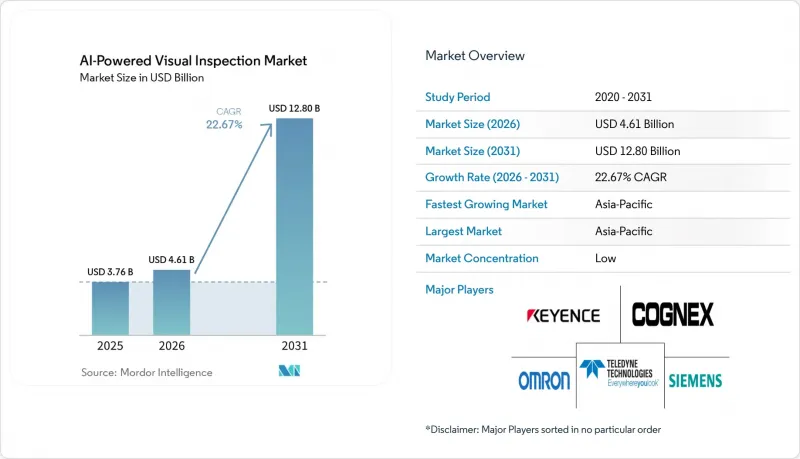
Mordor Intelligence에 의하면, AI 활용 외관 검사 시장 규모는 2025년 37억 6,000만 달러로 평가되었고, 2026년에는 46억 1,000만 달러로 확대될 것으로 추정되고, 2026-2031년 CAGR 22.67%로 성장을 지속할 전망이며, 2031년에는 128억 달러에 이를 것으로 예측됩니다.
본 보고서는 상용 폼 팩터별(통합형 AI 비전 시스템, 독립형 AI 소프트웨어, AI 비전 플랫폼 및 API 등), 배포 아키텍처별(엣지 및 임베디드형 AI,온프레미스형 서버 및 워크스테이션, 클라우드 및 SaaS, 하이브리드), 최종 사용자 산업별(전자 및 반도체, 전기차 및 배터리 제조 등)로 분류되어 있습니다. 시장 전망은 금액(달러) 기준으로 제시되어 있습니다.
세계의 AI 활용 외관 검사 시장 동향 및 인사이트
결함 감지 및 분류에서 인간을 능가하는 정확도를 달성하는 딥러닝 모델
AI 활용 외관 검사 시장은 많은 통제된 산업 환경에서 정확도가 더 이상 주요 과제가 아니게 된 상황의 혜택을 받고 있습니다. 2026년 1월 『Sensors』지에 게재된 리뷰에서는 R-CNN을 활용한 엔진 부품 검사에서 99.9%의 정확도, YOLOv8을 활용한 조립 검사에서 98%의 감지 및 분류 정확도 등 95%를 초과하는 정확도를 달성한 여러 도입 사례가 보고되었습니다. 이에 따라 AI 활용 외관 검사 시장 경쟁 구도가 변화하고 있습니다. 구매자들이 현재 훈련에 드는 노력, 라벨링에 소요되는 시간, 그리고 제품 변형 간 모델 전이(model transfer)에 더 많은 관심을 기울이고 있기 때문입니다. 코그넥스(Cognex)는 2026년 4월, 생산 용도로 단 10-20장의 훈련 이미지만 필요한 ‘Few Sample Classification’ 도구를 탑재한 『In-Sight 6900 비전 컨트롤러』를 출시하며 이러한 방향성을 한층 더 강화했습니다. 실질적인 효과로, AI 활용형 비주얼 검사 시장은 긴 설정 주기에서 훨씬 더 신속한 산업 현장 도입으로 전환되며, 과거 도입의 걸림돌이었던 이미지 부족이라는 과제를 극복할 수 있게 됩니다. 같은 『Sensors』지의 리뷰에서는 머신러닝 기반 비전 도입의 77%가 여전히 프로토타입 또는 파일럿 단계에 머물러 있다는 점도 지적되고 있으며, 상용 규모로의 확대에 있어 신속한 검증과 데이터 준비 부담 경감이 얼마나 중요한지가 부각되고 있습니다.
전기차(EV) 및 배터리 제조 : 더욱 엄격한 결함 허용 기준 하에서 고처리량 검사 수요 창출
AI 활용 외관 검사 시장은 특히 배터리 생산 분야에서 강력한 수요를 보이고 있습니다. 이 분야에서는 처리 능력과 엄격한 결함 허용 한도가 맞물려, 수작업이나 규칙 기반 검사로는 대응하기 어려운 운영 환경이 조성되고 있습니다. 연간 38GWh의 생산 능력을 갖춘 유럽과 미국의 기가팩토리에서는 하루에 약 600만 개의 원통형 셀을 처리하고 있으며, 전극의 오버행 허용 오차는 수백 마이크로미터에 달하고, 오염 허용 한계는 한 자릿수 마이크로미터에 이릅니다. 경제적 이점도 명백합니다. 인용된 조사에 따르면, 보증 기간 중 배터리 팩의 현장 고장률이 2.5%인 경우, 비용 부담은 1kWh당 약 7.50달러에 달하는 반면, 인라인 2D X선 검사의 경우 1kWh당 0.05달러에 그칩니다. 이러한 차이로 인해, 단 하나의 불량 셀이 팩 전체에 영향을 미칠 수 있는 배터리 셀, 탭, 용접 및 팩의 각 공정에서 AI 활용 외관 검사 시장의 가치가 높아지고 있습니다. 또한 UnitX Labs는 전용으로 설계된 AI 시스템이 배터리 탭 및 용접부 검사에서 하루 1만 6,000개를 1초 미만의 사이클 타임으로 처리할 수 있음을 입증하여, 이 분야에서는 고도로 전문화된 처리 능력이 필요하다는 견해를 뒷받침하고 있습니다. 그 결과, AI 활용 외관 검사 시장은 품질 수율의 향상이 직선적으로 진행되는 것이 아니라, 팩의 신뢰성과 안전성에 대한 기대와 시너지 효과를 내며 높아지는 이 분야에서 착실히 입지를 다져가고 있습니다.
라벨이 부착된 훈련 데이터 확보 및 모델 검증에 소요되는 높은 비용과 막대한 노력
AI 활용 외관 검사 시장은 여전히 제품, 표면 및 고장 모드에 맞춘 결함 라이브러리를 구축하는 데 필요한 막대한 비용과 노력이라는 큰 제약에 직면해 있습니다. 이러한 부담은 검증 결과를 문서화하고 감사 심사를 통과할 수 있는 형식으로 보관해야 하는 규제 환경 하에서는 더욱 커집니다. 2025년 9월에 최종 확정된 제조 및 품질 시스템 소프트웨어에 관한 ‘컴퓨터 소프트웨어 보증(CSA)’에 대한 FDA 지침은 위험 기반 검증의 필요성을 재확인하는 것으로, 이로 인해 제약 제조에 사용되는 AI 기반 품질 시스템의 업무 부담이 증가하고 있습니다. 이 문제는 제조업체가 다수의 제품 변종을 취급하는 경우, AI 활용 외관 검사 시장 전반에서 반복적으로 발생합니다. 제품 전환 시마다 새로운 라벨 생성, 시험 및 검증 작업이 필요하기 때문입니다. 이에 대해 각 벤더사는 합성 결함 생성이나 ‘퓨 샷(Few-shot)’ 워크플로우와 같은 솔루션으로 대응하고 있습니다. 예를 들어, 코그넥스(Cognex)의 ‘Few Sample Classification’ 기능이나 오버뷰 AI(Overview AI)의 ‘OV Auto-Defect Creator Studio’ 등이 있으며, 이들 모두 대규모 실제 결함 라이브러리에 대한 의존도를 낮추는 것을 목표로 하고 있습니다. 하지만 항공우주, 의료기기, 제약 분야의 AI 활용형 시각 검사 시장에서는 자동차나 소비자용 전자기기 분야에 비해 도입 주기가 길어질 가능성이 있습니다. 이는 규정 준수 대응에 필요한 작업량이 모델 훈련 작업만큼 신속하게 줄어들지 않기 때문입니다.
부문 분석
2025년, 통합형 AI 비전 시스템은 상용 폼 팩터 부문의 48.37%를 차지했으며, AI 활용 외관 검사 시장에서 가장 큰 점유율을 기록했습니다. 이러한 선두 위상은 카메라, 조명, 임베디드 컴퓨팅, 검사 소프트웨어 및 서비스 책임을 단일 검증된 유닛으로 통합한 패키지 시스템에 대한 구매자의 선호도를 반영합니다. 이러한 구성은 사이클 타임을 밀리초 단위로 측정할 수 있게 하며, 공급업체 간의 협업 미비로 인한 가동 중단이 용납되지 않는 공장에서의 통합 위험을 줄여줍니다. 이는 운영자가 확정적인 라인 성능과 단일 공급업체에 의한 명확한 지원 모델을 요구하는 자동차 및 전자 분야에서 특히 중요합니다. 따라서 AI 활용 외관 검사 시장에서는 시운전 시간을 단축하고, 보증, 교육, 서비스 책임에 대한 불확실성을 줄여주는 턴키 솔루션이 높이 평가되고 있습니다.
AI 비전 플랫폼 및 API 부문은 2031년까지 연평균 성장률(CAGR) 23.49%를 나타낼 것으로 예측되며, AI 활용 외관 검사 시장에서 가장 두드러진 성장을 보일 폼 팩터가 될 전망입니다. 이는 개별 하드웨어 노드에 대한 세부적인 제어보다는 모델의 이식성, 중앙 집중식 거버넌스, 그리고 여러 시설에 걸친 신속한 배포를 원하는 구매자층의 요구를 반영한 것입니다. 코그넥스는 2026년 5월 ‘OneVision’의 일반 제공을 시작하면서 이러한 방향성을 더욱 강화했습니다. 베타 버전 기간 동안 100개 이상의 고객사가 이 플랫폼을 이용했으며, 그 중 다수는 며칠 만에 단일 라인에서 여러 거점으로의 배포로 전환했습니다. 독립형 AI 소프트웨어는 이미 비전 하드웨어를 보유하고 있으며, 보다 고도화된 모델 계층만을 필요로 하는 제조업체에게는 여전히 유용하지만, 관리형 검사 서비스는 개발, 검증, 운영을 외부에 위탁하기를 선호하는 구매자에게 적합합니다. 이러한 선택지를 통해 AI 활용 외관 검사 업계는 더 큰 상업적 유연성을 향해 나아가고 있지만, 여전히 가장 강력한 수요를 보이는 것은 신속한 도입과 신뢰할 수 있는 생산 책임을 동시에 충족시키는 솔루션입니다.
지역별 분석
아시아태평양은 2025년 AI 활용 외관 검사 시장 점유율의 41.97%를 차지했으며, 2031년까지 연평균 성장률(CAGR) 22.78%로 확대될 것으로 예측됩니다. 이 지역에서는 반도체 제조의 높은 집적도, 대규모 가전제품 조립 능력, 그리고 배터리 제조의 급속한 확대가 맞물려 산업용 검사 시스템의 매우 광범위한 도입 기반이 형성되어 있습니다. 한국과 대만은 첨단 메모리, 디스플레이, 로직 제품 생산에 있어 결함 검출 정확도와 공정 일관성에 대한 요구가 매우 높기 때문에 여전히 중요한 시장으로 남아 있습니다. 중국에서는 리튬 이온 배터리 생산량이 증가하고, 국내 전기차 제조업체들이 수출 시장을 위한 품질 기준을 강화하고 있어 더욱 큰 수요층이 형성되고 있습니다. 일본과 인도에서도 산업 정책 및 전자기기 제조에 대한 투자로 인해 향후 AI를 활용한 검사를 뒷받침할 자산이 점차 증가하고 있어, 지역적인 비즈니스 기회가 확대되고 있습니다.
2025년 AI 활용형 시각 검사 시장에서 북미는 2위를 차지했습니다. 미국은 여전히 주요 상용화 거점이며, 코그넥스(Cognex), 랜딩 AI(Landing AI), 인스트루멘탈(Instrumental), AWS가 제조 업계 각 분야의 기업 내 도입 경로를 형성하고 있습니다. 'CHIPS and Science Act'에 따른 반도체의 국내 복귀(리쇼어링)로 인해 국내 웨이퍼 제조 능력이 확대되고 있으며, 이에 따라 프런트엔드 및 백엔드 공정 전반에 걸친 검사 기회가 증가하고 있습니다. 규제 대상 부문의 구매자들도 검증과 추적성을 더욱 중요시하게 되었으며, 이는 생산 및 품질 시스템 소프트웨어에 관한 FDA 지침에 개요된 품질 소프트웨어에 대한 광범위한 기대와 일치합니다.
2025년, 유럽은 AI 활용 외관 검사 시장에서 중요한 점유율을 차지했으며, 독일, 영국, 프랑스, 이탈리아 및 이들 국가가 보유한 확고한 자동차 및 산업 생산 거점이 이를 뒷받침하고 있습니다. 이 지역은 성숙한 품질 관리 시스템과 정밀 제조 분야에서 검사 자동화의 가치를 이미 이해하고 있는 사용자 기반이라는 강점을 활용하고 있습니다. 한편, EU AI법으로 인해 일부 주요 제조 현장에서는 조달 주기가 길어지고 있습니다. 이는 대규모 도입을 진행하기 전에 구매자가 문서, 리스크 관리, 인적 감독을 평가해야 하기 때문입니다. 이러한 규정 준수 부담은 수주를 지연시킬 가능성이 있지만, 감사 대응이 완료된 플랫폼을 보유하고 규제 대상 산업이나 품질에 민감한 산업에서 오랜 실적을 쌓아온 벤더에게는 강점이 되기도 합니다. 세계 기타 지역은 현재로서는 규모가 작은 편이지만, 시스템 비용의 감소와 통합 능력의 향상에 따라 멕시코의 그린필드형 스마트 팩토리 투자와 걸프 연안 국가들의 산업 다각화 프로그램이 향후 수요를 확대되고 있습니다.
기타 혜택 :
- 엑셀 형식 시장 예측(ME) 시트
- 3개월간의 애널리스트 지원
자주 묻는 질문
목차
제1장 서론
제2장 조사 방법
제3장 주요 요약
제4장 시장 구도
제5장 시장 규모 및 성장 예측
제6장 경쟁 구도
제7장 시장 기회 및 향후 전망
AJY 26.08.07According to Mordor Intelligence, the AI-powered visual inspection market size is expected to grow from USD 3.76 billion in 2025 to USD 4.61 billion in 2026 and is forecast to reach USD 12.80 billion by 2031 at 22.67% CAGR over 2026-2031.
This report is Segmented by Commercial Form Factor (Integrated AI Vision Systems, Standalone AI Software, AI Vision Platform and API, and More), Deployment Architecture (Edge/Embedded AI, On-Premise Server/Workstation, Cloud/SaaS, and Hybrid), End-User Industry (Electronics and Semiconductor, EV and Battery Manufacturing, and More). The Market Forecasts are Provided in Terms of Value (USD).
Global AI-powered Visual Inspection Market Trends and Insights
Deep Learning Models Achieving Super-Human Accuracy in Defect Detection and Classification
The AI-powered Visual Inspection Market is benefiting from a point where accuracy is no longer the main question in many controlled industrial settings. A January 2026 review in Sensors documented several deployments above 95% accuracy, including 99.9% precision for engine part inspection using R-CNN and 98% detection and classification accuracy for assembly inspection using YOLOv8. This changes the basis of competition in the AI-powered Visual Inspection Market, because buyers now pay closer attention to training effort, labeling time, and model transfer across product variants. Cognex reinforced that direction in April 2026 when it launched the In-Sight 6900 Vision Controller with a Few Sample Classification tool that needs only 10 to 20 training images for production use. The practical effect is that the AI-powered Visual Inspection Market can move from long setup cycles to much faster industrial adoption, overcoming the image scarcity that used to block deployment. The same Sensors review also noted that 77% of machine learning-based vision implementations remained at the prototype or pilot scale, underscoring why faster validation and lower data preparation effort matter so much for commercial scale-up.
EV and Battery Manufacturing Creating High-Throughput Inspection Demand At Tighter Defect Tolerances
The AI-powered Visual Inspection Market is seeing especially strong pull from battery production, where throughput and defect tolerance create a difficult operating environment for manual or rule-based inspection. A 38GWh-per-year western gigafactory processes nearly 6 million cylindrical cells per day, while electrode overhang tolerances range into the hundreds of microns and contamination thresholds reach single-digit microns. The economics are also direct, because the cited study showed that a 2.5% battery pack field failure rate during warranty translates to nearly USD 7.50 per kWh in cost exposure versus USD 0.05 per kWh for inline 2D X-ray inspection. That gap is driving the value of the AI-powered Visual Inspection Market in battery cell, tab, weld, and pack workflows, where a single weak cell can affect the entire pack. UnitX Labs has also shown that purpose-built AI systems can process 16,000 pieces per day with sub-second cycle times in battery tab and weld inspection, which supports the view that this vertical needs highly specialized throughput. As a result, the AI-powered Visual Inspection Market is gaining ground in a sector where quality yield improvement does not rise in a straight line, but rather compounds with pack reliability and safety expectations.
High Cost and Effort of Labeled Training Data Acquisition and Model Validation
The AI-powered Visual Inspection Market still faces a major constraint, the high cost and effort required to build defect libraries tailored to product, surface, and failure mode. That burden grows in regulated environments where validation must be documented and retained in a form that can pass audit review. The FDA guidance finalized in September 2025 on Computer Software Assurance for production and quality system software reinforced the need for risk-based validation, which raises the workload for AI-enabled quality systems used in pharmaceutical manufacturing. The problem is repeated across the AI-powered Visual Inspection Market when manufacturers run many product variants, as each changeover can trigger new labeling, testing, and validation activities. Vendors are responding with synthetic defect generation and few-shot workflows, including Cognex's Few Sample Classification feature and Overview AI's OV Auto-Defect Creator Studio, both aimed at reducing dependence on large real-world defect libraries. Even so, the AI-powered Visual Inspection Market is likely to face longer deployment cycles in aerospace, medical device, and pharmaceutical settings than in automotive or consumer electronics, because compliance work does not shrink as quickly as model training effort.
Other drivers and restraints analyzed in the detailed report include:
- Declining Edge AI Hardware Costs Enabling Factory-Floor Deployment At Scale
- Global Labor Shortages in Quality Inspection Roles Accelerating AI Automation
- Integration Complexity With Legacy MES, ERP, And SCADA Systems
For complete list of drivers and restraints, kindly check the Table Of Contents.
Segment Analysis
Integrated AI Vision Systems accounted for 48.37% of the commercial form factor segment in 2025, giving them the largest position within the AI-powered Visual Inspection Market. Their lead reflects buyer preference for packaged systems that combine cameras, illumination, embedded compute, inspection software, and service accountability into a single validated unit. That structure lowers integration risk for plants where cycle times are measured in milliseconds and downtime from a failed handoff between vendors is unacceptable. It is especially relevant in automotive and electronics settings, where operators want deterministic line performance and a clear support model from a single supplier. The AI-powered Visual Inspection Market has therefore rewarded turnkey offerings that shorten commissioning time and reduce uncertainty around warranty, training, and service ownership.
The AI Vision Platform and API segment is projected to grow at a 23.49% CAGR through 2031, making it the fastest-growing form factor in the AI-powered Visual Inspection Market. This reflects a buyer group that wants model portability, centralized governance, and faster rollout across multiple facilities rather than deeper control over each hardware node. Cognex strengthened that direction when OneVision reached general availability in May 2026, after more than 100 customers used the platform during beta, with many moving from a single line to a multi-site rollout in days. Standalone AI Software remains relevant for manufacturers that already own vision hardware and only need a more advanced model layer, while managed inspection services suit buyers who prefer to outsource development, validation, and operations. Across these choices, the AI-powered visual inspection industry is moving toward greater commercial flexibility, but the strongest demand still comes from solutions that offer fast deployment and reliable production accountability.
Complete Report Scope:
- By Commercial Form Factor
- Integrated AI Vision Systems
- Standalone AI Software (License and Subscription)
- AI Vision Platform and API (Cloud Consumption)
- AI Inspection Services (Professional Services and Managed Inspection)
- By Deployment Architecture
- Edge / Embedded AI
- On-Premise Server / Workstation
- Cloud / SaaS
- Hybrid (Edge + Cloud)
- By End-User Industry
- Electronics and Semiconductor
- EV and Battery Manufacturing
- Pharmaceutical and Medical Devices
- Food and Beverage
- Automotive (ICE and General Manufacturing)
- Aerospace and Defense
- Others (Packaging, Printing, Textile, and More)
- By Geography
- North America
- United States
- Canada
- Mexico
- Europe
- Germany
- United Kingdom
- France
- Italy
- Rest of Europe
- Asia-Pacific
- China
- Japan
- South Korea
- India
- Rest of Asia-Pacific
- Rest of World
- Middle East and Africa
- South America
- North America
Geography Analysis
Asia Pacific accounted for 41.97% of the AI-powered Visual Inspection Market share in 2025 and is projected to expand at a 22.78% CAGR through 2031. The region combines dense semiconductor fabrication, large consumer electronics assembly capacity, and rapid expansion of battery manufacturing, creating a very broad installed base for industrial inspection systems. South Korea and Taiwan remain important because advanced memory, display, and logic production place exceptional demands on defect detection accuracy and process consistency. China adds another major layer of demand as lithium-ion battery output rises and domestic EV producers tighten internal quality expectations for export markets. Japan and India are also expanding regional opportunities as industrial policy and electronics manufacturing investments add more assets that can support AI-enabled inspection over time.
North America ranked second in the AI-powered Visual Inspection Market in 2025. The US remains a major commercialization hub, with Cognex, Landing AI, Instrumental, and AWS all shaping enterprise adoption pathways across manufacturing verticals. Semiconductor reshoring under the CHIPS and Science Act is expanding domestic wafer fabrication capacity, thereby increasing inspection opportunities across front-end and back-end processes. Buyers in regulated sectors are also placing greater weight on validation and traceability, which aligns with the broader quality software expectations outlined in FDA guidance for production and quality system software.
Europe held a meaningful share of the AI-powered Visual Inspection Market in 2025, supported by Germany, the UK, France, and Italy, and their established automotive and industrial production bases. The region benefits from mature quality systems and a user base that already understands the value of inspection automation in precision manufacturing. At the same time, the EU AI Act is lengthening procurement cycles in some critical manufacturing settings because buyers must assess documentation, risk controls, and human oversight before large deployments move forward. That compliance burden can slow orders, but it also creates an advantage for vendors with audit-ready platforms and long records in regulated or quality-sensitive industries. The rest of the world remains smaller today, though greenfield smart factory investment in Mexico and industrial diversification programs in the Gulf are widening future demand as system costs fall and integration capability improves.
- Cognex Corporation (ViDi Suite)
- Landing AI (LandingLens)
- MVTec Software GmbH (HALCON / Deep Learning Tools)
- ISRA VISION GmbH (Atlas Copco Group)
- Keyence Corporation
- Microsoft Corporation (Azure AI Vision)
- Google LLC (Cloud Vision AI / Vertex AI Vision)
- Amazon Web Services Inc. (Lookout for Vision / Rekognition)
- Instrumental Inc.
- Zebra Technologies Corporation (Matrox Imaging)
- Basler AG (Basler AI)
- Teledyne Technologies Incorporated (DALSA AI Vision)
- Neurala Inc.
- Sight Machine Inc.
- Omron Corporation (AI Vision Systems)
- Datalogic S.p.A.
- Visionify Inc.
- Qualitas Technologies
- Pleora Technologies
- Radiant Vision Systems LLC
Additional Benefits:
- The market estimate (ME) sheet in Excel format
- 3 months of analyst support
TABLE OF CONTENTS
1 INTRODUCTION
- 1.1 Study Assumptions and Market Definition
- 1.2 Scope of the Study
2 RESEARCH METHODOLOGY
- 2.1 Study Deliverables
- 2.2 Study Assumptions
- 2.3 Research Phases
3 EXECUTIVE SUMMARY
4 MARKET LANDSCAPE
- 4.1 Market Overview
- 4.2 The Machine Vision Paradigm Shift: From Rule-Based to AI-Led Inspection Intelligence
- 4.3 Market Drivers
- 4.3.1 Deep Learning Models Achieving Super-Human Accuracy in Defect Detection and Classification
- 4.3.2 EV and Battery Manufacturing Creating High-Throughput Inspection Demand at Tighter Defect Tolerances
- 4.3.3 Declining Edge AI Hardware Costs Enabling Factory-Floor Deployment at Scale
- 4.3.4 Global Labor Shortages in Quality Inspection Roles Accelerating AI Automation
- 4.3.5 Digital Factory and Industry 4.0 Investments Expanding AI Inspection Budgets
- 4.3.6 Regulatory Traceability Mandates in Pharmaceutical and Medical Device Manufacturing
- 4.4 Market Restraints
- 4.4.1 High Cost and Effort of Labeled Training Data Acquisition and Model Validation
- 4.4.2 Integration Complexity With Legacy MES, ERP, and SCADA Systems
- 4.4.3 Cybersecurity and IP Concerns for Cloud-Connected AI Inspection Platforms
- 4.4.4 Model Drift and Revalidation Burden in High-Mix, Low-Volume Manufacturing Environments
- 4.5 Industry Value Chain Analysis
- 4.6 Regulatory Landscape
- 4.6.1 FDA 21 CFR Part 11 and AI-Based Quality Records in Pharmaceutical Manufacturing
- 4.6.2 IATF 16949 and ISO 9001: AI Inspection Validation in Automotive and General Manufacturing
- 4.6.3 EU AI Act and Emerging AI Governance Frameworks: Implications for Industrial AI Deployment
- 4.7 AI Technology Landscape
- 4.7.1 Convolutional Neural Networks and Vision Transformers for Image-Based Inspection
- 4.7.2 Classical Machine Learning and Rule-Based Hybrid Systems
- 4.7.3 Foundation Models and Generative AI for Anomaly Detection With Limited Labeled Data
- 4.7.4 Federated and On-Device Learning for Data-Sensitive Manufacturing Environments
- 4.8 Use Case Landscape
- 4.8.1 Defect Detection and Automated Defect Classification
- 4.8.2 Dimensional Measurement and Geometric Verification
- 4.8.3 Surface and Texture Inspection
- 4.8.4 Assembly Verification and Completeness Checking
- 4.8.5 Optical Character Recognition (OCR) and Traceability Marking
- 4.9 Impact of Macroeconomic Factors on AI Inspection Adoption
- 4.10 Porter's Five Forces Analysis
- 4.10.1 Threat of New Entrants
- 4.10.2 Bargaining Power of Buyers
- 4.10.3 Bargaining Power of Suppliers
- 4.10.4 Threat of Substitutes
- 4.10.5 Intensity of Competitive Rivalry
5 MARKET SIZE AND GROWTH FORECASTS (VALUE)
- 5.1 By Commercial Form Factor
- 5.1.1 Integrated AI Vision Systems
- 5.1.2 Standalone AI Software (License and Subscription)
- 5.1.3 AI Vision Platform and API (Cloud Consumption)
- 5.1.4 AI Inspection Services (Professional Services and Managed Inspection)
- 5.2 By Deployment Architecture
- 5.2.1 Edge / Embedded AI
- 5.2.2 On-Premise Server / Workstation
- 5.2.3 Cloud / SaaS
- 5.2.4 Hybrid (Edge + Cloud)
- 5.3 By End-User Industry
- 5.3.1 Electronics and Semiconductor
- 5.3.2 EV and Battery Manufacturing
- 5.3.3 Pharmaceutical and Medical Devices
- 5.3.4 Food and Beverage
- 5.3.5 Automotive (ICE and General Manufacturing)
- 5.3.6 Aerospace and Defense
- 5.3.7 Others (Packaging, Printing, Textile, and More)
- 5.4 By Geography
- 5.4.1 North America
- 5.4.1.1 United States
- 5.4.1.2 Canada
- 5.4.1.3 Mexico
- 5.4.2 Europe
- 5.4.2.1 Germany
- 5.4.2.2 United Kingdom
- 5.4.2.3 France
- 5.4.2.4 Italy
- 5.4.2.5 Rest of Europe
- 5.4.3 Asia-Pacific
- 5.4.3.1 China
- 5.4.3.2 Japan
- 5.4.3.3 South Korea
- 5.4.3.4 India
- 5.4.3.5 Rest of Asia-Pacific
- 5.4.4 Rest of World
- 5.4.4.1 Middle East and Africa
- 5.4.4.2 South America
- 5.4.1 North America
6 COMPETITIVE LANDSCAPE
- 6.1 Market Concentration and Fragmentation Overview
- 6.2 Key Strategic Moves (Mergers, Acquisitions, Partnerships, and Product Launches - 2022-2025)
- 6.3 Market Share Analysis (by Commercial Form Factor)
- 6.4 Company Profiles (includes Global Level Overview, Market Level Overview, Core AI Offerings, Financials as available, Strategic Information, Market Rank/Share for Key Companies, Products and Services, and Recent Developments)
- 6.4.1 Cognex Corporation (ViDi Suite)
- 6.4.2 Landing AI (LandingLens)
- 6.4.3 MVTec Software GmbH (HALCON / Deep Learning Tools)
- 6.4.4 ISRA VISION GmbH (Atlas Copco Group)
- 6.4.5 Keyence Corporation
- 6.4.6 Microsoft Corporation (Azure AI Vision)
- 6.4.7 Google LLC (Cloud Vision AI / Vertex AI Vision)
- 6.4.8 Amazon Web Services Inc. (Lookout for Vision / Rekognition)
- 6.4.9 Instrumental Inc.
- 6.4.10 Zebra Technologies Corporation (Matrox Imaging)
- 6.4.11 Basler AG (Basler AI)
- 6.4.12 Teledyne Technologies Incorporated (DALSA AI Vision)
- 6.4.13 Neurala Inc.
- 6.4.14 Sight Machine Inc.
- 6.4.15 Omron Corporation (AI Vision Systems)
- 6.4.16 Datalogic S.p.A.
- 6.4.17 Visionify Inc.
- 6.4.18 Qualitas Technologies
- 6.4.19 Pleora Technologies
- 6.4.20 Radiant Vision Systems LLC
7 MARKET OPPORTUNITIES AND FUTURE OUTLOOK
- 7.1 White-Space and Unmet-Need Assessment
- 7.2 Emerging Opportunities by End-User Vertical
- 7.3 AI Inspection Investment and Partnership Landscape Outlook


